Questions

[7 marks Questions]

🎯

Test yourself on this topic

8 questions · timed · auto-graded

Question 17 Marks
How can you experimentally prove water is a bad conductor of heat? How is it possible to heat water easily while cooking?
Answer
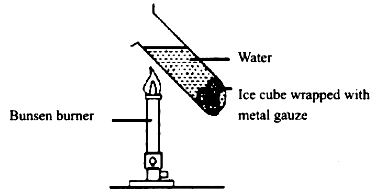
Take a glass tube and drop an ice cube wrapped in wire gauze in it.
Now fill 3/4th of this tube with water and place it above the burner as shown in the figure.
You can observe that the water boils at the edge and the ice present in the bottom of the tube has not melted indicating that heat has not reached the bottom where the ice cube is present. This proves that water is a bad conductor of heat.
It is easy to heat water easily or quickly while cooking. This is because, while cooking the vessel or pan is usually covered with a lid.
 

This leads to three things;

  1. Radiation from the hot water is reflected back into the pan rather than being emitted
  2. Free convection is effectively eliminated, and
  3. Evaporative cooling’ is also eliminated.
    This in turn allows the water to be heated more easily.
View full question & answer
Question 27 Marks
What are the changes of state in water? Explain.
Answer
 

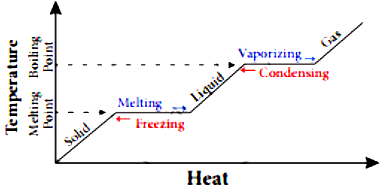
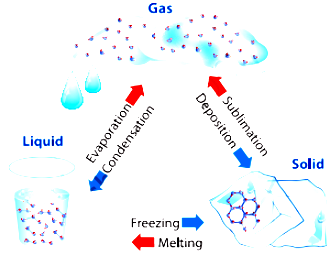
Any matter around us can be in three forms: solid, liquid and gas, called as states of matter. Depending upon the temperature, pressure and transfer of heat, matter is converted from one state to another and is known as change of state in matter. There are different such processes in the change of state in matter.

Changes of state of water

For example;

  • Water molecules are in liquid state at normal temperature. When water is heated to 100°C, it becomes steam or vapour which is a gaseous state of matter. The process by which a
    liquid is converted to vapour by absorbing heat is called boiling or vaporization.
  • The temperature at which a liquid changes its state to gas is called boiling point.
  • On reducing the temperature of the steam it becomes water again. The process by which a vapour is converted to liquid by releasing heat is called condensation. On reducing the temperature of water further to 0°C, it becomes ice which is a solid state of water.
  • The process by which a liquid is converted to solid by releasing heat is called freezing. The
    temperature by which a liquid changes its state to solid is called freezing point. Ice on
    heating, becomes water again by absorbing heat, a process known as melting.
  • Dry ice changes directly to gaseous state without becoming liquid. This process is called
    sublimation.
  • Thus, water changes its state when there is a change in temperature.

Various stages of conversion of state of matter

View full question & answer
Question 37 Marks
Explain convection in daily life.
Answer
Convection in daily life:

i. Hot air balloons: Air molecules at the bottom of the balloon get heated by a heat source and rise. As the warm air rises, cold air is pushed downward and it is also heated. When the hot air is trapped inside the balloon, it rises.

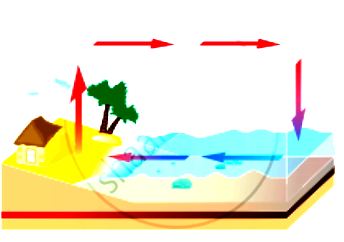
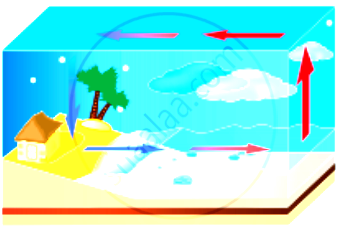
ii Breeze: During day time, the air in contact with the land becomes hot and rises. Now the cool air over the surface of the sea replaces it. It is called sea breeze. During night time, air above the sea is warmer. As the warmer air over the surface of the sea rises, cooler air above the land moves towards the sea.
a. See Breeze

b. Land breeze

iii. Winds: Air flows from area of high pressure to area of low pressure. The warm air molecules over hot surface rise and create low pressure. So, cooler air with high pressure flows towards low pressure area. This causes wind flow.

iv. Chimneys: Tall chimneys are kept in kitchen and industrial furnaces. As the hot gases and smoke are lighter, they rise up in the atmosphere.

View full question & answer
Question 47 Marks
Explain the following effects of heat.
(i) Expansion
(ii) Change in temperature
(iii) Change in state
(iv) Chemical changes.
Answer
(i) Expansion:
When heat is added to a substance, the molecules gain energy and vibrate and force other molecules apart. As a result, expansion takes place. You would have seen some space being left in railway tracks. It is because, during summer time, more heat causes expansion in tracks. Expansion is greater for liquids than for solids and maximum in case of gases.
(ii) Change in temperature :
When heat energy is added to a substance, the kinetic energy of its particles increases and so the particles move at higher speed. This causes rise in temperature. When a substance is cooled, that is, when heat is removed, the molecules lose heat and its temperature falls.
(iii) Change in state :
When you heat ice cubes, they become water and water on further heating changes into vapour. So, solid becomes liquid and liquid becomes gas, when heat is added. The reverse takes place when heat is removed.
(iv) Chemical changes :
Since heat is a form of energy it plays a major role in chemical changes. In some cases, chemical reactions need heat to begin and also heat determines the speed at which reactions occur. When we cook food, we light the wood and it catches fire and the food particles become soft because of the heat energy. These are all the chemical changes taking place due to heat.
View full question & answer
Question 57 Marks
Compare heat capacity and specific heat capacity.
Answer
Specific heat capacity:
1. It is the heat required to raise the temperature of $1 g$ of a substance through $1{ }^{\circ} C$.
2. It does not depend on the mass of the body It depends on the mass of the body
3. Its unit is $Jkg ^{-1}{ }^{\circ} C ^{-1}$
Heat capacity
1. It is the heat required to raise the temperature of a given mass of substance through $1{ }^{\circ} C$.
2. It depends on the mass of the body
3. Its unit is $J^{\circ} C ^{-1}$.
View full question & answer
Question 67 Marks
$600 g$ of copper at $50^{\circ} C$ is mixed with $1000 g$ water at $20^{\circ} C$. Find the final temperature of the mixture. Specific heat capacity of copper is $0.4 Jg ^{-10} C ^{-1}$ and that of water is $4.2 Jg ^{-10} C ^{-1}$
Answer
Let final temperature of the mixture of copper and water $=x^{\circ} C$
For copper:
Mass of copper $m_1=600 g$
Specific heat capacity of copper $c_1=0.4 Jg ^{-10} C ^{-1}$
Initial temperature of copper $t_1=50^{\circ} C$
Final temperature of copper $t_2=x^{\circ} C$
Fall in temperature $\Delta t =(50- x )^{\circ} C$
Heat lost by copper $= m _1 \times c _1 \times t$
\[
=600 \times 0.4 \times(50-x)
\]
For water :
Mass of water $m_2=1000 g$
Specific heat capacity of water $c _2=4.2 Jg ^{-10} C ^{-14}$
Initial temperature of water $t_1=20^{\circ} C$
Final temperature of water $t_2=x^{\circ} C$
Rise in temperature $\Delta t =( x -20)^{\circ} C$
Heat gained by water $= m _2 \times c _2 \times t$
\[
=100 \times 4.2 \times(x-20)
\]
According to the principle of calorimetry,
Heat lost by copper $=$ Heat gained by water
\[
\begin{array}{l}
600 \times 0.4 \times(50-x)=1000 \times 4.2 \times(x-20) \\
240 \times(50-x)=4200(x-20) \\
12,000-240 x=4200 x-84000 \\
4200 x+240 x=12000+84000 \\
4440=96000 \\
x=\frac{96000}{4440}=21.6
\end{array}
\]
So, final temperature of mixture of water and copper $x=21.6^{\circ} C$
View full question & answer
Question 77 Marks
Give some practical applications of specific latent heat of ice.
Answer
    • Specific latent heat of ice is very high (i.e.) 336 J/g.
      • Due to high specific latent heat of ice, snow on mountains do not melt as a whole, but melts gradually into water with the heat of the sun.
        If the specific latent heat of ice would not have been so high, all the snow would have melted very quickly and there would have been floods in the rivers.
      • All the water in lakes and ponds in cold places do not freeze all at the same time. If freezes slowly and keeps the surrounding moderate.
      • Drinks are cooled more effectively by ice pieces at 0°C and not by water at 0°C. This is because 1 g of ice takes away 336 J of heat from the drink to melt into water at 0°C.
View full question & answer
Question 87 Marks
Give the difference between heat and temperature.
Answer
    • Heat
      1. Heat is a form of energy due to which we feel hot or cold.
      2. Its SI unit is joule (J)
      3. It depends upon mass, nature and temperature of the body.
      4. It is a form of energy.
      5. It is measured by a calorimeter.
      Temperature :
      1. The degree of hotness or coldness of a body is known as temperature.
      2. Its SI unit is kelvin (K).
      3. It does not depend upon mass, nature and temperature of the body.
      4. It is a condition that determines the direction of flow of heat.
      5. It is measured by a thermometer.
View full question & answer
[7 marks Questions] - Science STD 9 Questions - Vidyadip