Questions

True False[1 Marks ]

🎯

Test yourself on this topic

14 questions · timed · auto-graded

Question 11 Mark
Is it true that the distance travelled by a circular wheel of diameter d cm in one nrevolution is $2\pi\text{d cm}?$ Why?
Answer
False:
Distance travelled by wheel in one revolution is equal to the circumference of wheel $=2\pi\text{r}=\pi(2\text{r})=\pi\text{d}.$
Hence, the given statement is false.
View full question & answer
Question 21 Mark
The areas of two sectors of two different circles with equal corresponding arc lengths are equal. Is this statement true? Why?
Answer
False: Consider two circles of radii, $r _1, r _2$ of are length, $I _1$ and $I _2$, and their correponding angles of sectors $\theta_1, \theta_2$ respectively.
$\text{l}_1=\frac{2\pi\text{r}_1\theta_1}{360^\circ},\text{l}_2\frac{2\pi\text{r}_2\theta_2}{360^\circ}$
Now, $l_1 = 1_2$ [Given]
$\Rightarrow\ \ \frac{2\pi\text{r}_1\theta_1}{360^\circ}=\frac{2\pi\text{r}_2\theta_2}{360^\circ}$
$\Rightarrow\ \ \text{r}_1\theta_1=\text{r}_2\theta_2=\text{x}\ \ [\text{say}]$
Area of sectors $A_1$ and $A_2$ are given by
$\text{A}_1=\frac{\pi\text{r}_1^2\theta_1}{360^\circ},\ \text{A}_2=\frac{\pi\text{r}_2^2\theta_2}{360^\circ}$
$\therefore\ \ \frac{\text{A}_1}{\text{A}_2}=\frac{\frac{\pi\text{r}_1\theta_1\text{r}_1}{360^\circ}}{\frac{\pi\text{r}_2\theta_2\text{r}_2}{360^\circ}}=\frac{\text{xr}_1}{\text{xr}_2}=\frac{\text{r}_1}{\text{r}_2}$
$\Rightarrow\ \ \frac{\text{A}_1}{\text{A}_2}=\frac{\text{r}_1}{\text{r}_2}$
Area of sector can be equal when $\frac{\text{r}_1}{\text{r}_2}=1$
i.e., equal radii. So, the area of sectors of two circles of same arcs length are not equal.
Hence, the given statement false.
View full question & answer
Question 31 Mark
If the length of an arc of a circle of radius r is equal to that of an arc of a circle of radius 2r, then the angle of the corresponding sector of the first circle is double the angle of the corresponding sector of the other circle. Is this statement false Why?
Answer
True.
False: Consider two circles $C _1$ and $C _2$ of radii 2 r respectively.
Let the lengths of two arcs be $I _1$ and $I _2$.
$\text{l}_1=\text{AB of C}_1=\frac{2\pi\text{r}\theta_1}{360^\circ}$
$\text{l}_2=\text{CD of C}_2=\frac{2\pi\text{r}'\theta_2}{360^\circ}=\frac{2\pi.2\text{r}\theta_2}{360^\circ}$
According to question,
$l_1 = l_2$
$\Rightarrow\ \ \frac{2\pi\text{r}\theta_1}{360^\circ}=\frac{2\pi.2\pi\theta_2}{360^\circ}$
$\Rightarrow\ \ \theta_1=2\theta_2$
i.e., Angle of sector of the Ist circle is twice the angle of the sector of the other circle.
Hence, the given statement false.
View full question & answer
Question 41 Mark
The areas of two sectors of two different circles are equal. Is it necessary that their corresponding arc lengths are equal? Why?
Answer
False: Using usual abbreviations for sectors
$\text{A}_1=\text{A}_2$
$\Rightarrow\ \ \frac{\pi\text{r}^2_1\theta_1}{360^\circ}=\frac{\pi\text{r}_2^2\theta_2}{360^\circ}$
$\Rightarrow\ \ \text{r}^2_1\theta_1=\text{r}^2_2\theta_2$
$\Rightarrow\ \ \frac{\theta_1}{\theta_2}==\frac{\text{r}_2^2}{\text{r}_1^2}$
Now, $\frac{\text{l}_1}{\text{l}_2}=\frac{2\pi\text{r}_1\theta_1}{2\pi\text{r}_2\theta_2}$ $=\frac{\text{r}_1}{\text{r}_2}\times\frac{\text{r}^2_2}{\text{r}_1^2}=\frac{\text{r}_2}{\text{r}_1}$
$\Rightarrow\ \frac{\text{l}_1}{\text{l}_2}=\frac{\text{r}_2}{\text{r}_1}$
Hence, arcs lenght can be equal if $\frac{\text{r}_2}{\text{r}_1}=1$
i.e., $r_1 = r_2 = r.$
Hence, the given statement is false.
View full question & answer
Question 51 Mark
In covering a distance s metres, a circular wheel of radius r metres makes $\frac{\text{s}}{2\pi\text{r}}$ revolutions. Is this statement true? Why?
Answer
True:
Distance covered by a cicular wheel in n revolution $=2\pi\text{rn}$
where n = number of revolutions
$\therefore\ \text{s}=2\pi\text{rn}$ or $\text{n}=\frac{\text{s}}{2\pi\text{r}}.$
Hence, the given statement true.
View full question & answer
Question 61 Mark
Circumferences of two circles are equal. Is it necessary that their areas be equal? Why?
Answer
True:$\because\ \ 2\pi\text{r}_1=2\pi\text{r}_2$ [Given]
$\Rightarrow\ \ \text{r}_1=\text{r}_2=\text{r}$ [say]
Now, $\frac{\text{A}_1}{\text{A}_2}=\frac{\pi\text{r}^2_1}{\pi\text{r}^2_2}=\frac{\text{r}^2}{\text{r}^2}=1$
$\therefore A_1 = A_2$ i.e., their areas are equal.
Hence, the given statement is true.
View full question & answer
Question 71 Mark
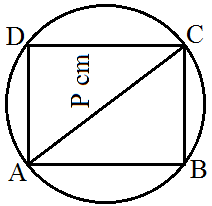
Is it true to say that area of a square inscribed in a circle of diameter $p cm$ is $p ^2 cm^2$ ? Why?
Answer
False: The diameter of the circle is p cm.
So, the diagonal of the square will be p cm.

Now, $AB^2 + BC^2 = AC^2$
$\Rightarrow AB^2 + AB^2 = p^2$
$\Rightarrow 2AB^2 = p^2$
$\Rightarrow\ \text{AB}=\frac{\text{p}}{\sqrt{2}}$
Now, Area of square $=\frac{\text{p}}{\sqrt{2}}\times\frac{\text{p}}{\sqrt{2}}=\frac{\text{p}^2}{2}\text{cm}^2$
Hence, the given statement is false.
View full question & answer
Question 81 Mark
Is the area of the largest circle that can be drawn inside a rectangle of length a cm and breadth $b cm(a>b)$ is $\pi b^2$ $cm ^2$ ? Why?
Answer
False: The diameter of circle that can be drawn inside the rectangle is equal to the breadth of rectangle.
The length of the rectangle = a cm
The breadth of the rectangle = b cm
$\therefore$ Diameter of circle = b cm
$\Rightarrow\ \ \text{r}=\frac{\text{b}}{2}\text{cm}$
$\therefore$ Area of circle $\text{A}=\pi\text{r}^2=\pi\Big(\frac{\text{b}}{2}\Big)^2=\frac{1}{4}\pi\text{b}^2\text{cm}^2$
Hence, the given statement is false.
View full question & answer
Question 91 Mark
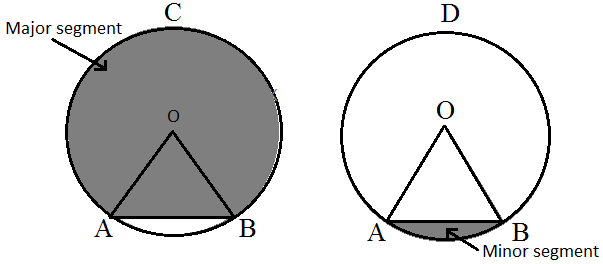
Is it true to say that area of a segment of a circle is less than the area of its corresponding sector? Why?
Answer

False:

Area of major segment (ACB) is always greater than its correponding sector (QACB) and area of minor segment (ACB) is smaller the its corresponding minor sector (QACB).
Hence, the given statement is false.
View full question & answer
Question 101 Mark
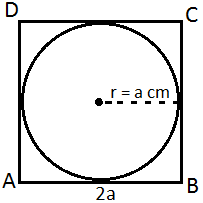
Will it be true to say that the perimeter of a square circumscribing a circle of radius a cm is 8a cm? Give reasons for your answer.
Answer
True: Side of square = Diameter of circle
$\therefore$ AB = 2a So, the perimeter of square = 4 × AB = 4 × 2a = 8a cm Hence, the given statement is true.
View full question & answer
Question 111 Mark
Areas of two circles are equal. Is it necessary that their circumferences are equal? Why?
Answer
True:
$\because\ \ \text{A}_1=\text{A}_2$ [Given]
$\Rightarrow\ \ \pi\text{r}_1^2=\pi\text{r}_2^2$
$\Rightarrow\ \ \text{r}_1^2=\text{r}_2^2$
$\Rightarrow\ \ \text{r}_1=\text{r}_2=\text{r}$ (say) [taking square root]
Now, $\frac{\text{C}_1}{\text{C}_2}=\frac{2\pi\text{r}_1}{2\pi\text{r}_2}=\frac{\text{r}_1}{\text{r}_2}=\frac{\text{r}}{\text{r}}=\frac{1}{1}$
Hence, $C_1 = C_2$
Hence, the given statement is true.
View full question & answer
Question 121 Mark
The numerical value of the area of a circle is greater than the numerical value of its circumference. Is this statement true? Why?
Answer
False:Let the radius of circle is r (0 < r < 2).
Then, the area of circle
$\text{A}=\pi\text{r}^2$ for $\text{r}=1.5,\text{ A}=\pi\times(1.5)^2$
$\therefore\ \text{A}=2.25\pi$
Circumference $(\text{C})=2\pi\text{r}=2\times\pi\times1.5$
$\Rightarrow\ \ \text{C}=3.0\pi$
$\therefore\ \ \text{C}>\text{A}$
So, the of a circle is not always greater than its circumference.
Hence, the given statement false.
View full question & answer
Question 131 Mark
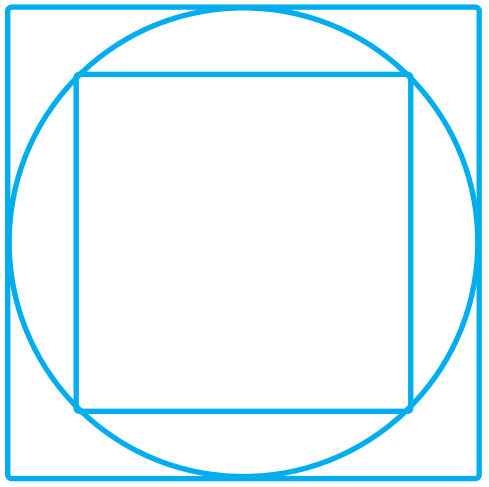
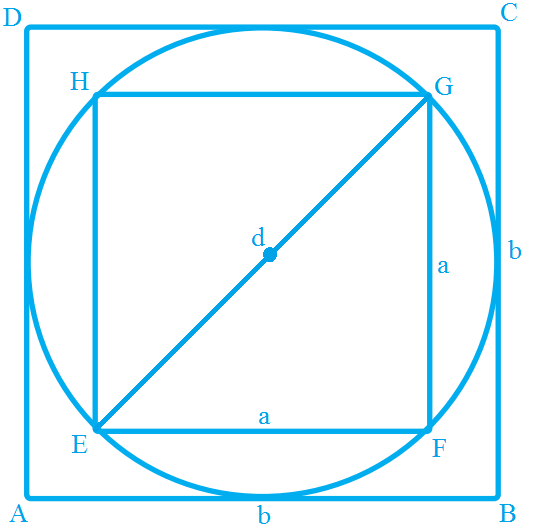
In Fig. a square is inscribed in a circle of diameter d and another square is circumscribing the circle. Is the area of the outer square four times the area of the inner square? Give reasons for your answer.
Answer
False: Let the side of the smaller square is a units and that of bigger square is b units.

Diameter of circle = d
So, diagonal of squaras EFGH = d
Then, by Pythagoras theorem,
$\text{a}^2+\text{a}^2=\text{a}^2$
$\Rightarrow\ \ 2\text{a}^2=\text{d}^2$
$\Rightarrow\ \ \text{a}^2=\frac{\text{d}^2}{2}$
$\therefore$ Area of outer square $=\text{a}^2=\frac{\text{d}^2}{2}$
Side of outer square = b = Diameter of circle
$\therefore$ Area of outer square $= b^2 = d^2$
$=\frac{2}{2}\text{d}^2=2\times\frac{1}{2}\text{d}^2$
⇒ Area of larger square = 2 Area of smaller square
So, the given statement is false.
View full question & answer
Question 141 Mark
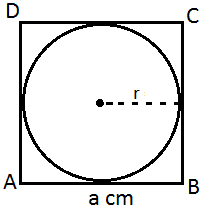
Is the area of the circle inscribed in a square of side $\text{a cm},\pi\text{a}^2\text{cm}^2?$ Give reasons for your answer.
Answer
False: The radius of the circle inscribed in a square of side a cm is $\text{r}=\frac{\text{a}}{2}$
$\therefore$ Area of circle $=\pi\text{r}^2$ $=\pi\Big(\frac{\text{a}}{2}\Big)^2=\frac{\pi\text{a}^2}{4}\text{cm}^2$ $\neq\pi\text{a}^2\text{cm}^2$ Hence, the given statement is false.
View full question & answer
True False[1 Marks ] - MATHS STD 10 Questions - Vidyadip