Questions

3 Marks Question

🎯

Test yourself on this topic

10 questions · timed · auto-graded

Question 13 Marks
Find the radius of a circle whose circumference is equal to the sum of the circumferences of two circles of radii $15\ cm$ and $18\ cm$.
Answer
Let the radius of a circle be $r.$
$\therefore$ circumference of a circle $=2\pi\text{r}$
Let the radii of two circles are $r_1$ and $r_2$ whose values are $15\ cm$ and $18\ cm$ respectively.
i.e.$, r_1 = 15\ cm$ and $r_2 = 18\ cm$
Now$,$ by given condition,
circumference of circle $=$ circumference of first circle $+$ circumference of second circle
$\Rightarrow\ \ 2\pi\text{r}=2\pi\text{r}_1+2\pi\text{r}_2$
$\Rightarrow\ \ \text{r}=\text{r}_1+\text{r}_2$
$\Rightarrow\ \ \text{r}=15+18$
$\therefore\ \ \text{r}=33 \text { cm}$
Hence$,$ required radius of a circle is $33\ cm.$
View full question & answer
Question 23 Marks
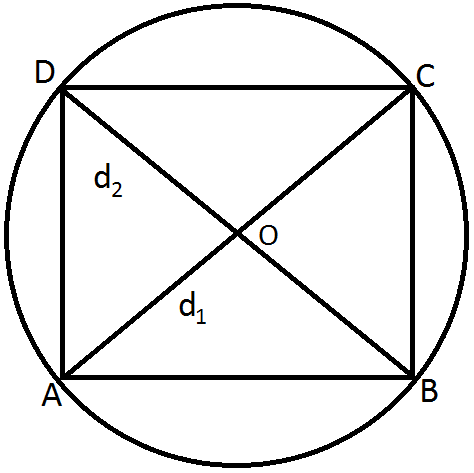
All the vertices of a rhombus lie on a circle. Find the area of the rhombus$,$ if area of the circle is $1256\ cm^2. (\text{Use }\pi=3.14)$
Answer
All the vertices of a rhombus lie on a circle so rhombus is a square and its diagonals are of length $2r \ cm.$

$\Rightarrow\ \ \pi r^2=1256\ cm^2$
$\Rightarrow\ \ \text{r}^2=\frac{1256}{\pi}$
$\Rightarrow\ \ \text{r}^2=\frac{1256\times100}{314}=400$
$\Rightarrow\ \ \text{r}=\sqrt{400}=20\ cm$
$\therefore$ Area of rhombus $=\frac{1}{2}\text{d}_1\text{d}_2=\frac{1}{2}\times2\text{r}\times2\text{r}$
$=2\text{r}^2=2\times20\times20$
$\Rightarrow$ Area of rhombus $= 800\ cm^2.$
View full question & answer
Question 33 Marks
The wheel of a motor cycle is of radius 35cm. How many revolutions per minute must the wheel make so as to keep a speed of 66km/ h?
Answer
Given, radius of wheel, r = 35cm
Circumference of the wheel $=2\pi\text{r}$
$=2\times\frac{22}{7}\times35$
$=220\text{cm}$
But speed of the wheel $=66\text{kmh}^{-1}=\frac{66\times1000}{60}\text{m/}\min$
$=1100\times100\text{cm}\min^{-1}$
$=110000\text{cm}\min^{-1}$
$\therefore$ Number of revolutions in $1\min=\frac{110000}{220}=500$ revolution
Hence, required number of revolutions per minute is 500.
View full question & answer
Question 43 Marks
A piece of wire 20cm long is bent into the form of an arc of a circle subtending an angle of 60° at its centre. Find the radius of the circle.
Answer
Length of arc of circle = 20cm
$\therefore$ Length of arc $=\frac{\theta}{360^\circ}\times60^\circ$
$\Rightarrow\ \ 20=\frac{60^\circ}{360^\circ}\times2\pi\text{r}$ $\Rightarrow\ \frac{20\times6}{2\pi}=\text{r}$
$\therefore\ \ \text{r}=\frac{60}{\pi}\text{cm}$
Hence, the radius of circle is $\frac{60}{\pi}\text{cm}.$
View full question & answer
Question 53 Marks
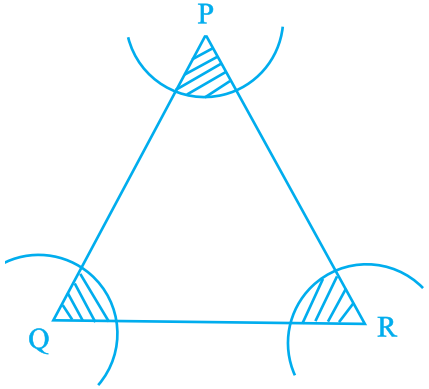
In Fig. arcs have been drawn with radii $14\ cm$ each and with centres $P, Q$ and $R$. Find the area of the shaded region.
Answer
Given that$,$ radii of each arc $(r) = 14\ cm$
Now$,$ area of the sector with contral $\angle\text{P}=\frac{\angle\text{P}}{360^\circ}\times\pi\text{r}^2$
$=\frac{\angle\text{P}}{360^\circ}\times\pi\times(14)^2\text{cm}^2$
$\big[\because$ area of any sector with central angle $\theta$ and radius $\text{r}=\frac{\pi\text{r}^2}{360^\circ}\times\theta\big]$
Area of the sector with central angle $=\frac{\angle\text{Q}}{360^\circ}\times\pi\text{r}^2$ $=\frac{\angle\text{Q}}{360^\circ}\times\pi\times(14)^2\text{cm}^2$
and area of the sector with central angle $\text{R}=\frac{\angle\text{R}}{360^\circ}\times\pi\text{r}^2$ $=\frac{\angle\text{R}}{360^\circ}\times\pi\times(14)^2\text{cm}^2$
Therefore$,$ sum of the areas $(in \ cm^2)$ of three sectors
$=\frac{\angle\text{P}}{360^\circ}\times\pi\times(14)^2+\frac{\angle\theta}{360^\circ}\times\pi\times(14)^2+\frac{\angle\text{R}}{360^\circ}\times\pi\times(14)^2$
$=\frac{\angle\text{P}+\angle\text{Q}+\angle\text{R}}{360}\times196\times\pi=\frac{180^\circ}{360^\circ}\times196\pi\text{ \ cm}^2$
$[$since$,$ sum of all interior angles in any triangle is $180^\circ ]$
$=98\pi\text{ \ cm}^2=98\times\frac{22}{7}$
$=14\times22=308\text{cm}^2$
Hence$,$ the required area of the shaded region $308\ cm^2.$
View full question & answer
Question 63 Marks
The length of the minute hand of a clock is 5cm. Find the area swept by the minute hand during the time period 6:05 am and 6:40 am.
Answer
Time difference = (6:40 am - 6:05 am) = 35 min.
Time swept by min hand is 35 min.
Length of min. hand will be radius of circle sweqt.
$\therefore\ \ \text{r}=5\text{cm}$
In 60 minutes time, area swept by min hand $=\pi\text{r}^2$
In 1 mintute time, area swept by min hand $=\frac{\pi\text{r}^2}{60}$
In 35 mintutes time, area swept by min hand $=\frac{\pi\text{r}^2}{60}\times35$
$\therefore$ Required area swept by min hand $=\frac{22}{7}\times\frac{5\times5\times35}{60}$
$=\frac{11\times25}{6}=\frac{275}{6}=45\frac{5}{6}\text{cm}^2$
Hence, the required area swept by the min, hand is $45\frac{5}{6}\text{cm}^2.$
View full question & answer
Question 73 Marks
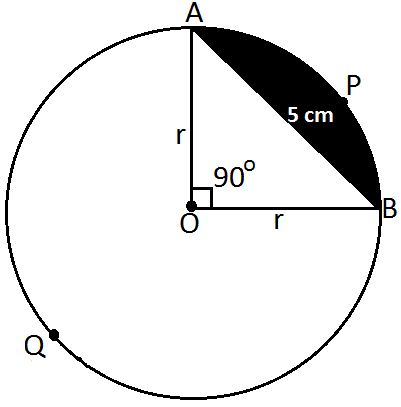
Find the difference of the areas of two segments of a circle formed by a chord of length 5cm subtending an angle of 90° at the centre.
Answer
Chord AB = 5cm divides the circle in two segments minor segment APB, and major segrment AQB.
We have to find out the difference in area of major and minor segrment.

Here, $\theta=90^\circ.$
Area of $\triangle\text{OAB}=\frac{1}{2}\text{ Base}\times\text{Altiude}=\frac{1}{2}\text{r}\times\text{r}=\frac{1}{2}\text{r}^2$
Area of minor segment APB
$=\frac{\pi\text{r}^2\theta}{360^\circ}-\text{Area of }\triangle\text{AOB}$
$=\frac{\pi\text{r}^290^\circ}{360^\circ}-\frac{1}{2}\text{r}^2$
⇒ Area of minor segment $=\Big(\frac{\pi\text{r}^2}{4}-\frac{\text{r}^2}{2}\Big)\ \ \dots(\text{i})$
Area of major segment AQB = Area of circle - Area of minor segment
$=\pi\text{r}^2-\Big[\frac{\pi\text{r}^2}{4}-\frac{\text{r}^2}{2}\Big]$
⇒ Area of minor segment AQB  $=\Big[\frac{3}{4}\pi\text{r}^2+\frac{\text{r}^2}{2}\Big]\ \ \dots(\text{ii})$
Difference between areas of major and minor segment
$ =\Big(\frac{3}{4}\pi\text{r}^2+\frac{\text{r}^2}{2}\Big)-\Big(\frac{\pi\text{r}^2}{4}-\frac{\text{r}^2}{2}\Big)$
$ =\frac{3}{4}\pi\text{r}^2+\frac{\text{r}^2}{2}-\frac{\pi\text{r}^2}{4}+\frac{\text{r}^2}{2}$
⇒ Required area $=\frac{2}{4}\pi\text{r}^2+\text{r}^2=\frac{1}{2}\pi\text{r}^2+\text{r}^2$
In right angle $\triangle\text{OAB},$
$\text{r}^2+\text{r}^2=\text{AB}^2$ $\Rightarrow\ 2\text{r}^2=5^2\Rightarrow\ \text{r}^2=\frac{25}{2}$
So, required area $=\Big[\frac{1}{2}\pi\frac{25}{2}+\frac{25}{2}\Big]=\Big[\frac{25\pi}{4}+\frac{25}{2}\Big]\text{cm}^2$
View full question & answer
Question 83 Marks
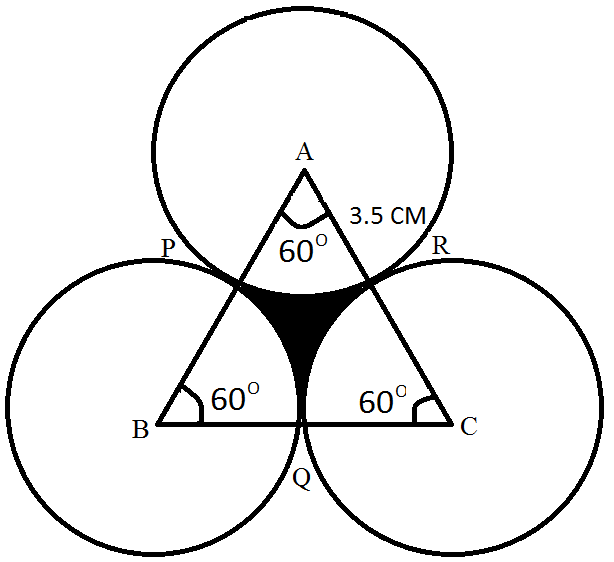
Three circles each of radius 3.5cm are drawn in such a way that each of them touches the other two. Find the area enclosed between these circles.
Answer
Area of equilateral triangle with side 7cm

$=\frac{\sqrt{3}}{4}\times(7)^2\text{cm}^2$
$=\Big(\frac{\sqrt{3}\times49}{4}\Big)\text{cm}^2$
$=21.2176\text{cm}^2$
Area of one sector with central angle 60° and radius 3.5cm
$=\frac{60^\circ}{360^\circ}\times\pi\times(3.5)^2$
$=\frac{\pi}{6}(12.25)\text{cm}^2$
$\therefore$ Area of three such sectors $=3\times\frac{\pi}{6}(12.25)\text{cm}^2$
$=\frac{\pi}{2}(12.25)\text{cm}^2$
$=\frac{22}{14}(12.25)\text{cm}^2$
$=19.25\text{cm}^2$
Now, area enclosed between these circles = Area of $\triangle$ - Area of three sectors
$=21.2176\text{cm}^2-19.25\text{cm}^2$
$=1.9676\text{cm}^2$
View full question & answer
Question 93 Marks
Find the number of revolutions made by a circular wheel of area $1.54\ m^2$ in rolling a distance of $17\ m$.
Answer
Distance covered by wheel in $n$ revolutions with radius $\text{r}=2\pi\text{r n}.$
$\therefore\ \ 2\pi\text{r n}=176\text{m}$
Area of wheel $($circular$) = 154m^2$
$\Rightarrow\ \ \pi\text{r}^2=154$
$\Rightarrow\ \ \text{r}^2=\frac{1.54}{\pi}=\frac{154\times7}{22\times100}=\frac{7\times7}{10\times10}$
$\Rightarrow\ \ \text{r}=0.7\text{m}$
Now$, 2\pi\text{r n}=176$
$\Rightarrow\ \ 2\times\frac{22}{7}\times0.7\times\pi=176\ \ [\text{from (i)}]$
$\Rightarrow\ \ \text{n}=\frac{176\times7\times10}{2\times22\times7}=40$
Hence$, n = 40$ revolutions.
View full question & answer
Question 103 Marks
The diameters of front and rear wheels of a tractor are $80\ cm$ and $2\ m$ respectively. Find the number of revolutions that rear wheel will make in covering a distance in which the front wheel makes $1400$ revolutions.
Answer
$[$Distance travelled by rear wheel$] = [$Distance travelled by front wheel$]$
$\Rightarrow\ \ 2\pi\text{r}_1\text{n}_1=2\pi\text{r}_2\text{n}_2$
$\Rightarrow\ \ \text{r}_1\text{n}_1=\text{r}_2\text{n}_2$
Front wheel
Rear wheel
$r_2 = 80\ cm = 0.8m$ $r_1 = 2\ m$
$n_2 = 1400$ revolutions $n_1 =$ ?
$\therefore$ From $(1),$ we get
$2\times\text{n}_1=0.8\times1400$
$\Rightarrow\ \ \text{n}_1=\frac{0.8\times1400}{2}=0.4\times1400$
$\Rightarrow\ \text{n}_1=560$
Hence$,$ the number of revolutions made by rear wheel $= 560.$
View full question & answer
3 Marks Question - MATHS STD 10 Questions - Vidyadip