Questions

5 Marks Questions

🎯

Test yourself on this topic

25 questions · timed · auto-graded

Question 15 Marks
A cow is tied with a rope of length 14m at the corner of a rectangular field of dimensions 20m × 16m. Find the area of the field in which the cow can graze.
Answer
Let ABCD be a rectangular field of dimensions 20m × 16m.
Suppse, a cow is tied at a point A.
Let length of rope be AE = 14m = r(say).
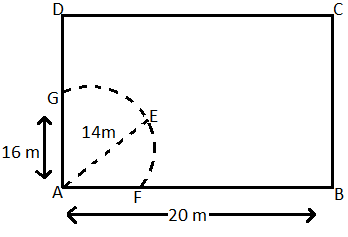
$\therefore$ Area of the field in which the cow graze = Area of sector AFEG $=\frac{\theta}{360^\circ}\times\pi\text{r}^2$
$=\frac{90}{360}\times\pi(14)^2$
[so, the angle between two adjacent sides of a recfangle is 90°]
$=\frac{1}{4}\times\frac{22}{7}\times196$
$=154\text{m}^2$
View full question & answer
Question 25 Marks
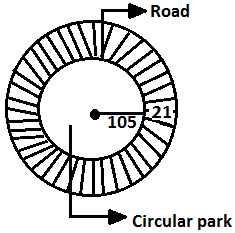
A circular park is surrounded by a road $21\ m$ wide. If the radius of the park is $105\ m,$ find the area of the road.
Answer
Given that$,$ a circular park is surrouded by a road.

Width of the road $= 21\ m$
Radius of the park $(r_i) = 105\ m$
$\therefore$ Radius of whole circular portion $($park $+$ road$),$
$r_e = 105 + 21 = 126\ m$
Now$,$ area of road $=$ Area of whole circular portion $-$ Area of circular park
$=\pi\text{r}_\text{e}^2-=\pi\text{r}_\text{i}^2$ $[\because\text{area of circle}=\pi\text{r}^2]$
$=\pi(\text{r}^2_\text{e}-\text{r}^2_\text{i})$
$=\pi\big\{(126)^2-(105)^2\big\}$
$=\frac{22}{7}\times(126+105)(126-105)$
$=\frac{22}7{}\times231\times21$ $\big[\because(\text{a}^2-\text{b}^2)=(\text{a}-\text{b})(\text{a}+\text{b})\big]$
$=66\times231$
$=15246\text{cm}^2$
Hence$,$ the required area of the road is $15246\ cm^2.$
View full question & answer
Question 35 Marks
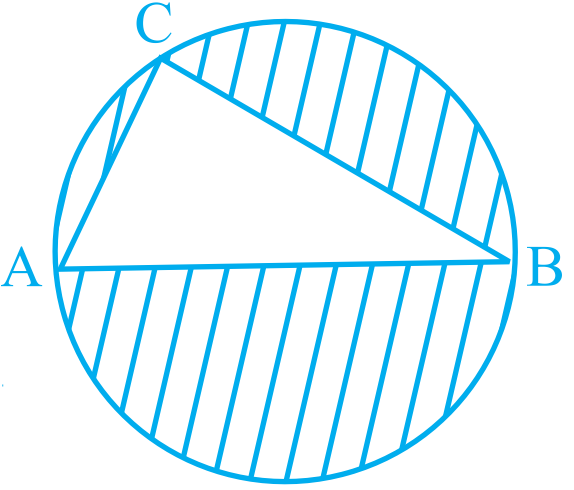
In Fig. $AB$ is a diameter of the circle$, AC = 6\ cm $ and $BC = 8\ cm$. Find the area of the shaded region $(\text{Use }\pi=3.14).$
Answer
Given$, AC = 6\ cm$ and $BC = 8\ cm$
We know that, triangle in a semi-circle with hypotenuse as diameter is right angled triangle.
$\therefore\ \ \angle\text{C}=90^\circ$
In right angled $\triangle\text{ACB},$ use Pythagoras theorem,
$\therefore AB^2 = AC^2 + CB^2$
$\Rightarrow AB^2 = 6^2 + 8^2 = 36 + 64$
$\Rightarrow AB^2 = 100$
$\Rightarrow AB = 10\ cm [$since$,$ side cannot be negative$]$
$\therefore$ Area of $\triangle\text{ABC}=\frac{1}{2}\times\text{BC}\times\text{AC}=\frac{1}{2}\times8\times6=24\text{ cm}^2$
Here$,$ diameter of circle$, AB = 10\ cm$
$\therefore$ Radius of circle, $\text{r}=\frac{10}{2}=5\text{ cm}$
Area of circle $=\pi\text{r}^2=3.14\times(5)^2$
$=3.14\times25=78.5\text{ cm}^2$
$\therefore$ Area of the shaded region $=$ Area of circle $-$ Area of $\triangle\text{ABC}$
$=78.5-24=54.5\text{ cm}^2$
View full question & answer
Question 45 Marks
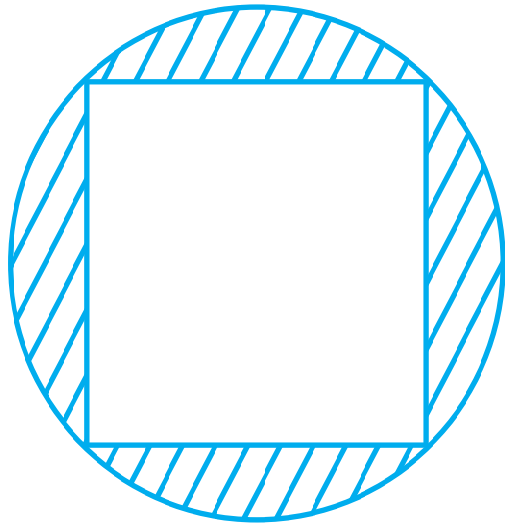
In Fig, a square of diagonal 8cm is inscribed in a circle. Find the area of the shaded region.
Answer
Let the side of a square be a and the radius of circle be r.
Given that, length of diagonal of square = 8cm
$\Rightarrow\ \ \text{a}\sqrt{2}=8$
$\Rightarrow\ \ \text{a}=4\sqrt{2}\text{cm}$
Now, Diagonal of square = Diameter of a circle
⇒ Diameter of circle = 8
⇒ Radius of circle $=\text{r}=\frac{\text{Diameter}}{2}$
$\Rightarrow\ \ \text{r}=\frac{8}{2}=4\text{cm}$
$\therefore$ Area of circle $=\pi\text{r}^2=\pi(4)^2$
$=16\pi\times\text{cm}^2$
and Area of square $=\text{a}^2=(4\sqrt{2}^2)$
$= 32\text{cm}^2$
So, the area of the shaded region = Area of circle - Area of square
$=(16\pi-32)\text{cm}^2$
Hence, the required area of the shaded region is $(16\pi-32)\text{cm}^2.$
View full question & answer
Question 55 Marks
The area of a circular playground is $22176\ m^2$. Find the cost of fencing this ground at the rate of $Rs. 50$ per metre.
Answer
Fencing is made on circumferemce $(2\pi\text{r})$ of circular field. So$,$ we require redius for it.
Area of the circular playground $= 22176m^2$
$\Rightarrow\ \ \pi\text{r}^2=22176$
$\Rightarrow\ \ \frac{22}{7}\text{r}^2=22176$
$\Rightarrow\ \ \text{r}^2=\frac{7\times22176}{2}$
$\Rightarrow\ \ \text{r}^2=\sqrt{7\times1008}$
$\Rightarrow\ \ \text{r}=\sqrt{7\times7\times3\times3\times2\times2\times2\times2}$
$\Rightarrow\ \ \text{r}=7\times3\times2\times2$
$\Rightarrow\ \ \text{r}=84\text{m}$
$\therefore$ Length of fencing = Circumference of circle
$=2\pi\text{r}=2\times\frac{22}{7}\times84=24\times22\text{m} $
So$,$ Cost of fencing $=₹\ 50\times24\times22=₹\ 26400$
Hence$,$ cots of fencing $=₹\ 26400.$
View full question & answer
Question 65 Marks
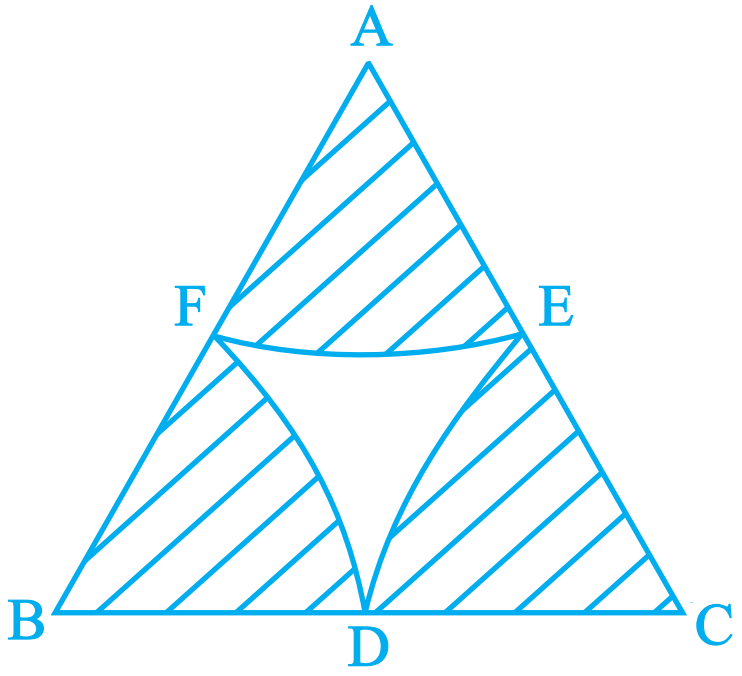
In Fig. arcs are drawn by taking vertices $A, B$ and $C$ of an equilateral triangle of side $10\ cm$. to intersect the sides $BC, CA$ and $AB$ at their respective mid$-$points $D, E$ and $F.$ Find the area of the shaded region $(\text{Use }\pi=3.14).$
Answer
Since, $\text{ABC}$ is an equilateral triangle.

$\therefore\ \ \angle\text{A}=\angle\text{B}=\angle\text{C}=60^\circ$
and $AB = BC = AC = 10\ cm$
So$, E, F$ and $D$ are mid-points of the sides.
$\therefore AE = EC = CD = BD = BF = FA = 5\ cm$
Now$,$ area of sector $\text{CDE}=\frac{\theta\pi\text{r}^2}{360}=\frac{60\times3.14}{360}(5)^2$
$=\frac{3.14\times25}{6}=\frac{78.5}{6}=13.0833\text{cm}^2$
$\therefore$ Area of shaded region $= 3($Area of sector $\text{CDE})$
$= 3 \times 13.0833$
$= 39.25\ cm^2$
View full question & answer
Question 75 Marks
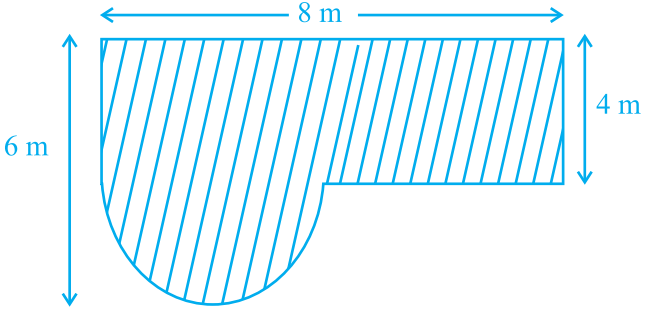
Find the area of the shaded field shown in Fig.
Answer
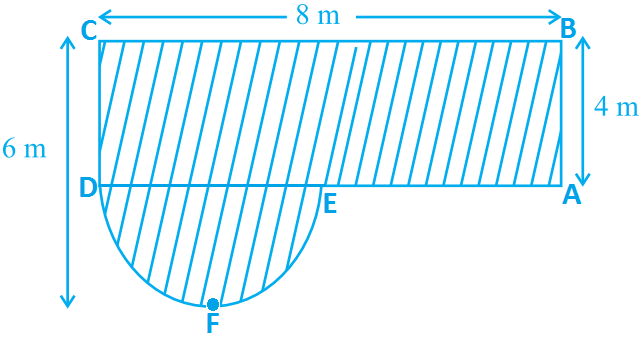
In a figure, join $ED$

From figure, radius of semi$-$circle $\text{DFE}, r = 6 - 4 = 2m$
Now, area of rectangle $\text{ABCD} = BC × AB = 8 × 4 = 32m2$
and area of semi-circle $\text{DFE}=\frac{\pi\text{r}^2}{2}=\frac{\pi}{2}(2)^2=2\pi\text{ m}^2$
$\therefore$ Area of shaded region $=$ Area of rectangle $\text{ABCD} \  +\  $ Area of semi$-$circle $\text{DFE}$
$=(32+2\pi)\text{m}^2$
View full question & answer
Question 85 Marks
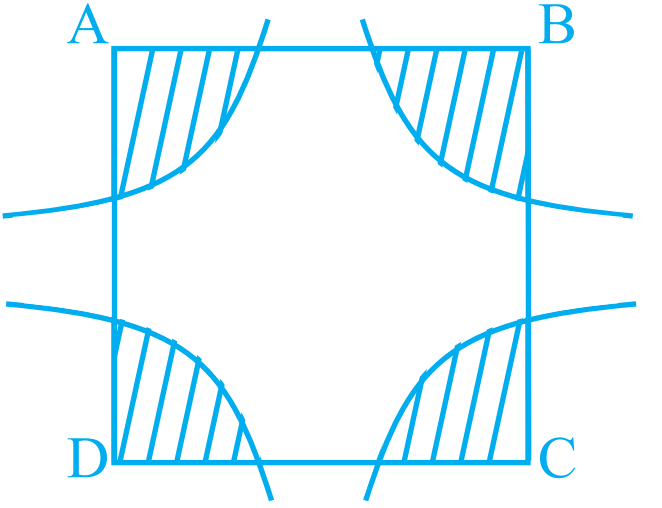
In Fig. arcs have been drawn of radius $21\ cm$ each with vertices $A, B, C$ and $D$ of quadrilateral $\text{ABCD}$ as centres. Find the area of the shaded region.
Answer
Given that, radius of each arc $(r) = 21\ cm$
Area of sector with $\angle\text{A}=\frac{\angle\text{A}}{360^\circ}\times\pi\text{r}^2$ $=\frac{\angle\text{A}}{360^\circ}\times\pi\times(21)^2\text{cm}^2$
$\big[\because$ area of any sector with central angle $\theta$ and radius $\text{r}=\frac{\pi\text{r}^2}{360^\circ}\times\theta\big]$
Area of sector with $\angle\text{B}=\frac{\angle\text{B}}{360^\circ}\times\pi\text{r}^2$ $=\frac{\angle\text{B}}{360^\circ}\times\pi\times(21)^2\text{cm}^2$
Area of sector with $\angle\text{C}=\frac{\angle\text{C}}{360^\circ}\times\pi\text{r}^2$ $=\frac{\angle\text{C}}{360^\circ}\times\pi\times(21)^2\text{cm}^2$
Area of sector with $\angle\text{D}=\frac{\angle\text{D}}{360^\circ}\times\pi\text{r}^2$ $=\frac{\angle\text{D}}{360^\circ}\times\pi\times(21)^2\text{cm}^2$
Therefore$,$ sum of the areas $($in \ $cm^2)$ of the four sectors
$=\frac{\angle\text{A}}{360^\circ}\times\pi\times(21)^2+\frac{\angle\text{B}}{360^\circ}\times\pi\times(21)^2+\frac{\angle\text{C}}{360^\circ}\times\pi\times(21)^2+\frac{\angle\text{D}}{360^\circ}\times\pi\times(21)^2$
$=\frac{\big(\angle\text{A}+\angle\text{B}+\angle\text{C}+\angle\text{D}\big)}{360^\circ}\times\pi\times(21)^2$
[$\because$ sun of all interior angles in any quadrilateral $= 360^\circ ]$
$= 22 \times 3 \times 21 = 1386\ cm^2$
Hence$,$ required area of the shade region is $1386\ cm^2.$
View full question & answer
Question 95 Marks
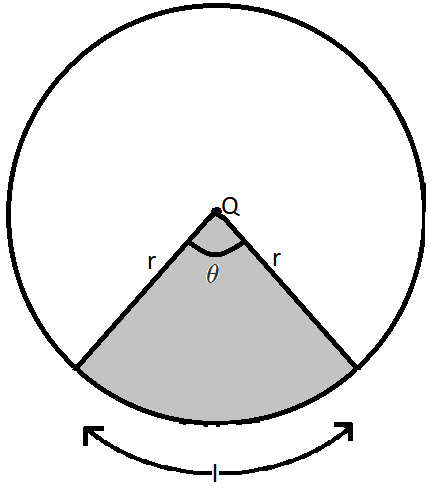
Area of a sector of central angle $200^\circ$ of a circle is $770\ cm^2.$ Find the length of the corresponding arc of this sector.
Answer
In the given sector$,$
$\theta=200^\circ,\ \text{A}=770\text{cm}^2\text{ and l}=$?
$\text{A}=\frac{\pi\text{r}^2\theta}{360^\circ}$
$\Rightarrow\ \ \text{r}^2=\frac{\text{A}\times360^\circ}{\pi\theta}=\frac{770\times360^\circ\times7}{22\times200^\circ}=21\text{cm}$
$\Rightarrow\ \text{r}=21\text{cm}$
Now$,$ length of arc $\text{l}=\frac{2\pi\text{r}\theta}{360^\circ}$
$=2\times\frac{22}{7}\times\frac{21\times200^\circ}{360^\circ}=\frac{200}{3}\text{cm}=73\frac{1}{3}\text{cm}$
Hence$,$ the required length of arc $=73\frac{1}{3}\text{cm}.$
View full question & answer
Question 105 Marks
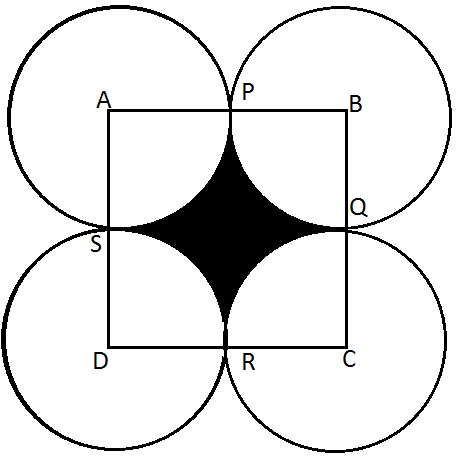
Four circular cardboard pieces of radii $7\ cm$ are placed on a paper in such a way that each piece touches other two pieces. Find the area of the portion enclosed between these pieces.
Answer
As we know that point of contact of two circles lies on the line joining their centres.

So$,$ the line segments $\text{AB, BC, CD}$ and $AD$ will pass through the corresponding point of contact $\text{P, Q, R, S}$ respectively.
As $SD$ and $AS$ are radius at contact point $S$.
So$, AD$ will be perpendicular to the tangent through S. It implies that interior angles of quadrilateral are $90^\circ$ each.
As radius of each circle is equal.
So quadrilateral $\text{ABCD}$ will be square with side $2r = 2 \times 7 = 14\ cm.$
In the given figure$,$ there is a square and $4$ sectors.
$4$ sectors square
$r = 7\ cm$ $a = 2r = 2 \times 7 = 14$
$\theta = 90^\circ $ $ a = 14\ cm$
Area enclosed between circles $=$ Area of square $-$ Area of $4$ sectors
$=\text{a}^2-4.\frac{\pi\text{r}^2\theta}{360^\circ}$
$=14\times14-\frac{4\times\pi\times7\times7\times90^\circ}{360^\circ}$
$\therefore$ Required Area $=(196-49\pi)\text{cm}^2$
$=\Big(196-49\times\frac{22}{7}\Big)\text{cm}^2$
$=(196-7\times22)\text{cm}^2$
$=(196-157)\text{cm}^2$
$=42\text{cm}^2$
Hence$,$ the area enclosed between circles $= 42\ cm^2.$
View full question & answer
Question 115 Marks
Find the area of the sector of a circle of radius $5\ cm,$ if the corresponding arc length is $3.5\ cm.$
Answer

Here$, l = 3.5\ cm$
$r = 5\ cm$
Length of are $\text{l}=\frac{2\pi\text{r}\theta}{360^\circ}$
$\Rightarrow\ \ 3.5=\frac{2\times\pi\times5\times\theta}{360^\circ}$
$\Rightarrow\ \ \frac{\pi\theta}{36}=3.5$
$\Rightarrow\ \ \theta=\frac{3.5\times36}{\pi}$
Now$,$ Area of sector $=\frac{\pi\text{r}^2\theta}{360^\circ}=\frac{\pi\times5\times5\times35\times36}{360^\circ\times\pi\times10}$
$=\frac{25\times35}{100}=\frac{875}{100}=8.75\text{cm}^2$
$\therefore$ Area of sector $= 8.75\ cm^2$​​​​​​​
View full question & answer
Question 125 Marks
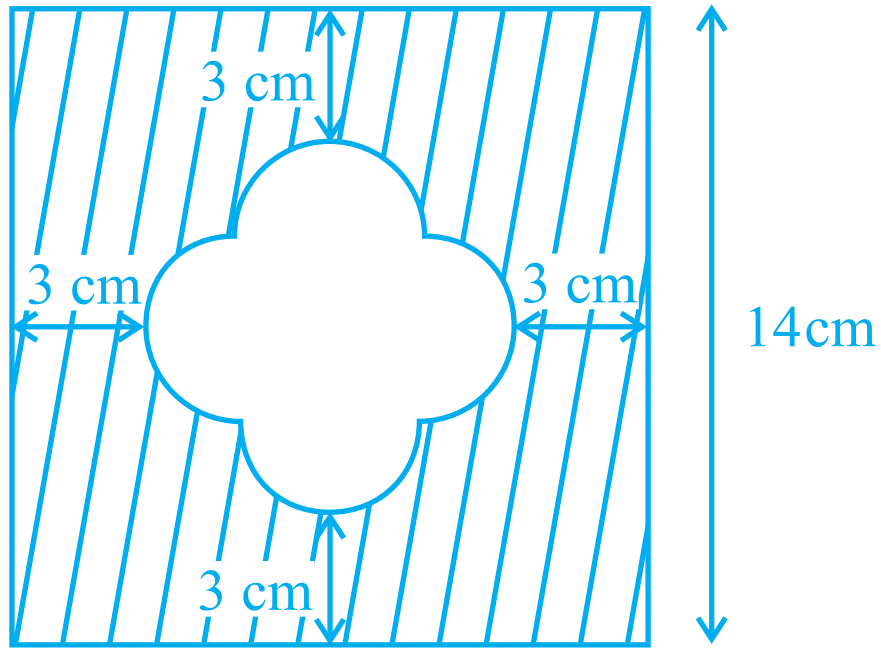
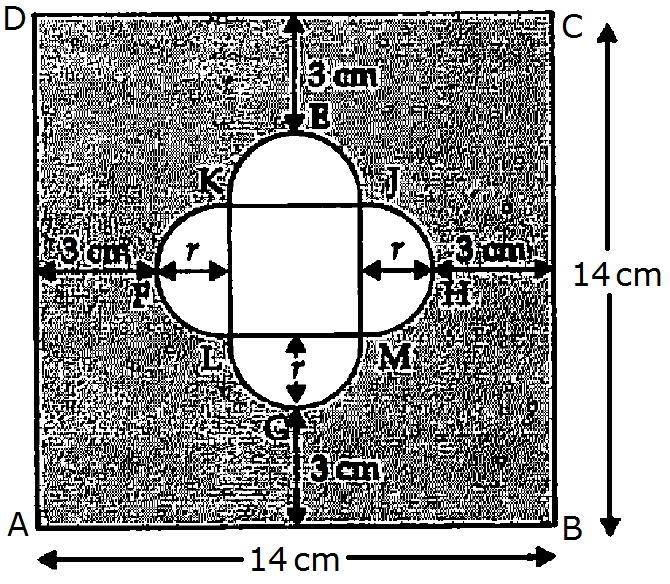
Find the area of the shaded region given in Fig.
Answer
Identification of shapes of figures:
  1. $4$ semi circles of radius $r$
  2. square $\text{ABCD}$ of side $14\ cm$
  3. square $JIKLM$ of side $2r$
  4. From figure,
    $AB = 3 + 3 + r + 2r + r$
    $\Rightarrow 14 = 6 + 4r$
    $\Rightarrow 4r = 14 - 6$
    $\Rightarrow 4r = 8$
    $\Rightarrow\ \text{r}=\frac{8}{4}=2\text{ cm}$
    So$,$ the area of shaded region
    $=$ Area of square $-$ Area of $4$ semi circles $-$ Area of square $\text{(JKLM)}$
    One square $\text{ABCD}$
    $a_1 = 14\ cm$
    One square $\text{JKLM}$
    $a_2 = 2r$
    $\Rightarrow a_2 = 2 \times 2$
    $\Rightarrow a_2 = 4\ cm$
    Four semi$-$circles
    $r = 2\ cm$
    $\therefore$ Required area $=\text{a}_1^2-4\times\frac{\pi\text{r}^2}{2}-\text{a}^2_2$
    $=14\times14-\frac{4\times\pi\times2\times2}{2}-4\times4$
    $=169-16-8\pi=(180-8\pi)\text{ cm}^2$
    Hence$,$ the shaded area $=(180-8\pi)\text{ cm}^2.$
View full question & answer
Question 135 Marks
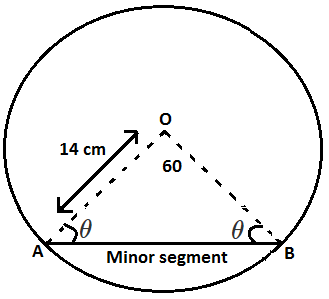
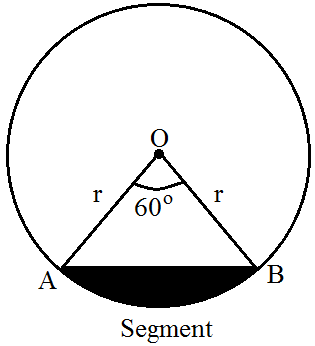
Find the area of the minor segment of a circle of radius 14cm, when the angle of the corresponding sector is 60°.
Answer

Given that, radius of circle (r) = 14cm
and angle of the corresopnding sector i.e., central angle $(\theta)=60^\circ$
Since, in $\triangle\text{AOB},$ OA = OB = Radius of circle i.e., $\triangle\text{AOB}$ is isosceles.
$\Rightarrow\ \ \angle\text{OAB}=\angle\text{OBA}=\theta$
Now, in $\triangle\text{OAB},\ \ \angle\text{AOB}+\angle\text{OAB}+\angle\text{OBA}=180^\circ$
[since, sum of interior angles of any triangle is 180°]
$\Rightarrow\ \ 60^\circ+\theta+\theta=180^\circ$ $[\text{given, }\angle\text{AOB}=60^\circ]$
$\Rightarrow\ \ 2\theta=120^\circ$
$\Rightarrow\ \ \theta=60^\circ$
i.e., $\angle\text{OAB}=\angle\text{OBA}=60^\circ=\angle\text{AOB}$
Since, all angles of $\triangle\text{AOB}$ are equal to 60° i.e., $\triangle\text{AOB}$ is an equilateral triangle.
Also, OA = OB = AB = 114cm
So, Area of $\triangle\text{OAB}=\frac{\sqrt{3}}{4}(\text{side})^2$
$=\frac{\sqrt{3}}{4}\times(14)^2$ $\big[\because$ area of an equilateral triangle $=\frac{\sqrt{3}}{4}(\text{side})^2\big]$
$=\frac{\sqrt{3}}{4}\times196=49\sqrt{3}\text{ cm}^2$
View full question & answer
Question 145 Marks
Find the area of the segment of a circle of radius 12cm whose corresponding sector has a central angle of 60° $(\text{Use }\pi=3.14).$
Answer

Area of minor segment = Area of sector - Area of $\triangle\text{OAB}$
In $\triangle\text{OAB},$
$\theta=60^\circ$
$\text{QA}=\text{OB}=\text{r}=12\text{cm}$
$\angle\text{B}=\angle\text{A}=\text{x}$
[$\angle\text{s}$ opp, to equal sides are euqal]
$\Rightarrow\ \ \angle\text{A}+\angle\text{B}+\angle\text{O}=180^\circ$
$\Rightarrow\ \ \text{x}+\text{x}+60^\circ=180^\circ$
$\Rightarrow\ \ 2\text{x}=180^\circ-60^\circ$
$\Rightarrow\ \ \text{x}=\frac{120^\circ}{2}=60^\circ$
$\therefore\ \triangle\text{OAB}$ is equilateral $\triangle$ with each side (a) = 12cm
Area of the equilateral $\triangle=\frac{\sqrt{3}}{4}\text{a}^2$
Area of minor segment = Area of the sector - Area of $\triangle\text{OAB}$
$=\frac{\pi\text{r}^2\theta}{360^\circ}-\frac{\sqrt{3}}{4}\text{a}^2$
$=\frac{3.14\times12\times12\times60^\circ}{360^\circ}-\frac{\sqrt{3}}{4}\times12\times12$
$=6.28\times12-36\sqrt{3}$
$\therefore$ Area of minor segment $=(75.36-36\sqrt{3})\text{cm}^2.$
View full question & answer
Question 155 Marks
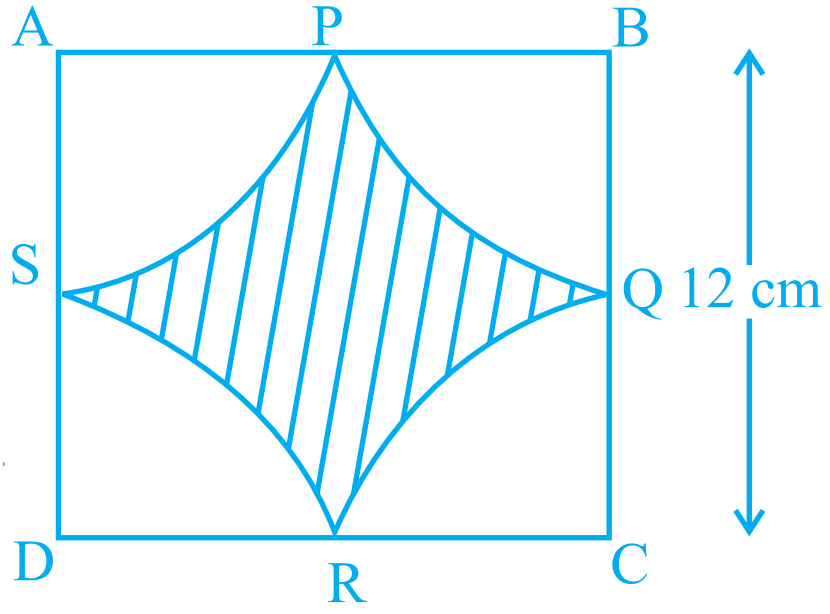
Find the area of the shaded region in Fig. where arcs drawn with centres $\text{A, B, C}$ and $D$ intersect in pairs at mid $-$ points ${\text{P, Q, R}}$ and $S$ of the sides $\text{AB, BC, CD}$ and $DA,$ respectively of a square $\text{ABCD} (\text{Use }\pi=3.14).$
Answer
Given$,$ side of a square $BC = 12\ cm$
Since$, Q$ is a mid$-$point $of BC$
$\therefore$ Radius $=\text{BQ}=\frac{12}{2}=6\text{cm}$
Now$,$ area of quadrant $\text{BPQ}=\frac{\pi\text{r}^2}{4}=\frac{3.14\times(6)^2}{4}=\frac{11.3.04}{4}\text{cm}^2$
Area of four quadrants $=\frac{4\times113.04}{4}=1123.04\text{cm}^2$
Now$,$ area of square $\text{ABCD} = (12)^2 = 144\ cm^2$
$\therefore$ Area of the shaded region = Area of square $-$ Area of four quadrants
$= 144 - 113.04 = 30.96\ cm^2$
View full question & answer
Question 165 Marks
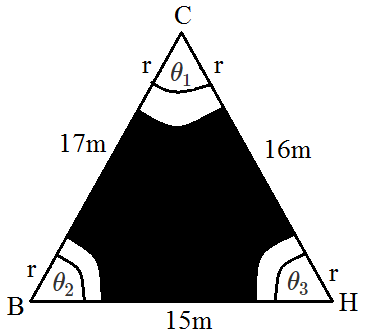
Sides of a triangular field are $15\ m, 16\ m$ and $17\ m.$ With the three corners of the field a cow, a buffalo and a horse are tied separately with ropes of length $7\ m$ each to graze in the field. Find the area of the field which cannot be grazed by the three animals.
Answer
Since with the three corners of the field a cow, a buffalo and a horse and tied separately with ropes of length $7\ m$ each to graze in the field.

Area of field which cannot be grazed by animals
$=$ Area of $\triangle\text{BCH}$ -Area of three sectors
Here,$ a = 15\ m, b = 16\ m, c = 17\ m$
$\therefore\ \ \text{s}=\frac{\text{a}+\text{b}+\text{c}}{2}=\frac{15+16+17}{2}$
$\Rightarrow\ \ \text{s}=\frac{48}{2}=24\text{ m}$
Area of $\triangle\text{BCH}=\sqrt{\text{s}(\text{s}-\text{a})(\text{s}-\text{b})(\text{s}-\text{c})}$
$=\sqrt{24(24-15)(24-16)(24-17)}$
$=\sqrt{24\times9\times8\times7}$
$=\sqrt{2\times2\times2\times3\times3\times3\times2\times2\times2\times7}$
$\Rightarrow\ \ \text{ar}(\triangle\text{BCH})=24\sqrt{21}\text{ m}^2$
Area of $3$ sectors $=\frac{\pi\text{r}^2\theta_1}{360^\circ}+\frac{\pi\text{r}^2\theta_2}{360^\circ}+\frac{\pi\text{r}^2\theta_3}{360^\circ}$
$=\frac{\pi\text{r}^2}{360^\circ}[\theta_1+\theta_2+\theta_3]$
$=\frac{22}{7}\times\frac{7\times7}{360^\circ}\times180^\circ$ $(\because\theta_1+\theta_2+\theta_3=180^\circ)$
$=77\text{ m}^2$
$\therefore$ Area of $3$ sectors grazed by animals $= 77\ m^2$
Hence$,$ the area which cannot be grazed by 3 animals is equal to $(24\sqrt{21}-77)\text{ m}^2.$
View full question & answer
Question 175 Marks
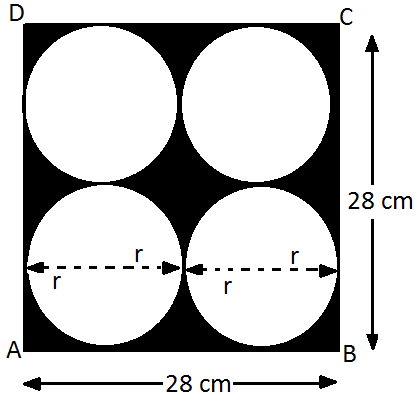
On a square cardboard sheet of area $784\ cm^2,$ four congruent circular plates of maximum size are placed such that each circular plate touches the other two plates and each side of the square sheet is tangent to two circular plates. Find the area of the square sheet not covered by the circular plates.
Answer
Let a be the side of square $\text{ABCD.}$

Area of square $\text{ABCD}= 784\ cm^2$
$\Rightarrow\ \ \text{a}^2=784$
$\Rightarrow\ \text{a}=\sqrt{784}$
$=\sqrt{2\times2\times2\times2\times7\times7}$
$=2\times2\times7$
$\Rightarrow\ \text{a}=28\text{cm}$
Now$,$ in four circles$,$
$4\text{r}=\text{AB}$
$\Rightarrow\ \ 4\text{r}=28\text{cm}$
$\Rightarrow\ \ \text{r}=7\text{cm}$
Area enclosed between circles and square $=$ Area of square $-$ Area of $4$ circles
$=784-4\pi\text{r}^2$
$=784-4\times\frac{22}{7}\times7\times=784-616=168\text{cm}^2$
Hence$,$ the area of square sheet not covered by circular plates is $168\ cm^2.$
View full question & answer
Question 185 Marks
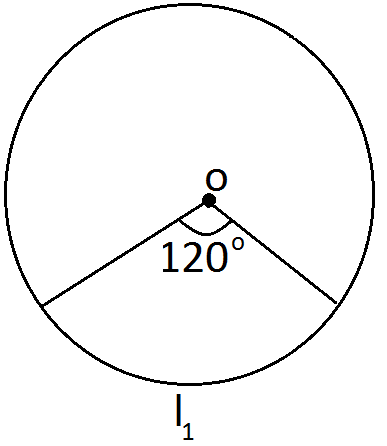
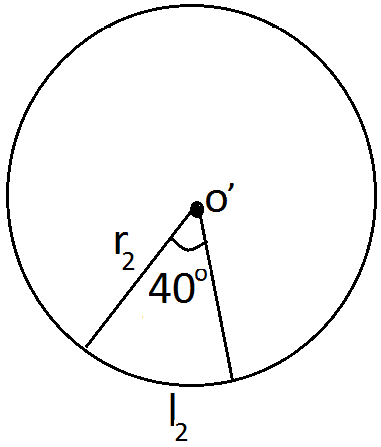
The central angles of two sectors of circles of radii $7\ cm$ and $21\ cm$ are respectively $120^\circ$ and $40^\circ $. Find the areas of the two sectors as well as the lengths of the corresponding arcs. What do you observe?
Answer
For the first circle$,$ we have
$\text{r}_1=7\text{cm}$
$\theta_1=120^\circ$
$\text{A}_1=$?
$\text{l}_1=$?

$\text{A}_1=\frac{\pi\text{r}_1^2\theta_1}{360^\circ}=\frac{22}{7}\times\frac{7\times7\times120^\circ}{360^\circ}$
$=\frac{154}{3}\text{ cm}^2$
Now, $\text{l}_1=\frac{2\pi\text{r}_1\theta_1}{360^\circ}=2\times\frac{22}{7}\times\frac{7\times120^\circ}{360^\circ}$
$=\frac{2\times22}{3}=\frac{44}{3}\text{ cm}$
For the second circle, we have
$\text{r}_2=21\text{ cm}$
$\theta_2=40^\circ$
$\text{A}_2=$?
$\text{l}_2=$?

$\text{A}_2=\frac{\pi\text{r}_2^2\theta_2}{360^\circ}=\frac{22}{7}\times\frac{21\times21\times40^\circ}{360^\circ}$
$=22\times7=154\text{ cm}^2$
$\text{l}_2=\frac{2\pi\text{r}_2\theta_2}{360^\circ}=2\times\frac{22}{7}\times\frac{21\times40^\circ}{360^\circ}$
$=\frac{44}{3}\text{ cm}$
Hence, the length of arcs of two given circles are equal but area of $II^{nd}$ circle is three times that of$ I^{st}$ i.e., unequal.
View full question & answer
Question 195 Marks
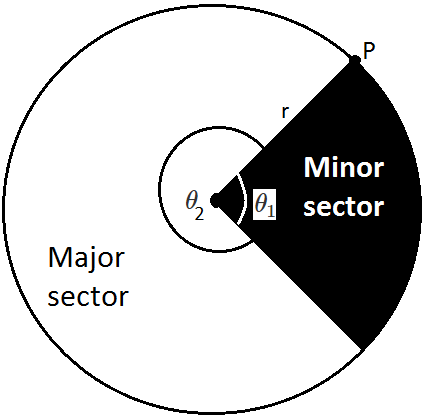
Find the difference of the areas of a sector of angle $120^\circ$ and its corresponding major sector of a circle of radius $21\ cm.$
Answer
For minor sector
$\text{r}_1=21\text{cm}$
$\theta_1=120^\circ$
For major sector
$\text{r}_2=21\text{cm}$
$\theta_2=360^\circ-120^\circ=240^\circ$
Difference in areas of major and minor sectors

$=\frac{\pi}{360^\circ}(\theta_2-\theta_1)\ \ [\because\text{r}_1=\text{r}_2=\text{r}]$
$=\frac{22\times21\times21}{7\times360^\circ}[240^\circ-120^\circ]$
$=\frac{22\times21\times21\times120^\circ}{7\times360^\circ}$
$=462\text{cm}^2$
Hence$,$ the difference in areas of major and minor sectors of given circle is $462\ cm^2.$
View full question & answer
Question 205 Marks
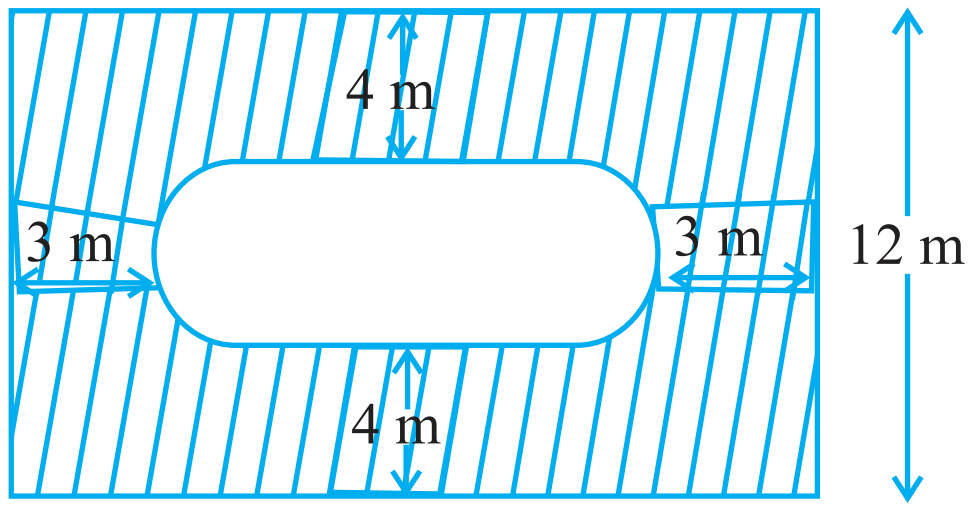
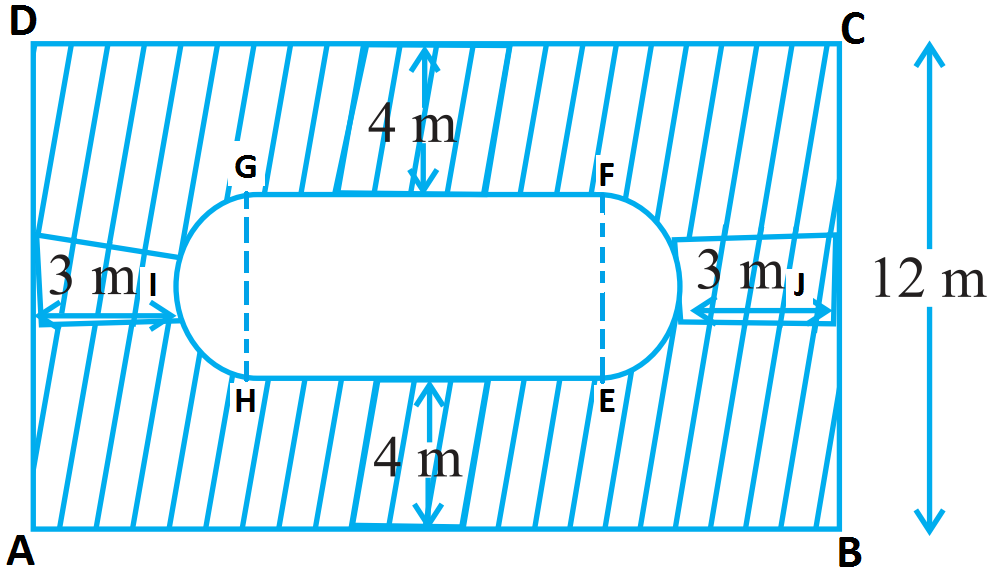
Find the area of the shaded region in Fig.
Answer
Join $GH$ and $FE$

Here, breadth of the rectangle $BC = 12\ m$
$\therefore$ Breadth of the inner rectangle $\text{EFGH} = 12 - (4 + 4) = 4\ cm$
which is equal to the diameter of the semi$-$circle $\text{EJF}, d = 4m$
$\therefore$ Radius of semi$-$circle $\text{EJF}, r = 2,$
$\therefore$ Length of inner rectangle $\text{EFGH} = 26 - (5 + 5) = 16m$
$\therefore$ Area of two semi-circle $\text{EJF}$ and $\text{HIG} =2\Big(\frac{\pi\text{r}^2}{2}\Big)=2\times\pi\frac{(2)^2}{2}=4\pi\text{ m}$
Now$,$ area of inner rectangle $\text{EFGH = EH} \times FG = 16 \times 4 = 64m^2$
and area of inner rectangle $\text{ABCD} = 26 \times 12 = 312m^2$
$\therefore$ Area of shaded region $=$ Area of outer rectangle $- ($Area of two semi$-$circles $+$ Area of inner rectangle$)$
$=312-(64 + 4\pi)=(248 - 4\pi)\text{m}^2$
View full question & answer
Question 215 Marks
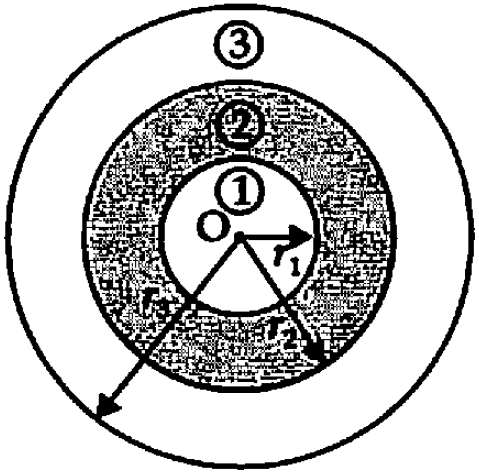
An archery target has three regions formed by three concentric circles as shown in Fig. If the diameters of the concentric circles are in the ratio 1 : 2 : 3, then find the ratio of the areas of three regions.
Answer

$\text{d}_1:\text{d}_2:\text{d}_3=1:2:3\ \ [\text{given]}$
$=1\text{d}:2\text{d}:3\text{d}\ \ [\times\text{by d}]$
$\Rightarrow\ \ \text{d}_1:\text{d}_2:\text{d}_3=\frac{\text{d}}{2}:\frac{2\text{d}}{2}:\frac{3\text{d}}{2}\ \ \Big[\times\text{by}\frac{1}{2}\Big]$
$\Rightarrow\ \ \text{r}_1:\text{r}_2:\text{r}_3=\text{r},2\text{r},3\text{r}$
$\therefore\ \ \text{r}_1=\text{r},\ \ \text{r}_2=2\text{r},\ \ \text{r}_3=3\text{r}$
Now, $\text{A}_1=\pi\text{r}^2$
$\text{A}_2=\pi(2\text{r})^2=4\pi\text{r}^2$
$\text{A}_3=\pi(3\text{r})^2=9\pi\text{r}^2$
Area of innermost circle $=\pi​​​​\text{r}^2_1=\pi\text{r}^2$
Area of region between first and second circles
$=\text{A}_2-\text{A}_1=4\pi\text{r}^2-\pi\text{r}^2=3\pi\text{r}^2$
Area of region between second and third circles
$=\text{A}_3-\text{A}_2=9\pi\text{r}^2-4\pi\text{r}^2=5\pi\text{r}^2$
$\therefore$ Required ratio $=\pi\text{r}^2:3\pi\text{r}^2:5\pi\text{r}^2$
On dividing all the three ratios by $\pi\text{r}^2,$ we get the required ratio of areas of three regions as 1 : 3 : 5.
View full question & answer
Question 225 Marks
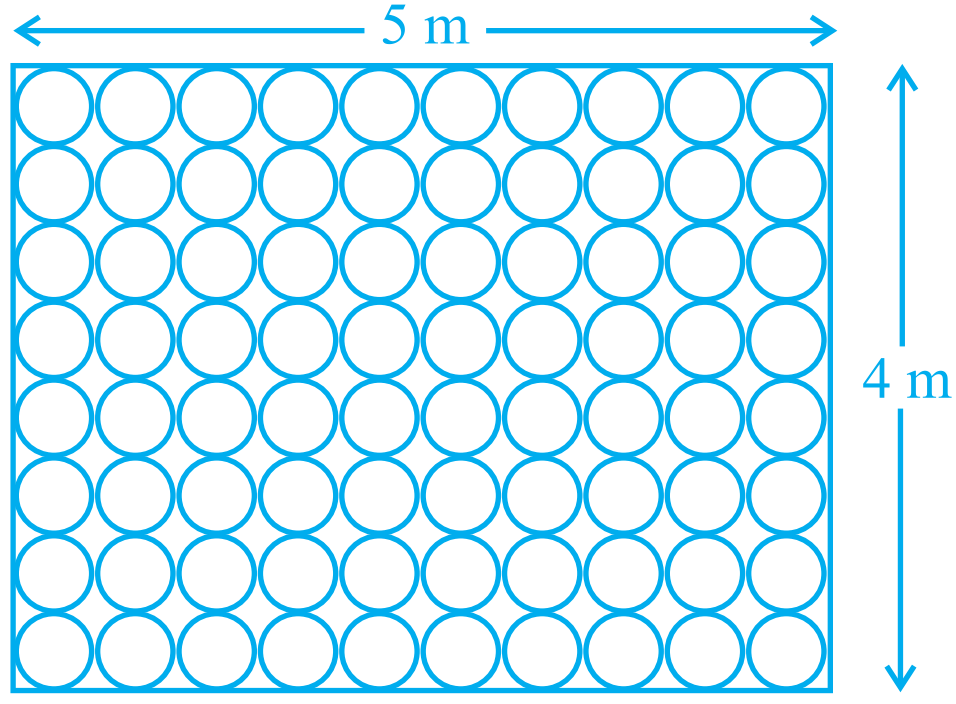
Floor of a room is of dimensions $5\ m \times 4\ m$ and it is covered with circular tiles of diameters $50\ cm$ each as shown in Fig. Find the area of floor that remains uncovered with tiles. $(\text{Use }\pi=3.14)$
Answer
As the diameter of circular tile is $50\ cm$ each$,$ then $\text{r}=\frac{0.5}{2}=0.25\text{m}$
Number of tiles length wise $=\frac{5\text{m}}{0.5\text{m}}=10\text{ tiles}$
Number of tiles length wise $=\frac{4\text{m}}{0.5\text{m}}=8\text{ tiles}$
So$, 10$ tiles are length wise and $8$ tiles
So$,$ total number of tiles $= 10 \times 8 = 80.$
$\therefore$ Area of fioor not covered by tiles
$=$ Area of rectangular floor $-$ Area of 80 tiles
$=5\times4-80\pi\text{r}^2=20-80\times\pi\times0.25\times0.25$
$=20-\frac{80\times314\times25\times25}{100\times100\times100}=20-\frac{157}{10}=20-15.7=4.3\text{ m}^2$
Hence$,$ the area of floor not covered by tiles $= 4.3\ m^2.$
View full question & answer
Question 235 Marks
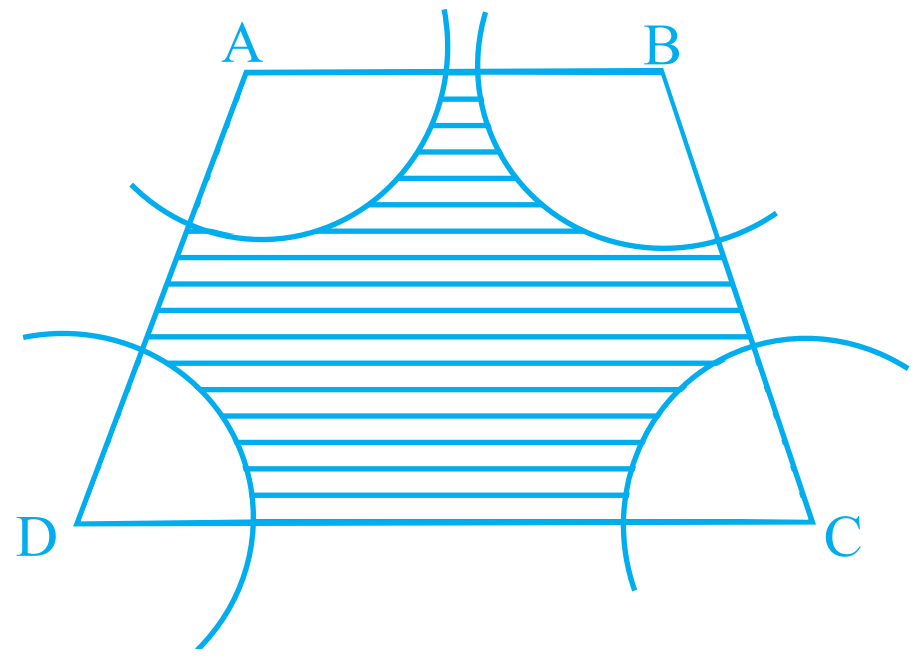
In Fig. $\text{ABCD}$ is a trapezium with $\text{AB || DC, AB} = 18\ cm, DC = 32\ cm$ and distance between $AB$ and $DC = 14\ cm$. If arcs of equal radii $7\ cm$ with centres $\text{A, B, C}$ and $D$ have been drawn, then find the area of the shaded region of the figure.
Answer
In the given figure, there are sectors and one trapezium.
4 sectors
Trapezium
$r = 7\ cm$ $a = 18\ cm$
  $b = 32\ cm$
  $h = 14\ cm$
Area of shaded part $=$ Area of trapezium $-$ Area of $4$ sectors
$=\frac{(\text{a}+\text{b})\text{h}}{2}-\Big[\frac{\pi\text{r}^2\theta_1}{360^\circ}+\frac{\pi\text{r}^2\theta_2}{360^\circ}+\frac{\pi\text{r}^2\theta_3}{360^\circ} +\frac{\pi\text{r}^2\theta_4}{360^\circ}\Big]$
$=\frac{(18+32)\times14}{2}-\frac{\pi\text{r}^2}{360^\circ}(\theta_1+\theta_2+\theta_3+\theta_4)$
$=\frac{50\times14}{2}-\frac{22}{7}\times\frac{7\times7}{360^\circ}\times360^\circ$
$\Rightarrow$ Area of shaded region $= 350 - 22 \times 7 = 350 - 154 = 196\ cm^2$
Hence$,$ the area of shaded region is $196\ cm^2.$
View full question & answer
Question 245 Marks
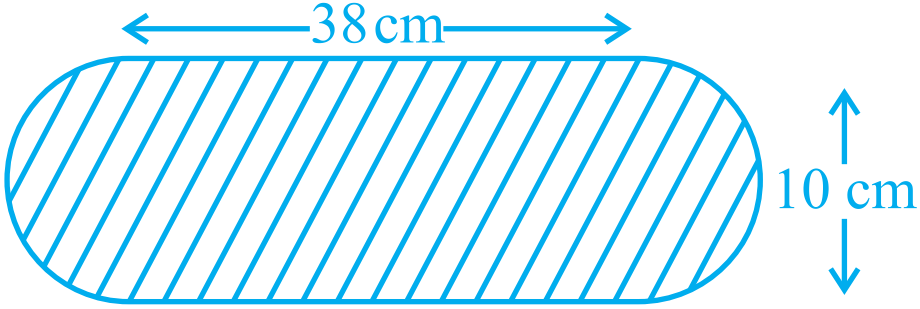
Find the area of the flower bed $($with semi$-$circular ends$)$ shown in Fig.
Answer
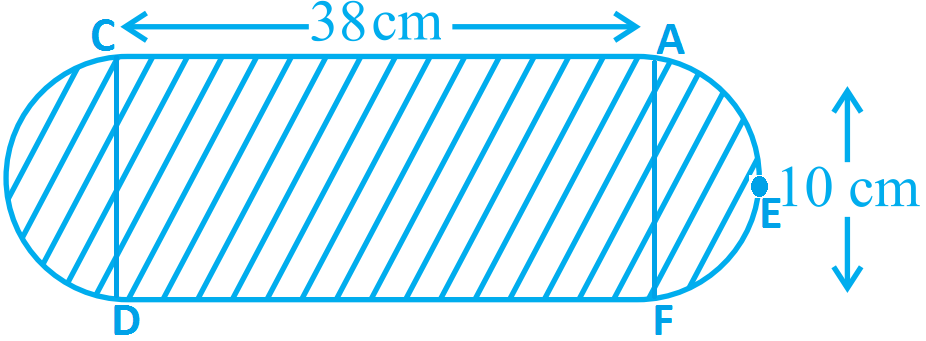
Length and breadth of a circular bed are $38\ cm$ and $10\ cm.$
$\therefore$ Area of rectangle $\text{ACDF}=$ Length $\times$ Breadth $ = 38 \times 10 = 380\ cm^2$

Both ends of flower bed are semi$-$circles.
$\therefore$ Radius of semi-circle $=\frac{\text{DF}}{2}=\frac{10}{2}=5\text{ cm}$
$\therefore$ Area of one semi-circles $=\frac{\pi\text{r}^2}{2}=\frac{\pi}{2}(5)^2=\frac{25\pi}{2}\text{ cm}^2$
$\therefore$ Area of two semi-circles $=2\times\frac{25}{2}\pi=25\pi\text{  cm}^2$
$\therefore$ Total area of fiower bed $-$ Area of rectangle $\text{ACDF +}$ Area of two semi$-$circles
$=(380+25\pi)\text{ cm}^2$
View full question & answer
Question 255 Marks
A circular pond is $17.5\ m$ is of diameter. It is surrounded by a $2\ m$ wide path. Find the cost of constructing the path at the rate of $Rs. 25$ per $m^2$
Answer
Radius of the circular pond $\text{r}_1=\frac{17.5}{2}\text{m}=8.75\text{m}$

Width of path $= 2m$
$\therefore$ Radius of the path including pond
$\text{r}_2=8.75+2=10.75\text{m}$
Area of path $=\pi\text{r}^2_2-\pi\text{r}^2_1=\pi[\text{r}^2_2-\text{r}^2_1]$
Cost of constructing the parh $=\text{Rs.}\ 25\ \pi(\text{r}^2_2-\text{r}^2_1)$
$\therefore$ Required cost $=\text{Rs.}\ 25\times\frac{22}{7}[(10.75)^2-(8.75)^2]$
$=25\times\frac{22}{7}[10.75-8.75][10.75+8.75]$
$=25\times\frac{22}{7}\times2\times19.5=\frac{50\times22\times19.5}{7}$
$=\frac{1100\times19.5}{7}=\frac{21450}{7}=\text{Rs.}\ 3064.29$
Hence$,$ the cots of constructing path is $Rs. 306429.$
View full question & answer