Question 13 Marks
Write the formula for the area of a segment in a circle of radius r given that the sector angle is $\theta$ (in degrees).
Answer
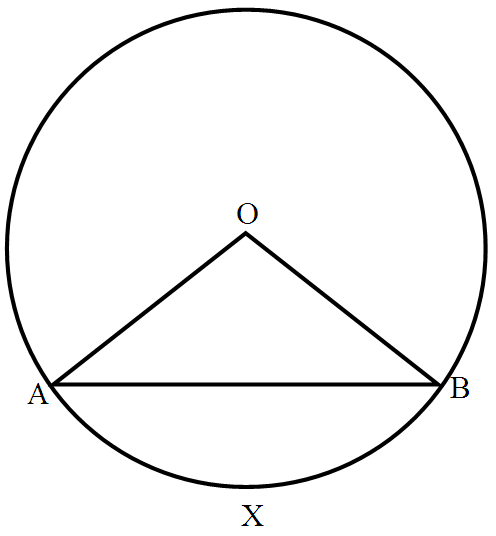 In this figure, centre of the circle is O, radius OA = r and $\angle\text{AOB}=\theta$
We are going to find the area of the segment AXB.
Area of the segment AXB = Area of the sector OAXB - Area of $\triangle\text{AOB}\ \dots(1)$
We know that area of the sector $\text{OAXB}=\frac{\theta}{360}\times\pi\text{r}^2$
We also know that area of $\triangle\text{AOB}=\text{r}^2$ $\triangle\text{AOB}=\text{r}^2\sin \frac{\theta}{2}\cos\frac{\theta}{2}$
Substituting these values in equation (1) we get,
Area of the segment AXB $=\frac{\theta}{360}\times\pi\text{r}^2-\text{r}^2\sin\frac{\theta}{2}\cos\frac{\theta}{2}$
Area of the segment AXB$=\Big(\frac{\theta}{360}\times\pi-\sin\frac{\theta}{2}\cos\frac{\theta}{2}\Big)\text{r}^2$
So Area of the segment AXB $=\Big(\frac{\pi\theta}{360}-\sin\frac{\theta}{2}\cos\frac{\theta}{2}\Big)\text{r}^2$
Therefore, area of the segment is $=\Big(\frac{\pi\theta}{360}-\sin\frac{\theta}{2}\cos\frac{\theta}{2}\Big)\text{r}^2.$ View full question & answer→Question 23 Marks
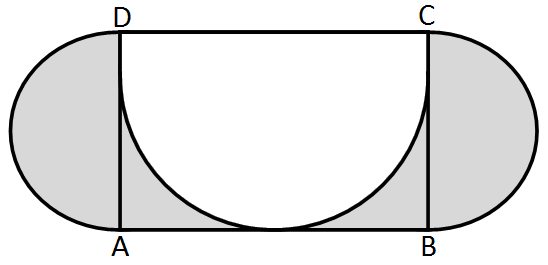
In the following figure, ABCD is a rectangle with AB = 14cm and BC = 7cm. Taking DC, BC and AD
as diameters, three semi-circles are drawn as shown in the figure. Find the area of the shaded region.
AnswerArea of the shaded region can be calculated as shown below,
Area of the shaded region = Area of rectangle − area of the semi-circle with diameter DC triangle + 2 × area of two semicircles with diameters AD and BC
$\therefore$ Area of the shaded region $=7\times14-\frac{\pi\times7^2}{2}+2\times\frac{\pi\times3.5^2}{2}$
$\therefore$ Area of the shaded region $=98-\frac{\pi\times49}{2}+\pi\times12.25$
Substituting $\pi=\frac{22}{7}$ we get,
$\therefore$ Area of the shaded region $=98-\frac{\frac{22}{7}\times49}{2}+\frac{22}{7}\times12.25$
$\therefore$ Area of the shaded region $=98-\frac{22\times7}{2}+22\times1.75$
$\therefore$ Area of the shaded region $=98-77+22\times1.75$
$\therefore$ Area of the shaded region $=21+38.5$
$\therefore$ Area of the shaded region $=59.5$
Therefore, area of the shaded region is $59.5\text{cm}^2$
View full question & answer→Question 33 Marks
Two circular pieces of equal radii and maximum area, touching each other are cut out from a rectangular card board of dimensions $14cm \times 7cm$. Find the area of the remaining card board.$\Big(\text{Use }\pi=\frac{22}{7}\Big).$
AnswerLength of rectangle $= 14cm$ and breadth $= 7cm$
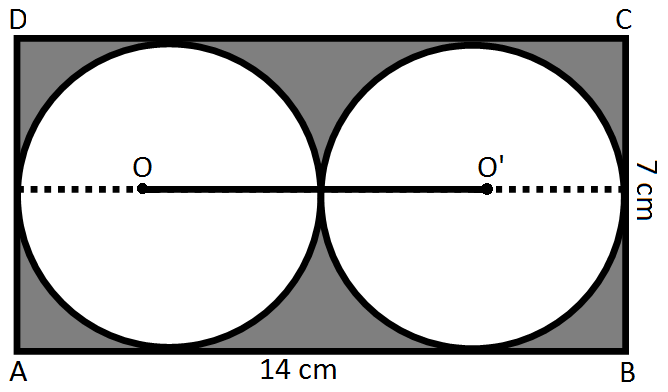
$\therefore$ Total area $= l \times b = 14 \times 7 = 98cm^2$ Radiud of each circle $= \frac{7}{2} \text{cm}$ $\therefore$ Area of two circle $=2\pi\text{r}^2$ $=2\times\frac{22}{7}\times\frac{7}{2}\times\frac{7}{2}=77\text{cm}^2$ Area of the remaining portion $= 98 - 77 = 21cm^2$ View full question & answer→Question 43 Marks
The perimeter of a certain sector of a circle of radius 5.6m is 27.2m. Find the area of the sector.
Answer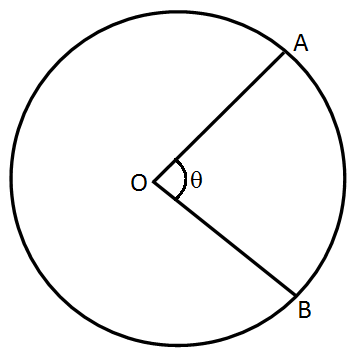
$\theta=$ angle subtended at centre
Radius (r) = 5.6m $=\text{OA}\pm\text{OB}$
Perimeter of sector = 27.2m
(AB arc length) + OA + OB = 27.2
$\Rightarrow\Big(\frac{\theta}{360^\circ}\times2\pi\text{r}\Big)+5.6+5.6=27.2$
$\Rightarrow\frac{5.6\pi\theta}{180^\circ}+11.2=27.2$
$\Rightarrow5.6\times\frac{22}{7}\times\theta=16\times180$
$\Rightarrow\theta=\frac{16\times180}{0.8\times22}=163.64^\circ$
Area of sector $=\frac{\theta}{360^\circ}\times\pi\text{r}^2=\frac{163.64^\circ}{360^\circ}\times\frac{22}{7}\times5.6\times5.6$
$=\frac{163.64}{180}\times11\times0.8\times5.6$
$=44.8\text{cm}^2$ View full question & answer→Question 53 Marks
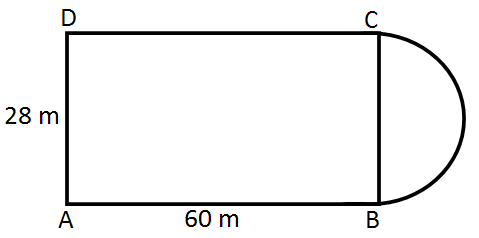
A plot is in the form of a rectangle $A B C D$ having semi-circle on $B C$ as shown in the following figure. If $A B=60 m$ and $B C=28 m$, find the area of the plot.
Answer
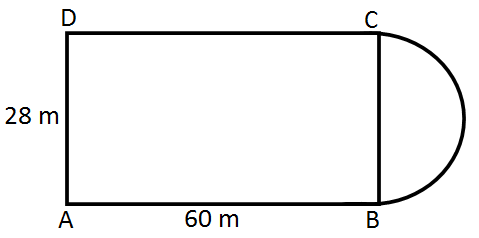
Given AB = 60m = DC [length]
$BC = 28m = AD$ [breadth]
Radius of semicircle $\text{r}=\frac{1}{2}\times\text{BC}=14\text{m}$
Area of semicircle $\text{r}=\frac{1}{2}\times\text{BC}=14\text{m}$
Area of plot = (Area of rectangle ABCD) + (area of semicircle)
$=(\text{length}\times\text{breadth})+\frac{1}{2}\pi\text{r}^2$
$=(60\times28)+\Big[\frac{1}{2}\times\frac{22}{7}\times14\times14\Big]$
$= 1680 + 308 = 1988m^2$ View full question & answer→Question 63 Marks
In the following figure, $O E=20 cm$. In sector $O S F T$, square $O E F G$ is inscribed. Find the area of the shaded region.
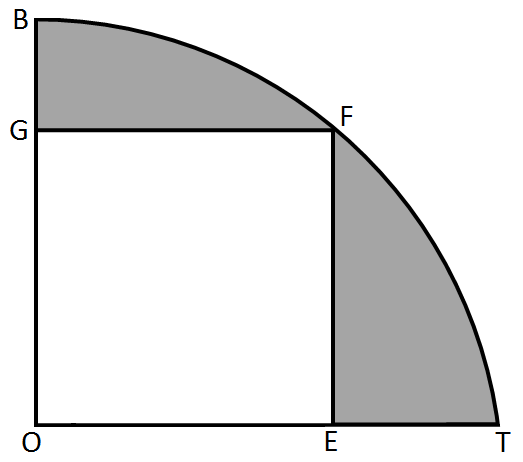
AnswerIn the figure $OSFT$ is a quadrant and $OEFG$ is a square inscribed in it The side of the square is OE $=20 cm$ 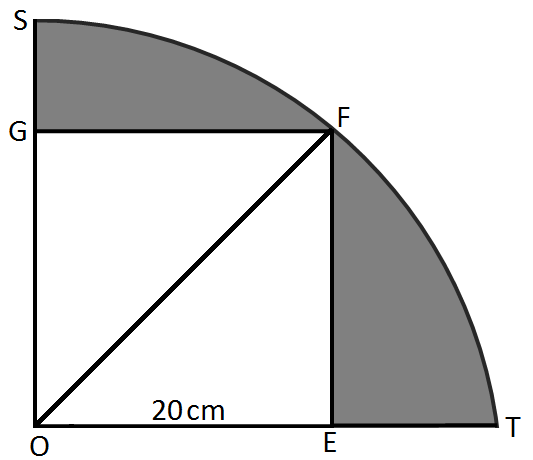
$\therefore\text{Diagonal}=\sqrt{2}\times\text{side}$
$\therefore $ Radius (r) of the sector $=20\sqrt{2}\text{cm}$
Now area of quadrant OTFS $=\frac{1}{4}\times \pi\text{r}^2$
$=\frac{1}{4}(3.14)\times\big(20\sqrt{2}\big)^2\text{cm}^2$
$=\frac{1}{4}\times3.14\times800\text{cm}^2=628\text{cm}^2$
Area of square $OEFG = (side)^2$
$=(20)^2\text{cm}^2=400\text{cm}^2$
Area of shaded region $= 628 - 400$
$= 228cm^2$ View full question & answer→Question 73 Marks
An archery target has three regions formed by the concentric circles as shown in the figure. If the diameters of the concentric circles are in the ratio 1:2:3, then find the ratio of the areas of three regions.
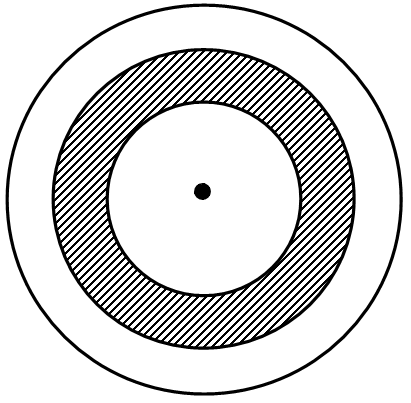
AnswerLet the diameters of concentric circles be k,
$\therefore$ Radius of concentric circles are $\frac{\text{k}}{2},\text{k}\text{ and }\frac{3\text{k}}{2}.$
$\therefore$ Area of inner circle , $\text{A}_1=\pi\Big(\frac{\text{k}}{2}\Big)^2=\frac{\text{k}^2\pi}{4}$
$\therefore$ Area of middle region,
$\text{A}_2=\pi(\text{k})^2-\frac{\text{k}^2\pi}{4}=\frac{3\text{k}^2\pi}{4}$
$[\therefore\text{area of ring}=\pi(\text{R}^2-\text{r}^2),$ where R is radius of outer and r is radius of inner ring]
and area of outer region, $\text{A}_3=\pi\Big(\frac{3\text{k}}{2}\Big)-\pi\text{k}^2$
$=\frac{9\pi\text{k}^2}{4}-\pi\text{k}^2=\frac{5\pi\text{k}^2}{4}$
$\therefore\text{Required ratio}=\text{A}_1:\text{A}_2:\text{A}_3$
$=\frac{\text{k}^2\pi}{4}:\frac{3\text{k}^2\pi}{4}:\frac{5\pi\text{k}^2}{4}=1:3:5$
View full question & answer→Question 83 Marks
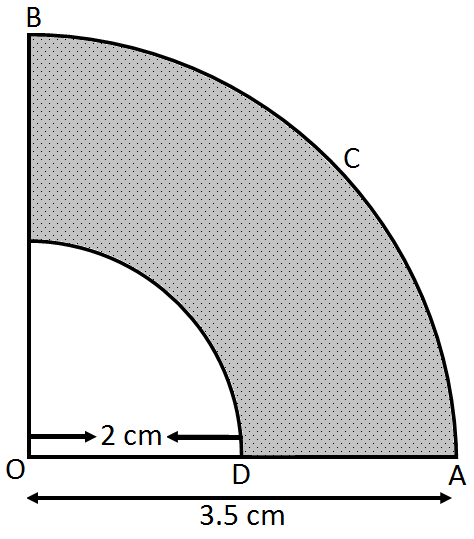
In the following figure, OACB is a quadrant of a circle with centre O and radius 3.5cm. If OD = 2cm, find the area of the: (i) Quadrant OACB (ii) Shaded region.
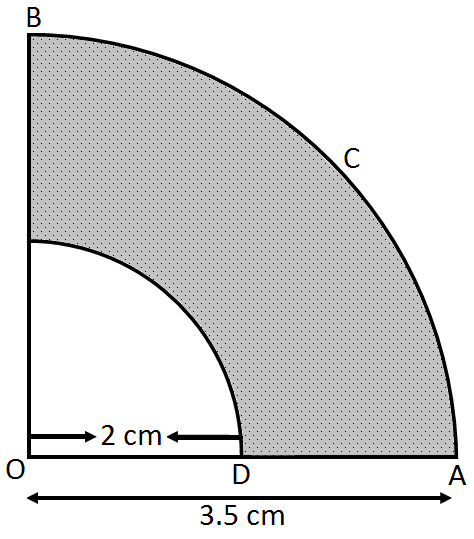
AnswerIt is given that OACB is a quadrant of circle with centre at O and radius 3.5cm.
- We know that the area of quadrant of circle of radius r is,
$\text{A}=\frac{1}{4}\pi\text{r}^2$
Substituting the value of radius $\text{r}=3.5\text{cm},$
$\text{A}=\frac{1}{4}\times\frac{22}{7}\times3.5\times3.5$
$=9.625\text{cm}^2$
Hence, the area of OACB is $=9.625\text{cm}^2.$
- It is given that radius of quadrant of small circle is cm.
Let the area of quadrant of small circle be. A'.
$\text{A}'=\frac{1}{4}\pi\text{r}^2$
$=\frac{1}{4}\times\frac{22}{7}\times2\times2$
$=3.14\text{cm}^2$
It is clear from the above figure that area of shaded region is the difference of larger quadrant and the smaller one. Hence,
Area of shaded region $=\text{A}-\text{A}'$
$=9.625-3.14$
$=6.485\text{cm}^2$ View full question & answer→Question 93 Marks
A circular field has a perimeter of $650\ m$. A square plot having its vertices on the circumference of the field is marked in the field. Calculate the area of the square plot.
AnswerPerimeter of the circular field $= 650m$
$\therefore$ Radius (r) $= \frac{\text{Circumference}}{2\pi} $
$=\frac{650\times7}{2\times22}=\frac{2275}{22}\text{m}$
$\therefore$ Diagonal of the inscribed square = diameter of the circle
=$2\text{r}=2\times\frac{2275}{22}=\frac{2275}{11}\text{m}$
$\therefore\text{side}=\frac{\text{diagonal}}{\sqrt{2}}=\frac{2275}{\sqrt{2}\times11}$
and area of the squrae field $= a^2$
$=\Big(\frac{2275}{11\sqrt{2}}\Big)^2\text{m}^2=\frac{5175625}{121\times2}\text{m}^2$
$= 21386.88\text{m}^2$
$=21387\text{m}^2\text{(approx)}$
View full question & answer→Question 103 Marks
A circular pond is of diameter 17.5m. It is surrounded by a 2m wide path. Find the cost of constructing the path at the rate of ₹ 25 per square metre. $(\text{Use }\pi=3.14)$
AnswerDiameter, d = 17.5m
Radius, r $=\frac{17.5}{2}\text{m}$
Radius of the pond with the 2m wide path $=2+\frac{17.5}{2}\text{m}$
Area of the circular path = Area of the pond with the path - area of the pond
$=\pi\Big(2+\frac{17.5}{2}\Big)-\pi\Big(\frac{17.5}{2}\Big)^2$
$=122.57\text{m}^2$
Cost of constructing the path = 25 × 122.57 = Rs 3064.2
View full question & answer→Question 113 Marks
The radii of two circles are $19\ cm$ and $9\ cm$ respectively. Find the radius and area of the circles which has it circumference equal to the sum of the circumferences of the two circles.
AnswerLet the radius of circles be $rcm , r _1 cm$ and $r _2 cm$ respectively.
Then their circumferences are
$C =2 \pi r cm , C _1=2 \pi r _1 cm$ and $C _2=2 \pi r _2 cm$ resprctively it is given that,
Circumference $C$ of circle $=$ Circumference $C_1$ of circle + circumference $C_2$ of circle
$2 \pi r=2 \pi r_1+2 \pi r_2$
$2 \pi r=2 \pi\left(r_1+r_2\right) r=r_1+r_2$
We have, $r_1=19 cm$ and $r_2=9 cm$ Substituting the values of $r_1, r_2 r=19+9$
$r=28 cm$
Hence the radius of the circle is 28 cm
We know that the area A of circle is
$A =\pi r ^2$ Substituting the value of r
$A=\frac{22}{7} \times 28 \times 28$
$=2464 cm^2$
Hence the area of the circle is $=2464 cm^2$
View full question & answer→Question 123 Marks
A field is in the form of a circle. A fence is to be erected around the field. The cost fencing would be Rs. 2640 at the rate of Rs. 12 per metre. The, the field is to be thoroughly ploughed at the cost of Re. 0.50 per $m ^2$. What is the amount required to plough the field?
$\left[\right.$ Take $\left.\pi=\frac{22}{7}\right]$.
AnswerGiven
Total cost of fencing the circular field = Rs. 2640
Cost per metre fencing $=$ Rs 12
Total cost of fencing $=$ circumference $\times$ cost per fencing
$\Rightarrow 2640=$ circumference $\times 12$
$\Rightarrow$ circumference $=\frac{2640}{12}=220 m$
Let radius of field be rm
Circumference $=2 \pi rm$
$2 \pi r =220$
$2 \times \frac{22}{7} \times r =220$
$r =\frac{70}{2}=35 m$
Area of field $=\pi r ^2$
$=\frac{22}{7} \times 35 \times 35$
$=3850 m^2$
Cost of ploughing per $m ^2$ land $=$ Rs. 0.50
Cost of ploughing $3850 m^2$ land $=\frac{1}{2} \times 3850$
$=$ Rs. 1925
View full question & answer→Question 133 Marks
Find the ratio of the area of the circle circumscribing a square to the area of the circle inscribed in the square.
AnswerLet the side of the square inscribed in a square be a units.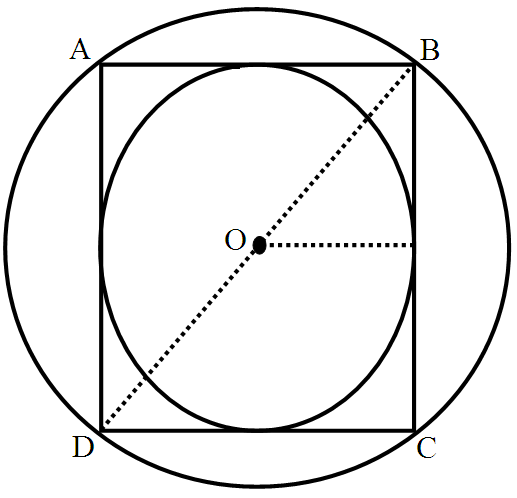
Diameter of the circle outside the square = Diagonal of the square $= \sqrt{2}\text{a}$ Radius $=\frac{\sqrt{2}\text{a}}{2}=\frac{\text{a}}{\sqrt{2}}$ So, the area of the circle circumscribing the square $=\pi\Big(\frac{\text{a}}{\sqrt{2}}\Big)^2$ Now, the radius of the circle inscribed in a square $=\frac{\text{a}}{2}$ Hence, area of the circle inscribed in a square $=\pi\Big(\frac{\text{a}}{2}\Big)^2$ From (i) and (ii) $\frac{\text{Area or circle circumscribing a square}}{\text{Area of circle inscribed in a square }}$$=\frac{\pi\Big(\frac{\text{a}}{\sqrt{2}}\Big)^2}{\pi\Big(\frac{\text{a}}{2}\Big)^2}$ $=\frac{\frac{1}{2}}{\frac{1}{4}}$ $=\frac{2}{1}$ Hence, the required ratio is 2 : 1. View full question & answer→Question 143 Marks
In the following figure, shows a kite in which BCD is the shape of a quadrant of a circle of radius 42cm. ABCD is a square and = $\triangle\text{CEF}$ is an isosceles right angled triangle whose equal sides are 6cm long. Find the area of the shaded region.
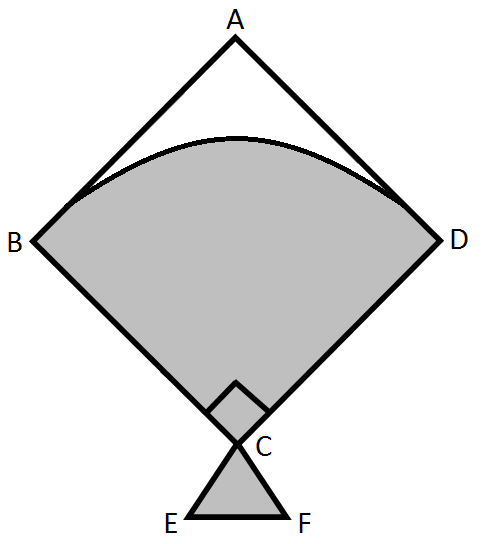
AnswerABCD is a square with side = 42cm BCD is a quadrant in which $\triangle\text{BCD}=90^\circ$ and radius = 42cm $\triangle\text{CEF}$ is an isosceles right triangle in which CE = CF = 6cm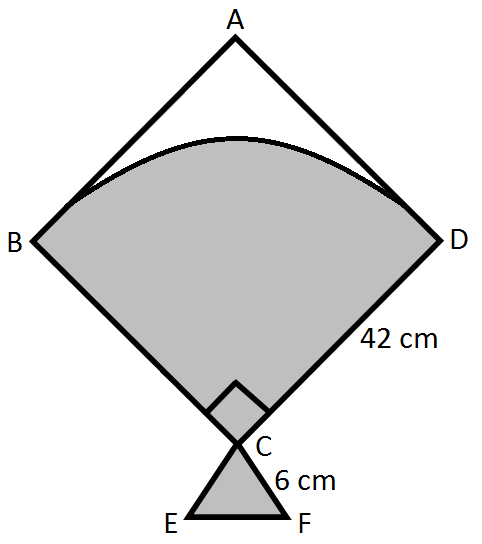
$\therefore$ Area of shaded portion = area of quadrant BCD + area of $\triangle\text{CEF}$ $= \frac{1}{4}\pi\text{r}^2+\frac{1}{2}\text{CF}\times\text{CE}$ $=\frac{1}{4}\times\frac{22}{7}\times42\times42+\frac{1}{2}\times6\times6\text{cm}^2$ $=1386+18=1404\text{cm}^2$ View full question & answer→Question 153 Marks
A circle is inscribed in an equilateral triangle ABC is side 12cm, touching its sides (the following figure). Find the radius of the inscribed circle and the area of the shaded part.
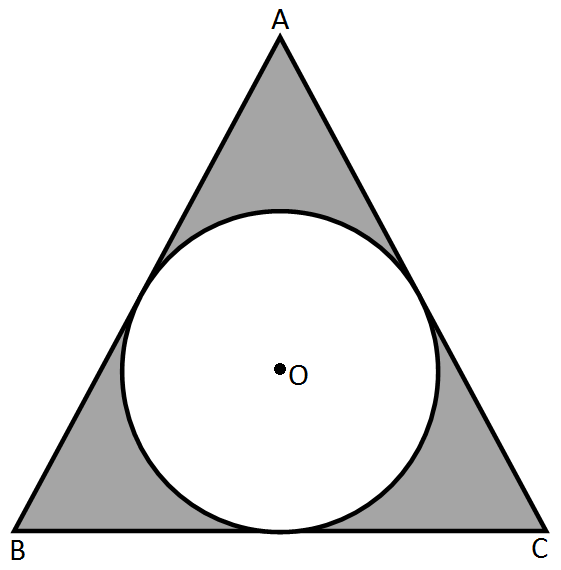
AnswerEach side of the equilateral triangle ABC (a) = 12cm
$\therefore\text{Area}=\frac{\sqrt{3}}{4}\text{a}^2=\frac{\sqrt{3}}{4}(12)^2\text{cm}^2$
$=\frac{1.732\times12\times12}{4}=62.352\text{cm}^2$
In $\triangle\text{ABC},$ draw $\text{AD}\perp\text{BC},$ O will fall on AD
and $\text{OD}=\frac{1}{3}\text{AD}$ ($\because$ O is centroid also)
$=\frac{1}{3}\times\frac{\sqrt{3}}{2}\text{(side)}$
$=\frac{\sqrt{3}}{6}\times12=2\sqrt{3}$
$\therefore$ Radius of incircle (r) $=\text{OD}=2\sqrt{3}\text{cm}$
and area of incircle $=\pi\text{r}^2=\frac{22}{7}\times\big(2\sqrt{3}\big)^2\text{cm}^2$
$=\frac{22}{7}\times12=\frac{264}{7}\text{cm}^2=37.714\text{cm}^2$
$\therefore$ Area of shaded portion
$=62.352-37.714=24.638\text{cm}^2$
View full question & answer→Question 163 Marks
The circumference of a circle exceeds the diameter by 16.8cm. Find the circumference of the circle.
AnswerLet radius of circle $=\text{r}\text{ cms}$ Diameter (d) = 2 × radius = 2r Circumference (c) $=2\pi\text{r}$ Given circumference exceeds diameter by 16.8cm $\text{C}=\text{d}+16.8$ $\Rightarrow2\pi\text{r}=2\text{r}+16.8$ $\Rightarrow2\text{r}(\pi-1)=16.8$ $\Rightarrow2\text{r}\times\Big(\frac{22}{7}-1\Big)=16.8$ $\Rightarrow2\text{r}\times\frac{15}{7}=16.8$ $\Rightarrow\text{r}=\frac{16.8\times7}{30}=5.6\times0.7$ $\Rightarrow\text{r}=3.92\text{cm}$Circumference $=2\pi\text{r}=2\times\frac{22}{7}\times3.92$
$=\frac{2464}{100}=24.64\text{cm}$
View full question & answer→Question 173 Marks
Find the area of the circle in which a square of area $64 cm^2$ is inscribed. [Use $\pi=3.14$ ]
AnswerArea of square $=64 cm^2$
$\therefore$ Side of square $=\sqrt{\text{Area}}=\sqrt{64}=8\text{cm}$
$\because$ The square in inscribed in the circle
$\therefore$ Radius of the circle will be $=\frac{1}{2}$ diagonal of
the square (r) $=\frac{1}{2}\times\sqrt{2 }\text{a}=\frac{1}{2}\times\sqrt{2}\times8\text{cm}=4\sqrt{2}$
$\therefore$ Area of the circle $=\pi\text{r}^2$
$=3.14\times(4\frac{1}{2}\times\sqrt{2}\times8\text{cm}=4\sqrt{2})^2\text{cm}^2$
$=3.14\times32=100.48\text{cm}^2$
View full question & answer→Question 183 Marks
The diameter of a coin is $1\ cm$ (in the following figure). If four such coins be placed on a table so that the rim of each touches that of the other two, find the area of the shaded region $\big(\text{Take }\pi = 3.1416\big). $
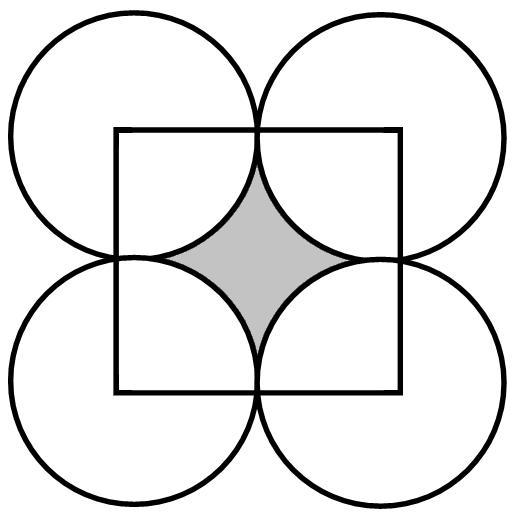
AnswerLook at the figure carefully shaded region is bounded between four sectorsof the circle withsame radius and a square of side 1cm.
Therefore, the area of the shaded region is nothing but the differencethearea of the square andarea of one circle.
$\therefore$ Area of the shaded region = Area of square - Area of a circle
$\therefore$ Area of the shaded region $=1^2-\pi(0.5^2)$
$\therefore$ Area of the shaded region $=1-0.25\pi$
Substituting $\pi=3.1416$ we get,
$\therefore $ Area of the shaded region $= 1-3.1416 \times 0.25$
$\therefore$ Area of the shaded region $= 1- 0.7854$
$\therefore$ Area of the shaded rigion $= 0.2146$
Therefore, area of the shaded region is. $0.2146cm^2$
View full question & answer→Question 193 Marks
A rectangular piece is $20\ m$ long and $15\ m$ wide. From its four corners, quadrants of radii $3.5\ m$ have been cut. Find the area of the remaining part.
Answer
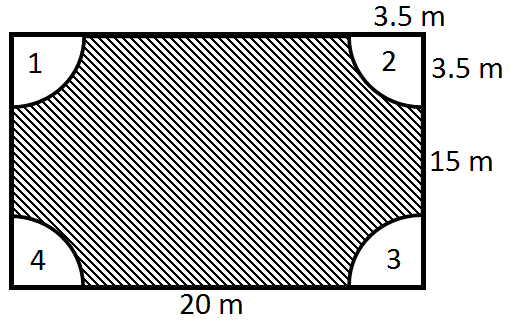
Length of rectangular piece $l = 20m$
Breadth of rectangular piece $b = 15m$
Radius of each quadrant $r = 3.5m$
Area of rectangular piece = (length × breadth) $= 20 \times 15 = 300m^2.$
Area of quadrant each $=\frac{1}{4}$ (area of circle with radius 3.5m)
$=\frac{1}{4}\times\pi\text{r}^2$
$=\frac{1}{4}\times\frac{22}{7}\times3.5\times3.5=\frac{38.5}{4}\text{m}^2$
Area of remaining part = [area of rectangular piece] - 4 [area of each quadrant]
$=300-4\Big[\frac{38.5}{4}\Big]=300-38.5$
$=261.5\text{m}^2$ View full question & answer→Question 203 Marks
The area of a circle inscribed in an equilateral triangle is $154cm^2$. Find the perimeter of the triangle.$\Big[\text{use } \pi = \frac{22}{7} \text{and } \sqrt{3} = 1.73\Big]$
AnswerArea of the inscribed circle of $\triangle\text{ABC}=154\text{cm}^2$
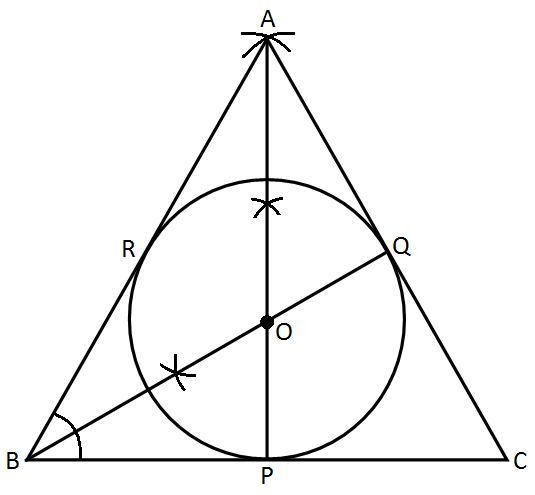
Let r be the radius, then
$\pi\text{r}^2=154$
$\Rightarrow\frac{22}{7}\text{r}^2=154\Rightarrow\text{r}^2=\frac{154\times7}{22}$
$\Rightarrow\text{r}^2=49=(7)^2$
$\therefore$ $r = 7cm$
$\therefore$ $OP = 7cm$
$\therefore\text{In the equilateral }\triangle\text{ABC},$
AP is $\perp$ BC which bisects BC at P
$\therefore$ AP $= 3OP = 3 \times 7 = 21cm$
Let a be side of the triangle ABC
$\therefore\frac{\sqrt{3}}{2}\text{a}=\text{AP}=21\Rightarrow\text{a}=\frac{21\times2}{\sqrt{3}}$
$\Rightarrow\text{a}=\frac{21\times2\times\sqrt{3}}{\sqrt{3}+\sqrt{3}}=\frac{21\times2\sqrt{3}}{3}=7\times2\sqrt{3}$
$= 7 \times 2(1.73) = 24.22cm$
Perimeter of the triangle $= 3a$
$= 3 \times 24.22 = 72.7cm$ View full question & answer→Question 213 Marks
Find the area of the following figure, in square cm, correct to one place of decimal.$\Big(\text{Take }\pi=\frac{22}{7}\Big).$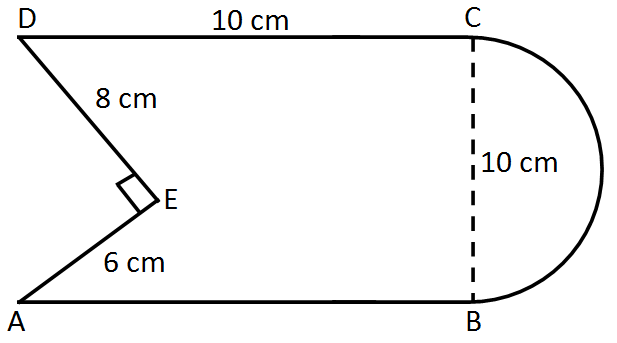
AnswerJoin $AD$
$ABCD$ is a square whose each side $= 10cm$
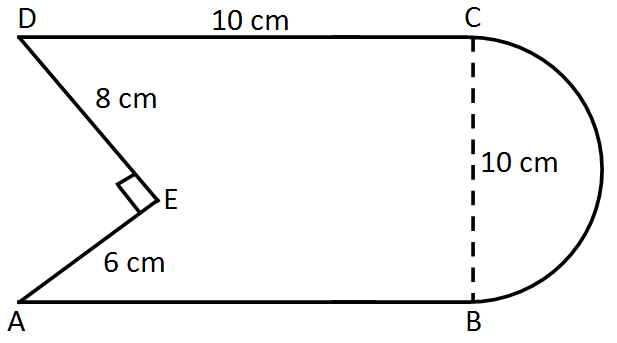
Area of square $= a^2 = (10)^2 = 100cm^2$
Area of half semicircle whose radius is $\frac{10}{2}=5$
$=\frac{1}{2}\pi\text{r}^2=\frac{1}{2}\times\frac{22}{7}\times5\times5$
$=\frac{275}{7}=39.28\text{cm}^2$
$\therefore$ Total area of the figure $= 100 - 24 + 39.28 = 76 + 39.28 = 115.28cm^2 = 115.28cm^2$ View full question & answer→Question 223 Marks
In the following figure, the square $A B C D$ is divided into five equal parts, all having same area. The central part is circular and the lines $A E, G C, B F$ and HD lie along the diagonals $A C$ and $B D$ of the square. If $A B=22 cm$, find:
The perimeter of the part $ABEF$.
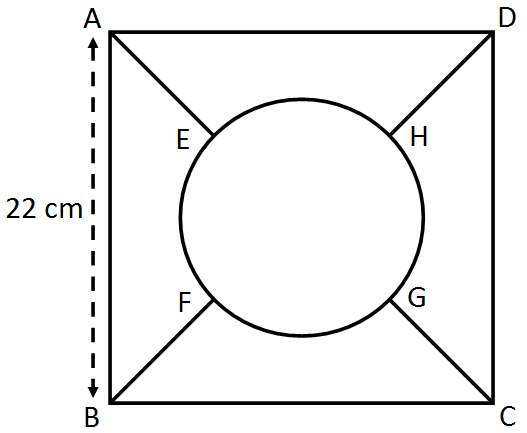
AnswerWe have a square $ABCD.$
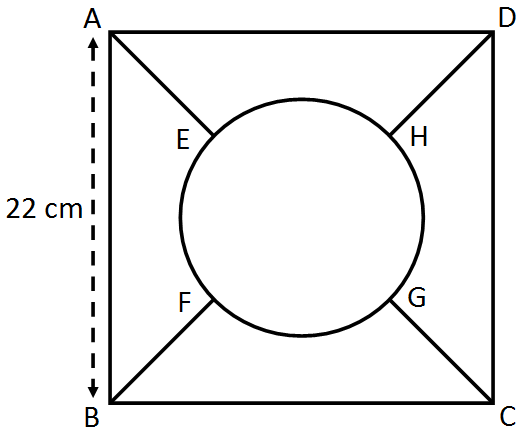
We have,
$AB = 22cm$
We have to find the perimeter of ABEF. Let O be the centre of the circular region.Use Pythagoras theorem to get,
$2 (AE + r)^2 = 22^2$
$AE + r = 15.56$
$AE = (15.56 - 5.56)$cm
$=10c,$
Similarly,
BF = 10cm
Now length of arc EF,
$=\frac{\text{Perimeter of circular region}}{4}$
$=\frac{34.88}{4}\text{cm}$
= 8.64cm
So, perimeter of ABFE,
$= AB + BF + EF + AE$
$= 50.64cm$ View full question & answer→Question 233 Marks
Prove that the area of a circular path of uniform width surrounding a circular region of radius r is $\pi\text{h}(2\text{r}+\text{h}).$
Answer
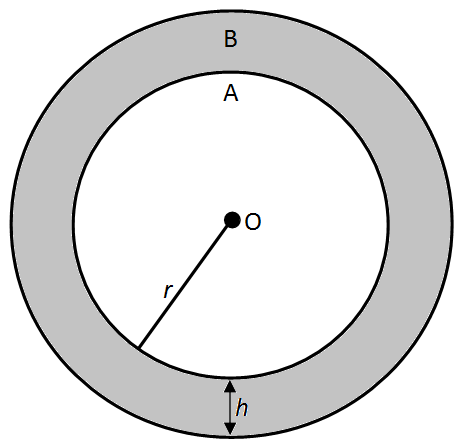 The width of the circular path = h
Let the inner circle be region A and the outer circle be region B
Radius of region A = r
Radius of region B = r + h
Area of the circular path = Area of region B − Area of region A
$=\pi(\text{r}+\text{h})^2-\pi\text{r}^2$
$=\pi(\text{r}^2+\text{h}^2+2\text{rh}-\text{r}^2)$
$=\pi\text{h}(\text{h}+2\text{r})$
Hence proved View full question & answer→Question 243 Marks
In the the following figure, PSR, RTQ and PAQ are three semicircles of diameter 10cm, 3cm and 7cm respectively. Find the perimeter of shaded region.
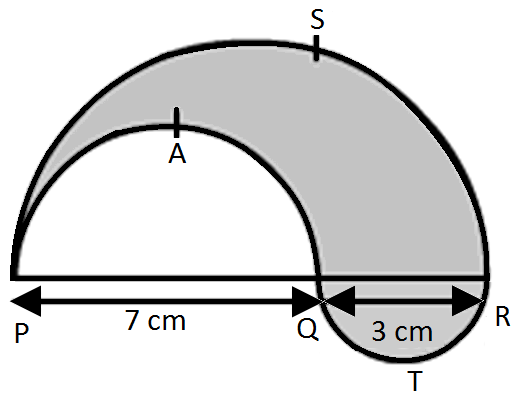
AnswerRadius of larger semicircle $(\text{r}_1)=\frac{10}{2}=5\text{cm}$
Radius of large semicircle $=(\text{r}_2)=\frac{7}{2}\text{cm}$
Radius of small semicircle $(\text{r}_2)=\frac{3}{2}\text{cm}$
$\therefore$ perimeter of the shaded portion
$=\pi\text{r}_1+\pi\text{r}_2+\pi\text{r}_3$
$=\pi\Big(5+\frac{7}{2}+\frac{3}{2}\Big)\text{cm}=\pi\times10\text{cm}$
$=\frac{22}{7}\times10=\frac{220}{7}=31.41\text{cm}$
View full question & answer→Question 253 Marks
In the following figure, two circles with centres $A$ and $B$ touch each other at the point $C$. If $A C=8 cm$ and $A B=3 cm$, find the area of the shaded region.
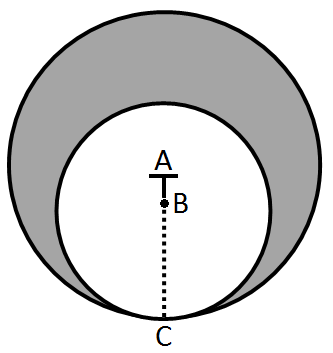
AnswerArea of the shaded region can be calculated as shown below,
Area of the shaded region = Area of circle with radius AC - area of circlewith radius radius BC
We have given radius of the outer circle that is 8cm but we don’t know theradius of theinner circle.
We can calculate the radius of the inner circle as shown below,
$BC = AC - AB$
$\therefore$ $BC = 8 - 3$
$\therefore$ $BC = 5$
$\therefore$ Area of the shaded region $=\pi\times8\times8-\pi\times5\times5$
$\therefore$ Area of the shaded region $=\pi\times64-\pi\times25$
$\therefore$ Area of the shaded region $=\pi\times39$
Substituting $\pi=\frac{22}{7}$ we get,
$\therefore$ Area of the shaded region $=\frac{22}{7}\times39$
$\therefore$ Area of the shaded region $=122.57$
Therefore, area of the shaded region is $122.57cm^2$.
View full question & answer→Question 263 Marks
Four equal circles, each of radius a, touch each other. Show that the area between them is $\frac{6}{7}\text{a}^2$ $\Big(\text{Take }\pi=\frac{22}{7}\Big).$
AnswerIt is given that four equal circles of radius a touches each other.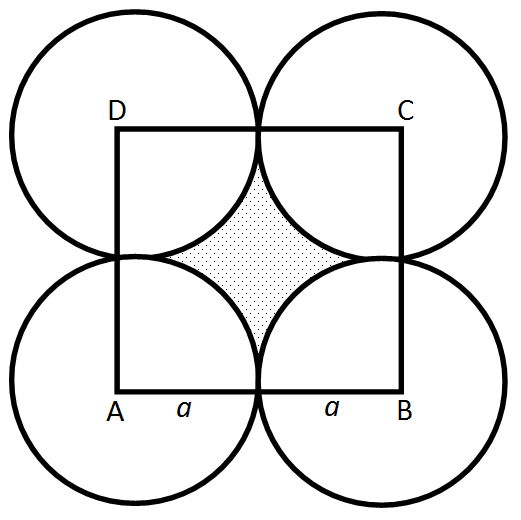 So,
So,
Area of circle $= \pi\text{a}^2$ Since circles touches each other, the lines joining their centre make a square ABCD. The side of square is 2a. Area of quadrant inside squqre $=\frac{1}{4}\pi\text{a}^2$ Area of shaded region = Area of square - 4 × Area of quadrant $=(2\text{a})^2-4\times\frac{\pi\text{a}^2}{4}$ $=4\text{a}^2-\frac{22}{7}\text{a}^2$ $= \frac{6}{7}\text{a}^2$ View full question & answer→Question 273 Marks
The perimeter of a sector of a circle of radius 5.7m is 27.2m. Find the area of the sector.
AnswerRadius of the circle (r) = 5.7m
Perimeter of the sector = 27.2m
Length of the arc = Perimeter - 2r
= (27.2 - 2 x 5.7)m
= 27.2 - 11.4 = 15.8m
Let $\theta$ be the central angle, then
$2\pi\text{r}\times\frac{\theta}{360^\circ}=15.8$
$\Rightarrow2\times\frac{22}{7}\times5.7\times\frac{\theta}{360^\circ}=15.8$
$\Rightarrow\frac{\theta}{360^\circ}=\frac{15.8\times7}{2\times22\times5.7}=\frac{110.6}{250.8}\dots(\text{i})$
$\therefore$ Area of the sector $=\pi\text{r}^2\times\frac{\theta}{360^\circ}$
$=\frac{22}{7}\times(5.7)^2\times\frac{110.6}{250.8}$ [From (i)]
$=\frac{22}{7}\times\frac{32.49\times110.6}{250.8}=\frac{32.49\times15.8}{11.4}$
$=45.03\text{m}^2$
View full question & answer→Question 283 Marks
In a hospital used water is collected in a cylindrical tank of diameter 2m and height 5m. After recycling, this water is used to irrigate a park of hospital whose length is 25m and breadth is 20m. If tank is filled completely then what will be the height of standing water used for irrigating the park.
AnswerDiameter of cylinder (d) = 2m
Radius of cylinder (r) = 1m
Height of cylinder (H) = 5m
Volume of cylinderical tank, $\text{V}_\text{c}=\pi\text{r}^2\text{H}=\pi\times(1)^2\times5=5\pi\text{ m}^3$
Length of the park (l) = 25m
Breadth of park (b) = 20m
height of standing water in the park = h
Volume of water in the park = lbh $=25\times20\times\text{h m}^3$
Now water from the tank is used to irrigate the park. So,
Volume of cylinderical tank = Volume of water in the park
$\Rightarrow5\pi=25\times20\times\text{h}$
$\Rightarrow\frac{5\pi}{25\times20}=\text{h}$
$\Rightarrow\text{h}=\frac{\pi}{100}\text{m}$
$\Rightarrow\text{h}=0.0314\text{m}$
View full question & answer→Question 293 Marks
In the following figure, an equilateral triangle ABC of side 6cm has been inscribed a circle. Find the area of the shaded region. $\big(\text{Take }\pi=3.14\big).$
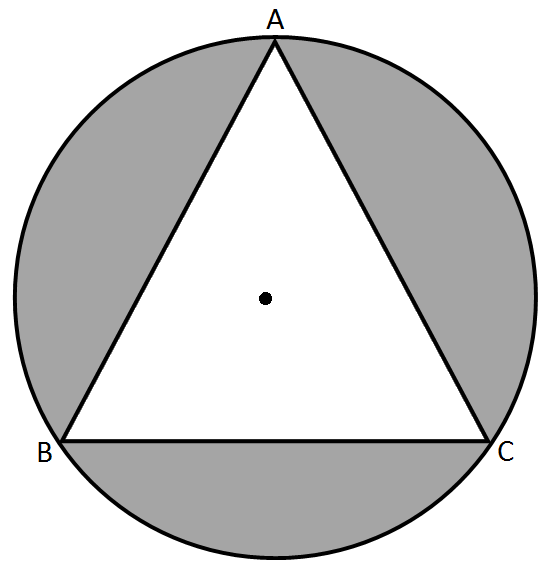
AnswerWe have to find the area of the shaded portion. We have $\triangle\text{ABC}$ which is an equilateral triangle and $\text{AB}=6\text{cm}$ .Let r be the radius of the circle.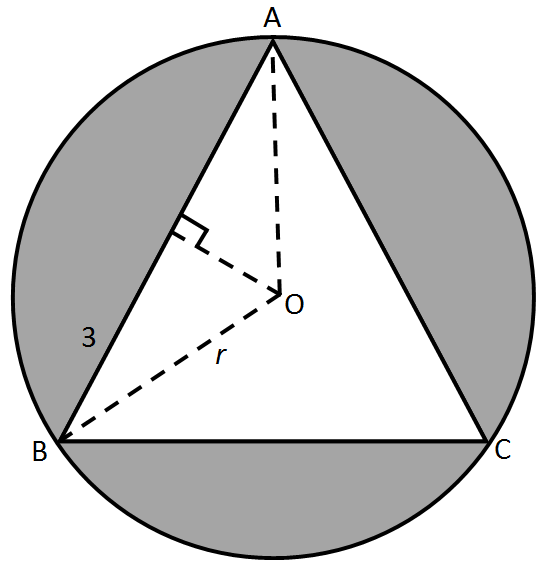 We have O as the circumcentre.
$\angle\text{OBA}=30^\circ$ So, $\cos (30^\circ)=\frac{3}{\text{r}}$ Thus, $\text{r}=2\sqrt{3}$ So area of the shaded region, = Area of the circle -ar $ (\triangle\text{ABC})$ $=(3.14)(2\sqrt{3})^2-\frac{\sqrt{3}}{4}(6)^2$ $=(37.68-15.59)\text{cm}^2$ $=22.126\text{cm}^2$ View full question & answer→Question 303 Marks
Find the area of the sector of a circle of radius $5\ cm$, if the corresponding arc length is $3.5\ cm$.
AnswerLet the central angle of the sector be $\theta.$
Given that, radius of the sector of a circle (r) = 5cm
and arc length (l) = 3.5cm
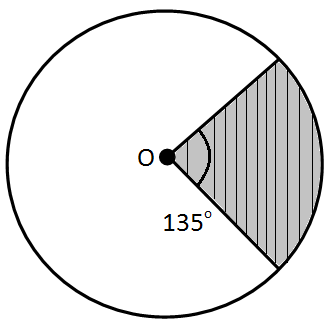
$\therefore$ Central angle of the sector,
$\theta=\frac{\text{are length(l)}}{\text{radius}}$
$\Rightarrow\theta=\frac{3.5}{5}=0.7\text{ Radian}$ $\Big[\therefore\theta=\frac{\text{l}}{\text{r}}\Big]$
$\Rightarrow\theta=\Big(0.7\times\frac{180^\circ}{\pi}\Big)$ $\Big[\therefore1\text{R}=\frac{180^\circ}{\pi}\text{D}^\circ\Big]$
Now, area of sector with angle $\theta=0.7$
$=\frac{\pi\text{r}^2}{360^\circ}\times(0.7)\times\frac{180^\circ}{\pi}$
$=\frac{(5)^2}{2}\times0.7=\frac{25\times7}{2\times10}=\frac{175}{20}=8.75\text{cm}^2$
Hence, required area of the sector of a circle is $8.75cm^2.$ View full question & answer→Question 313 Marks
In a circle of radius 35cm, an arc subtends an angle of 72° at the centre. Find the length of the arc and area of the sector.
AnswerWe know that the arc length l and area A of a sector of an angle $\theta$ in the circle of radius r is given.
by $\text{l}=\frac{\theta}{360^\circ}\times2\pi\text{r}$ and $\text{A}=\frac{\theta}{360^\circ}\times\pi\text{r}^2$ respectively.
It is given that, r = 35cm and $\theta=72^\circ$
We will calculate the arc length using the value of r and $\theta,$
$\text{l}=\frac{72^\circ}{360^\circ}\times2\pi\times35\text{cm}$
$=\frac{75^\circ}{360^\circ}\times2\times\frac{22}{7}\times35\text{cm}$
$=44\text{cm}$
Now, we will find the value of area A of the sector
$\text{A}=\frac{72^\circ}{360^\circ}\times\pi\times35\times35\text{cm}^2$
$=770\text{cm}^2$
View full question & answer→Question 323 Marks
The sum of the radii of two circles is 140cm and the difference of their circumferences is $88\ cm$. Find the diameters of the circles.
AnswerLet the radius of two circles be $r_1cm$ and $r_2cm$ respectively. Then their circumferences are $\text{C}_1=2\pi\text{r}_1\text{cm}$ and $\text{C}_2=2\pi\text{r}_2\text{cm}$ respectively and their areas are $\text{A}_1=\pi\text{r}^2_1\text{cm}^2$ and $\text{A}_2=\pi\text{r}^2_2\text{cm}^2$ respectively.
It is given that the sum of the radii of two circles is 140cm and difference of their circumferences is 88cm.
So,
$r_1+ r_2 = 140cm ....(1)$
$C_1- C_2 = 88cm$
$2\pi\text{r}_1-2\pi\text{r}_2=88\text{cm}$
$2\pi(\text{r}_1-\text{r}_2)=88\text{cm}$
$\text{r}_1-\text{r}_2=\frac{88}{2\pi}\text{cm}$
$\text{r}_1-\text{r}_2=\frac{88}{2\times\frac{22}{7}}\text{cm}$
$\text{r}_1-\text{r}_2=\frac{88\times7}{44}\text{cm}$
$r_{1 -} r_2 = 14cm ....(2)$
Now, solving (1) and (2)
$\text{r}_1=77\text{cm}$
$\text{r}_2=63$
Thus diameters of circles are,
$2\text{r}_1=154\text{cm}$
$2\text{r}_2=126\text{cm}$
View full question & answer→Question 333 Marks
AB is a chord of a circle with centre O and radius 4cm. AB is of length 4cm and divides the circle into two segments. Find the area of the minor segment.
Answer
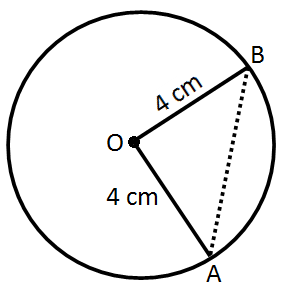 Radius of circle r = 4cm = OA = OB
Length of chord AB = 4cm
OA is equilateral triangle $\angle\text{AOB}=60^\circ\rightarrow\theta$
Angle subtended at centre $\theta=60^\circ$
Area of segment (shaded region) $=(\text{area of sector})-(\text{area of }\triangle\text{AOB})$
$=\frac{\theta}{360^\circ}\times\pi\text{r}^2-\frac{\sqrt{3}}{4}(\text{Side})^2$
$=\frac{60}{360}\times\frac{22}{7}\times4\times4-\frac{\sqrt{3}}{4}\times4\times4$
$=\frac{176}{3}-4\sqrt{3}=58.67-6.92=51.75\text{cm}^2$ View full question & answer→Question 343 Marks
In the following figure, $ABCD$ is a trapezium of area $24.5cm^2$, If $\text{AD}||\text{BC}, \angle\text{DAB} = 90^\circ$$AD = 10\ cm, BC = 4\ cm$ and $ABE$ is quadrant of a circle, then find the area of the shaded region.
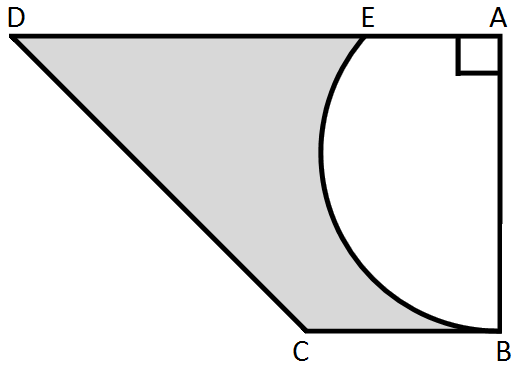
AnswerArea of trapezium $=\frac{1}{2}(\text{AD}+\text{BC})\times\text{AB}$
$\Rightarrow 24.5=\frac{1}{2}(10+4)\times\text{AB}$
$\Rightarrow \text{AB}=3.5\text{cm}$
Area of shaded region = Area of trapezium ABCD - Area of quadrant ABE
$=24.5-\frac{1}{4}\times\frac{22}{7}\times(3.5)^2$
$=24.5-9.625$
$=14.875\text{cm}^2$
Hence, the area of shaded region is $14.875cm^2$
View full question & answer→Question 353 Marks
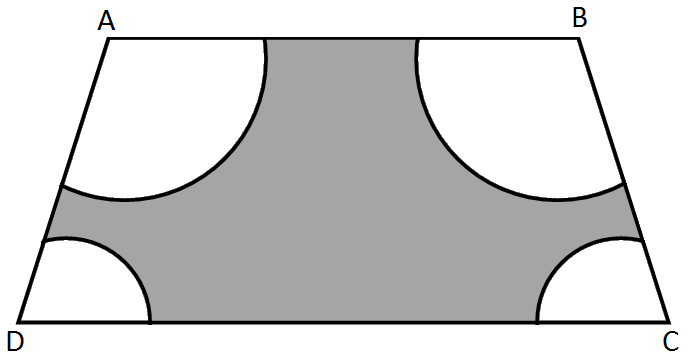
In the given figure, ABCD is a trapezium with $\text{AB}||\text{DC},\text{AB}=18\text{cm}$ DC = 32cm and the distance between AB and DC is 14cm. Circles of equal radii 7cm with centres A, B, C and D have been drawn. Then find the area of the shaded region.$\Big(\text{Use }\pi=\frac{22}{7}\Big)$
AnswerIn trapezium ABCD
$\text{AB } || \text{ DC}$
AB = 18cm, DC = 32cm Height = 14cm
Radius of each at the corner of trapezium = 7cm
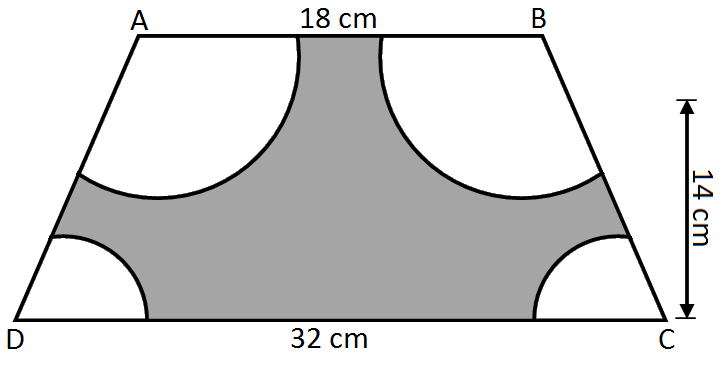
$\therefore$ Angle of a quadrilateral $=360^\circ$
$\therefore$ 4 sectrors compete a circle
$\therefore$ Angle of a circle $=\pi \text{r}^2=\pi\cdot(7)^2=\frac{22}{7}\times49\text{cm}^2$
$=154\text{cm}^2$
and area of trapezium
$=\frac{1}{2}(\text{AB}+\text{DC)}\times\text{h}$
$=\frac{1}{2}(18+32)\times14\text{cm}^2$
$=\frac{1}{2}\times50\times14=350\text{cm}^2$
$\therefore$ Area of shaded portion
$= 350 - 154 = 196\text{cm}^2$ View full question & answer→Question 363 Marks
A play ground has the shape of a rectangle, with two semi-circles on its smaller sides as diameters, added to its outside. If the sides of the rectangle are 36m and $24.5\ m$, find the area of the playground. $\Big(\text{Take }\pi=\frac{22}{7}\Big).$
AnswerIt is given that a play ground has a shape of rectangle, with two semicircles on its smaller sides as diameter, added to its outside. So,
Area of play ground = Area of rectangle + 2 × Area of semicircle
We have, sides of rectangle $l = 36$ m and b $= 24.5m.$
Since, the diameter of semicircle is 2r = b. then,
$r = 24.52 = 12.25mr = 24.52 = 12.25m$
Area of semicircle $=\frac{\pi\text{r}^2}{2}$
$=\frac{1}{2}\times\frac{22}{7}\times12.25.\times12.25$
$= 235.81m^2$
Area of rectangle $= l × b$
$= 36 \times 24.5$
$= 882m^2$
Thus, the area of playground is
Area of play ground = Area of rectangle + 2 × Area of semicircle
$= 882 + 2 \times 235.81$
$= 882 + 471.62$
$= 1353.62m^2$
View full question & answer→Question 373 Marks
Four equal circles, each of radius $5\ cm$, touch each other as shown in the following figure. Find the area included between them$\big(\text{Take } \pi = 3.14).$
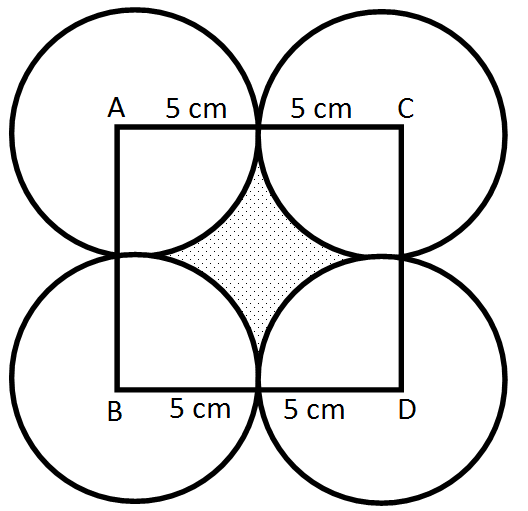
AnswerRadius of each circle = 5cm $\because$ The four circles touch eachother externally $\therefore$ By joining their centres, we get a square whose side will be $5 + 5 = 10cm$
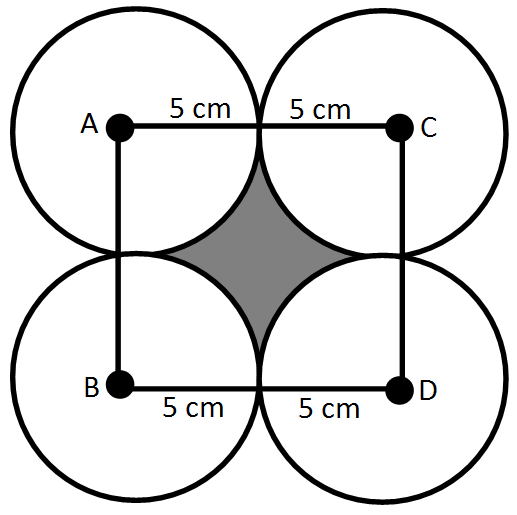
Now area of square so formed $= a^2= (10)^2 = 100cm^2$
and area of 4 quadrants $=4\times\frac{1}{4}\pi\text{r}^2=\pi\text{r}^2$
$= 3.14 \times (5)^2cm^2= 3.14 \times 25cm^2= 78.5cm^2$
$\therefore$ Area of the part included between the circles $= 100 – 78.5 = 21.5cm^2$ View full question & answer→Question 383 Marks
In the following figure, shows a sector of a circle, centre O, containing an angle $\theta^\circ.$ Prove that: Area of the shaded region is $\frac{\text{r}^2}{2}\Big(\tan\theta-\frac{\pi\theta}{180}\Big)$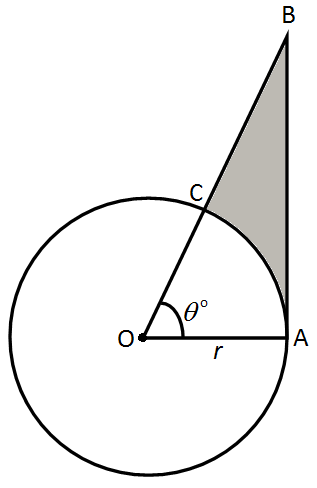
AnswerIt is given that the radius of circle is r and the angle $\angle\text{AOC}=\theta^\circ$ 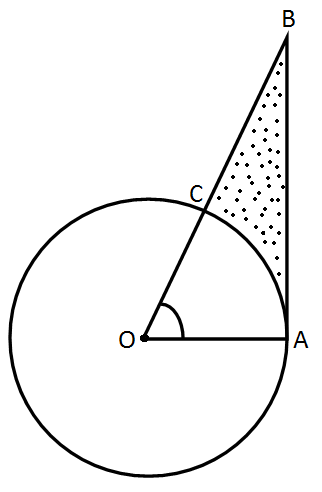 In $\triangle\text{AOB},$ It is given that OA = r . $\cos\theta=\frac{\text{OA}}{\text{OB}}$ $\text{OB}=\frac{\text{OA}}{\cos\theta}$ $\text{OB}=\text{r}\sec\theta$ $\tan\theta=\frac{\text{AB}}{\text{OA}}$ $\text{AB}=\text{OA}\tan\theta$ $\text{AB}=\text{r}\tan\theta$ We know that area A of the sector at an angle $\theta$ in the circle of radius r is $\text{A}=\frac{\theta}{360^\circ}\times\pi\text{r}^2$Thus
Area of sector $\text{AOC}=\frac{\theta}{360^\circ}\pi\text{r}^2$Area of $\triangle\text{AOB}=\frac{1}{2}\times\text{OA}\times\text{AB}$
$=\frac{1}{2}\times\text{r}\times\text{r}\tan\theta$ $=\frac{1}{2}\times\text{r}^2\tan\theta$ Area of shaded region ABC = Area of $\triangle\text{AOB }-$ Area of sector AOC $=\frac{1}{2}\text{r}^2\tan\theta-\frac{\theta}{360^\circ}\times\pi\text{r}^2$ $=\frac{\text{r}^2}{2}\Big(\tan\theta-\frac{\pi\theta}{180^\circ}\Big)$ Hence, Area of shaded region $\text{ABC}=\frac{\text{r}^2}{2}\Big(\tan\theta-\frac{\pi\theta}{180^\circ}\Big)$ View full question & answer→Question 393 Marks
Figure shows a sector of a circle of radius r cm containing an angle $\theta.$ The area of the sector is A $cm^2$ and perimeter of the sector is $50\ cm$. Prove that.$\theta=\frac{360}{\pi}\Big(\frac{25}{\text{r}}-1\Big)$
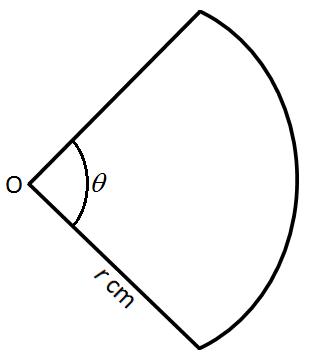
AnswerRadius of the sector of the circle = r cm and angle at the centre $= 0$ Area of sector $OAB = Acm^2$ and perimeter of sector $OAB = 50cm$
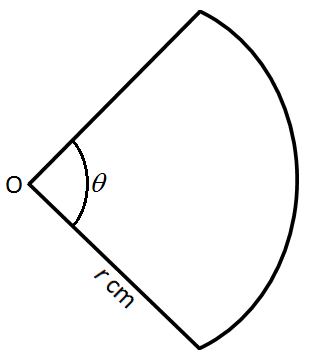
Area of the sector $=\pi\text{r}^2\times\frac{\theta}{360^\circ}$ $\Rightarrow\text{A}=\pi\text{r}^2\times\Big(\frac{\theta}{360^\circ}\Big)$ Perimeter = 2OA + arc AB $\Rightarrow50=2\text{r}+2\pi\text{r}\times\Big(\frac{\theta}{360^\circ}\Big)$ $\Rightarrow50-2\text{r}=2\pi\text{r}\Big(\frac{\theta}{360^\circ}\Big)$ $\Rightarrow\frac{\theta}{360^\circ}=\frac{50-2\text{r}}{2\pi\text{r}}=\frac{50}{2\pi\text{r}}-\frac{2\text{r}}{2\pi\text{r}}$ $\Rightarrow\frac{\theta}{360^\circ}=\frac{25}{\pi\text{r}}-\frac{1}{\pi}\ ....(\text{i})$ $\Rightarrow\theta=360\Big(\frac{25}{\pi\text{r}}-\frac{1}{\pi}\Big)=\frac{360^\circ}{\pi}\Big(\frac{25}{\text{r}}-1\Big)$ View full question & answer→Question 403 Marks
In the following figure find the area of the shaded region. $\big(\text{Use }\pi=3.14\big)$
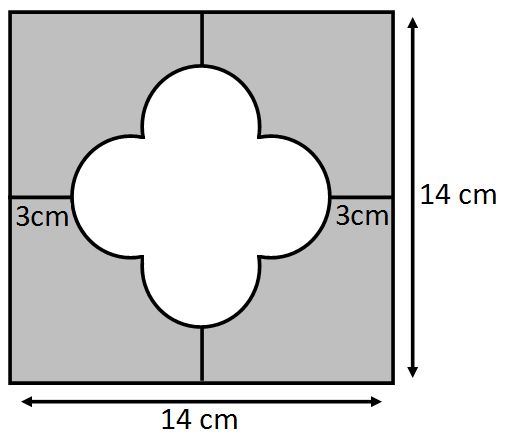
AnswerSide of large square = 14cm
Radius of each semicircle $=\frac{4}{2}=2\text{cm}$
Side of square $= 4cm$
Area of square $= 4 \times 4 = 16cm^2$
$\therefore$ Area of semicircles $=4\times\frac{1}{2}\pi\text{r}^2$
$= 2 \times 3.14 \times 2 \times 2$
$= 8 \times 3.14$
$= 25.12cm^2$
$\therefore$ Area of shaded region = Area of large square – Area of central portion
$= (14)2 - (16 + 25.12)cm^2$
$= 154.88cm^2$
View full question & answer→Question 413 Marks
If the circumference of two circles are in the ratio 2 : 3, what is the ratio of their areas?
AnswerWe are given ratio of circumferences of two circles. If $\text{c}=2\pi\text{r}$ and $\text{c}' =2\pi\text{r}'$are circumferences of two circles such that
$\frac{\text{c}}{\text{c}'}=\frac{2}{3}$
$\Rightarrow\frac{2\pi\text{r}}{2\pi\text{r}'}=\frac{2}{3}\ \dots(1)$
Simplifying equation (1) we get,
$\frac{\text{r}}{\text{r}'}=\frac{2}{3}$
Let $\text{A}= \pi\text{r}^2$and $\text{A}'= \pi\text{r}^2$ are the areas of the respective circles and we are asked to find their ratio.
$\frac{\text{A}}{\text{A}'}=\frac{\pi\text{r}^2}{\pi\text{r}'^2}$
$\frac{\text{A}}{\text{A}'}=\frac{\text{r}^2}{\text{r}'^2}$
$\frac{\text{A}}{\text{A}'}=\Big(\frac{\text{r}}{\text{r}'}\Big)^2\ \dots(2)$
We know that $\frac{\text{r}}{\text{r}'}=\frac{2}{3}$ substituting this value in equation (2) we get,$\frac{\text{A}}{\text{A}'}=\Big(\frac{2}{3}\Big)^2$
$\Rightarrow\frac{\text{A}}{\text{A}'}=\frac{4}{9}$
Therefore, ratio of their areas is 4:9.
View full question & answer→Question 423 Marks
From each of the two opposite corners of a square of side 8cm, a quadrant of a circle of radius $1.4cm$ is cut. Another circle of radius $4.2cm$ is also cut from the centre as shown in the following figure. Find the area of the remaining (Shaded) portion of the square.$\Big(\text{Use }\pi=\frac{22}{7}\Big)$
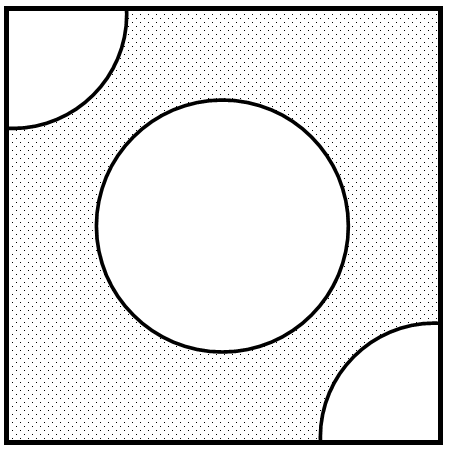
AnswerSide of a square $ABCD = 8cm$
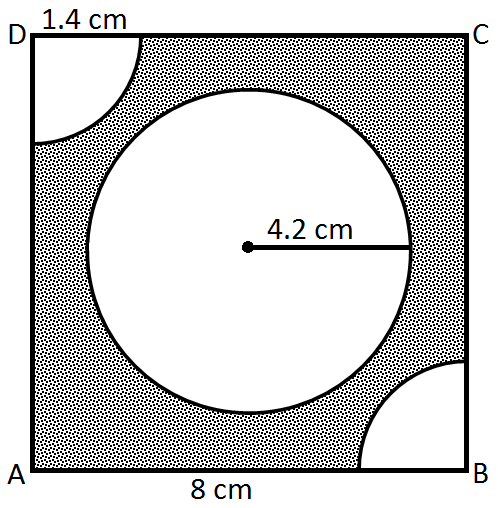
$\therefore$ Area $= a^2 = (8)^2= 64cm^2$
Radius of each quadrants $= 1.4cm$
$\therefore$ Area of 2 quadrants
$=2\times\frac{1}{4}\pi\text{r}^2=\frac{1}{2}\times\frac{22}{7}(1.4)^2\text{cm}^2$
$=\frac{1}{2}\times\frac{22}{7}\times1.4\times1.4=4.312\text{cm}^2$
Radius of center circle = 4.2cm
Area of center circle $=\pi\text{r}^2$
$=\frac{22}{7}\times4.2\times4.2$
$=22\times0.6\times4.2$
$=55.44\text{cm}^2$
Area of shaded region = Area of square - Area of two quadrant - Area of circle
$=64-4.312-55.44$
$=4.23$ View full question & answer→Question 433 Marks
A rectangular park is $100\ m$ by 50m. It is surrounding by semi-circular flower beds all round. Find the cost of levelling the semi-circular flower beds at $60$ paise per square metre $\big(\text{Take }\pi=3.14\big).$
AnswerSince four semicircular flower beds rounds the rectangular park. Then, diameters of semicircular.
plots are $2r_1 = l$ and $2r_2 = w$
So, the radius of semicircle at larger side of rectangle
$\text{r}_1=\frac{\text{l}}{2}$
$=\frac{100}{2}$
$=50\text{m}$
Area of semicicluar plot at larger side of rectangle $=\frac{1}{2}\pi\text{r}^2$
$=\frac{1}{2}\times3.14\times50\times50$
$=3925\text{m}^2$
And the radius of semicircle at smaller side of rectangle
$\text{r}_2=\frac{\text{l}}{2}$
$=\frac{50}{2}$
$=25\text{m}$
Area of semicicluar plot at samller side of rectangle $=\frac{1}{2}\pi\text{r}^2$
$=\frac{1}{2}\times3.14\times25\times25$
$=981.25\text{m}^2$
Now, the total area of semicircular plot is sum of area of four semicircular plots.
Total Area of plot $= 2 × 3925 + 2 × 981.25$
$= 7850 + 1962.5m^2$
$= 9812.5m^2$
Since, The cost of levelling semicircular flower bed per square meter $= Rs. 0.60$
So, The cost of levelling 9812.5 square meter flower bed $= Rs. 0.60 × 9812.5$
$= Rs. 5887.50$
View full question & answer→Question 443 Marks
A car travels 1 kilometre distance in which each wheel makes 450 complete revolutions. Find the radius of the its wheels.
AnswerDistance covered by the car in 450 revolutions = 1km = 1000m
$\therefore$ Distance covered in 1 revolution $=\big(\frac{1000}{450}\big)$
$=\big(\frac{20}{9}\big)\text{m}$
Perimeter of wheel $=2\pi\text{r}$
$\Rightarrow\frac{2\times22}{7}\text{r}=220\Rightarrow\text{r}=\frac{220\times7}{2\times22}$
⇒ r = 35m.
View full question & answer→Question 453 Marks
Find the area of a shaded region in the the following figure,where a circular arc of radius $7\ cm$ has been drawn with vertex A of an equilateral triangle $ABC$ of side $14\ cm$ as centre. $\big(\text{Use }\pi=\frac{22}{7}$ and $\sqrt{3}=1.73\big)$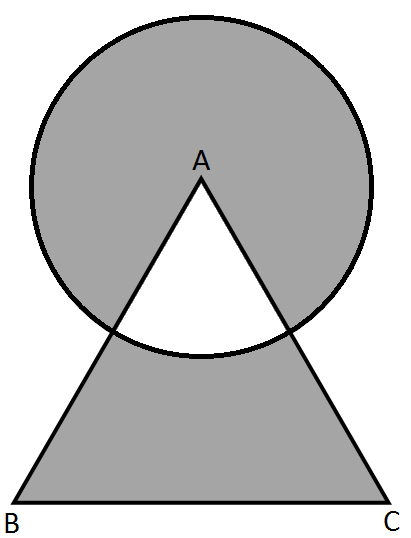
AnswerIn equilateral traingle all the angles are of $60^\circ$
$\therefore\angle\text{BAC}=60^\circ$
Area of the shaded region = (Area of triangle ABC - Area of sector having central angle $60^\circ$) + Area of sector having central angle $(360^\circ - 60^\circ)$
$=\frac{\sqrt{3}}{4}\text{(AB)}^2-\frac{60^\circ}{360^\circ}\pi(7)^2+\frac{300^\circ}{360^\circ}\pi(7)^2$
$=\frac{\sqrt{3}}{4}(14)^2-\frac{1}{6}\times\frac{22}{7}(7)^2+\frac{5}{6}\times\frac{22}{7}(7)^2$
$=84.77-25.67+128.35$
$=187.45\text{cm}^2$
Hence, the area of shaded region is $187.45cm^2$
View full question & answer→Question 463 Marks
The side of a square is 10cm. Find the area of circumscribed and inscribed circles.
AnswerCircumscribed circle 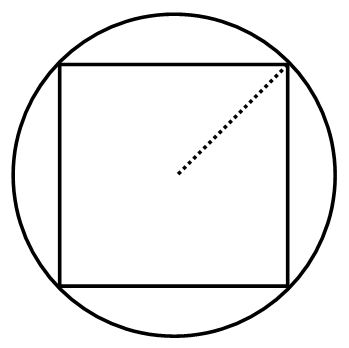 Radius $=\frac{1}{2}$ (diagonal of square) $=\frac{1}{2}\times\sqrt{2}\text{ side}$ $=\frac{1}{2}\times\sqrt{2}\times10$ $=5\sqrt{2}\text{cm}$ $\text{Area}=\pi\text{r}^2$ $=\frac{22}{7}\times25\times2$ $=\frac{1100}{7}\text{cm}^2$ Inscribed circle
 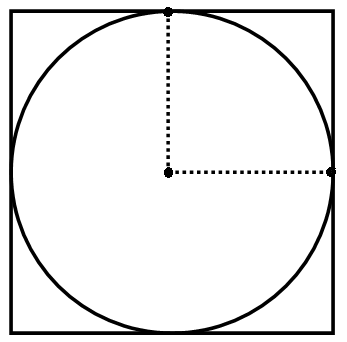 $\text{Radius}=\frac{1}{2}(\text{sides})$ $=\frac{1}{2}\times10$$=5\text{cm}$
$\text{Area}=\pi\text{r}^2$
$=\frac{22}{7}\times5\times5$$=\frac{550}{7}\text{cm}^2$ View full question & answer→Question 473 Marks
In the given figure, the side of square is $28\ cm$ and radius of each circle is half of the length of the side of the square where $O$ and $O$' are centres of the circles. Find the area of shaded region.
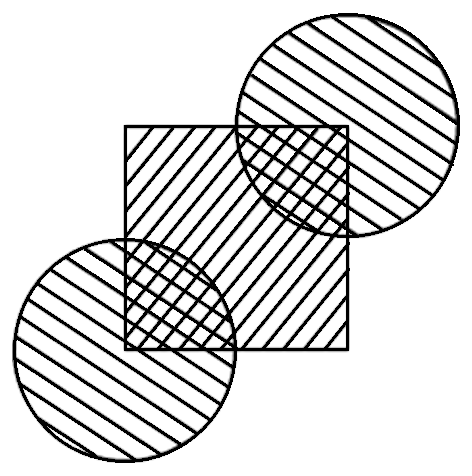
AnswerSide = 28cm, Radius $=\frac{28}{2}\text{cm}=14\text{cm}$
The area of the shaded region
= Area of square $+\frac{3}{4}$ (Area of circle)
$+\frac{3}{4}$ (Area of circle)
= Area of square $+\frac{3}{2}$ (Area of circle)
[Area of square $= (Side)^2$; Area of circle $=\pi\text{r}^2$]
$=(28)^2+\frac{3}{2}\times\frac{22}{7}\times14\times14$
$=784+924=1708\text{cm}^2$
View full question & answer→Question 483 Marks
The length of the minute hand of a clock is $14\ cm$. Find the area swept by the minute hand in $5$ minutes.
AnswerAngle make by the minute hand in 1 minute $= 6^\circ$
Angle make by the minute hand in 5 minute $= 5 ⨯ 6^\circ = 30^\circ$
Area of the sector having central angle is given by
$\frac{30^\circ}{360^\circ}\pi(14)^2$
$=\frac{1}{12}\times\frac{22}{7}(14)^2$
$=51.33\text{cm}^2$
Hence, the area swept by minute hand in $5$ minutes is $51.33cm^2$
View full question & answer→Question 493 Marks
Find the area enclosed between two concentric circles of radii 3.5cm and 7cm. A third concentric circle is drawn outside the 7cm circle, such that the area enclosed between it and the 7cm circle is same as that between the two inner circles. Find the radius of the third circle correct to one decimal place.
Answer
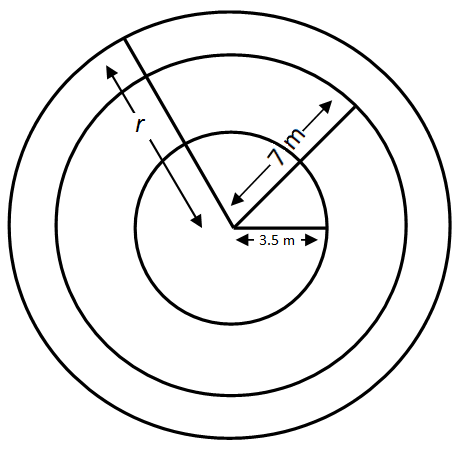 The area enclosed between the two circles of radii 3.5cm and 7cm
$=\pi(7^2-3.5^2)$
$=115.\text{cm}^2$
Let the radius of the outemost circle be r cm.
Area betweent the circles with radius r and 7cm = Area betweent the circles with radius 7cm and 3.5cm
$\pi(\text{r}^2-7^2)=115.5$
$\Rightarrow(\text{r}^2-7^2)=\frac{115.5}{\pi}$
$\Rightarrow\text{r}^2=36.75+49=85.75\text{cm}$
$\Rightarrow\text{r}=9.26\text{cm}$ View full question & answer→Question 503 Marks
Find the area of the shaded region in the following figure, if AC = 24cm, BC = 10cm and O is the centre of the circle.
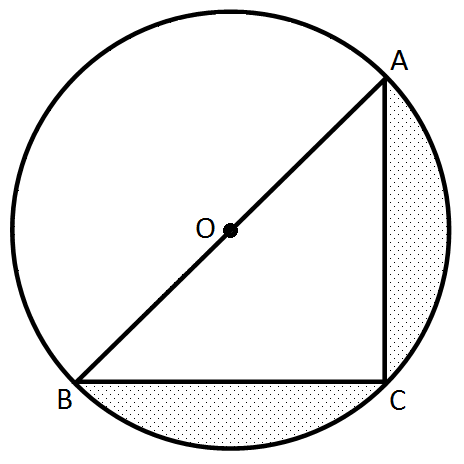
AnswerIt is given a triangle ABC is cut from a circle.
$\text{AC}=24\text{cm}$
$\text{BC}=10\text{cm}$
Area of $\triangle\text{ABC} =\frac{1}{2}\ \text{AC}\ \times\text{BC}$
$=\frac{1}{2}\times24\times10$
$=120\text{cm}^2$
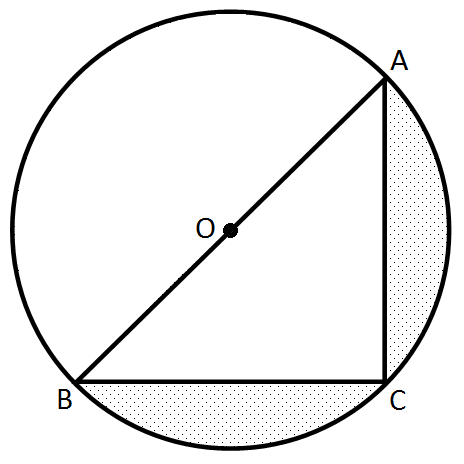 In $\triangle\text{ABC},$
$\angle\text{ACB}=90^\circ ,$ Since any angle inscribed in semicircle is always right angle
By applying Pythagoras theorem,
$ \text{AB}^2=\text{AC}^2+\text{BC}^2$
$=24\times24+10\times10$
$=576+100$
$=676\text{cm}^2$
$\text{OA}=\frac{\text{AB}}{2}$
$=\frac{26}{2}\text{cm}$
$=13\text{cm}$
We know that the area A of circle of radius r is
$\text{A}=\pi\text{r}^2$
Substituting the value of radius r,
$\text{A}=3.14\times13\times13$
$=530.66\text{cm}^2$
Area of semicircle $=\frac{1}{2}\pi\text{r}^2$
$=\frac{530.66}{2}\text{cm}^2$
$=265.33\text{cm}^2$
Area of sharded region = Area of circle of circle - Area of semicircle - Area of triangle.
$=530.66-265.33-120$
$=145.33\text{cm}^2$ View full question & answer→