Questions

5 Marks Questions

🎯

Test yourself on this topic

15 questions · timed · auto-graded

Question 15 Marks
Prove that the perpendicular at the point of contact of the tangent to a circle passes through the centre.
Answer
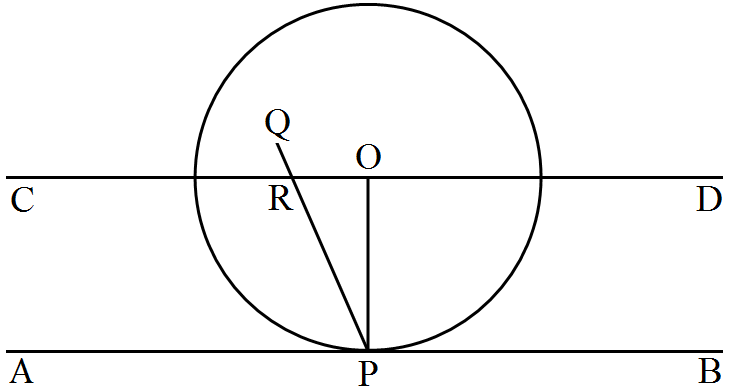
Let AB be the tangent to the circle at point P with centre O.
To prove: PQ passes through the point O.
Construction: Join OP.
Through O, draw a straight line CD parallel to the tangent AB.
Proof: Suppose that PQ doesn't passes through point O. PQ intersect CD at R and also intersect AB at P.
AS, CD || AB, PQ is the line of intersection,
$\angle\text{ORP} = \angle\text{RPA} $ (Alternate interior angles)
But also,
$\angle\text{RPA}=90^\circ(\text{OP}\perp\text{AB})$
$\Rightarrow\angle\text{ORP}=90^\circ$
$\angle\text{ROP}+\angle\text{OPA}=180^\circ$ (Co interior angles)
$\Rightarrow\angle\text{ROP}+90^\circ=180^\circ$
$\Rightarrow\angle\text{ROP}=90^\circ$
Thus, the $ \triangle\text{ORP}$ has 2 right angles i.e. $ \angle\text{ORP} $ and $ \angle\text{ROP} $ which is not possible.
Hence, our supposition is wrong.
$\therefore$ PQ passes through the point O.
View full question & answer
Question 25 Marks
A quadrilateral is drawn to circumscribe a circle. Prove that the sume of opposite sides are equal.
Answer

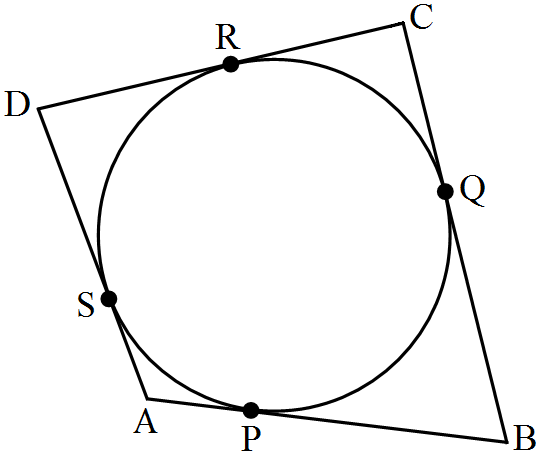
Given: ABCD is a quadrilateral in which a circle is inscribed.
To prove: AB + CD = AD + BC
proof:
We know that the langths of tangent drawn fro an external point to circle are equal.
$\therefore$ AP = AS ....(i)
BP = BQ ....(ii)
CR = CQ ....(iii)
DR = DQ ....(iv)
⇒ AB + CD = (AP + BP) + (CR + DR)
= (AS + BQ) + (CQ + DS) ....(from (i), (ii), (iii), (iv))
= (AS + DS) + (CQ + BQ)
= AD + BC
Hence proved.
View full question & answer
Question 35 Marks
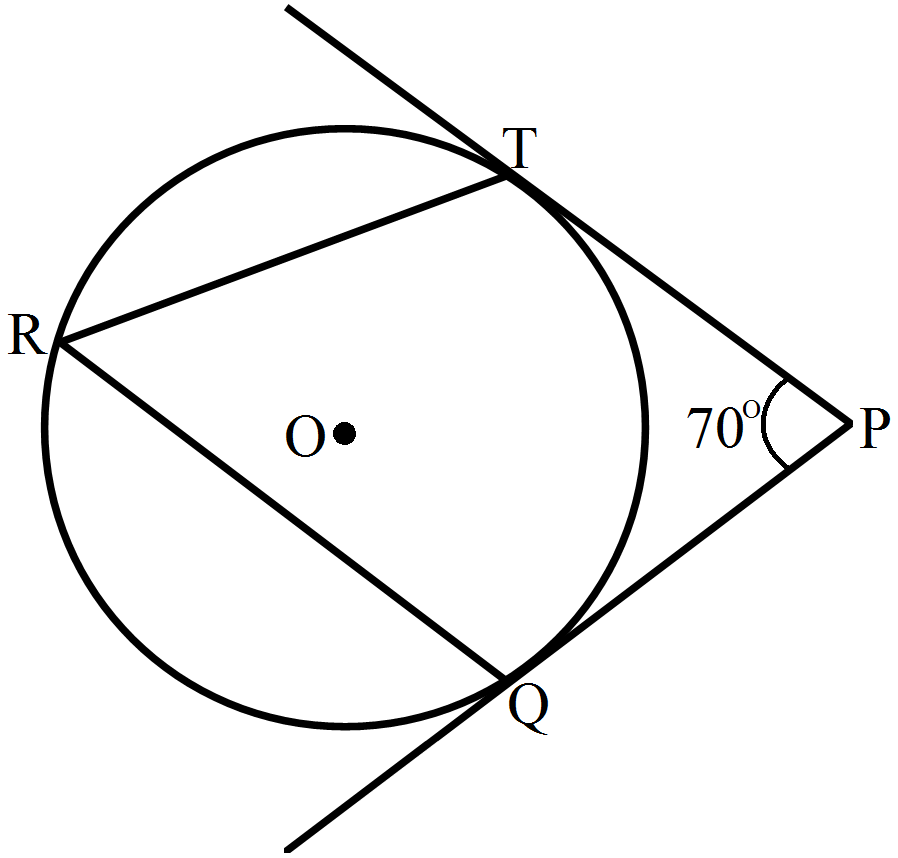
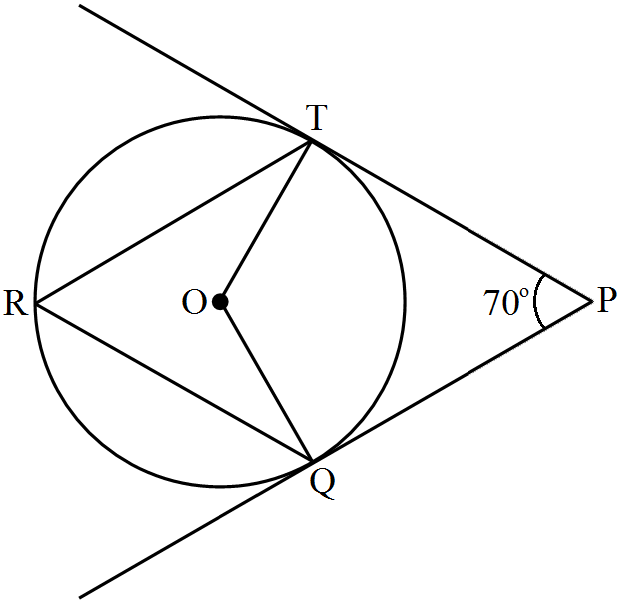
In the given figure, O is the centre of a circle PT and PQ are tangents to the circle from an external point P. If $\text{TPQ} = 70^\circ$ then$ \angle\text{TRQ} .$
Answer
Construction: Join OQ and OT We know that the radius and tangent are perperpendular at their point of contact $\therefore\angle\text{OTP}=\angle\text{OQP}=90^\circ$ Now, In quadrilateral OQPT $\angle\text{QOT}+\angle\text{OTP}+\angle\text{OQP}+\angle\text{TPQ}=360^\circ$[Angle sum property of a quadrilateral] $\Rightarrow \angle\text{QOT}+90^\circ+90^\circ+70^\circ=360^\circ$ $\Rightarrow 250^\circ+\angle\text{QOT}=360^\circ$ $\Rightarrow \angle\text{QOT}=110^\circ$ We know that the angle subtended by an arc at the centre is double the angle subtended by the arc at any point on the remaining part of the circle. $\therefore\text{TRQ}=\frac{1}{2}(\angle\text{QOT})=55^\circ$
View full question & answer
Question 45 Marks
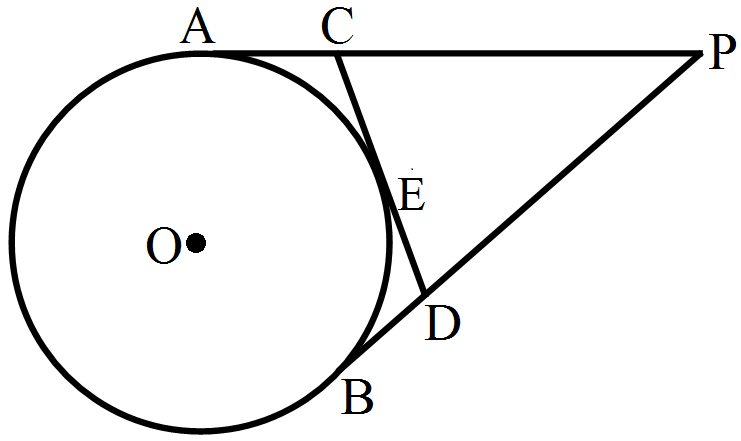
From an external point P, tangents PA and PB are drawn to a circle with centre O. If CD is the tangent to the circle at a point E and PA = 14cm, find the perimeter of $\triangle\text{PCD}.$
Answer
Given, PA and PB are the tangents to a circle with centre O and CD is a tangent at E and PA = 14cm.
Tangent drawn from an external point are equal.
$\therefore\text{PA}=\text{PB},\text{CA}=\text{CE}$ and $\text{DB}=\text{DE}$
Perimeter of $\triangle\text{PCD}=\text{PC}+\text{CD}+\text{PD}$
$=(\text{PA}-\text{CA})+(\text{CE}+\text{DE})+(\text{PB}-\text{DB})$
$=(\text{PA}-\text{CE})+(\text{CE}+\text{DE})+(\text{PB}-\text{DE})$
$=(\text{PA}+\text{PB})$
$=2\text{PA } (\therefore\text{PA}=\text{PB})$
$=(2\times14)\text{cm}$
$=28\text{cm}$
$\therefore\text{Perimeter of }\triangle\text{ PCD}=28\text{cm}.$
View full question & answer
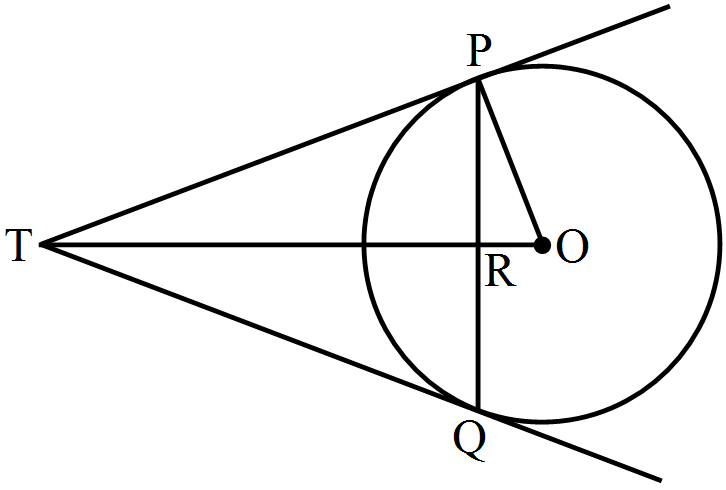
Question 55 Marks
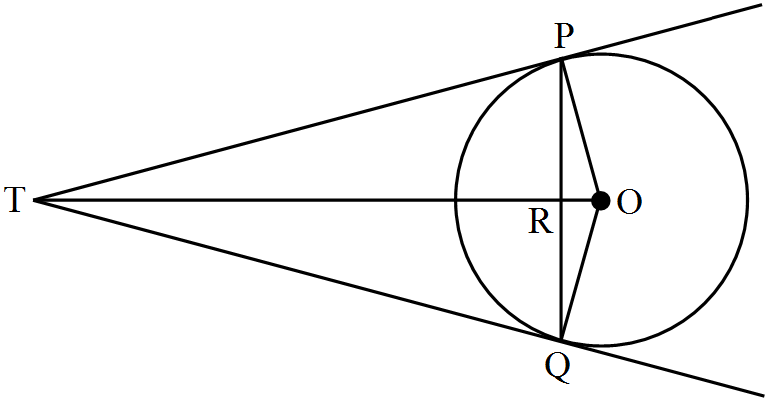
PQ is a chord of length 16cm of a circle of radius 10cm. The tangent at P and Q intersect at point T as shown in the figure.
Finf the length of TP.
Answer

Construction: Join OQ.
In $\triangle\text{TPO}$ and $\triangle\text{TQO},$
TP = TQ ....(tangent from an external point to the circle are equal)
OT = OT ....(Common side)
OP = OQ ....(radii of the same circle)
$\Rightarrow\triangle\text{TPO}\cong\triangle\text{TQO}$ ....(SSS congruence criterion)
$\Rightarrow\angle\text{PTO}=\angle\text{QTR}$ ....(cpct) .....(i)
In $\triangle\text{TRP}$ and $\triangle\text{TRQ},$
TP = TQ ....(tangent from an external point to the circle are equal)
TR = TR ....(Common side)
$\angle\text{PTR}=\angle\text{QTR}\dots\text{(from (i)})$
$\Rightarrow\triangle\text{TRP}\cong\triangle\text{TRQ}$ ....(SAS congruence criterion)
$\Rightarrow\angle\text{TRP}=\angle\text{TRQ}$
Since PRQ is a straight line segment,
$\angle\text{TRP}=\angle\text{TRQ}=180^\circ$
$\Rightarrow\angle\text{TRP}=\angle\text{TRQ}=90^\circ$
So, $\text{OR}\perp\text{PQ}$
We know that the perpendicular from the centre to the chord of a circle bisects the chord.
So, PR = 8cm
In $\triangle\text{ORP},$
$OR^2 = OP^2 - RP^2 ..$.(By Pythagoras theorem)
$\Rightarrow OR^2= 10^2 - 8^2$
$\Rightarrow OR^2 = 36$
$\Rightarrow OR = 6cm$
In right $\triangle\text{PRT},$
$PT^2= TR^2 + PR^2$
$\Rightarrow PT^2 = TR^2 + 8^2 ....(i)$
In right $\triangle\text{POT},$
$\Rightarrow OT^2 = PT^2 + OP^2$
$\Rightarrow (TR+ 6)^2 = PT^2 + OP^2$
$\Rightarrow TR^2 + 12TR + 36 = PT^2 + 10^2 ....(ii)$
Solving (i) and (ii), we get
TP = 10.7cm
View full question & answer
Question 65 Marks
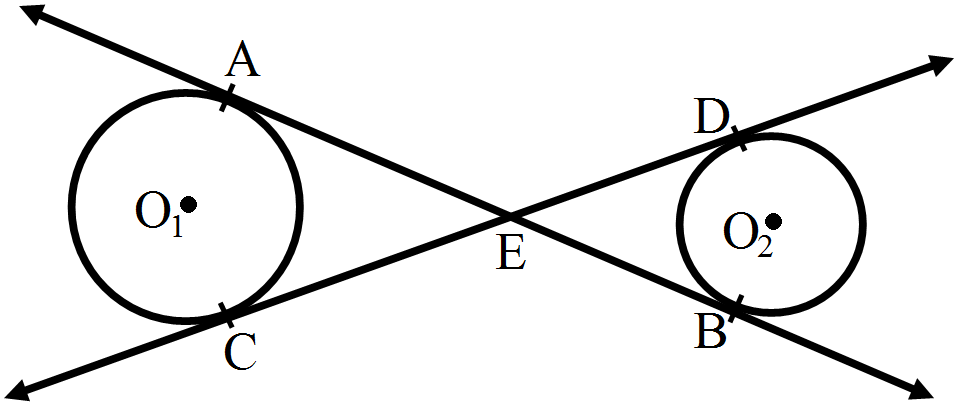
In the given figure, common tangents $A B$ and $C D$ to the two circles with centres $O_1$ and $O_2$ intersect at $E$. Prove that $A B=C D$.
Answer
We know that tangent segments to a circle from the same external point are congruent.
So, we have
$EA = EC$ for the circle having centre $O _1$
and
$ED = EB$ for the circle having centre $O _1$
Now, Adding ED on both sides in EA = EC, we get
$EA + ED = EC + ED$
$\Rightarrow EA + EB = EC + ED$
$\Rightarrow AB = CD$
View full question & answer
Question 75 Marks
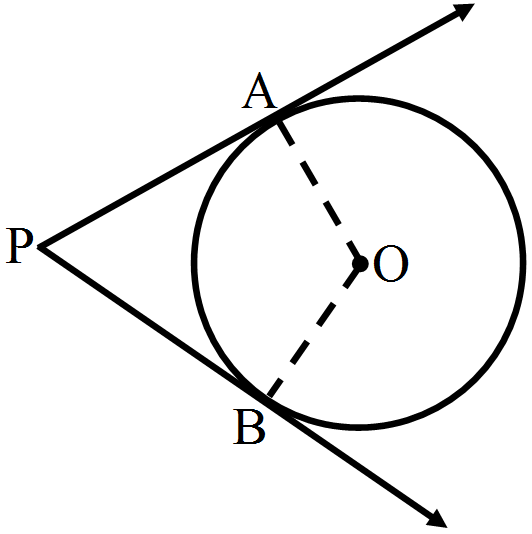
In the given figure, O is the centre of the circle. PA and PB are tangents. Show that AOBP is a cyclic quadrilateral.
Answer
We know that the radius and tangent are perpendicular at their point of contact
$\therefore\angle\text{OBP}=\angle\text{OAP}=90^\circ$
Now, In quadrilateral AOBP
$\angle\text{APB}+\angle\text{AOB}+\angle\text{OBP}+\angle\text{OAP}=360^\circ$[Angle sum property of a quadrilateral]
$\Rightarrow\angle\text{APB}+\angle\text{AOB}+90^\circ+90^\circ=360^\circ$
$\Rightarrow\angle\text{APB}+\angle\text{AOB}=180^\circ$
Also, $\angle\text{OBP}+\angle\text{OAP}=180^\circ$
Since, the sum of the opposite angles of the quadrilateral is 80º
Hence, AOBP is a cyclic quadrilateral.
View full question & answer
Question 85 Marks
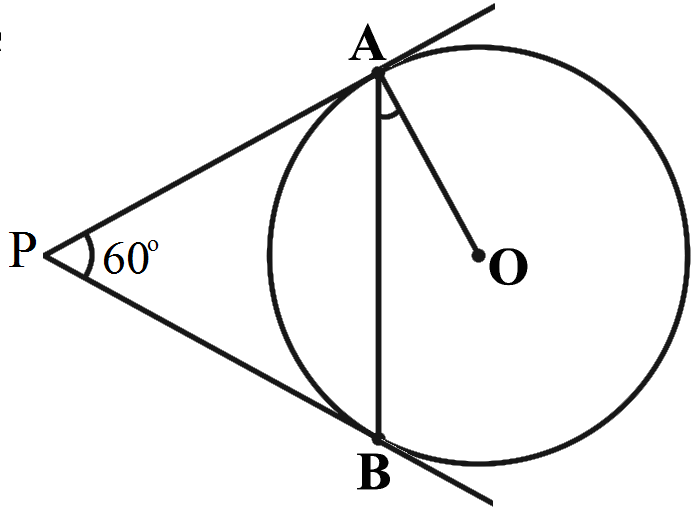
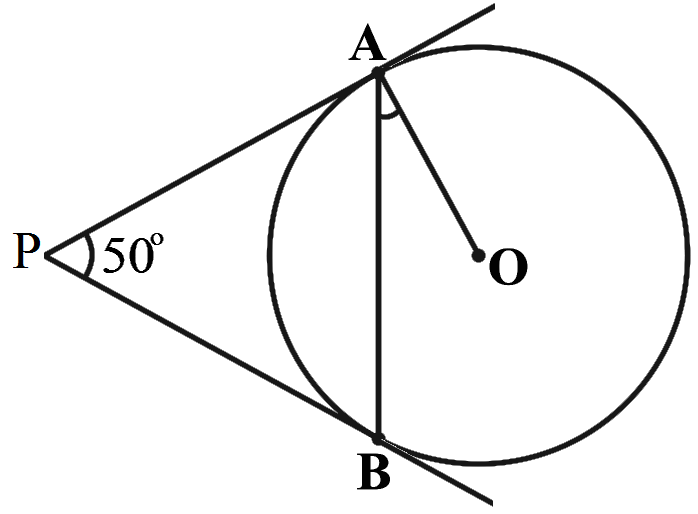
In the given figure, PA and PB are two tangents to the circle with centre O. If $\angle\text{APB}=60^\circ$ then find the measure of $\angle\text{OAB}.$
Answer

We know that the radius and tangent are perperpendular at their point of contact.
$\therefore\angle\text{OBP}=\angle\text{OAP}=90^\circ$
Now, In quadrilateral AOBP
$\angle\text{AOB}+\angle\text{OBP}+\angle\text{APB}+\angle\text{OAP}=360^\circ$ [Angle sum property of a quadrilateral]
$\Rightarrow\angle\text{AOB}=90^\circ+60^\circ+90^\circ=360^\circ$
$\Rightarrow240^\circ+\angle\text{AOB}=360^\circ$
$\Rightarrow\angle\text{AOB}=120^\circ$
Now, In isoceles triangle AOB
$\angle\text{AOB}+\angle\text{OAB}+\angle\text{OBA}=180^\circ$[Angle sum property of a triangle]
$\Rightarrow120^\circ+2\angle\text{OAB}=180^\circ$ $\big[\therefore\angle\text{OAB}=\angle\text{OBA}\big]$
$\Rightarrow\angle\text{OAB}=30^\circ$
View full question & answer
Question 95 Marks
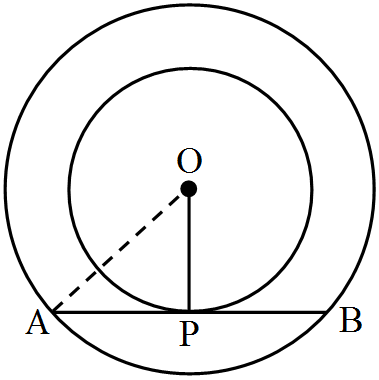
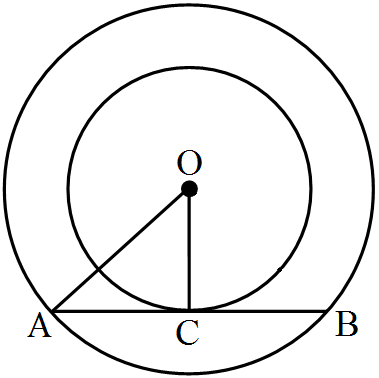
In two concentric circles, a chord of length 8cm of the larger circle touches the smaller circle. If the radius of the larger circle is 5cm then Find the radius of the smaller circle.
Answer


We know that the radius and tangent are perperpendular at their point of contact
Since, the perpendicular drawn from the centre bisect the chord.
$\therefore\text{AP}=\text{PB}=\frac{\text{AB}}{2}=4\text{cm}$
In right triangle AOP
$ \mathrm{AO}^2=O \mathrm{P}^2+\mathrm{PA}^2$
$ \Rightarrow 5^2=\mathrm{OP}^2+4^2$
$ \Rightarrow O P^2=9 $
$ \Rightarrow O P=3 \mathrm{~cm}$
Hence, the radius of the smaller circle is $3cm.$
View full question & answer
Question 105 Marks
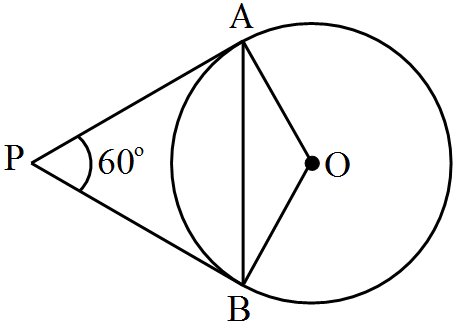
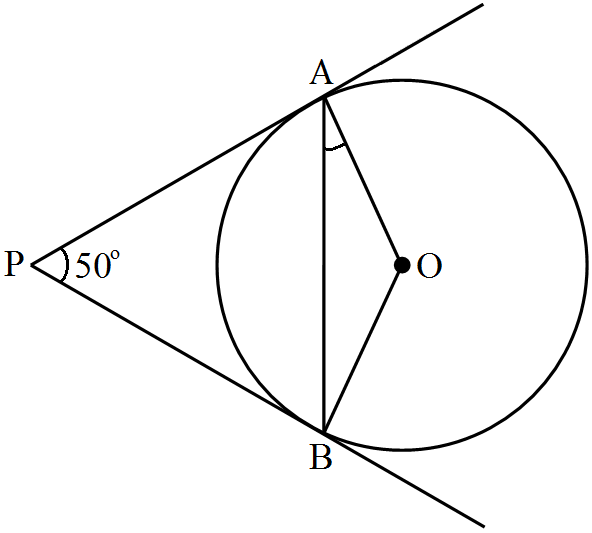
In the given figure, PA and PB are two tangents to the circle with centre O. If $ \text{APB} = 50^\circ$ then what is the measure of $\angle\text{OAB}.$
Answer
Construction: Join OB

We know that the radius and tangent are perperpendular at their point of contact
$\therefore\angle\text{OBP}=\angle\text{OAP}=90^\circ$
Now, In quadrilateral AOBP
$\angle\text{AOB}+\angle\text{OBP}+\angle\text{APB}+\angle\text{OAP}=360^\circ$[Angle sum property of a quadrilateral]
$\Rightarrow \angle\text{AOB}+90^\circ+50^\circ+90^\circ=360^\circ$
$\Rightarrow 230^\circ+\angle\text{BOC}=360^\circ$
$\Rightarrow \angle\text{AOB}=130^\circ$
Now, In isoceles triangle AOB
$\angle\text{AOB}+\angle\text{OAB}+\angle\text{OBA}=180^\circ$[Angle sum property of a triangle]
$\Rightarrow130^\circ+2\angle\text{OAB}=180^\circ$$[\therefore\angle\text{OAB}=\angle\text{OBA}]$
$\Rightarrow\angle\text{OAB}=25^\circ$
View full question & answer
Question 115 Marks
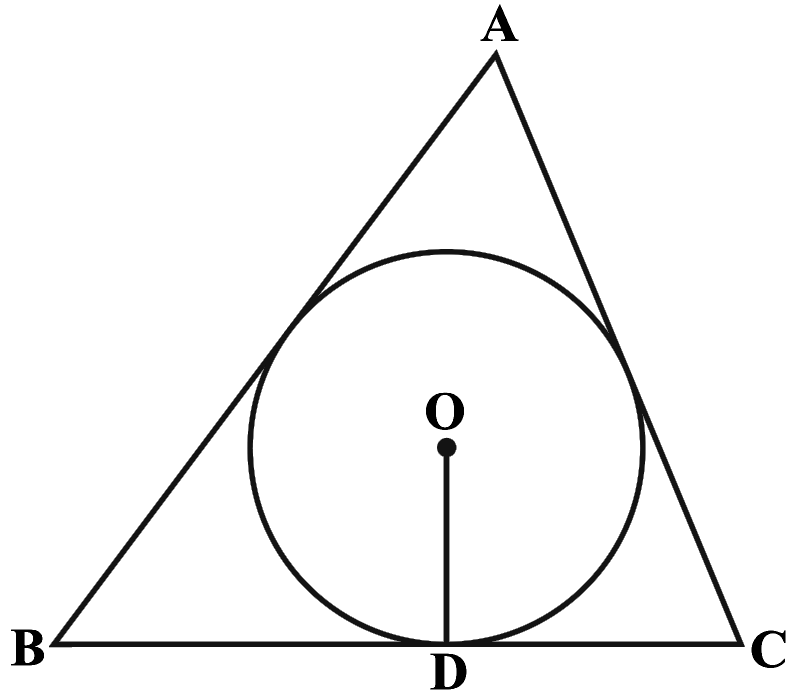
In the given figure, a triangle ABC is drawn to circumscribe a circle of radius 2cm such that the segments BD and DC into which BC is divided by the point of contact D, are of lengths 4cm and 3cm respectively. If the area of $\triangle\text{ABC} = 21\text{cm}^2$ then find the lengths of sides of AB and AC.
Answer
Construction: Join $\text{OA},\text{OB},\text{OC},\text{OE}\perp\text{AB}$ at $\text{OF}\perp\text{AC}$ at F

We know that tangent segments to a circle from the same external point are congruent.
Now, we have
AE = AF, BD = BE = 4cm and CD = CF = 3cm
Now, $\text{Area}(\triangle\text{ABC})=\text{Area}(\triangle\text{BOC})+\text{Area}(\triangle\text{AOB})+\text{Area}(\triangle\text{ABC})+\text{Area}(\triangle\text{AOC})$
$\Rightarrow21=\frac{1}{2}\times\text{BC}\times\text{OD}+\frac{1}{2}\times\text{AB}\times\text{OE}\frac{1}{2}\times\text{AC}\times\text{OF}$
$\Rightarrow42=7\times2+(4+\text{x})\times2+(3+\text{x})\times2$
$\Rightarrow21=7+4+\text{x}+3+\text{x}$
$\Rightarrow21=14+2\text{x}$
$\Rightarrow2\text{x}=7$
$\Rightarrow\text{x}=3.5\text{cm}$
$\therefore$ AB = 4 + 3.5 = 7.5 cm and AC = 3 + 3.5 = 6.5 cm
View full question & answer
Question 125 Marks
Two concentric circles are of radii 5cm and 3cm, respectively. Find the length of the chord of the larger circle (in cm) which touches the smaller circle.
Answer

Given: Two circles have the same centre O and AB is a chord of the larger circle touching the
smaller circle at C; also, OA = 5cm and OC = 3cm.
In
$\triangle\text{OAC},\text{OA}^2=\text{OC}^2-\text{AC}^2$
$\therefore\text{AC}^2=\text{OA}^2-\text{OC}^2$
$\Rightarrow\text{AC}^2=5^2-3^2$
$\Rightarrow\text{AC}^2=25-9$
$\Rightarrow\text{AC}^2=16$
$\Rightarrow\text{AC}=4\text{cm}$
$\therefore\text{AB}=2\text{AC}$(since perpendicular drawn from the centre of the circlebisects the chord)
$\therefore\text{AB}=2\times4=8\text{cm}$
The length of the chord of the larger circle is 8cm.
View full question & answer
Question 135 Marks
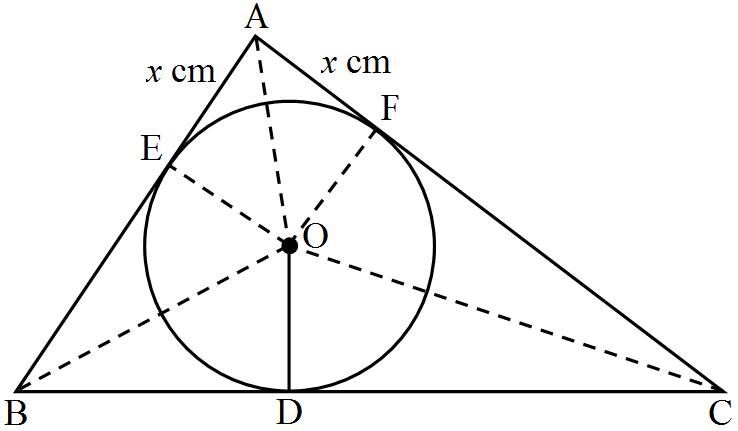
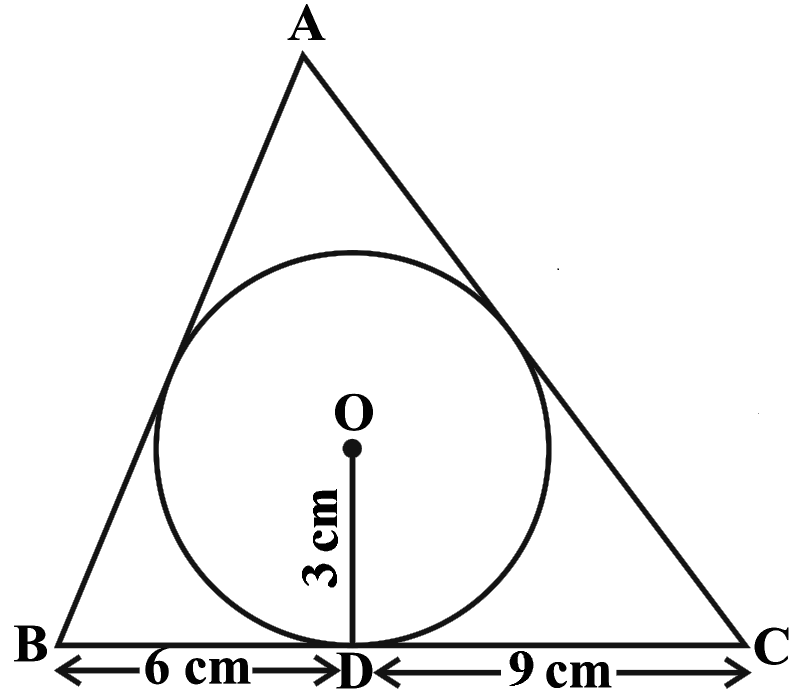
In the given figure, a triangle ABC is drawn to circumscribe a circle of radius 3cm such that the segments BD and DC into which BC is divided by the point of contact D are, of lengths 6cm and 9cm respectively. If the area of $\triangle\text{ABC}=54\text{cm}^2$then find the lengths of sides of AB and AC.
Answer
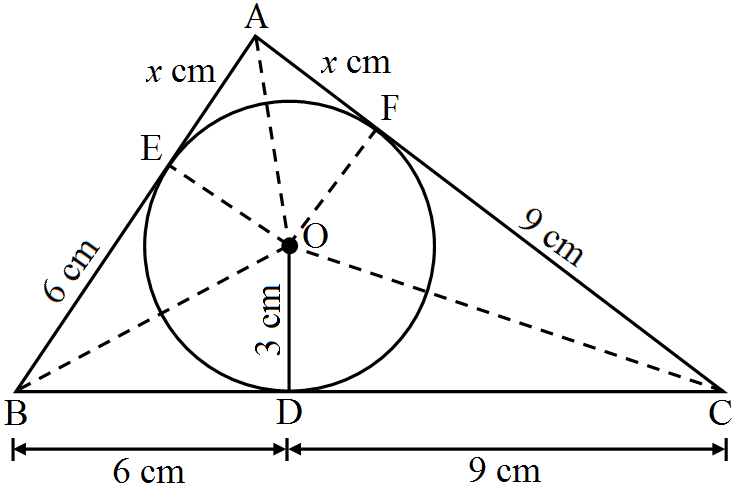
Construction: Join $\text{OA},\text{OB},\text{OC},\text{OE}\perp\text{AB}$ at E and $\text{OF}\perp\text{AC}$ at F

We know that tangent segments to a circle from the same external point are congruent.
Now, we have
AE = AF, BD = BE = 6cm and CD = CF = 9cm
Now,
$\text{Area}(\triangle\text{ABC})$
$=\text{Area}(\triangle\text{BOC})+\text{Area}(\triangle\text{AOB})+\text{Area}(\triangle\text{AOC})$
$\Rightarrow54=\frac{1}{2}\times\text{BC}\times\text{OD}+\frac{1}{2}\times\text{AB}\times\text{OE}+\frac{1}{2}\times\text{AC}\times\text{OF}$
$\Rightarrow108=15\times3+(6+\text{x})\times3+(9+\text{x})\times3$
$\Rightarrow36=15+6+\text{x}+9+\text{x}$
$\Rightarrow36=30+2\text{x}$
$\Rightarrow2\text{x}=6$
$\Rightarrow\text{x}=3\text{cm}$
$\therefore$ AB = 6 + 3 = 9cm and AC = 9 + 3 = 12cm
View full question & answer
Question 145 Marks
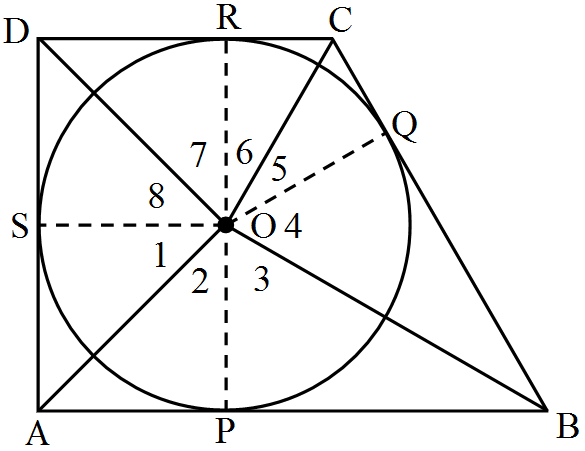
Prove that the opposite sides of a quadrilateral circumscribing a circle subtend supplementary angles at the centre of the circle.
Answer

Given A quad. ABCD circumscibes a circle with centre O.
To prove: $\angle\text{AOB}+\angle\text{COD}=180^\circ$
and $\angle\text{AOD}+\angle\text{BOC}=180^\circ$
Construction: Join OP, OQ, OR and OS.
Proof:
We know that tangents drawn from an external point to a circle subtend equal angles at the centre.
$\therefore\angle1=\angle2,\angle3=\angle4,\angle5=\angle6$ and $\angle7=\angle8$
and $\angle1+\angle2+\angle3+\angle4+\angle5+\angle6+\angle7+\angle8=360^\circ$
$\Rightarrow2(\angle2+\angle3)+2(\angle6+\angle7)=360^\circ$ and$2(\angle1+\angle8)+2(\angle4+\angle5)=360^\circ$
$\Rightarrow\angle2+\angle3+\angle6+\angle7=180^\circ$ and $\angle1+\angle8+\angle4+\angle5=180^\circ$
$\Rightarrow\angle\text{AOB}+\angle\text{COD}=180^\circ$ and $\angle\text{AOD}+\angle\text{BOC}=180^\circ$
Hence proved.
View full question & answer
Question 155 Marks
Prove that the angle between the two tangent drawn from an external point to a circle is supplenentary to the angle subtended by the line segments joining the points of contact at the centre.
Answer

Given PA and PB are the tangent drawn from a point P to a circle with centre O. Also, the line segments OA and OB are shown.
To prove: $\angle\text{APB}+\angle\text{AOB}=180^\circ$
Proof:
We know that the tangent is perpendicular to the radius through the point of contact.
$\therefore\text{PA}\perp\text{OA}\Rightarrow\angle\text{OAP}=90^\circ$
$\therefore\text{PB}\perp\text{OB}\Rightarrow\angle\text{OBP}=90^\circ$
$\therefore\angle\text{OBP}+\angle\text{OBP}=90^\circ+90^\circ=180^\circ\dots\text{(i)}$
But, we know that tha sum of all the angles of a quadrilateral is 360º.
$\therefore\angle\text{OAP}+\angle\text{APB}+\angle\text{AOB}+\angle\text{OBP}=360^\circ\dots\text{(ii)}$
From (i) and (ii), we get
$\angle\text{APB}+\angle\text{AOB}=180^\circ$
Hence proved.
View full question & answer
5 Marks Questions - MATHS STD 10 Questions - Vidyadip