Questions · Page 2 of 2

M.C.Q (1 Marks)

MCQ 511 Mark
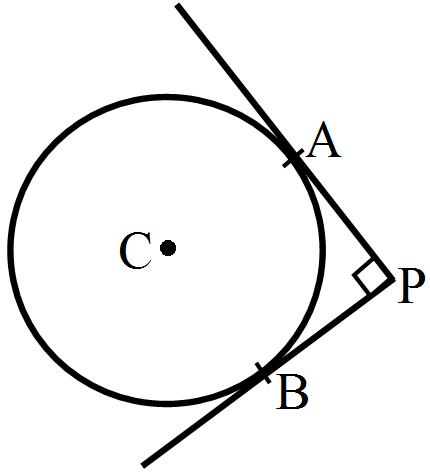
In the given figure, PA and PB are two tangents drawn from an external point P to a circle with centre C and radius 4cm. If $\text{PA}\perp \text{PB}$ then the length of each tangent.
  • A
    3cm
  • 4cm
  • C
    5cm
  • D
    6cm
Answer
Correct option: B.
4cm
Construction: Join CA and CB.Since AP and PB are tangent to the circle,
$\angle\text{CAP}=\angle\text{CBA}=90^\circ$
Given that $\angle\text{APB}=90^\circ$
We know that tangents drawn from an external point to the circle are equal.
$\Rightarrow\text{AP}=\text{PB}$
Also, $\text{CA}=\text{CB}$ ....(radii of the same circle)
So, quadrilateral APBC is a square.
Thus, AP = PB = CA = CB = 4cm.
View full question & answer
MCQ 521 Mark
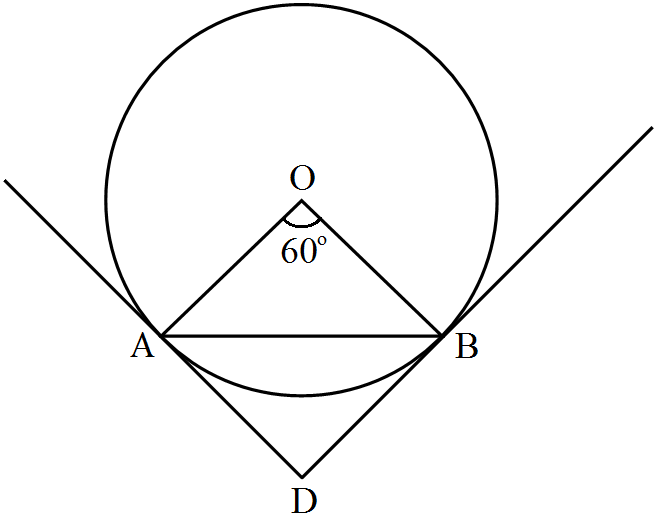
If a chord $AB$ subtends an angle of $60^\circ$ at the centre of a circle, then the angle between the tangents to the circle drawn from $A$ and $B$ is:
  • A
    $30^\circ $
  • B
    $60^\circ $
  • C
    $90^\circ $
  • $120^\circ $
Answer
Correct option: D.
$120^\circ $

Since $AD$ and $DB$ are the tangent to the circle.
$\angle\text{OAD}=\angle\text{OBD}=90^\circ....($tangent is perpendicular to the radius of a circle$)$
In $\text{ABOD}$
$\angle\text{OAD}+\angle\text{ADB}+\angle\text{OBD}+\angle\text{AOB}=360^\circ$
$\Rightarrow90^\circ+\angle\text{ADB}+90^\circ+60^\circ=360^\circ$
$\Rightarrow\angle\text{ADB}=120^\circ$
View full question & answer
MCQ 531 Mark
In a right triangle ABC, right angled at B, BC = 12cm and AB = 5cm. The radius of the circle inscribed in the triangle is:
  • A
    1cm
  • 2cm
  • C
    3cm
  • D
    4cm
Answer
Correct option: B.
2cm
In right $\triangle\text{ABC},$
$\text{AC}^2=\text{AB}^2+\text{BC}^2$ ....(By Pythagoras theorem)
$\Rightarrow\text{AC}^2=5^2+12^2$
$\Rightarrow\text{AC}^2=169$
$\Rightarrow\text{AC}=13\text{cm}$
We know that,
$\text{ar}(\triangle\text{ABC})=\frac{1}{2}\times(\text{perimeter of }\triangle\text{ABC})\times\text{r}$
$\Rightarrow\frac{1}{2}\times\text{base}\times\text{height}=\frac{1}{2}\times(\text{perimeter of }\triangle\text{ABC})\times\text{r}$
$\Rightarrow\frac{1}{2}\times12\times5=\frac{1}{2}\times(5+12)\times\text{r}$
$\Rightarrow\frac12\times5=30\times\text{r}$
$\Rightarrow\text{r}=2\text{cm}$
View full question & answer
MCQ 541 Mark
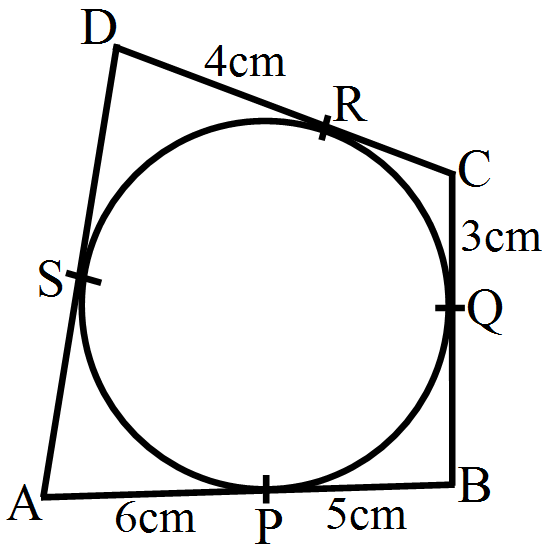
In the given figure, quadrilateral ABCD is circumscribed, touching the circle at P, Q, R and S. If AP = 6cm, BP = 5cm, CQ = 3cm and DR = 4cm, then the perimeter of quadrilateral ABCD is:
  • A
    18cm
  • B
    27cm
  • 36cm
  • D
    32cm
Answer
Correct option: C.
36cm
We know that tangent from an external point to the circle are equal.RC = QC = 3cm
PB = BQ = 5cm
AP = AS = 6cm
SD = DR = 4cm
Perimeter of quad. ABCD
= AB + BC + CD + AD
= (AP + PB) + (BQ + CQ) + (CR + DR) + (AS + SD)
= (6 + 5) + (5 + 3) + (3 + 4) + (6 + 4)
= 36cm
View full question & answer
MCQ 551 Mark
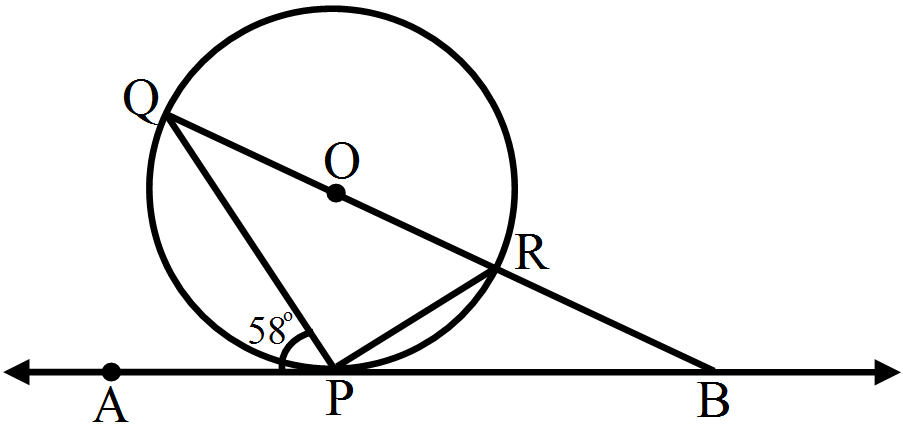
In the given figure, O is the centre of the circle. AB is the tangent to the circle at the point P. If $\angle\text{APQ}=58^\circ$ then the measure of $\angle\text{PQB}$ is:
  • 32º
  • B
    58º
  • C
    122º
  • D
    132º
Answer
Correct option: A.
32º
$\angle\text{APQ}=58^\circ$
$\angle\text{QPR}=90^\circ$ ....(angle inscribed a semicircle)
Since APB is a straight line,
$\angle\text{APQ}+\angle\text{QPR}+\angle\text{RPB}=180^\circ$
$\Rightarrow58^\circ+90^\circ+\angle\text{RPB}=180^\circ$
$\Rightarrow\angle\text{RPB}=32^\circ$
We know that angle that subtend the same arc are equal.
So, $\angle\text{RPB}=\angle\text{RPB}=32^\circ$
View full question & answer
MCQ 561 Mark
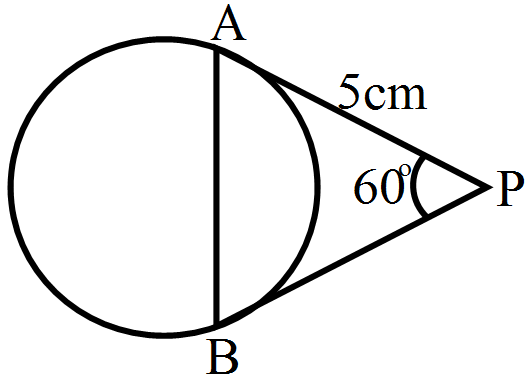
In the given figure, PA and PB are tangents to the given circle, such that PA = 5cm and $\angle\text{APB} = 60^\circ.$ The length of chord AB is:
  • A
    $5\sqrt{2}\text{cm}$
  • $5\text{cm}$
  • C
    $5\sqrt{3}\text{cm}$
  • D
    $7.5\text{cm}$
Answer
Correct option: B.
$5\text{cm}$
We know that tangents from an external point to the circle are equal.$\text{PA}=\text{PB}$
$\Rightarrow\angle\text{PBA}=\angle\text{PAB}=\text{x}^\circ$
In $\triangle\text{PAB},$
$\angle\text{PBA}+\angle\text{PAB}+\angle\text{APB}=180^\circ$....(Angle Sum Property)
$\Rightarrow\angle\text{PAB}+\angle\text{PAB}+60^\circ=180^\circ$
$\Rightarrow2\angle\text{PAB}=120^\circ$
$\Rightarrow\angle\text{PAB}=60^\circ=\angle\text{PBA}$
So, $\triangle\text{PAB}$ is an equilateral triangle. thus, AB = PA = 5cm.
View full question & answer
MCQ 571 Mark
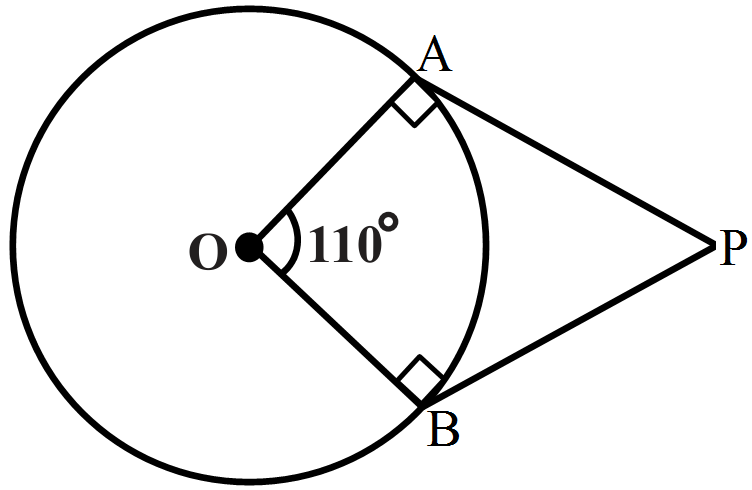
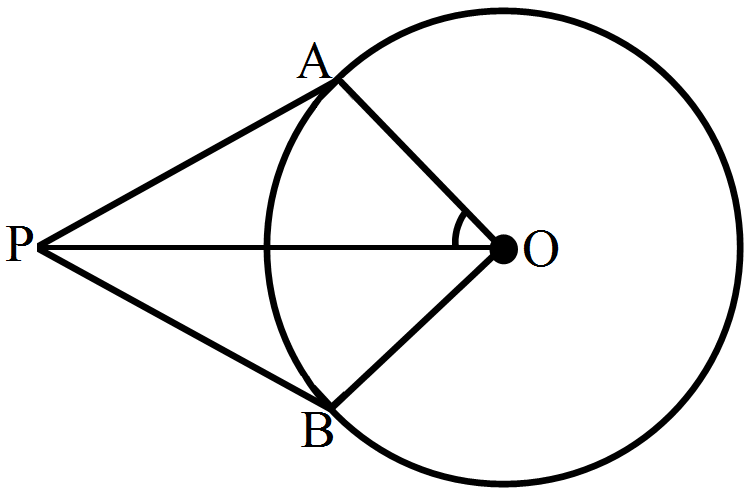
If PA and PB are two tangents to a circle with centre O, such that $\angle\text{AOB} = 110^\circ,$ find $ \angle\text{APB}$ is equal to
  • A
    55º
  • B
    60º
  • 70º
  • D
    90º
Answer
Correct option: C.
70º
Since PA and PB are the tangent to the circle.
$\angle\text{OAP}=\angle\text{OBP}=90^\circ$ ...(tangent is perpendicular to the radius of a circle)
In AOBP,
$\angle\text{OAP}+\angle\text{APB}+\angle\text{OBP}+\angle\text{AOB}=360^\circ$
$\Rightarrow90^\circ+\angle\text{APB}+90^\circ+110^\circ=360^\circ$
$\Rightarrow\angle\text{APB}=70^\circ$
View full question & answer
MCQ 581 Mark
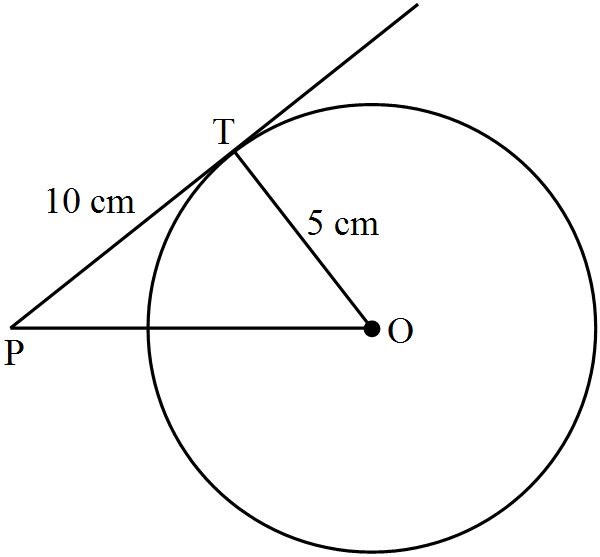
The length of the tangent from an external point P to a circle of radius 5cm is 10cm. The distance of the point from the centre of the circle is:
  • A
    $8\text{cm}$
  • B
    $\sqrt{104}\text{cm}$
  • C
    $12\text{cm}$
  • $\sqrt{125}\text{cm}$
Answer
Correct option: D.
$\sqrt{125}\text{cm}$


In $\triangle\text{PTO}$

By Pythagoras theorem,

$\text{OP}^2=\text{PT}^2+\text{OT}^2$

$\Rightarrow\text{OP}^2=10^2+5^2$

$\Rightarrow\text{OP}^2=100+25$

$\Rightarrow\text{OP}=\sqrt{125}\text{cm}$

Hence, the distance of the point from the centre of the circle is $\sqrt{125}\text{cm}.$
View full question & answer
MCQ 591 Mark
If PA and PB are two tangent to a circle with centre O such that $\angle\text{APB}=80^\circ.$ Then, $\angle\text{AOP}=?$
  • A
    40º
  • 50º
  • C
    60º
  • D
    70º
Answer
Correct option: B.
50º
Construction: Join CA and CB.
In $\triangle\text{PAO}$ and $\triangle\text{PBO},$
$\angle\text{OAP}=\angle\text{OBP}=90^\circ$....(Since AP and PB are tangent to the circle)
$\text{OP}=\text{OP}$ ....(common side)
$\text{AO}=\text{BO}$ ....(radii of the same circle)
$\Rightarrow\triangle\text{PAO}\cong\triangle\text{PBO}$ ....(RHS congruence criterion)
$\angle\text{OPA}=\angle\text{OPB}$ ....(cpct)
$\Rightarrow\angle\text{OPA}=\frac{1}{2}\angle\text{APB}=40^\circ$
In $\triangle\text{PAO},$
$\angle\text{OPA}+\angle\text{PAO}+\angle\text{AOP}=180^\circ$ ....(Angle Sum Property)
$\Rightarrow40^\circ+90^\circ+\angle\text{AOP}=180^\circ$
$\Rightarrow\angle\text{AOP}=50^\circ$
View full question & answer