Question 13 Marks
The area of a triangle is 5sq units. Two of its vertices are $(2, 1)$ and $(3, -2)$. If the third vertex is $\Big(\frac{7}{2},\text{y}\Big),$ find the value of y.
AnswerLet $A(x_1, y_1) = A(2, 1), B(x_2, y_2) = B(3, -2$) and $\text{C}(\text{x}_3, \text{y}_3)=\text{C}\Big(\frac{7}{2},\text{y}\Big).$
Now, Area $(\triangle\text{ABC})=\Big|\frac{1}{2}[\text{x}_1(\text{y}_2-\text{y}_3)+\text{x}_2(\text{y}_3-\text{y}_1)+\text{x}_3(\text{y}_1-\text{y}_2)]\Big|$
$\Rightarrow\ 5=\frac{1}{2}\Big|2(-2-\text{y})+3(\text{y}-1)+\frac{7}{2}(1+2)\Big|$
$\Rightarrow\ 10=\Big|-4-2\text{y}+3\text{y}-3+\frac{21}{2}\Big|$
$\Rightarrow\ 10=\Big|\text{y}+\frac{7}{2}\Big|$
$\Rightarrow\ 10=\text{y}+\frac{7}{2}$ or $-10=\text{y}+\frac{7}{2}$
$\Rightarrow\ \text{y}=\frac{13}{2}$ or $\text{y}=\frac{-27}{2}$
Hence, $\text{y}=\frac{13}{2}$ or $\text{y}=\frac{-27}{2}.$
View full question & answer→Question 23 Marks
Find the distance of the point (1, 2) from the mid-point of the line segment joining the points (6, 8) and (2, 4).
AnswerLet P(1, 2), A(6, 8) and B(2, 4) be the given points.
Coordinates of midpoint of the line segment joining A(6, 8) and B(2, 4) are $\text{Q}\Big(\frac{6+2}{2},\frac{8+4}{2}\Big)=\text{Q}(4,6)$
Now, distance $\text{PQ}=\sqrt{(4-1)^2+(6-2)^2}$
$\Rightarrow\ \text{PQ}=\sqrt{9+16}$
$\Rightarrow\ \text{PQ}=\sqrt{25}$
$\Rightarrow\ \text{PQ}=5$
Hence, the distant = 5 units.
View full question & answer→Question 33 Marks
In the seating arrangement of desks in a classroom three students Rohini, Sandhya and Bina are seated at A(3, 1), B(6, 4) and C(8, 6). Do you think they are seated in a line?
AnswerLet A(3, 1), B(6, 4) and C(8, 6) be the given points.$\text{AB}=\sqrt{(6-3)^2+(4-1)^2}$
$\Rightarrow{\text{AB}}=\sqrt{(3)^2+(3)^2}$
$\Rightarrow{\text{AB}}=\sqrt{9+9}$
$\Rightarrow{\text{AB}}=\sqrt{18}$
$\Rightarrow{\text{AB}}=3\sqrt{2}$
$\text{BC}=\sqrt{(8-6)^2+(6-4)^2}$
$\Rightarrow{\text{BC}}=\sqrt{(2)^2+(2)^2}$
$\Rightarrow{\text{BC}}=\sqrt{4+4}$
$\Rightarrow{\text{BC}}=\sqrt{8}$
$\Rightarrow{\text{BC}}=2\sqrt{2}$
${\text{AC}}=\sqrt{(8-3)^2+(6-1)^2}$
$\Rightarrow{\text{AC}}=\sqrt{(5)^2+(5)^2}$
$\Rightarrow{\text{AC}}=\sqrt{25+25}$
$\Rightarrow{\text{AC}}=\sqrt{50}$
$\Rightarrow{\text{AC}}=5\sqrt{2}$
Since, $\text{AB}+\text{BC}={\text{AC}}$
Points, A, B, C are collinear.
Hence, Rohini, Sandhya and Bina are seated in a line.
View full question & answer→Question 43 Marks
Show that the points (-3, 2), (-5, -5), (2, -3) and (4, 4) are the vertices of a rhombus. Find the area of this rhombus.
AnswerA(-3, 2), B(-5, -5), C(2, -3) and D(4, 4) be the given points.$\text{AB}=\sqrt{(-5+3)^2+(-5-2)^2}$
$\Rightarrow\ \text{AB}=\sqrt{(2)^2+(-7)^2}$
$\Rightarrow\ \text{AB}=\sqrt{4+49}$
$\Rightarrow\ \text{AB}=\sqrt{53}$
$\text{BC}=\sqrt{(2+5)^2+(-3+5)^2}$
$\Rightarrow\ \text{BC}=\sqrt{(7)^2+(2)^2}$
$\Rightarrow\ \text{BC}=\sqrt{49+4}$
$\Rightarrow\ \text{BC}=\sqrt{53}$
$\text{CD}=\sqrt{(4-2)^2+(4+3)^2}$
$\Rightarrow\ \text{CD}=\sqrt{(2)^2+(7)^2}$
$\Rightarrow\ \text{CD}=\sqrt{4+49}$
$\Rightarrow\ \text{CD}=\sqrt{53}$
$\text{AD}=\sqrt{(4+3)^2+(4-2)^2}$
$\Rightarrow\ \text{AD}=\sqrt{(7)^2+(2)^2}$
$\Rightarrow\ \text{AD}=\sqrt{49+4}$
$\Rightarrow\ \text{AD}=\sqrt{53}$
$\text{AC}=\sqrt{(2+3)^2+(-3-2)^2}$
$\Rightarrow\ \text{AC}=\sqrt{(5)^2+(-5)^2}$
$\Rightarrow\ \text{AC}=\sqrt{25+25}$
$\Rightarrow\ \text{AC}=\sqrt{50}$
$\text{BD}=\sqrt{(4+5)^2+(4+5)^2}$
$\Rightarrow\ \text{BD}=\sqrt{(9)^2+(9)^2}$
$\Rightarrow\ \text{BD}=\sqrt{81+81}$
$\Rightarrow\ \text{BD}=\sqrt{162}$
Since, AB = BC = CD = AD and diagonals $\text{AC}\neq\text{BD}$
$\therefore$ ABCD is a rhombus,
Area of rhombus ABCD $=\frac{1}{2}\times\text{AC}\times\text{BD}$
$=\frac{1}{2}\times\sqrt{50}\times\sqrt{162}$
$=\frac{1}{2}\times90$
$=45\text{ sq. units}$
View full question & answer→Question 53 Marks
If the points A(-1, -4), B(b, c) and C(5, -1) are collinear and 2b + c = 4, find the values of b and c.
AnswerA(-1, -4), B(b, c) and C(5, -1) are collinear.
if area of $\triangle\text{ABC}=0$
Now area of $\triangle\text{ABC}=\frac{1}{2}[\text{x}_1(\text{y}_2-\text{y}_3)+\text{x}_2(\text{y}_3-\text{y}_1)+\text{x}_3(\text{y}_1-\text{y}_2)]$
$=\frac{1}{2}[-1(\text{c}+1)+\text{b}(-1+4)+5(-4-\text{c})]$
$=\frac{1}{2}[-\text{c}-1-\text{b}+4\text{b}-20-5\text{c}]$
$=\frac{1}{2}[3\text{b}-6\text{c}-21]$
$\because$ Points are collinear
$\therefore$ area $\triangle\text{ABC}=0$
$\therefore\ \frac{1}{2}(3\text{b}-6\text{c}-21)=0$
⇒ 3b - 6c = 21
3b - 6c = 21 ......(i)
and 2b + c = 4 ......(ii)
⇒ c = 4 - 2b
Substituting the value of c in (i)
⇒ 3b - 6(4 - 2b) = 21
⇒ 3b - 24 + 12b = 21
⇒ 15b = 21 + 24 = 45
$\Rightarrow\ \text{b}=\frac{45}{15}=3$
$\therefore$ c = 4 - 2b = 4 - 2 × 3 = 4 - 6 = -2
$\therefore$ b = 3, c = -2.
View full question & answer→Question 63 Marks
A(6, 1), B(8, 2) and C(9, 4) are three vertices of a parallelogram ABCD. If E is the mid-point of DC, find the area of $\triangle\text{ADE.}$
Answer
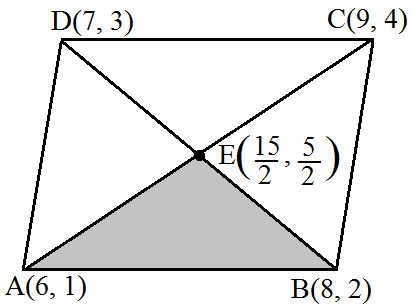 Three vertices are given, then D can be calulated and it comes out to be (7, 3).
Since, E is midpoint of BD.
Therefore, coordinates of E are $\Big(\frac{15}{2},\frac{5}{2}\Big).$
Now, vertices of triangle ABE rae (6, 1), (8, 2) and $\Big(\frac{15}{2},\frac{5}{2}\Big).$
⇒ Area of the $\triangle\text{ABE}=\frac{1}{2}\begin{vmatrix}1&6&1\\1&8&2\\1&\frac{15}{2}&\frac{5}{2}\end{vmatrix}$
$=\frac{1}{2}\Big[1(20-15)-6\Big(\frac{5}{2}-2\Big)+1\Big(\frac{15}{2}-8\Big)\Big]$
$=\frac{1}{2}\Big[5-\frac{6}{2}-\frac{1}{2}\Big]$
$=\frac{3}{4}\text{ sq.units}$ View full question & answer→Question 73 Marks
Find the value of a when the distance between the points $(3, a)$ and $(4, 1)$ is $\sqrt{10}.$
AnswerDistance between (3, a) and (4, 1)$=\sqrt{(\text{x}_2-\text{x}_1)^2+(\text{y}_2-\text{y}_1)^2}$
$=\sqrt{(4-3)^2+(1-\text{a})^2}$
$=\sqrt{(1)^2+(1-\text{a})^2}$
$=\sqrt{1+1-2\text{a}+\text{a}^2}$
$=\sqrt{\text{a}^2-2\text{a}+2}$
But distance is given $\sqrt{10}$ $\therefore\ \sqrt{\text{a}^2-2\text{a}+2}=\sqrt{10}$
$\Rightarrow a^2 - 2a + 2 = 10$
$\Rightarrow a^2 - 2a + 2 - 10 = 0$
$\Rightarrow a^2 - 2a - 8 = 0$
$\Rightarrow a^2 - 4a + 2a - 8 =0$
$\begin{cases}\because-8=-4\times2\\\ \ -2=-4+2\end{cases}$
$\Rightarrow a(a - 4) + 2(a - 4) = 0$
$\Rightarrow (a - 4)(a + 2) = 0$
Either $a - 4 = 0,$
then $a = 4 or a + 2 = 0,$
then $a = -2 a = 4, -2$
View full question & answer→Question 83 Marks
Find the value of a for which the area of the triangle formed by the points A(a, 2a), B(-2, 6) and C(3, 1) is 10 square units.
AnswerA(a, 2a), B(-2, 6) and C(3, 1) Area of $\triangle\text{ABC}=\frac{1}{2}|\text{x}_1(\text{y}_2-\text{y}_3)+\text{x}_2(\text{y}_3-\text{y}_1)+\text{x}_3(\text{y}_1-\text{y}_2)|$$=\frac{1}{2}[\text{a}(6-1)+(-2)(1-2\text{a})+3(2\text{a}-6)]$
$=\frac{1}{2}[5\text{a}-2+4\text{a}+6\text{a}-18]$
$=\frac{1}{2}[15\text{a}-20]$
$\because$ Area $\triangle\text{ABC}=10\text{ sq.units}$
$=\frac{1}{2}[15\text{a}-20]=10$
$\Rightarrow\ 15\text{a}-20=20$
$\Rightarrow\ 15\text{a}=20+20=40$
$\Rightarrow\ \text{a}=\frac{40}{15}=\frac{8}{3}$
Hence, $\text{a}=\frac{8}{3}$
View full question & answer→Question 93 Marks
Find the area of a triangle whose vertices are,
$(6, 3), (-3, 5)$ and $(4, -2).$
AnswerArea of a triangle is given by,$\frac{1}{2}\big[\text{x}_1(\text{y}_2-\text{y}_3)+\text{x}_2(\text{y}_3-\text{y}_1)+\text{x}_3(\text{y}_1-\text{y}_2)\big]$
Here, $x_1 = 6, y_1 = 3, x_2 = -3, y_2 = 5, x_3 = 4, y_3 = -2$
Let A(6, 3), B(-3, 5) and C(4, -2) be the given points
Area of $\triangle\text{ABC}=\frac{1}{2}\Big[6(5+2)+(-3)(-2-3)+4(3-5)\Big]$
$=\frac{1}{2}\Big[6\times7-3\times(-5)+4(-2)\Big]$
$=\frac{1}{2}\Big[42+15-8\Big]$
$=\frac{49}{2}\text{sq.units}$
View full question & answer→Question 103 Marks
Prove that the points A(1, 7), B(4, 2), C(-1, -1) D(-4, 4) are the vertices of a square.
AnswerVertices A(1, 7), B(4, 2), C(-1,-1), D(-4, 4)
If these are the vertices of a square, then its diagonals and sides are equal
$\therefore\ \text{AC}=\sqrt{(1+1)^2+(7+1)^2}$
$=\sqrt{2^2+8^2}=\sqrt{4+64}=\sqrt{68}$
$\text{BD}=\sqrt{(4+4)^2+(2-4)^2}$
$=\sqrt{(8)^2+(-2)^2}=\sqrt{64+4}=\sqrt{68}$
$\therefore$ AC = BD
Now, $\text{AB}=\sqrt{(1-4)^2+(7-2)^2}$
$=\sqrt{(-3)^2+(5)^2}=\sqrt{9+25}=\sqrt{34}$
$\text{BC}=\sqrt{(4+1)^2+(2+1)^2}$
$=\sqrt{(5)^2+(3)^2}=\sqrt{25+9}=\sqrt{34}$
$\text{CD}=\sqrt{(-1+4)^2+(-1-4)^2}$
$=\sqrt{(3)^2+(-5)^2}=\sqrt{9+25}=\sqrt{34}$
and $\text{DA}=\sqrt{(1+4)^2+(7-4)^2}$
$=\sqrt{(5)^2+(3)^2}=\sqrt{25+9}=\sqrt{34}$
$\therefore$ AB = BC = CD = DA and AC = BD
$\therefore$ The figure is a square.
View full question & answer→Question 113 Marks
If the coordinates of the mid-points of the sides of a triangle are $(1, 1) (2, -3)$ and $(3, 4)$, find the vertices of the triangle.
AnswerThe co-ordinates of the midpoint $\left(x_m, y_m\right)$ between two points $\left(x_1, y_1\right)$ and $\left(x_2, y_2\right)$ is given by,
$(\text{x}_\text{m},\text{y}_\text{m})=\bigg[\Big(\frac{\text{x}_1+\text{x}_2}{2}\Big),\Big(\frac{\text{y}_1+\text{y}_2}{2}\Big)\bigg]$
Let the three vertices of the triangle be $A(x_A, y_A), B(x_B, y_B) and C(x_C, y_C).$
The three midpoints are given.
Let these points be $M_{AB}(1, 1), M_{BC}(2, -3) and M_{CA}(3, 4).$
Let us now equate these points using the earlier mentioned formula,
$(1,1)=\bigg[\Big(\frac{\text{x}_\text{A}+\text{x}_\text{B}}{2}\Big),\Big(\frac{\text{y}_\text{A}+\text{y}_\text{B}}{2}\Big)\bigg]$ Equating the individual components
we get, $x_A + x_B = 2 y_A + y_B = 2 $Using the midpoint of another side we have,
$(2,-3)=\bigg[\Big(\frac{\text{x}_\text{B}+\text{x}_\text{C}}{2}\Big),\Big(\frac{\text{y}_\text{B}+\text{y}_\text{C}}{2}\Big)\bigg]$
Equating the individual components
we get, $x_B + x_C = 4 y_B + y_C = -6$ Using the midpoint of the last side we have,
$(3,4)=\bigg[\Big(\frac{\text{x}_\text{A}+\text{x}_\text{C}}{2}\Big),\Big(\frac{\text{y}_\text{A}+\text{y}_\text{C}}{2}\Big)\bigg]$ Equating the individual components
we get, $x_A + x_C = 6 y_A + y_C = 8$ Adding up all the three equations which have
variable ‘x’ alone we have,$ x_A + x_B + x_B + x_C + x_A + x_C$
$= 2 + 4 + 6 2(x_A + x_B + x_C)$
$= 12 x_A + x_B + x_C = 6$
Substituting $x_B + x_C = 4$
in the above equation we have, $x_A + x_B + x_C = 6 x_A + 4 = 6 x_A = 2$
Therefore, $x_A + x_C = 6 x_C = 6 - 2 x_C = 4$
And, $x_A + x_B = 2 x_B = 2 - 2 x_B = 0$
Adding up all the three equations which have variable ‘y’ alone
we have, $y_A + y_B + y_B + y_C + y_A + y_C$
$= 2 - 6 + 8 2(y_A + y_B + y_C)$
$= 4 y_A + y_B + y_C = 2$ Substituting
$y_B + y_C = -6$ in the above equation
we have, $y_A + y_B + y_C = 2 y_A - 6 = 2 y_A = 8$
Therefore, $y_A + y_C = 8 y_C = 8 - 8 y_C = 0$
And, $y_A + y_B = 2 y_B = 2 - 8 y_B = -6$
Therefore the co-ordinates of the three vertices of the triangle are A(2, 8), B(0, -6) and C(4, 0).
View full question & answer→Question 123 Marks
Name the quadrilateral formed, if any, by the following points, and given reason for your answers:
A(-1, -2), B(1, 0), C(-1, 2), D(-3, 0).
AnswerLet A(-1, -2), B(1, 0), C(-1, 2), D(-3, 0).
$\text{AB}=\sqrt{(-1-1)^2+(-2-0)^2}$
$=\sqrt{(-2)^2+(-2)^2}=\sqrt{4+4}=\sqrt{8}=2\sqrt{2}$
$\text{BC}=\sqrt{(-1-(-1))^2+(0-2)^2}$
$=\sqrt{(2)^2+(-2)^2}=\sqrt{4+4}=\sqrt{8}=2\sqrt{2}$
$\text{CD}=\sqrt{(-1-(-3))^2+(2-0)^2}$
$=\sqrt{(2)^2+(2)^2}=\sqrt{4+4}=\sqrt{8}=2\sqrt{2}$
$\text{AD}=\sqrt{(-1-(-3))^2+(-2-0)^2}$
$=\sqrt{(2)^2+(-2)^2}=\sqrt{4+4}=\sqrt{8}=2\sqrt{2}$
Diagonal $\text{AC}=\sqrt{(-1-(-1))^2+(-2-2)^2}$
$=\sqrt{0^2+(-4)^2}=\sqrt{16}=4$
Diagonal $\text{BD}=\sqrt{(-1-(-3))^2+(0-0)^2}$
$=\sqrt{(4)^2+0^2}=\sqrt{16}=4$
Here, all sides of this quadrilateral are of same length and also diagonals are of same length. So, given points are vertices of a square.
View full question & answer→Question 133 Marks
The mid-point $P$ of the line segment joining the points $A (-10,4)$ and $B (-2,0)$ lies on the line segment joining the points $C(-9,-4)$ and $D(-4, y)$. Find the ratio in which $P$ divides $C D$. Also, find the value of $y$.
AnswerP is the mid-point of line segment joining the points A(-10, 4) and B(-2, 0). Coordinates of P will be,$=\Big(\frac{\text{x}_1+\text{x}_2}{2},\frac{\text{y}_1+\text{y}_2}{2}\Big)$
$=\Big(\frac{-10-2}{2},\frac{4+0}{2}\Big)=\Big(\frac{-12}{2},\frac{4}{2}\Big)$
$=(-6, 2)$
$P$ lies on $C D$ also, Let $P$ divides $C(9,-4)$ and $D(-4, y)$ in the ratio $m_1: m_2 \therefore \quad-6=\frac{m_1(-4)+m_2(-9)}{m_1+m_2}$
$-6\text{m}_1-6\text{m}_2=-4\text{m}_1-9\text{m}_2$
$\Rightarrow\ -6\text{m}_1+4\text{m}_1=-9\text{m}_2+6\text{m}_2$
$\Rightarrow\ -2\text{m}_1=-3\text{m}_2$
$\Rightarrow\ \frac{\text{m}_1}{\text{m}_2}=\frac{-3}{-2}=\frac{3}{2}$
$\therefore\ \text{m}_1:\text{m}_2=3:2$
and $2=\frac{3\times\text{y}+2\times(-4)}{3+2}\Rightarrow\ 2=\frac{3\text{y}-8}{5}$ $\Rightarrow\ 10=3\text{y}-8\Rightarrow\ 3\text{y}=10+8=18$ $\Rightarrow\ \text{y}=\frac{18}{3}=6$ $\text{y}=6$
View full question & answer→Question 143 Marks
Find the equation of the perpendicular bisector of the line segment joining points $(7, 1)$ and $(3, 5).$
AnswerLet the given points are $A(7, 1)$ and $B(3, 5)$ and mid point be M.
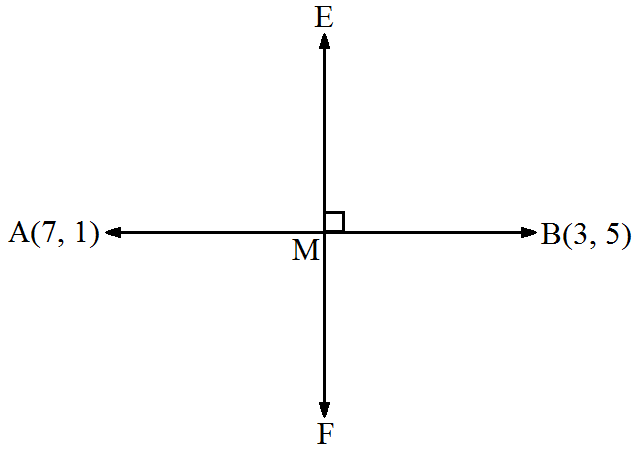
$\therefore$ Co-ordinates of mid point of
AB.$=\Big(\frac{7+3}{2},\frac{1+5}{2}\Big)=(5, 3)$
Now slope of $AB (m_1)$
$=\frac{\text{y}_2-\text{y}_1}{\text{x}_2-\text{x}_1}=\frac{5-1}{3-7}$
$=\frac{4}{-4}=-1$
$\therefore$ Slope of perpendicular to
$AB (m_2)$
$=\frac{-1}{\text{m}_1}=-(-1)=1$
$\therefore$ Equation of the perpendicular line passing through multiple
$y - y_1 = m(x - x_1)$
$\Rightarrow y - 3 = 1(x - 5)$
$\Rightarrow y - 3 = x - 5$
$\Rightarrow x - y = -3 + 5$
$\Rightarrow x - y = 2$ View full question & answer→Question 153 Marks
Find the distance between the following pair of points:
$(-6, 7)$ and $(-1, -5).$
AnswerWe have $P(-6, 7)$ and $Q(-1, -5)$
Here,
$x_1 = -6, y_1 = 7$ and
$x_2 = -1, y_2 = -5$
$\text{PQ}=\sqrt{(\text{x}_2-\text{x}_1)^2+(\text{y}_2-\text{y}_1)^2}$
$\text{PQ}=\sqrt{[-1-(-6)]^2+(-5-7)^2}$
$\text{PQ}=\sqrt{(-1+6)^2+(-5-7)^2}$
$\text{PQ}=\sqrt{(5)^2+(-12)^2}$
$\text{PQ}=\sqrt{25+144}$
$\text{PQ}=\sqrt{169}$
$\text{PQ}=13$
View full question & answer→Question 163 Marks
Ayush starts walking from his house to office. Instead of going to the office directly, he goes to a bank first, from there to his daughter’s school and then reaches the office. What is the extra distance travelled by Ayush in reaching the office? (Assume that all distance covered are in straight lines). If the house is situated at (2, 4), bank at (5, 8), school at (13, 14) and office at (13, 26) and coordinates are in kilometers.
AnswerThe position of the ayush's house is (2, 4) and that of the bank is (5, 8).The distance between the house and the bank is,
$\text{d}_1=\sqrt{(5-2)^2+(8-4)^2}$
$=\sqrt{3^2+4^2}$
$=\sqrt{9+16}$
$=5\text{ units}$
The position of the bank is (5, 8) and that of the school is (13, 14).
The distance between the bank and the school is,
$\text{d}_2=\sqrt{(13-5)^2+(14-8)^2}$
$=\sqrt{8^2+6^2}$
$=\sqrt{64+36}$
$=10\text{ units}$
The position of the school is (13, 14) and that of the office is (13, 26).
The distance between the bank and the school is,
$\text{d}_3=\sqrt{(13-13)^2+(26-14)^2}$
$=\sqrt{0^2+12^2}$
$=12\text{ units}$
Suppose d be the total distance travelled by ayush,
$\text{d}=\text{d}_1+\text{d}_2+\text{d}_3$
$\text{d}=5+10+12$
$\text{d}=27\text{km}$
Now, let D be the shortest distance between ayush house and the office,
$\text{D}=\sqrt{(13-2)^2+(26-4)^2}$
$=\sqrt{11^2+22^2}$
$=\sqrt{605}$
$=24.6\text{km}$
Thus the extra distance covered by ayush is d - D = 27 - 24.6 = 2.4km.
View full question & answer→Question 173 Marks
Find the point on x-axis which is equidistant from the points $(-2, 5)$ and $(2, -3).$
AnswerLet $A(-2, 5)$ and $(2, -3)$ be the given points.
Let $(x, 0)$ be the point on x-axis.
Such that $PA = PB$
$PA = PB$
$PA^2 = PB^2$
$(x + 2)^2 + (0 - 5)^2 = (x - 2)^2 + (0 + 3)^2$
$\Rightarrow x^2 + 4 + 4x + 25 = x^2 + 4 - 4x + 9$
$\Rightarrow x^2 + 4x - x^2 + 4x = 4 + 9 - 4 - 25$
$\Rightarrow 8x = -16$
$\Rightarrow x = -2$
$\therefore$ The point on x-axis is $(-2, 0).$
View full question & answer→Question 183 Marks
Find the area of a triangle whose vertices are,
(a, c + a), (a, c) and (-a, c - a).
AnswerCoordinates of $\triangle\text{ABC}$ are (a, c + a), (a, c) and (-a, c - a)
$\therefore$ Area of $\triangle\text{ABC}=\frac{1}{2}[\text{x}_1(\text{y}_2-\text{y}_3)+\text{x}_2(\text{y}_3-\text{y}_1)+\text{x}_3(\text{y}_1-\text{y}_2)]$
$=\frac{1}{2}[\text{a}(\text{c}-\text{c}+\text{a})+\text{a}(\text{c}-\text{a}-\text{c}-\text{a})+(-\text{a})(\text{c}+\text{a}-\text{c})]$
$=\frac{1}{2}(\text{a}^2-2\text{a}^2-\text{a}^2)$
$=\frac{1}{2}(-2\text{a}^2)$
$=\text{a}^2\text{ sq.units}$
View full question & answer→Question 193 Marks
If the coordinates of the mid-points of the sides of a triangle be $(3, -2), (-3, 1)$ and $(4, -3)$, then find the coordinates of its vertices.
AnswerThe co-ordinates of the midpoint $(x_m, y_m)$ between two points $(x_1, y_1)$ and $(x_2, y_2)$ is given by,
$(\text{x}_\text{m},\text{y}_\text{m})=\bigg[\Big(\frac{\text{x}_1+\text{x}_2}{2}\Big),\Big(\frac{\text{y}_1+\text{y}_2}{2}\Big)\bigg]$
Let the three vertices of the triangle be $A(x_A, y_A), B(x_B, y_B)$ and $C(x_C, y_C).$
The three midpoints are given. Let these points be $M_{AB}(3, -2), M_{BC}(-3, 1)$ and $M_{CA}(4, -3).$
Let us now equate these points using the earlier mentioned formula,
$(3,-2)=\bigg[\Big(\frac{\text{x}_\text{A}+\text{x}_\text{B}}{2}\Big),\Big(\frac{\text{y}_\text{A}+\text{y}_\text{B}}{2}\Big)\bigg]$
Equating the individual components we get, $x_A + x_B = 6 y_A + y_B = -4$
Using the midpoint of another side we have,
$(-3,1)=\bigg[\Big(\frac{\text{x}_\text{B}+\text{x}_\text{C}}{2}\Big),\Big(\frac{\text{y}_\text{B}+\text{y}_\text{C}}{2}\Big)\bigg]$
Equating the individual components we get, $x_B + x_C = -6 y_B + y_C = 2$
Using the midpoint of the last side we have, $(4,-3)=\bigg[\Big(\frac{\text{x}_\text{A}+\text{x}_\text{C}}{2}\Big),\Big(\frac{\text{y}_\text{A}+\text{y}_\text{C}}{2}\Big)\bigg]$
Equating the individual components we get, $x_A+x_C=8 y_A+y_C=-6$
Adding up all the three equations which have variable ' $x^{\prime}$ alone we have,
$x_A+x_B+x_B+x_C+x_A+x_C=6-6+82\left(x_A+x_B+x_C\right)=8 x_A+x_B+x_C=4$
Substituting $x_B+x_C=-6$ in the above equation
we have, $x_A+x_B+x_C=4 x_A+8=4 x_A=10$
Therefore, $x_A+x_C=8 x_C=8-10 x_C=-2$ And, $x_A+x_B=6 x_B=6-10 x_B=-4$
Adding up all the three equations which have variable ' $y^{\prime}$ alone
we have, $y_A+y_B+y_B+y_C+y_A+y_C=-4+2-62\left(y_A+y_B+y_C\right)=-8 y_A+y_B+y_C=-4$
Substituting $y_B+y_C=2$ in the above equation
we have, $y_A+y_B+y_C=-4 y_A+2=-4 y_A=-6$
Therefore, $y_A+y_C=-6 y_C=-6+6 y_C=0$ And, $y_A+y_B=-4 y_B=-4+6 y_B=2$
Therefore the co-ordinates of the three vertices of the triangle are $A (10,-6), B (-4,2)$ and $C (-2,0)$.
View full question & answer→Question 203 Marks
Find the circumcentre of the triangle whose vertices are $(-2, -3), (-1, 0), (7, -6).$
AnswerThe distance d between two points $(x_1, y_1)$ and $(x_2, y_2)$ is given by the formula,
$\text{d}=\sqrt{(\text{x}_1-\text{x}_2)^2+(\text{y}_1-\text{y}_2)^2}$
The circumcentre of a triangle is the point which is equidistant from each of the three vertices of the triangle.
Here the three vertices of the triangle are given to be
$A(-2, -3), B(-1, 0)$ and $C(7, -6)$. Let the circumcentre of the triangle be represented by the point $R(x, y).$
So we have, $AR = BR = CR$
$\text{AR}=\sqrt{(-2-\text{x})^2+(-3-\text{y})^2}$
$\text{BR}=\sqrt{(-1-\text{x})^2+(-\text{y})^2}$
$\text{CR}=\sqrt{(7-\text{x})^2+(-6-\text{y})^2}$
Equating the first pair of these equations we have,
AR = BR
$\sqrt{(-2-\text{x})^2+(-3-\text{y})^2}=\sqrt{(-1-\text{x})^2+(-\text{y})^2}$
Squaring on both sides of the equation
we have,
$(-2 - x)^2 + (-3 - y)^2$
$= (-1 - x)^2 + (-y)^2 4 + x^2 + 4x + 9 + y^2 + 6y$
$= 1 + x^2 + 2x + y^2 2x + 6y$
$= -12 x + 3y = -6$
Equating another pair of the equations we have,AR = CR
$\sqrt{(-2-\text{x})^2+(-3-\text{y})^2}=\sqrt{(7-\text{x})^2+(-6-\text{y})^2}$
Squaring on both sides of the equation we have,
$(-2 - x)^2 + (-3 - y)^2$
$= (7 - x)^2 + (-6 - y)^2 4 + x^2 + 4x + 9 + y^2 + 6y$
$= 49 + x^2 - 14x + 36 + y^2 + 12y 18x - 6y$
$= 72 3x - y = 12$
Now we have two equations for $‘x’$ and $‘y’,$
which are $x + 3y = -6 3x - y = 12$ From the second equation
we have $y = 3x - 12$. Substituting this value of ‘y’ in the first equation
we have, $x + 3(3x - 12) = -6 x + 9x - 36 = -6 10x = 30 x = 3$
Therefore the value of ‘y’ is, $y = 3x - 12 y = 9 - 12 y = -3$
Hence the co-ordinates of the circumcentre of the triangle with the given vertices are $(3, -3).$
View full question & answer→Question 213 Marks
If the point $C(-1,2)$ divides internally the line segment joining the points $A(2,5)$ and $B(x, y)$ in the ratio $3: 4$, find the value of $x^2+y^2$.
AnswerIt is given that the point $C(-1, 2)$ divides the line segment joining the points $A(2, 5)$ and $B(x, y)$ in the ratio 3 : 4 internally.
Using the section formula, we get
$(-1, 2)=\Big(\frac{3\times\text{x}+4\times2}{3+4},\frac{3\times\text{y}+4\times5}{3+4}\Big)$
$\Rightarrow\ (-1, 2)=\Big(\frac{3\text{x}+8}{7},\frac{3\text{y}+20}{7}\Big)$
$\Rightarrow\ \frac{3\text{x}+8}{7}=-1$ and $\frac{3\text{y}+20}{7}=2$
$\Rightarrow 3x + 8 = -7$ and $3y + 20 = 14$
$\Rightarrow 3x = -15$ and $3y = -6$
$\Rightarrow x = -5$ and $y = -2$
$\therefore x^2 + y^2 = 25 + 4 = 29$
Hence, the value of $x^2 + y^2$ is $29.$
View full question & answer→Question 223 Marks
If the point $P(x, y)$ is equidistant from the points $A(5,1)$ and $B(1,5)$, prove that $x=y$.
Answer$\because$ Point P(x, y) is equidistant from the points A(5, 1) and B(1, 5), thenPA = PB
Now, $\text{PA}=\sqrt{(\text{x}_2-\text{x}_1)^2+(\text{y}_2-\text{y}_1)^2}$
$=\sqrt{(5-\text{x})^2+(1-\text{y})^2}$
and $\text{PB}=\sqrt{(1-\text{x})^2+(5-\text{y})^2}$
$\because\ \text{PA}=\text{PB}$
$\therefore\ \sqrt{(5-\text{x})^2+(1-\text{y})^2}=\sqrt{(1-\text{x})^2+(5-\text{y})^2}$
Squaring both sides,
$(5 - x)^2 + (1 - y)^2 = (1 - x)^2 + (5 - y)^2$
$25 + x^2 - 10x + 1 + y^2 - 2y = 1 + x^2 - 2x + 25 + y^2 - 10y$
$\Rightarrow -10x - 2y + 26 = -2x - 10y + 26$
$\Rightarrow -10x - 2y = -2x - 10y$
$\Rightarrow -10x + 2x = -10y + 2y$
$\Rightarrow -8x = -8y$
$\Rightarrow x = y$
Hence x = y
View full question & answer→Question 233 Marks
Show that the mid-point of the line segment joining the points (5, 7) and (3, 9) is also the mid-point of the line segment joining the points (8, 6) and (0, 10).
AnswerLet A(5, 7), B(3, 9), C(8, 6) and D(0, 10) be the given points.
Coordinates of the mid-point of AB are $\Big(\frac{5+3}{2},\frac{7+9}{2}\Big)=(4,8)$
Coordinates of the mid-point of CD are $\Big(\frac{8+0}{2},\frac{6+10}{2}\Big)=(4,8)$
Hence, the midpoints of AB = midpoint of CD.
View full question & answer→Question 243 Marks
If the mid-point of the line joining (3, 4) and (k, 7) is (x, y) and 2x + 2y + 1 = 0 find the value of k.
Answer
 Since, (x, y) is the mid-point
$\text{x}=\frac{3+\text{k}}{2},\text{y}=\frac{4+7}{2}=\frac{11}{2}$
Again,
2x + 2y + 1 = 0
$\Rightarrow2\times\Big(\frac{3+\text{k}}{2}\Big)+2\times\frac{11}{2}+1=0$
⇒ 3 + k + 11 + 1 = 0
⇒ 3 + k + 12 = 0
⇒ k + 15 = 0
⇒ k = -15 View full question & answer→Question 253 Marks
Let ABCD be a square of side 2a. Find the coordinates of the vertices of this square when, The centre of the square is at the origin and coordinate axes are parallel to the sides AB and AD respectively.
AnswerThe distance between any two adjacent vertices of a square will always be equal. This distance is nothing but the side of the square.
Here, the side of the square ‘ABCD’ is given to be ‘2a’.
Here it is said that the centre of the square is at the origin and that the sides of the square are parallel to the axes.
Moving a distance of half the side of the square in either the ‘upward’ or ‘downward’ direction and also along either the ‘right’ or ‘left’ direction will give us all the four vertices of the square.
Half the side of the given square is ‘a’.
The centre of the square is the origin and its vertices are (0, 0). Moving a distance of ‘a’ to the right as well as up will lead us to the vertex ‘A’ and it will have vertices (a, a).
Moving a distance of ‘a’ to the left as well as up will lead us to the vertex ‘B’ and it will have vertices (-a, a).
Moving a distance of ‘a’ to the left as well as down will lead us to the vertex ‘C’ and it will have vertices (-a, -a).
Moving a distance of ‘a’ to the right as well as down will lead us to the vertex ‘D’ and it will have vertices (a, -a).
So, the co-ordinates of the different vertices of the square are,
⇒ A(a, a)
⇒ B(-a, a)
⇒ C(-a, -a)
⇒ D(a, -a)
View full question & answer→Question 263 Marks
For what value of a the point (a, 1), (1, -1), and (11, 4) are collinear?
AnswerLet A(a, 1), B(1, -1) and C(11, 4) be the given points.
Area of $\triangle\text{ABC}=\frac{1}{2}\{\text{a}(-1-4)+1(4-1)+11(1+1)\}$
$=\frac{1}{2}\{-5\text{a}+3+22\}$
$=\frac{1}{2}\{-5\text{a}+25\}$
For the points to be collinear,
Area of $\triangle\text{ABC}=0$
$=\frac{1}{2}\{-5\text{a}+25\}=0$
⇒ -5a + 25 = 0
⇒ -5a = -25
⇒ a = 5
View full question & answer→Question 273 Marks
Find the coordinates of the circumcentre of the triangle whose vertices are $(3,0),(-1,-6)$ and $(4,-1)$. Also, find its circumradius.
AnswerThe distance $d$ between two points $\left(x_1, y_1\right)$ and $\left(x_2, y_2\right)$ is given by the formula,
$\text{d}=\sqrt{(\text{x}_1-\text{x}_2)^2+(\text{y}_1-\text{y}_2)^2}$
The circumcentre of a triangle is the point which is equidistant from each of the three vertices of the triangle.
Here the three vertices of the triangle are given to be $A(3, 0), B(-1, -6)$ and $C(4, -1)$
Let the circumcentre of the triangle be represented by the point $R(x, y)$.So
we have, $AR = BR = CR$
$\text{AR}=\sqrt{(3-\text{x})^2+(-\text{y})^2}$
$\text{BR}=\sqrt{(-1-\text{x})^2+(-6-\text{y})^2}$
$\text{CR}=\sqrt{(4-\text{x})^2+(-1-\text{y})^2}$
Equating the first pair of these equations we have,
AR = BR$\sqrt{(3-\text{x})^2+(-\text{y})^2}=\sqrt{(-1-\text{x})^2+(-6-\text{y})^2}$
Squaring on both sides of the equation
we have, $(3 - x)^2 + (-y)^2$
$= (-1 - x)^2 + (-6 - y)^2 9 + x^2 - 6x + y^2$
$= 1 + x^2 + 2x + 36 + y^2 + 12y 8x + 12y$
$=-28 2x + 3y$
= -7Equating another pair of the equations
we have,
AR = CR$\sqrt{(3-\text{x})^2+(-\text{y})^2}=\sqrt{(4-\text{x})^2+(-1-\text{y})^2}$
Squaring on both sides of the equation
we have, $(3 - x)^2 + (-y)^2$
$= (4 - x)^2 + (-1 - y)^2 9 + x^2 - 6x + y^2$
$= 16 + x^2 - 8x + 1 + y^2 + 2y 2x - 2y$
$= 8 x - y = 4$
Now we have two equations for ‘x’ and ‘y’,
which are $2x + 3y = -7 x - y = 4$ From the second equation
we have y = x - 4. Substituting this value of ‘y’ in the first equation
we have, $2x + 3(x - 4) = -7 2x + 3x - 12 = -7 5x = 5 x = 1$
Therefore the value of ‘y’ is, $y = x - 4 y = 1 - 4 y = -3$
Hence the co-ordinates of the circumcentre of the triangle with the
given vertices are (1, -3). The length of the circumradius can be found out substituting the values of ‘x’ and ‘y’ in ‘AR’.
$\text{AR}=\sqrt{(3-\text{x})^2+(-\text{y})^2}$
$=\sqrt{(3-1)^2+(3)^2}$ $=\sqrt{(2)^2+(3)^2}$
$=\sqrt{4+9}$ $\text{AR}=\sqrt{13}$
Thus the circumradius of the given triangle is $\sqrt{13}\text{ units}.$
View full question & answer→Question 283 Marks
Find a point on y-axis which is equidistant form the points $(5, -2)$ and $(-3, 2).$
AnswerThe point lies on y-axis. Its $x = 0$ Let the required point be $p(0, y)$ and let $A(5, -2)$ and $B(-3, 2)$.$\therefore$
$PA = PB$
$\Rightarrow PA^2 = PB^2$
$\Rightarrow (5 - 0)^2 + (-2 - y)^2 = (-3 - 0)^2 + (2 - y)^2$
(By distance formula)
$\Rightarrow 25 + 4 + y^2 + 4y = 9 + 4 - 4y + y^2$
$\Rightarrow y^2 + 4y + 4y - y^2 = 13 - 29$
$\Rightarrow 8y = -16$
$\Rightarrow\ \text{y}=\frac{-16}{8}=-2$
$\therefore$ The reqquired point will be $(0, -2).$
View full question & answer→Question 293 Marks
Find a relation between x and y such that the point $(x, y)$ is equidistant from the points $(3, 6)$ and $(-3, 4).$
AnswerPoint $(x, y)$ is equidistant form $(3, 6)$ and $(-3, 4).$
Therefore $\sqrt{(\text{x}-3)^2+(\text{y}-6)^2}=\sqrt{\big(\text{x}-(-3)\big)^2+{\text{(y}-4)^2}}$
$\sqrt{(\text{x}-3)^2+(\text{y}-6)^2}=\sqrt{(\text{x}+3)^2+(\text{y}-4)^2}$
Squaring both the side
$\big(\text{x}-3\big)^2+\big(\text{y}-6\big)^2=\big(\text{x}+3\big)^2+\big(\text{y}-4\big)^2$
$x^2 + 9 - 6x + y^2 + 36 - 12y$
$= x^2 + 9 + 6x + y^2 + 16 - 8y$
$36 - 16 = 6x + 6x + 12y - 8y$
$20 = 12x + 4y$
$3x + y = 5$
View full question & answer→Question 303 Marks
Prove that the points (3, 0), (4, 5), (-1, 4) and (-2, -1), taken in order, form a rhombus. Also, find its area.
Answer
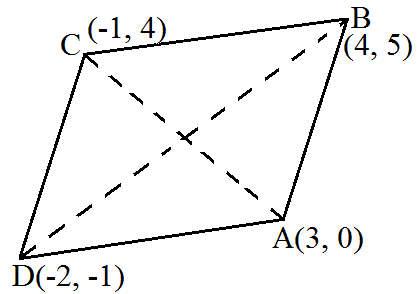 Let the given vertices be A(3, 0), B(4, 5), C(-1, 4) and D(-2, -1).
Length of $\text{AB}=\sqrt{(4-3)^2+(5-0)^2}$
$=\sqrt{1+25}=\sqrt{26}$
Length of $\text{BC}=\sqrt{(-1-4)^2+(4-5)^2}$
$=\sqrt{25+1}=\sqrt{26}$
Length of $\text{CD}=\sqrt{(-2+1)^2+(-1-4)^2}$
$=\sqrt{1+25}=\sqrt{26}$
Length of $\text{DA}=\sqrt{(3+2)^2+(0+1)^2}$
$=\sqrt{25+1}=\sqrt{26}$
Length of diagonal $\text{AC}=\sqrt{\big[3-(-1)\big]^2+(0-4)^2\Big]}$
$=\sqrt{16+16}=4\sqrt{2}$
Length of diagonal $\text{BD}=\sqrt{\Big[4-(-2)\Big]^2+\Big[5-(-1)\Big]^2}$
$=\sqrt{36+36}=6\sqrt{2}$
Here all sides of the quadrilateral ABCD are off same lengths but the diagonals are of different lengths.
So, ABCD is a rhombus.
Therefore area of rhombus ABCD $=\frac{1}{2}\times4\sqrt{2}\times6\sqrt{2}$
= 24 square units. View full question & answer→Question 313 Marks
If A(-1, 3), B(1, -1) and C(5, 1) are the vertices of a triangle ABC, what is the length of the median through vertex A?
AnswerThe vertices of ∆ABC are A(-1, 3), B(1, -1) and C(5, 1) Let AD be the median,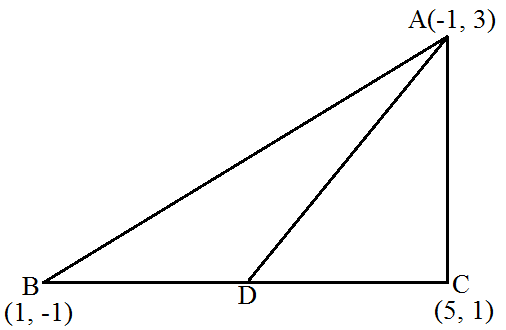
$\therefore$ Co-ordinates of in mid-point D of BC $=\Big(\frac{\text{x}_1+\text{x}_2}{2},\frac{\text{y}_1+\text{y}_2}{2}\Big)$ $=\Big(\frac{1+5}{2},\frac{-1+1}{2}\Big)=\Big(\frac{6}{2},\frac{0}{2}\Big)=(3,0)$ $\therefore$ Length of median AD $=\sqrt{(\text{x}_2-\text{x}_1)^2+(\text{y}_2-\text{y}_1)^2}$ $=\sqrt{(3+1)^2+(0-3)^2}$ $=\sqrt{(4)^2+(-3)^2}=\sqrt{16+9}=\sqrt{25}=5$ Hence median = 5 units View full question & answer→Question 323 Marks
Show that the points $A(5,6), B(1,5), C(2,1)$ and $D(6,2)$ are the vertices of a square.
AnswerPoints are given $A(5,6), B(1,5), C(2,1)$ and $D(6,2)$.
Now, $AB^2 = (x_2 - x_1)^2 + (y_2 - y_1)^2$
$= (1 - 5)^2 + (5 - 6)^2$
$= (-4)^2 + (-1)^2 = 16 + 1 = 17$
Similarly, $BC^2 = (2 - 1)^2 + (1 - 5)^2$
$= (1)^2 + (-4)^2$
$= 1 + 16 = 17$
$CD^2 = (6 - 2)^2 + (2 - 1)^2 = (4)^2 + (1)^2$
$= 16 + 1 = 17$
and $DA^2 = (5 - 6)^2 + (6 - 2)^2$
$= (-1)^2 + (4)^2$
$= 1 + 16 = 17$
Diagonal $AC^2 = (2 - 5)^2 + (1 - 6)^2$
$= (-3)^2 + (-5)^2$
$= 9 + 25 = 34$
and $BD^2 = (6 - 1)^2 + (2 - 5)^2$
$= (5)^2 + (-3)^2$
$= 25 + 9 = 34$
We see that,
$AB = BC = CD = DA$
and diagonals $AC = BD$
$\therefore$ $ABCD$ is a square.
View full question & answer→Question 333 Marks
If (a, b) is the mid-point of the line segment joining the points A(10, -6), B(k, 4) and a - 2b = 18, find the value of k and the distance AB.
AnswerIt is given that A(10, -6) and B(k, 4).
Suppose (a, b) be midpoint of AB. Then,
$\text{a}=\frac{10+\text{k}}{2},\text{b}=\frac{-6+4}{2}=\frac{-2}{2}=-1$
Now, a - 2b = 18
⇒ a = 18 - 2 = 16
Therefore, 16 × 2 = 10 + k
⇒ k = 22
Further,
$\text{AB}=\sqrt{(22-10)^2+(4+6)^2}$
$=\sqrt{144+100}$
$=2\sqrt{61}$
View full question & answer→Question 343 Marks
Let ABCD be a square of side 2a. Find the coordinates of the vertices of this square when, A coincides with the origin and AB and AD are along OX and OY respectively.
AnswerThe distance between any two adjacent vertices of a square will always be equal. This distance is nothing but the side of the square.
Here, the side of the square ‘ABCD’ is given to be ‘2a’.
Since it is given that the vertex ‘A’ coincides with the origin we know that the co-ordinates of this point is (0, 0).
We also understand that the side ‘AB’ is along the x-axis. So, the vertex ‘B’ has got to be at a distance of ‘2a’ from ‘A’.
Hence the vertex ‘B’ has the co-ordinates (2a, 0).
Also it is said that the side ‘AD’ is along the y-axis. So, the vertex ‘D’ it has got to be at a distance of ‘2a’ from ‘A’.
Hence the vertex ‘D’ has the co-ordinates (0, 2a)
Finally we have vertex ‘C’ at a distance of ‘2a’ both from vertex ‘B’ as well as ‘D’.
Hence the vertex of ‘C’ has the co-ordinates (2a, 2a)
So, the co-ordinates of the different vertices of the square are,
⇒ A(0, 0)
⇒ B(2a, 0)
⇒ C(2a, 2a)
⇒ D(0, 2a)
View full question & answer→Question 353 Marks
Prove that the points $(7,10),(-2,5)$ and $(3,-4)$ are the vertices of an isosceles right triangle.
AnswerLet points are $(7,10),(-2,5)$ and $(3,-4)$
Now, $\text{AB}=\sqrt{\text{(x}_2-\text{x}_1)^2+(\text{y}_2-\text{y}_1)^2}$
$=\sqrt{(-2-7)^2+(5-10)^2}=\sqrt{(-9)^2+(-5)^2}$
$=\sqrt{81+25}=\sqrt{106}$
Similarly, $\text{BC}=\sqrt{(3+2)^2+(-4-5)^2}$
$=\sqrt{(5)^2+(-9)^2}$
$=\sqrt{25+81}=\sqrt{106}$
and $\text{AC}=\sqrt{(3-7)^2+(-4-10)^2}$
$=\sqrt{(-4)^2+(-14)^2}=\sqrt{16+196}=\sqrt{212}$
We see that $\text{AB}=\text{BC}=\sqrt{106}$
$\therefore$ It is an isosceles triangle,
and $\text{AB}^2+\text{BC}^2=\big(\sqrt{106}\big)^2+(\sqrt{106}\big)^2$
$=106+106=212$
and $\text{AC}^2=(\sqrt{212})^2=212$
$\therefore$ $AB^2 + BC^2 = AC^2$
$\therefore$ It is an isosceles right triangle.
View full question & answer→Question 363 Marks
Find the coordinates of the point where the diagonals of the parallelogram formed by joining the points (-2, -1), (1, 0), (4, 3) and (1, 2) meet.
Answer
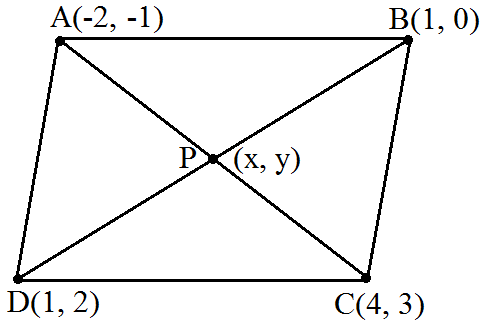 Let P(x, y) be the given points.
We know that diagonals of a parallelogram bisect each other.
$\text{x}=\frac{-2+4}{2}$
$\Rightarrow\ \text{x}=\frac{2}{2}=1$
$\text{y}=\frac{-1+3}{2}=\frac{2}{2}=1$
$\therefore$ Coordinates of P are (1, 1). View full question & answer→Question 373 Marks
The points $A \left( x _1, y _1\right), B \left( x _2, y _2\right)$ and $C \left( x _3, y _3\right)$ are the vertices of $\triangle A B C$.
Find the points of coordinates $Q$ and $R$ on medians $BE$ and $CF$ respectively such that $B Q: Q E=2: 1$ and $C R: R F=2: 1$.
Answer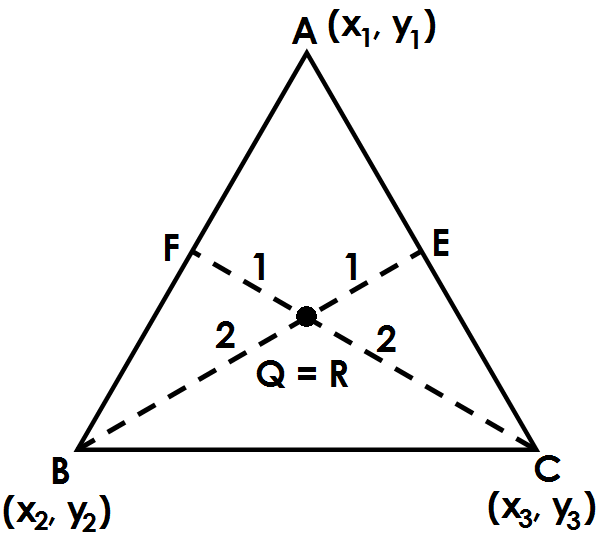
Median $BE$ of the triangle will divide the side $AC$ in two equal parts.
Therefore, $E$ is the midpoint of side $AC$.
Coordinates of $E$ are,
$\Big(\frac{\text{x}_1+\text{x}_3}{2},\frac{\text{y}_1+\text{y}_3}{2}\Big)$
The point $Q$ divided the side BE in the ratio 2 : 1.
Coordinates of $Q$ are,
$\Bigg(\frac{2\times\big(\frac{\text{x}_1+\text{x}_3}{2}\big)+1\times\text{x}_2}{2+1},\frac{2\times\big(\frac{\text{y}_1+\text{y}_3}{2}\big)+1\times\text{y}_2}{2+1}\Bigg)=\Big(\frac{\text{x}_1+\text{x}_2+\text{x}_3}{3},\frac{\text{y}_1+\text{y}_2+\text{y}_3}{3}\Big)$
Similarly, Coordinates of $Q$ and $R$ are $\Big(\frac{\text{x}_1+\text{x}_2+\text{x}_3}{3},\frac{\text{y}_1+\text{y}_2+\text{y}_3}{3}\Big).$ View full question & answer→Question 383 Marks
Find the points of trisection of the line segment joining the points:
(2, -2) and (-7, 4).
AnswerLet A(2, -2) and B(-7, 4) be the given points. Let the points of trisection be P and Q.Then, $\text{AP}=\text{PQ}=\text{QB}=\lambda\ (\text{say})$
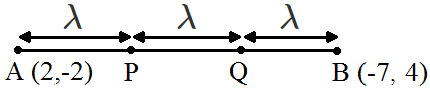
$\text{PB}=\text{PQ}+\text{QB}=2\lambda$
And, $\text{AQ}=\text{AP}+\text{PQ}=2\lambda$
$\text{AP}:\text{PB}=\lambda:2\lambda=1:2$
And, $\text{AQ}:\text{QB}=2\lambda:\lambda=2:1$
So, P divides AB internally in the ratio 1 : 2 while Q divides internally in the ratio 2 : 1. Thus, the coordinates of P and Q are,
$\text{P}\Big(\frac{1\times(-7)+2\times2}{1+2},\frac{1\times4+2\times(-2)}{1+2}\Big)=\text{P}(-1,0)$
$\text{Q}\Big(\frac{2\times(-7)+1\times2}{2+1},\frac{2\times4+1\times(-2)}{2+1}\Big)=\text{Q}(-4,2)$
Hence, the two points of trisection are (-1, 0) and (-4, 2). View full question & answer→Question 393 Marks
If the point $A(0,2)$ is equidistant from the points $B(3, p)$ and $C(p, 5)$, find $p$. Also, find the length of $A B$.
AnswerIt is given that $A(0, 2)$ is equidistant from the points $B(3, p)$ and $C(p, 5).$
$\therefore\ \text{AB}=\text{AC}$
$\Rightarrow\ \sqrt{(3-0)^2+(\text{p}-2)^2}=\sqrt{(\text{p}-0)^2+(5-2)^2}$ (Distance formula)
Squaring on both sides, we get
$9 + p^2 - 4p + 4 = p^2 + 9$
$\Rightarrow -4p + 4 = 0$
$\Rightarrow p = 1$
Thus, the value of p is 1.
$\therefore\ \text{AB}=\sqrt{(3-0)^2+(1-2)^2}$
$=\sqrt{3^2+(-1)^2}=\sqrt{9+1}=\sqrt{10}\text{ units}$
View full question & answer→Question 403 Marks
Find the points of trisection of the line segment joining the points:
(5, -6) and (-7, 5).
AnswerThe line segment whose end points are A(5, -6) and B(-7, 5) which is trisected at C and D. C divides it in the ratio 1 : 2 i.e., AC : CB = 1 : 2  $\therefore$ Co-ordinates of C will be, $=\Big[\frac{\text{mx}_2+\text{nx}_1}{\text{m}+\text{n}},\frac{\text{my}_2+\text{ny}_1}{\text{m}+\text{n}}\Big]$ $=\frac{1\times(-7)+2\times5}{1+2},\frac{1\times5+2\times(-6)}{1+2}$ $=\Big(\frac{-7+10}{3},\frac{5-12}{3}\Big)$ or, $\Big(\frac{3}{3},\frac{-7}{3}\Big)$ or $\Big(1,\frac{-7}{3}\Big)$ Now, $\because$ D intersects AB in the ratio 2 : 1 i.e. AD : DB = 2 : 1 $\therefore$ Co-ordinates of D will be $\Big(\frac{(2\times(-7))+1\times5}{2+1},\frac{2\times5+1\times(-6)}{2+1}\Big)$or $\Big(\frac{-14+5}{3},\frac{10-6}{3}\Big)$ or $\Big(\frac{-9}{3},\frac{4}{3}\Big)$ or $\Big(-3,\frac{4}{3}\Big)$
 View full question & answer→Question 413 Marks
If the point $P(x, 3)$ is equidistant from the point $A(7,-1)$ and $B(6,8)$, then find the value of $x$ and find the distance $A P$.
AnswerPoint $P(x, 3)$ is equidistant from the points $A(7, -1)$ and $B(6, 8).PA = PB$
$\sqrt{(\text{x}-7)^2+(3+1)^2}=\sqrt{(\text{x}-6)^2+(3-8)^2}$
Squaring both sides, $(x - 7)^2 + (4)^2 = (x - 6)^2 + (-5)^2$
$\Rightarrow x^2 - 14x + 49 + 16 = x^2 - 12x + 36 + 25$
$\Rightarrow x^2 - 14x + 65 = x^2 - 12x + 61$
$\Rightarrow x^2 - 14x + 12x - x^2 = 61 - 65$
$\Rightarrow-2\text{x}=-4\Rightarrow\text{x}=\frac{-4}{-2}=2$
$\therefore\ \text{x}=2$
$\therefore\ \text{AP}=\sqrt{(2-7)^2+(4)^2}=\sqrt{(-5)^2+(4)^2}$
$=\sqrt{25+16}=\sqrt{41}$
View full question & answer→Question 423 Marks
Show that the following sets of points are collinear.
(1, -1), (2, 1) and (4, 5).
AnswerLet A(1, -1), B(2, 1) and C(4, 5) be the given points. Area of $\triangle\text{ABC}=\frac{1}{2}[1(1-5)+2(5+1)+4(-1-1)]$$=\frac{1}{2}[-4+12-8]$
$=\frac{1}{2}\times0$ $=0$ Since, area of $\triangle\text{ABC}=0$ $\therefore$ The points (1, -1), (2, 1) and (4, 5) are collinear.
View full question & answer→Question 433 Marks
Find the value of k, if the points A(7, -2), B(5, 1) and C(3, 2k) are collinear.
AnswerLet A(7, -2), B(5, 1) and C(3, 2k) the given points.Three points are collinear if area enclosed by three points is zero.
Area of $\triangle\text{ABC}=\frac{1}{2}|\text{x}_1(\text{y}_2-\text{y}_3)+\text{x}_2(\text{y}_3-\text{y}_1)+\text{x}_3(\text{y}_1-\text{y}_2)|$
$=\frac{1}{2}|7(1-2\text{k})+5(2\text{k}-(-2))+3((-2)-1)|=0$
$=\frac{1}{2}|7-14\text{k}+10\text{k}+10-6-3|=0$
$=\frac{1}{2}|8-4\text{k}|=0$
$\Rightarrow\ 8-4\text{k}=0$
$\Rightarrow\ -4\text{k}=-8$
$\Rightarrow\ \text{k}=2$
Hence, the value of k is 2.
View full question & answer→Question 443 Marks
If A and B are (1, 4) and (5, 2) respectively, find the coordinates of P when $\frac{\text{AP}}{\text{BP}}=\frac{3}{4}.$
AnswerPoint P divides the line segment joining the points (1, 4) and (5, 2) in the ratio of AP : PB = 3 : 4
Co-ordinates of P will be,
$\Big(\frac{\text{mx}_2+\text{nx}_1}{\text{m}+\text{n}},\frac{\text{my}_2+\text{ny}_1}{\text{m}+\text{n}}\Big)$
or $\Big(\frac{3\times5+4\times1}{3+4},\frac{3\times2+4\times4}{3+4}\Big)$
$=\Big(\frac{15+4}{7},\frac{6+16}{7}\Big)$ or $\Big(\frac{19}{7},\frac{22}{7}\Big)$
View full question & answer→Question 453 Marks
A(3, 2) and B(-2, 1) are two vertices of a triangle ABC whose centroid G has the coordinates $\Big(\frac{5}{3},-\frac{1}{3}\Big).$ Find the coordinates of the third vertex C of the triangle.
AnswerLet the third vertex be C(x, y)
Two vertices A(3, 2) and B(-2, 1)
Coordinates of centroid of triangle are $\bigg(\frac{\text{x}+3-2}{3},\frac{\text{y}+2+1}{3}\bigg)$
But the centroid of the triangle are $\Big(\frac{5}{3},-\frac{1}{3}\Big)$
$\therefore\ \frac{\text{x}+3-2}{3}=\frac{5}{3}$ and $\frac{\text{y}+2+1}{3}=-\frac{1}{3}$
$\Rightarrow\frac{\text{x}+1}{3}=\frac{5}{3}\Rightarrow\frac{\text{y}+3}{3}=-\frac{1}{3}$
⇒ x + 1 = 5 ⇒ y + 3 = -1
⇒ x = 4 ⇒ y = -4
Hence, the third vertex of the triangle is C(4, -4).
View full question & answer→Question 463 Marks
If the points A(6, 1), B(8, 2), C(9, 4) and D(k, p) are the vertices of a parallelogram taken in order, then find the values of k and p.
AnswerThe diagonals of a parallelogram bisect each other. O is the mid-point of AC and also of BD. O is the mid-point of AC.
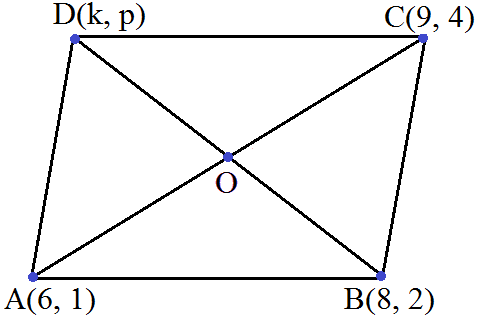
$\therefore$ Co-ordinates of O will be,
$\Big(\frac{6+9}{2},\frac{1+4}{2}\Big)$ or $\Big(\frac{15}{2},\frac{5}{2}\Big)$
$\because$ O is also the mid-point of BD
$\therefore\ \frac{15}{2}=\frac{8+\text{k}}{2}$
and $\frac{5}{2}=\frac{2+\text{p}}{2}$
⇒ 8 + k = 15 ⇒ k = 15 - 8 = 7
and 2 + p = 5 ⇒ p = 5 - 2 = 3
$\therefore$ k = 7, p = 3 View full question & answer→Question 473 Marks
Three vertices of a parallelogram are (a + b, a - b), (2a + b, 2a - b), (a - b, a + b). Find the fourth vertex.
AnswerIn parallelogram ABCD co-ordinates are of A(a + b, a - b), B(2a + b, 2a - b), C(a - b, a + b) Let co-ordinates of D be (x, y). Join diagonal AC and BD. Which bisect each other at O. O is the mid-point of AC as well as BD.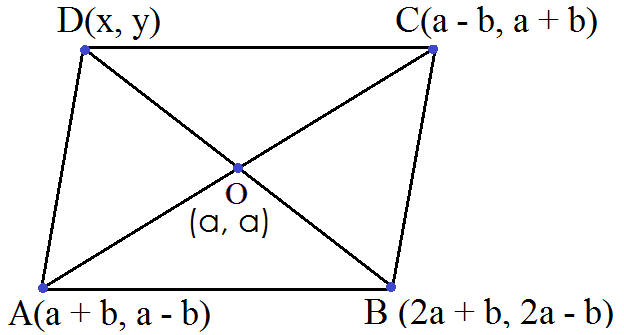
If O is the mid-point of AC, then its co-ordinates will be $\Big(\frac{\text{x}_1+\text{x}_2}{2},\frac{\text{y}_1+\text{y}_2}{2}\Big)$ or $\Big(\frac{\text{a}+\text{b}+\text{a}-\text{b}}{2},\frac{\text{a}-\text{b}+\text{a}+\text{b}}{2}\Big)$ or $\Big(\frac{2\text{a}}{\text{a}},\frac{2\text{a}}{\text{a}}\Big)$ or (a, a) and if O is mid-point of BD, then co-ordinates will be $\Big(\frac{\text{x}+2\text{a}+\text{b}}{2},\frac{\text{y}+2\text{a}-\text{b}}{2}\Big)$ $\therefore\ \frac{\text{x}+2\text{a}+\text{b}}{2}=\text{a}$ $\Rightarrow\ \text{x}+2\text{a}+\text{b}=2\text{a}$ $\Rightarrow\ \text{x}=2\text{a}-2\text{a}-\text{b}=-\text{b}$ and $\frac{\text{y}+2\text{a}-\text{b}}{2}=\text{a}$ $\Rightarrow\ \text{y}+2\text{a}-\text{b}=2\text{a}$ $\Rightarrow\ \text{y}=2\text{a}-2\text{a}+\text{b}=\text{b}$ $\therefore$ Co-ordinates of D will be = (-b, b). View full question & answer→Question 483 Marks
$A B C D$ is a parallelogram with vertices $A\left(x_1, y_1\right), B\left(x_2, y_2\right)$ and $C\left(x_3, y_3\right)$. Find the coordinates of the fourth vertex $D$ in terms of $x _1, x _2, x _3, y _1, y _2$ and $y _3$.
AnswerLet the coordinates of $D$ be $(x, y)$. We know that diagonals of a parallelogram bisect each other. 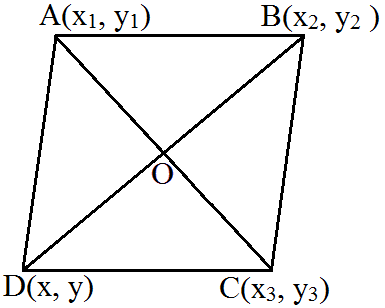
Therefore, mid-point of AC = mid-point of
BD$\Big(\frac{\text{x}_1+\text{x}_3}{2},\frac{\text{y}_1+\text{y}_3}{2}\Big)=\Big(\frac{\text{x}_2+\text{x}}{2},\frac{\text{y}_2+\text{y}}{2}\Big)$
i.e., $x_1 + x_3 = x_2 + x$ and $y_1 + y_3 = y_2 + y$
i.e., $x_1 + x_3 - x_2 = x$ and $y_1 + y_3 - y_2 = y$
Thus, the coordinates of D are $(x_1 + x_3 - x_2, y_1 + y_3 - y_2).$ View full question & answer→Question 493 Marks
Two vertices of a triangle are $(1, 2), (3, 5)$ and its centroid is at the origin. Find the coordinates of the third vertex.
AnswerLet $A (1,2)$ and $B (3,5)$ are two vertex then the third vertex be $C ( x , y )$.
We know that the coordinate of the centroid of a triangle whose angular points are $(x_1, y_1), (x_2, y_2)$ and $(x_3, y_3)$ are
$\Big(\frac{\text{x}_1+\text{x}_2+\text{x}_3}{3},\frac{\text{y}_1+\text{y}_2+\text{y}_3}{3}\Big)$
It is given that coordinates of the centroid are (0, 0) $(0,0)=\Big(\frac{1+3+\text{x}}{3},\frac{2+5+\text{y}}{3}\Big)$ $\frac{1+3+\text{x}}{3}=0$ and $\frac{2+5+\text{y}}{3}=0$
$x = -4$ and $y = -7$
Hence, the coordinates of third vertex are -4 and -7.
View full question & answer→Question 503 Marks
Write the coordinates of a point on x-axis which is equidistant from the points $(-3, 4)$ and $(2, 5).$
AnswerThe point is on $x$-axis.
Its ordinates of the point $P$ is $(x, 0)$.
P is equidistant from $A (-3,4)$ and $B (2,5)$.
Now, $\text{PA}=\sqrt{(\text{x}_2-\text{x}_1)^2+(\text{y}_2-\text{y}_1)^2}$
$=\sqrt{(\text{x}+3)^2+(0-4)^2}=\sqrt{(\text{x}+3)^2+16}$
and $PA^2 = (x + 3)^2 + 16$
Similarly $\text{PB}^2=\big[\sqrt{(\text{x}-2)^2+(0-5)^2}\big]^2$
$= (x - 2)^2 + 25$
$\because$ $PA = PB$
$\Rightarrow PA^2 = PB^2$
$\therefore$ $(x + 3)^2 + 16 = (x - 2)^2 + 25$
$x^2 + 6x + 9 + 16 = x^2 - 4x + 4 + 25$
$\Rightarrow x^2 + 6x - x^2 + 4x = 25 + 4 - 9 - 16$
$\Rightarrow 10x = 4$
$\Rightarrow\ \text{x}=\frac{4}{10}=\frac{2}{5}$
$\therefore$ Co-ordinates of points P will be $\Big(\frac{2}{5},0\Big).$
View full question & answer→