MCQ 11 Mark
Directions : In the following questions, a statement of assertion $(A)$ is followed by a statement of reason $(R)$. Mark the correct choice as :
Assertion $(A)$ : The point $(0, 4)$ lies on $y-$ axis.
Reason $(R)$ : The $x-$ coordinate on the point on $y-$ axis is zero.
- ✓
Both assertion $(A)$ and reason $(R)$ are true and reason $(R)$ is the correct explanation of assertion $(A)$.
- B
Both assertion $(A)$ and reason $(R)$ are true but reason $(R)$ is not the correct explanation of assertion $(A)$.
- C
Assertion $(A)$ is true but reason $(R)$ is false.
- D
Assertion $(A)$ is false but reason $(R)$ is true.
AnswerCorrect option: A. Both assertion $(A)$ and reason $(R)$ are true and reason $(R)$ is the correct explanation of assertion $(A)$.
View full question & answer→MCQ 21 Mark
Directions : In the following questions, a statement of assertion $(A)$ is followed by a statement of reason $(R).$ Mark the correct choice as :
Assertion : Mid $-$ point of a line segment divides line in the ratio $1 : 1$.
Reason : If area of triangle is zero that means points are collinear.
- A
$A$ is true $,R$ is true; $R$ is a correct explanation for $A.$
- ✓
$A$ is true $,R$ is true; $R$ is not a correct explanation for $A.$
- C
$A$ is true; $R$ is False.
- D
$A$ is false; $R$ is true.
AnswerCorrect option: B. $A$ is true $,R$ is true; $R$ is not a correct explanation for $A.$
View full question & answer→MCQ 31 Mark
Directions : In the following questions, a statement of assertion $(A)$ is followed by a statement of reason $(R).$ Mark the correct choice as:
Assertion : Three points $A, B, C$ are such that $AB + BC > AC,$ then they are collinear.
Reason : Three points are collinear if they lie on a straight line.
- A
$A$ is true $ ,R$ is true; $R$ is a correct explanation for $A.$
- B
$A$ is true $,R$ is true; $R$ is not a correct explanation for $A$.
- C
$A$ is true; $R$ is False.
- ✓
$A$ is false; $R$ is true.
AnswerCorrect option: D. $A$ is false; $R$ is true.
View full question & answer→MCQ 41 Mark
Directions : In the following questions, a statement of assertion $(A)$ is followed by a statement of reason $(R).$ Mark the correct choice as :
Assertion : The point $(0, 4)$ lies on $y -$ axis.
Reason : The $x -$ coordinate on the point on $y -$ axis is zero.
- ✓
Both assertion $(A)$ and reason $(R)$ are true and reason $(R)$ is the correct explanation of assertion $(A)$.
- B
Both assertion $(A)$ and reason $(R)$ are true but reason $(R)$ is not the correct explanation of assertion $(A)$.
- C
Assertion $(A)$ is true but reason $(R)$ is false.
- D
Assertion $(A)$ is false but reason $(R)$ is true.
AnswerCorrect option: A. Both assertion $(A)$ and reason $(R)$ are true and reason $(R)$ is the correct explanation of assertion $(A)$.
View full question & answer→MCQ 51 Mark
Directions : In the following questions, a statement of assertion $(A)$ is followed by a statement of reason $(R)$. Mark the correct choice as:
Assertion : Mid $-$ point of a line segment divides line in the ratio $1 : 1.$
Reason : The ratio in which the point $(-3, k)$ divides the line segment joining the points $(-5, 4)$ and $(-2, 3)$ is $1 : 2.$
- A
Both assertion $(A)$ and reason $(R)$ are true and reason $(R)$ is the correct explanation of assertion $(A)$.
- B
Both assertion $(A)$ and reason $(R)$ are true but reason $(R)$ is not the correct explanation of assertion $(A)$.
- ✓
Assertion $(A)$ is true but reason $(R)$ is false.
- D
Assertion $(A)$ is false but reason $(R)$ is true.
AnswerCorrect option: C. Assertion $(A)$ is true but reason $(R)$ is false.
View full question & answer→MCQ 61 Mark
Directions : In the following questions, a statement of assertion $(A)$ is followed by a statement of reason $(R).$ Mark the correct choice as:
Assertion : The point $(-1, 6)$ divides the line segment joining the points $(-3, 10)$ and $(6, -8)$ in the ratio $2 : 7$ internally.
Reason : Given three points, i.e. $A, B, C$ form an equilateral triangle, then $AB = BC = AC.$
- A
Both assertion $(A)$ and reason $(R)$ are true and reason $(R)$ is the correct explanation of assertion $(A)$.
- ✓
Both assertion $(A)$ and reason $(R)$ are true but reason $(R)$ is not the correct explanation of assertion $(A)$.
- C
Assertion $(A)$ is true but reason $(R)$ is false.
- D
Assertion $(A)$ is false but reason $(R)$ is true.
AnswerCorrect option: B. Both assertion $(A)$ and reason $(R)$ are true but reason $(R)$ is not the correct explanation of assertion $(A)$.
View full question & answer→MCQ 71 Mark
Directions : In the following questions, a statement of assertion $(A)$ is followed by a statement of reason $(R)$. Mark the correct choice as:
Assertion : The point $(-1, 6)$ divides the line segment joining the points $(-3, 10)$ and $(6, -8)$ in the ratio $2:7$ internally.
Reason : Given three points, i.e. $A, B, C$ form an equilateral triangle, then $AB = BC = AC.$
- A
Both assertion $(A)$ and reason $(R)$ are true and reason $(R)$ is the correct explanation of assertion $A)$.
- ✓
Both assertion $(A)$ and reason $(R)$ are true but reason $(R)$ is not the correct explanation of assertion $A)$.
- C
Assertion $(A)$ is true but reason $(R)$ is false.
- D
Assertion $(A)$ is false but reason $(R)$ is true.
AnswerCorrect option: B. Both assertion $(A)$ and reason $(R)$ are true but reason $(R)$ is not the correct explanation of assertion $A)$.
View full question & answer→MCQ 81 Mark
Directions : In the following questions, a statement of assertion $(A)$ is followed by a statement of reason $(R)$. Mark the correct choice as:
Assertion $(A)$ : Mid $-$ point of a line segment divides line in the ratio $1 : 1.$
Reason $(R)$ : The ratio in which the point $(–3, k)$ divides the line segment joining the points $(–5, 4)$ and $(–2, 3)$ is $1 : 2.$
- A
Both assertion $(A)$ and reason $(R)$ are true and reason $(R)$ is the correct explanation of assertion $(A)$.
- B
Both assertion $(A)$ and reason $(R)$ are true but reason $(R)$ is not the correct explanation of assertion $(A)$.
- ✓
Assertion $(A)$ is true but reason $(R)$ is false.
- D
Assertion $(A)$ is false but reason $(R)$ is true.
AnswerCorrect option: C. Assertion $(A)$ is true but reason $(R)$ is false.
View full question & answer→MCQ 91 Mark
Directions : In the following questions, a statement of assertion $(A)$ is followed by a statement of reason $(R).$ Mark the correct choice as :
Assertion : The coordinates of the points which divide the line segment joining $A (2, -8)$ and $B(-3, -7)$ into three equal parts are$\Big(\frac{1}{3},\frac{-23}{3}\Big)$ and $\Big(\frac{-4}{3},\frac{-22}{3}\Big).$
Reason : The points which divide $AB$ in the ratio $1 : 3$ and $3 : 1$ are called points to trisection of $AB.$
- A
$A$ is true, $R$ is true; $R$ is a correct explanation for $A.$
- B
$A$ is true, $R$ is true; $R$ is not a correct explanation for $A.$
- ✓
$A$ is true; $R$ is False.
- D
$A$ is false; $R$ is true.
AnswerCorrect option: C. $A$ is true; $R$ is False.
View full question & answer→MCQ 101 Mark
Directions : In the following questions, a statement of assertion $(A)$ is followed by a statement of reason $(R).$ Mark the correct choice as:
Assertion $(A)$ : Mid $-$ point of a line segment divides line in the ratio $1 : 1.$
Reason $(R)$ : The ratio in which the point $(–3, k)$ divides the line segment joining the points $(–5, 4)$ and $(–2, 3)$ is $1 : 2.$
- A
Both assertion $(A)$ and reason $(R)$ are true and reason $(R)$ is the correct explanation of assertion $(A)$.
- B
Both assertion $(A)$ and reason $(R)$ are true but reason $(R)$ is not the correct explanation of assertion $(A)$.
- ✓
Assertion $(A)$ is true but reason $(R)$ is false.
- D
Assertion $(A)$ is false but reason $(R)$ is true.
AnswerCorrect option: C. Assertion $(A)$ is true but reason $(R)$ is false.
View full question & answer→MCQ 111 Mark
Directions : In the following questions, a statement of assertion $(A)$ is followed by a statement of reason $(R).$ Mark the correct choice as :
Assertion : Points $(3, 2), (-2, -3)$ and $(2, 3)$ form a right triangle.
Reason : If $(x, y)$ is equidistant from $(3, 6)$ and $(-3, 4),$ then $3x + y = 5.$
- A
$A$ is true, $R$ is true; $R$ is a correct explanation for $A.$
- ✓
$A$ is true, $R$ is true; $R$ is not a correct explanation for $A.$
- C
$A$ is true; $R$ is False.
- D
$A$ is false; $R$ is true.
AnswerCorrect option: B. $A$ is true, $R$ is true; $R$ is not a correct explanation for $A.$
View full question & answer→MCQ 121 Mark
Directions: In the following questions, a statement of assertion $(A)$ is followed by a statement of reason $(R)$. Mark the correct choice as:
Assertion: There is no such point or $X -$ axis which are at a distance $c ( c <3)$ from the point $(2,3)$.
Reason: The distance between two points $\left( x _1, y _1\right)$ and $\left( x _2, y _2\right)$ is $\sqrt{\left( x _2- x _1\right)^2+\left( y _2- y _1\right)^2}$
- ✓
$A$ is true, $R$ is true; $R$ is a correct explanation for $A$.
- B
$A$ is true, $R$ is true; $R$ is not a correct explanation for $A$.
- C
$A$ is true; $R$ is False.
- D
$A$ is false; $R$ is true.
AnswerCorrect option: A. $A$ is true, $R$ is true; $R$ is a correct explanation for $A$.
$A$ is true, $R$ is true; $R$ is a correct explanation for $A$.
View full question & answer→MCQ 131 Mark
Directions : In the following questions, a statement of assertion $(A)$ is followed by a statement of reason $(R).$ Mark the correct choice as :
Assertion : If the points $A(4, 3)$ and $B(x, 5)$ are on the circle with centre $O(2, 3),$ then find the value of $x$ is $2.$
Reason : If three points $(0, 0), (3,\sqrt{3})$ and $(3,\lambda)$ form an equilateral triangle, then $A$ equals to $\pm\sqrt{2}.$
- A
$A$ is true, $R$ is true; $R$ is a correct explanation for $A$.
- B
$A $ is true, $R$ is true; $R$ is not a correct explanation for $A.$
- ✓
$A$ is true; $R$ is False.
- D
$A$ is false; $R$ is true.
AnswerCorrect option: C. $A$ is true; $R$ is False.
View full question & answer→MCQ 141 Mark
Directions : In the following questions, a statement of assertion $(A)$ is followed by a statement of reason $(R)$. Mark the correct choice as:
Assertion : Points $A(6, 4), B(-4, -6)$ and $C(4, 6)$ are such that $\text{AB}=\sqrt{200},$
$\text{BC}=\sqrt{208},$
$\text{AC}=\sqrt{8}.$ Since, $AB + BC’ > AC,$ points $A, B$ and $C$ form a triangle.
Reason : If $BC^2 = AB^2 + AC$’, then $\triangle\text{ABC}$ is a right triangle, right angled at $A$.
- A
$A$ is true, $R$ is true; $R$ is a correct explanation for $A$.
- ✓
$A$ is true, $R$ is true; $R$ is not a correct explanation for $A$.
- C
$A$ is true; $R$ is False.
- D
$A$ is false; $R$ is true.
AnswerCorrect option: B. $A$ is true, $R$ is true; $R$ is not a correct explanation for $A$.
$A$ is true, $R$ is true; $R$ is not a correct explanation for $A$.
View full question & answer→MCQ 151 Mark
Directions : In the following questions, a statement of assertion $(A)$ is followed by a statement of reason $(R).$ Mark the correct choice as :
Assertion : The distance between the points $(10 \cos 30^\circ , 0)$ and $(0, 10 \cos 60^\circ )$ is $10$ units.
Reason : Mid $-$ point of line segment joining $(a, b)$ and $(c, d)$ is given by $\Big(\frac{\text{a}-\text{c}}{2},\frac{\text{b}-\text{d}}{2}\Big).$
- A
$A$ is true, $R$ is true; $R$ is a correct explanation for $A.$
- B
$A$ is true, $R$ is true; $R$ is not a correct explanation for $A.$
- ✓
$A$ is true; $R$ is False.
- D
$A$ is false; $R$ is true.
AnswerCorrect option: C. $A$ is true; $R$ is False.
View full question & answer→MCQ 161 Mark
Directions : In the following questions, a statement of assertion $(A)$ is followed by a statement of reason $(R$). Mark the correct choice as:
Assertion : Centroid ofa triangle formed by the points $(a, b),(b, c)$ and $(c, a)$ is at origin, Then $a+b+c=0$.
Reason : Centroid of a $\triangle A B C$ with vertices $A\left(x_1, y_1\right), B\left(x_2, y_2\right)$ and $C\left(x_ 3, y_3\right)$ is given by $\left(\frac{x_1+x_2+x_3}{3}, \frac{y_1+y_2+y_3}{3}\right)$.
- ✓
Both $A$ and $R$ are true and $R$ is the correct explanation for $A$.
- B
Both $A$ and $2$ are true and $R$ is not the correct explanation for $A$.
- C
$A$ is true but $R$ is false.
- D
$A$ is false but $R$ is true.
AnswerCorrect option: A. Both $A$ and $R$ are true and $R$ is the correct explanation for $A$.
Both $A$ and $R$ are true and $R$ is the correct explanation for $A$.
View full question & answer→MCQ 171 Mark
Directions: In the following questions, a statement of assertion $(A)$ is followed by a statement of reason $(R)$. Mark the correct choice as:
Assertion $( A )$ : The value of $y$ is $6,$ for which the distance between the points $P(2,-3)$ and $Q(10, y)$ is $10$ .
Reason $(R)$ : Distance between two given points $A\left(x_1, y_1\right)$ and $B\left(x_2, y_2\right)$ is given by:
$AB=\sqrt{\left(x_2-x_1\right)^2+\left(y_2-y_1\right)^2}$
- A
oth assertion $(A)$ and reason $(R)$ are true and reason $(R)$ is the correct explanation of assertion $(A)$.
- B
Both assertion $(A)$ and reason $(R)$ are true but reason $(R)$ is not the correct explanation of assertion $(A)$.
- C
Assertion $(A)$ is true but reason $(R)$ is false.
- ✓
Assertion $(A)$ is false but reason $(R)$ is true.
AnswerCorrect option: D. Assertion $(A)$ is false but reason $(R)$ is true.
Assertion $(A)$ is false but reason $(R)$ is true.
View full question & answer→MCQ 181 Mark
Directions : In the following questions, a statement of assertion $(A)$ is followed by a statement of reason $(R).$ Mark the correct choice as :
Assertion : In quadrilateral $\text{ABCD},$ if $AB = BC = CD = DA$ and $\text{AC = BD},$ then $\text{ABCD}$ is a square.
Reason : A quadrilateral is a square if all its sides are equal and the diagonals are equal.
- A
$A$ is true, $R$ is true; $R$ is a correct explanation for $A$.
- ✓
$A$ is true, $R$ is true; $R$ is not a correct explanation for $A.$
- C
$A$ is true; $R$ is False.
- D
$A$ is false; $R$ is true.
AnswerCorrect option: B. $A$ is true, $R$ is true; $R$ is not a correct explanation for $A.$
View full question & answer→MCQ 191 Mark
Directions : In the following questions, a statement of assertion $(A)$ is followed by a statement of reason $(R).$ Mark the correct choice as:
Assertion : The distance of a points $P(x, y)$ from the origin is $\sqrt{\text{x}^{2}-\text{y}^{2}}.$
Reason: If $P (-1, 1)$ is the mid $-$ point of the line segment joining $A \ (-3, b)$ and $B(1, b + 4),$ then value of b is $-1.$
- A
$A$ is true, $R$ is true; $R$ is a correct explanation for $A$.
- B
$A$ is true, $R$ is true; $R$ is not a correct explanation for $A$.
- C
$A$ is true; $R$ is False.
- ✓
$A$ is false; $R$ is true.
AnswerCorrect option: D. $A$ is false; $R$ is true.
View full question & answer→MCQ 201 Mark
Statement A (Assertion) : If the centre of a circle is at the origin and its radius $=2$ units, then a point on the circle is $(0,2)$.
Statement R (Reason) : The centre of the circle is the mid point of the line joining the end points of its diameter.
- A
Both assertion (A) and reason ( $R$ ) are true and reason $(R)$ is the correct explanation of assertion $(A)$.
- ✓
Both assertion (A) and reason ( $R$ ) are true and reason $(R)$ is not the correct explanation of assertion (A).
- C
Assertion $(A)$ is true but reason $(R)$ is false.
- D
Assertion (A) is false but reason $(R)$ is true.
AnswerCorrect option: B. Both assertion (A) and reason ( $R$ ) are true and reason $(R)$ is not the correct explanation of assertion (A).
(b) : Let $P(0,2)$ and $C(0,0)$
$\therefore$ Radius $=P C=\sqrt{(0-0)^2+(2-0)^2}=\sqrt{2^2}=2$ units
So, assertion and reason both are true but reason is not the correct explanation of assertion.
View full question & answer→MCQ 211 Mark
Statement $A ($Assertion$)$ : Point $P\left(1, \frac{5}{2}\right)$ is equidistant from the points $A(-5,3)$ and $B(7,2)$.
Statement $R$ (Reason$)$ : If a point $P$ is equidistant from the points $A$ and $B$, then $\text{AP=BP}$.
- ✓
Both assertion $(A)$ and reason ( $R$ ) are true and reason $(R)$ is the correct explanation of assertion $(A)$.
- B
Both assertion $(A)$ and reason ( $R$ ) are true and reason $(R)$ is not the correct explanation of assertion $(A).$
- C
Assertion $(A)$ is true but reason $(R)$ is false.
- D
Assertion $(A)$ is false but reason $(R)$ is true.
AnswerCorrect option: A. Both assertion $(A)$ and reason ( $R$ ) are true and reason $(R)$ is the correct explanation of assertion $(A)$.
We have, $P\left(1, \frac{5}{2}\right), A(-5,3)$ and $B(7,2)$Using distance formula, we have
$A P=\sqrt{(1+5)^2+\left(\frac{5}{2}-3\right)^2}$
$=\sqrt{36+\frac{1}{4}}$
$=\sqrt{\frac{145}{4}}$
$=\frac{\sqrt{145}}{2} \text {units}$
$B P=\sqrt{(1-7)^2+\left(\frac{5}{2}-2\right)^2}$
$=\sqrt{36+\frac{1}{4}}$
$=\sqrt{\frac{145}{4}}$
$=\frac{\sqrt{145}}{2} \text {units}$
Hence $\text{AP=BP}$.
$\therefore$ Point $P$ is equidistant from points $A$ and $B$.
View full question & answer→MCQ 221 Mark
Statement A (Assertion) : The points $(-4,0),(4,0)$ and $(0,3)$ are the vertices of an isosceles triangle.
Statement R (Reason) : Two sides of an isosceles triangle are equal.
- A
Both assertion (A) and reason ( $R$ ) are true and reason $(R)$ is the correct explanation of assertion $(A)$.
- ✓
Both assertion (A) and reason ( $R$ ) are true and reason $(R)$ is not the correct explanation of assertion (A).
- C
Assertion $(A)$ is true but reason $(R)$ is false.
- D
Assertion (A) is false but reason $(R)$ is true.
AnswerCorrect option: B. Both assertion (A) and reason ( $R$ ) are true and reason $(R)$ is not the correct explanation of assertion (A).
(b): The points are $A(-4,0), B(4,0)$ and $C(0,3)$.Using distance formula $d=\sqrt{\left(x_2-x_1\right)^2+\left(y_2-y_1\right)^2}$
$A B=\sqrt{(4-(-4))^2+(0-0)^2}=\sqrt{(4+4)^2}=\sqrt{8^2}=8$ units
$B C=\sqrt{(0-4)^2+(3-0)^2}=\sqrt{16+9}=\sqrt{25}=5$ units
$C A=\sqrt{(-4-0)^2+(0-3)^2}=\sqrt{16+9}=\sqrt{25}=5$ units
And, $A B^2 \neq B C^2+C A^2 \quad \because B C=C A$
$\therefore \quad \triangle A B C$ is an isosceles triangle.
View full question & answer→MCQ 231 Mark
Statement A (Assertion) : If the coordinates of the mid-points of the sides $A B$ and $A C$ of $\triangle A B C$ are $D(3,5)$ and $E(-3,-3)$ respectively, then $B C=20$ units.
Statement R (Reason) : The line joining the mid points of two sides of a triangle is parallel to the third side and equal to half of it.
58. Statement A (Assertion) : The points $(-4,0),(4,0)$ and $(0,3)$ are the vertices of an isosceles triangle.
Statement $R$ (Reason) : Two sides of an isosceles triangle are equal.
- ✓
Both assertion (A) and reason ( $R$ ) are true and reason $(R)$ is the correct explanation of assertion $(A)$.
- B
Both assertion (A) and reason ( $R$ ) are true and reason $(R)$ is not the correct explanation of assertion (A).
- C
Assertion $(A)$ is true but reason $(R)$ is false.
- D
Assertion (A) is false but reason $(R)$ is true.
AnswerCorrect option: A. Both assertion (A) and reason ( $R$ ) are true and reason $(R)$ is the correct explanation of assertion $(A)$.
(a) : Length of $D E=\sqrt{(3+3)^2+(5+3)^2}=\sqrt{6^2+8^2}$ $=10$ units
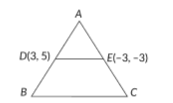
We know, line joining the mid points of two sides of a triangle is parallel to third side and equal to half of it.
So, $D E=\frac{1}{2} B C \Rightarrow B C=20$ units.
Hence, both assertion and reason are true and reason is the correct explanation of assertion. View full question & answer→MCQ 241 Mark
Statement A (Assertion): The co-ordinates of the points which divides the line segment joining $A(2,-8)$ and $B(-3,-7)$ into three equal parts are $\left(\frac{1}{3},-\frac{23}{3}\right)$ and $\left(-\frac{4}{3},-\frac{22}{3}\right)$.
Statement R (Reason) : The points which divide $A B$ in the ratio $1: 3$ and $3: 1$ are called points of trisection of $A B$.
- A
Both assertion (A) and reason ( $R$ ) are true and reason $(R)$ is the correct explanation of assertion $(A)$.
- B
Both assertion (A) and reason ( $R$ ) are true and reason $(R)$ is not the correct explanation of assertion (A).
- C
Assertion $(A)$ is true but reason $(R)$ is false.
- D
Assertion (A) is false but reason $(R)$ is true.
View full question & answer→MCQ 251 Mark
Statement A (Assertion) : The point $P(-4,6)$ divides the join of $A(-6,10)$ and $B(3,-8)$ in the ratio $2: 7$.
Statement R (Reason) : If the point $C(x, y)$ divides the join of $A\left(x_1, y_1\right)$ and $B\left(x_2, y_2\right)$ in the ratio $m: n$, then $x=\frac{m x_2+n x_1}{m+n}$ and $y=\frac{m y_2+n y_1}{m+n}$.
- ✓
Both assertion (A) and reason ( $R$ ) are true and reason $(R)$ is the correct explanation of assertion $(A)$.
- B
Both assertion (A) and reason ( $R$ ) are true and reason $(R)$ is not the correct explanation of assertion (A).
- C
Assertion $(A)$ is true but reason $(R)$ is false.
- D
Assertion (A) is false but reason $(R)$ is true.
AnswerCorrect option: A. Both assertion (A) and reason ( $R$ ) are true and reason $(R)$ is the correct explanation of assertion $(A)$.
(a) : Clearly reason is true.
Let $P(-4,6)$ divides $A(-6,10)$ and $B(3,-8)$ in the ratio $k: 1$. Then, $\frac{k \times 3+1 \times(-6)}{k+1}=-4$ and $\frac{k \times(-8)+1 \times 10}{k+1}=6$
$\Rightarrow 3 k-6=-4 k-4$ and $-8 k+10=6 k+6$
$\Rightarrow 7 k=2$ and $14 k=4$
$\Rightarrow k=2 / 7$
$\therefore \quad$ Required ratio is $2 / 7: 1$, i.e., $2: 7$.
$\therefore \quad$ So, assertion and reason both are true and reason is the correct explanation of assertion.
View full question & answer→MCQ 261 Mark
Statement A (Assertion) : Point $P(0,2)$ is the point of intersection of $y$-axis with the line $3 x+2 y=4$.
Statement R (Reason) : The distance of point $P(0,2)$ from $x$-axis is 2 units.
- A
Both assertion (A) and reason ( $R$ ) are true and reason $(R)$ is the correct explanation of assertion $(A)$.
- ✓
Both assertion (A) and reason ( $R$ ) are true and reason $(R)$ is not the correct explanation of assertion (A).
- C
Assertion $(A)$ is true but reason $(R)$ is false.
- D
Assertion (A) is false but reason $(R)$ is true.
AnswerCorrect option: B. Both assertion (A) and reason ( $R$ ) are true and reason $(R)$ is not the correct explanation of assertion (A).
(b) : Point $P(0,2)$ is the point of intersection of $y$-axis with line $3 x+2 y=4$.
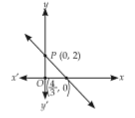
Also, the distance of point $P(0,2)$ from $x$-axis is 2 units. $\therefore$
Both assertion and reason are true but reason is not the correct explanation of assertion. View full question & answer→MCQ 271 Mark
Statement A (Assertion) : The distance of the point $(2,11)$ from the $x$-axis is 11 units.
Statement R (Reason) : The distance of a point $(x, y)$ from $x$-axis is its ordinate, i.e., $y$ units.
- ✓
Both assertion (A) and reason ( $R$ ) are true and reason $(R)$ is the correct explanation of assertion $(A)$.
- B
Both assertion (A) and reason ( $R$ ) are true and reason $(R)$ is not the correct explanation of assertion (A).
- C
Assertion $(A)$ is true but reason $(R)$ is false.
- D
Assertion (A) is false but reason $(R)$ is true.
AnswerCorrect option: A. Both assertion (A) and reason ( $R$ ) are true and reason $(R)$ is the correct explanation of assertion $(A)$.
(a) : We know that the distance of a point $(x, y)$ from $x$-axis is its ordinate, i.e., $y$ units.
$\therefore \quad$ Distance of $(2,11)$ from $x$-axis is 11 units.
$\therefore \quad$ Assertion is true; Reason is true and it is the correct explanation of assertion.
View full question & answer→MCQ 281 Mark
Statement A (Assertion) : The distance of the point $P(6,-6)$ from the origin is 6 units.
Statement R (Reason): The distance between two points $A\left(x_1, y_1\right)$ and $B\left(x_2, y_2\right)$ is given by
$
A B=\sqrt{\left(x_2-x_1\right)^2+\left(y_2-y_1\right)^2} .
$
- A
Both assertion (A) and reason ( $R$ ) are true and reason $(R)$ is the correct explanation of assertion $(A)$.
- B
Both assertion (A) and reason ( $R$ ) are true and reason $(R)$ is not the correct explanation of assertion (A).
- C
Assertion $(A)$ is true but reason $(R)$ is false.
- ✓
Assertion (A) is false but reason $(R)$ is true.
AnswerCorrect option: D. Assertion (A) is false but reason $(R)$ is true.
(d) : Let $P(6,-6)$ be the given point and $O(0,0)$ be the origin.
Then, $O P=\sqrt{(6-0)^2+(-6-0)^2}=\sqrt{6^2+(-6)^2}=6 \sqrt{2}$
So, assertion is false but reason is true.
View full question & answer→