MCQ 11 Mark
$\text{ABCD}$ is a rectangle whose three vertices are $B(4, 0), C(4, 3)$ and $D(0, 3)$. The length of one of its diagonals is :
AnswerThe given vertices are $B(4, 0), C(4, 3)$ and $D(0, 3).$
Here $, BD$ one of the diagonals.
So,
$\text{BD}=\sqrt{(4-0)^2+(0-3)^2}$
$=\sqrt{(4)^2+(-3)^2}$
$=\sqrt{16+9}$
$=\sqrt{25}$
$=5 $
Hence, the length of the diagonal is $5$ units.
View full question & answer→MCQ 21 Mark
The distance of the point $(–3, 4)$ from the $x-$ axis is :
AnswerPoint $P(-3, 4)$ can be located in the coordinate plane as follows :
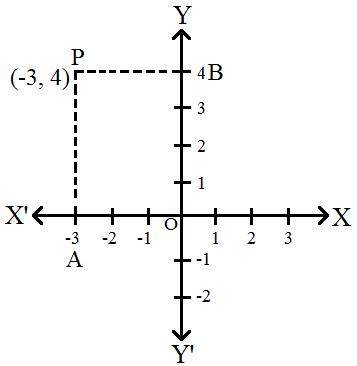
Clearly, distance of $P$ from $X-$ axis $= PA = BO = 4$ unit. View full question & answer→MCQ 31 Mark
In Figure $2, P(5, - 3)$ and $Q(3, y)$ are the points of trisection of the line segment joining $A(7, –2)$ and $B(l, –5)$. Then $y$ equals

- A
$2$
- B
$4$
- ✓
$–4$
- D
$-\frac{5}{2}$
View full question & answer→MCQ 41 Mark
If $\text{P}\Big(\frac{\text{a}}{2},4\Big )$ is the mid $-$ point of the line-segment joining the point $(-6, 5)$ and $B(- 2, 3),$ then the value of a is :
Answer
$P$ is mid point of $AB.$
So, $\frac{\text{a}}{2}=\frac{-6-2}{2}$
$a = -8$ View full question & answer→MCQ 51 Mark
If the points $A(x, 2), B(-3, -4) $ and $C(7, -5)$ are collinear, then the value of $x$ is :
AnswerLet $A(x, 2), B(-3, -4)$ and $C(7, -5)$
Now,
If these points $\text{ABC}$ are collinear then they form a triangle having area equal to $0.$
So,
Area of triangle $\text{ABC} = 0$
$\Rightarrow\frac{1}{2}\{\text{x}_1(\text{y}_2-\text{y}_3)+\text{x}_2(\text{y}_3-\text{y}_1)+\text{x}_3(\text{y}_1-\text{y}_2)\}$
$\Rightarrow\frac{1}{2}\{\text{x}(-4+5)-3(-5-2)+7(2+4)\}=0$
$\Rightarrow\text{x}(1)+21+42=0$
$\Rightarrow\text{x}=-63$
View full question & answer→MCQ 61 Mark
In Fig. $3,$ the area of triangle $\text{ABC}\ ($in sq. units$)$ is :
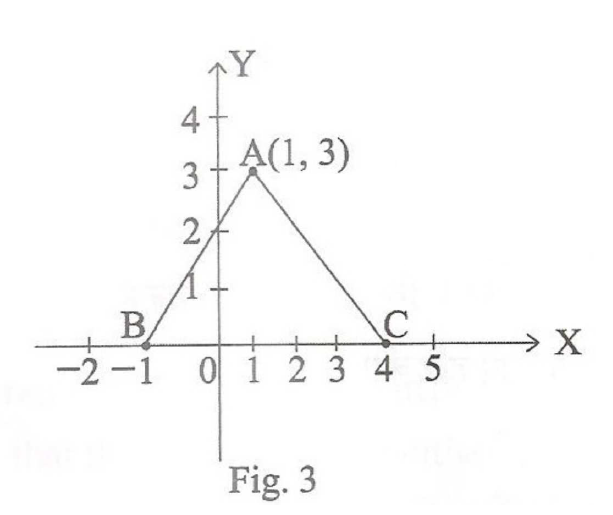
AnswerArea of $\triangle\text{ABC}$
$=\frac{1}{2}\big[\text{x}_1(\text{y}_2-\text{y}_3)+\text{x}_2(\text{y}_2-\text{y}_1)+\text{x}_3(\text{y}_1-\text{y}_2)\big]$
$=\frac{1}{2}\big[1(0 - 0)+(-1)(0 - 3)+4(3-0)\big]$
$=\frac{1}{2}[3+12]$
$=\frac{15}{2}=7.5$
View full question & answer→MCQ 71 Mark
If the coordinates of one end of a diameter of a circle are $(2, 3)$ and the coordinates of its centre are $(–2, 5),$ then the coordinates of the other end of the diameter are :
- ✓
$(-6, 7)$
- B
$(6, -7)$
- C
$(6, 7)$
- D
$(-6, -7)$
AnswerCorrect option: A. $(-6, 7)$
Let the coordinates of one end point of a diameter $AB$ of a circle are $A(2, 3)$ and the coordinates of the center of the cicle are $C(-2, 5)$.
Find the coordinates of $B$.
Let the coordinates of the point $B$ be $(x, y)$
Since, center is the mid $-$ point of the diameter $AB.$
The coordinates of center is
$\text{C}\Big(\frac{2+\text{x}}{2},\frac{3+\text{y}}{2}\Big)$
Now equating the coordinates of center we get,
$\frac{2+\text{x}}{2}=-2$
$2 + x = -4$
$\Rightarrow x = -4 - 2 = -6$
$\frac{3+\text{y}}{2}=5$
$3 + y = 2 \times 5 = 10$
$y = 10 - 3 = 7$
Hence, the coordinates of $B$ are $(-6, 7)$
View full question & answer→MCQ 81 Mark
The coordinates of the point $P$ dividing the line segment joining the points $A(1, 3)$ and $B(4, 6)$ in the ratio $2 : 1$ are :
- A
$(2, 4)$
- ✓
$(3, 5)$
- C
$(4, 2)$
- D
$(5, 3)$
AnswerCorrect option: B. $(3, 5)$
Point $P$ divides line segment $AB$ internally in the ratio $2 : 1$
By internal division formula :
$\text{P}=\Big(\frac{\text{mx}_2+\text{nx}_1}{\text{m}+\text{n}},\frac{\text{ny}_2+\text{ny}_1}{\text{m}+\text{n}}\Big)$
$\text{P}=\Big(\frac{2\times4+1\times1}{2+1},\frac{2\times6+1\times3}{2+1}\Big)$
$\text{P}=\Big(\frac{8+1}{3},\frac{12+3}{3}\Big)$
$\text{P}=(3,5)$
View full question & answer→MCQ 91 Mark
The point $P$ which divides the line segment joining the points $A(2,- 5)$ and $B(5, 2)$ in the ratio $2 : 3$ lies in the quadrant :
Answer$ A(2,-5) \Rightarrow x_1=2, y_1=-5$
$ B(5,2) \Rightarrow x_2=5, y_2=2 $
$m_1= 2, m_2= 3$
Let the coordinates of $P$ be $(x, y)$
$\therefore$ By section formula,
$\text{x}=\frac{\text{m}_1\text{x}_2+\text{m}_2\text{x}_1}{\text{m}_1+\text{m}_2},\text{y}=\frac{\text{m}_2\text{y}_1+\text{m}_1\text{y}_2}{\text{m}_1+\text{m}_2}$
$\text{x}=\frac{2\times5+3\times2}{2+3},\text{y}=\frac{-5\times3+2\times2}{2+3}$
$\text{x}=\frac{10+6}{5},\text{y}=\frac{-15+4}{5}$
$\text{x}=\frac{16}{5},\text{y}=\frac{-11}{5}$
$\therefore\ \text{P}=\Big(\frac{16}{5},\frac{-11}{5}\Big)$
$P$ lies in the $IV$ quadrant.
View full question & answer→MCQ 101 Mark
The mid $-$ point of segment $AB$ is the point $P(O, 4)$. If the coordinates of $B$ are $(-2, 3)$ then the coordinates of $A$ are :
- ✓
$(2, 3)$
- B
$(-2, -5)$
- C
$(2, 9)$
- D
$(-2, 11)$
AnswerCorrect option: A. $(2, 3)$

$B = (-2, 3)$
$C = (0, 4)$
$A = ?$
$\Big[\frac{\text{x}_1+\text{x}_2}{2},\frac{\text{y}_1+\text{y}_2}{2}\Big]$
$\frac{\text{x}_1+(-2)}{2}$
$\frac{\text{x}_1-2}{2}=0$
$\text{x}_1-2=0$
$\text{x}_1=2 $
And, $\frac{\text{y}_1+3}{2}=0$
$\text{y}_1+3=8$
$\text{y}_1=8-3$
$\text{y}_1=5$
Therefore $, A = (2, 3).$ View full question & answer→MCQ 111 Mark
The distance between the points $(m, - n)$ and $(-m, n)$ is :
- A
$\sqrt{\text{m}^2+\text{n}^2}$
- B
$\text{m + n}$
- ✓
$2\sqrt{\text{m}^2+\text{n}^2}$
- D
$\sqrt{2\text{m}^2+\text{n}^2}$
AnswerCorrect option: C. $2\sqrt{\text{m}^2+\text{n}^2}$
The distance between two points is given by
$\text{d}=\sqrt{(\text{x}_2-\text{x}_1)^2+(\text{y}_2-\text{y}_1)^2}$
$\text{d}=\sqrt{(-\text{m}-\text{m})^2+(\text{n}-\text{(-n)})^2}$
$=\sqrt{(-2\text{m})^2+(2\text{n})^2}$
$=\sqrt{4\text{m}^2+4\text{n}^2}$
$=\sqrt{4(\text{m}^2+\text{n}^2)}$
$\text{d}=2\sqrt{\text{m}^2+\text{n}^2}$
View full question & answer→MCQ 121 Mark
It is being given that the points $A(1, 2), B(0, 0)$ and $C(a, b)$ are collinear. Which of the following relations between $a$ and $b$ is true?
- A
$a = 2b$
- ✓
$2a = b$
- C
$a + b = 0$
- D
$a – b = 0$
AnswerCorrect option: B. $2a = b$
Since the given points are collinear, they do not form a triangle, which means area of the triangle is Zero.
Area of a triangle with vertices $(x_1, y_1); (x_2, y_2)$ and $(x_3, y_3)$ is
$\Big[\frac{\text{x}_1(\text{y}_2-\text{y}_3)+\text{x}_2(\text{y}_3-\text{y}_1+\text{x}_3(\text{y}_1-\text{y}_2)}{2}\Big]$
Hence, substituting the points $(x_1, y_1) = (1, 2); (x_2, y_2) = (0, 0) $ and $(x_3, y_3) = (a, b)$ in the area formula,
we get $\Big[\frac{1(0-\text{b})+0(\text{a}-1)+\text{a}(2-0)}{2}\Big]=0$
$\Rightarrow -b + 2a = 0$
$\Rightarrow 2a = b$
View full question & answer→MCQ 131 Mark
Point $P \Big(\frac{\text{a}}{8},4\Big)$ is the mid-point of the line segment joining the points $A(– 5, 2)$ and $ B(4, 6).$ The value of $'a’$ is :
AnswerMidpoint formula $=\text{x}_1+\frac{\text{x}_2}{2},=\text{y}_1+\frac{\text{y}_2}{2}$
$X_1=-5, X_2=4, Y_1=2, Y_2=6$
So, substitute the values,
$\frac{(-5+4)}{2},\frac{(2+6)}{2}=\Big(\frac{\text{a}}{8,4}\Big)$
$\Big(\frac{-1}{2}\Big),\Big(\frac{8}{2}\Big)=\Big(\frac{\text{a}}{8,4}\Big)$
$\frac{-1}{2},\frac{\text{a}}{8},\frac82=4$
$2\text{a}=-{8},4=4$
$\text{a}=\frac{-8}{2}$
$\text{a}=-4$
View full question & answer→MCQ 141 Mark
If $(a, b)$ is the mid $-$ point of the line segment joining the points $A(10, –6)$ and $B(k, 4)$ and $a – 2b = 18,$ the value of $k$ is :
Answer$(a, b)$ is the mid $-$ point of Line segment joining the points $A(10, −6)$ and $B(k, 4)$
So,
$\text{a}=\frac{10+\text{k}}{2}$ and $\ \text{b}=\frac{-6+4}{2}=-1$
It is given that,
$a − 2b = 18$
Put $b = −1$
$a − 2(−1) = 18$
$a = 18 − 2 = 16$
Now,
$\text{a}=\frac{10+\text{k}}{2}$
$16=\frac{10+\text{k}}{2}$
$\text{k}+10=32$
$32-10=\text{k}$
$\text{k}=22$
View full question & answer→MCQ 151 Mark
If the point $P(6, 2)$ divides the line segment joining $A(6, 5)$ and $B(4, y)$ in the ratio $3 : 1,$ then the value of $y$ is :
AnswerGiven, point $P(6, 2)$ divided the line segment joining the points $A(6, 5)$ and $B(4, y)$ in the ratio of $3 : 1$. using section formula,
$\text{y}=\frac{\text{my}_2+\text{ny}_1}{\text{m+n}} \ ...\text{(i)}$
$\Rightarrow y = 2, m = 3, n = 1$
$y_1= 5, y_2=y$
From eq. $(i)$
$\Rightarrow2=\frac{3\times\text{y}+1\times5}{3+2}$
$\Rightarrow2=\frac{3\text{y}+5}{4}$
$\Rightarrow8 = 3\text{y} + 5$
$\Rightarrow3 = 3\text{y}$
$\Rightarrow\text{y} = 1$
Hence value of $y = 1$
View full question & answer→MCQ 161 Mark
The co $-$ ordinates of the point which is reflection of point $(–3, 5) $ in $x-$ axis are.
- A
$(3, 5)$
- B
$(3, –5)$
- ✓
$(–3, –5)$
- D
$(–3, 5)$
AnswerCorrect option: C. $(–3, –5)$
View full question & answer→MCQ 171 Mark
If the point $P (6, 2)$ divides the line segment joining $A (6, 5)$ and $B (4, y)$ in the ratio $3 : 1,$ then the value of $y$ is.
- ✓
$(2, 0)$
- B
$(0, 2)$
- C
$(3, 0)$
- D
$(2, 2)$
AnswerCorrect option: A. $(2, 0)$
As the point is on $x-$ axis the $y-$ coordinate is zero i.e. $P = (x, 0)$
Now, Point $P$ is equidistant from $A(-1, 0)$ and $B(5, 0)$ so distance is same.
i.e. $AP = PB$
Applying distance formula,
$\text{d}=\sqrt{(\text{x}_2-{\text{x}}_1)^2+(\text{y}_2-\text{y}_1)^2}$
$\sqrt{(\text{x}-(-1)){}^2+(0-0)^2}$
$=\text{d}=\sqrt{(5-{\text{x}})^2+(0-0))^2}$
$\text{x}+1=5-\text{x}$
$2\text{x}=4$
$\text{x}=2$
Therefore, the point is $P = (2, 0).$
View full question & answer→MCQ 181 Mark
If the point $P(k, 0)$ divides the line segment joining the points $A(2, -2)$ and $B(-7, 4)$ in the ratio $1 : 2,$ then the value of $k$ is :
AnswerLet $A(2,-2)=\left(x_1, y_1\right), B(-7,4)=\left(x_2, y_2\right)$ and $P(k, 0)=(x, y)$
Also $m_1: m_2=1: 2$
Now as by section formula we know that,
$(\text{x},\text{y})=(\frac{\text{x}_1\text{m}_2+\text{x}_2\text{m}_1}{\text{m}_1+\text{m}_2},\frac{\text{y}_1\text{m}_2+\text{y}_2\text{m}_1}{\text{m}_1+\text{m}_2})$
Now,
$\text{x}=\frac{\text{x}_1\text{m}_2+\text{x}_2\text{m}_1}{\text{m}_1+\text{m}_2}$
$\Rightarrow\text{k}=\frac{(2)\times2+(-7)\times1}{1+2}$
$\Rightarrow\text{k}=\frac{4-7}{3}=\frac{-3}3=-1$
Therefore the Value of $k$ is $-1.$
View full question & answer→MCQ 191 Mark
The value of $p,$ for which the points $A(3, 1), B(5, p)$ and $C(7, -5)$ are collinear, is :
AnswerThe given points are $A(3, 1), B(5, p)$ and $C(7, -5).$
Here,
$\left(x_1=3, y_1=1\right),\left(x_2=5, y_2=p\right) $ and $\left(x_3=7, y_3=-5\right)$
The given points $A, B$ and $C$ are collinear.
$\therefore \mathrm{x}_1\left(\mathrm{y}_2-\mathrm{y}_3\right)+\mathrm{x}_2\left(\mathrm{y}_3-\mathrm{y}_1\right)+\mathrm{x}_3\left(\mathrm{y}_1-\mathrm{y}_2\right)=0$
$\Rightarrow 3(p - (-5)) + 5(-5 - 1) + 7(1 - p) = 0$
$\Rightarrow 3(p + 5) + 5(-6) + 7(1 - p) = 0$
$\Rightarrow 3p + 15 - 30 + 7 - 7p = 0$
$\Rightarrow -4p + 22 - 30 = 0$
$\Rightarrow -4p - 8 = 0$
$\Rightarrow 4p = -8$
$\Rightarrow\text{p}=\frac{-8}{4}=-2$
$\therefore\text{p}=-2$
View full question & answer→MCQ 201 Mark
The distance between the points $(\text{a}\cos\theta+\text{b}\sin\theta,0)$ and $(0,\text{a}\sin\theta-\text{b}\cos\theta),$ is :
AnswerCorrect option: C. $\sqrt{\text{a}^2+\text{b}^2}$
Since by the distance formula,
The distance between the points $(\text{a}\cos\theta+\text{b}\sin\theta,0)$ and $(0,\text{a}\sin\theta-\text{b}\cos\theta)$ is,
$\text{D}=\sqrt{(0-\text{a}\cos\theta-\text{b}\sin\theta)^2+(\text{a}\sin\theta-\text{b}\cos\theta-0)}$
$=\sqrt{(-\text{a}\cos\theta-\text{b}\sin\theta)^2+(\text{a}\sin\theta-\text{b}\cos\theta)^2}$
$=((\text{x}\pm\text{y})^2=\text{x}^2+2\text{xy}+\text{y}^2)$
$=\sqrt{\text{a}^2\cos^2\theta+2\text{ab}\sin\theta\cos\theta+\text{b}^2\sin^2\theta+ \text{a}^2\sin^2\theta-2\text{ab}\sin\theta\cos\theta+\text{b}^2\cos^2\theta}$
$=\sqrt{(\text{a}^2+\text{b}^2)\sin^2\theta+(\text{a}^2+\text{b}^2)\cos^2\theta}$
$=\sqrt{\text{a}^2+\text{b}^2(\sin^2\theta+\cos^2\theta)}$
$=\sqrt{\text{a}^2+\text{b}^2}$
View full question & answer→MCQ 211 Mark
If the line segment joining the points $(3, -4)$ and $(1, 2)$ is trisected at points $P(a, -2)$ and $\text{Q}\Big(\frac{5}{3},\text{b}\Big).$ Then,
- A
$\text{a}=\frac{8}{3},\text{b}=\frac{2}{3}$
- ✓
$\text{a}=\frac{7}{3},\text{b}=0$
- C
$\text{a}=\frac{1}{3},\text{b}=1$
- D
$\text{a}=\frac{2}{3},\text{b}=\frac{1}{3}$
AnswerCorrect option: B. $\text{a}=\frac{7}{3},\text{b}=0$
We have two points $A(3, -4)$ and $B(1, 2)$.
There are two points $P(a, -2)$ and $\text{Q}\Big(\frac{5}{3},\text{b}\Big)$ which trisect the line segment joining $A$ and $B.$
Now according to the section formula if any point $P$ divides a line segment joining $A(x_1,y_1)$ and $B(x_2, y_2)$ in the ratio $m: n $ internally than,
$\text{P(x, y)}=\Big(\frac{\text{nx}_1+\text{mx}_2}{\text{m}+\text{n}},\frac{\text{ny}_1+\text{my}_2}{\text{m}+\text{n}}\Big)$
The point $P$ is the point of trisection of the line segment $AB$.
So, $P$ divides $AB$ in the ratio $1: 2.$
Now we will use section formula to find the co $-$ ordinates of unknown point $A$ as,
$\text{P(a,}-2)=\Big(\frac{2(3)+1(1)}{1+2},\frac{2(-4)+1(2)}{1+2}\Big)$
$=\Big(\frac{7}{3},-2\Big)$
Equate the individual terms on both the sides.
We get $,\text{a}=\frac{7}{3}$
Similarly, the point $Q$ is the point of trisection of the line segment $AB$.
So $,Q$ divides $AB$ in the ratio $2: 1$
Now we will use section formula to find the co $-$ ordinates of unknown point $A$ as,
$\text{Q}\Big(\frac{5}{3},\text{b}\Big)=\Big(\frac{2(1)+1(3)}{1+2},\frac{2(2)+1(-4)}{1+2}\Big)$
$=\Big(\frac{5}{3},0\Big)$
Equate the individual terms on both the sides.
We get $, b = 0$
View full question & answer→MCQ 221 Mark
The distance between the points $(-1, -5)$ and $(-6, 7)$ is :
- A
$144$ units
- B
$169$ units
- C
$12$ units
- ✓
$13$ units
AnswerCorrect option: D. $13$ units
Let point $A$ be $(x1,y1) =(-1,-5)$ and point $B(x2,y2) =(-6,7)$
$\therefore$ Distance between $A$ and $B$
Using distance formula:
$=\sqrt{\text{(x2-x1)}+\text{(y2-y1)}^2}$
$=\sqrt{(-6+1)^2+(7+5)^2}$
$=\sqrt{25+144}$
$=\sqrt{169}=13\text{ units}$
View full question & answer→MCQ 231 Mark
If $A(4, 2), B(6, 5)$ and $C(1, 4)$ be the verteces of $\triangle\text{ABC}$ and $AD$ is a median, then the coordinates of $D$ are :
- A
$\Big(\frac{5}{2},3\Big)$
- B
$\Big(5,\frac{7}{2}\Big)$
- ✓
$\Big(\frac{7}{2},\frac{9}{2}\Big)$
- D
$\text{none of these}$
AnswerCorrect option: C. $\Big(\frac{7}{2},\frac{9}{2}\Big)$
Since $D$ is the median on the side $BC, D$ is the mid point formula, we get
$\text{D}=\Big(\frac{6+1}{2},\frac{5+4}{2}\Big)$
$\text{D}=\Big(\frac{7}{2},\frac{9}{2}\Big)$
View full question & answer→MCQ 241 Mark
If points $(t, 2t), (-2, 6)$ and $(3, 1)$ are collinear, then $t =$
- A
$\frac{3}{4}$
- ✓
$\frac{4}{3}$
- C
$\frac{5}{3}$
- D
$\frac{3}{5}$
AnswerCorrect option: B. $\frac{4}{3}$
We have three collinear points $A(t, 2t), B(-2, 6), C(3, 1).$
In general if $A\left(x_1, y_1\right), B\left(x_2, y_2\right), C\left(x_3, y_3\right)$ are collinear then,
$\frac{1}{2}\Big[\text{x}_1(\text{y}_2 - \text{y}_3) + \text{x}_2(\text{y}_3 - \text{y}_1) + \text{x}_3\text{(y}_1 - \text{y}_2)\Big] = 0$
So,
$t(6 - 1) - 2(1 - 2t) + 3(2t - 6) = 0$
So,
$5t + 4t + 6t - 2 - 18 = 0$
So,
$15t = 20$
Therefore,
$\text{t}=\frac{4}{3}$
View full question & answer→MCQ 251 Mark
If the points $A(2, 3), B(5 , k)$ and $C(6, 7)$ are collinear then :
- A
$\text{k}=4$
- ✓
$\text{k}=6$
- C
$\text{k}=\frac{-3}{2}$
- D
$\text{k}=\frac{11}{4}$
AnswerCorrect option: B. $\text{k}=6$
The given points are $A (2, 3), B(5, k)$ and $C(6, 7)$ are collinear.
$\therefore(\text{x}_1=2,\text{y}_1=3),(\text{x}_2=5,\text{y}_2=\text{k)}$and $(\text{x}_3=6,\text{y}_3=7)$
The given points are collinear.
$\Rightarrow\text{x}_1(\text{y}_2-\text{y}_3)+\text{x}_2(\text{y}_3-\text{y}_1)+\text{x}_3(\text{y}_1-\text{y}_2)=0$
$\Rightarrow2(\text{k}-7)+5(7-3)+6(3-\text{k)}=0$
$\Rightarrow5\text{k}-14+20+18-6\text{k}=0$
$\Rightarrow4\text{k}=24$
$\Rightarrow\text{k}=6$
View full question & answer→MCQ 261 Mark
The distance between the points $(\text{a}\cos25^\circ,0)$ and $(0,\text{a}\cos65^\circ)$ is :
AnswerDistance between $(\text{a}\cos25^\circ,0)$ and $(0,\text{a}\cos65^\circ)$
$=\sqrt{(\text{x}_2-\text{x}_1)^2+(\text{y}_2-\text{y}_1)^2}$
$=\sqrt{(0-\text{a}\cos25^\circ)^2+(\text{a}\cos65^\circ-0)^2}$
$=\sqrt{\text{a}^2\cos^225^\circ+\text{a}^2\cos^265^\circ}$
$=\sqrt{\text{a}^2[\cos^225^\circ+\cos^265^\circ]}$
$=\text{a}\sqrt{\cos^2(90^\circ-65^\circ)+\cos^265^\circ}$
$=\text{a}\sqrt{\sin^265^\circ+\cos^265^\circ}$
$=\text{a}(\sqrt{1})=\text{a}$
View full question & answer→MCQ 271 Mark
The coordinates of the fourth vertex of the rectangle formed by the points $(0, 0), (2, 0), (0, 3)$ are,
- A
$(3, 0)$
- B
$(0, 2)$
- ✓
$(-2, 3)$
- D
$(3, 2)$
AnswerCorrect option: C. $(-2, 3)$
Three vertices of a rectangle are $A(0, 0), B(2, 0), C(0, 3).$
Let fourth vertex be $D(x, y).$
The diagonals of a rectangle bisect eachother at $O.$
$O$ is the mid $-$ point of $AC,$ then
Coordinates of $O$ will be $\Big(\frac{0+0}{2},\frac{0+3}{2}\Big)$
or $\Big(0,\frac{3}{2}\Big)$
$\because O$ is also the mid $-$ point of $BD$
$0=\frac{2+\text{x}}{2}$
$\Rightarrow\ 2+\text{x}=0$
$\Rightarrow\ \text{x}=-2$
and $\frac{3}{2}=\frac{0+\text{y}}{2}$
$\Rightarrow\ \text{y}=3$
$\therefore$ Co-ordinates of $D$ are $(-2, 3).$
View full question & answer→MCQ 281 Mark
A line segment is of length $10$ units. If the coordinates of its one end are $(2, -3)$ and the abscissa of the other end is $10,$ then its ordinate is :
- A
$9, 6$
- ✓
$3, -9$
- C
$-3, 9$
- D
$9, -6$
AnswerCorrect option: B. $3, -9$
Let the ordinate of other end $= y$
Then distance between $(2, -3)$ and $(10, y) = 10$ units
$\Rightarrow\ \sqrt{(\text{x}_2-\text{x}_1)^2+(\text{y}_2-\text{y}_1)^2}=10$
$\Rightarrow\ \sqrt{(10-2)^2+(\text{y}+3)^2}=10$
$\Rightarrow\ \sqrt{(8)^2+(\text{y}+3)^2}=10$
Squaring both sides
$ \Rightarrow(8)^2+(y+3)^2=(10)^2 $
$ \Rightarrow 64+(y+3)^2=100 $
$ \Rightarrow(y+3)^2=100-64=36=(6)^2 $
$ \Rightarrow(y+3)^2-(6)^2=0 $
$ \Rightarrow(y+3+6)(y+3-6)=0 $
$ \left\{\because a^2-b^2=(a+b)(a-b)\right\} $
$\Rightarrow (y + 9)(y - 3) = 0$
Either $y + 9 = 0,$ then $y = -9$
or $y - 3,$ then $y = 3$
$\therefore y = 3, -9$
View full question & answer→MCQ 291 Mark
The distance of the point $(-3, 4)$ from the origin is :
- A
$7$ units
- B
$25$ units
- C
$1$ unit
- ✓
$5$ units
AnswerCorrect option: D. $5$ units
Let the given point be $\left(x_1, y_1\right)=(-3,4)$ and the origin is $\left(x_2, y_2\right)=(0,0)$
$\therefore$ The distance of the given point from the origin $=\sqrt{\text{(x2-x1)}^2+{\text{(y2-y1)}}^2}$
$=\sqrt{(0+3)^2+(0-4)^2}$
$=\sqrt{9+16}$
$=\sqrt{25=5}\text{ units}$
View full question & answer→MCQ 301 Mark
If $x$ is a positive integer such that the distance between points $P(x, 2)$ and $Q(3, -6)$ is $10$ units, then $x =$
AnswerDistance between $P(x, 2)$ and $Q(3, -6) = 10$ units
$\Rightarrow\ \sqrt{(\text{x}_2-\text{x}_1)^2+(\text{y}_2-\text{y}_1)^2}=10$
$\Rightarrow\ \sqrt{(3-\text{x})^2+(-6-2)^2}=10$
$\Rightarrow\ \sqrt{(3-\text{x})^2+(-8)^2}=10$
$\Rightarrow\ \sqrt{(3-\text{x})^2+64}=10$
Squaring both sides,
$ (3-x)^2+64=100 $
$ \Rightarrow 9+x^2-6 x+64-100=0 $
$ \Rightarrow x^2-6 x-27=0 $
$ \Rightarrow x^2-9 x+3 x-27=0 $
$\begin{Bmatrix}\because\ 27=-9\times3\\\ \ -6=-9+3\end{Bmatrix}$
$\Rightarrow x(x - 9) + 3(x - 9) = 0$
$\Rightarrow (x - 9)(x - 3) = 0$
Either $x - 9 = 0,$ then $x = 9$ or $x + 3 = 0,$ then $x = -3$
$x$ is positive integer.
Hence $x = 9.$
View full question & answer→MCQ 311 Mark
The disrtance of point $P(2, 3)$ from the $X-$ axis is :
AnswerWe know that, if $(x, y)$ is any point on the cartesian piane in first quadrant.
Then, $x =$ Perpendicular distance from $Y-$ axis
and $y =$ Perpendicular distance from $X-$ axis
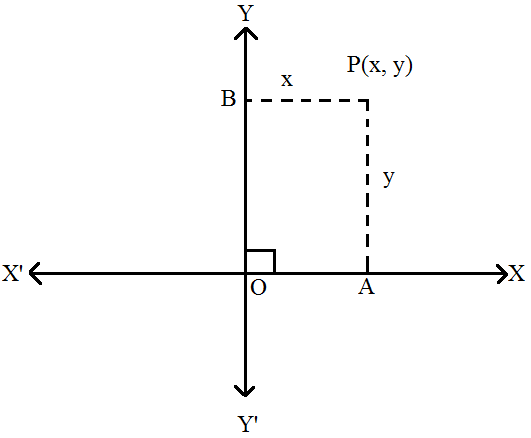
Distance of the point $P(2, 3)$ from the $X-$ axis $=$ Ordinate of a point $P(2, 3) = 3.$ View full question & answer→MCQ 321 Mark
Two vertices of $\triangle\text{ABC}$ are $A(-1, 4)$ and $B(5, 2)$ and its centroid is $G(0, -3).$ Then, the coordinates of $C$ are :
- A
$(4, 3)$
- B
$(4, 15)$
- ✓
$(-4, -15)$
- D
$(-15, -4)$
AnswerCorrect option: C. $(-4, -15)$
Let the third vertex have coordinates $D (x,y).$
The centroid of a triangle is given by
$\text{C}(\text{x,y}) = \Big(\frac{\text{x}_1 + \text{x}_2 + \text{x}_3}{3},\frac{\text{y}_1 + \text{y}_2 + \text{y}_3}{3}\Big)$
$\Rightarrow \text{G}(0,-3) = \Big(\frac{-1 +5 \text{ x}}{3},\frac{4+2+\text{ y}}{3}\Big)$
$\Rightarrow \text{G}(0,-3) = \Big(\frac{4+\text{ x}}{3},\frac{4+2+\text{ y}}{3}\Big)$
$\Rightarrow \frac{4+\text{ x}}{3} = 0 $ and $\frac{6 + \text{ y}}{3} = -3$
$\Rightarrow 4+\text{x} - 0 $ and $ 6+\text{ y} = -9$
$\Rightarrow \text{x} = -4 $ and $\text{ y} = -15$
So, the coordinates of the third vertex are $(-4,-15)$
View full question & answer→MCQ 331 Mark
If $A(-1, 0), B(5, -2)$ and $C(8, 2)$ are the vertices of a $\triangle\text{ABC}$ then its centroid is :
- A
$(12, 0)$
- B
$(6, 0)$
- C
$(0, 6)$
- ✓
$(4, 0)$
AnswerCorrect option: D. $(4, 0)$
Let the centrcid have coordinates $C(x,y).$
The centroid of a triangle is given by
$\text{C}(\text{x,y}) = \Big(\frac{\text{x}_1+\text{x}_2+\text{x}_3}{3},\frac{\text{y}_1+\text{y}_2+\text{y}_3}{3}\Big)$
$\Rightarrow \text{C}\text{(x,y)} = \Big(\frac{-1+5+8}{3},\frac{0-2+2}{3}\Big)$
$\Rightarrow \text{C}(\text{x,y}) = (4,0)$
View full question & answer→MCQ 341 Mark
The distance between the points $(a, b)$ and $(-a, -b)$ is :
AnswerCorrect option: C. $2\sqrt{\text{a}^2+\text{b}^2}$
The distance between the points $(a,b)$ and $(-a,-b)$
$=\sqrt{(-a-a)^2 + (-b-b)^2}$
$=\sqrt{4\text{a}^2+4\text{b}^2}$
$=2\sqrt{\text{a}^2+\text{b}^2}$
View full question & answer→MCQ 351 Mark
$A$ is a point on the $x -$ axis whose abscissa is $5$ and $B$ is the point $(1, -3),$ then the distance $AB$ is
- A
$8$ units
- ✓
$5$ units
- C
$9$ units
- D
$25$ units
AnswerCorrect option: B. $5$ units
$A$ is a point of the $x-$ axis,therefore coordinates of $A$ are $(5,0)$
Here. $A (5,0)$ and $B (1,-3)$
$\therefore\text{AB}=\sqrt{(1-5)^2+(-3-0)^2}$
$=\sqrt{16+9}$
$=\sqrt{25}=5\text{ units}$
View full question & answer→MCQ 361 Mark
In the given figure $P(5, -3)$ and $Q(3, y)$ are the points of teisection of the line segment joining $A(7, -2)$ and $B(1, -5). $ Then $y$ equals :

- A
$2$
- B
$4$
- ✓
$-4$
- D
$\frac{-5}{2}$
AnswerSince $P$ and $Q$ are the points of trisection.
This means $AP = PQ = QB.$
So, $Q$ divides $AB$ in the ratio $2 : 1$ and let the coordinates of $Q$ be $(x, y).$
We know that, the centre is the mid $-$ point of the diameter.
Using the section formula, we get
$(3,\text{y})=\Big(\frac{2(1)+1(7)}{2+1},\frac{2(-5)+1(-2)}{2+1}\Big)$
$\Rightarrow\ \text{y}=\frac{2(-5)+1(-2)}{2+1}$
$\Rightarrow\ \text{y}=-4$
View full question & answer→MCQ 371 Mark
$\text{AOBC}$ is a rectangle whose three vertices are vertices $A(0, 3), O(0, 0)$ and $B(5, 0).$ The length of its diagonal is :
AnswerCorrect option: C. $\sqrt{34}$
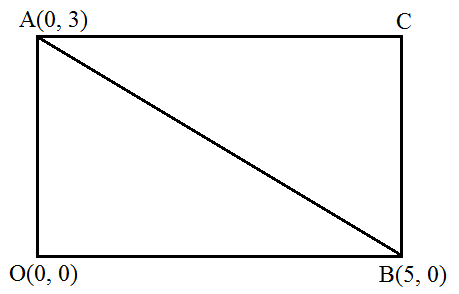
Now, length of the diagonal $AB =$ Distance between the points $A(0, 3)$ and $B(5, 0)$
Distance between the point $(x_1, y_1)$ and $(x_2, y_2)$
$\text{d}=\sqrt{(\text{x}_2-\text{x}_1)^2+(\text{y}_2-\text{y}_1)^2}$
Here, $\mathrm{x}_1=0, \mathrm{y}_1=3$ and $\mathrm{x}_2=5, \mathrm{y}_2=0$
Distance between the points $A(0, 3 )$ and $B(5, 0)$
$\text{AB}=\sqrt{(5-0)^2+(0-3)^2}$
$\text{AB}=\sqrt{25+9}$
$\text{AB}=\sqrt{34}$
Hence, the required length of its diagonal is $\sqrt{34}.$ View full question & answer→MCQ 381 Mark
$\text{AOBC}$ is a rectangle whose three vertices are $A(0, 3), O(0, 0)$ and $B(5, 0)$. The length of each of its diagonals is :
- A
$5\text{ units}$
- B
$3\text{ units}$
- C
$4\text{ units}$
- ✓
$\sqrt{34}\text{ units}$
AnswerCorrect option: D. $\sqrt{34}\text{ units}$
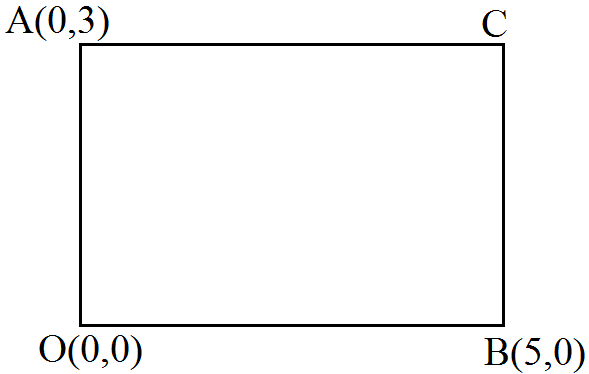
The diagonal $=\sqrt{(0-5)^2+(3-0)^2}$
$=\sqrt{5^2+3^2}$
$=\sqrt{25+9}$
$=\sqrt{34}\text{ units}$ View full question & answer→MCQ 391 Mark
The points $A(4, -1), B(6, 0), C(7, 2) $ and $D(5, 1)$ are the vertices of a
AnswerGiven : the points $A(4-1),B(6,0),C(7,2) $ and $D(5,1)$
$\therefore\text{AB}=\sqrt{(6-4)^2+(0+1)^2=\sqrt{4+1}=2\sqrt{5\text{units}}}$
$\text{BC}=\sqrt{(7-6)^2+(2-0)^2=\sqrt{1+4}=\sqrt{5\text{units}}}$
$\text{CD}=\sqrt{(5-7)^2+(1-2)^2=\sqrt{1+4}=\sqrt{5\text{units}}}$
$\text{AD}=\sqrt{(5-4)^2+(1+1)^2=\sqrt{1+4}=\sqrt{5\text{units}}}$
Therefore diagonals $AC$ and $BD$ are not equal.
Since all sides are equal and both diagonals are not equal.
Therefore the given quadrilateral is a rhambus.
View full question & answer→MCQ 401 Mark
The points $A(1, 2), B(5, 4), C(3, 8)$ and $D(-1, 6)$ are the vertices of a :
AnswerGiven : The points $A(1,2),B(,5,4),C(3,8)$ and $D(-1,6)$
$\therefore\text{AB}\sqrt{(5-1)^2+(4-2)^2=\sqrt{16+4}=2\sqrt{5\text{ units}}}$
$\text{BC}\sqrt{(3-5)^2+(8-4)^2=\sqrt{4+16}=2\sqrt{5\text{ units}}}$
$\text{CD}\sqrt{(-1-3)^2+(6-8)^2=\sqrt{16+4}=2\sqrt{5\text{ units}}}$
$\text{AD}\sqrt{(-1-1)^2+(6-2)^2=\sqrt{16+4}=2\sqrt{5\text{ units}}}$
Therefore the $4$ sides $AB,BD,CD$ and $DA$ are equal
and the $\text{AC}\sqrt{(3-1)^2+(8-2)^2=\sqrt{4+36}=2\sqrt{10\text{ units}}}$
and $\text{BD}\sqrt{(-1-5)^2+(6-4)^2=\sqrt{36+4}=2\sqrt{10\text{ units}}}$
Therefore diagonals $AC$ and $BD$ are equal
Since all $4$ sides are equal and both diagonals are also equal.
Therefore, the given quadrilateral is a square.
View full question & answer→MCQ 411 Mark
If three points $(0, 0), (3,\sqrt{3})$ and $(3,\lambda)$ form an equilateral triangle, then $\lambda=$
AnswerLet the points $(0, 0), (3,\sqrt{3})$ and $(3,\lambda)$ form an equilateral triangle
$AB = BC = CA$
$\Rightarrow A B^2=B C^2=C A^2$
Now, $A B^2=\left(x_2-x_1\right)^2+\left(y_2-y_1\right)^2$
$=(3-0)^2+(\sqrt{3}-0)^2$
$=(3)^2+(\sqrt{3})^2$
$=9+3=12$
$\text{BC}^2=(3-3)^2+(\lambda-\sqrt{3})^2$
$=(0)^2+(\lambda-\sqrt{3})^2=(\lambda-\sqrt{3})^2$
and $\text{CA}^2=(0-3)^2+(0-\lambda)^2$
$=(-3)^2+(-\lambda)^2$
$=9+\lambda^2$
$\text{AB}^2=\text{CA}^2$
$\Rightarrow\ 12=9+\lambda^2$
$\Rightarrow\ \lambda^2=12-9=3$
$\therefore\ \lambda=\pm\sqrt{3}$
View full question & answer→MCQ 421 Mark
The ratio in which the line segment joining $P(x_1, y_1)$ and $Q(x_2, y_2)$ is divided by $x-$ axis is :
- A
$ y_1: y_2 $
- ✓
$ -y_1: y_2 $
- C
$ x_1: x_2 $
- D
$ -x_1: x_2 $
AnswerCorrect option: B. $ -y_1: y_2 $
Let a point $A$ on $x-$ axis divides the line segment joining the points $P\left(x_1, y_1\right), Q\left(x_2, y_2\right)$ in the ratio $m_1: m_2$ and let co $-$ ordinates of $A$ be $(x, 0)$
$\therefore\ 0=\frac{\text{m}_1\text{y}_2+\text{m}_2\text{y}_1}{\text{m}_1+\text{m}_2}$
$\Rightarrow\ 0=\text{m}_1\text{y}_2+\text{m}_2\text{y}_1$
$\Rightarrow\ \text{m}_1\text{y}_2=-\text{m}_2\text{y}_1$
$\Rightarrow\ \frac{\text{m}_1}{\text{m}_2}=\frac{-\text{y}_1}{\text{y}_2}$
$\therefore$ Ratio is $ -y_1: y_2 $
View full question & answer→MCQ 431 Mark
If the points $A(1, 2), O(0, 0)$ and $C(a, b)$ are collinear, then :
- A
$a = b$
- B
$a = 2b$
- ✓
$2a = b$
- D
$a = -b$
AnswerCorrect option: C. $2a = b$
Let the given points are $A=\left(x_1, y_1\right)=(1,2), B=\left(x_2, y_2\right)=(0,0)$ and $C=\left(x_3, y_3\right)=(a, b)$.
$\because\text{Area of } \triangle\text{ABC }\triangle=\frac{1}{2}[\text{x}_1(\text{y}_2-\text{y}_3)+\text{x}_2(\text{y}_3-\text{y}_1)+\text{x}_3(\text{y}_1-\text{y}_2)]$
$\therefore\triangle=\frac{1}{2}[1(0 - \text{b})+0(\text{b}-2)+\text{a}(2 -0)]$
$\triangle=\frac{1}{2}(\text{-b} + 0 +2\text{a})$
$\triangle=\frac{1}{2}(2\text{a}-\text{b})$
Since, the points $A(1, 2), B(0, 0)$ and $C(a, b)$ are collinear, then area of $\triangle\text{ABC}$ should be equal to zero.
$\text{i.e.,}\text{ area of }\triangle\text{ ABC}=0$
$\Rightarrow\frac{1}{2}(2\text{a} - \text{b})=0 $
$\Rightarrow2\text{a}-\text{b}=0$
$\Rightarrow2\text{a}=\text{b}$
Hence, the required relation is $2a = b.$
View full question & answer→MCQ 441 Mark
The distance between $(\text{at}^2\text{2at}) $ and $ (\frac{\text{a}}{\text{t}^2},\frac{-2\text{a}}{\text{t}})$
- ✓
$\text{a}(\text{t}+\frac{1}{\text{t}})^2$
- B
$\text{a}(\text{t}+\frac{1}{\text{t}})\text{units}$
- C
$(\text{t}+\frac{1}{\text{t}})^2\text{units}$
- D
$\text{a}(\text{t}-\frac{1}{\text{t}})^2\text{units}$
AnswerCorrect option: A. $\text{a}(\text{t}+\frac{1}{\text{t}})^2$
The ditance between $(\text{at}^2\text{2at}) $ and $ (\frac{\text{a}}{\text{t}^2},\frac{-2\text{a}}{\text{t}})$
$=\sqrt{\Bigg(\frac{\text{a}}{\text{t}^2}{\text{-at}^2\Bigg)}^2\Bigg(\frac{\text{-2a}}{\text{t}}{\text{-at}^2\Bigg)}^2}$
$=\text{a}\sqrt{\frac{1}{\text{t}^4}+\text{t}^4-2+\frac{4}{\text{t}^2}+4\text{t}^2+8}$
$=\text{a}\sqrt{\frac{1}{\text{t}^4}+\text{t}^4+\frac{4}{\text{t}^2}+4\text{t}^2+6}$
$=\text{a}\sqrt{\frac{1}{\text{t}^4}+\text{t}^4-4+2+\frac{4}{\text{t}^2}+4\text{t}^2}$
$=\sqrt{(\text{t}^2+\frac{1}{\text{t}^2}+2)}^2$
$=\text{a}(\text{t}^2+\frac{1}{\text{t}^2}+2)^2$
$=\text{a}(\text{t}+\frac{1}{\text{t}})^2\text{units}$
View full question & answer→MCQ 451 Mark
If points $(1, 2), (-5, 6)$ and $(a, -2)$ are collinear, then $a =$
AnswerThe area of a triangle whose vertices are $(1, 2), (-5, 6)$ and $(a, -2)$
$=\frac{1}{2}[\text{x}_1(\text{y}_2-\text{y}_3)+\text{x}_2(\text{y}_3-\text{y}_1)+\text{x}_3(\text{y}_1-\text{y}_2)]$
$=\frac{1}{2}[1(6+2)+(-5)(-2-2)+\text{a}(2-6)]$
$=\frac{1}{2}[1\times8+(-5)(-4)+\text{a}(-4)]$
$=\frac{1}{2}[8+20-4\text{a}]$
$\Rightarrow\ \frac{1}{2}(28-4\text{a})$
$=(14-2\text{a})\text{ sq.units}$
$\because$ The points are collinear.
$\therefore$ Area $= 0$
$\Rightarrow\ 14-2\text{a}=0$
$\Rightarrow\ 2\text{a}=14$
$\Rightarrow\ \text{a}=\frac{14}{2}=7$
Hence $, a = 7$
View full question & answer→MCQ 461 Mark
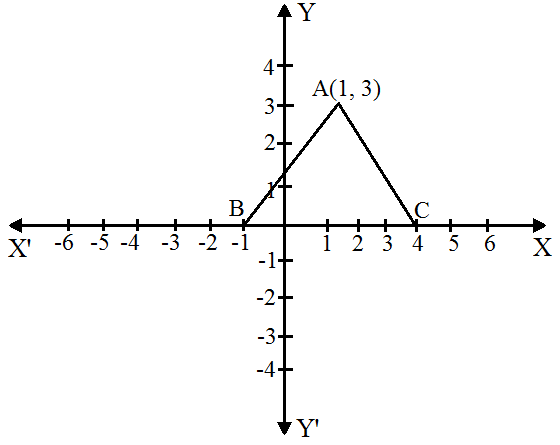
In the figure, the area of $\triangle \text{ABC} \ ($in square units$)$ is :
Answer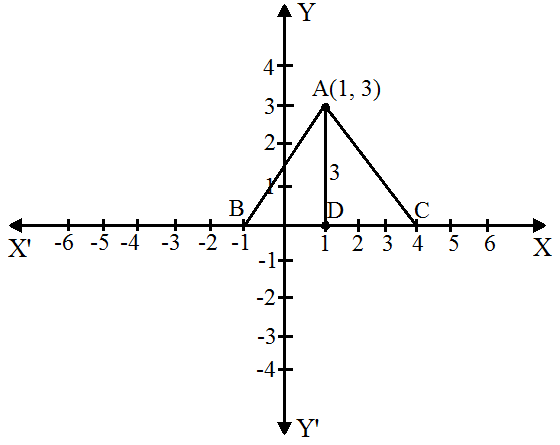
The coordinates of $A$ are $(1, 3).$
$\therefore$ Distance of $A$ from the $x-$ axis $, AD = y-$ coordinate of $A = 3$ units.
The number of units between $B$ and $C$ on the $x-$ axis are $5.$
$\therefore BC = 5$ units
Now,
Area of $\triangle\text{ABC}=\frac{1}{2}\times\text{BC}\times\text{AD}$
$=\frac{1}{2}\times5\times3=\frac{15}{2}=7.5\text{ sq.units}$
Thus, the area of $\triangle \text{ABC}$ is $7.5$ sq. units. View full question & answer→MCQ 471 Mark
If the distance between the points $(p, -5)$ and $(2, 7)$ is $13$ units, then the value of $p$ is
- ✓
$-3, 7$
- B
$3, -7$
- C
$3, 7$
- D
$-3, -7$
AnswerCorrect option: A. $-3, 7$
Let point $A$ be $(p,-5)$ and point $B (2,7)$ and distance between $A$ and $B=13$ units
$\therefore13=\sqrt{(2-\text{p})^2+(7+5)^2}$
$\Rightarrow13=\sqrt{4=\text{p}2-4\text{p}+144}$
$\Rightarrow13=\sqrt{\text{p}2-4\text{p}+148}$
$\Rightarrow169=\text{p}2-4\text{p}+48$
$\Rightarrow\text{p}2-4\text{p}-21=0$
$\Rightarrow\text{p}2-7\text{p}=3\text{p}-21=0$
$= \text{p}\text{(p-7)}+3\text{p-7}=0$
$\Rightarrow\text{(p-7)}\text{(p+3)}=0$
$\Rightarrow$$\text{p}=7,\text{p}=-3$
View full question & answer→MCQ 481 Mark
If $P(2, 4), Q(0, 3), R(3, 6)$ and $S(5, y) $ are the vertices of a paralelogram $\text{PQRS},$ then the value of $y$ is:
AnswerIt is given that $P(2, 4), Q(0, 3), R(3, 6) $ and $S(5, y)$ are the vertices of a parallelogram $\text{PQRS}.$
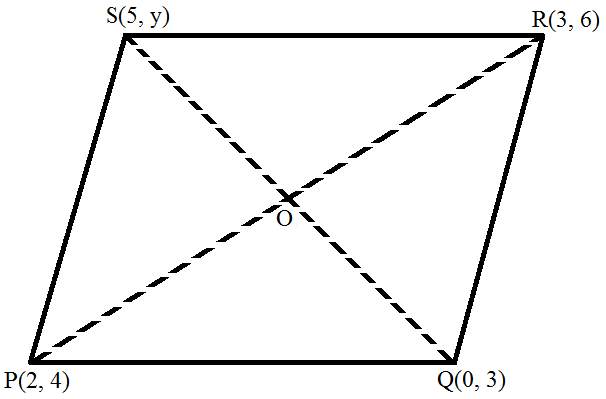
Join $PR$ and $QS,$ intersecting each other at $O$.
We know that the diagonals of the parallelogram bisect each other.
So, $O$ is the mid $-$ point of $PR$ and $QS$.
Coordinates of mid $-$ point of $\text{PR}=\Big(\frac{2+3}{2},\frac{4+6}{2}\Big)$
$=\Big(\frac{5}{2},\frac{10}{2}\Big)=\Big(\frac{5}{2},5\Big)$
Coordinates of mid $-$ point of $\text{QS}=\Big(\frac{0+5}{2},\frac{3+\text{y}}{2}\Big)$
$=\Big(\frac{5}{2},\frac{3+\text{y}}{2}\Big)$
Now, these points coincides at the point $O.$
$\therefore\ \Big(\frac{5}{2},\frac{3+\text{y}}{2}\Big)=\Big(\frac{5}{2},5\Big)$
$\Rightarrow\ \frac{3+\text{y}}{2}=5$
$\Rightarrow 3 + y = 10$
$\Rightarrow y = 7$
Thus, the value of $y$ is $7.$ View full question & answer→MCQ 491 Mark
The points $P(0, 6), Q(-5, 3)$ and $R(3, 1)$ are the vertices of a triangle, which is:
AnswerCorrect option: D. Right$-$angled.
$\text{PQ}=\sqrt{(0+5^2+(6-3)^2}$
$=\sqrt{25+9}=\sqrt{34}\text{ units}$
$\text{QR}=\sqrt{(-5-3)^2+(3-1)^2}$
$=\sqrt{64+4)}=\sqrt{68}\text{ units}$
$\text{PR}=\sqrt{(0-3)^2+(6-1)^2}$
$=\sqrt{9+25}=\sqrt{34}\text{ units}$
Since $\text{PQ}=\text{PR}=\triangle\text{ABC}$ is an isosceles triangle.
Also, $\text{PQ}^2=34,+\text{ PR}^2=34$ and $\text{QR}^2=68$
Clearly, $\text{PQ}^2+\text{PR}^2=\text{QR}^2,$
and so, $\triangle\text{PQR}$ is a rights$-$angled triangle.
View full question & answer→MCQ 501 Mark
The coordinates of the point on $x-$ axis which are equidistant from the points $(-3, 4)$ and $(2, 5)$ are:
Answer$\because$ The point is on $x-$axis.
$\therefore$ Its ordinate will be $= 0$
Let the points be $P(x, 0)$ which is equidistant from $A(-3, 4) $ and $B(2, 5)$
$P A=P B $
$\Rightarrow P A^2=P B^2$
Now, $P A^2=(-3-x)^2+(4-0)^2$
$=(-3-x)^2+(4)^2$
$=9+x^2+6 x+16=x^2+6 x+25$
and $P B^2=(2-x)^2+(5-0)^2=(2-x)^2+(5)^2$
$=4-4 x+x^2+25$
$=x^2-4 x+29$
$\therefore x^2+6 x+25=x^2-4 x+29$
$\Rightarrow x^2+6 x-x^2+4 x=29-25$
$\Rightarrow 10x = 4$
$\Rightarrow\ \text{x}=\frac{4}{10}=\frac{2}{5}$
Point will be $\Big(\frac{2}{5},0\Big).$
View full question & answer→