MCQ 11 Mark
Directions : In the following questions, a statement of assertion $(A)$ is followed by a statement of reason $(R)$. Mark the correct choice as:
Assertion : If $\text{x}\sin^3\theta +\text{y}\cos3\theta = \sin\theta \cos\theta $ and $ \text {x} \sin\theta = \text{y}\cos\theta , $ then $ \text{ x}^2+\text{y}^2=1.$
Reason : For any value of $\theta , \sin^2\theta +\cos^2\theta =1.$
- ✓
Both assertion $(A)$ and reason $(R)$ are true and reason $(R)$ is the correct explanation of assertion $(A)$.
- B
Both assertion $(A)$ and reason $(R)$ are true but reason $(R)$ is not the correct explanation of assertion $(A)$.
- C
Assertion $(A)$ is true but reason $(R)$ is false.
- D
Assertion $(A)$ is false but reason $(R)$ is true.
AnswerCorrect option: A. Both assertion $(A)$ and reason $(R)$ are true and reason $(R)$ is the correct explanation of assertion $(A)$.
View full question & answer→MCQ 21 Mark
Directions : In the following questions, a statement of assertion $(A)$ is followed by a statement of reason $(R)$. Mark the correct choice as:
Assertion : If $\cos\text{A}+\cos^{2}\text{A}=1$ then $\sin^{2}\text{A}+\sin^{4}\text{A}=2.$
Reason : $1-\sin^{2}\text{A}=\cos^{2}\text{A},$ for any value of $A$.
- A
Both $A$ and $R$ are true and $R$ is the correct explanation for $A.$
- B
Both $A$ and $R$ are true and $R$ is not the correct explanation for $A.$
- C
$A$ is true but $R$ is false.
- ✓
$A$ is false but $R$ is true.
AnswerCorrect option: D. $A$ is false but $R$ is true.
View full question & answer→MCQ 31 Mark
Directions : In the following questions, a statement of assertion $(A)$ is followed by a statement of reason $(R).$ Mark the correct choice as :
Assertion : $\frac{(\sin\theta-\cos\theta)(\sin\theta+\cos)}{(\cos\theta-\sin\theta)(\cos\theta+\sin\theta)}=-1.$
Reason : $\sin^{2}\theta+\cos^{2}\theta=-1.$
- A
$A$ is true, $R$ is true; $R$ is a correct explanation for $A.$
- B
$A$ is true, $R$ is true; $R$ is not a correct explanation for $A.$
- ✓
$A$ is true; $R$ is false.
- D
$A$ is false; $R$ is true.
AnswerCorrect option: C. $A$ is true; $R$ is false.
View full question & answer→MCQ 41 Mark
Directions : In the following questions, a statement of assertion $(A)$ is followed by a statement of reason $(R).$ Mark the correct choice as :
Assertion : In a right angled triangle, if $\tan\theta=\frac{3}{4}$ then $\sin\theta=\frac{3}{5}.$
Reason : $\sin60^\circ=\frac{1}{2}.$
- A
Both $A$ and $R$ are true and $R$ is the correct explanation for $A.$
- B
Both $A$ and $R$ are true and $R$ is not the correct explanation for $A.$
- ✓
$A$ is true but $R$ is false.
- D
$A$ is false but $R$ is true.
AnswerCorrect option: C. $A$ is true but $R$ is false.
View full question & answer→MCQ 51 Mark
Directions: In the following questions, a statement of assertion $(A)$ is followed by a statement of reason $(R)$. Mark the correct choice as:
Assertion: In a right angled triangle, if $\tan\theta=\frac{3}{4},$ then greatest side of the triangle is 5 units.
Reason: $(greatest side)^2 = (hypotenuse)^2 = (perpendicular)^2 + (base)^2.$
- ✓
$A$ is true, $R$ is true; $R$ is a correct explanation for $A.$
- B
$A$ is true, $R$ is true; $R$ is not a correct explanation for $A.$
- C
$A$ is true; $R$ is false.
- D
$A$ is false; $R$ is true.
AnswerCorrect option: A. $A$ is true, $R$ is true; $R$ is a correct explanation for $A.$
$A$ is true, $R$ is true; $R$ is a correct explanation for $A.$
View full question & answer→MCQ 61 Mark
Directions : In the following questions, a statement of assertion $(A)$ is followed by a statement of reason $(R).$ Mark the correct choice as :
Assertion : $\cos^{2}\text{A}-\sin^{2}\text{A}=1,$$\tan^{2}\text{A}-\sec^{2}\text{A}=1$ are trigonometric identities.
Reason : An equation involving trigonometric ratios of an angle is called a trigonometric identity. It is true for all values of the angles involved.
- A
$A$ is true, $R$ is true; $R$ is a correct explanation for $A.$
- B
$A$ is true, $R$ is true; $R$ is not a correct explanation for $A.$
- C
$A$ is true; $R$ is false.
- ✓
$A$ is false; $R$ is true.
AnswerCorrect option: D. $A$ is false; $R$ is true.
View full question & answer→MCQ 71 Mark
Directions : In the following questions, a statement of assertion $(A)$ is followed by a statement of reason $(R)$. Mark the correct choice as:
Assertion : The equation $\sec^{2}\theta=\frac{4\text{xy}}{(\text{x}+\text{y})^{2}}$ is only possible when $x = y.$
Reason : $\sec^{2}\theta>1$ and therefore $(x - y)^2 < 0.$
- ✓
$A$ is true, $R$ is true; $R$ is a correct explanation for $A$.
- B
$A$ is true, $R$ is true; $R$ is not a correct explanation for $A$.
- C
$A$ is true; $R$ is false.
- D
$A$ is false; $R$ is true.
AnswerCorrect option: A. $A$ is true, $R$ is true; $R$ is a correct explanation for $A$.
$A$ is true, $R$ is true; $R$ is a correct explanation for $A$.
View full question & answer→MCQ 81 Mark
Directions : In the following questions, a statement of assertion $(A)$ is followed by a statement of reason $(R).$ Mark the correct choice as:
Assertion : $\sin60^\circ=\cos30^\circ.$
Reason : $\sin2\theta=\sin\theta+\sin\theta,$ where $\theta$ is an acute angle.
- A
$A$ is true, $R$ is true; $R$ is a correct explanation for $A.$
- B
$A$ is true, $R$ is true; $R$ is not a correct explanation for $A.$
- ✓
$A$ is true; $R$ is false.
- D
$A$ is false; $R$ is true.
AnswerCorrect option: C. $A$ is true; $R$ is false.
View full question & answer→MCQ 91 Mark
Directions : In the following questions, a statement of assertion $(A)$ is followed by a statement of reason $(R).$ Mark the correct choice as :
Assertion : $\cos60^\circ-\sin60^\circ$ is negative.
Reason : $\sin^{2}\theta-\cos^{2}\theta$ is positive, where $\theta$ is an acute angle.
- A
$A$ is true, $R$ is true; $R$ is a correct explanation for $A.$
- B
$A$ is true, $R$ is true; $R$ is not a correct explanation for $A.$
- ✓
$A$ is true; $R$ is false.
- D
$A$ is false; $R$ is true.
AnswerCorrect option: C. $A$ is true; $R$ is false.
View full question & answer→MCQ 101 Mark
Directions : In the following questions, a statement of assertion $(A)$ is followed by a statement of reason $(R.)$ Mark the correct choice as :
Assertion : $ \sin\text{A}$ is the product of $ \sin\text{A}$
Reason : The value of $\sin\theta$ increases as $\theta$ increases.
- A
Both assertion $(A)$ and reason $(R)$ are true and reason $(R)$ is the correct explanation of assertion $(A)$.
- B
Both assertion $(A)$ and reason $(R)$ are true but reason $(R)$ is not the correct explanation of assertion $(A)$.
- C
Assertion $(A)$ is true but reason $(R)$ is false.
- ✓
Assertion $(A)$ is false but reason $(R)$ is true.
AnswerCorrect option: D. Assertion $(A)$ is false but reason $(R)$ is true.
View full question & answer→MCQ 111 Mark
Directions : In the following questions, a statement of assertion $(A)$ is followed by a statement of reason $(R).$ Mark the correct choice as :
Assertion : The value of each of the trigonometric ratios of an angle does not depend on the size of the triangle. It only depends on the angle.
Reason : In right $\triangle\text{ABC},$
$\angle\text{B}=90^\circ$ and $\angle\text{A}=\theta^\circ\sin\theta=\frac{\text{BC}}{\text{AC}}<1$ and $\cos\theta=\frac{\text{AB}}{\text{AC}}<1$ as hypotenuse is the longest side.
- A
$A$ is true, $R$ is true; $R$ is a correct explanation for $A$.
- ✓
$A$ is true, $R$ is true; $R$ is not a correct explanation for $A$.
- C
$A$ is true; $R$ is false.
- D
$A$ is false; $R$ is true.
AnswerCorrect option: B. $A$ is true, $R$ is true; $R$ is not a correct explanation for $A$.
View full question & answer→MCQ 121 Mark
Directions : In the following questions, a statement of assertion $(A)$ is followed by a statement of reason $(R).$ Mark the correct choice as :
Assertion : In a right angled triangle, if $\cos\theta=\frac{1}{2}$ and $\sin\theta=\frac{\sqrt{3}}{2},$ then $\tan\theta=\sqrt{3}.$
Reason : $\tan\theta=\frac{\sin\theta}{\cos\theta}.$
- ✓
Both $A$ and $R$ are true and $R$ is the correct explanation for $A.$
- B
Both $A$ and $R$ are true and $R$ is not the correct explanation for $A.$
- C
$A$ is true but $R$ is false.
- D
$A$ is false but $R$ is true.
AnswerCorrect option: A. Both $A$ and $R$ are true and $R$ is the correct explanation for $A.$
View full question & answer→MCQ 131 Mark
Directions : In the following questions, a statement of assertion $(A)$ is followed by a statement of reason $(R)$. Mark the correct choice as:
Assertion : The value of $ 2\tan^245^\circ+\cos^230^\circ-\sin^260^\circ $ is $ 2.$
Reason : value of $\tan45^\circ=1, \cos30^\circ=\sqrt{\frac{3}{2}} $ and $ \sin60^\circ =\sqrt{\frac{3}{2}}.$
- ✓
Both assertion $(A)$ and reason $(R)$ are true and reason $(R)$ is the correct explanation of assertion $(A)$.
- B
Both assertion $(A)$ and reason $(R)$ are true but reason $(R)$ is not the correct explanation of assertion $(A)$.
- C
Assertion $(A)$ is true but reason $(R)$ is false.
- D
Assertion $(A)$ is false but reason $(R)$ is true.
AnswerCorrect option: A. Both assertion $(A)$ and reason $(R)$ are true and reason $(R)$ is the correct explanation of assertion $(A)$.
View full question & answer→MCQ 141 Mark
Directions : In the following questions, a statement of assertion $(A)$ is followed by a statement of reason $(R)$. Mark the correct choice as:
Assertion : If $\text{ x}=2 \sin^2\theta $ and $\text{y }=2 \cos^2\theta +1$ then the value of $x+y=3.$
Reason : For any value of $\theta , \sin^2\theta +\cos^2\theta =1$
- ✓
Both assertion $(A)$ and reason $(R)$ are true and reason $(R)$ is the correct explanation of assertion $(A)$.
- B
Both assertion $(A)$ and reason $(R)$ are true but reason $(R)$ is not the correct explanation of assertion $(A)$.
- C
Assertion $(A)$ is true but reason $(R)$ is false.
- D
Assertion $(A)$ is false but reason $(R)$ is true.
AnswerCorrect option: A. Both assertion $(A)$ and reason $(R)$ are true and reason $(R)$ is the correct explanation of assertion $(A)$.
View full question & answer→MCQ 151 Mark
Directions : In the following questions, a statement of assertion $(A) $ is followed by a statement of reason $(R).$ Mark the correct choice as:
Assertion : $\sin^{2}67+\cos^{2}67=1.$
Reason : For any value of $\theta,$
$\sin^{2}\theta+\cos^{2}\theta=1.$
- ✓
Both $A$ and $R$ are true and $R$ is the correct explanation for $A.$
- B
Both $A$ and $R$ are true and $R$ is not the correct explanation for $A.$
- C
$A$ is true but $R$ is false.
- D
$A$ is false but $R$ is true.
AnswerCorrect option: A. Both $A$ and $R$ are true and $R$ is the correct explanation for $A.$
View full question & answer→MCQ 161 Mark
Directions : In the following questions, a statement of assertion $(A)$ is followed by a statement of reason $(R).$ Mark the correct choice as:
Assertion : $2\cos\theta=\text{a}+\frac{1}{\text{a}},$ where $a > 0, \text{a}\neq1.$
Reason : $-1\leq\cos\theta\leq1$ for all values of $\theta.$
- A
$A$ is true, $R$ is true; $R$ is a correct explanation for $A.$
- B
$A$ is true, $R$ is true; $R$ is not a correct explanation for $A.$
- C
$A$ is true; $R$ is false.
- ✓
$A$ is false; $R$ is true.
AnswerCorrect option: D. $A$ is false; $R$ is true.
View full question & answer→MCQ 171 Mark
Directions : In the following questions, a statement of assertion $(A)$ is followed by a statement of reason $(R).$ Mark the correct choice as :
Assertion : $(\cot\theta+3)(3\cot\theta+1)=3\ \text{cosec}^{2}\theta+10\cot\theta.$
Reason : $1+\cot^{2}\theta=\text{cosec}^{2}\theta.$
- ✓
$A$ is true, $R$ is true; $R$ is a correct explanation for $A.$
- B
$A$ is true, $R$ is true; $R$ is not a correct explanation for $A.$
- C
$A$ is true; $R$ is false.
- D
$A$ is false; $R$ is true.
AnswerCorrect option: A. $A$ is true, $R$ is true; $R$ is a correct explanation for $A.$
View full question & answer→MCQ 181 Mark
Directions : In the following questions, a statement of assertion $(A)$ is followed by a statement of reason $(R).$ Mark the correct choice as:
Assertion : If $\sec\theta+\tan\theta=\text{x},$ then the value of $\sin\theta=\frac{\text{x}^{2}-1}{\text{x}^{2}-1}.$
Reason : $\text{x}+\frac{1}{\text{x}}=2\tan\theta$ and $\text{x}-\frac{1}{\text{x}}=2\sec\theta.$
- A
$A$ is true, $R$ is true; $R$ is a correct explanation for $A.$
- B
$A$ is true, $R$ is true; $R$ is not a correct explanation for $A.$
- ✓
$A$ is true; $R$ is false.
- D
$A$ is false; $R$ is true.
AnswerCorrect option: C. $A$ is true; $R$ is false.
View full question & answer→MCQ 191 Mark
Directions: In the following questions, a statement of assertion $(A)$ is followed by a statement of reason $(R)$. Mark the correct choice as:
Assertion: The value of $\sin 60^{\circ} \cos 30^{\circ}+\sin 30^{\circ} \cos 60^{\circ}$ is $1$
Reason: $\sin 90^{\circ}=1$ and $\cos 90^{\circ}=0$
- A
Both assertion $(A)$ and reason $(R)$ are true and reason $(R)$ is the correct explanation of assertion $(A)$.
- ✓
Both assertion $(A)$ and reason $(R)$ are true but reason $(R)$ is not the correct explanation of assertion $(A)$.
- C
Assertion $(A)$ is true but reason $(R)$ is false.
- D
Assertion $(A)$ is false but reason $(R)$ is true.
AnswerCorrect option: B. Both assertion $(A)$ and reason $(R)$ are true but reason $(R)$ is not the correct explanation of assertion $(A)$.
Both assertion $(A)$ and reason $(R)$ are true but reason $(R)$ is not the correct explanation of assertion $(A)$.
View full question & answer→MCQ 201 Mark
Statement A (Assertion) :
$\frac{\sin \theta-2 \sin ^3 \theta}{2 \cos ^3 \theta-\cos \theta}=\tan \theta$, where $\theta$ is acute angle.
Statement $R$ (Reason) ; For acute angle $A$, tan $A=\frac{\sin A}{\cos A}$.
- ✓
Both assertion (A) and reason ( $R$ ) are true and reason $(R)$ is the correct explanation of assertion $(A)$.
- B
Both assertion (A) and reason ( $R$ ) are true and reason $(R)$ is not the correct explanation of assertion (A).
- C
Assertion $(A)$ is true but reason $(R)$ is false.
- D
Assertion (A) is false but reason $(R)$ is true.
AnswerCorrect option: A. Both assertion (A) and reason ( $R$ ) are true and reason $(R)$ is the correct explanation of assertion $(A)$.
(a) : We have, L.H.S. $\frac{\sin \theta-2 \sin ^3 \theta}{\cos \theta-2 \sin ^2 \cos \theta}$
$
=\frac{\sin \theta\left(1-2 \sin ^2 \theta\right)}{\cos \theta\left(1-2 \sin ^2 \theta\right)}=\tan \theta=\text { R.H.S }
$
$\therefore$ Assertion and Reason both are true and Reason is the correct explanation of Assertion.
View full question & answer→MCQ 211 Mark
Statement $A(A s s e r t i o n):$ If $\sec \theta+\tan \theta$ $=x$, then the value of $\sec \theta-\tan \theta=\frac{1}{x}$.
Statement R (Reason): $\sec ^2 \theta+\tan ^2 \theta=1$.
- A
Both assertion (A) and reason ( $R$ ) are true and reason $(R)$ is the correct explanation of assertion $(A)$.
- B
Both assertion (A) and reason ( $R$ ) are true and reason $(R)$ is not the correct explanation of assertion (A).
- ✓
Assertion $(A)$ is true but reason $(R)$ is false.
- D
Assertion (A) is false but reason $(R)$ is true.
AnswerCorrect option: C. Assertion $(A)$ is true but reason $(R)$ is false.
(c) : We have, $\sec ^2 0-\tan ^2 \theta=1$
$\Rightarrow(\sec \theta+\tan \theta)(\sec \theta-\tan \theta)-1$
$\Rightarrow \quad x(\sec \theta-\tan \theta)=1 \Rightarrow \sec \theta-\tan \theta-1 / x$
Thus, $\sec \theta+\tan \theta=x$ and $\sec \theta-\tan \theta=1 / x$
$\therefore$ Assertion is true but Reason is false.
View full question & answer→MCQ 221 Mark
Statement A (Assertion): $\cos ^2 A-\sin ^2 A=1$ is a trigonometric identity.
Statement R (Reason) : An equation involving trigonometric ratios of an angle is called a trigonometric identity, if it is true for all values of the angles involved.
- A
Both assertion (A) and reason ( $R$ ) are true and reason $(R)$ is the correct explanation of assertion $(A)$.
- B
Both assertion (A) and reason ( $R$ ) are true and reason $(R)$ is not the correct explanation of assertion (A).
- C
Assertion $(A)$ is true but reason $(R)$ is false.
- ✓
Assertion (A) is false but reason $(R)$ is true.
AnswerCorrect option: D. Assertion (A) is false but reason $(R)$ is true.
(d) : We have, $\cos ^2 A=\sin ^2 A=1$ Put $A=45^{\circ}$ we pet,
$
\cos ^2 45^{\circ}=\sin ^2 45^{\circ}=\left(\frac{1}{\sqrt{2}}\right)^2-\left(\frac{1}{\sqrt{2}}\right)^2=0 \neq 1
$
$\therefore$ It is not trigonometric identity.
$\therefore \quad$ Aseertion is talce but Reason is true.
View full question & answer→MCQ 231 Mark
Statement A (Assertion) : $\sqrt{\frac{1-\cos \theta}{1+\cos \theta}}$ $=\operatorname{cosec} \theta-\cot \theta$
Statement R (Reason) : $\sin ^2 \theta+\cos ^2 \theta=1$.
- ✓
Both assertion (A) and reason ( $R$ ) are true and reason $(R)$ is the correct explanation of assertion $(A)$.
- B
Both assertion (A) and reason ( $R$ ) are true and reason $(R)$ is not the correct explanation of assertion (A).
- C
Assertion $(A)$ is true but reason $(R)$ is false.
- D
Assertion (A) is false but reason $(R)$ is true.
AnswerCorrect option: A. Both assertion (A) and reason ( $R$ ) are true and reason $(R)$ is the correct explanation of assertion $(A)$.
(a) : We have, $\sqrt{\frac{1-\cos \theta}{1+\cos \theta}}-\sqrt{\frac{(1-\cos \theta)(1-\cos \theta)}{(1+\cos \theta)(1-\cos \theta)}}$
$
=\sqrt{\frac{(1-\cos \theta)^2}{1-\cos ^2 \theta}}-\sqrt{\frac{(1-\cos \theta)^2}{\sin ^2 \theta}} \quad\left(\because \sin ^2 \theta-1-\cos ^2 \theta\right)
$
$=\frac{1-\cos \theta}{\sin \theta}=\frac{1}{\sin \theta}-\frac{\cos \theta}{\sin \theta}=\operatorname{cosec} \theta-\cot \theta=$ R.H..
$\therefore$ Assertion and Reason both are true and Reason is the correct explanation of Assertion.
View full question & answer→MCQ 241 Mark
Statement $A\left(\right.$ Assertion) : If $\sin \theta=\frac{1}{2}$ and $\theta$ is acute angle, then $\left(3 \cos \theta-4 \cos ^3 \theta\right)$ is equal to 0.Statement R (Reason) : As $\sin \theta=\frac{1}{2}$ and $\theta$ is acute, so $\theta$ must be $60^{\circ}$.
- A
Both assertion (A) and reason ( $R$ ) are true and reason $(R)$ is the correct explanation of assertion $(A)$.
- B
Both assertion (A) and reason ( $R$ ) are true and reason $(R)$ is not the correct explanation of assertion (A).
- ✓
Assertion $(A)$ is true but reason $(R)$ is false.
- D
Assertion (A) is false but reason $(R)$ is true.
AnswerCorrect option: C. Assertion $(A)$ is true but reason $(R)$ is false.
(c) : We have, $\sin \theta=\frac{1}{2}$
$\Rightarrow \theta=30^{\circ} \quad\left[\because \sin 30^{\circ}=\frac{1}{2}\right]$
$\therefore 3 \cos \theta-4 \cos ^3 \theta=3 \cos 30^{\circ}-4 \cos ^3 3 \sigma^{\circ}$
$
=\frac{3 \sqrt{3}}{2}-4\left(\frac{\sqrt{3}}{2}\right)^3=\frac{3 \sqrt{3}}{2}-\frac{3 \sqrt{3}}{2}=0
$
$\therefore$ Asoertion is true bet Reason is false.
View full question & answer→MCQ 251 Mark
Statement $A$ (Assertion) : $A B C D$ is a rectangle such that $\angle C A B=60^{\circ}$ and $A C=a$ units. The area of rectangle $A B C D$ is $\frac{\sqrt{3}}{2} a^2$ sq. units.
Statement $R$ (Reason) : The value of $\sin 60^{\circ}$ is $\frac{\sqrt{3}}{2}$ and $\cos 60^2$ is $\frac{1}{2}$.
- A
Both assertion (A) and reason ( $R$ ) are true and reason $(R)$ is the correct explanation of assertion $(A)$.
- B
Both assertion (A) and reason ( $R$ ) are true and reason $(R)$ is not the correct explanation of assertion (A).
- C
Assertion $(A)$ is true but reason $(R)$ is false.
- ✓
Assertion (A) is false but reason $(R)$ is true.
AnswerCorrect option: D. Assertion (A) is false but reason $(R)$ is true.
(d): Clearly, reason is true.
In $\triangle A B C, A C=a$ units, $\angle A=60^{\circ}$
$\therefore \quad \sin 60^{\circ}=\frac{B C}{A C}=\frac{B C}{a}$
$\Rightarrow \frac{\sqrt{3}}{2}=\frac{B C}{2} \Rightarrow B C=\frac{\sqrt{3} e}{2}$
Also, $\cos 60^{\circ}-\frac{A B}{A C} \Rightarrow \frac{1}{2}=\frac{A B}{a}$
$\Rightarrow A B=s / 2$
$\therefore$ Area of rectangle $A B C D=A B \times B C$
$
-\frac{\pi}{2} \times \frac{\sqrt{3} r }{2}-\frac{\sqrt{3} r^2}{4}
$
$\therefore$ Assertion is false.
View full question & answer→MCQ 261 Mark
Statement A (Assertion) : In $\triangle P Q R$, right angled at $Q, Q R=3 cm , P R=5 cm$ and $P Q=$ $4 cm$. The value of $\sin ^2 R+\operatorname{cosec} R$ is $\frac{189}{100}$.
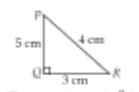
Statement $R$ (Reason) : $\sin ^2 A=(\sin A)^2$ and cosec $A=(\operatorname{scc} A)^{-1}$. - A
Both assertion (A) and reason ( $R$ ) are true and reason $(R)$ is the correct explanation of assertion $(A)$.
- B
Both assertion (A) and reason ( $R$ ) are true and reason $(R)$ is not the correct explanation of assertion (A).
- ✓
Assertion $(A)$ is true but reason $(R)$ is false.
- D
Assertion (A) is false but reason $(R)$ is true.
AnswerCorrect option: C. Assertion $(A)$ is true but reason $(R)$ is false.
(c) : Since, $P R=5$ and $P Q=4$
$
\therefore \quad \sin R=\frac{P Q}{P R}=\frac{4}{5}
$So, $\sin ^2 R+\operatorname{cosec} R$
$
=\left(\frac{4}{5}\right)^2+\frac{1}{4 / 5}=\frac{16}{25}+\frac{5}{4}=\frac{64+125}{25 \times 4}=\frac{189}{100}
$
Also, $\operatorname{cosec} A=(\sin A)^{-1}$
$\therefore$ Assertion is true but Reason is false.
View full question & answer→MCQ 271 Mark
Statement A (Assertion) : In a $\triangle A B C$, right angled at $B$, if $\sin A=\frac{8}{17}$, then coss $A=\frac{15}{17}$ and $\tan A=\frac{8}{15}$.
Statement R (Reason) : For acute angle 0 , $\cos \theta=\frac{\text { Hypotenuse }}{\text { Base }}$ and $\tan \theta=\frac{\text { Base }}{\text { Perpendicular }}$.
- A
Both assertion (A) and reason ( $R$ ) are true and reason $(R)$ is the correct explanation of assertion $(A)$.
- B
Both assertion (A) and reason ( $R$ ) are true and reason $(R)$ is not the correct explanation of assertion (A).
- ✓
Assertion $(A)$ is true but reason $(R)$ is false.
- D
Assertion (A) is false but reason $(R)$ is true.
AnswerCorrect option: C. Assertion $(A)$ is true but reason $(R)$ is false.
(c) : Clearly, reason is false.
Given, $\sin \lambda=\frac{8}{17}$
$
\cos A=\sqrt{1-\left(\frac{8}{17}\right)^2}=\sqrt{\frac{289-64}{17^2}}=\frac{15}{17}
$
$
\tan A=\frac{\sin A}{\cos A}=\frac{8 / 17}{15 / 17}=\frac{8}{15}
$
$\therefore$ Asecrtion is true.
View full question & answer→MCQ 281 Mark
Statement A (Assertion) : The value of each of the trisonometric ratios of an angle do not vary with the lengths of the sides of the triangle, if the angle remains the same.
Statement $R$ (Reason) : In right $\triangle A B C, \angle B=$ $90^{\circ}$ and $\angle A=\theta, \sin \theta=\frac{B C}{A C}<1$ and $\cos \theta=\frac{A B}{A C}$ $<1$ as hypotenuse is the longeet side.
- A
Both assertion (A) and reason ( $R$ ) are true and reason $(R)$ is the correct explanation of assertion $(A)$.
- ✓
Both assertion (A) and reason ( $R$ ) are true and reason $(R)$ is not the correct explanation of assertion (A).
- C
Assertion $(A)$ is true but reason $(R)$ is false.
- D
Assertion (A) is false but reason $(R)$ is true.
AnswerCorrect option: B. Both assertion (A) and reason ( $R$ ) are true and reason $(R)$ is not the correct explanation of assertion (A).
(b) :
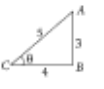
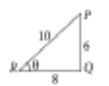
In $\triangle A B C$ and in $\triangle P Q R$, $\sin \theta=\frac{A B}{A C}=\frac{3}{5}$ and $\sin \theta=\frac{P Q}{P R}=\frac{6}{10}$
$\Rightarrow \sin \theta=\frac{3}{5}$ and $\sin \theta=\frac{3}{5}$
Similarly, this will also holds for other trigonometric ratios.
$\therefore$ Trigonometric ratio does not depend on the size of the triangle.
$\therefore$ Assertion and Reason both are true but Reason is not the correct explanation of Asoertion. View full question & answer→