Questions

3 Marks Question

🎯

Test yourself on this topic

3 questions · timed · auto-graded

Question 13 Marks
If two zeroes of the polynomial $p(x) = x^4- 6x^3- 26x^2 + 138x - 35$ are 2 ± $\sqrt3$. Find the other zeroes.
Answer
As 2 ± $\sqrt3$ are the zeroes of p(x), so x - (2 ± $\sqrt3$) are the factors of p(x) and the product of factors,
$\{ x - ( 2 + \sqrt { 3 } ) \} \{ x - ( 2 - \sqrt { 3 } ) \}$
$= \{ ( x - 2 ) - \sqrt { 3 } \} \{ ( x - 2 ) + \sqrt { 3 } \}$
$= ( x - 2 ) ^ { 2 } - ( \sqrt { 3 } ) ^ { 2 }$
$= x^2 - 4x + 1$
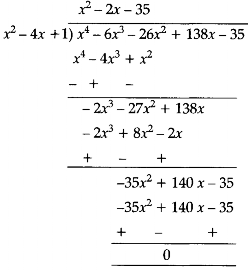
Dividing p(x) by $x^2 - 4x + 1$​​​​​​​

Factorising $(x^2 - 2x - 35)$ we get
$= (x + 5)(x - 7)$
$x = -5, 7$
Hence, other two zeroes of p(x) are $- 5$ and $7.$
View full question & answer
Question 23 Marks
Find a quadratic polynomial of the given numbers as the sum and product of its zeroes respectively. $- \frac { 1 } { 4 } , \frac { 1 } { 4 }$
Answer
Let the polynomial be $ax^2 + bx + c,$
and its zeroes be $\alpha $ and $\beta $.
Then, $\alpha + \beta = - \frac { 1 } { 4 } = - \frac { b } { a } \text { and } \alpha \beta = \frac { 1 } { 4 } = \frac { c } { a }$
If a = 4, then b = 1 and c = 1.
So, one quadratic polynomial which fits the given conditions is $4x^2 + x + 1.$
Aliter,
It given that $\alpha + \beta = - \frac { 1 } { 4 } \text { and } \alpha \beta = \frac { 1 } { 4 }$
now, standard form of quadratic polynomial is given by $x ^ { 2 } - ( \alpha + \beta ) x + \alpha \beta$
$= x ^ { 2 } - ( \alpha + \beta ) x + \alpha \beta$
$= x ^ { 2 } - \left( - \frac { 1 } { 4 } \right) x + \frac { 1 } { 4 }$
$= \frac { 1 } { 4 } \left( 4 x ^ { 2 } + x + 1 \right)$
Hence the required quadratic polynomial is $4x^2 + x + 1$
View full question & answer
Question 33 Marks
Find the zeroes of quadratic polynomial $3x^2 - x - 4$ and verify the relationship between the zeroes and their coefficients.
Answer
The quadratic equation is given as: $3x^2 – x – 4$
(Now we will factorize 1 in such a way that the product of factors is equal to -12 and the sum is equal to 1)
$= 3x^2 - 4x + 3x - 4$
$= x(3x - 4) + 1(3x - 4)= (3x – 4 )(x + 1)$
The value of $3x^2 − x − 4$ is zero when $3x − 4 = 0$ or $x + 1 = 0,$
when $x=\frac{4}{3} \text { or } x=-1$
Therefore, the zeroes of $3x^2 − x − 4$ are $\frac{4}{3}$ and $-1$
Sum of zeroes = $\frac{4}{3}+(-1)=\frac{1}{3}=\frac{-(-1)}{3}=\frac{-\text { coefficient of } x}{\text { coefficient of } x^{2}}$
Product of zeroes =$\frac{4}{3}(-1)=\frac{-4}{3}=\frac{\text { constant term }}{\text { coefficient of } x^{2}}$
Hence verified.
View full question & answer
3 Marks Question - MATHS STD 10 Questions - Vidyadip