Questions

Assertion (A) & Reason (B) MCQ

🎯

Test yourself on this topic

7 questions · timed · auto-graded

MCQ 11 Mark
Directions : In the following questions, a statement of assertion $(A)$ is followed by a statement of reason $(R)$. Mark the correct choice as:
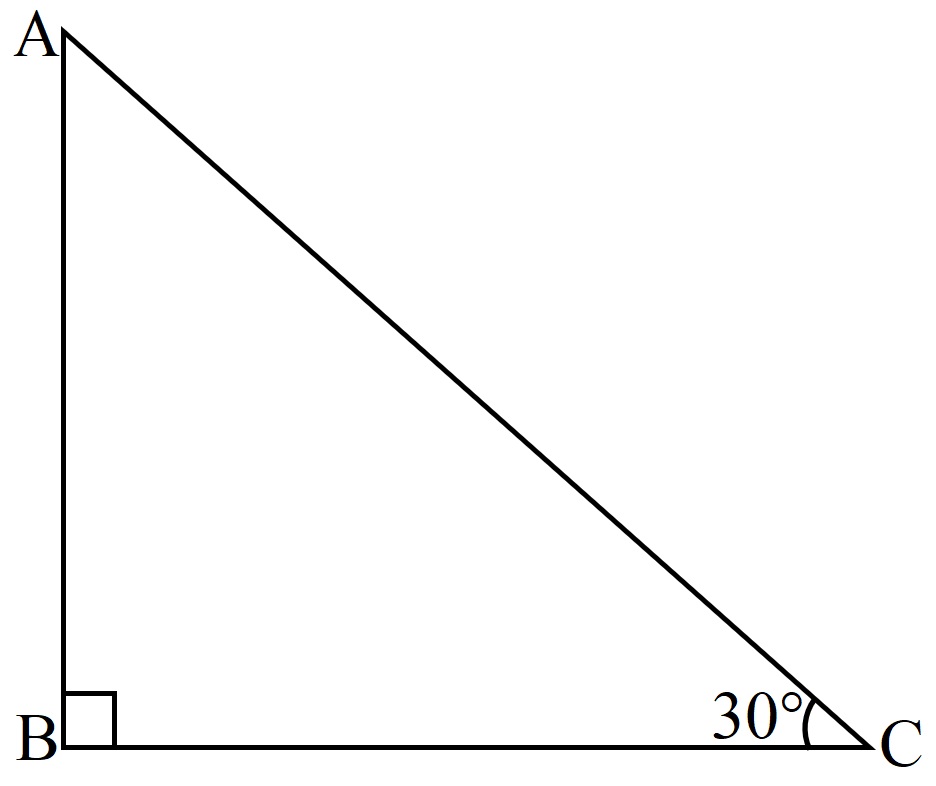
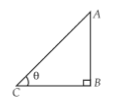
Assertion : In the figure, if $BC = 20m,$ then height $AB$ is $11.56m.$
Reason : $\tan\theta=\frac{\text{AB}}{\text{BC}}=\frac{\text{perpendicular}}{\text{base}}$ where $\theta$ is the $\angle\text{ACB}$​​​​​​​
  • Both assertion $(A)$ and reason $(R)$ are true and reason $(R)$ is the correct explanation of assertion $(A)$.
  • B
    Both assertion $(A)$ and reason $(R)$ are true but reason $(R)$ is not the correct explanation of assertion $(A)$.
  • C
    Assertion $(A)$ is true but reason $(R)$ is false.
  • D
    Assertion $(A)$ is false but reason $(R)$ is true.
Answer
Correct option: A.
Both assertion $(A)$ and reason $(R)$ are true and reason $(R)$ is the correct explanation of assertion $(A)$.
Both the assertion and reason are correct, reason is the correct explanation of the assertion.
$\tan30^\circ=\frac{\text{AB}}{\text{BC}}=\frac{\text{AB}}{20}$
$\text{AB}=\frac{1}{\sqrt{3}}\times20=\frac{20}{1.73}=11.56\text{m}$
View full question & answer
MCQ 21 Mark
Directions: In the following questions, a statement of assertion $(A)$ is followed by a statement of reason $(R)$ .Mark the correct choice as:
Assertion: If the length of shadow of a vertical pole is equal to its height, then the angle of elevation of the sun is $45^{\circ}$
Reason: According to pythagoras theorem, $h ^2= I ^2+ b ^2$ where $h =$ hypotenuse, $I =$ length and $b =$ base
  • A
    Both assertion $(A)$ and reason $(R)$ are true and reason $(R)$ is the correct explanation of assertion $(A)$.
  • Both assertion $(A)$ and reason $(R)$ are true but reason $(R)$ is not the correct explanation of assertion $(A)$.
  • C
    Assertion $(A)$ is true but reason $(R)$ is false.
  • D
    Assertion $(A)$ is false but reason $(R)$ is true.
Answer
Correct option: B.
Both assertion $(A)$ and reason $(R)$ are true but reason $(R)$ is not the correct explanation of assertion $(A)$.
Both assertion $(A)$ and reason $(R)$ are true but reason $(R)$ is not the correct explanation of assertion $(A).$
View full question & answer
MCQ 31 Mark
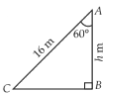
Statement A (Assertion) : A ladder $16 m$ long just reaches the top of a vertical wall. If the ladder makes an angle of $60^{\circ}$ with the wall, then the height of the wall is $8 m$.
Statement R (Reason): The value of $\sin 60^{\circ}=\frac{\sqrt{3}}{2}$.
  • A
    Both assertion (A) and reason ( $R$ ) are true and reason $(R)$ is the correct explanation of assertion $(A)$.
  • Both assertion (A) and reason ( $R$ ) are true and reason $(R)$ is not the correct explanation of assertion (A).
  • C
    Assertion $(A)$ is true but reason $(R)$ is false.
  • D
    Assertion (A) is false but reason $(R)$ is true.
Answer
Correct option: B.
Both assertion (A) and reason ( $R$ ) are true and reason $(R)$ is not the correct explanation of assertion (A).
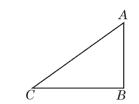
(b) : Clearly, reason is correct. Let $A B=h m$ be the height of the wall and $A C=16 m$ be the length of the ladder.
Image
In $\triangle A B C, \cos 60^{\circ}=\frac{A B}{A C} \Rightarrow \frac{1}{2}=\frac{h}{16}$
$\Rightarrow h=\frac{16}{2}=8 m$
$\therefore \quad$ Both assertion and reason are correct but reason is not the correct explanation of assertion.
View full question & answer
MCQ 41 Mark
Statement A (Assertion) : If a vertical tower of height $50 m$ casts a shadow of length $50 \sqrt{3} m$, then the angle of elevation of the Sun is $60^{\circ}$.
Statement R (Reason): If the angle of elevation of the Sun decreases, then the length of shadow of a tower increases.
  • A
    Both assertion (A) and reason ( $R$ ) are true and reason $(R)$ is the correct explanation of assertion $(A)$.
  • B
    Both assertion (A) and reason ( $R$ ) are true and reason $(R)$ is not the correct explanation of assertion (A).
  • C
    Assertion $(A)$ is true but reason $(R)$ is false.
  • Assertion (A) is false but reason $(R)$ is true.
Answer
Correct option: D.
Assertion (A) is false but reason $(R)$ is true.
(d) : Clearly, reason is correct.
Now, let $A B$ be the tower of height $50 m$ and $A C$ is the shadow of the tower of length $50 \sqrt{3} m$.
Let $\angle A C B=\theta$
Now in $\triangle A B C$,
$
\begin{aligned}
& \tan \theta=\frac{A B}{A C}=\frac{50}{50 \sqrt{3}} \\
\Rightarrow & \tan \theta=\frac{1}{\sqrt{3}}=\tan 30^{\circ} \\
\Rightarrow & \theta=30^{\circ}
\end{aligned}
$
So, assertion is wrong.
View full question & answer
MCQ 51 Mark
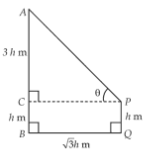
Statement A (Assertion): The height of an observer is $h m$. He stands on a horizontal ground at a distance $\sqrt{3} h m$ from a vertical pillar of height $4 h m$. The angle of elevation of the top of the pillar as seen by the observer is $60^{\circ}$.
Statement $R$ (Reason): The value of $\tan 60^{\circ}=\sqrt{3}$.
  • Both assertion (A) and reason ( $R$ ) are true and reason $(R)$ is the correct explanation of assertion $(A)$.
  • B
    Both assertion (A) and reason ( $R$ ) are true and reason $(R)$ is not the correct explanation of assertion (A).
  • C
    Assertion $(A)$ is true but reason $(R)$ is false.
  • D
    Assertion (A) is false but reason $(R)$ is true.
Answer
Correct option: A.
Both assertion (A) and reason ( $R$ ) are true and reason $(R)$ is the correct explanation of assertion $(A)$.
(a) : Let $P Q$ be the observer and $A B$ be the pillar.
Let $\theta$ be the angle of elevation.
Image
Here, $P Q=h m$
$A B=4 h m$ and $B Q=\sqrt{3} h m$.
Clearly, $B C=P Q=h m$ and $P C=Q B=\sqrt{3} h m$.
$
\therefore A C=(4 h-h) m =3 h m
$In $\triangle A C P, \tan \theta=\frac{A C}{C P}=\frac{3 h}{\sqrt{3} h}=\sqrt{3}=\tan 60^{\circ} \Rightarrow \theta=60^{\circ}$
$\therefore$ Required angle of elevation is $60^{\circ}$.
$\therefore \quad$ Both assertion and reason are correct and reason is the correct explanation of assertion.
View full question & answer
MCQ 61 Mark
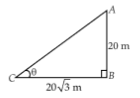
Statement A (Assertion) : In the given figure, a tower $A B$ is $20 m$ high and $B C$, its shadow on the ground, is $20 \sqrt{3} m$ long. The Sun's is $30^{\circ}$.
Image
Statement R (Reason) : The angle of elevation and depression can be acute or obtuse angle.
  • A
    Both assertion (A) and reason ( $R$ ) are true and reason $(R)$ is the correct explanation of assertion $(A)$.
  • Both assertion (A) and reason ( $R$ ) are true and reason $(R)$ is not the correct explanation of assertion (A).
  • C
    Assertion $(A)$ is true but reason $(R)$ is false.
  • D
    Assertion (A) is false but reason $(R)$ is true.
Answer
Correct option: B.
Both assertion (A) and reason ( $R$ ) are true and reason $(R)$ is not the correct explanation of assertion (A).
(b) : Let Sun's altitude be $\theta$.
In $\triangle A B C$,
Image
$
\tan \theta=\frac{A B}{B C}=\frac{20}{20 \sqrt{3}}=\frac{1}{\sqrt{3}}
$
$
\Rightarrow \tan \theta=\tan 30^{\circ} \Rightarrow \theta=30^{\circ}
$
View full question & answer
MCQ 71 Mark
Statement A (Assertion) : If the height and length of the shadow of a man are the same, then the angle of elevation of the Sun is $45^{\circ}$.
Statement R (Reason) : The value of $\tan 45^{\circ}=0$.
  • A
    Both assertion (A) and reason ( $R$ ) are true and reason $(R)$ is the correct explanation of assertion $(A)$.
  • B
    Both assertion (A) and reason ( $R$ ) are true and reason $(R)$ is not the correct explanation of assertion (A).
  • Assertion $(A)$ is true but reason $(R)$ is false.
  • D
    Assertion (A) is false but reason $(R)$ is true.
Answer
Correct option: C.
Assertion $(A)$ is true but reason $(R)$ is false.
(c) : Clearly, Reason is wrong.
Let $\theta$ be the angle of elevation of Sun.
Let $A B$ be the man and $B C$ be his shadow.
Then, $A B=B C$
Image
In $\triangle A B C, \tan \theta=\frac{A B}{B C}=1 \quad[\because A B=B C]$
$\Rightarrow \tan \theta=\tan 45^{\circ} \Rightarrow \theta=45^{\circ}$
$\therefore$ Assertion is correct.
View full question & answer