Questions

2 Marks Questions

🎯

Test yourself on this topic

12 questions · timed · auto-graded

Question 12 Marks
When we toss a coin, there are two possible outcomes-Head or Tail. Therefore, the probability of each outcome is $\frac{1}{2}.$ Justify your answer.
Answer
There are two outcomes of equally in all manner. So probability of both head and tail are equal to $\frac{1}{2}$ each.
Hence, the given statement is true.
View full question & answer
Question 22 Marks
Two dice are thrown at the same time and the product of numbers appearing on them is noted. Find the probability that the product is less than 9.
Answer
Number of total outcomes = 36
When product of numbers appearing on them is less than 9, then possible ways are (1, 6), (1, 5) (1, 4), (1, 3), (1, 2), (1, 1), (2, 2), (2, 3), (2, 4), (3, 2), (4, 2), (4, 1), (3, 1), (5, 1), (6, 1) and (2, 1).
Number of possible ways = 16
$\therefore\ \text{Required probability}=\frac{16}{36}=\frac{4}{9}$
View full question & answer
Question 32 Marks
Box A contains 25 slips of which 19 are marked Re 1 and other are marked Rs. 5 each. Box B contains 50 slips of which 45 are marked Re 1 each and others are marked Rs. 13 each. Slips of both boxes are poured into a third box and resuffled. A slip is drawn at random. What is the probability that it is marked other than Re 1?
Answer
Total number of slips in a box, n(S) = 25 + 50 = 75
From the chart it is clear that, there are 11 slips which are marked other than Rs. 1.
$\therefore\ \ \text{Required probabitily}=\frac{\text{Number of slips other than Rs. 1}}{\text{Total number of slips}}=\frac{11}{75}$
View full question & answer
Question 42 Marks
Is it true to say that the mean, mode and median of grouped data will always be different? Justify your answer.
Answer
Not always. The median, mean and mode can be the same.
They may be equal if number of observations are odd and are equispaced.
View full question & answer
Question 52 Marks
Sushma tosses a coin $3$ times and gets tail each time. Do you think that the outcome of next toss will be a tail? Give reasons.
Answer
As the coin is' tossed $3$ times and gets tail each time but it is not necessary that $4^{th}$​​​​​​​ time will be tail it may be either tail or head in any further toss.
Hence, the given statement is false.
View full question & answer
Question 62 Marks
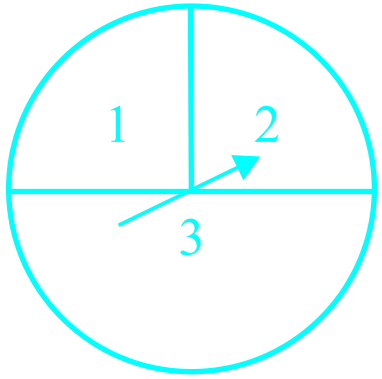
A game consists of spinning an arrow which comes to rest pointing at one of the regions (1, 2 or 3) Fig. Are the outcomes 1, 2 and 3 equally likely to occur? Give reasons.
Answer
The area of region 3 is double either of 1 or 2 and area of 1 and 2 are equal so no. of outcomes (or probability) of region 3 is double of either 1 or 2.
So the outcomes of 1, 2, 3 are not equally likely to occur.
View full question & answer
Question 72 Marks
If I toss a coin 3 times and get head each time, should I expect a tail to have a higher chance in the $4^{\text {th }}$ toss? Give reason in support of your answer.
Answer
As we know that a coin has two equal chances always either head or tail. So next time on tossing he can get either tail or head.
So, the given statement is false.
View full question & answer
Question 82 Marks
In calculating the mean of grouped data, grouped in classes of equal width, we may use the formula $\bar{\text{x}}=\text{a}+\frac{\sum\text{f}_\text{i}\text{d}_\text{i}}{\sum\text{f}_\text{i}}$ where a is the assumed mean. a must be one of the mid-points of the classes. Is the last statement correct? Justify your answer.
Answer
Not always. Assumed mean can be considered any convenient number which makes calculation easy.
View full question & answer
Question 92 Marks
There are 1000 sealed envelopes in a box, 10 of them contain a cash prize of Rs. 100 each, 100 of them contain a cash prize of Rs. 50 each and 200 of them contain a cash prize of Rs. 10 each and rest do not contain any cash prize. If they are well shuffled and an envelope is picked up out, what is the probability that it contains no cash prize?
Answer
Total number of sealed envelopes in a box, n(S) = 1000
Number of envelopes containing cash prize = 10 + 100 + 200 = 310
Number of envelopes containing no cash prize,
n(E) = 1000 - 310 = 690
$\therefore\ \ \text{P(E)}=\frac{\text{n(E)}}{\text{n(S)}}=\frac{690}{1000}=\frac{69}{100}=0.69$
View full question & answer
Question 102 Marks
A coin is tossed $3$ times. List the possible outcomes. Find the probability of getting:
  1. All heads.
  2. At least 2 heads.
Answer
The possible outcomes if a coin is tossed 3 times is, $S =\{( HHH ),( TTT ),( HTT ),( THT ),( TEH ),( THH ),( HTH ),( HHT )\}$
i. Let $E _1=$ Event of getting all head $=\{( HHH )\}$
$\therefore n\left(E_1\right)=1$
$\therefore P\left(E_1\right)=\frac{n\left(E_1\right)}{n(S)}=\frac{1}{8}$
ii. Let $E _2=$ Event of getting atieast 2 heads $=\{( HHT ),( HTH ),( THH ),( HHH )\}$
$\therefore n\left(E_2\right)=4$
$\therefore P\left(E_2\right)=\frac{n\left(E_2\right)}{n(S)}=\frac{4}{8}=\frac{1}{2}$
View full question & answer
Question 112 Marks
A student says that if you throw a die, it will show up 1 or not 1. Therefore, the probability of getting 1 and the probability of getting ‘not 1’ each is equal to $\frac{1}{2}.$ Is this correct? Give reasons.
Answer
A dice can be thrown in 6 different equally likely ways. Possible outcomes are given by S = {1, 2, 3, 4, 5, 6}.
P(getting 1) $=\frac{1}{6}$ and P(not getting 1) $=\frac{5}{6}.$
Hence, the given statement is not correct.
View full question & answer
Question 122 Marks
In a family having three children, there may be no girl, one girl, two girls or three girls. So, the probability of each is $\frac{1}{4}.$ Is this correct? Justify your answer
Answer
False: In a family of three children events are (b, b, b,), (g, b, b), (g, g, b), (g, g, g) T(E) = 4
The probability of each is not $\frac{1}{4},$ because the outcomes are not equally likely.
View full question & answer
2 Marks Questions - MATHS STD 10 Questions - Vidyadip