Questions

5 Marks Questions

🎯

Test yourself on this topic

31 questions · timed · auto-graded

Question 15 Marks
The weights (in kg) of 50 wrestlers are recorded in the following table:
Weight (in kg)
100-110
110-120
120-130
130-140
140-150
Number of wrestlers
4
14
21
8
3
Find the mean weight of the wrestlers.
Answer
We first, find the class mark $x_i$​​​​​​​, of each class and then proceed as follows.
Weight (in kg)
Number of wreslers ($f_i​​​​​​​$)
Class marks ($x_i​​​​​​​$)
Devlation $d_i = x_i - a$
$f_i d_i$
100-110
110-120
120-130
130-140
140-150
4
14
21
8
3
105
115
a = 125
135
145
-20
-10
0
10
20
-80
-140
0
80
60
 
$\text{N}=\sum\text{f}_\text{i}=50$
 
 
$\sum\text{f}_\text{i}\text{d}_\text{i}=-80$
$\therefore$ Assumed mean, a = 125,
Class width, h = 10
and total obsevations, (N) = 50
By stop deviation method,
mean $\bar{(\text{x})}=\text{a}+\frac{\sum\text{f}_\text{i}\text{ d}_\text{i}}{\sum\text{f}_\text{i}}$
$=125+\frac{(-80)}{50}$
$=125-1.6=123.4\text{kg}$
View full question & answer
Question 25 Marks
The monthly income of 100 families are given as below:
Income (in Rs.)
Number of families
0-5000
5000-10000
10000-15000
15000-20000
20000-25000
25000-30000
30000-35000
35000-40000
8
26
41
16
3
3
2
1
Calculate the modal income.
Answer
In a given data, the highest frequency is 41, which lies in the interval 10000-15000.
Here,$ l = 1000, f_m = 41, f_1 = 26, f_2 = 16 $and $h = 5000$
$\therefore\ \ \text{Mode}=\text{l}+\Big(\frac{\text{f}_\text{m}-\text{f}_\text{i}}{2\text{f}_\text{m}-\text{f}_\text{i}-\text{f}_2}\Big)\times\text{h}$
$=10000+\Big(\frac{41-26}{2\times41-26-16}\Big)\times5000$
$=10000+\Big(\frac{15}{82-42}\Big)\times5000$
$=10000+\Big(\frac{15}{40}\Big)\times5000$
$=10000+15\times125=10000+1875=\text{Rs. }11875$
Hence, the modal income is Rs. 11875.
View full question & answer
Question 35 Marks
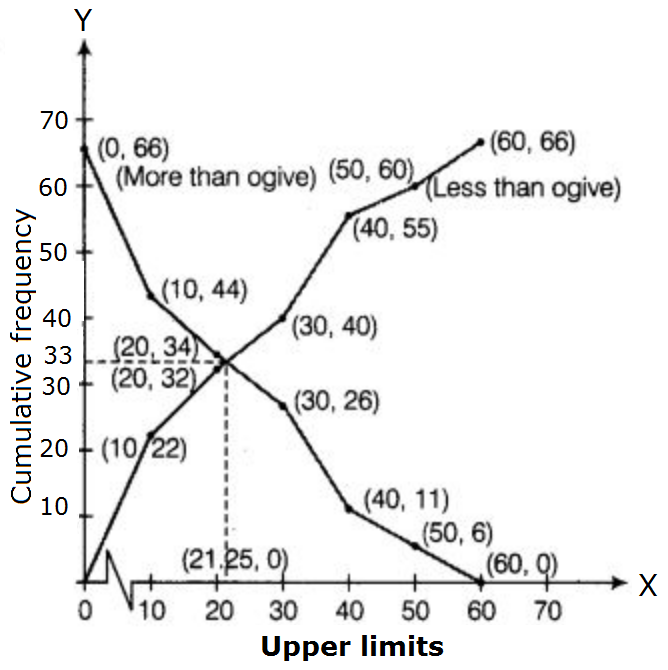
The annual rainfall record of a city for 66 days is given in the following table.
Rainfall (in cm)
0-10
10-20
20-30
30-40
40-50
50-60
Number of days
22
10
8
15
5
6
Calculate the median rainfall using ogives (of more than type and of less than type)
Answer
We observe that, the annual rainfall record of a city less than 0 is 0. Similarly, less than 10 include the annual rainfall record of a city from 0 as well as the annual rainfall record of a city from $0-10._v$​​​​​​​ So, the total annual rainfall record of a city for less than 10cm is 0 + 22 = 22 days. Continuing in this manner, we will get remaining less than 20, 30, 40, 50, and 60. Also, we observe that annual rainfall record of a city for 66 days is more than or equal to 0cm. Since, 22 days lies in the interval 0-10. So, annual rainfall record for 66 - 22 = 44days is more than or equal to 10cm. Continuing in this manner we will get remaining more than or equal to 20, 30, 40, 50 and 60. Now, we construct a table for less than and more than type.
Less than type
More than type
Rainafall (in cm)
Number of days
Rainfall (in cm)
Number of days
Less than 0
Less than 10
Less than 20
Less than 30
Less than 40
Less than 50
Less than 60
$00 + 22 = 22$
$22 + 10 = 32$
$32 + 8 = 40$
$40 + 15 = 55$
$55 + 5 = 60$
$60 + 6 = 66$
More than or equal to 0
More than or equal to 10
More than or equal to 20
More than or equal to 30
More than or equal to 40
More than or equal to 50
More than or equal to 6066
 
$66 - 22 = 44$
$44 - 10 = 34$
$34 - 8 = 26$
$26 - 15 = 11$
$11 - 5 = 6$
$6-6=0$
To draw less than type ogive we plot the points (0, 0), (10, 22), (20, 32), (30, 40), (40, 55), (50, 60), (60, 66) on the paper and join them by free hand. To draw the more than type ogive we plot the points (0, 66), (10, 44), (20, 34), (30, 26), (40, 11), (50, 6) and (60, 0) on the graph paper and join them by free hand,
$\because$ Total number of days (n) = 66
Now, $\frac{\text{n}}{2}=33$ Firstly,
we plot a line parallel to X-axis at intersection point of both ogives, which further intersect at (0, 33) on
Y-axis. Now, we draw a line perpendicular to
X-axis at intersection point of both ogives, which further intersect at (21.25, 0) on
X-axis. Which is the required median using ogives. Hence, median rainfall = 21.25cm.
View full question & answer
Question 45 Marks
The weights of tea in 70 packets are shown in the following table:
Weight (in gram)
Number of packets
200-201
201-202
202-203
203-204
204-205
205-206
13
27
18
10
1
1
Find the mean weight of packets.
Answer
First,we find the class marks of the given data as follows,
Welght (in g)
Number of Packets ($f_i$​​​​​​​)
Class marks ($x_i​​​​​​​$)
Deviation ($d_i = x_i - a$)
$f_i d_i$
200-201
201-202
202-203
203-204
204-205
205-206
13
27
18
10
1
1
200.5
201.5
202.5
a = 203.5
204.5
205.5
-3
-2
-1
0
1
2
-39
-54
-18
0
1
2
 
$\text{N}=\sum\text{f}_\text{i}=70$
 
 
$\sum\text{f}_\text{i}=\text{d}_\text{i}=-108$
Here, (assumed mean) a = 203.5
and (class width) h = 1
By step deviation method,
$\text{Mean }\bar{(\text{x})}=\text{a}+\frac{\sum\text{f}_\text{i}\text{d}_\text{i}}{\sum\text{f}_\text{i}}$
$=203.5-\frac{108}{70}$
$=203.5-1.54=201.96$
Hence, the required mean weight is 201.96g.
View full question & answer
Question 55 Marks
Find the mean of the distribution:
Class
1-3
3-5
5-7
7-10
Frequency
9
22
27
17
Answer
We first, find the class marl $x_i$​​​​​​​ of each class and then proceed as follows.
Class
Class marks $(x_i​​​​​​​$)
Frequency ($f_i​​​​​​​$)
$f_i x_i$
1-3
3-5
5-7
7-10
2
4
6
8.5
9
22
27
17
18
88
162
144.5
 
 
$\sum\text{f}_\text{i}=75$
$\sum\text{f}_\text{i}\text{ x}_\text{i}=412.5$
Therefore, mean $\bar{(\text{x})}=\frac{\sum\text{f}_\text{i}\text{ x}_\text{i}}{\sum\text{f}_\text{i}}=\frac{412.5}{75}=5.5$
Hence, mean of the given distribution is 5.5.
View full question & answer
Question 65 Marks
The following table shows the cumulative frequency distribution of marks of 800 students in an examination:
Marks Number of students
Below 10 10
Below 20 50
Below 30 130
Below 40 270
Below 50 440
Below 60 570
Below 70 670
Below 80 740
Below 90 780
Below 100 800
Construct a frequency distribution table for the data above.
Answer
Here, we observe that 10 students have scored marks below 10 i.e., it lies between class interval 0-10. Similarly, 50 students have scored marks below 20. So, 50 - 10 = 40 students lies in the interval 10-20 and so on. The table of a frequency distribution for the given data is,
Class interval Number of students
0-10 10
10-20 50 - 10 = 40
20-30 130 - 50 = 80
30-40 270 - 130 = 140
40-50 440 - 270 = 170
50-60 570 - 440 = 130
60-70 670 - 570 = 100
70-80 740 - 670 = 70
80-90 780 - 740 = 40
90-100 800 - 780 = 20
View full question & answer
Question 75 Marks
The weight of coffee in 70 packets are shown in the following table:
Weight (in g)
Number of packets
200-201
201-202
202-203
202-203
204-205
205-206
12
26
20
9
2
1
Determine the modal weight.
Answer
In the given data, the highest frequency is 26, which lies in the interval 201-202
Here, $l = 201, f_m = 26, f_1 = 12, f_2 = 200 $and (class width) h = 1
$\therefore\ \ \text{Mode}=\text{l}+\Big(\frac{\text{f}_\text{m}-\text{f}_\text{i}}{2\text{f}_\text{m}-\text{f}_\text{i}-\text{f}_2}\Big)\times\text{h}$ $=201+\Big(\frac{26-12}{2\times26-12-20}\Big)\times1$
$=201+\Big(\frac{14}{52-32}\Big)=201+\frac{14}{20}=201+0.7=201.7\text{g}$
Hence, the modal weight is 201.7g.
View full question & answer
Question 85 Marks
Form the frequency distribution table from the following data:
Marks (out of 90)
Number of candidates
More than or equal to 80
4
More than or equal to 70
6
More than or equal to 60
11
More than or equal to 50
17
More than or equal to 40
23
More than or equal to 30
27
More than or equal to 20
30
More than or equal to 10
32
More than or equal to 0
34
View full question & answer
Question 95 Marks
The table below shows the salaries of 280 persons.
Salary (in thousand (Rs.))
Number of persons
5-10
10-15
15-20
20-25
25-30
30-35
35-40
40-45
45-50
49
133
63
15
6
7
4
2
1
Calculate the median and mode of the data.
Answer
First, we construct a cumulative frequency table.
Salary (in Rs. thoousand)
Number of persons ($f_i$)
Cumulative frequency (cf)
5-10
10-15
15-20
20-25
25-30
30-35
35-40
40-45
45-50
$49 = f_i$
$f_m = 133 = f$
$63 = f_2$
15
6
7
4
2
1
49 = cf
133 + 49 = 182
182 + 63 = 245
245 + 15 = 260
260 + 6 = 266
266 + 7 = 273
273 + 4 = 277
277 + 2 = 279
279 + 1 = 280
 
N = 280
 
$\therefore\ \ \frac{\text{N}}{2}=\frac{280}{2}=140$
  1. Here, median class is 10-15, because 140 lies in it.
Lower limit (l) = 10, Frequency (f) = 133,

Cumulative frequency (cf) = 49 and class width (h) = 5

$\therefore\ \ \text{Median}=\text{l}+\frac{\Big(\frac{\text{N}}{2}-\text{cf}\Big)}{\text{f}}\times\text{h}$

$=10+\frac{(140-49)}{133}\times5$

$=10+\frac{91\times5}{133}$

$=10+\frac{455}{133}=10+3.421$

$=\text{Rs. }13.421\ (\text{in thousand})$

$=13.421\times1000$

$=\text{Rs. }13421$
  1. Here, the highest frequency is 133, which lies in the interval 10-15, called modal class,
Lower limit (l) = 10, class width $(h) = 5, f_m = 133, f_1 = 49, and f_2 = 63,$

$\therefore\ \ \text{Median}=\text{l}+\bigg(\frac{\text{f}_\text{m}-\text{f}_1}{2\text{f}_\text{m}-\text{f}_1-\text{f}_2}\bigg)\times\text{h}$

$=10+\bigg\{\frac{133-49}{2\times133-49-63}\bigg\}\times5$

$=10+\frac{84\times5}{266-112}=10+\frac{84\times5}{154}=10+2.727$

$=\text{Rs. }12.727\ (\text{in thousand})$

$=12.727\times1000$

$=\text{Rs. }12727$
Hence,the median and modal salary are Rs. 13421 and Rs. 12727,respetively.
View full question & answer
Question 105 Marks
Two dice are thrown together. Find the probability that the product of the numbers on the top of the dice is:
  1. 6
  2. 12
  3. 7
Answer
Number of total outcomes = 36
  1. When product of the number on the top of the dice is 6.
So, the possible ways are (1, 6), (2, 3), (3, 2) and (6, 1).

Number of possible ways = 4

$\therefore\ \text{Required probability}=\frac{4}{36}=\frac{1}{9}$
  1. When product of the number on the top of the dice is 12.
So, the possilble ways are (2, 6), (3, 4), (4, 3) and (6, 2).

Number of possible ways = 4

$\therefore\ \text{Required probability}=\frac{4}{36}=\frac{1}{9}$
  1. Product of the numbers on the top of the dice cannot be 7.
So, its probability is zero.
View full question & answer
Question 115 Marks
Size of agricultural holdings in a survey of 200 families is given in the following table:
Size of agricultural holdings (in ha)
Number of families
0-5
5-10
10-15
15-20
20-25
25-30
30-35
10
15
30
80
40
20
5
Compute median and mode size of the holdings.
Answer
Slze of agricultural holdings (in hec)
Number of families ($f_i$)
Cumulative frequency
0-5
5-10
10-15
15-20
20-25
25-30
30-35
10
15
30
80
40
20
5
10
25
55
135
175
195
200
Here, N = 200
Now, $\frac{\text{N}}{2}=\frac{200}{2}=100,$ which lies in the interval 15-20.
Lower limit, l = 15, h = 5, f = 80 and cf = 55
$\therefore\ \ \text{Median}=\text{l}+\bigg(\frac{\frac{\text{N}}{2}-\text{cf}}{\text{f}}\bigg)\times\text{h}$ $=15+\Big(\frac{100-55}{80}\Big)\times5$
$=15+\Big(\frac{45}{16}\Big)=15+2.81=17.81\text{ hec}$
In a given table 80 is the highest frequency.
So, the modal class is 15-20.
Here, $l = 15, f_m = 80, f_1, = 30, f_2 = 40$ and h = 5
$\therefore\ \ \text{Mode}=\text{l}+\bigg(\frac{\text{f}_\text{m}-\text{f}_1}{2\text{f}_\text{m}-\text{f}_1-\text{f}_2}\bigg)\times\text{h}$
$=15+\Big(\frac{80-30}{2\times80-30-40}\Big)\times5$
$=15+\Big(\frac{50}{160-70}\Big)\times5$
$=15+\Big(\frac{50}{90}\Big)\times5=15+\frac{25}{9}$
$=15+2.77=17.77\text{ hec}$
View full question & answer
Question 125 Marks
The mean of the following frequency distribution is 50, but the frequencies $f_1$ and $f_2 $in classes 20-40 and 60-80, respectively are not known. Find these frequencies, if the sum of all the frequencies is 120.
Class
0-20
20-40
40-60
60-80
80-100
Frequency
17
$f_1$
32
$f_2$
19
Answer
First we caluculate the class mark of given data.
Class
Frequency ($f_i$)
Class marks ($x_i$)
$\text{u}_\text{i}=\frac{\text{x}_\text{i}-\text{a}}{\text{h}}$
$f_i u_i$
0-20
20-40
40-60
60-80
80-100
17
$f_1$
32
$f_2​​​​​​​$
19
10
30
a = 50
70
90
-2
-1
0
1
2
-34
$-f_1​​​​​​​$​​​​​​​
0
$f_2​​​​​​​$
38
 
$\sum\text{f}_\text{i}=68+\text{f}_1+\text{f}_2$
 
 
$\sum\text{f}_\text{i}\text{u}_\text{i}=4+\text{f}_2\text{f}_1$
Given that, sum of all frequencies = 120
$\Rightarrow\ \ \sum\text{f}_\text{i}=68+\text{f}_1+\text{f}_2=120$
$\Rightarrow\ \ \text{f}_1+\text{f}_2=52\ \ \dots(\text{i})$
Here, (assumed mean) a = 50
and (class width) h = 20
By stop deviation mothod,
$\text{Mean}=\text{a}+\frac{\sum\text{f}_\text{i}\text{u}_\text{i}}{\sum\text{f}_\text{i}}\times\text{h}$
$\Rightarrow\ \ 50=50+\frac{(4+\text{f}_2-\text{f}_1)}{120}\times20$
$\Rightarrow\ \ 4+\text{f}_2-\text{f}_1=0$
$\Rightarrow\ \ -\text{f}_2+\text{f}_1=4\ \ \dots(\text{ii})$
On adding Eqs. (i) and (ii), we get
$2\text{f}_1=56$
$\text{f}_1=28$
Put the value of $f_1​​​​​​​$​​​​​​​ in Eq. (i), we get
$\text{f}_2=52-28$
$\Rightarrow\ \ \text{f}_2=24$
Hence, $\text{f}_1=28\text{ and f}_2=24.$
View full question & answer
Question 135 Marks
Draw the less than type and more than type ogives for the data and use them to find the median weight.
Answer
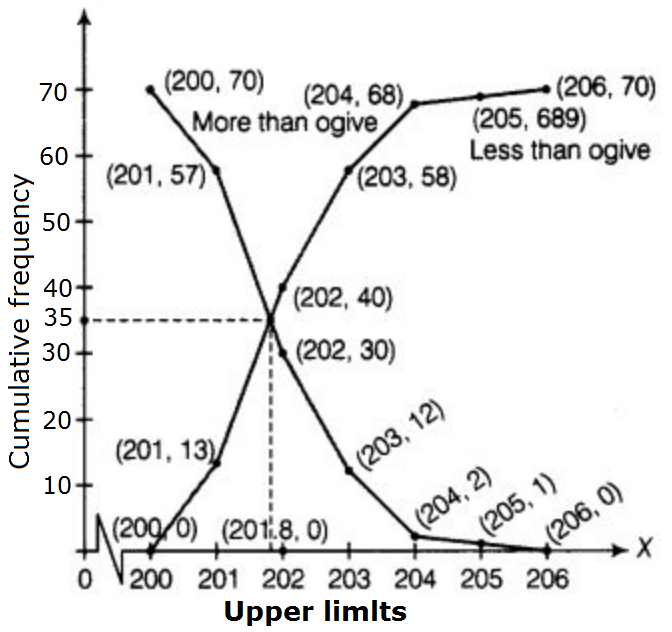
Here, we observe that, the weight of all 70 packets is more than or equal to 200. Since, 13 packets lie in the interval 200-201. So, the weight of 70 - 13 = 57 packets is more than or equal to 201. Continuing in this manner we will get remaining more than or equal to 202, 203, 204, 205 and 206.
(i) Less than
(ii) More than type
Weight (in g)
Number of packets
Number of packets
Number of students
Less than 200
Less than 201
Less than 202
Less than 203
Less than 204
Less than 205
Less than 206
0
13
40
58
68
69
70
More than or equal to 200
More than or equal to 201
More than or equal to 202
More than or equal to 203
More than or equal to 204
More than or equal to 205
More than or equal to 206
7
70 - 13 = 57
57 - 27 = 57
30 - 18 = 12
12 - 10 = 2
2 - 1 = 1
1 - 1 = 0
To draw the less than type ogive, we plot the points (200, 0), (201, 13), (202, 40), (203, 58), (204, 68), (205, 69), (206, 70) on the paper and join them by free hand. To draw the more than type ogive plot the points (200, 70), (201, 57), (202, 30), (203, 12), (204, 2), (205, 1), (206, 0) on the the graph paper and join them by free hand.
Hence,required median weight = intersection point of x-axis = 201.8g.
View full question & answer
Question 145 Marks
Calculate the mean of the scores of 20 students in a mathematics test:
Marks
10-20
20-30
30-40
40-50
50-60
Number of students
2
4
7
6
1
Answer
We first, find the class mark of each class and then proceed as follows.
Class
Class marks ($x_i$​​​​​​​)
Frequency ($f_i​​​​​​​$)
$f_i x_i$
10-20
20-30
30-40
40-50
50-60
15
25
35
45
55
2
4
7
6
1
30
100
245
270
55
 
 
$\sum\text{f}_\text{i}=20$
$\sum\text{f}_\text{i}\text{ x}_\text{i}=700$
Therefore, mean $\bar{(\text{x})}=\frac{\sum\text{f}_\text{i}\text{ x}_\text{i}}{\sum\text{f}_\text{i}}=\frac{700}{20}=35$
Hence, the mean of scores of 20 students in mathematics test is 35.
View full question & answer
Question 155 Marks
The following are the ages of 300 patients getting medical treatment in a hospital on a particular day:
Age (in years)
10-20
20-30
30-40
40-50
50-60
60-70
Number of patients
60
42
55
70
53
20
Form:
  1. Less than type cumulative frequency distribution.
  2. More than type cumulative frequency distribution.
Answer
  1. We observe that the number of patients which take medical treatment in a hospital on a particular day less than 10 is O’. Similarly, less than 20 include the number of patients which take medical treatment from 0-10 as well as the number of patients which take medical treatment from 10-20.
So, the total number of patients less than 20 is 0 + 60 = 60, we say that the cumulative frequency of the class 10-20 is 60. Similarly, for other class.
  1. Also, we observe that all 300 patients which take medical treatment more than or equal to 10. Since, there are 60 patients which take medical treatment in the interval 10-20, this means that there are 300 - 60 = 240 patients which take medical treatment more than or equal to 20. Continuing in the same manner.
(i) Less the type
(ii) More than type
Age (in year)
Number of students
Age (in year)
Number of students
Less than 10
0
More than or equal to 10
300
Less than 20
60
More than or equal to 20
240
Less than 30
102
More than or equal to 30
198
Less than 40
157
More than or equal to 40
143
Less than 50
227
More than or equal to 50
73
Less than 60
280
More than or equal to 60
60
Less than 70
300
 
 
View full question & answer
Question 165 Marks
A die has its six faces marked 0, 1, 1, 1, 6, 6. Two such dice are thrown together and the total score is recorded.
  1. How many different scores are possible?
  2. What is the probability of getting a total of 7?
Answer
Given, a die has its six faces marked (0, 1, 1, 1, 6, 6)
Total sample space, $n(S) = 6^2 = 36$​​​​​​​
  1. The different score which are possible are 6 scores i.e., 0, 1, 2, 6, 7 and 12.
  2. Let E = Event of getting a sum 7
= {(1, 6), (1, 6), (1, 6), (1, 6), (1, 6), (1, 6), (6, 1), (6, 1), (6, 1), (6, 1), (6, 1), (6, 1)}

$\therefore$ n(E) = 12

$\therefore\ \ \text{P(E})=\frac{\text{n(E})}{\text{n(S)}}=\frac{12}{36}=\frac{1}{3}$
View full question & answer
Question 175 Marks
The median of the following data is 50. Find the values of p and q, if the sum of all the frequencies is 90.
Marks
Frequency
20-30
30-40
40-50
50-60
60-70
70-80
80-90
p
15
25
20
q
8
10
Answer
Marks
Frequency
Cumulative frequency
20-30
30-40
40-50
50-60
60-70
70-80
80-90
p
15
25
20 = f
q
8
10
p
15 + p
40 + q = cf
60 + p
60 + p + q
68 + p + q
78 + p + q
Given, N = 90
$\therefore\ \ \frac{\text{N}}{2}=\frac{90}{2}=45$
$\therefore\ \ \text{Median}=\text{l}+\frac{\Big(\frac{\text{N}}{2}-\text{cf}\Big)}{\text{f}}\times\text{h}$
$=50+\frac{(45-40-\text{p})}{20}\times10$
$\Rightarrow\ \ 50=50+\Big(\frac{5-\text{p}}{2}\Big)$
$\Rightarrow\ \ 0=\frac{5-\text{p}}{2}$
$\therefore$ p = 5
Also, 78 + p + q = 90 [given]
⇒ 78 + 5 + q = 90
⇒ q = 90 - 83
$\therefore$ q = 7
View full question & answer
Question 185 Marks
The maximum bowling speeds, in km per hour, of 33 players at a cricket coaching centre are given as follows:
Speed (km/ h)
85-100
100-115
115-130
130-145
Number of players
11
9
8
5
Calculate the median bowling speed.
Answer
First we construct the cumulative frequency table,
Speed (in km/ h)
Number of players
Cumulative frequency
85-100
100-115
115-130
130-145
11
9
8
5
11
11 + 9 = 20
20 + 8 = 28
28 + 5 = 33
It is given that, n = 33
$\therefore\ \ \frac{\text{n}}{2}=\frac{33}{2}=16.5$
So, the median class in 100-115.
where, lower limit (l) = 100,
frequency (f) = 9.
cumulative frequency (cf) = 11
and class width (h) = 15
$\therefore\ \ \text{median} =\text{l}+\frac{\Big(\frac{\text{n}}{2}-\text{cf}\Big)}{\text{f}}\times\text{h}$
$=100+\frac{(16.5-11)}{9}\times15$
$=100+\frac{5.5\times15}{9}=100+\frac{82.5}{9}=100+9.17$
Hence, the median bowling speed is 109.17 km/ h.
View full question & answer
Question 195 Marks
Draw the less than type ogive for this data and use it to find the median weight.
Answer
We observe that, the number of packets less than 200 is 0, Similarly, less than 201 include the number of packets from 0-200 as well as the number of packets from 200-201. So, the total number of packets less than 201 is 0 + 13 = 13. We say that, the cumulative frequency of the class 200-201 is 13. Similarly, for other class.
Less than type
Weight (in g)
Number of packets
Less than 200
Less than 201
Less than 202
Less than 203
Less than 204
Less than 205
Less than 206
0
0 + 13 = 13
27 + 13 = 40
18 + 40 = 58
10 + 58 = 68
1 + 68 = 69
1 + 69 = 70
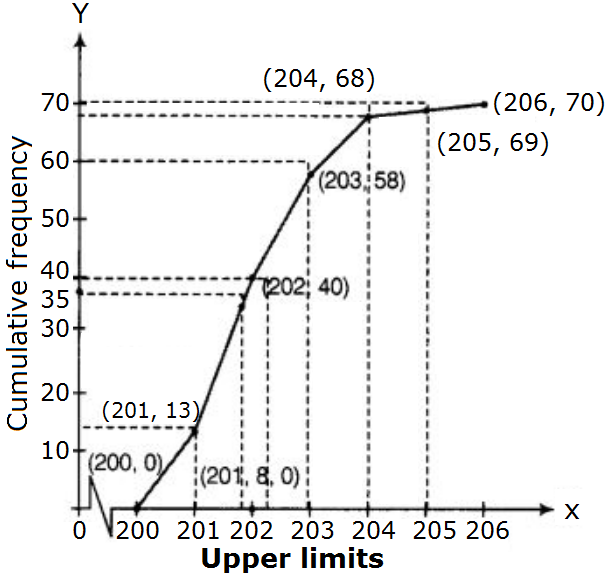
To draw the less than type ogive, we plot the points (200, 0), (201, 13), (202, 40) (203, 58), (204, 68), (205, 69) and (206, 70) on the paper and join by free hand, Total number of packets (n) = 70
Now, $\frac{\text{N}}{2}=35$ Firstly, we plot a point (0, 35) on Y-axis and draw a line y = 35 parallel to X-axis. The line cuts the less than ogive curve at a point. We draw a line on that point which is perpendicular to X-axis. The foot of the line perpendicular to X-axis is the required median. Median weight = 201.8g.
View full question & answer
Question 205 Marks
At a fete, cards bearing numbers 1 to 1000, one number on one card, are put in a box. Each player selects one card at random and that card is not replaced. If the selected card has a perfect square greater than 500, the player wins a prize. What is the probability that:
  1. The first player wins a prize?
  2. The second player wins a prize, if the first has won?
Answer
Given that, at a fete, cards bearing numbers 1 to 1000 one number on one card, are put in a box. Each player selects one card at random and that card is not replaced so, the total number of outcomes are n(S) = 1000
If the selected card has a perfect square greater than 500, then player wins a prize.
Let $E_1 $= Event first player wins a prize = Player select a card which is a perfect square greater than 500
$= {529, 576, 625, 676, 729, 784, 841, 900, 961}$
$= {(23)^2, (24)^2, (25)^2, (26)^2, (27)^2, (28)^2, (29)^2, (30)^2, (31)^2,}$
$\therefore$ $n(E_1) = 9$
So, required probability $=\frac{\text{n(E}_1)}{\text{n(S)}}=\frac{9}{1000}=0.009$
First, has won i.e., one card is already selected, greater than 500, has a perfect square. Since, repeatition is not allowed. So, one card is removed out of 1000 cards. So, number of remaining cards is 999.
$\therefore$ Total number of remaining outcomes, n(S’) = 999.
Let $E_2 =$ Event the second player wins a prize, if the first has won.
= Remaining cards has a perfect square greater than 500 are 8.
$\therefore$ $n(E_2) = 9 - 1 = 8$
So, required probability $=\frac{\text{n(E}_2)}{\text{n(S)}}=\frac{8}{999}$
View full question & answer
Question 215 Marks
Find the unknown entries a, b, c, d, e, f in the following distribution of heights of students in a class:
Height (in cm)
Frequency
Cumulative frequency
150-155
155-160
160-170
165-170
170-175
175-180
12
b
10
d
e
2
a
25
c
43
48
f
Total
50
 
Answer
Height (in cm)
Frequency
Cumulative frequency (given)
Cumulative frequency
150-155
15-160
160-165
165-170
170-175
175-180
12
b
10
d
e
2
a
25
c
43
48
f0
12
12 + b
22 + b
22 + b + d
22 + b + d + e
24 + b + d + e
Total
50
 
 
On comparing last two table, we get
a = 12
$\therefore$ 12 + b = 25
⇒ b = 25 - 12 = 13
22 + b = c
⇒ c = 22 + 13 = 35
22 + b + d = 43
⇒ 22 + 13 + d = 43
⇒ d = 43 - 35 = 8
and 22 + b + d + e = 48
⇒ 22 + 13 + 8 + e = 48
⇒ e = 48 - 43 = 5
and 24 + b + d + e = f
⇒ 24 + 13 + 8 + 5 = f
$\therefore$ f = 50
View full question & answer
Question 225 Marks
Calculate the mean of the following data:
Class 4-7 8-11 12-15 16-19
Frequency 5 4 9 10
Answer
Since, given data is not continuous, so we subtract 0.5 from the lower iimit and add 0.5 in the upper limit of each class.
Now, we first find class mark $x_i$ of each class and then proceed as follows
Class
Class marks ($x_i$)
Frequency ($f_i$)
$f_i x_i$
3.5-7.5
7.5-11.5
11.515.5
15.5-19.5
5.5
9.5
13.5
17.5
5
4
9
10
27.5
38
121.5
75
 
 
$\sum\text{f}_\text{i}=28$
$\sum\text{f}_\text{i}\text{ x}_\text{i}=362$
Therefore, mean $\bar{(\text{x})}=\frac{\sum\text{f}_\text{i}\text{ x}_\text{i}}{\sum\text{f}_\text{i}}=\frac{362}{28}=12.93$
Hence, mean of the given data is 12.93.
View full question & answer
Question 235 Marks
A bag contains 24 balls of which x are red, 2x are white and 3x are blue. A ball is selected at random. What is the probability that it is:
  1. not red?
  2. white?
Answer
Given that, A bag contains total number of balls $=24 A$ bag contains number of red bails $=24$
A bag contains number of white balls $=2 x$ and a bag contains number of blue balls $= x$
By condition, $x+2 x+3 x=24$
$\Rightarrow 6 x=24$
$\therefore x=4$
$\therefore$ Number of red balls $= x =4$
Number of white balls $=2 x=2 \times 4=8$
and number of blue balls $=3 x =3 \times 4=12$
So, total number of outcomes for a ball is selected at random in a bag contains 24 balls
$\Rightarrow n(S)=24$
Let $E _2=$ Event of selecting a ball which is not red i.e., can be white or blue.
$\therefore n \left( E _1\right)=$ Number of white balls + Number of blue balls
$\Rightarrow n\left(E_1\right)=8+12=20$
$\therefore$ Required probability $=\frac{ n \left( E _1\right)}{ n ( S )}=\frac{20}{24}=\frac{5}{6}$
Let $E_2=$ Event of selecting a ball which is white
$\therefore n \left( E _2\right)=$ Number of white balls $=8$
So, required probability $=\frac{ n \left( E _1\right)}{ n ( S )}=\frac{8}{24}=\frac{1}{3}$
View full question & answer
Question 245 Marks
The following is the distribution of weights (in kg) of 40 persons:
Weight (in kg)
40-45
45-50
50-55
55-60
60-65
65-70
70-75
75-80
Number of persons
4
4
13
5
6
5
2
1
Construct a cumulative frequency distribution (of the less than type) table for the data above.
Answer
The cumulative distribution (less than type) table is shown below,
Weight (in kg) Cumulative frequency
Less than 45 4
Less than 50 4 + 4 = 8
Less than 55 8 + 13 = 21
Less than 60 21 + 5 = 26
Less than 65 26 + 6 = 32
Less than 70 32 + 5 = 37
Less than 75 37 + 2 = 39
Less than 80 39 + 1 = 40
View full question & answer
Question 255 Marks
The distribution of heights (in cm) of 96 children is given below:
Height (in cm)
Number of children
124-128
128-132
132-136
136-140
140-144
144-148
148-152
152-156
156-160
160-164
5
8
17
24
16
12
6
4
3
1
Draw a less than type cumulative frequency curve for this data and use it to compute median height of the children.
Answer
Height (in cm)
Number of children
Less than 124
Less than 128
Less than 132
Less than 136
Less than 140
Less than 144
Less than 148
Less than 152
Less than 156
Less than 160
Less than 164
0
5
13
30
54
70
82
88
92
95
96
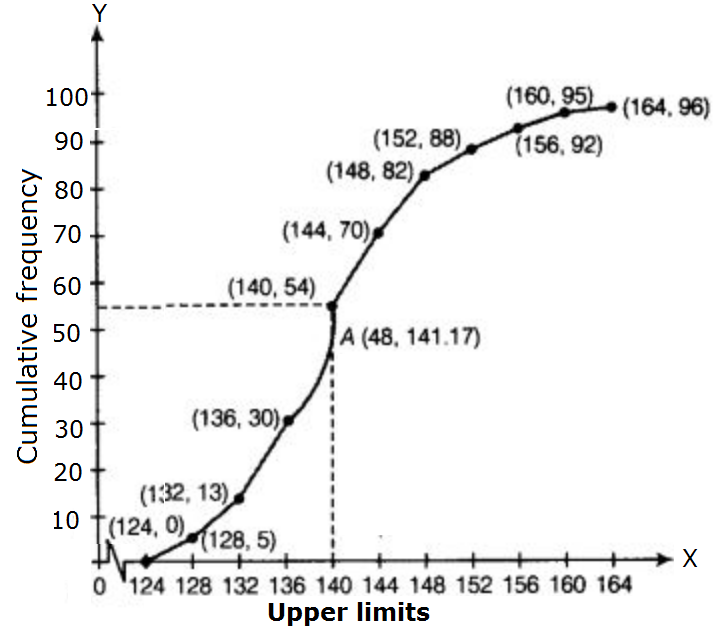
To draw the less than type ogive, we plot the points (124, 0), (128, 5), (132, 13), (136, 30), (140, 54), (144, 70), (148, 82), (152, 88), (156, 92), (160, 95), (164, 96) and join all these point by free hand.

Here, $\frac{\text{N}}{2}=\frac{96}{2}$
We take, y = 48 in Y-coordinate and draw a line parallel to X-axis, meets the curve at A and draw a perpendicular line from point A to the X-axis and this line meets the X-axis at the point which is the median i.e., median = 141.17.
View full question & answer
Question 265 Marks
Two dice are numbered 1, 2, 3, 4, 5, 6 and 1, 1, 2, 2, 3, 3, respectively. They are thrown and the sum of the numbers on them is noted. Find the probability of getting each sum from 2 to 9 separately.
Answer
Number of total outcomes = 36
i. Let $E _1=$ Event of getting sum $2=\{(1,1),(1,1)\}$
$\therefore$ n($E_1$​​​​​​​) = 2
$\therefore\ \ \text{P}(\text{E}_1)=\frac{\text{n}(\text{E}_1)}{\text{n(S)}}=\frac{1}{36}=\frac{1}{18}$
ii. Let $E _2=$ Event of getting sum $3=\{(1,2),(1,2),(2,1),(2,1)\}$
$\therefore$ n$(E_2​​​​​​​$​​​​​​​) = 4
$\therefore\ \ \text{P}(\text{E}_2)=\frac{\text{n}(\text{E}_2)}{\text{n(S)}}=\frac{4}{36}=\frac{1}{9}$
iii. Let $E _3=$ Event of getting sum $4=\{(2,2),(2,2),(3,1),(3,1),(1,3),(1,3)\}$
$\therefore$ n($E_3​​​​​​​$) = 6
$\therefore\ \ \text{P}(\text{E}_3)=\frac{\text{n}(\text{E}_3)}{\text{n(S)}}=\frac{6}{36}=\frac{1}{6}$
iv. Let $E_4=$ Event of getting sum $5=\{(2,3),(2,3),(4,1),(4,1),(3,2),(3,2)\}$
$\therefore$ n($E_4) = 6$
$\therefore\ \ \text{P}(\text{E}_4)=\frac{\text{n}(\text{E}_4)}{\text{n(S)}}=\frac{6}{36}=\frac{1}{6}$
v. Let $E_5=$ Event of getting sum $6=\{(3,3),(3,3),(4,2),(4,2),(5,1),(5,1)\}$
$\therefore$ $n(E_5) = 6$
$\therefore\ \ \text{P}(\text{E}_5)=\frac{\text{n}(\text{E}_5)}{\text{n(S)}}=\frac{6}{36}=\frac{1}{6}$
vi. Let $E_6=$ Event of getting sum $7=\{(4,3),(4,3),(5,2),(5,2),(6,1),(6,1)\}$
$\therefore$ $n(E_6​​​​​​​) = 6$
$\therefore\ \ \text{P}(\text{E}_6)=\frac{\text{n}(\text{E}_6)}{\text{n(S)}}=\frac{6}{36}=\frac{1}{6}$
vii. Let $E _7=$ Event of getting sum $8=\{(5,3),(5,3),(6,2),(6,2)\}$
$\therefore$ $n(E_7) = 4$
$\therefore\ \ \text{P}(\text{E}_7)=\frac{\text{n}(\text{E}_7)}{\text{n(S)}}=\frac{4}{36}=\frac{1}{9}$
viii. Let $E_8=$ Event of getting sum $9=\{(6,3),(6,3)\}$
$\therefore$ $n(E_8) = 2$
$\therefore\ \ \text{P}(\text{E}_8)=\frac{\text{n}(\text{E}_8)}{\text{n(S)}}=\frac{2}{36}=\frac{1}{18}$
View full question & answer
Question 275 Marks
The mileage (km per litre) of 50 cars of the same model was tested by a manufacturer and details are tabulated as given below:
Mileage (km/ l)
10-12
12-14
14-16
16-18
Number of cars
7
12
18
13
Find the mean mileage.
The manufacturer claimed that the mileage of the model was 16km/ litre. Do you agree with this claim?
Answer
Mileage $(kmL^{-1})$
Class marks ($x_i$)
Number of cars ($f_i$)
$f_i x_i$
10-12
12-14
14-16
16-18
11
13
15
17
7
12
18
13
77
156
270
221
Total
 
$\sum\text{f}_\text{i}=50$
$\sum\text{f}_\text{i}=724$
Here, $\sum\text{f}_\text{i}=50$
and $\sum\text{f}_\text{i}\text{ x}_\text{i}=724$
$\therefore\ \ \text{mean }\bar{\text{x}}=\frac{\sum\text{f}_\text{i}\text{x}_\text{i}}{\sum\text{f}_\text{i}}$
$=\frac{724}{50}=14.48$
Hence, mean mileage is $14.48kmL^{-1}.$
No the manufacturer is claming mileage $1.52kmh^{-1}$ more than average mileage.
View full question & answer
Question 285 Marks
Given below is a cumulative frequency distribution showing the marks secured by 50 students of a class:
Marks
Below 20
Below 40
Below 60
Below 80
Below 100
Number of students
17
22
29
37
50
Form the frequency distribution table for the data.
Answer
Here, we observe that, 17 students have scored marks below 20 i.e., it lies between class interval 0-20 and 22 students have scored marks below 40, so 22 - 17 = 5 students lies in the class interval 20-40 continuing in the same manner, we get the complete frequency distribution table for given data.
Marks
Number of students
0-20
20-40
40-60
60-80
80-100
17
22 - 17 = 5
29 - 22 = 7
37 - 29 = 8
50 - 37 = 13
View full question & answer
Question 295 Marks
An aircraft has 120 passenger seats. The number of seats occupied during 100 flights is given in the following table:
Number of seats
100-104
104-108
108-112
112-116
116-120
Frequency
15
20
32 18 15
Determine the mean number of seats occupied over the flights.
Answer
We first, find the class mark $x_i$​​​​​​​, of each class and then proceed as follows.
Number of seats
Class marks ($x_i​​​​​​​$)
Frequency ($f_i​​​​​​​$)
Devlation $di = x_i - a$
$f_i d_i$
100-104
104-108
108-112
112-116
116-120
102
106
a = 110
114
118
15
20
32
18
15
-8
-4
0
4
8
-120
-80
0
72
120
 
 
$\text{N}=\sum\text{f}_\text{i}=100$
 
$\sum\text{f}_\text{i}\text{d}_\text{i}=-8$
$\therefore$ Assumed mean, a = 110,
Class width, h = 4
and total obsevations, N = 100
By stop deviation method,
mean $\bar{(\text{x})}=\text{a}+\frac{\sum\text{f}_\text{i}\text{d}_\text{i}}{\sum\text{f}_\text{i}}$
$=110+\Big(\frac{-8}{100}\Big)=110-0.08=109.92$
View full question & answer
Question 305 Marks
50 students enter for a school javelin throw competition. The distance (in metres) thrown are recorded below:
Distance (in m)
0-20
20-40
40-60
60-80
80-100
Number of students
6
11
17
12
4
  1. Construct a cumulative frequency table.
  2. Draw a cumulative frequency curve (less than type) and calculate the median distance thrown by using this curve.
  3. Calculate the median distance by using the formula for median.
  4. Are the median distance calculated in (ii) and (iii) same?
Answer
Distance
number of students $(f_i$)
Cumulative frequency (cf)
0-20
20-40
40-60
60-80
80-100
6
11
17
12
4
6
17
34
46
50
Distance (in m)
Cumulative frequency
0
Less than 20
Less than 40
Less than 60
Less than 80
Less than 100
0
6
17
34
46
50
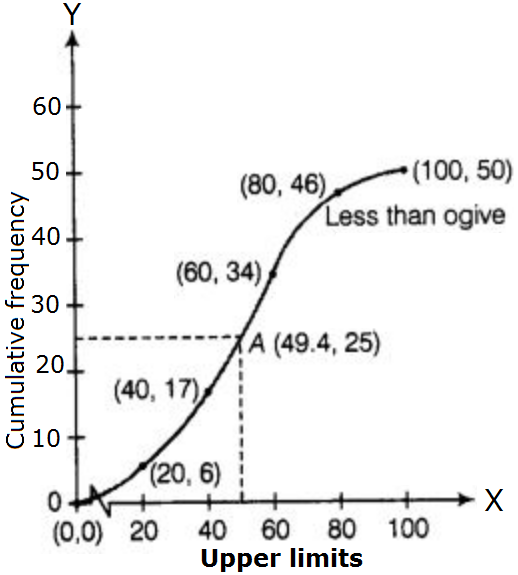
To draw less than type ogive, we plot the points (0, 0), (20, 6), (40, 17), (60, 34), (80, 46), (100, 50), join all these points by free hand.

Taking Y = 25 on y-axis and draw a line parallel to X-axis, which meets the curve at point A From point A we draw a line perpendicular to X-axis, where this meets that point is the required median i.e., 49.4.
Now, $\frac{\text{N}}{2}=\frac{50}{2}=25$
which lies is the interval 40-60.
$\therefore$ l = 40, h = 20, cf = 17 and f = 17
$\therefore\ \ \text{Median}=\text{l}+\bigg(\frac{\frac{\text{N}}{2}-\text{cf}}{\text{f}}\bigg)\times\text{h}$
$=40+\frac{(25-17)}{17}\times20$
$=40+\frac{8\times20}{17}$
$=40+9.14$
$=49.41$
Yes, median distance calculated by parts (ii) and (iii) are same.
View full question & answer
Question 315 Marks
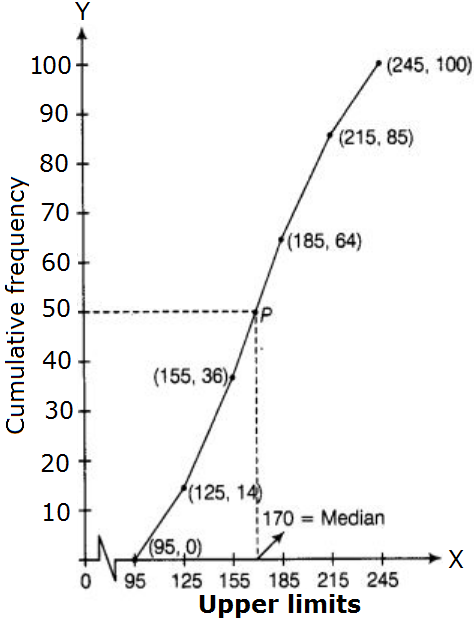
The following is the frequency distribution of duration for100 calls made on a mobile phone:
Duration (in seconds)
Number of calls
95-125
125-155
155-185
185-215
215-245
14
22
28
21
15
Calculate the average duration (in sec) of a call and also find the median from a cumulative frequency curve.
Answer
First, we calculate class marks as follows
Duration (in s)
Number of calls ($f_i$​​​​​​​)
Class marks ($x_i​​​​​​​$)
$\text{u}_\text{i}=\frac{\text{x}_\text{i}-\text{a}}{\text{h}}$
$f_i u_i$
95-125
1258-155
155-185
185-215
215-245
14
22
28
21
15
110
140
a = 170
200
230
-2
-1
0
1
2
-28
-22
0
21
30
 
$\sum\text{f}_\text{i}=100$
 
 
$\sum\text{f}_\text{i}\text{u}_\text{i}=1$
Here, (assumed mean) a = 170, and (class width) h = 30 By step deviation method, Average $\bar{(\text{x})}=\text{a}+\frac{\sum\text{f}_\text{i}\text{u}_\text{i}}{\sum\text{f}_\text{i}}\times\text{h}$ $=170+\frac{1}{100}\times30$ $=170+0.3=170.3$ Hence, average duration is 170.3s. For calculating median from a cumulative frequency curve We prepare less than type or more than type ogive We observe that, number of calls in less than 95s is 0. Similarly, in less than 125s include the number of calls in less than 95s as well as the number of calls from 95-125.s So, the total number of calls less than 125s is 0 + 14 = 14. Continuing in this manner, we will get remaining in less than 155, 185, 215 and 245s. manner, we will get remaining in less than 155, 185, 215 and 245s. Now, we construct a table for less than ogive (cumulative frequency curve).
Less than type
Duration (in s)
Number of calls
Less than 95
Less than 125
Less than 155
Less than 185
Less than 215
Less than 245
0
0 + 14 = 14
14 + 22 = 36
36 + 28 = 64
64 + 21 = 85
85 + 15 = 100
To draw less than type ogive we plot then the points (95, 0), (125, 14), (155, 36), (185, 64), (215, 85), (245, 100) on the paper and join them by free hand.
$\because$ Total number of calls (n) = 100 $\therefore\ \ \frac{\text{n}}{2}=\frac{100}{2}=50.$ Now, point 50 taking on Y-axis draw a line parallel to X-axis meet at a point P and draw a perpendicular line from P to the X-axis, the intersection point of X-axis is the median. Hence, required median is 170.
View full question & answer
5 Marks Questions - MATHS STD 10 Questions - Vidyadip