MCQ 11 Mark
Which one of the following is non $-$ crystalline or amorphous?
View full question & answer→MCQ 21 Mark
Mild non-corrosive basic salt is
- A
$Ca ( OH )_2$
- B
$NaCl$
- C
$NaOH$
- ✓
$NaHCO _3$
AnswerCorrect option: D. $NaHCO _3$
(D) $NaHCO _3$
View full question & answer→MCQ 31 Mark
A student requires hard water for an experiment in his laboratory which is not available in the neighbouring area. In the laboratory, there are some salts, which when dissolved in distilled water can convert it into hard water. Select from the following groups of salts, a group, each salt of which when dissolved in distilled water will make it hard.
- A
Sodium chloride, Potassium chloride.
- B
Sodium sulphate, Potassium sulphate.
- C
Sodium sulphate, Calcium sulphate.
- ✓
Calcium sulphate, Calcium chloride.
AnswerCorrect option: D. Calcium sulphate, Calcium chloride.
Calcium sulfate (or calcium sulphate) is the inorganic compound with the formula $\ce{CaSO4}$ and related hydrates. In the form of $\gamma-$ anhydrite $($the anhydrous form$),$ it is used as a desiccant. One particular hydrate is better known as plaster of Paris, and another occurs naturally as the mineral gypsum
Calcium chloride is an inorganic compound, a salt with the chemical formula $\mathrm{CaCl}_2$. It is a colorless crystalline solid at room temperature, highly soluble in water. Calcium chloride is commonly encountered as a hydrated solid with generic formula $\mathrm{CaCl}_2\left(\mathrm{H}_2 \mathrm{O}\right) \mathrm{x}$, where $\mathrm{x}=0,1,2,4$, and $6$ . These compounds are mainly used for deicing and dust control. Because the anhydrous salt is hygroscopic, it is used as a desiccant Hard water can be prepared by dissolving sulphates, chlorides or bicarbonate salts of $\mathrm{Ca}^{2+}$ or $\mathrm{Mg}^{2+}$ ions.
View full question & answer→MCQ 41 Mark
When you add a few drops of acetic acid to a test $-$ tube containing sodium bicarbonate powder, which one of the following is your observation?
- A
- B
A colourless gas with pungent smell is released with brisk effervescence.
- C
A brown coloured gas is released with brisk effervescence.
- ✓
Formation of bubbles of a colourless and odourless gas.
AnswerCorrect option: D. Formation of bubbles of a colourless and odourless gas.
$\mathrm{NaHCO}_3+\mathrm{HC}_2 \mathrm{H}_3 \mathrm{O}_2 \rightarrow \mathrm{NaC}_2 \mathrm{H}_3 \mathrm{O}_2+\mathrm{H}_2 \mathrm{O}+\mathrm{CO}_2$
There is double displacement in which acetic acid reacts with sodium bicarbonate to form sodium acetate and carbonic acid.
$\mathrm{NaHCO}_3+\mathrm{HC}_2 \mathrm{H}_3 \mathrm{O}_2 \rightarrow \mathrm{NaC}_2 \mathrm{H}_3 \mathrm{O}_2+\mathrm{H}_2 \mathrm{CO}_3$
Carbonic acid is unstable and undergoes a decomposition reaction to produce carbon dioxide gas.
$\mathrm{H}_2 \mathrm{CO}_3 \rightarrow \mathrm{H}_2 \mathrm{O}+\mathrm{CO}_2$
Carbon dioxide escapes from the solution as bubbles.
Acetic acid, systematically named ethanoic acid is a colorless liquid organic compound with the chemical formula $\mathrm{CH}_3 \mathrm{COOH} \ ($also written as $\mathrm{CH}_3 \mathrm{CO}_2 \mathrm{H}$ or $\mathrm{C}_2 \mathrm{H}_4 \mathrm{O}_2 ).$ When undiluted, it is sometimes called glacial acetic acid. Vinegar is roughly $3-9 \%$ acetic acid by volume, making acetic acid the main component of vinegar apart from water. Acetic acid has a distinctive sour taste and pungent smell. In addition to household vinegar, it is mainly produced as a precursor to polyvinyl acetate and cellulose acetate. It is classified as a weak acid since it only partially dissociates in solution, but concentrated acetic acid is corrosive and can attack the skin.
View full question & answer→MCQ 51 Mark
A student takes about $6 mL$ distilled water in four test tubes marked $P, Q, R$ and $S$. He dissolves sodium sulphate in $P,$ potassium sulphate in $Q,$ calcium sulphate in $R$ and magnesium sulphate in $S$. After that he adds equal amount of soap solution in each test tube. On shaking these test tubes, he would observe a good amount of lather in the test tubes marked.
- ✓
$P$ and $Q.$
- B
$Q$ and $R.$
- C
$R$ and $S.$
- D
$P$ and $S.$
AnswerCorrect option: A. $P$ and $Q.$
Lather $($foam$)$ is formed by the reaction of soap solution with sodium sulphate and potassium sulphate in the test tubes $P$ and $Q,$ respectively. They are dissolved in water to give a neutral solution.
Sulphates, chlorides and bicarbonates of calcium and magnesium make the water hard.
Thus, the lather is not formed in the test tubes $R$ and $S.$
View full question & answer→MCQ 61 Mark
On adding acetic acid to sodium hydrogen carbonate in a test tube, a student observes :
- A
- B
A colourless gas with pungent smell.
- ✓
Bubbles of a colourless and odourless gas.
- D
A strong smell of vinegar.
AnswerCorrect option: C. Bubbles of a colourless and odourless gas.
View full question & answer→MCQ 71 Mark
Which one of the following are the correct observations about acetic acid?
- ✓
It turns blue litmus red and smells like vinegar.
- B
It turns blue litmus red and smells like burning sulphur.
- C
It turns res litmus blue and smells like vinegar.
- D
It turns red litmus blue and has a fruity smell.
AnswerCorrect option: A. It turns blue litmus red and smells like vinegar.
Since acids turns blue litmus red and acetic acid is a strong acid, so it will turn blue litmus red.
Moreover, it smells like that of vinegar.
View full question & answer→MCQ 81 Mark
On adding $2\ mL$ acetic acid to $2\ mL$ of water in a test tube, it was observed that :
- ✓
A clear and transparent solution is formed.
- B
A white precipitate is formed almost immediately.
- C
Two separate layers were formed.
- D
A colourless and odourless gas is evolved.
AnswerCorrect option: A. A clear and transparent solution is formed.
View full question & answer→MCQ 91 Mark
Following are the steps involved in the experiment 'to determine the percentage of water absorbed by raisins'. They are not in proper sequence.
- Soak the raisins in fresh water.
- Weigh dry raisins.
- Weigh soaked raisins.
- Wipe out soaked raisins.
The correct sequence of steps is
- A
$\ce{I, II, III, IV}$
- ✓
$\ce{II, I, IV, III}$
- C
$\ce{II, I, III, IV}$
- D
$\ce{I, II, IV, III}$
AnswerCorrect option: B. $\ce{II, I, IV, III}$
View full question & answer→MCQ 101 Mark
The colour of raisins as used in the experiment, 'to determine the percentage of water absorbed by raisins' was.
MCQ 111 Mark
A student added acetic to test tubes $\ce{I, II, III}$ and $\ce{IV}$ containing the labelled substance and then brought a burning splinter near the mouth of each test tube.
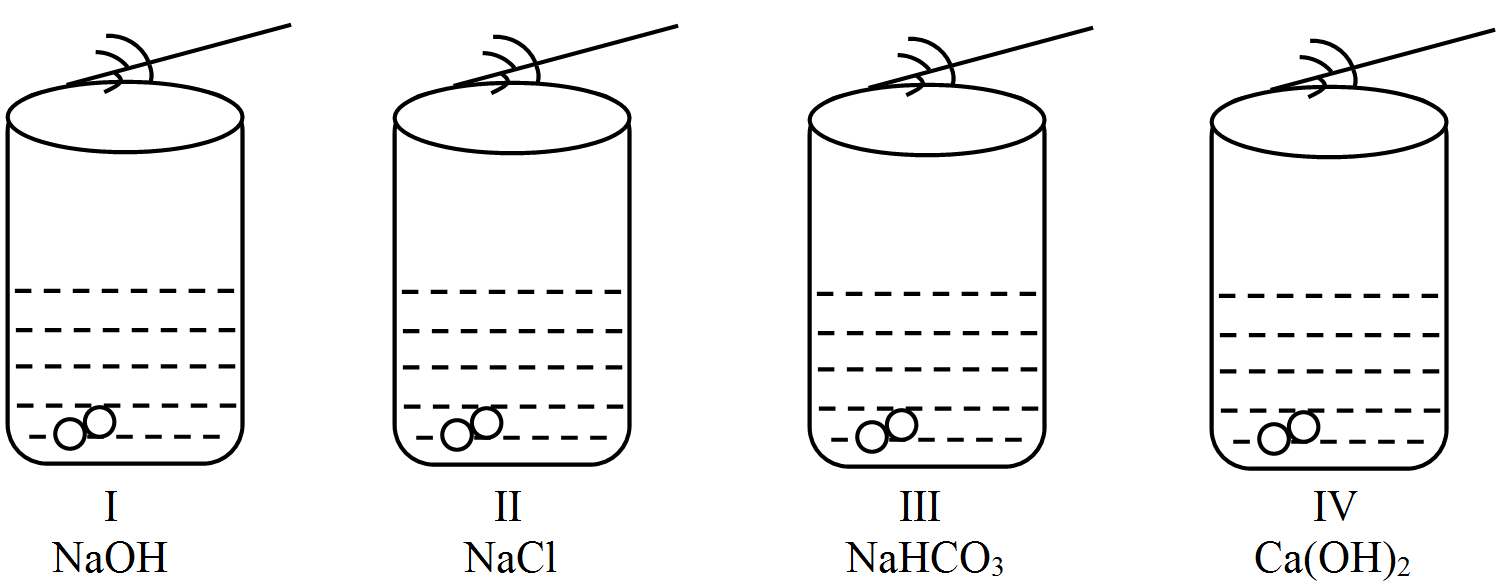
The splinter would be extinguished when brought near the mouth of test tube: - A
$\ce{I}$
- B
$\ce{II}$
- ✓
$\ce{III}$
- D
$\ce{IV}$
AnswerCorrect option: C. $\ce{III}$
View full question & answer→MCQ 121 Mark
Vapours of acetic acid smell :
- ✓
- B
- C
Suffocating like sulphur dioxide.
- D
AnswerVinegar is no less than $4\%$ acetic acid by volume, making acetic acid the main component of vinegar apart from water. Acetic acid has a distinctive sour taste and pungent smell. Thats why Vapours of acetic acid pungent like vinegar.
View full question & answer→MCQ 131 Mark
During the course of an experiment, 'to determine the percentage of water absorbed by raisins', raisins are weighed.
AnswerCorrect option: C. Once $-$ only after completing the experiment.
View full question & answer→MCQ 141 Mark
Consider the following oils:
- Mobil oil.
- Castor oil.
- Turpentine oil.
- Kerosene.
- Mustard oil.
- Coconut oil.
Which of these can be used for preparation of soap?
- A
$\ce{I, II, III, VI}$
- ✓
$\ce{II, V, VI}$
- C
$\ce{II, III, V, VI}$
- D
$\ce{II, III, VI}$
AnswerCorrect option: B. $\ce{II, V, VI}$
View full question & answer→MCQ 151 Mark
A student is testing water to know which is best for cleansing purposes with soaps. He would find that the cleansing action of soaps is best when he uses water obtained from.
AnswerRain water is appropriate for cleansing purpose as rain water is distilled water and which is appropriate for the cleansing purpose. In rain water, micelle formation takes place effectively which is appropriate for cleansing action of soap.
View full question & answer→MCQ 161 Mark
The chemical mostly used in the preparation of most of the soaps we use is .
MCQ 171 Mark
You are asked to prepare hard water in your laboratory. Select a group from the following groups of salts, any salt of which you may dissolve in distilled water to obtain hard water.
- A
$\mathrm{NaCl} ; \mathrm{Na}_2 \mathrm{SO}_4 ; \mathrm{KCl}$
- B
$\mathrm{NaCl} ; \mathrm{CaCl}_2 ; \mathrm{KCl}$
- ✓
$\mathrm{CaCl}_2 ; \mathrm{CaSO}_4 ; \mathrm{MgSO}_4$
- D
$\mathrm{Na}_2 \mathrm{SO}_4 ; \mathrm{CaSO}_4 ; \mathrm{MgSO}_4$
AnswerCorrect option: C. $\mathrm{CaCl}_2 ; \mathrm{CaSO}_4 ; \mathrm{MgSO}_4$
Hard water contains $\mathrm{Ca}^{2+}$ and $\mathrm{Mg}^{2+}$ ions.
So, the salts that can be added to water to make it hard are calcium sulphate, calcium chloride and magnesium chloride.
View full question & answer→MCQ 181 Mark
If you take some distilled water in a test $-$ tube, add an equal amount of acetic acid to it, shake the test $-$ tube well and leave it undisturbed on the test-tube stand, then after about $5$ minutes, what would you observe?
- A
There is a layer of water over the layer of acetic acid.
- B
A precipitate is settling at the bottom of the test-tube.
- C
Bubbles of colourless gas are coming out of the test-tube.
- ✓
There is a clear, colourless transparent solution in the test-tube.
AnswerCorrect option: D. There is a clear, colourless transparent solution in the test-tube.
Well it is so because Acetic Acid is miscible in water or it is soluble in water, when Acetic acid is added to water it dissolves readily in water forming Homogeneous solution.
View full question & answer→MCQ 191 Mark
The students of a class were asked by the teacher to study the different parts of an embryo of an angiosperm. Given below are the essential steps for the experiment :
- Soak the seeds in plain water and keep them overnight.
- Cut open the soaked seed and observe its different parts.
- Take some healthy seeds in a petri $-$ dish.
- Drain the excess water, cover the seeds with a wet cotton cloth and leave them as it is for a day.
The correct sequence of these steps is. - ✓
$\ce{C, A, D, B}$
- B
$\ce{C, D, A, B}$
- C
$\ce{A, C, D, B}$
- D
$\ce{A, C, B, D}$
AnswerCorrect option: A. $\ce{C, A, D, B}$
View full question & answer→MCQ 201 Mark
You have four test tubes, $\ce{A, B, C}$ and $D$ containing sodium carbonate, sodium chloride, lime water and blue litmus solutions respectively. Out of these the material of which test tube/test tubes would be suitable for the correct test of acetic/ethanoic acid?
- A
Only $A$
- B
$A$ and $B$
- C
$B$ and $C$
- ✓
$A$ and $D$
AnswerCorrect option: D. $A$ and $D$
The chemical reaction between ethanoic $($acetic$)$ acid and sodium carbonate is :
$2 \mathrm{CH}_3 \mathrm{COOH}+\mathrm{Na}_2 \mathrm{CO}_3 \rightarrow 2 \mathrm{CH}_3 \mathrm{COONa}+\mathrm{CO}_2+\mathrm{H}_2 \mathrm{O}$
On passing $\mathrm{CO}_2$ gas through lime water, the lime water turns milky. The milky appearance of lime water is due to the formation of solid calcium carbonate $\left(\mathrm{CaCO}_3\right)$.
Reaction :
$\mathrm{Ca}(\mathrm{OH})_2+\mathrm{CO}_2 \rightarrow \mathrm{CaCO}_3+\mathrm{H}_2 \mathrm{O}$
therefore, out of four test tubes $\ce{A, B, C}$ and $D,$ only $A$ and $D$ test tubes would be suitable for the correct test of acetic/ ethanoic acid.
Acetic acid also reacts with lime water to give calcium acetate $\left(\mathrm{CH}_3 \mathrm{COO}\right)_2 \mathrm{Ca}$ ) as a product. But here it is not considered as a correct test of acetic/ ethanoic acid.
Reaction:
$2 \mathrm{CH}_3 \mathrm{COOH}+\mathrm{Ca}(\mathrm{OH})_2 \rightarrow\left(\mathrm{CH}_3 \mathrm{COO}\right)_2 \mathrm{Ca}+2 \mathrm{H}_2 \mathrm{O}$
Hence, the correct answer is the option $(d).$
View full question & answer→MCQ 211 Mark
In an experiment to study the properties of acetic acid a student takes about $2 \ mL$ of acetic acid in a dry test tube. He adds about $2\ mL$ of water to it and shakes the test tube well. He is likely to observe that :
- ✓
The acetic acid dissolves readily in water.
- B
The solution becomes light orange.
- C
Water floats over the surface of acetic acid.
- D
Acetic acid floats over the surface of water.
AnswerCorrect option: A. The acetic acid dissolves readily in water.
Ethanoic acid will readily dissolve in water because both are polar solvents and like dissolves.
View full question & answer→MCQ 221 Mark
A student takes $2\ mL$ acetic acid in a dry test tube and adds a pinch of sodium hydrogen carbonate to it. He makes the following observations :
- A colorless and odourless gas evolves with a brisk effervescence.
- The gas turns lime water milky when passed through it.
- The gas burns with an explosion when a burning splinter is brought near it.
- The gas extinguishes the burning splinter that is brought near it.
The correct observations are :
- A
$\ce{I, II}$ and $\ce{III}$
- B
$\ce{II, III}$ and $\ce{IV}$
- C
$\ce{III, IV}$ and $\ce{I}$
- ✓
$\ce{IV, I}$ and $\ce{II}$
AnswerCorrect option: D. $\ce{IV, I}$ and $\ce{II}$
When acetic acid is added to $\mathrm{NaHCO}_3$ solution, and when a burning splinter is brought near the mouth of each test tube, the splinter would be extinguished due to the evolution of carbon dioxide gas with brisk effervescence from the test tube.
$\mathrm{CH}_3 \mathrm{COOH}+\mathrm{NaHCO}_3 \rightarrow \mathrm{CH}_3 \mathrm{COONa}+\mathrm{H}_2 \mathrm{O}+\mathrm{CO}_2$
View full question & answer→MCQ 231 Mark
Hard water required for an experiment is not available in a school laboratory. However, following salts are available in the laboratory. Select the salts which may be dissolved in water to make it hard for the experiment.
- Calcium Sulphate.
- Sodium Sulphate.
- Calcium Chloride.
- Potassium Sulphate.
- Sodium Hydrogen Carbonate.
- Magnesium Chloride.
- A
$1, 2$ and $4$
- ✓
$1, 3$ and $6$
- C
$3, 5$ and $6$
- D
$2, 4$ and $5$
AnswerCorrect option: B. $1, 3$ and $6$
Hard water contains $\mathrm{Ca}^{2+}$ and $\mathrm{Mg}^{2+}$ ions.
So , the salts that can be added to water to make it hard are calcium sulphate, calcium chloride and magnesium chloride.
View full question & answer→MCQ 241 Mark
Read the following statements:
- When a red litmus paper is dipped into reaction mixture of a saponification reaction, it turns blue and the reaction is exothermic.
- When a blue litmus paper is dipped into reaction mixture of a saponification reaction, its colour does not change and the reaction is exothermic.
- When a red litmus paper is dipped into reaction mixture of a saponification reaction, its colour does not change and the reaction is endothermic.
- When a blue litmus paper is dipped into reaction mixture of a saponification reaction, its colour does not change and the reaction is endothermic.
Which of the above statements are correct?
- ✓
$\ce{I}$ and $\ce{II}$
- B
$\ce{II}$ and $\ce{III}$
- C
$\ce{III}$ and $\ce{IV}$
- D
$\ce{I}$ and $\ce{IV}$
AnswerCorrect option: A. $\ce{I}$ and $\ce{II}$
Saponification reaction mixture is basic in nature. Formation of soap that is saponification involves base $($usually sodium hydroxide, $\ce{NaOH})$ hydrolysis of triglycerides, which are esters of fatty acids, to form the sodium salt of a carboxylate. Hence reaction mixture is basic. So, the student will observe that there is no change in the blue litmus paper but red litmus will turn blue.
View full question & answer→MCQ 251 Mark
A student prepared $20\%$ sodium hydroxide solution in a beaker containing water. The observations noted by him are given below.
- Sodium hydroxide is in the form of pellets.
- It dissolves in water readily.
- The beaker appears cold when touched from outside.
- The red litmus paper turns blue when dipped into the solution.
The correct observations are :
- A
$\ce{I, II}$ and $\ce{III}$
- B
$\ce{II, III}$ and $\ce{IV}$
- C
$\ce{III, IV}$ and $\ce{I}$
- ✓
$\ce{I, II}$ and $\ce{IV}$
AnswerCorrect option: D. $\ce{I, II}$ and $\ce{IV}$
Sodium hydroxide is in the form of pallets and it readily dissolves in water to form a solution. Since, it is basic in nature, $\ce{NaOH}$ turns red litmus paper blue.
View full question & answer→MCQ 261 Mark
A student takes $\mathrm{Na}_2 \mathrm{CO}_3$ powder in a test tube and pours some drops of acetic acid over it. He observes :
- A
No reaction in the test tube.
- B
Colourless gas with pungent smell.
- ✓
Bubbles of a colourless and odourless gas.
- D
White fumes with smell of vinegar.
AnswerCorrect option: C. Bubbles of a colourless and odourless gas.
Acetic acid reacts with $\mathrm{Na}_2 \mathrm{CO}_3$ to form sodium acetate, carbon dioxide and water. It is this colorless gas carbon dioxide gas which comes out as bubbles.
View full question & answer→MCQ 271 Mark
A student adds $4\ ml$ of acetic acid to a test tube containing $4\ mL$ of distilled water. He then shakes the test tube and leaves it to settle. After about $10$ minutes he observes :
- A
A layer of water over the layer of acetic acid.
- B
A layer of acetic acid over the layer of water.
- C
A precipitate settling at the bottom of the test tube.
- ✓
A clear colorless solution.
AnswerCorrect option: D. A clear colorless solution.
It is because reaction of acetic acid $\mathrm{CH}_3 \mathrm{COOH}$ with water $\mathrm{H}_2 \mathrm{O}$ is a simple neutralization reaction because water $\mathrm{H}_2 \mathrm{O}$ acts as base and it will accept proton $\mathrm{H}^{+}$from acetic acid $\mathrm{CH}_3 \mathrm{COOH}$. Reaction will be like this
$\mathrm{CH}_3 \mathrm{COOH}+\mathrm{H}_2 \mathrm{O} \Rightarrow \mathrm{CH}_3 \mathrm{COO}-+\mathrm{H}_3 \mathrm{O}+$
As it is a simple neutralization reaction so the solution will be colorless solution.
View full question & answer→MCQ 281 Mark
Wich of the following observations is true about dilute solution of acetic acid?
- A
It smells like vinegar and turns red litmus blue.
- B
It smells like onion and turns blue litmus red.
- C
It smells like orange and turns red litmus blue.
- ✓
It smells like vinegar and turns blue litmus red.
AnswerCorrect option: D. It smells like vinegar and turns blue litmus red.
The odor of vinegar is same as that of acetic acid.
Also, being an acid $($though weak$)$ it turns blue litmus to red.
View full question & answer→MCQ 291 Mark
Acetic acid smells like :
AnswerVinegar is no less than $4\%$ acetic acid by volume, making acetic acid the main component of vinegar apart from water. Acetic acid has a distinctive sour taste and pungent smell.
View full question & answer→MCQ 301 Mark
The step $(s)$ necessary for determining the percentage of water absorbed by raisins is/are :
- A
Raisins should be completely immersed in water.
- B
Raisins should be soaked in water for sufficient time.
- C
Gently wipe dry the soaked raisins.
- ✓
View full question & answer→MCQ 311 Mark
To determine the percentage of water absorbed by raisins, raisins are soaked in water for :
- A
$30$ seconds.
- B
$10$ minutes.
- ✓
$2$ to $3$ hours.
- D
$24$ hours.
AnswerCorrect option: C. $2$ to $3$ hours.
View full question & answer→MCQ 321 Mark
Raisins are wiped off gently before final weighing with help of :
MCQ 331 Mark
Acetic acid solution turns :
AnswerUnder acidic conditions, the phenol is protonated and results in a red color. The process is reversible so if a solution becomes acidic, litmus will be red. Blue litmus is the deprotonated form and when you put it in acetic acid it will become protonated and turns red.
View full question & answer→MCQ 341 Mark
On adding $\text{NaHCO}_{3}$ to acetic acid, a gas is evolved which turns lime water milky due to the formation of :
View full question & answer→MCQ 351 Mark
When a small amount of acid is added to water, the phenomena which occur are :
- Dilution.
- Neutralisation.
- Formation of $\mathrm{H}_3 \mathrm{O}^{+}$ ions.
- Salt formation.
The correct statements are : - A
$(A)$ and $(C).$
- ✓
$(B)$ and $(D).$
- C
$(A)$ and $(B).$
- D
$(C)$ and $(D).$
AnswerCorrect option: B. $(B)$ and $(D).$
When a small amount of acid is added to water, a concentrated acid turns into dilute acid. This process is called dilution of acid. A dilute acid is also called an aqueous solution in which acid releases hydronium ions $\left(\mathrm{H}^{+}\right)$ and undergoes ionisation.
$\text{HCl}(\text{aq})\rightarrow\text{H}^+(\text{aq})+\text{Cl}^-\text{(aq)}.$
View full question & answer→MCQ 361 Mark
Baking soda is a mixture of :
- A
Sodium carbonate and acetic acid.
- B
Sodium carbonate and tartaric acid.
- ✓
Sodium hydrogen carbonate and tartaric acid.
- D
Sodium hydrogen carbonate and acetic acid.
AnswerCorrect option: C. Sodium hydrogen carbonate and tartaric acid.
Baking soda is a mixture of sodium hydrogen carbonate $\left(\mathrm{NaHCO}_3\right)$ and a mild edible tartaric acid.
View full question & answer→MCQ 371 Mark
The chemical formula for plaster of Paris is :
- A
$\text{CaSO}_4. 2 \text{H}_2\text{O}.$
- B
$\text{CaSO}_4. \text{H}_2\text{O}.$
- ✓
$\text{CaSO}_4.\frac12\text{H}_2\text{O}.$
- D
$\text{2CaSO}_4. \text{H}_2\text{O.}$
AnswerCorrect option: C. $\text{CaSO}_4.\frac12\text{H}_2\text{O}.$
Calcium sulphate with half a molecule of water per molecule of the salt $($hemi $-$ hydrate$)$ is called plaster of paris $($plaster of paris$).$
It is prepared by heating gypsum $(\text{CaSO}_4. 2 \text{H}_2\text{O}.)$ at $120^\circ C$ in rotary kilns, where it gets partially dehydrated.
View full question & answer→MCQ 381 Mark
The property which is not shown by acids is :
AnswerAcids have a sour taste, they turn blue litmus paper red and their $\ce{pH}$ is less than seven. But they do not feel soapy.
View full question & answer→MCQ 391 Mark
Which of the following is a natural indicator?
AnswerLitmus and turmeric are natural indicators.
View full question & answer→MCQ 401 Mark
The colour of methyl orange indicator in a solution is yellow. The $\ce{pH}$ of this solution is likely to be :
- A
$7$
- B
Less than $7$
- C
$0$
- ✓
More than $7$
AnswerCorrect option: D. More than $7$
Basic or alkaline solutions turn a methyl orange indicator yellow.
Thus, the $\ce{pH}$ of the solution is likely to be more than $7.$
View full question & answer→MCQ 411 Mark
In one of the industrial processes used for manufacture of sodium hydroxide, a gas $X$ is formed as by $-$ product. The gas $X$ reacts with lime water to give a compound $Y$ which is used as a bleaching agent in chemical industry. The compound $X$ and $Y$ could be :
- A
$\mathrm{H}_2$ and $\mathrm{NaHCO}_3,$ respectively.
- B
$\mathrm{CO}_2$ and $\mathrm{CaOCl}_2$ respectively.
- ✓
$\mathrm{Cl}_2$ and $\mathrm{CaOCl}_2$ respectively.
- D
$\mathrm{Cl}_2$ and $\mathrm{NaHCO}_3$ respectively.
AnswerCorrect option: C. $\mathrm{Cl}_2$ and $\mathrm{CaOCl}_2$ respectively.
View full question & answer→MCQ 421 Mark
The products of chlor $-$ alkali process are :
- A
$\mathrm{NaCl}, \mathrm{Cl}_2$ and $\mathrm{H}_2$
- ✓
$\mathrm{H}_2, \mathrm{Cl}_2$ and $\ce{NaOH}$
- C
$\mathrm{Cl}_2, \mathrm{Na}_2 \mathrm{CO}_3$ and $\mathrm{H}_2 \mathrm{O}$
- D
$\mathrm{NaOH}, \mathrm{Cl}_2$ and $\ce{HCl}$
AnswerCorrect option: B. $\mathrm{H}_2, \mathrm{Cl}_2$ and $\ce{NaOH}$
The process of electrolysis of sodium chloride solution is called the chlor $-$ alkali process because of the products formed,
i.e., $\mathrm{H}_2, \mathrm{Cl}_2$ and $\ce{NaOH}$ . 'Chlor' stands for chlorine and 'alkali' for sodium hydroxide $(\mathrm{NaOH})$.
View full question & answer→MCQ 431 Mark
A solution reacts with marble chips to produce a gas which turns lime water milky. The solution contains :
- A
$\mathrm{Na}_2 \mathrm{SO}_2$
- B
$\mathrm{CaSO}_4$
- ✓
$\mathrm{H}_2 \mathrm{SO}_4$
- D
$\mathrm{~K}_2 \mathrm{SO}_4$
AnswerCorrect option: C. $\mathrm{H}_2 \mathrm{SO}_4$
Marble chips contain calcium carbonate $\left(\mathrm{CaCO}_3\right)$, which reacts with sulphuric acid $\left(\mathrm{H}_2 \mathrm{SO}_4\right)$ to form carbon dioxide gas $\left(\mathrm{CO}_2\right)$. Carbon dioxide gas, when passed through lime water $\left[\mathrm{Ca}(\mathrm{OH})_2\right]$, turns it milky.
View full question & answer→MCQ 441 Mark
The salt which will give a neutral solution on dissolving in water will be :
- A
$\mathrm{CH}_3 \mathrm{COONa}$
- B
$\mathrm{NH}_4 \mathrm{Cl}$
- ✓
$\ce{KCl}$
- D
$\mathrm{Na}_2 \mathrm{CO}_3$
AnswerCorrect option: C. $\ce{KCl}$
$\ce{KCl}$ is formed from a strong acid, hydrochloric acid $(\mathrm{HCl})$, and a strong base, potassium hydroxide $(\mathrm{KOH})$. On dissolving in water, $\ce{KCl}$ hydrolyses to form equal amounts of $\mathrm{H}^{+}$and $\mathrm{OH}^{-}$ions. This is why an aqueous solution of $\ce{KCl}$ is neutral with a $\ce{pH}$ of almost $7 .$
View full question & answer→MCQ 451 Mark
Which of the following types of medicine is used for treating indigestion caused by over $-$ eating?
AnswerIndigestion is caused by the formation of excess acid in the stomach. An antacid is a medicine that is generally a base or a basic salt that neutralises acidity in the stomach.
View full question & answer→MCQ 461 Mark
It has been found that rubbing vinegar on the stung area of the skin of a person gives him relief. The person has been stung by :
AnswerWhen a wasp stings a person, it injects an alkaline solution into the person's skin. This causes high irritation and pain. Applying a weak acid, such as vinegar, to the wound neutralises the alkaline solution and soothes the pain.
View full question & answer→MCQ 471 Mark
Which of the following is $($are$)$ true when $\ce{HCl} \ (g)$ is passed through water?
- It does not ionise in the solution as it is a covalent compound.
- It ionises in the solution.
- It gives both hydrogen and hydroxyl ion in the solution.
- It forms hydronium ion in the solution due to the combination of hydrogen ion with water molecule.
- A
$1$ only
- B
$3$ only
- ✓
$2$ and $4$
- D
$3$ and $4$
AnswerCorrect option: C. $2$ and $4$
Any acid produces hydrogen ion $\left(\mathrm{H}^{+}\right)$which is present as hydronium ion $\left(\mathrm{H}_3 \mathrm{O}^{+}\right)$because of combination with water molecule.
View full question & answer→MCQ 481 Mark
Which of the following is a weak acid?
AnswerAcetic acid is a weak acid.
View full question & answer→MCQ 491 Mark
The acid present in the body of red ant is $............$
AnswerAn ant is known as Formica in Latin.
Thus the acid found in the red ant's body is known as formic acid.
Thus, we get a burning and itching sensation due to formic acid after an ant's bite.
View full question & answer→MCQ 501 Mark
As we go higher up on mountains, our ears pop because :
- A
Air pressure around our ears increases.
- B
The pressure exerted by the blood near ears increases.
- ✓
Air pressure around our ears decreases.
- D
AnswerCorrect option: C. Air pressure around our ears decreases.
View full question & answer→