Question types

How do Organisms Reproduce? question types

764 questions across 9 question groups — pick any mix to generate a Science paper with step-by-step answer keys.

764
Questions
9
Question groups
5
Question types
Sample Questions

How do Organisms Reproduce? questions

One sample from each question group in this chapter. Select any group above to see the full set with answer keys.

Q 1M.C.Q1 Mark
Assertion: Probability of survival of an organism produced through sexual reproduction is more than that of organism produced through asexual mode.
Reason: Variations provide advantages to individuals for survival.
  • Both A and R are true, and R is the correct explanation of A.
  • B
    Both A and R are true, and R is not the correct explanation of A
  • C
    A is true but R is false.
  • D
    A is false but R is true.

Answer: A.

View full solution
Q 2M.C.Q1 Mark
A farmer wants to grow banana plants genetically similar enough to the plants already available in his field. Which one of the following methods would you suggest for this purpose?
  • A
    Regeneration
  • B
    Budding
  • Vegetative propagation
  • D
    Sexual reproduction

Answer: C.

View full solution
Q 3M.C.Q1 Mark
A student was asked to observe and identify the various parts of an embryo of a red kidney bean seed. He identified the parts and listed them as under:
  1. Tegmen.
  2. Testa.
  3. Cotyledon.
  4. Radicle.
  5. Plumule.
The correctly identified parts among these are:
  • A
    $\ce{I, II}$ and $\ce{III}.$
  • B
    $\ce{II, III}$ and $\ce{IV.}$
  • $\ce{III, IV}$ and $\ce{V.}$
  • D
    $\ce{I, III, IV}$ and $\ce{V.}$

Answer: C.

View full solution
Q 4M.C.Q1 Mark
A student has to focus his compound microscope to observe a prepared slide showing different stages of binary fission in Amoeba. The steps he is likely to follow are listed below in a haphazard manner :
  1. Adjust the diaphragm and the mirror of the microscope so that sufficient light may enter to illuminate the slide.
  2. Fix the slide on the stage carefully.
  3. Adjust the microscope to high power and focus.
  4. Adjust the microscope to low power and focus.
The correct sequence of the above steps to observe the slide under the microscope is:
  • A
    $\ce{I, II, IV, III}$
  • $\ce{II, I, IV, III}$
  • C
    $\ce{II, IV, I, III}$
  • D
    $\ce{I, IV, II, III}$

Answer: B.

View full solution
Q 5M.C.Q1 Mark
When you study a slide showing different stages of budding in yeast, you observe the following stages:
  1. The bud may get separated from the parent body and develop into a new individual.
  2. The body of the bud develops and gives rise to another baby bud.
  3. A bud comes out in any direction from the body of the parent cell.
  4. Thus they may form a colony.
The proper sequence of the above stages is :
  • A
    $\ce{II, I, III, IV}$
  • B
    $\ce{II, III, I, IV}$
  • C
    $\ce{III, II, I, IV}$
  • $\ce{III, I, II, IV}$

Answer: D.

View full solution
For two statements are given $-$ one labelled Assertion $(A)$ and the other labelled Reason $(R)$. Select the correct answer to these questions from the codes $\ce{(a), (b), (c)}$ and $(d)$ as given below :
Assertion : Potato tuber is used for the vegetative reproduction of potato plant.
Reason : Potato tuber is an underground stem of the potato plant.
  • A
    Both $A$ and $R$ are true and $R$ is correct explanation of the assertion.
  • Both $A$ and $R$ are true but $R$ is not the correct explanation of the assertion.
  • C
    $A$ is true but $R$ is false.
  • D
    $A$ is false but $R$ is true.

Answer: B.

View full solution
For two statements are given $-$ one labelled Assertion $(A)$ and the other labelled Reason $(R).$ Select the correct answer to these questions from the codes $\ce{(a), (b), (c)}$ and $(d)$ as given below :
Assertion : Multiple fission produces many daughter cells simultaneously.
Reason : Multiple fission occurs during favourable conditions.
  • A
    Both $A$ and $R$ are true and $R$ is correct explanation of the assertion.
  • B
    Both $A$ and $R$ are true but $R$ is not the correct explanation of the assertion.
  • $A$ is true but $R$ is false.
  • D
    $A$ is false but $R$ is true.

Answer: C.

View full solution
For two statements are given $-$ one labelled Assertion $(A)$ and the other labelled Reason $(R)$. Select the correct answer to these questions from the codes $\ce{(a), (b), (c)}$ and $(d)$ as given below :
Assertion : All the sepals together are called corolla.
Reason : The function of sepals is to protect the flower in the bud stage.
  • A
    Both $A$ and $R$ are true and $R$ is correct explanation of the assertion.
  • B
    Both $A$ and $R$ are true but $R$ is not the correct explanation of the assertion.
  • C
    $A$ is true but $R$ is false.
  • $A$ is false but $R$ is true.

Answer: D.

View full solution
For two statements are given $-$ one labelled Assertion $(A)$ and the other labelled Reason $(R).$ Select the correct answer to these questions from the codes $\ce{(a), (b), (c)}$ and $(d)$ as given below :
Assertion : Internal fertilisation occurs in mammals and birds.
Reason : External fertilisation occurs in reptiles, amphibians and fishes.
  • A
    Both $A$ and $R$ are true and $R$ is correct explanation of the assertion.
  • B
    Both $A$ and $R$ are true but $R$ is not the correct explanation of the assertion.
  • $A$ is true but $R$ is false.
  • D
    $A$ is false but $R$ is true.

Answer: C.

View full solution
For two statements are given $-$ one labelled Assertion $(A)$ and the other labelled Reason $(R)$. Select the correct answer to these questions from the codes $\ce{(a), (b), (c)}$ and $(d)$ as given below :
Assertion : Sexual reproduction leads to greater variety in population.
Reason : Sexual reproduction plays an important role in the origin of new species.
  • A
    Both $A$ and $R$ are true and $R$ is correct explanation of the assertion.
  • Both $A$ and $R$ are true but $R$ is not the correct explanation of the assertion.
  • C
    $A$ is true but $R$ is false.
  • D
    $A$ is false but $R$ is true.

Answer: B.

View full solution
Students were asked to observe the permanent slides showing different stages of budding in yeast under high power of a microscope.
  1. Which adjustment screw (coarse/ fine) were you asked to move to focus the slides?
  2. Draw three diagrams in correct sequence showing budding in yeast.
View full solution
A student is observing a permanent slide showing sequentially the different stages of asexual reproduction taking place in yeast. Name this process and draw diagrams, of what he observes, in a proper sequence.
View full solution
Explain the term "Regeneration" as used in relation to reproduction of organisms. Describe briefly how regeneration is carried out in multicellular organisms like Hydra.
View full solution
Given below are certain situations. Analyze and describe its possible impact on a person :
a) Testes of a male boy are not able to descend into scrotum during his embryonic development.
b) Vas deferens of a man is plugged.
c) Prostate and seminal vesicles are not functional.
d) Egg is not fertilised in a human female.
e) Placenta does not attach to the uterus optimally.
View full solution
  1. Draw a sectional view of human female reproductive system and label the part where:
  1. Eggs develop.
  2. Fertilisation take place.
  3. Fertilised egg gets implanted.
  1. Describe, in brief, the changes the uterus undergoes:
  1. To receive the zygote.
  2. If zygote is not formed.
View full solution
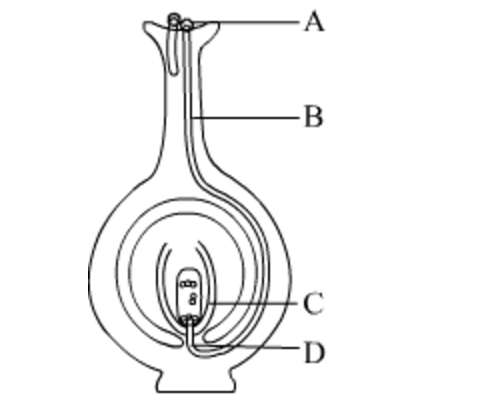
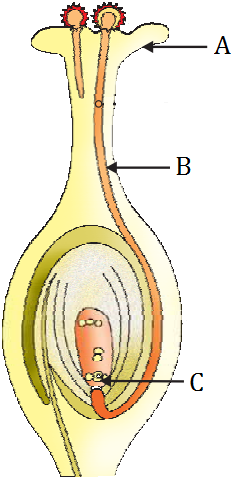
  1. Name the parts labelled as A, B, C and D in the diagram given below:
  1. What is pollination? State its significance.
  2. How does fertilisation occur in flowers? Name the parts of the flower that develop into (i) seed, and (ii) fruit after fertilisation.
View full solution
  1. Write the functions of each of the following parts in a human female reproductive system:
  1. Ovary.
  2. Uterus.
  3. Fallopian tube.
  1. Write the structure and functions of placenta in a human female.
View full solution
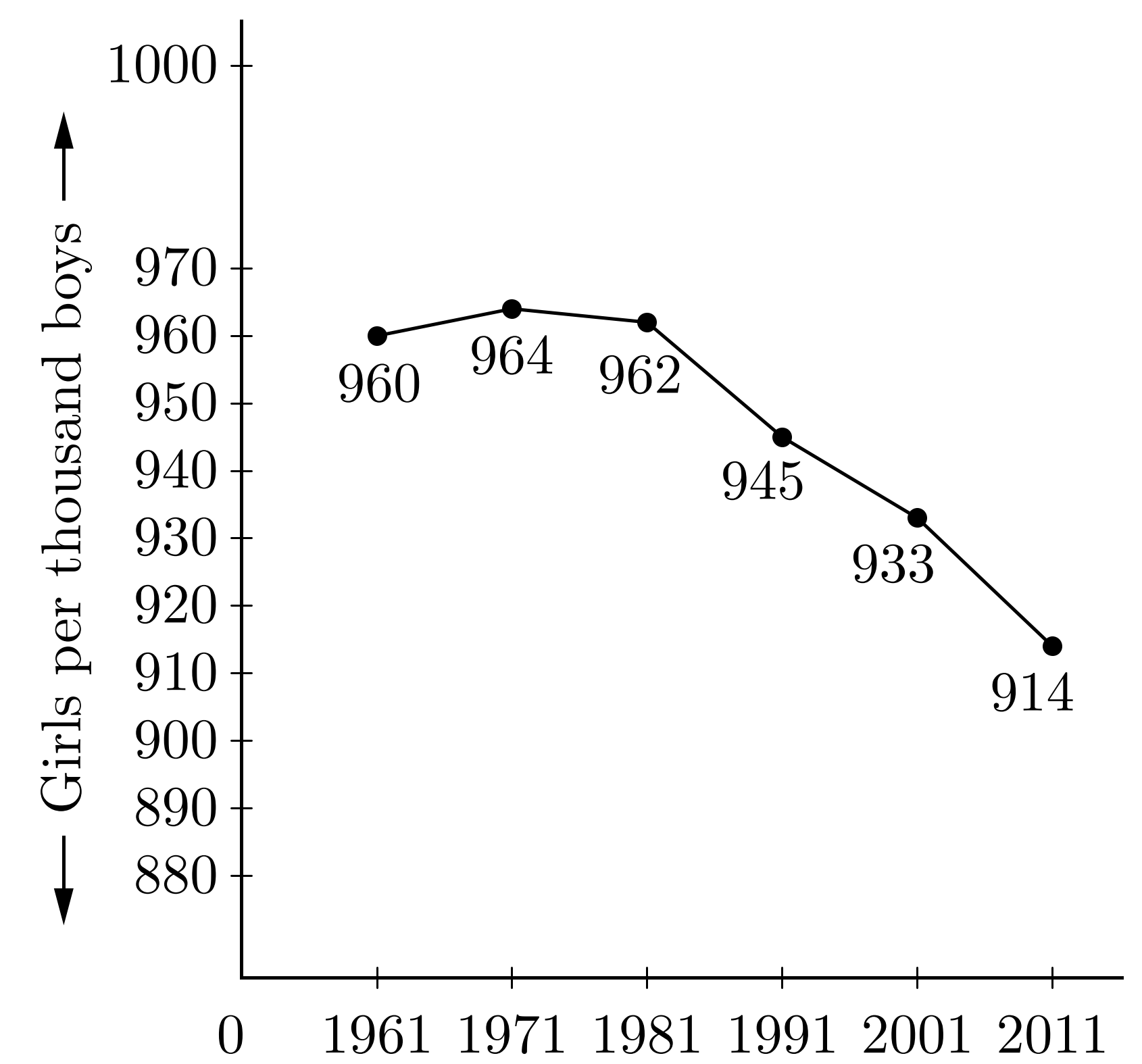
In our country, ultrasound imaging (echography) is used to take images of the developing babies (foetus). It is considered safe for both the mother and the foetus. In this method, the doctor holds a probe and moves it across the abdomen of the mother.
Ultrasound waves which are transmitted into the abdomen are reflected from the surface of the foetus. These reflected waves are picked up by the probe and relayed to a machine that produces the image of the developing baby. In some parts of our country, ultrasound is done illegally.
(i) What could be the reason of performing ultrasound illegally?
(ii) "Man, and not the woman is responsible for the birth of a girl child." What is meant by this statement?
(iii) Can ultrasound examination of expecting mothers answer the following questions? Write 'Yes' or 'No'.
(a) What is the colour of the baby's eyes?
(b) Is there more than one foetus?
or
(iv) Based on the data shown in the graph alongside, state what could be the reason for the decline in the boys child sex ratio?
View full solution
Reproduction (or procreation or breeding) is the biological process by which new individual organisms- "offspring" are produced from their "parents". Reproduction is a fundamental feature of all known life; each individual organism exists as the result of reproduction. There are two forms of reproduction: asexual and sexual. In asexual reproduction, an organism can reproduce without the involvement of another organism. Asexual reproduction is not limited to single-celled organisms. The cloning of an organism is a form of asexual reproduction. By asexual reproduction, an organism creates a genetically similar or identical copy of itself. The evolution of sexual reproduction is a major puzzle for biologists. Sexual reproduction typically requires the sexual interaction of two specialized organisms, called gametes, which contain half the number of chromosomes of normal cells and are created by meiosis, with a male typically fertilizing a female of the same species to create a fertilized zygote. This produces offspring organisms whose genetic characteristics are derived from those of the two parental organisms. Asexual reproduction is a process by which organisms create genetically similar or identical copies of themselves without the contribution of genetic material from another organism. Bacteria divide asexually via binary fission. Sexual reproduction is a biological process that creates a new organism by combining the genetic material of two organisms in a process that starts with meiosis, a specialized type of cell division.

(i) What do you mean by reproduction?
(ii) How many forms of reproduction are there? What are they?
(iii) What do you mean by asexual reproduction?
or
(iv) What do you mean by sexual reproduction?

View full solution
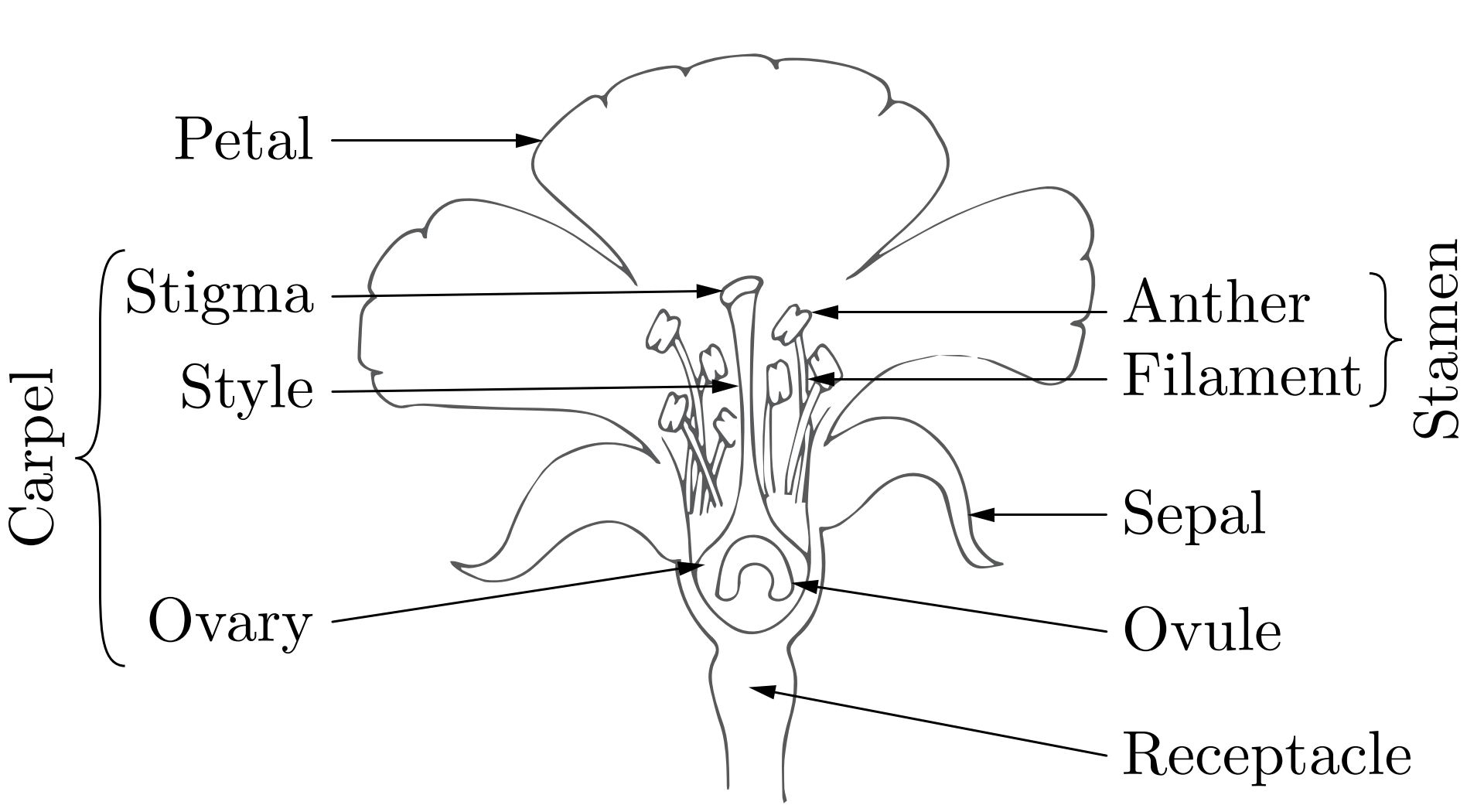
The reproductive parts of angiosperms are located in the flower. The different parts of a flower are sepals, petals, stamens and carpels. Stamens and carpels are the reproductive parts of a flower which contain the germ-cells. The flower may be unisexual (papaya, watermelon) when it contains either stamens or carpels or bisexual (hibiscus, mustard) when it contains both stamens and carpels. Stamen is the male reproductive part and it produces pollen grains that are yellowish in colour. Carpel is present in the centre of a flower and is the female reproductive part. It is made of three parts. The swollen bottom part is the ovary, middle elongated part is the style and the terminal part which may be sticky is the stigma. The ovary contains ovules and each ovule has an egg cell. The male germcell produced by pollen grain fuses with the female gamete present in the ovule. This fusion of the germ-cells or fertilization gives us the zygote which is capable of growing into a new plant.

(i) What are the different parts of a flower?
(ii) Name the reproductive parts of a flower.
(iii) Which is the male reproductive part of a flower?
or
(iv) Which is the female reproductive part of a flower?

View full solution

Reproduction in human beings is by sexual reproduction where both the male and female gametes fertilise to give rise to an embryo. The fertilization of the human embryo occurs inside the body of the female.

(i) Name the part of the male reproductive system where the formation of sperms takes place.
(ii) What is the placenta?
(iii) What is the other name of the oviduct?
(iv) Define the term implantation.
View full solution

The sexual act always has the potential to lead to pregnancy will make major demands on the body and the mind of the woman and if she is not ready for it, her health will be adversely affected. Therefore, many ways have been devised to avoid pregnancy.

The sexual act always has the potential to lead to pregnancy will make major demands on the body and the mind of the woman and if she is not ready for it, her health will be adversely affected. Therefore, many ways have been devised to avoid pregnancy.
(i) Name any two bacterial diseases that are caused due to unprotected sex.
(ii) In what a pill helps in preventing pregnancy?
(iii) What is vasectomy?
or
(iv) What are the common side-effects of using contraceptive pills?
View full solution

Generate a How do Organisms Reproduce? paper free

Pick question groups from the list above, set marks and difficulty, and export a branded PDF with step-by-step answer keys. First 3 chapters free — no signup.

Download App