Questions

[3 Mark Questions]

🎯

Test yourself on this topic

9 questions · timed · auto-graded

Question 13 Marks
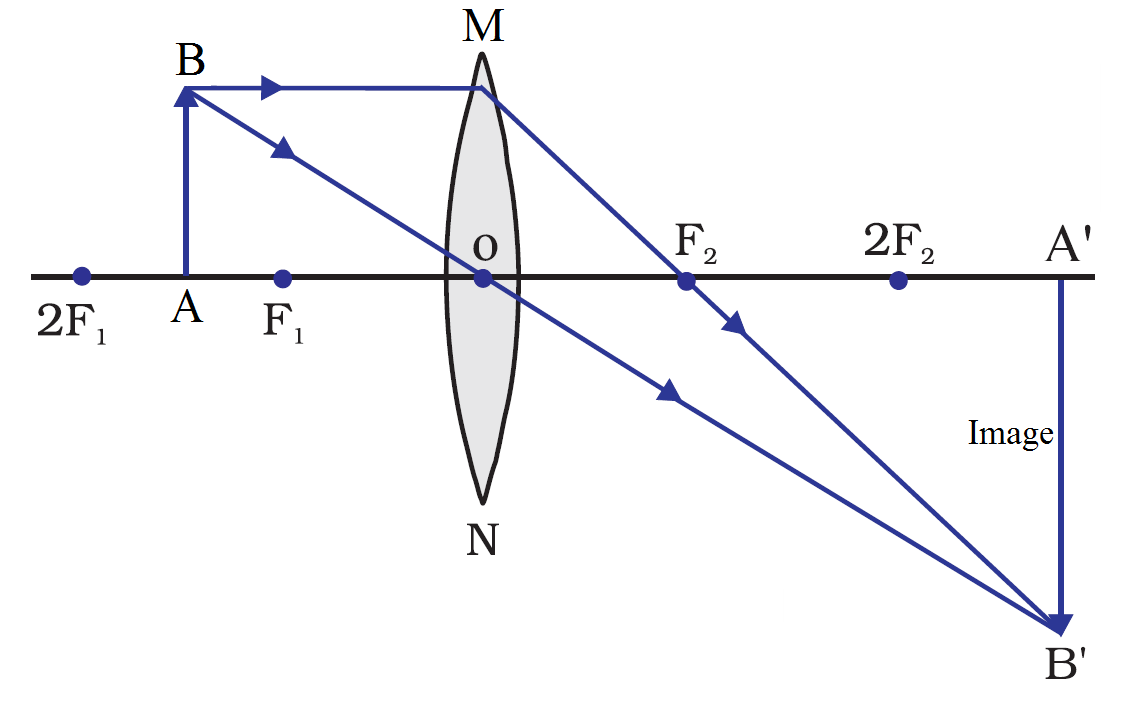
The image of a candle flame formed by a lens is obtained on a screen placed on the other side of the lens. If the image is three times the size of the flame and the distance between lens and image is 80cm, at what distance should the candle be placed from the lens? What is the nature of the image at a distance of 80cm and the lens?
Answer
The image is real as only the real image can be taken on the screen.Here, image distance, v = +80cm
Magnification, m = -3
Object distance, u = ?
Now, magnification, $\text{m}=\frac{\text{v}}{\text{u}}\Rightarrow\ -3=\frac{80}{\text{u}}\ \text{or u }=\frac{-80}{3}\text{cm}$
Nature of image will be real, magnified and inverted. The image will be formed beyond 2F.
By using lens formula,
$\frac{1}{\text{v}}-\frac{1}{\text{u}}=\frac{1}{\text{f}}$
$\Rightarrow\ \frac{1}{\text{f}}=\frac{1}{80}-\frac{3}{-80}=\frac{1}{20}\text{ or f }=20\text{cm}$
Focal length is positive so, the lens is convex.
View full question & answer
Question 23 Marks
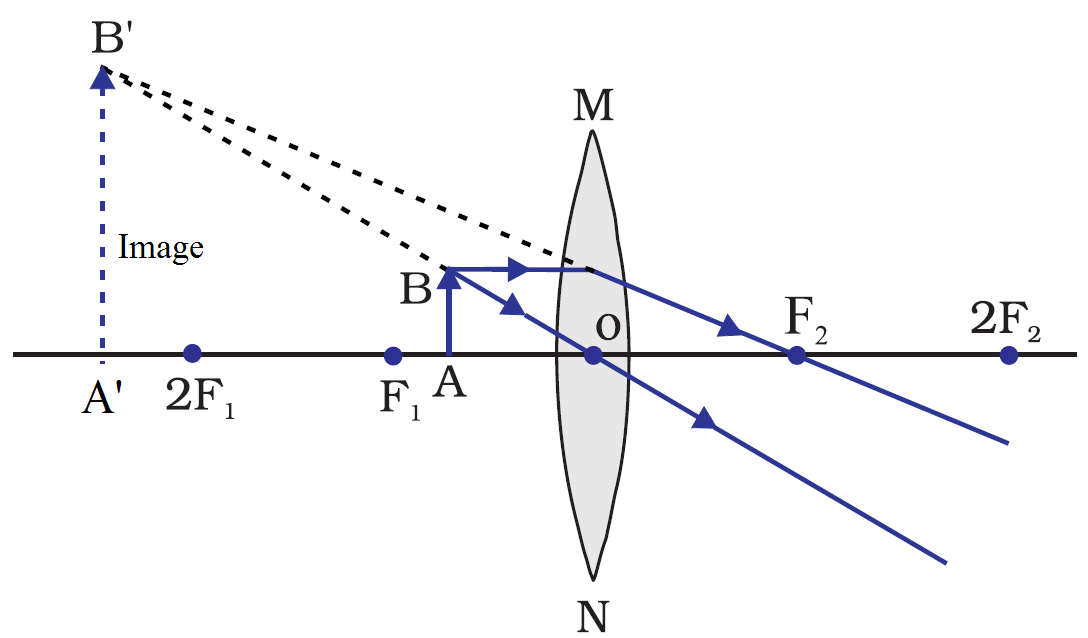
A convex lens of focal length 20cm can produce a magnified virtual as well as real image. Is this a correct statement? If yes, where shall the object be placed in each case for obtaining these images?
Answer

The statement is correct.
A convex lens of focal length 20cm will produce a magnified Virtual image if object is placed at a distance less than 20cm from the lens.

A convex lens of focal length 20cm will produce a magnified real image if object is placed at a distance greater than 20cm and less than 40cm from the lens.
View full question & answer
Question 33 Marks
Size of image of an object by a mirror having a focal length of 20cm is observed to be reduced to $\frac{1}{3}\text{rd}$ of its size. At what distance the object has been placed from the mirror? What is the nature of the image and the mirror?
Answer
Since image size is $\frac{1}{3}$ of object size, so image distance is $\frac{1}{3}$ of object distance because $\frac{\text{h}'}{\text{h}}=\frac{\text{v}}{\text{u}}$ Using the mirror formula, we can calculate object distance and image distance,$\frac{1}{\text{v}}+\frac{1}{\text{u}}=\frac{1}{\text{f}}$
or, $\frac{3}{\text{u}}-\frac{1}{\text{u}}=-\frac{1}{20}$ or, $\frac{3-1}{\text{u}}=-\frac{1}{20}$ or, $\text{u}=-40\text{cm}$ Using this, we can find image distance:$\frac{1}{\text{v}}+\frac{1}{\text{u}}=\frac{1}{\text{f}}$
or, $\frac{1}{\text{v}}-\frac{1}{40}=-\frac{1}{20}$ or, $\frac{1}{\text{v}}=-\frac{1}{20}+\frac{1}{40}$ or, $\frac{-2+1}{40}=-\frac{1}{40}$But above value of image distance does not match with our initial assumption. This means that the mirror is not a concave mirror but a convex mirror. Let us calculate with the assumption that it is a convex mirror.
$\frac{1}{\text{v}}+\frac{1}{\text{u}}=\frac{1}{\text{f}}$
or, $\frac{1}{\text{v}}-\frac{1}{40}=-\frac{1}{20}$ or, $\frac{1}{\text{v}}=-\frac{1}{20}+\frac{1}{40}=\frac{3}{40}$ or, $\text{v}=\frac{40}{3}\text{cm}$Nature of mirror: convex mirror.
Nature of image: Smaller than object, erect and virtual.
View full question & answer
Question 43 Marks
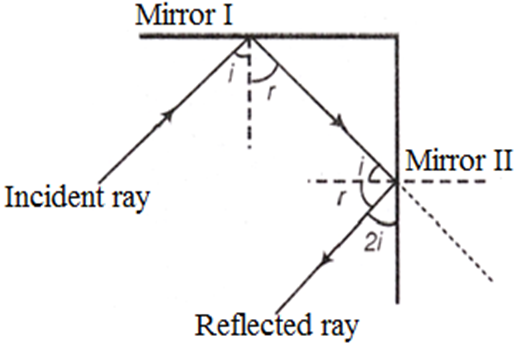
Under what condition in an arrangement of two plane mirrors, incident ray and reflected ray will always be parallel to each other, whatever may be angle of incidence. Show the same with the help of diagram.
Answer

When two plane mirrors are placed at right angle with each other, then the incident ray and reflected ray will always be parallel to each other, irrespective of the angle of incidence.
View full question & answer
Question 53 Marks
Sudha finds out that the sharp image of the window pane of her science laboratory is formed at a distance of 15cm from the lens. She now tries to focus the building visible to her outside the window instead of the window pane without disturbing the lens. In which direction will she move the screen to obtain a sharp image of the building? What is the approximate focal length of this lens?
Answer
Let us assume that the window pane is between $F_2$ and infinity from this lens and this is a convex lens. We know that when the object is between infinity and $F_2$, its inverted and real image is formed between $2 F$ and $2 F_2$. Now, the distant building is at infinity from the lens. Its image would be formed at 2 F . So, the screen needs to be moved towards the lens in order to get a sharp image. Its approximate focal length is 10 cm (less than image distance in earlier case).
View full question & answer
Question 63 Marks
How are power and focal length of a lens related? You are provided with two lenses of focal length 20cm and 40cm respectively. Which lens will you use to obtain more convergent light?
Answer
$\text{P}=\frac{1}{\text{f}(\text{in meter})}=\frac{100}{\text{f}(\text{in cm})}$$\text{f}_1=20\text{cm}\ \therefore\ \text{P}_1=\frac{100}{20}=5.0\text{D}$
$\text{f}_2=40\text{cm}\ \therefore\ \text{P}_2=\frac{100}{40}=2.5\text{D}$
The lens of focal length 20cm or power 5.0D will be used to have more convergent light. This is because lens of small focal length or large power strongly converges the parallel beam of light.
View full question & answer
Question 73 Marks
How is the refractive index of a medium related to the speed of light? Obtain an expression for refractive index of a medium with respect to another in terms of speed of light in these two media?
Answer
The speed of light in medium and refractive index of medium are related as,Speed of light in the medium $=\frac{\text{Speed of light in vacuum}}{\text{Speed of light in the medium}}.$
Consider a ray of light travelling from medium 1 into medium 2.
Let v1 = Speed of light in medium 1
v2 = Speed of light in medium 2.
Refractive index of medium 2 with respect to medium 1 = $n_{21}$
The refractive index of medium 2 with respect to medium 1 (i.e. $n_{21}$) is given by the ratio of the speed of light in medium 1 and the speed of light in medium 2.
$\Rightarrow\ \text{n}_{21}=\frac{\text{Speed of light in medium 1}}{\text{Speed of light in medium 2}}=\frac{\text{v}_1}{\text{v}_2}.$
View full question & answer
Question 83 Marks
Define power of a lens. What is its unit? One student uses a lens of focal length 50cm and another of -50cm. What is the nature of the lens and its power used by each of them?
Answer
The degree of divergence or convergence achieved by a given lens is called power of the lens. The unit of power of lens is diopter and is expressed by D. Focal length of lens used by first student is in positive hence it is a convex lens. The lens of second student is a concave lens.$\text{P}=\frac{1}{\text{f}}=\frac{1}{0.5}=2$
Power of lens (first student) = +2
Power of lens (second student) = -2
View full question & answer
Question 93 Marks
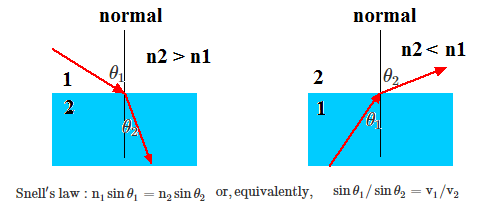
Draw a ray diagram showing the path of rays of light when it enters with oblique incidence:
  1. From air into water;
  2. From water into air.
Answer
  1. The light slows down when it passes from a rarer medium into a denser medium. Also, the light ray bends more towards the normal. (left image).
  2. From a denser medium to a rarer medium the light ray bends away from the normal (right image).
View full question & answer
[3 Mark Questions] - Science STD 10 Questions - Vidyadip