Questions

M.C.Q

🎯

Test yourself on this topic

26 questions · timed · auto-graded

MCQ 11 Mark
According to Mendele′ ev's Periodic Law, the elements were arranged in the periodic table in the order of:
  • A
    Increasing atomic number.
  • B
    Decreasing atomic number.
  • Increasing atomic masses.
  • D
    Decreasing atomic masses.
Answer
Correct option: C.
Increasing atomic masses.
The Mendeleev's periodic law is an arrangement of elements in increasing order of their atomic masses as Mendeleev's periodic law states that, the physical and chemical properties of elements are a periodic function of their atomic masses.
View full question & answer
MCQ 21 Mark
In Mendele′ ev ’s Periodic Table, gaps were left for the elements to be discovered later. Which of the following elements found a place in the perioidc table later:
  • Germanium.
  • B
    Chlorine.
  • C
    Oxygen.
  • D
    Silicon.
Answer
Correct option: A.
Germanium.
Mandeleev named the undiscovered elements as Eka-boron, Eka-aluminium and Eka-silicon. These were replaced with scandium, gallium and germanium respectively in due course of time.
View full question & answer
MCQ 31 Mark
The element with atomic number 14 is hard and forms acidic oxide and a covalent halide. To which of the following categories does the element belong?
  • A
    Metal.
  • Metalloid.
  • C
    Non-metal.
  • D
    Left-hand side element.
Answer
Correct option: B.
Metalloid.
 The element with atomic number (Z) = 14 is silicon (Si). It is a metalloid.
View full question & answer
MCQ 41 Mark
The elements A, B, C, D and E have atomic number 9, 11, 17, 12 and 13 respectively. Which pair of elements belong to the same group?
  • A
    A and B.
  • B
    B and D.
  • A and C.
  • D
    D and E.
Answer
Correct option: C.
A and C.
Elements A(Z = 9) and C(Z = 17) belong to the same group. It is a halogen family (group 17).
View full question & answer
MCQ 51 Mark
Which of the following elements would lose an electron easily?
  • A
    Mg.
  • B
    Na.
  • K.
  • D
    Ca.
Answer
Correct option: C.
K.
The element potassium (K) with maximum size would lose electron easily.
View full question & answer
MCQ 61 Mark
Which of the following elements does not lose an electron easily?
  • A
    Na.
  • F.
  • C
    Mg.
  • D
    Al.
Answer
Correct option: B.
F.
 Metals can easily lose electrons and exhibit electropositive nature whereas non-metals have tendency to accept electrons and exhibit electronegative nature. Na, Al and Mg are metals whereas F is a non-metal.
View full question & answer
MCQ 71 Mark

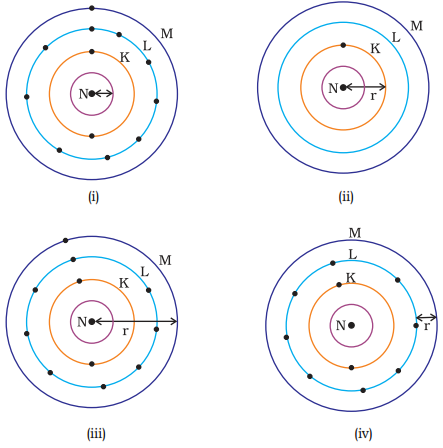
Which one of the following depict the correct representation of atomic radius (r) of an atom?
  • A
    (i) and (ii).
  • (ii) and (iii).
  • C
    (iii) and (iv).
  • D
    (i) and (iv).
Answer
Correct option: B.
(ii) and (iii).
The distance between nucleus and outermost orbit is called atomic radius. In fig (iii), it is quite clear. In all other figures, the distance is not correctly shown.
View full question & answer
MCQ 81 Mark
Which among the following elements has the largest atomic radii?
  • A
    Na.
  • B
    Mg.
  • K.
  • D
    Ca.
Answer
Correct option: C.
K.
Na and K belong to the same group. i.e. Group I. Ca and Mg belong to the Group II. The atomic radius decreases in moving from left to right along a period. This is due to an increase in nuclear charge which tends to pull the electrons closer to the nucleus and reduces the size of the atom. Hence K has largest atomic radii.
View full question & answer
MCQ 91 Mark
Which of the following statement $(s)$ about the Modern Periodic Table are incorrect :
  1. The elements in the Modern Periodic Table are arranged on the basis of their decreasing atomic number.
  2. The elements in the Modern Periodic Table are arranged on the basis of their increasing atomic masses.
  3. Isotopes are placed in adjoining group $(s)$ in the Periodic Table.
  4. The elements in the Modern Periodic Table are arranged on the basis of their increasing atomic number.
  • A
    $(i)$ only.
  • $(i), (ii)$ and $(iii).$
  • C
    $(i), (ii)$ and $(iv)$.
  • D
    $(iv)$ only.
Answer
Correct option: B.
$(i), (ii)$ and $(iii).$
The modern periodic table is tabular arrangement of elements in increasing order of their atomic number therefore isotopes are paced at same position.
View full question & answer
MCQ 101 Mark
An element which is an essential constituent of all organic compounds belongs to:
  • A
    Group 1.
  • Group 14.
  • C
    Group 15.
  • D
    Group 16.
Answer
Correct option: B.
Group 14.
Carbon is an essential element for all organic compounds and belongs to group 14.
View full question & answer
MCQ 111 Mark
Three elements B, Si and Ge are:
  • A
    Metals.
  • B
    Non-metals.
  • Metalloids.
  • D
    Metal, non-metal and metalloid respectively.
Answer
Correct option: C.
Metalloids.
These are also called semi-metals and possess the characteristics of both metals and non-metals.
View full question & answer
MCQ 121 Mark
Arrange the following elements in the order of their decreasing metallic character Na, Si, Cl, Mg, Al:
  • A
    Cl > Si > Al > Mg > Na.
  • Na > Mg > Al > Si > Cl.
  • C
    Na > Al > Mg > Cl > Si.
  • D
    Al > Na > Si > Ca > Mg.
Answer
Correct option: B.
Na > Mg > Al > Si > Cl.
 The metallic character of the elements decreases along a period. These elements are present in third period.
View full question & answer
MCQ 131 Mark
Which of the given elements A, B, C, D and E with atomic number 2, 3, 7, 10 and 30 respectively belong to the same period?
  • A
    A, B, C.
  • B, C, D.
  • C
    A, D, E.
  • D
    B, D, E.
Answer
Correct option: B.
B, C, D.
The elements B(Z = 3), C(Z = 7) and D(Z = 10) belong to the same period. It is second period.
View full question & answer
MCQ 141 Mark
Which of the following are the characteristics of isotopes of an element?
  1. Isotopes of an element have same atomic masses.
  2. Isotopes of an element have same atomic number.
  3. Isotopes of an element show same physical properties.
  4. Isotopes of an element show same chemical properties.
  • A
    $(i), (iii)$ and $(iv).$
  • B
    $(ii), (iii)$ and $(iv).$
  • C
    $(ii)$ and $(iii).$
  • $(ii)$ and $(iv).$
Answer
Correct option: D.
$(ii)$ and $(iv).$
Isotopes of an element have same atomic number but different atomic masses. They show same chemical properties but different physical properties.
View full question & answer
MCQ 151 Mark
Which of the following statements about the Modern Periodic Table is correct:
  • A
    It has 18 horizontal rows known as Periods.
  • B
    It has 7 vertical columns known as Periods.
  • It has 18 vertical columns known as Groups.
  • D
    It has 7 horizontal rows known as Groups.
Answer
Correct option: C.
It has 18 vertical columns known as Groups.
Modern Periodic Table has 18 Groups and 7 periods. Columns are called groups, while rows are called periods.
View full question & answer
MCQ 161 Mark
On moving from left to right in a period in the periodic table, the size of the atom.
  • A
    Increases.
  • Decreases.
  • C
    Does not change appreciably.
  • D
    First decreases and then increases.
Answer
Correct option: B.
Decreases.
Atomic size decreases along a period. However, the noble gas atom is an exception. It has very large size.
View full question & answer
MCQ 171 Mark
Which one of the following does not increase while moving down the group of the periodic table?
  • A
    Atomic radius.
  • B
    Metallic character.
  • Valence.
  • D
    Number of shells in an element.
Answer
Correct option: C.
Valence.
 Elements of the same group have same number of valence electrons hence valency will remain same.
View full question & answer
MCQ 181 Mark
Arrange the following elements in the order of their increasing nonmetallic character Li, O, C, Be, F:
  • A
    F < O < C < Be < Li.
  • Li < Be < C < O < F.
  • C
    F < O < C < Be < Li.
  • D
    F < O < Be < C < Li.
Answer
Correct option: B.
Li < Be < C < O < F.
 These all elements belong to same period in which non-metallic characters increases from left to right.
View full question & answer
MCQ 191 Mark
Which of the following set of elements is written in order of their increasing metallic character?
  • Be Mg Ca.
  • B
    Na Li K.
  • C
    Mg Al Si.
  • D
    C O N.
Answer
Correct option: A.
Be Mg Ca.
These elements are in same group but Be is at the top, while Ca is at bottom. Metallic character increases as we move down the group.
View full question & answer
MCQ 201 Mark
Which of the following is the outermost shell for elements of period $2?$
  • A
    $K$ shell.
  • $L$ shell.
  • C
    $M$ shell.
  • D
    $N$ shell.
Answer
Correct option: B.
$L$ shell.

The elements of $2^{nd}$ period contain two shells; $K$ and d $L$ shell.

View full question & answer
MCQ 211 Mark
Which of the following elements will form an acidic oxide?
  • An element with atomic number 7.
  • B
    An element with atomic number 3.
  • C
    An element with atomic number 12.
  • D
    An element with atomic number 19.
Answer
Correct option: A.
An element with atomic number 7.
Formation of acidic oxides is character of non-metals. Here element with atomic number 7 is a non-metal that is nitrogen. Rests of all are metals.
View full question & answer
MCQ 221 Mark
Where would you locate the element with electronic configuration 2, 8 in the Modern Periodic Table?
  • A
    Group 8.
  • B
    Group 2.
  • Group 18.
  • D
    Group 10.
Answer
Correct option: C.
Group 18.
In this element, the outermost shell is completely filled. Hence, this belongs to Group 18.
View full question & answer
MCQ 231 Mark
What type of oxide would Eka$-$aluminium form?
  • A
    $EO_3$
  • B
    $E_3O2$
  • $E_2O_3$
  • D
    $EO$
Answer
Correct option: C.
$E_2O_3$
Eka$-$aluminium is in the same group as Aluminum, i.e. Group $13$. Hence, there are $3$ electrons in its outermost orbit. So, it can lost $3$ electrons to form a bond. Oxygen has $6$ electrons in its outermost orbit which means it can gain $2$ electrons to form a bond.
View full question & answer
MCQ 241 Mark
Upto which element, the Law of Octaves was found to be applicable:
  • A
    Oxygen.
  • Calcium.
  • C
    Cobalt.
  • D
    Potassium.
Answer
Correct option: B.
Calcium.
 Law was found to be applicable upto the element calcium.
View full question & answer
MCQ 251 Mark
Which one of the following elements exhibit maximum number of valence electrons?
  • A
    Na.
  • B
    Al.
  • C
    Si.
  • P.
Answer
Correct option: D.
P.
Electronic configuration of,
Na: 2, 8, 1.
Al: 2, 8, 3.
Si: 2, 8, 4.
P: 2, 8, 5.
Phosphorus has 5 valence electrons, while others have less number of valence electrons.
View full question & answer
MCQ 261 Mark
Which of the following gives the correct increasing order of the atomic radii of O, F and N?
  • A
    O, F, N.
  • B
    N, F, O.
  • C
    O, N, F.
  • F, O, N.
Answer
Correct option: D.
F, O, N.
It is the correct order. These elements are present in second period.
View full question & answer