Questions · Page 1 of 4

MCQ (1 Mark)

🎯

Test yourself on this topic

50 questions · timed · auto-graded

MCQ 11 Mark
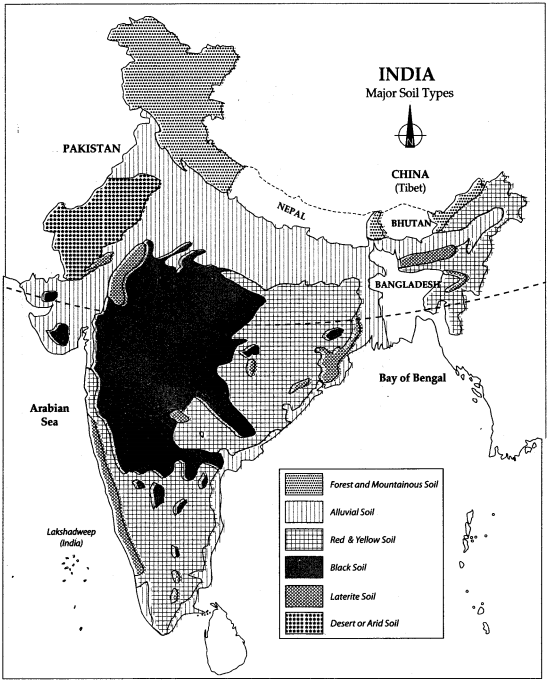
“M” gave his friend clues about a type of soil that suits for growing cotton. Which of the following clues provided by "M" would be most useful in identifying the ideal type of soil? Clues:
i. It is well-known for its capacity to hold moisture.
ii. It turns yellow when it is hydrated.
iii. It is rich in kankur and bhangar nodules.
iv. It is a well-drained loamy soil.
  • A
    Clue i
  • B
    Clue i and iii
  • C
    Clue i and ii
  • Clue iv
Answer
Correct option: D.
Clue iv
Clue iv
View full question & answer
MCQ 21 Mark
The Bua Tiger Reserve is in the state of :
  • A
    Rajasthan.
  • B
    Bihar.
  • C
    Uttar Pradesh.
  • West Bengal.
Answer
Correct option: D.
West Bengal.
It is in West Bengal
View full question & answer
MCQ 31 Mark
The Brundtland Commission Report published in $ ..........,$ shared ideas about sustainable development and how it could be achieved.
  • A
    $1997.$
  • $1987.$
  • C
    $1992.$
  • D
    $1977.$
Answer
Correct option: B.
$1987.$
View full question & answer
MCQ 41 Mark
Human beings have indiscriminately used resources which have. This has led to which of the following major problems.
  • A
    Depletion of resources for satisfying the greed of a few individuals.
  • B
    Accumulation of resources in few hands, which, divided the society into two segments i.e. haves and have nots.
  • Both $(A)$ and $(B).$
  • D
    None of the above.
Answer
Correct option: C.
Both $(A)$ and $(B).$
View full question & answer
MCQ 51 Mark
Black soil is favourable for the growth of $……….$
  • A
    Paddy and wheat.
  • B
    Nuts.
  • C
    Cereals.
  • Cotton.
Answer
Correct option: D.
Cotton.
View full question & answer
MCQ 61 Mark
What is the total geographical area of India?
  • A
    $3.25$ million sq $\ km.$
  • B
    $3.20$ million sq $\ km.$
  • C
    $3.22$ million sq $\ km.$
  • $3.28$ million sq $\ km.$
Answer
Correct option: D.
$3.28$ million sq $\ km.$
View full question & answer
MCQ 71 Mark
Water in the dams, forests etc. is a $…………..$ resources which can be used in the future?
  • A
    Potential.
  • Reserve.
  • C
    Renewable.
  • D
    National.
Answer
Correct option: B.
Reserve.
View full question & answer
MCQ 81 Mark
What is strip cropping?
  • A
    Planting lines of trees.
  • B
    Planting between water beds.
  • C
    Cultivating making steps.
  • Strips of grass are left to grow between the crops.
Answer
Correct option: D.
Strips of grass are left to grow between the crops.
View full question & answer
MCQ 91 Mark
What is stock?
  • A
    Resources which can be renewed or reproduced.
  • B
    Resources which are found in a region, but have not been utilised.
  • Materials in the environment which have the potential to satisfy human needs, but human beings do not have the appropriate technology to access these.
  • D
    Solar and wind energy, water, forests and wildlife.
Answer
Correct option: C.
Materials in the environment which have the potential to satisfy human needs, but human beings do not have the appropriate technology to access these.
View full question & answer
MCQ 101 Mark
At least $10$ percent of India’s recorded wild flora and $20$ percent of its mammals are on the :
  • A
    Extinct list.
  • B
    Endangered list.
  • Threatened list.
  • D
    Vulnerable list.
Answer
Correct option: C.
Threatened list.
At least $10$ percent of India’s recorded wild flora and $20$ percent of its mammals are on the threatened list.
View full question & answer
MCQ 111 Mark
Where is black soil mostly found?
  • A
    Karnataka and Kerala.
  • plateaus of Maharashtra, Saurashtra, Malwa, Madhya Pradesh and Chhattisgarh.
  • C
    Rajasthan and Gujrat.
  • D
    Assam.
Answer
Correct option: B.
plateaus of Maharashtra, Saurashtra, Malwa, Madhya Pradesh and Chhattisgarh.
View full question & answer
MCQ 121 Mark
How can we solve the problems of land degradation?
  • Afforestation.
  • B
    More agriculture crops.
  • C
    Try to grow plants in desert areas.
  • D
    Keep injury away from agriculture land.
Answer
Correct option: A.
Afforestation.
View full question & answer
MCQ 131 Mark
Which of the following options does not fall in the categories of land $-$ use pattern?
  • A
    Forests.
  • B
    Waste lands.
  • C
    Current fallow.
  • Gross sown area.
Answer
Correct option: D.
Gross sown area.
View full question & answer
MCQ 141 Mark
Give examples of non renewable resources.
  • A
    Flora and fauna, fisheries, livestock.
  • B
    Solar and wind energy, water, forests and wildlife.
  • Minerals and fossil fuels.
  • D
    Rocks and metals.
Answer
Correct option: C.
Minerals and fossil fuels.
View full question & answer
MCQ 151 Mark
The state of Rajasthan is very well endowed with solar and $ .......... $ energy but lacks in water resources.
  • A
    Geothermal.
  • B
    Hydro.
  • Wind.
  • D
    Tidal.
Answer
Correct option: C.
Wind.
View full question & answer
MCQ 161 Mark
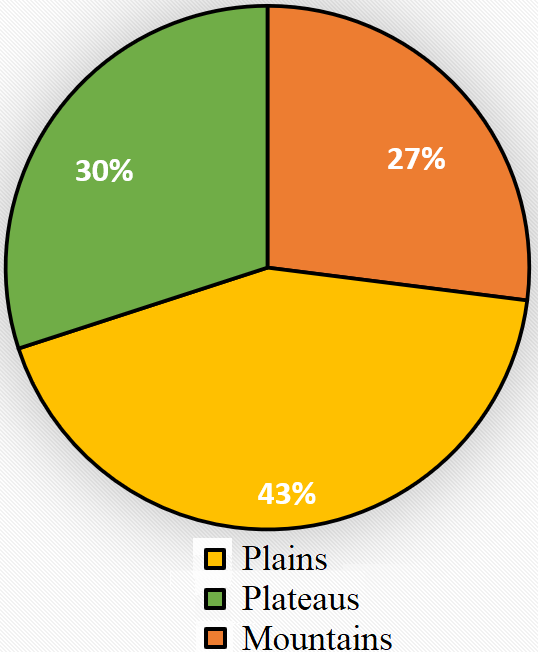
$ ........... $ account for $30\%$ of the total surface area of India.
  • A
    Deserts.
  • Mountains.
  • C
    Plains.
  • D
    Plateaus.
Answer
Correct option: B.
Mountains.
View full question & answer
MCQ 171 Mark
What type of a resource are rocks?
  • Abiotic.
  • B
    Renewable.
  • C
    Potential.
  • D
    Biotic.
Answer
Correct option: A.
Abiotic.
View full question & answer
MCQ 181 Mark
Forests and wastelands belonging to both government and private individuals and communities are called :
  • A
    Protected forests.
  • B
    Reserved forests.
  • Unclassed forests.
  • D
    Private forests.
Answer
Correct option: C.
Unclassed forests.
Such forests are called unclassed forests.
View full question & answer
MCQ 191 Mark
Land not available for cultivation is called :
  • A
    Forests.
  • Barren and waste lands.
  • C
    Fallow lands.
  • D
    Net sown area.
Answer
Correct option: B.
Barren and waste lands.
View full question & answer
MCQ 201 Mark
Which type of soil has a good capacity to hold moisture?
  • A
    Alluvial soil.
  • B
    Arid soil.
  • C
    Forest soil.
  • Black soil.
Answer
Correct option: D.
Black soil.
View full question & answer
MCQ 211 Mark
How do human beings interact with nature?
  • Through technology.
  • B
    Through nurturing environmental resources.
  • C
    Through industry.
  • D
    Through experimental advances.
Answer
Correct option: A.
Through technology.
View full question & answer
MCQ 221 Mark
Which of the following is $\text{NOT}$ correctly matched?
  $A$   $B$
$(i)$ On the basis of origin. $(A)$ Flora and fauna.
$(ii)$ On the basis of exhaustibility. $(B)$ Renewable and non $-$ renewable.
$(iii)$ On the basis of ownership. $(C)$ Individual, community, national and international.
$(iv)$ On the basis of status of development. $(D)$ Potential, developed stock and reserves..
  • Only $\ce{(i) - A}.$
  • B
    Only $\ce{(ii) - B}.$
  • C
    $\ce{(ii) - B}$ and $\ce{(iii) - C}.$
  • D
    $\ce{(iii) – C}$ and $\ce{(iv) - D.}$
Answer
Correct option: A.
Only $\ce{(i) - A}.$
View full question & answer
MCQ 231 Mark
Statement $1\ -$ Ninety $-$ five per cent of our basic needs for food, shelter and clothing are obtained from land.
Statement $2\ -$ Land is an utmost important natural resources supporting vegetation, wild life, human life, etc.
  • A
    Only Statement $1$ is true.
  • B
    Only Statement $2$ is true.
  • Both Statement $1$ and Statement $2$ are true.
  • D
    Both Statement $1$ and Statement $2$ are false.
Answer
Correct option: C.
Both Statement $1$ and Statement $2$ are true.
View full question & answer
MCQ 241 Mark
What are shelter belts?
  • A
    Cultivating making steps.
  • Planting lines of trees to create shelter.
  • C
    Planting huge bush plants in deserts.
  • D
    Planting near water beds.
Answer
Correct option: B.
Planting lines of trees to create shelter.
View full question & answer
MCQ 251 Mark
Which of these are resources based on ownership?
  • Individual Resources.
  • B
    Abiotic.
  • C
    Renewable Resources.
  • D
    Non renewable.
Answer
Correct option: A.
Individual Resources.
View full question & answer
MCQ 261 Mark
Interpret the following pie diagram and answer the following question :

What is the significance of $43$ percent land under plains?
  • A
    It provides facilities for agriculture and industry.
  • B
    It provides facilities for tourism.
  • C
    It ensures perennial flow of some river.
  • It possesses rich reserves of minerals, fossil fuels and forests.
Answer
Correct option: D.
It possesses rich reserves of minerals, fossil fuels and forests.
View full question & answer
MCQ 271 Mark
Species which are in danger of extinction are called :
  • Endangered species.
  • B
    Normal species.
  • C
    Vulnerable species.
  • D
    Rare species.
Answer
Correct option: A.
Endangered species.
Such species are called endangered species.
View full question & answer
MCQ 281 Mark
Which one of the following types of resources is iron ore?
  • A
    Renewable.
  • B
    Non renewable.
  • C
    Biotic.
  • Abiotic.
Answer
Correct option: D.
Abiotic.
View full question & answer
MCQ 291 Mark
Which of the following statements about Agenda $21$ is true?
  • A
    It aims at achieving global sustainable development.
  • B
    It is an agenda to combat environmental damage, poverty and disease through global cooperation.
  • C
    One of the major objectives of Agenda $21$ is that every local government should not draw its own local Agenda $21.$
  • Option $(a)$ and $(b).$
Answer
Correct option: D.
Option $(a)$ and $(b).$
View full question & answer
MCQ 301 Mark
Pick out the cause $($from below$)$ that enhances environmental degradation.
  • A
    Planting of trees.
  • B
    Check on grazing.
  • C
    Ban on use of plastic bags.
  • Allowing increase in the level of exhaust fumes emitted by cars, buses, trucks, etc.
Answer
Correct option: D.
Allowing increase in the level of exhaust fumes emitted by cars, buses, trucks, etc.
View full question & answer
MCQ 311 Mark
On the basis of origin, resources can be classified as $ .......... $ and $ .........$
  • Biotic and Abiotic.
  • B
    Renewable and Non $-$ renewable.
  • C
    Potential and Developed.
  • D
    None of the above.
Answer
Correct option: A.
Biotic and Abiotic.
View full question & answer
MCQ 321 Mark
The cheetah can move at the speed of :
  • A
    $110\ \text{km/ hr}$
  • B
    $111\ \text{km/ hr}$
  • $112\ \text{km/ hr}$
  • D
    $113\ \text{km/ hr}$
Answer
Correct option: C.
$112\ \text{km/ hr}$
The speed of the cheetah is $112\ \text{km/ hr}.$
View full question & answer
MCQ 331 Mark
Give examples of National resources?
  • A
    Plots, houses.
  • B
    Public parks, playgrounds, grazing grounds, burial grounds.
  • C
    Oceanic resources.
  • Minerals, water resources, forests, wildlife, land.
Answer
Correct option: D.
Minerals, water resources, forests, wildlife, land.
View full question & answer
MCQ 341 Mark
What is Black soil also known as?
  • A
    Fertile soil.
  • Regur soil.
  • C
    Barren soil.
  • D
    Khadar.
Answer
Correct option: B.
Regur soil.
View full question & answer
MCQ 351 Mark
$ ......... $ are the resources which are surveyed, and their quality and quantity have been determined for utilisation.
  • Developed resources.
  • B
    Reserves.
  • C
    Stock.
  • D
    Abiotic.
Answer
Correct option: A.
Developed resources.
View full question & answer
MCQ 361 Mark
What is Sustainable Development?
  • A
    Well planned use of resources and development.
  • B
    Accumulation of resources and then using them accordingly.
  • Development should take place without damaging the environment keeping in mind future generations.
  • D
    Using materials in the environment which have the potential to satisfy human needs.
Answer
Correct option: C.
Development should take place without damaging the environment keeping in mind future generations.
View full question & answer
MCQ 371 Mark
The lower horizon of soil are occupied by Kankar due to increasing $ ..........$
  • A
    Magnesium content.
  • B
    Potash and lime.
  • Calcium content.
  • D
    Phosphoric.
Answer
Correct option: C.
Calcium content.
View full question & answer
MCQ 381 Mark
What percentage of our land should be under forest according to the National Forest Policy $(1952)\ ?$
  • $33$
  • B
    $31$
  • C
    $22$
  • D
    $30$
Answer
Correct option: A.
$33$
View full question & answer
MCQ 391 Mark
Asiatic cheetah, pink head duck are examples of :
  • A
    Rare species.
  • Extinct species.
  • C
    Endemic species.
  • D
    Normal species.
Answer
Correct option: B.
Extinct species.
They are examples of Extinct species.
View full question & answer
MCQ 401 Mark
The processes of $…………$ and $………, $ go on simultaneously and generally there is a balance between the two.
  • A
    Denudation and erosion.
  • Soil formation and erosion.
  • C
    Soil formation and denudation.
  • D
    Climatic conditions and soil erosion.
Answer
Correct option: B.
Soil formation and erosion.
View full question & answer
MCQ 411 Mark
The Himalayan yew is a medicinal plant found in various parts of :
  • A
    Punjab and Haryana.
  • B
    Jammu and Kashmir.
  • C
    Punjab and Himachal Pradesh.
  • Himachal Pradesh and Arunachal Pradesh.
Answer
Correct option: D.
Himachal Pradesh and Arunachal Pradesh.
It is found in Himachal Pradesh and Arunachal Pradesh.
View full question & answer
MCQ 421 Mark
Which one of the following is not the basis of the classification of resources?
  • A
    Origin.
  • Shape.
  • C
    Ownership.
  • D
    Exhaustibility.
Answer
Correct option: B.
Shape.
View full question & answer
MCQ 431 Mark
The oceanic resources beyond $ ......... $ of the Exclusive Economic Zone belong to open ocean, and no individual country can utilise these without the concurrence of international institutions.
  • $200$ nautical miles.
  • B
    $12$ nautical miles.
  • C
    $22.5$ nautical miles.
  • D
    $100$ nautical miles.
Answer
Correct option: A.
$200$ nautical miles.
View full question & answer
MCQ 441 Mark
Species whose populations has declined to levels from where it is likely to move into the endangered category in the near future if the negative factors continue to operate are called :
  • A
    Endangered species.
  • B
    Normal species.
  • Vulnerable species.
  • D
    Rare species
Answer
Correct option: C.
Vulnerable species.
Such species are called vulnerable species.
View full question & answer
MCQ 451 Mark
What are developed resources?
  • Resources which are surveyed and their quality and quantity have been determined for utilisation.
  • B
    Resources which can be renewed or reproduced.
  • C
    Those things which are composed of non-living things.
  • D
    Resources which are found in a region, but have not been utilised.
Answer
Correct option: A.
Resources which are surveyed and their quality and quantity have been determined for utilisation.
View full question & answer
MCQ 461 Mark
Species whose population levels are considered to be normal for their survival are called :
  • A
    Endangered species.
  • Normal species.
  • C
    Vulnerable species.
  • D
    Rare species.
Answer
Correct option: B.
Normal species.
Such species are called normal species.
View full question & answer
MCQ 471 Mark
One of the key wildlife species in the faunal web is :
  • A
    Elephant.
  • B
    Lion.
  • Tiger.
  • D
    Fox.
Answer
Correct option: C.
Tiger.
Tiger is one of the key wildlife species in the faunal web.
View full question & answer
MCQ 481 Mark
The area covering states like Uttar Pradesh Bihar is the $ .......... $ soil type.
  • A
    Black soil.
  • Alluvial soil.
  • C
    Forest soil.
  • D
    Laterite soil.
Answer
Correct option: B.
Alluvial soil.
View full question & answer
MCQ 491 Mark
Minerals and fossil fuels are examples of non $-$ renewable resources which take $ ......... $ for their formation.
  • A
    Hundreds of years.
  • B
    Thousands of years.
  • Millions of years.
  • D
    Just a year.
Answer
Correct option: C.
Millions of years.
View full question & answer
MCQ (1 Mark) - Social Science STD 10 Questions - Vidyadip