Question types

Unit 3 Ch 2 : Federalism question types

338 questions across 8 question groups — pick any mix to generate a Social Science paper with step-by-step answer keys.

338
Questions
8
Question groups
5
Question types
Sample Questions

Unit 3 Ch 2 : Federalism questions

One sample from each question group in this chapter. Select any group above to see the full set with answer keys.

Q 1MCQ (1 Mark)1 Mark
Federal power sharing in India needs another tier of government below that of the State governments, it is called $ ...........$
  • A
    State offices.
  • B
    District government.
  • Local government.
  • D
    Tehsils.

Answer: C.

View full solution
Q 2MCQ (1 Mark)1 Mark
Choose the correct statement regarding language policy of the Indian Government.
  • A
    English is our national language.
  • B
    Citizens are free to choose any language as national language.
  • C
    Hindi is our national language.
  • Constitution of India did not declare any language as national language.

Answer: D.

View full solution
Q 3MCQ (1 Mark)1 Mark
Defence of the country, foreign affairs, banking, currency are subjects inducted in the :
  • A
    State list.
  • B
    Concurrent list.
  • Union list.
  • D
    None of the above.

Answer: C.

View full solution
Q 4MCQ (1 Mark)1 Mark
Who among the following is called head of the state at the state level?
  • Chief Minister.
  • B
    Speaker of Vidhan Sabha.
  • C
    Governor.
  • D
    Mayor.

Answer: A.

View full solution
Q 5MCQ (1 Mark)1 Mark
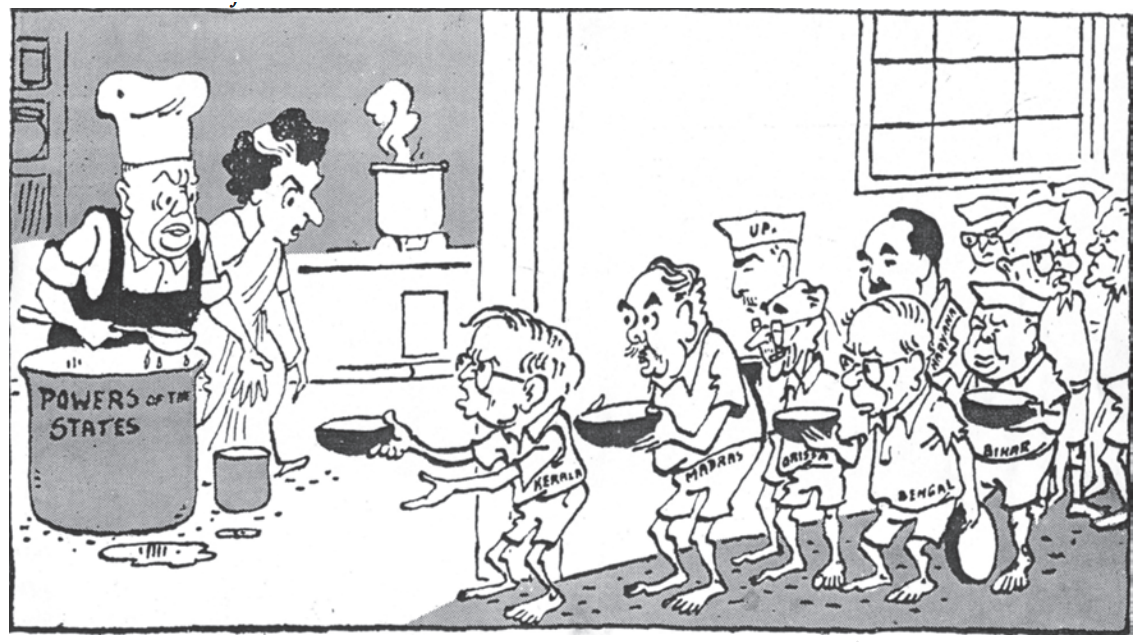
Study the given picture and find out which of the following options best signifies this cartoon?
  • A
    The state representatives are begging before the central government.
  • The central government is undermining the spirit of federalism.
  • C
    A lady is distributing food to the beggars.
  • D
    None of the above.

Answer: B.

View full solution
Direction : Mark the option which is most suitable:
Assertion $(A)$ : When power is taken away from central and state governments and given to local governments it is called decentralisation.
Reason $(R)$ : At least one third of all positions are reserved for women in local government bodies.
  • A
    If both assertion $(A)$ and reason $(R)$ are true and reason $(R)$ is the correct explanation of assertion $(A).$
  • If both assertion $(A)$ and reason $(R)$ are true but reason $(R)$ is not the correct explanation of assertion $(A).$
  • C
    Assertion $(A)$ is true but reason $(R)$ is false.
  • D
    Both assertion $(A)$ and reason $(R)$ are false.

Answer: B.

View full solution
Direction : Mark the option which is most suitable:
Assertion $(A)$ : Belgium shifted from a federal form of government to a unitary government.
Reason $(R)$ : Usually, a federation has two levels of government.
  • A
    If both assertion $(A)$ and reason $(R)$ are true and reason $(R)$ is the correct explanation of assertion $(A).$
  • B
    If both assertion $(A)$ and reason $(R)$ are true but reason $(R)$ is not the correct explanation of assertion $(A).$
  • C
    Assertion $(A)$ is true but reason $(R)$ is false.
  • Both assertion $(A)$ and reason $(R)$ are false.

Answer: D.

View full solution
Direction : Mark the option which is most suitable:
Assertion $(A)$ : Besides Hindi there are $21$ other languages recognized as scheduled languages by the constitution.
Reason $(R)$ : Restructuring the centre state relations is one more way in which federalism has been strengthened in practice.
  • A
    If both assertion $(A)$ and reason $(R)$ are true and reason $(R)$ is the correct explanation of assertion $(A).$
  • If both assertion $(A)$ and reason $(R)$ are true but reason $(R)$ is not the correct explanation of assertion $(A).$
  • C
    Assertion $(A)$ is true but reason $(R)$ is false.
  • D
    Both assertion $(A)$ and reason $(R)$ are false.

Answer: B.

View full solution
Direction : Mark the option which is most suitable:
Assertion $(A)$ : A major step towards decentralization was taken in $1992.$
Reason $(R)$ : The constitution was amended to make the third tier of democracy more powerful and effective.
  • A
    If both assertion $(A)$ and reason $(R)$ are true and reason $(R)$ is the correct explanation of assertion $(A).$
  • If both assertion $(A)$ and reason $(R)$ are true but reason $(R)$ is not the correct explanation of assertion $(A).$
  • C
    Assertion $(A)$ is true but reason $(R)$ is false.
  • D
    Both assertion $(A)$ and reason $(R)$ are false.

Answer: B.

View full solution
Direction : Mark the option which is most suitable:
Assertion $(A)$ : Both the union as well as the state Governments can make laws on the subjects mentioned in concurrent list.
Reason $(R)$ : According to our constitution the state government has the power to legislate on these residuary subjects.
  • A
    If both assertion $(A)$ and reason $(R)$ are true and reason $(R)$ is the correct explanation of assertion $(A).$
  • B
    If both assertion $(A)$ and reason $(R)$ are true but reason $(R)$ is not the correct explanation of assertion $(A).$
  • Assertion $(A)$ is true but reason $(R)$ is false.
  • D
    Both assertion $(A)$ and reason $(R)$ are false.

Answer: C.

View full solution
Fill in the blanks:
Since the United States is a ________ type of federation, all the constituent States have equal powers and States are ________ vis-à-vis the federal government. But India is a ________ type of federation and some States have more power than others. In India, the _______ government has more powers.
View full solution
Read the passage below and answer the questions that follow:
The creation of linguistic States was the first and a major test for democratic politics in our country. Many old States have vanished and many new States have been created. Areas, boundaries and names of the States have been changed. In 1947, the boundaries of several old States of India were changed in order to create new States. This was done to ensure that people who spoke the same language lived in the same State. Some States were created not on the basis of language but to recognise differences based on culture, ethnicity or geography. These include States like Nagaland, Uttarakhand and Jharkhand. When the demand for the formation of States on the basis of language was raised, some national leaders feared that it would lead to the disintegration of the country. The Central Government resisted linguistic States for some time. But the experience has shown that the formation of linguistic States has actually made the country, more united. It has also made administration easier.
  1. Select the two bases on which new states of India have been created.
  1. Religion and geography.
  2. Language and regional culture.
  3. Culture and religion.
  4. Language and community.
  1. Which state of India was first form on the bases of language?
  1. Karnataka.
  2. Tamil Nadu.
  3. Andhra Pradesh.
  4. Telangana.
  1. Here are four reactions to the language policy followed in India. Which are true in the case of India?
  1. Language based states have divided us by making everyone conscious of their language.
  2. The policy of accommodation has strengthened national unity.
  3. The language policy has only helped to consolidate the dominance of English over all other languages.
  4. It lead to the disintegration of the country.
  1. Which was the first test for democratic politics in our Country?
  1. Caste problem.
  2. Language problem.
  3. Problems related to union territories.
  4. Creation of linguistic state.
View full solution
Read the passage below and answer the questions that follow:
The Constitution clearly provided a threefold distribution of legislative powers between the Union Government and the State Governments. Thus, it contains three lists: Union List includes subjects of national importance such as defence of the country, foreign affairs, banking, communications and currency. They are included in this list because we need a uniform policy on these matters throughout the country. Union List includes subjects of national importance such as defence of the country, foreign affairs, banking, communications and currency. They are included in this list because we need a uniform policy on these matters throughout the country. The Union Government alone can make laws relating to the subjects mentioned in the Union List. l State List contains subjects of State and local importance such as police, trade, commerce, agriculture and irrigation. The State Governments alone can make law relating to the subject mentioned in the state list. Concurrent list includes subjects of common interest to both the Union Government as well as the State Governments, such as education, forest, trade unions, marriage, adoption and succession. Both the Union as well as the State Governments can make laws on these subjects. If the laws conflict with each other the law made by the union government will prevail.
  1. Both the union and the state government can make laws on the subjects mentioned in the:
  1. Union list.
  2. State list.
  3. Concurrent list.
  4. None of the above.
  1. Which of the following is not a subject of the Union List?
  1. Foreign affairs.
  2. Currency.
  3. Banking.
  4. Law and order.
  1. Which one of the following subjects is included in the concurrent list?
  1. Banking
  2. Trade
  3. Police
  4. Education
  1. What makes India a federal country?
  1. As per the Indian constitution, the nation follows a three-fold distribution of legislative powers.
  2. The distribution of powers between the union and state governments.
  3. There are three lists divided between the centre and state governments.
  4. All the above.
View full solution
Read the passage below and answer the questions that follow:
Rural local government is popularly known by the name panchayati raj. Each village, or a group of villages in some States, has a gram panchayat. This is a council consisting of several ward members, often called panch, and a president or sarpanch. They are directly elected by all the adult population living in that ward or village. It is the decision-making body for the entire village. The panchayat works under the overall supervision of the gram sabha. All the voters in the village are its members. It has to meet at least twice or thrice in a year to approve the annual budget of the gram panchayat and to review the performance of the gram panchayat.
The local government structure goes right up to the district level. A few gram panchayats are grouped together to form what is usually called a panchayat samiti or block or mandal. The members of this representative body are elected by all the panchyat members in that area. All the panchayat samitis or mandals in a district together constitute the zilla parishad. Most members of the zilla parishad are elected. Members of the Lok Sabha and MLAs of that district and some other officials of other district level bodies are also its members. Zilla parishad chairperson is the political head of the zilla parishad.
  1. What is the third tier of government in India known as?
  1. Village Panchayat.
  2. State government.
  3. Local self-government.
  4. Zila Parishad.
  1. Which statement is true about Panchayati Raj?
  1. The Panchayat samiti and Zila Parishad should be constituted with directly elected member.
  2. Minimum age should be 18 year to contest the election at the panchayat level.
  3. For the financial review of Panchayats, the state finance commission is established.
  4. Election of Panchayati Raj institution is conducted under the guidance of the State Election Commission.
  1. Which government works at district level?
  1. Panchayat Samiti.
  2. Zila Parishad.
  3. Village Panchayat.
  4. Gram Panchayat.
  1. What was the main purpose behind bringing the Panchayati Raj system in India?
  1. To Prevent Criminalization of Politics.
  2. Decentralization of the political power to the general public.
  3. To reduce election Expences.
  4. Development of Villages.
View full solution
Read the passage below and answer the questions that follow:
The need for decentralisation was recognised in our Constitution. Since then, there have been several attempts to decentralise power to the level of villages and towns. Panchayat in villages and municipalities in urban areas were set up in all the States. But these were directly under the control of state governments. Elections to these local governments were not held regularly. Local governments did not have any powers or resources of their own. Thus, there was very little decentralisation in effective terms.
A major step towards decentralisation was taken in 1992. The Constitution was amended to make the third-tier of democracy more powerful and effective. Now it is constitutionally mandatory to hold regular elections to local government bodies. Seats are reserved in the elected bodies and the executive heads of these institutions for the Scheduled Castes, Scheduled Tribes and Other Backward Classes. At least one-third of all positions are reserved for women. An independent institution called the State Election Commission has been created in each State to conduct panchayat and municipal elections. The State governments are required to share some powers and revenue with local government bodies. The nature of sharing varies from State to State.
  1. What is the basic idea behind decentralization?
  1. There are a large number of problems and issues which are best settled at the local level.
  2. Besides, at the local level it is possible for the people to directly participate in decision making. This helps to inculcate a habit of democratic participation.
  3. Local government is the best way to realise one important principle of democracy, namely local self-government.
  4. All the above.
  1. Consider the following statements on the practice of federalism in India. Identify those which hold true for decentralisation after 1992.
  1. B and C
  2. A and C
  3. A and D
  4. B and D
  1. In local self-government institutions at least one-third of all positions are reserved for?
  1. Men.
  2. Women.
  3. Scheduled caste.
  4. Scheduled tribe.
  1. Which of these is incorrect, based on the Consitutional Amendment, 1992?
  1. One-fourth of positions are reserved for women.
  2. Regular elections should be held to the local government bodies.
  3. Seats are reserved for SCs, STs and OBCs.
  4. State Election Commission looks after these elections.
View full solution
Read the passage below and answer the questions that follow:
A second test for Indian federation is the language policy. Our Constitution did not give the status of national language to any one language. Hindi was identified as the official language. But Hindi is the mother tongue of only about 40 per cent of Indians. Therefore, there were many safeguards to protect other languages. Besides Hindi, there are 21 other languages recognised as Scheduled Languages by the Constitution. A candidate in an examination conducted for the Central Government positions may opt to take the examination in any of these languages. States too have their own official languages. Much of the government work takes place in the official language of the concerned State. Unlike Sri Lanka, the leaders of our country adopted a very cautious attitude in spreading the use of Hindi. According to the Constitution, the use of English for official purposes was to stop in 1965. However, many non Hindi speaking States demanded that the use of English continue. In Tamil Nadu, this movement took a violent form. The Central Government responded by agreeing to continue the use of English along with Hindi for official purposes. Many critics think that this solution favoured the English speaking elite. Promotion of Hindi continues to be the official policy of the Government of India. Promotion does not mean that the Central Government can impose Hindi on States where people speak a different language. The flexibility shown by Indian political leaders helped our country avoid the kind of situation that Sri Lanka finds itself in.
  1. How many languages are included in the Eight Schedule of the Indian Constitution?
  1. 15
  2. 22
  3. 20
  4. 21
  1. Which language is recognised as the official language by the Constitution of India?
  1. English
  2. Hindi
  3. Tamil
  4. Sanskrit
  1. According to the constitution, the use of English for official purpose was stop in Which year?
  1. 1955
  2. 1965
  3. 1975
  4. 1985
  1. Why Hindi was not given the status of national language?
  1. Because there were only 40% people speaking Hindi language.
  2. To protect other language.
  3. Both of these.
  4. None of these.
View full solution

Generate a Unit 3 Ch 2 : Federalism paper free

Pick question groups from the list above, set marks and difficulty, and export a branded PDF with step-by-step answer keys. First 3 chapters free — no signup.

Download App