Questions

1 Marks Question

Take a timed test

128 questions · self-marked practice — reveal the answer and mark yourself.

Question 31 Mark
What is the function of phloem parenchyma?
Answer
The main function of phloem parenchyma is food storage. It also helps in translocation of food.
View full question & answer
Question 41 Mark
Wall thickenings are uneven in which tissues?
Answer
Collenchyma, it is present only at corners of cells.
View full question & answer
Question 51 Mark
Arrange the following in the sequence you would find them in a plant starting from the periphery-phellem, phellogen, phelloderm.
Answer
Phellem (cork)-phellogen (cork cambium)-phelloderm (secondary cortex).
View full question & answer
Question 71 Mark
How is the pericycle organised in the stem of sunflower?
Answer
Pericycle is made of sclerenchyma cells and occurs in the form of semilunar patches above the phloem and inner to the endodermis.
View full question & answer
Question 81 Mark
What is the difference between alternate and opposite types of phyllotaxy?
Answer
In alternate phyllotaxy just one leaf grows from one node, while in opposite phyllotaxy two leaves grow from a single node.
View full question & answer
Question 91 Mark
What are the cells that make the leaves curl in plants during water stress?
Answer
Bulliform cells present in the upper epidermis of monocot leaves make the leaves curl in plants during water stress.
View full question & answer
Question 101 Mark
How is the age of a tree calculated?
Answer
The age of a tree is calculated by counting the number of annual rings; an annual ring refers to the wood produced during a year and includes the spring wood and autumn wood.
View full question & answer
Question 111 Mark
What is meant by stele?
Answer
Stele refers to all the tissues that are found inner to the endodermis and consists of pericycle, vascular bundles, conjuctive tissue and pith.
View full question & answer
Question 121 Mark
What is the difference between valvate and twisted aestivation?
Answer
In valvate aestivation sepals or petals don't overlap, while in twisted aestivation sepals or petals slightly overlap.
View full question & answer
Question 131 Mark
The cell wall of cells of a plant tissue shows the presence of hemicellulose and pectin. Name the tissue.
Answer
Collenchyma.
View full question & answer
Question 141 Mark
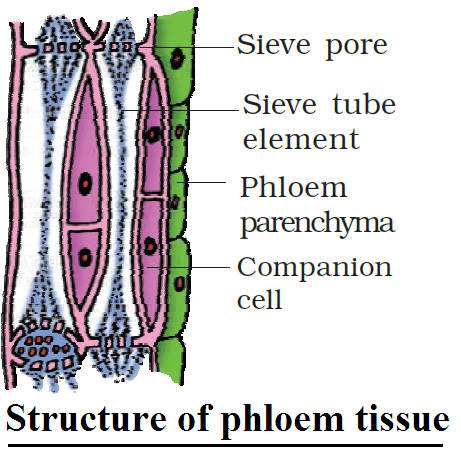
Write the precise function of: Sieve tube.
Answer
Sieve tube It is present in the phloem tissue. It's function is the transportation of synthesized food throughout the plant.
View full question & answer
Question 151 Mark
  1. Which kind of cells form pericycle?
  2. What is its function?
Answer
  1. Pericycle is formed of parenchymatous cells.
  2. It gives rise to lateral roots.
View full question & answer
Question 161 Mark
Why do the vascular bundles vary in size in the dorsiventral leaves?
Answer
  • The size of vascular bundles is dependent on the thickness of veins.
  • The veins vary in thickness in the reticulate venation of dicot/ dorsiventral leaves and hence the difference in size.
View full question & answer
Question 171 Mark
Give one basic functional difference between phellogen and phelloderm.
Answer
  1. Phellogen: is meristematic and divides to produce new cells.
  2. Phelloderm: stores food materials.
View full question & answer
Question 181 Mark
Why is root's apical meristem is subterminal?
Answer
The presence of root cap makes the root's apical meristem subterminal.
View full question & answer
Question 191 Mark
Which part of the plant would show the following:
  1. Radial vascular bundle.
  2. Polyarch xyle.
  3. Well developed pith.
Answer
  1. Roots show radial vascular bundle.
  2. Monocot roots show polyarch xylem.
  3. Dicotyledonous stems and mono-cotyledonous roots show well developed pith.
View full question & answer
Question 201 Mark
What is the advantage of tap roots over fibrous roots?
Answer
Tap roots, by going deeper inside the ground, provide better anchorage. So, plants can be very big in size.
View full question & answer
Question 211 Mark
Protoxylem is the first formed xylem. If the protoxylem lies next to phloem, what kind of arrangement of xylem would you call it?
Answer
Exarch.
View full question & answer
Question 221 Mark
How are companion cells connected to the sieve tube elements?
Answer
Companion cells are connected to the sieve tube elements by the pit fields present in the common longitudinal walls between them.
View full question & answer
Question 241 Mark
If one debarks a tree, what parts of the plant are being removed?
Answer
Bark means cork, cork cambium, secondary cortex and secondary phloem. Debarking removes all these tissues.
View full question & answer
Question 271 Mark
What is morphology?
Answer
Morphology is the study of the form, structure and configuration of an organism.
View full question & answer
Question 281 Mark
Write the location of root apical meristem and shoot apical meristem.
Answer
Root apical meristem-Root tip. Shoot apical meristem-Topmost regions of stem axis.
View full question & answer
Question 291 Mark
Name the group of plants, where:
  1. Phloem parenchyma is absent.
  2. Sieve tubes and companion cells are absent in the phloem.
Answer
  1. Monocot plants.
  2. Gymnosperms.
View full question & answer
Question 301 Mark
What is plant anatomy?
Answer
Plant anatomy is the branch of science that studies the internal structure of plants.
View full question & answer
Question 311 Mark
What is cuticle? What is its significance?
Answer
  • Cuticle is the waxy substance present on the outer surface of epidermis of leaves and stem.
  • It prevents the loss of water through transpiration.
View full question & answer
Question 321 Mark
Name the tissues related to mesophyll.
Answer
Palisade and spongy parenchyma are the two tissues related to mesophyll.
View full question & answer
Question 331 Mark
What is the other name given to phloem fibres? What type of cells are they?
Answer
Bast fibres; they are sclerenchyma fibres.
View full question & answer
Question 361 Mark
Mention the features of isobilateral leaves.
Answer
Isobilateral (equifacial) leaves are placed in a plant in such a way that both its surfaces receive equal amount of sunlight. It does not have distinct upper and lower surfaces. Mesophyll is usually indistinguishable. Most of the monocot plants have isobilateral leaves.
View full question & answer
Question 371 Mark
Describe the features of pith in dicot stems.
Answer
The pith consists of a large number of rounded, parenchymatous cells with big intercellular spaces. It occupies the central portion of the stem it.
View full question & answer
Question 381 Mark
Describe in brief, structure of androecium.
Answer
Androecium is composed of stamens. Each stamen which represents the male reproductive organ consists of a stalk or a filament and an anther. Each anther is usually bilobed and each lobe has two chambers, the pollen-sacs. The pollen grains are produced in pollen-sacs.
View full question & answer
Question 391 Mark
Name the epidermis which covers both the upper surface and lower surface of the leaf.
Answer
  1. Upper surface is covered by adaxial epidermis.
  2. Lower surface is covered by abaxial epidermis.
View full question & answer
Question 411 Mark
What are bulliform cells? What is their function?
Answer
  • Bulliform Cells are certain adaxial epidermal cells along the veins, which have become large, empty and colourless.
  • When bulliform cells are turgid, the leaf surface is exposed; when they are flaccid, the leaves curl inwards and the surface is not exposed.
View full question & answer
Question 421 Mark
Arrange the following in the sequence you would find them in a plant starting from the periphery – phellem, phellogen, phelloderm.
Answer
Phellen → Phellgen → Phelloderm.
View full question & answer
Question 431 Mark
What is the function of apical meristem?
Answer
Apical meristems are responsible for the growth in length of roots and shoot.
View full question & answer
Question 441 Mark
Write the constitution of periderm.
Answer
Phellogen, phellem and phelloderm are collectively called periderm. ​​​​​​
View full question & answer
Question 451 Mark
Mention two features in a transverse section, by seeing which you will confirm that it is a dicotyledonous root.
Answer
  1. Two to four groups of vascular tissues.
  2. Small or inconspicuous pith.
View full question & answer
Question 461 Mark
Why do the primary and secondary phloems get crushed as secondary growth advances?
Answer
Due to the continued formation and accumulation of a large quantity of secondary xylem, the thin-walled phloem cells get crushed.
View full question & answer
Question 471 Mark
Protoxylem is the first formed xylem. If the protoxylem lies next to phloem what kind of arrangement of xylem would you call it?
Answer
If protoxylem lies next to the phloem, this arrangement of xylem is called exarch.
View full question & answer
Question 481 Mark
Why the endodermis of a dicot stem is called starch sheath?
Answer
The endodermis of a dicot stem is rich in starch grains, so it is called starch sheath.
View full question & answer
Question 491 Mark
What are secondary medullary rays?
Answer
These are the narrow bands of parenchyma which pass through the secondary xylem and secondary phloem in the radial direction formed by the cambial ring during secondary growth.
View full question & answer
Question 501 Mark
Name the tissue represented by jute fibres used in making ropes.OR
Name the dead elements present in phloem.
Answer
Phloem fibres/ bast fibres/ sclerenchyma fibres.
View full question & answer
Question 521 Mark
Give two examples of lateral meristem in plants.
Answer
Fascicular cambium, interfascicular cambium, cork cambium/ phellogen.
View full question & answer
Question 531 Mark
A separate layer of cuticle covers the epidermis. What is its use?
Answer
Cuticle and cutinised outer walls of epidermal cells reduce the rate of water loss through transpiration.
View full question & answer
Question 551 Mark
Large number of stomata are seen on lower surface of dicot leaves or on the upper surface?
Answer
The stomata are more in number in the lower epidermis than the upper epidermis.
View full question & answer
Question 561 Mark
Name the tissue that makes up the following in a dicot stem:
  1. Hypoderm.
  2. Pith.
Answer
  1. Collenchyma.
  2. Parenchyma.
View full question & answer
Question 581 Mark
Name some common vegetables showing underground modification of stem.
Answer
Potato, Ginger, Turmeric, Zimicand.
View full question & answer
Question 591 Mark
Mention the functions of companion cells.
Answer
  1. The companion cells help to regulate the pressure gradient in sieve tubes.
  2. In the absence of a nucleus, the functions of sieve tubes are regulated by the nucleus of the ompanion cells.
View full question & answer
Question 611 Mark
Name the term used to describe these vascular bundles in which phloem lies at the centre and is surrounded by the xylem?
Answer
Amphibasal.
View full question & answer
Question 621 Mark
Why are apical meristem and intercalary meristem considered as primary meristems?
Answer
They are considered as primary meristems because they appear early in the life of a plant and contribute to the formation of primary plant body.
View full question & answer
Question 631 Mark
What do you mean by permanent or mature cells?
Answer
Mature or permanent cells are those cells which have become structurally and functionally specialised and lost the capacity to divide.
View full question & answer
Question 641 Mark
What are casparian strips?
Answer
Casparian strips are the bands of deposition of suberin on the tangential and radial walls of the endodermal cells of the roots.
View full question & answer
Question 651 Mark
What is meant by (a) early bark and (b) late bark?
Answer
  1. The bark formed early in the growing season (spring), is called early bark.
  2. The bark formed late in the growing season (autumn), is called late bark.
View full question & answer
Question 661 Mark
While eating peach or pear it is usually seen that some stone like structures get entangled in the teeth, what are these stone like structures called?
Answer
The structures that get entangled in the teeth while eating fruits like peach and pear are actually the stone cells or brachysclereids which areunbranched, short and isodiametric type of sclereids. These stone cells usually occur in groups and provide grit or stone like hardness that get entangled in the spaces between teeth.
View full question & answer
Question 671 Mark
Arrange the following in the sequence in which you would find them in a plant starting from the periphery: Pericycle, Epidermis, Pith, Endodermis, Cortex.
Answer
Epidermis, Cortex, Endodermis, Pericycle, Pith.
View full question & answer
Question 691 Mark
Why xylem vessels are called syncytes?
Answer
The xylem vessels are formed from a number of cells, so they are called syncytes.
View full question & answer
Question 701 Mark
What is meant by polyarch xylem?
Answer
When there are more than six xylem groups in the radial vascular bundles of roots, it is called polyarch xylem.
View full question & answer
Question 711 Mark
Where are apical meristems located?
Answer
Apical meristems are located at the tips of root and shoot.
View full question & answer
Question 731 Mark
How do guard cells differ from other epidermal cells?
Answer
Guard cells possess chloroplasts and carry out photosynthesis, while other epidermal cells have no chloroplasts.
View full question & answer
Question 741 Mark
In how many zones, the ground tissue system is differentiated?
Answer
In three major zones, i.e., cortex, pericycle and pith with Smedullary rays.
View full question & answer
Question 751 Mark
What constitutes the stele in plants?
Answer
In plants, stele is constituted by all the tissues that are on the inner side of the endodermis, i.e., pericycle, vascular bundles and pith.
View full question & answer
Question 761 Mark
Why the heartwood's colour is dark?
Answer
The dark colour is due to the accumulation of secondary metabolites like tannins, gums, oils and resins, etc., in the wood tissue.
View full question & answer
Question 771 Mark
How are the adjacent parenchyma cells are connected to each other?
Answer
By plasmodesmata or cytoplasmic bridges.
View full question & answer
Question 791 Mark
Why is there no secondary growth in monocots?
Answer
In monocots there is no cambium and the vascular bundles are scattered; hence, there is no secondary growth.
View full question & answer
Question 801 Mark
What is the difference between a mango fruit and a coconut fruit in terms of edible part?
Answer
Edible part in mango: Mesocarp. Edible part in coconut: Seed.
View full question & answer
Question 811 Mark
On the basis of which structure you can say that neem shows a compound leaf?
Answer
The number and position of auxillary bud is an indicator if a leaf is a simple one or a compound one. In neem leaves there is a single auxillary bud at the start of the bunch of leaflets. So it is a compound leaf.
View full question & answer
Question 821 Mark
Name those parenchymatous cells which are associated with sieve tubes in angiosperms. Mention their role also.
Answer
Companion cells are associated with sieve tubes in angiosperms. They help sieve tubes in the translocation of solutes.
View full question & answer
Question 871 Mark
Name two characteristic bands that are found in endodermis of dicot root.
Answer
Casparian strips or casparian bands.
View full question & answer
Question 881 Mark
In a pitcher plant the pitcher shows modification of which part of the flowering plant?
Answer
Modification of leaf.
View full question & answer
Question 911 Mark
What is present on the surface of the leaves which helps the plant prevent loss of water but is absent in roots?
Answer
Thick waxy layer called cuticle is present on the surface of the leaves which helps the plant to prevent loss of water. It is absent in roots.
View full question & answer
Question 921 Mark
Why is cambium called as lateral meristem?
Answer
The cambium lies parallel to the circumference and helps to increase in girth, hence is called as lateral meristem.
View full question & answer
Question 931 Mark
Why is heartwood more durable?
Answer
Heartwood is durable due to the deposits of substances like resins, tannins, oils, gums, etc, which make the wood hard and resistant to the attacks of microbes and insects.
View full question & answer
Question 941 Mark
How the secondary growth in dicot stems is achieved?
Answer
Secondary growth in dicot stems is achieved by the activity of fascicular, inter fascicular cork cambium and the lateral meristems.
View full question & answer
Question 951 Mark
Which kind of tissue stores starch in potato and makes the shells of the nuts?
Answer
Parenchymatous tissue stores starch (food) in potato and sclerenchymatous tissues make the shells of the nuts.
View full question & answer
Question 961 Mark
Why is there a need to provide new protective cell layers in a dicot stem undergoing secondary growth?
Answer
As the dicot stem continues to increase in girth (diameter) due to the activity of vascular cambium, the epidermis and the peripheral layers of cortex become broken; hence there is a need to provide new protective cell layers.
View full question & answer
Question 971 Mark
How do the bulliform cells present in the epidermis help grasses?
Answer
The bulliform cells present in the epidermis of grasses help in folding of leaves during hot summer day and prevent transpiration.
View full question & answer
Question 981 Mark
Product of photosynthesis is transported from the leaves to various parts of the plants and stored in some cell before being utilized. What are the cells/ tissues that store them?
Answer
The food gets stored in specialized parenchymatous cells present either in roots or stems.
View full question & answer
Question 991 Mark
What is the difference between hypodermis of dicot and monocot stems?
Answer
In dicot stems, hypodermis consists of a few layers of collenchyma cells, whereas, in case of monocot stems, hypodermis consists of 2-3 layers of sclerenchyma cells.
View full question & answer
Question 1001 Mark
What changes in histology makes a stem to produce flowers?
Answer
The shoot apical meristem changes into floral meristem. This finally results in development of flower. Internodes do not elongate and the axis gets condensed. Nodes, in stead of producing leaves, produce different floral parts.
View full question & answer
Question 1021 Mark
What is the epidermal cell modification in plants which prevents water loss?
Answer
In grasses, certain adaxial epidermal cells along the veins modify themselves into large, empty, colourless cells. These are called bulliform cells or motor cells. Bulliform cells help in folding and unfolding of grass leaves. When the bulliform cells in the leaves have absorbed water and are turgid, the leaf surface is exposed. When they are flaccid due to water stress, they make the leaves curl inwards (inrolling) to minimise water loss (transpiration).
View full question & answer
Question 1031 Mark
Mention the function of ray parenchyma in plants.
Answer
The ray parenchyma cells help in radial conduction of water.
View full question & answer
Question 1051 Mark
Describe the mode of vegetative propagation in banana plants?
Answer
In banana, the lateral branches originate from the basal and underground portion of the main stem, grow horizontally beneath the soil and then come out obliquely Som upward giving rise to leafy shoots.
View full question & answer
Question 1061 Mark
In which vascular bundles, phloem lies on the outer side and xylem towards the inner side or central axis?
Answer
Collateral vascular bundles.
View full question & answer
Question 1071 Mark
What constitutes the cambial ring?
Answer
Ring of vascular cambium (cambial ring) is formed by two types of meristems, fascicular or intrafascicular and interfascicular cambium. Intrafascicular cambium is a primary meristem which occurs as strips in vascular bundles. Interfascicular cambium is a secondary meristem which arises from the cells of medullary rays which occur at the level of intrafascicular strips. The two types of meristematic tissues get connected to form a cambial ring.
View full question & answer
Question 1081 Mark
What is mesophyll?
Answer
Mesophyll is the ground tissue of leaves; it consists of thin-walled, chloroplast-containing cells.
View full question & answer
Question 1091 Mark
What is the role of veins and veinlets in leaves?
Answer
Veins and veinlets are like supply channels in leaves. They transport water to leaves and take back products of photosynthesis to different parts of plants.
View full question & answer
Question 1101 Mark
How is an axillary bud formed?
Answer
During the formation of leaves and elongation of stem, some cells of the shoot apical meristem that are left behind, constitute the axillary buds.
View full question & answer
Question 1121 Mark
Certain adaxial epidermal cells in grasses, along the midrib modify themselves to large, empty, colourless cells. Name these.
Answer
These cells are called bulliform cells.
View full question & answer
Question 1131 Mark
How the vessel members in xylems are interconnected?
Answer
The vessel members are interconnected through perforations in their end/ common walls.
View full question & answer
Question 1141 Mark
What is conjuctive tissue?
Answer
The parenchymatous tissue present between xylem and phloem of roots, is called conjuctive tissue.
View full question & answer
Question 1151 Mark
Give two examples of lateral meristem in plants.
Answer
Fascicular combium and phellogen (cork cambium).
View full question & answer
Question 1161 Mark
In a dicot root, the vascular cambium is completely secondary, justify.
Answer
It is completely secondary in origin because it originates from the tissue located below the phloem groups and from pericycle cells that lie opposite to the xylem groups of the vascular bundles.
View full question & answer
Question 1171 Mark
While explaining the internal structure in plants stem, teacher makes a statement about various arrangement of vascular bundles in plants. After lecture, Arun asked about the reason and significance of such arrangements
  1. What functions they perform in plants?
  2. What values Arun has, as science student?
Answer
  1. Vascular bundle consists of xylem and phloem which conduct water and food, respectively.
  2. As a science student Arun showed willingness to know reasons and significamce of each statement.
View full question & answer
Question 1181 Mark
Which type of inflorescence shows an unlimited growth and why?
Answer
The racemose inflorescence shows unlimited growth. The apex in this type of inflorescence does not terminate into a flower and continues to grow. Flowers are borne laterally in racemose.
View full question & answer
Question 1201 Mark
Ginger grows under the ground, yet it is called a modified stem. What is the reason?
Answer
The presence of nodes and internodes on ginger gives a clue that it is not a root, but a stem.
View full question & answer
Question 1211 Mark
What is the advantage of fibrous roots over tap roots?
Answer
In fibrous roots there are more direct channels to stem for water absorption. So, fibrous roots don't have to go deep inside the ground in search of water.
View full question & answer
Question 1221 Mark
Define epiphyllous arrangement of stamens.
Answer
When stamens are attached to the perianth, it is called epiphyllous arrangement.
View full question & answer
Question 1241 Mark
Mention two functions performed by xylem is plants.
Answer
  1. Xylem functions as the conducting tissue for water and minerals.
  2. It also provides mechanical strength to plant parts.
View full question & answer
Question 1251 Mark
How are the vessel members in xylem interconnected?
Answer
The vessel members are interconnected through perforations in their common end walls.
View full question & answer
Question 1261 Mark
When a dicot leaf is exposed to sunlight, the light rays first pass through the epidermis and then through
  1. lower epidermis.
  2. spongy parenchyma.
  3. palisade parenchyma.
  4. vascular bundles.
Answer
  1. palisade parenchyma.
View full question & answer
Question 1271 Mark
In dicot leaves, how the vascular bundles are related to size of the veins?
Answer
The size of the vascular bundles is dependent on the size of veins present in leaves.
View full question & answer
Question 1281 Mark
What is an 'endarch' arrangement? Which one, out of the root and stem shows this arrangement?
Answer
  1. When the protoxylem lies towards the centre/ pith and the metaxylem lies towards the periphery of the organ, the arrangement of xylem is endarch.
  2. It is found in stems.
View full question & answer