Questions · Page 1 of 4

M.C.Q (1 Marks)

Take a timed test

50 questions · auto-graded multiple-choice test.
MCQ 11 Mark
Which of the following is not a polysaccharide?
  • Lactose
  • B
    Starch
  • C
    Glycogen
  • D
    Dextrin
Answer
Correct option: A.
Lactose
Lactose is a disaccharide made up of glucose and galactose.
View full question & answer
MCQ 21 Mark
Proteins perform many physiological functions. For example, some functions as enzymes. Which of the following represents an additional function that some proteins discharge?
  • A
    Antibiotics.
  • B
    Pigment conferring colour to skin.
  • C
    Pigments making colours of flowers.
  • Hormones.
Answer
Correct option: D.
Hormones.
Antibiotics which contain enzymes do contain protein but many antibiotics may not contain enzymes or protein. Pigments are not proteins.
View full question & answer
MCQ 31 Mark
Many elements are found in living organisms either free or in the form of compounds. Which of the following is not found in living organisms?
  • Silicon
  • B
    Magnesium
  • C
    Iron
  • D
    Sodium.
Answer
Correct option: A.
Silicon
Iron is found in haemoglobin, sodium and magnesium play important role in some metabolic activities.
View full question & answer
MCQ 41 Mark
Enzymes concerned with transfer of electrons are:
  • A
    Hydrolase
  • Dehydrogenase
  • C
    Transaminase
  • D
    Deoxygenase
Answer
Correct option: B.
Dehydrogenase
Dehydrogenases catalyze dehydrogenation reactions, which involve addition or removal of electrons.
Addition or removal of electrons will lead to reduction or oxidation of substrates.
Dehydrogenases are a type of oxidoreductases.
View full question & answer
MCQ 51 Mark
Esterase enzyme belongs to which of the following class:
  • A
    Oxidoreductase
  • B
    Carboxylase
  • Hydrolases
  • D
    Transferases
Answer
Correct option: C.
Hydrolases
Esterases are the enzyme which hydrolyse ester linkage.
Hence, esterases belong to class Hydrolase.
Hydrolases are the enzymes catalysing hydrolysis.
View full question & answer
MCQ 61 Mark
Lactose is composed of:
  • A
    Glucose $+$ glucose.
  • B
    Glucose $+$ fructose.
  • C
    Fructose $+$ galactose.
  • Glucose $+$ galactose.
Answer
Correct option: D.
Glucose $+$ galactose.
View full question & answer
MCQ 71 Mark
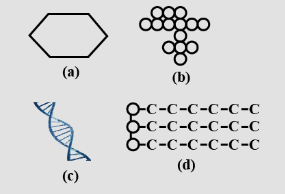
implified diagrams of macromolecules are given. What is the function of the molecule of diagram $C$
  • A
    Store energy for future use.
  • Carry genetic information.
  • C
    Act as an enzyme in chemical reactions.
  • D
    Provide "quick energy' for cells.
Answer
Correct option: B.
Carry genetic information.
The molecule $C$ represents a part of double helical molecule of $\text{DNA.}$
The $\text{DNA}$ is a repository of genetic information.
It is capable of making its own copies by the process of replication and also code for proteins by specifying the sequence of amino acids.
View full question & answer
MCQ 81 Mark
Which among the following are the largest physical and chemical molecules:
  • A
    Carbohydrates
  • B
    Lipids
  • Proteins
  • D
    Nucleic acids
Answer
Correct option: C.
Proteins
Proteins are body building molecules and provide the structural framework for cells.
They are biopolymers of amino acids.
They are the largest physical and chemical components of a cell.
No other biomolecule possesses such immense structural and physiological diversity as proteins.
View full question & answer
MCQ 91 Mark
Spoilage of oil can be detected by which fatty acid?
  • A
    Oleic acid.
  • B
    Linolenic acid.
  • C
    Linoleic acid.
  • Erucic acid.
Answer
Correct option: D.
Erucic acid.
Erucic acid.
View full question & answer
MCQ 101 Mark
Hydrolysis of starch occurs with the help of:
  • A
    Peptidase
  • Amylase
  • C
    Sucrose
  • D
    Lipase
Answer
Correct option: B.
Amylase
Amylase
View full question & answer
MCQ 111 Mark
A polysaccharide, which is synthesized and stored in liver cells, is:
  • A
    Lactose.
  • B
    Galactose.
  • C
    Arabinose.
  • Glycogen.
Answer
Correct option: D.
Glycogen.
Glycogen.
View full question & answer
MCQ 121 Mark
The enormous diversity of protein molecules is due mainly to the diversity of:
  • Amino acid sequences within the protein molecule.
  • B
    Peptide bonds.
  • C
    $R$ groups on the amino acids.
  • D
    Amino groups on the amino acids.
Answer
Correct option: A.
Amino acid sequences within the protein molecule.
View full question & answer
MCQ 131 Mark
Which group contains biocatalysts?
  • Peptidase, amylase, rennin.
  • B
    Glucose, amino acids, fatty acids.
  • C
    Rhodopsin, pepsin, steapsin.
  • D
    Myosin, oxytocin, adrenalin.
Answer
Correct option: A.
Peptidase, amylase, rennin.
View full question & answer
MCQ 141 Mark
Which of the following is a milk protein:
  • A
    Lactogen
  • B
    Myosin
  • Casein
  • D
    Pepsin
Answer
Correct option: C.
Casein
Proteins are a very versatile biomolecules performing a variety of structural and functional roles.
Pepsin is a proteolytic enzyme secreted as pepsinogen in the stomach.
Myosin is a protein found in muscle tissue.
Lactogen is milk sugar and casein is milk protein.
View full question & answer
MCQ 151 Mark
Which is the first step in analysis of biomolecules?
  • A
    Precipitation.
  • Extraction.
  • C
    Staining.
  • D
    Reagent Reaction.
Answer
Correct option: B.
Extraction.
Extraction.
View full question & answer
MCQ 171 Mark
The primary structure of a protein molecule has.
  • Two ends.
  • B
    One end.
  • C
    Three ends.
  • D
    No ends.
Answer
Correct option: A.
Two ends.
Primary structure of a protein is simply the amino acid sequence of it which has two ends the carboxyl and amino terminals.
View full question & answer
MCQ 181 Mark
The similarity between $\text{DNA}$ and $\text{RNA}$ is that both are:
  • A
    Double stranded
  • B
    Having similar sugars
  • Polymers of nucleotides
  • D
    Having similar pyrimidines
Answer
Correct option: C.
Polymers of nucleotides
$\text{DNA}$ and $\text{RNA}$ are polynucleotides.
They are polymers made up of nucleotides.
They are synthesized by joining together of a large number of nucleotides with the help of ester bonds.
Consecutive nucleotides in $\text{DNA}$ and $\text{RNA}$ are joined with the help of phosphodiester bonds.
View full question & answer
MCQ 191 Mark
Sugars are technically called carbohydrates, referring to the fact that their formulae are only multiple of $\ce{C(H_2O)}$. Hexoses therefore have six carbons, twelve hydrogens and six oxygen atoms. Glucose is a hexose. Choose from among the following another hexose.
  • Fructose.
  • B
    Erythrose.
  • C
    Ribulose.
  • D
    Ribose.
Answer
Correct option: A.
Fructose.
Six carbon sugars having formula $\ce{C_6H_{12}O_6}$ Erythrose is a four carbon sugar. Ribulose and ribose are both five carbon sugars.
View full question & answer
MCQ 201 Mark
When we homogenise any tissue in an acid the acid soluble pool represents.
  • Cytoplasm.
  • B
    Cell membrane.
  • C
    Nucleus.
  • D
    Mitochondria.
Answer
Correct option: A.
Cytoplasm.
The function and shape of a protein is affected by sequence of $20$ types of amino acids, each having an amino group $\ce{-NH_2}$, a carboxylic acid group $\text{-COOH,}$ a hydrogen atom each attached to carbon located next to $\text{-COOH}$ group and a side chain $R$ which varies from one amino acid to other. $($It can be hydrogen or an aliphatic group, an aromatic or heterocyclic group$)$.
View full question & answer
MCQ 221 Mark
Nucleic acids are made up of:
  • A
    Amino acids
  • B
    Pentose sugars
  • C
    Nucleosides
  • Nucleotides
Answer
Correct option: D.
Nucleotides
Nucleic acids are long chain polymers of nucleotides.
The nucleotides, in turn, are phosphoric acid esters of nucleosides which mainly consists of a nitrogenous base, Sugar, and phosphate.
The nitrogenous base includes purines and pyrimidines while the sugar contains ribose and deoxyribose sugar. phosphate is formed of phosphoric acid.
View full question & answer
MCQ 231 Mark
For growth of body and its repair one needs which of the following component:
  • A
    Carbohydrates
  • B
    Fats
  • Proteins
  • D
    Vitamins
Answer
Correct option: C.
Proteins
Proteins
View full question & answer
MCQ 241 Mark
Which of the following is not a pyrimidine?
  • A
    Uracil
  • B
    Cytosine
  • Guanine
  • D
    Thymine
Answer
Correct option: C.
Guanine
Guanine is a purine.
View full question & answer
MCQ 251 Mark
The most abundant component of living organisms is:
  • A
    Protein.
  • Water.
  • C
    Sugar.
  • D
    Nucleic acid.
Answer
Correct option: B.
Water.
Water composes about $70\%$ of body weight of humans. This should give clue for 'water' as the correct answer.
View full question & answer
MCQ 261 Mark
A compound formed of a sugar and a nitrogen base, is called a:
  • A
    Nucleotide.
  • B
    Nucleic acid.
  • Nucleoside.
  • D
    Disaccharide.
Answer
Correct option: C.
Nucleoside.
Nucleoside.
View full question & answer
MCQ 271 Mark
Which of the following is not a co$-$enzyme:
  • A
    $\text{NAD}$
  • B
    $\text{NADP}$
  • C
    $\text{FAD}$
  • $\text{ATP}$
Answer
Correct option: D.
$\text{ATP}$
$\text{ATP}$ or adenosine triphosphate is a nucleotide.
View full question & answer
MCQ 281 Mark
Oils are rich in:
  • Fats that are generally liquid at room temperature.
  • B
    Glycerol that possesses three hydroxyl groups.
  • C
    Esters of fatty acids.
  • D
    Saturated fatty acids.
Answer
Correct option: A.
Fats that are generally liquid at room temperature.
View full question & answer
MCQ 291 Mark
Due to discovery of which of the following in $1980$ the evolution was termed as $\text{RNA}$ world?
  • A
    $\text{mRNA, tRNA, rRNA}$ synthesize proteins.
  • B
    In some virus $\text{RNA}$ is genetic material.
  • $\text{RNA}$ have enzymatic property.
  • D
    $\text{RNA}$ is not found in all cells.
Answer
Correct option: C.
$\text{RNA}$ have enzymatic property.
View full question & answer
MCQ 301 Mark
Which is distributed more widely in a cell?
  • A
    $\text{DNA.}$
  • $\text{RNA.}$
  • C
    Chloroplasts.
  • D
    Spherosomes.
Answer
Correct option: B.
$\text{RNA.}$
$\text{RNA.}$
View full question & answer
MCQ 311 Mark
An organic substance bound to an enzyme and essential for its activity is called as:
  • A
    Apoenzyme
  • B
    lsoenzyme
  • Coenzyme
  • D
    Holoenzyme
Answer
Correct option: C.
Coenzyme
Enzymes are simple if they are made up of only proteins, e.g., pepsin, amylase, etc., while conjugate enzymes have an additional non$-$protein cofactor, e.g., dehydrogenase enzymes.
The cofactor can be organic or inorganic.
Loosely attached organic cofactor are called coenzymes, e.g., $\text{NAD, FAD}$ etc., while firmly attached one is prosthetic group, e.g., haeme, biotin etc.
View full question & answer
MCQ 321 Mark
The helical structure of protein is stabilized by:
  • Hydrogen bonds.
  • B
    Disulphide bonds.
  • C
    Peptide bonds.
  • D
    None of these.
Answer
Correct option: A.
Hydrogen bonds.
Hydrogen bonds.
View full question & answer
MCQ 331 Mark
Primary metabolites are always found in animal cells. Which of the following is not an example of primary metabolite?
  • A
    Amino acids.
  • B
    Sugar.
  • C
    Carbohydrate.
  • Alkaloids.
Answer
Correct option: D.
Alkaloids.
Alkaloids.
View full question & answer
MCQ 341 Mark
An example of competitive inhibition of enzymes is the inhibition of:
  • Succinic dehydrogenase by malonate.
  • B
    Cytochrome oxidase by cyanide.
  • C
    Hexokinase by glucose $b-$phosphate.
  • D
    Carbonic anhydrase by carbon dioxide.
Answer
Correct option: A.
Succinic dehydrogenase by malonate.
View full question & answer
MCQ 351 Mark
It is said that elemental composition of living organisms and that of inanimate objects $($like earth’s crust$)$ are similar in the sense that all the major elements are present in both. Then what would be the difference between these two groups? Choose a correct answer from among the following:
  • A
    Living organisms have more gold in them than inanimate objects
  • B
    Living organisms have more water in their body than inanimate objects
  • Living organisms have more carbon, oxygen and hydrogen per unit mass than inanimate objects.
  • D
    Living organisms have more calcium in them than inanimate objects.
Answer
Correct option: C.
Living organisms have more carbon, oxygen and hydrogen per unit mass than inanimate objects.
A comparison of elements present in non$-$living and living matter is given in the table below:
Element
$%$ Weight of
Earth crust
(Non living matter)
Human Body
(living mater)
Hydrogen
$0.14$ $0.5$
Carbon
$0.03$ $18.5$
Nitrogen
$46.6$ $65.0$
Sulphur
Very little
$3.3$
Sodium
$0.03$ $0.3$
Calcium
$3.6$ $1.5$
Magnesium
$2.1$ $0.1$
Silicon
$27.7$
Negligible
View full question & answer
MCQ 361 Mark
Cellulose, the most important constituent of plant cell wall is made of:
  • A
    Unbranched chain of glucose molecules linked by $\alpha\ 1, 4$ glycosidic bond.
  • B
    Branched chain of glucose molecules linked by $\beta\ 1, 4$ glycosidic bond in straight chain and $\alpha\ 1, 6$ glycosidic bond at the site of branching.
  • Unbranched chain of glucose molecules linked by $\beta\ 1, 4$ glycosidic bond.
  • D
    Branched chain of glucose molecules linked by $\alpha\ 1, 6$ glycosidic bond at the site of branching.
Answer
Correct option: C.
Unbranched chain of glucose molecules linked by $\beta\ 1, 4$ glycosidic bond.
View full question & answer
MCQ 371 Mark
Chitin, forming the exoskeleton of arthropods is a:
  • A
    Storage polysaccharide.
  • $N-$containing structural polysaccharide.
  • C
    Mucopolysaccharide.
  • D
    $N-$containing structural oligosaccharide.
Answer
Correct option: B.
$N-$containing structural polysaccharide.
View full question & answer
MCQ 381 Mark
What is the name of heterocyclic carbon compound attached to sugar?
  • Nucleoside.
  • B
    Nucleotide.
  • C
    Nucleic Acid.
  • D
    All of the above.
Answer
Correct option: A.
Nucleoside.
Nucleoside.
View full question & answer
MCQ 391 Mark
The sequence of amino acids in a protein is called:
  • Primary structure.
  • B
    Secondary structure.
  • C
    Tertiary structure.
  • D
    Quaternary structure.
Answer
Correct option: A.
Primary structure.
Primary structure.
View full question & answer
MCQ 401 Mark
The fact that all biomolecules undergo turnover is known as:
  • A
    Catabolism.
  • B
    Anabolism.
  • Metabolism.
  • D
    All of the above.
Answer
Correct option: C.
Metabolism.
Metabolism.
View full question & answer
MCQ 411 Mark
Protein synthesis in a cell takes place.
  • In cytoplasm as well as in mitochondria.
  • B
    In the nucleolus as well as in cytoplasm.
  • C
    Only on ribosomes attached to the nuclear envelope.
  • D
    Only in the cytoplasm.
Answer
Correct option: A.
In cytoplasm as well as in mitochondria.
View full question & answer
MCQ 431 Mark
Proteins is made up of:
  • A
    Carbon, hydrogen, chlorine, sulphur
  • Carbon, hydrogen, oxygen, nitrogen
  • C
    Carbon, manganese, phosphorus, nitrogen
  • D
    Carbon, iodine, oxygen and inorganic phosphate
Answer
Correct option: B.
Carbon, hydrogen, oxygen, nitrogen
View full question & answer
MCQ 441 Mark
Enzyme first used for nitrogen fixation is:
  • Nitrogenase.
  • B
    Nitroreductase.
  • C
    Transferase.
  • D
    Transaminase.
Answer
Correct option: A.
Nitrogenase.
Nitrogenase.
View full question & answer
MCQ 451 Mark
In $\text{RNA,}$ thymine is replaced by:
  • Uracil.
  • B
    Guanine.
  • C
    Both.
  • D
    None of these.
Answer
Correct option: A.
Uracil.
Uracil.
View full question & answer
MCQ 461 Mark
Feedback inhibition of an enzymatic reaction is caused by:
  • End product.
  • B
    Substrate.
  • C
    Enzyme.
  • D
    Rise in temperature.
Answer
Correct option: A.
End product.
End product.
View full question & answer
MCQ 471 Mark
Radioactive thymidine when added to the medium surrounding living mammalian cells gets incorporated into the newly synthesized $\text{DNA.}$ Which of the following types of chromatin is expected to become radioactive if cells are exposed radioactive thymidine as soon as they enter the $S-$phase?
  • A
    Heterochromatin.
  • Euchromatin.
  • C
    Both $(a)$ and $(b).$
  • D
    Neither heterochromatin nor euchromatin but only the nucleolus.
Answer
Correct option: B.
Euchromatin.
Euchromatin.
View full question & answer
MCQ 481 Mark
Feedback inhibition of enzymes is affected by which of the following:
  • A
    Enzyme
  • B
    Substrate
  • End products
  • D
    Intermediate end products
Answer
Correct option: C.
End products
End products
View full question & answer
MCQ 491 Mark
Which of the following elements is highest in percentage composition in the human body?
  • Oxygen.
  • B
    Carbon.
  • C
    Hydrogen.
  • D
    Nitrogen.
Answer
Correct option: A.
Oxygen.
Oxygen.
View full question & answer
MCQ 501 Mark
Which of the following statements regarding enzyme inhibition is correct?
  • A
    Competitive inhibition is seen when a substrate competes with an enzyme for binding to an inhibitor protein.
  • B
    Non$-$competitive inhibitors often bind to the enzyme irreversibly.
  • Competitive inhibition is seen when the substrate and the inhibitor compete for the active site on the enzyme.
  • D
    Non$-$competitive inhibition of an enzyme can be overcome by adding large amount of substrate.
Answer
Correct option: C.
Competitive inhibition is seen when the substrate and the inhibitor compete for the active site on the enzyme.
View full question & answer
M.C.Q (1 Marks) - BIOLOGY STD 11 Science Questions - Vidyadip