Questions

2 Marks Questions

Take a timed test

75 questions · self-marked practice — reveal the answer and mark yourself.

Question 12 Marks
Distinguish cytokinesis from karyokinesis.
Answer
  Cytokinesis   Karyokinesis
i. Cytokinesis is the biological process involving the division of a cell’s cytoplasm during mitosis or meiosis. i. Karyokinesis is the biological process involving the division of a cell’s nucleus during mitosis or meiosis.
ii. Stages such as prophase, metaphase, anaphase, and telophase are not present in cytokinesis. ii. It is divided into four stages –prophase, metaphase, anaphase, and telophase
View full question & answer
Question 22 Marks
Describe the following: Bivalent Draw a diagram to illustrate your answer.
Answer
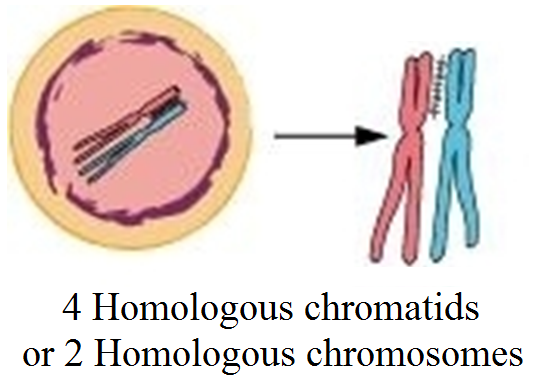
Bivalent Bivalent or tetrad is a pair of synapsed homologous chromosomes. They are formed during the zygotene stage of prophase I of meiosis.
View full question & answer
Question 32 Marks
Describe the following: Chiasmata Draw a diagram to illustrate your answer.
Answer
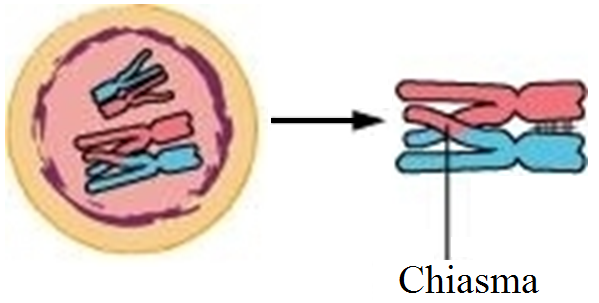
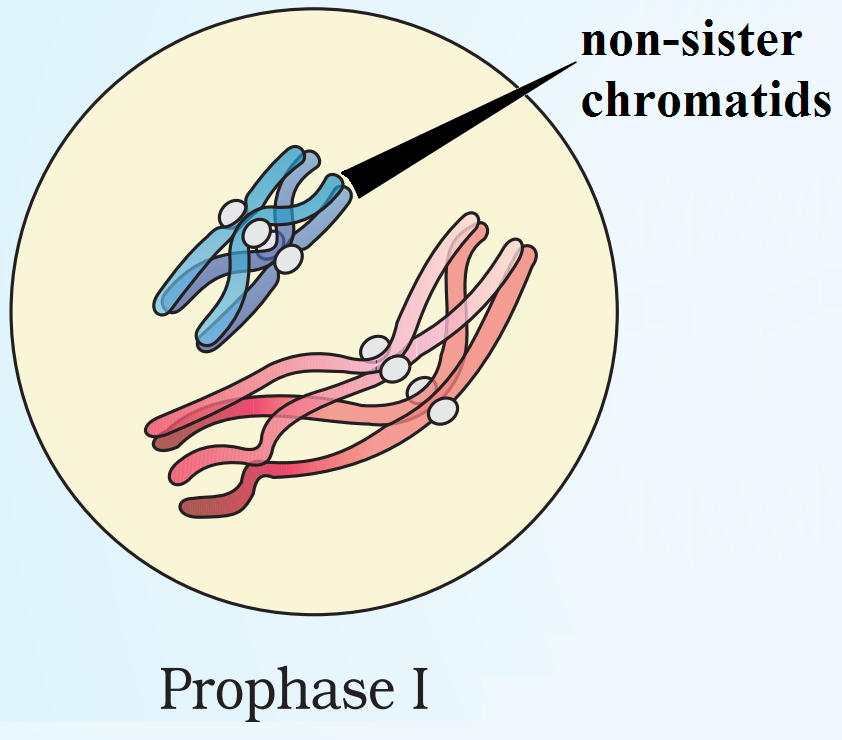
Chiasmata Chiasmata is the site where two non-sister chromatids of homologous chromosomes have crossed over. It represents the site of cross-over. It is formed during the diplotene stage of prophase I of meiosis.
View full question & answer
Question 42 Marks
Describe the following: synapsis Draw a diagram to illustrate your answer.
Answer
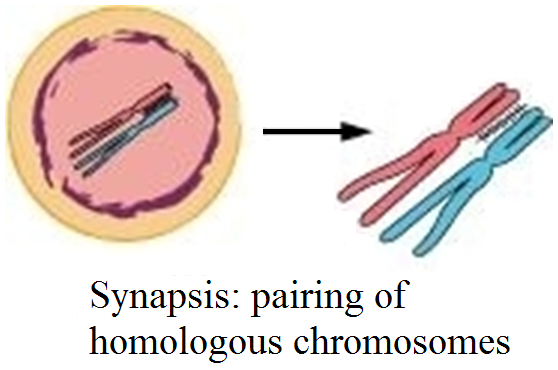
Synapsis The pairing of homologous chromosomes is called synapsis. This occurs during the second stage of prophase I or zygotene.
View full question & answer
Question 52 Marks
Discuss with your teacher about: haploid insects and lower plants where cell-division occurs, and
Answer
In some insects and lower plants, fertilization is immediately followed by zygotic meiosis, which leads to the production of haploid organisms. This type of life cycle is known as haplontic life cycle.
View full question & answer
Question 62 Marks
Discuss with your teacher about: some haploid cells in higher plants where cell-division does not occur.
Answer
The phenomenon of polyploidy can be observed in some haploid cells in higher plants in which cell division does not occur. Polyploidy is a state in which cells contain multiple pairs of chromosomes than the basic set. Polyploidy can be artificially induced in plants by applying colichine to cell culture.
View full question & answer
Question 72 Marks
Describe the arrangement of chromosomes and their attachment to spindle fibres during mitotic metaphase.
Answer
All the chromosomes lie at the equator, with one chromatid of each chromosome connected by its kinetochore to spindle fibres from one pole and its sister chromatid connected by its kinetochore to spindle fibre from the opposite pole. The plane of alignment of all the chromosomes at the equator during metaphase, is referred to as metaphase plate.
View full question & answer
Question 82 Marks
Supply a specific scientific term for each of the following:
  1. The period between two successive mitotic divisions.
  2. Point at which two sister chromatids are held together.
  3. Phase in the cell cycle when protein and RNA are synthesised.
  4. Nuclear division.
Answer
  1. Interphase.
  2. Kinetochore.
  3. G-phase.
  4. Mitotic or M-phase.
View full question & answer
Question 92 Marks
Describe cell division. List various types of cell division. Also mention about the need of cell division?
Answer
Cell division, cell reproduction or cell multiplication is the process of formation of new daughter cells from the pre-existing cell or parent cell.It is of three types:
  1. Amitosis.
  2. Mitosis.
  3. Meiosis.
A cell divides when it attains the size and the nucleocytoplasmic ratio disturbs. The DNA duplication also causes a cell to divide.
View full question & answer
Question 102 Marks
Colchicine is known to be the mitotic poison. How?
Answer
Colchicine is considered to be the mitotic poison because
  1. This alkaloid inhibits the formation of spindle by preventing assembly of microtubules. It is an alkaloid obtained from the corms of Autumn crocus.
  2. The chromosomes duplicate, but they remain within the same cell, increasing the number of chromosomes. As a result, the colchicine treated meristematic cells show doubling of chromosome.
View full question & answer
Question 112 Marks
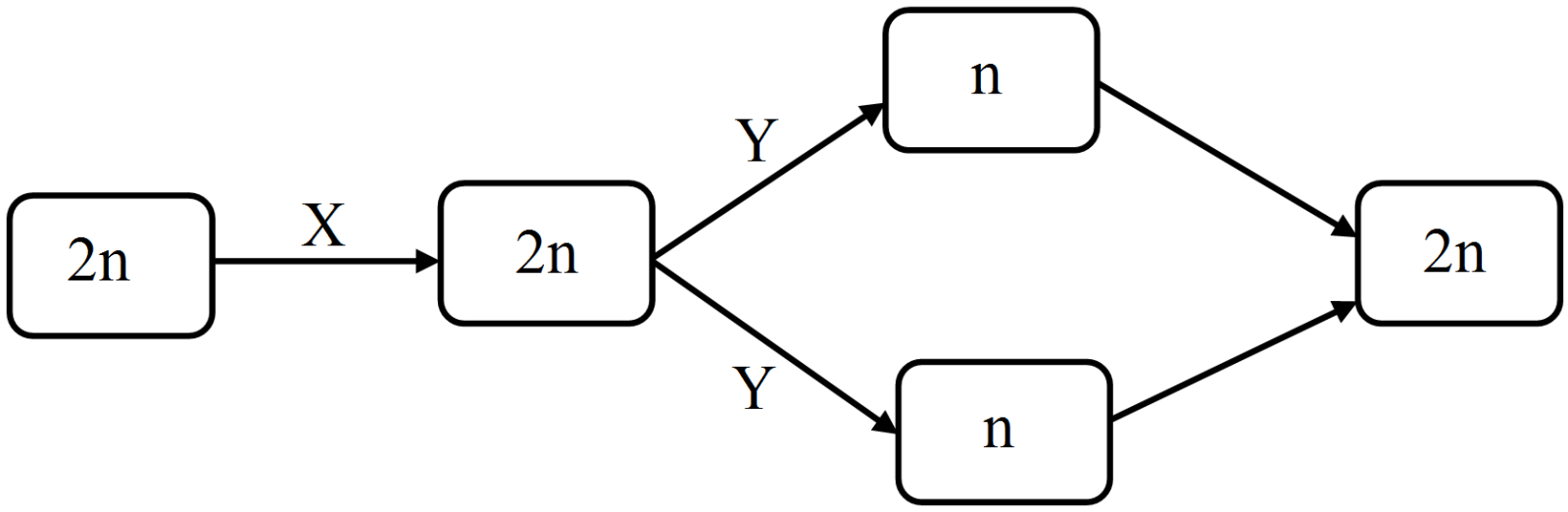
The diagram below represents the changes in the number of chromosomes during several Sun processes that occur in an animal cell.
  1. Name the process of cell division occurring at X and Y.
  2. State two differences in the behaviour of chromosomes between X and Y.
Answer
  1. X-Mitosis. Y-Meiosis.
    1. In X, there is no association of homologous chromosomes, but in Y, homologous chromosomes pair up together to form bivalents during prophase-I.
    2. In X, there is no crossing over as there is no formation of chiasmata, but in Y, crossing over occurs at the chiasmata whereby some genes Pontos are swapped between homologous chromosomes.
View full question & answer
Question 122 Marks
How does metaphase I differ from metaphase?
Answer
Metaphase I
Metaphase
The homologous pairs of chromosomes are arranged in two rows near the centre of the spindles. There is no metaphasic plate formed.
Centromeres of all the chromosomes are arranged in a single row at the centre of the spindles
There is no metaphasic plate formed.
A metaphasic plate is formed.
View full question & answer
Question 132 Marks
Give significance of glycocalyx.
Answer
Glycocalyx is significant in the following ways:
  1. It protects the cell from loss of water and nutrients.
  2. Serves as a protective layer against attack by phagocytosis and viruses.
  3. Helps in attachment to a surface.
  4. Provides virulence.
View full question & answer
Question 142 Marks
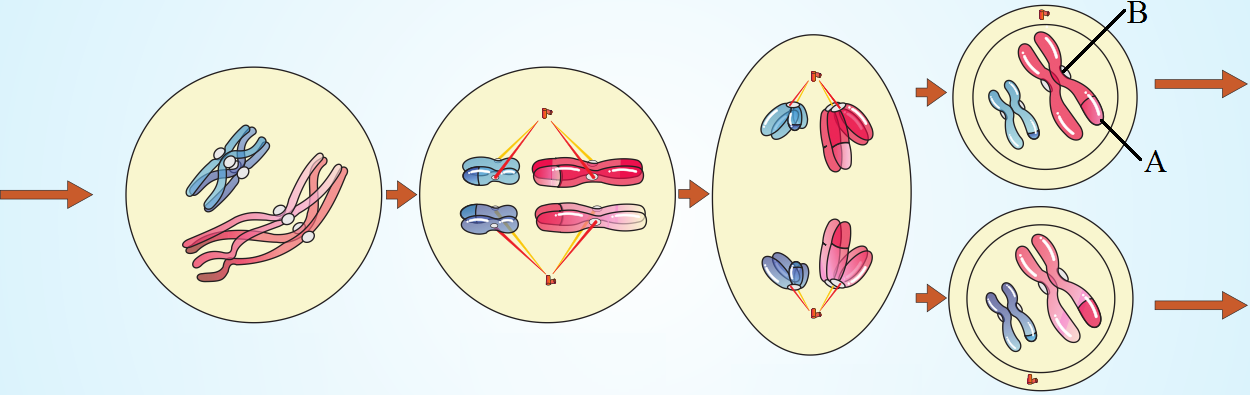
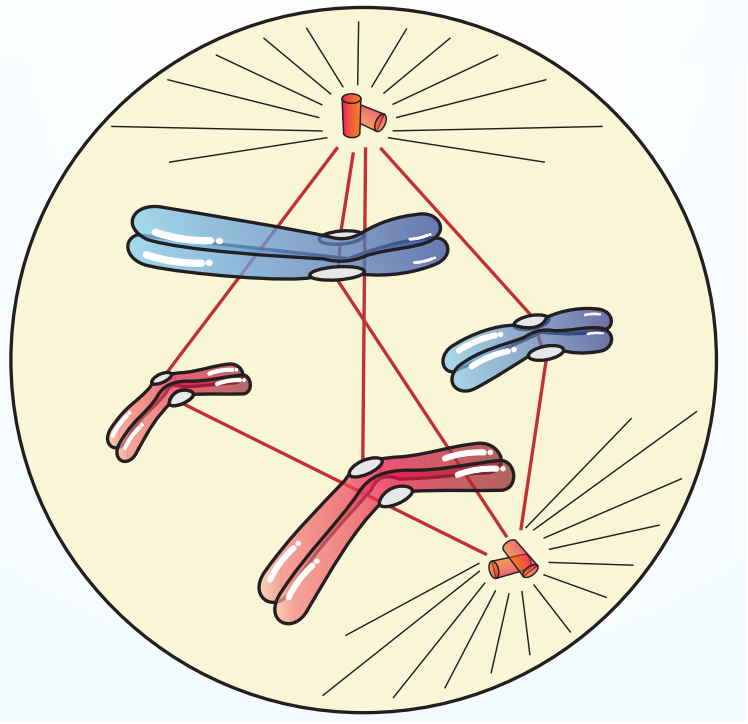
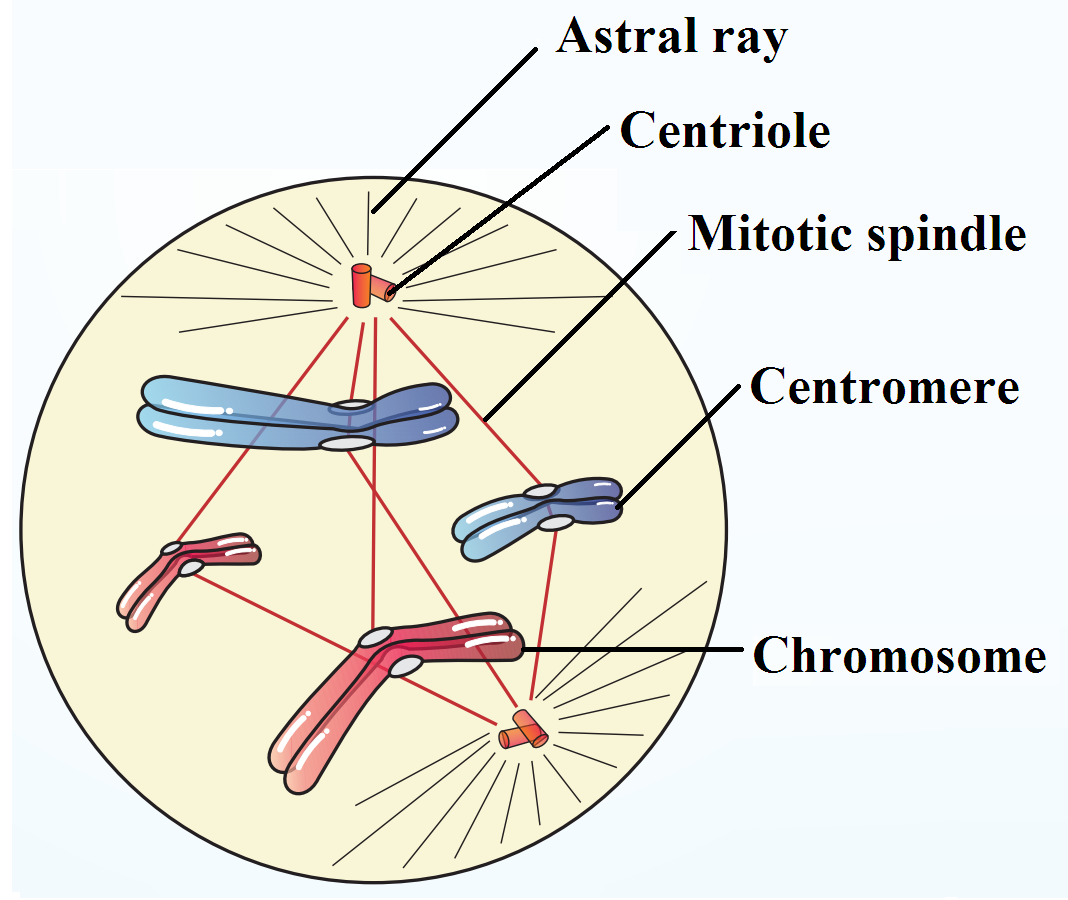
Answer the following questions based upon the given figure.
  1. What type of division is this? Whether meiotic or/and mitotic and which stage?
  2. What is A and B?
Answer
  1. It is a meiotic division showing synapsis and it is in the zygotene stage of prophase-I of meiosis-I.
  2. A-centromere, B-chromatid.
View full question & answer
Question 152 Marks
Differentiate between animal cell and plant cell.
Answer
 
Animal Cell
Plant Cell
1.
Cell wall absent
Cell wall present
2.
Chloroplast absent
Chloroplast present in green parts
3.
Centriole present
Centriole absent
4.
Vacuoles are smaller
Comparatively vacuoles are larger
View full question & answer
Question 162 Marks
How does meiosis facilitate creation of offsprings, with distinct characters?
Answer
Meiosis happens during gametogenesis and as a result gametes have half the number of chromosomes. During fertilization, when gametes fuse together two different sets of chromosomes make a new set. This results in an offspring, who has distinct characters, compared to parents.
View full question & answer
Question 172 Marks
  1. Do bacterial cells have nucleus like eukaryotic cell? Explain.
  2. Are there any form of bacteria present that are made up of more than one cell?
Answer
  1. No, bacterial cells do not have well-defined nucleus instead, the genetic material in them is dispersed in the cytosol, also there is no internal membrane that delimits a nucleus.
  2. No, there is no pluricellular bacteria, i.e., made up of more than one cell. All bacterial cells are unicellular prokaryotes.
View full question & answer
Question 182 Marks
What is chiasmata? Mention its significance also.
Answer
Chiasmata is X-shaped structure of separated bivalents of recombined homologous chromosomes. Chiasmata formation is necessary for the separation of homologous chromosomes which have undergone the process of crossing over.
View full question & answer
Question 192 Marks
What are the facts which prove that all cells are autonomous?
Answer
All cells are autonomous because of the following facts:
  1. Each and every cell converts non-living materials into components of living matter.
  2. Each cell builds up its own macromolecules from macromolecules.
  3. All cells obtain or manufacture food.
  4. A cell always buildsup new structure to replace the worn out ones.
View full question & answer
Question 202 Marks
  1. Name two surface extensions that are not concerned with motility in bacterial cells.
  2. Give the name of the structure that helps in motility of bacterial cells.
Answer
  1. Pill and fimbriae are the two surface extensions that are not concerned with motility.
  2. Structure that helps in motility of bacterial cell is flagella.
View full question & answer
Question 212 Marks
Mitochondria and plastids have their own DNA (genetic material). What is known about their fate during nuclear division like mitosis?
Answer
The DNA present in mitochondria and chloroplast is extra chromosomal DNA. It has nothing to do with the nuclear divisions. In mitosis, only nuclear DNA takes part.
View full question & answer
Question 222 Marks
Mention two functions of the centrioles.
Answer
Functions of centrioles are:
  1. The centrioles play a vital role in cell division by forming spindle fibres, which act as guides for the alignment of the chromosomes as they separate later during the process of cell division.
  2. The centrioles are also responsible for formation of basal bodies, cilia and flagella.
View full question & answer
Question 232 Marks
Complete the following sentences with suitable words.
  1. Chromosome condensation occurs during......
  2. ....is marked by the alignment of chromosomes at the equatorial plate.
  3. ....is the equational division in which the chromosome number of the parent is conserved in the daughter cell.
  4. Each parent cell has pairs of....chromosomes, one homologous from the father and one from the mother.
Answer
  1. prophase.
  2. Metaphase.
  3. Meiosis-II.
  4. homologous.
View full question & answer
Question 242 Marks
List the differences between metaphase of mitosis and metaphase-I of meiosis.
Answer
Differences between metaphase of mitosis and metaphase-I of meiosis are
S.No.
Mitotic Metaphase
Meiotic Metaphase
1
The chromosomes at the metaphase are arranged in such a way that the centromeres lie at the metaphase plate and the arms of chromosomes are free.
The chromosomes at the metaphase (meiosis-I) are arranged in such a way that the centromeres of homologous chromosomes lie on either side of the metaphase plate, pointing towards the opposite poles.
2
A chromosome is connected to both the spindle poles due to the presence of two tractile fibrils.
In metaphase-I, a chromosome is connected to only one spindle pole of its side due to the presence of a single tractile fibril.
View full question & answer
Question 252 Marks
What is the need of meiosis in cell division?
Answer
  1. Meiosis is essential for all sexually reproducing organisms.
  2. It occurs in reproductive cells, so that gametes formed are haploid or have half the number of chromosomes of those cells which are directly derived from zygote.
  3. Two types of gametes fuse during zygote formation. As a result, zygote comes to have double the number of chromosomes contained in gametes. Meiosis maintains a fixed number of chromosomes of a species by reducing it to number by half.
View full question & answer
Question 262 Marks
Mitosis results in producing two cells are similar to other. What would be the consequence if the following irregularities occur during mitosis? Duplication of DNA does not occur.
Answer
If DNA duplication does not occur than cell might not be able to surpass S-phase of cell-cycle as no chromosome formation will take place, and will not be able to enter M-(mitotic phase) or if in case it enters mitosis the cycle will cease.
View full question & answer
Question 272 Marks
Both unicellular and multicellular organisms undergo mitosis. What are the differences, if any, observed in the process between the two?
Answer
In unicellular organisms, mitosis is a method of asexual reproduction. E.g., in bacteria, mitosis results in formation of identical daughter cells. However in multicellular organisms, mitosis helps in growth and repair of cells and tissues. E.g., repair of damaged skin through production of new skin cells.
View full question & answer
Question 282 Marks
What is the difference between cell walls of Gram positive and Gram negative bacteria?
Answer
The cell wall of Gram positive bacteria is single-layered (outer membrane is absent) and contains 70-80% peptidoglycan and little amount of lipids. It's wall also has teichoic acid. The light cell wall of Gram negative bacteria on the other hand is two-layered, outer membrane is present, i.e., thin
layer of peptidoglycan and plasma membrane is present, teichoic acid is absent in wall.
View full question & answer
Question 292 Marks
Mitosis results in producing two cells are similar to other. What would be the consequence if the following irregularities occur during mitosis? Nuclear membrane fails to disintegrate.
Answer
If nuclear membrane fails to disintegrate, the spindle fibres would not be able to reach chromosomes and they would not move towards opposite poles of the cell. In certain protozoan’s, such as Amoeba, the spindle is formed within the nucleus and this is called intra nuclear mitosis or pre-mitosis.
View full question & answer
Question 302 Marks
Enlist any four significant points of meiosis.
Answer
  1. Meiosis involves two sequential cycles of nuclear and cell division, called meiosis I and meiosis II, but only a single cycle of DNA replication.
  2. Meiosis I is initiated after the chromosomes have replicated to produce identical sister chromatids at S-phase.
  3. Meiosis involves pairing of homologous chromosomes and recombination between them.
  4. Four haploid cells are formed at the end of meiosis II.
View full question & answer
Question 312 Marks
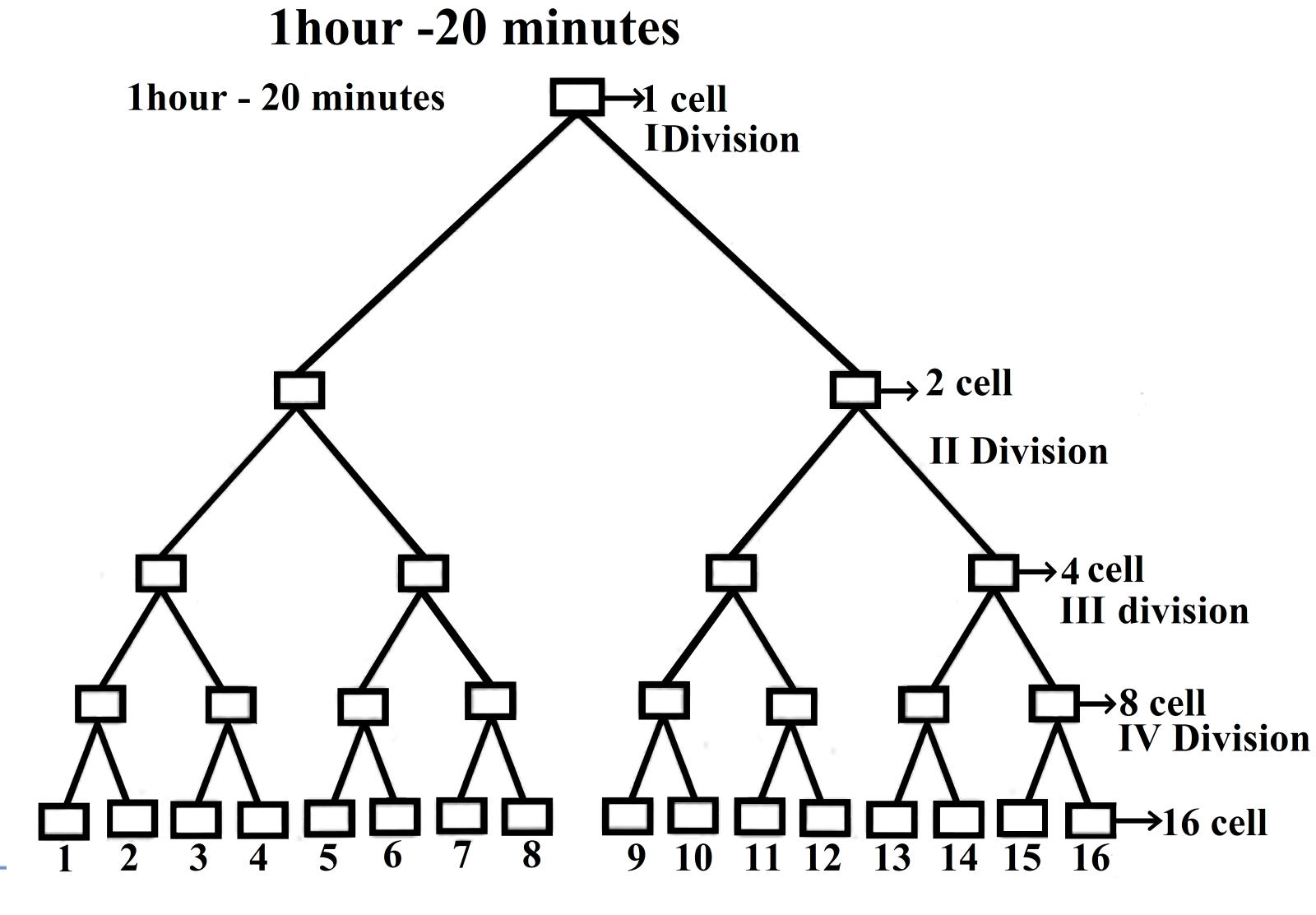
Given that the average duplication time of E.coli is 20 minutes, how much time will two E.coli cells take to become 32 cells?
Answer
These are the 4 subsequent cell divisions to produce 16 cells and each division takes = 20 min Total time = 20 × 4 = 80 minutes or 1 hr 20 minutes So, 1 cell produces 16 cells in 1 hour 20 minutes and 2 cells produces 32 cells in 1 hour 20 minutes.
View full question & answer
Question 322 Marks
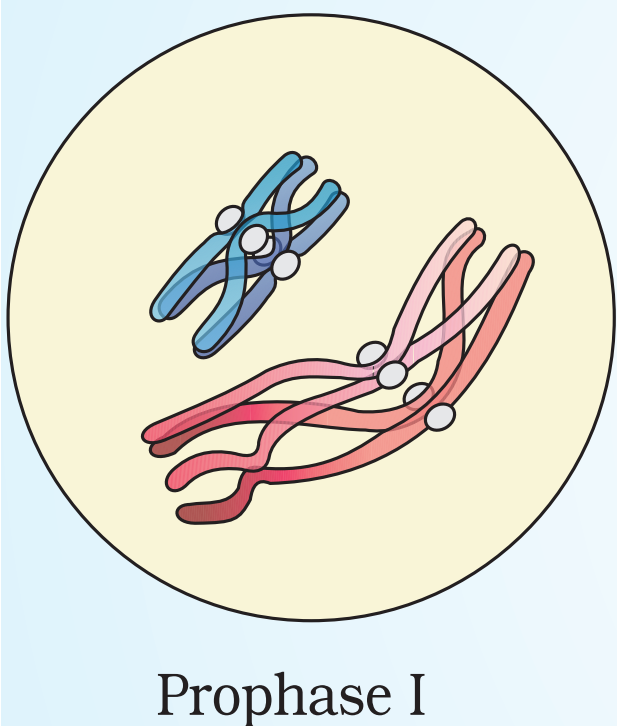
The diagram shows a bivalent at prophase-I of meiosis. Which of the four chromatids can cross over?
Answer
In this case, non-sister chromatids can cross over. It is important to remember that crossing over always takes place between two non-sister chromatids and never between two sister chromatids.
View full question & answer
Question 332 Marks
Match the words listed in column I with suitable words from the column II.
S.No.
Column I
S.No.
Column II
A
Karyokinesis
1
Meiocytes
B
Cytokinesis
2
Plant cells
C
C. Meiosis
3
Nuclear division
D
D. Cell plate
4
Cytoplasmic division
Answer
S.No.
Column I
S.No.
Column II
A
Karyokinesis
3
Nuclear division
B
Cytokinesis
4
Cytoplasmic division
C
C. Meiosis
1
Meiocytes
D
D. Cell plate
2
Plant cells
View full question & answer
Question 342 Marks
Describe telophase I of meiosis.
Answer
Telophase I:
  • The nuclear membrane and nucleolus reappear, cytokinesis follows and this is called as diad of cells.
  • Although in many cases the chromosomes do undergo some dispersion, they do not reach the extremely extended state of the interphase nucleus.
  • The stage between the two meiotic divisions is called interkinesis and is generally short lived. Interkinesis is followed by prophase II, a much simpler prophase than prophase I.
View full question & answer
Question 352 Marks
Write about cellular autonomy in unicellular organisms.
Answer
Unicellular organisms possess the following cellular autonomy:
  1. The cell has complete independent existence.
  2. All life activities are carried out by the same cell.
  3. Division of labour is absent.
  4. The cell depends upon its own internal and intrinsic information.
View full question & answer
Question 362 Marks
Between a prokaryote and a eukaryote, which cell has a shorter cell division time?
Answer
Prokaryotic cells has shorter cell division time than eukaryotic cells. A typical eukaryotic cell cycle is illustrated by human cells in culture. These cells divide once in approximately every 24 hours. In bacteria (E.coli) cell cycle is of 20 minutes.
View full question & answer
Question 372 Marks
What attributes does a chromatid require to be classified as a chromosome?
Answer
A chromatid consists of centromere and arms. These attributes are required by it to be classified as chromosome. Chromatids separate at the time of division (sister chromatids) and form chromosomes.
View full question & answer
Question 382 Marks
Meiosis is advantageous than mitosis as it produces variations so plays important role in evolution. What are the stages during which chances of recombination of genes are increased during meiosis? Explain these events.
Answer
Stages during which recombination of genes occurs in meiosis are bidy
  1. Crossing over is exchange of genes between the non-sister chromatids i of homologous chromosomes. It occurs at recombination nodules during pachytene stage of prophase-I of meiosis-I and is regulated by recombinase enzyme.
  2. Arrangement of bivalents at the equator of the spindle during metaphase-I of meiosis.
View full question & answer
Question 402 Marks
Differentiate between G, and $G _2$-phase
Answer
Differences between G, and $G _2$-phase are
S.No.
$G_1$-phase
$G_2$-phase
1
It is called first growth period
It is post-synthetic phase.
2
Its duration is variable.
It lasts for 2-5 years.
3
Cells grow in size.
Cell prepares to go into mitotic phase.
View full question & answer
Question 412 Marks
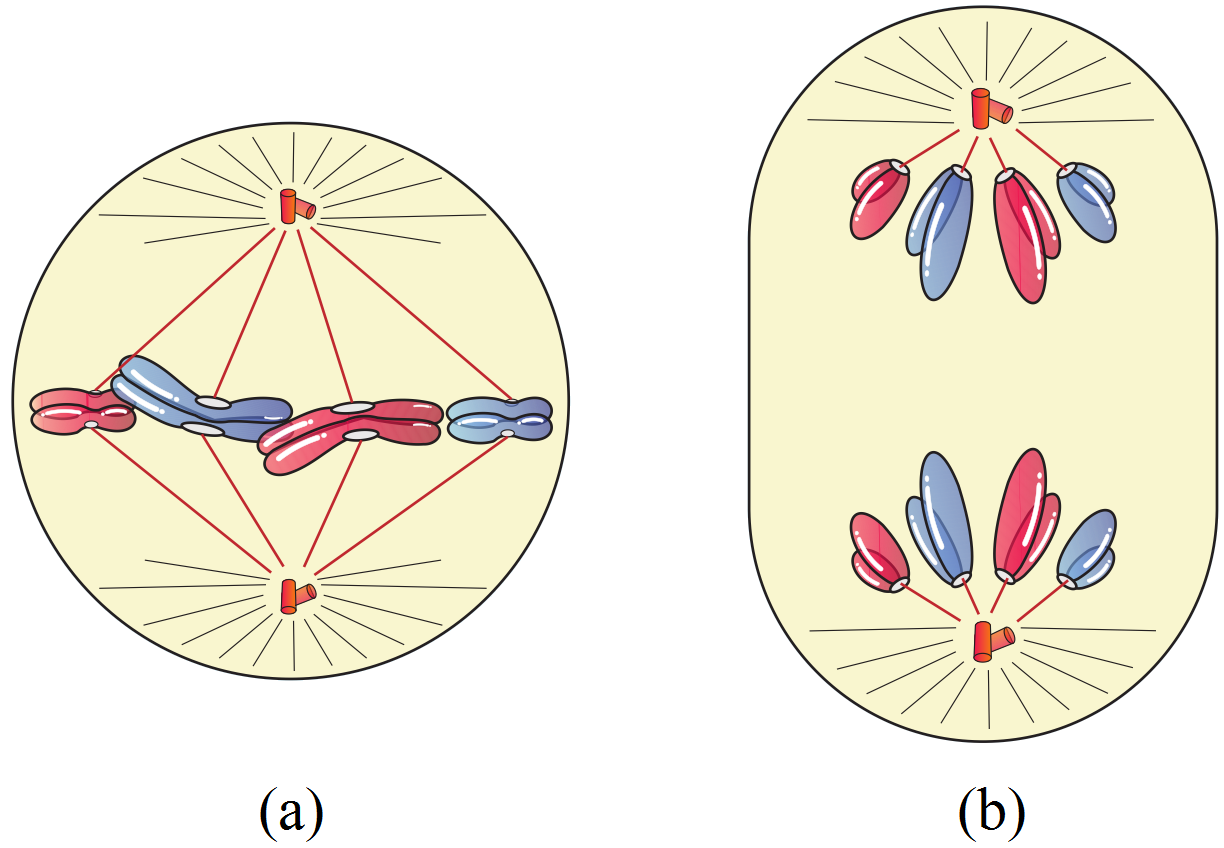
  1. Name the stages and type of cell division represented in A and B, respectively.
  2. Also explain any one of them.
Answer
  1. Stages and type of cell division are
    1. Metaphase-I-meiosis.
    2. Anaphase-I-meiosis.
  2. For metaphase.
View full question & answer
Question 422 Marks
How many chromosomes in daughter cells are formed by mitosis from diploid parent cells? And what is the chromosome number in daughter cells formed by meiosis from diploid parent cells?
Answer
Mitosis-2n (diploid); Meiosis-n (haploid).
View full question & answer
Question 432 Marks
What is the benefit of cell wall in plant cells?
Answer
Cell wall is stronger and less impervious than plasma membrane. It tends to provide greater mechanical strength to plants. Since, plants have to withstand vagaries of nature and they cannot run for safety, so they need a stronger structure. Cell wall also prevents entry of undesirable matters in cell and facilitates exchange of materials among cells.
View full question & answer
Question 442 Marks
Which part of the human body should one use to demonstrate stages in mitosis?
Answer
All somatic cells except germ cells of the human body can be used to demonstrate stages in mitosis. Mitotic cell division is seen in diploid somatic cells in animals. It is also called equational division or somatic cell division.
View full question & answer
Question 452 Marks
  1. At what stage of mitosis do the chromosomes migrate to the two opposite poles?
  2. List the significance of meiosis.
Answer
  1. Anaphase.
  2.  
  1. Meiosis ensures the maintenance of a constant chromosome number, characteristic of a species, through genemtions.
  2. The crossing over results in variations of genetic characters in the progeny, variation is necessary for survival of species and it is the raw material for evolution.
View full question & answer
Question 462 Marks
  1. Why is mitosis also known as an equational division?
  2. You are viewing a dividing cell under a microscope. How can you determine whether it is an animal cell or a plant cell?
Answer
  1. Meiosis is known as equational division because number of chromosomes maintain equal in daughter cells as in the parental cells after division.
  2. Cytokinesis is different in plant cells and animal cells. Animal cell divides by cell furrow system, while plant cell divides by cell plate method.
View full question & answer
Question 472 Marks
Mitosis results in producing two cells are similar to other. What would be the consequence if the following irregularities occur during mitosis? Centromeres do not divide.
Answer
If the centromeres do not divide one of the daughter cell will receive a complete pair of chromosomes and other cell would not get any of them. This may result in trisomy.
View full question & answer
Question 482 Marks
Which tissue of animals and plants exhibits meiosis?
Answer
Meiosis takes place only in the reproductive cells or germ cells (gametes) of the body which include the cells of testes and ovaries in animals and the male and female reproductive parts of the plant i.e. the Androecium and Gynoecium.
View full question & answer
Question 492 Marks
What are the major functions of plant cell vacuoles? What is the covering membrane of the vacuoles called?
Answer
Vacuoles in plant cell contains not only unuseful substances and water, but also contain pigments and toxic molecules. Tonoplast is the covering membrane of the vacuoles.
View full question & answer
Question 502 Marks
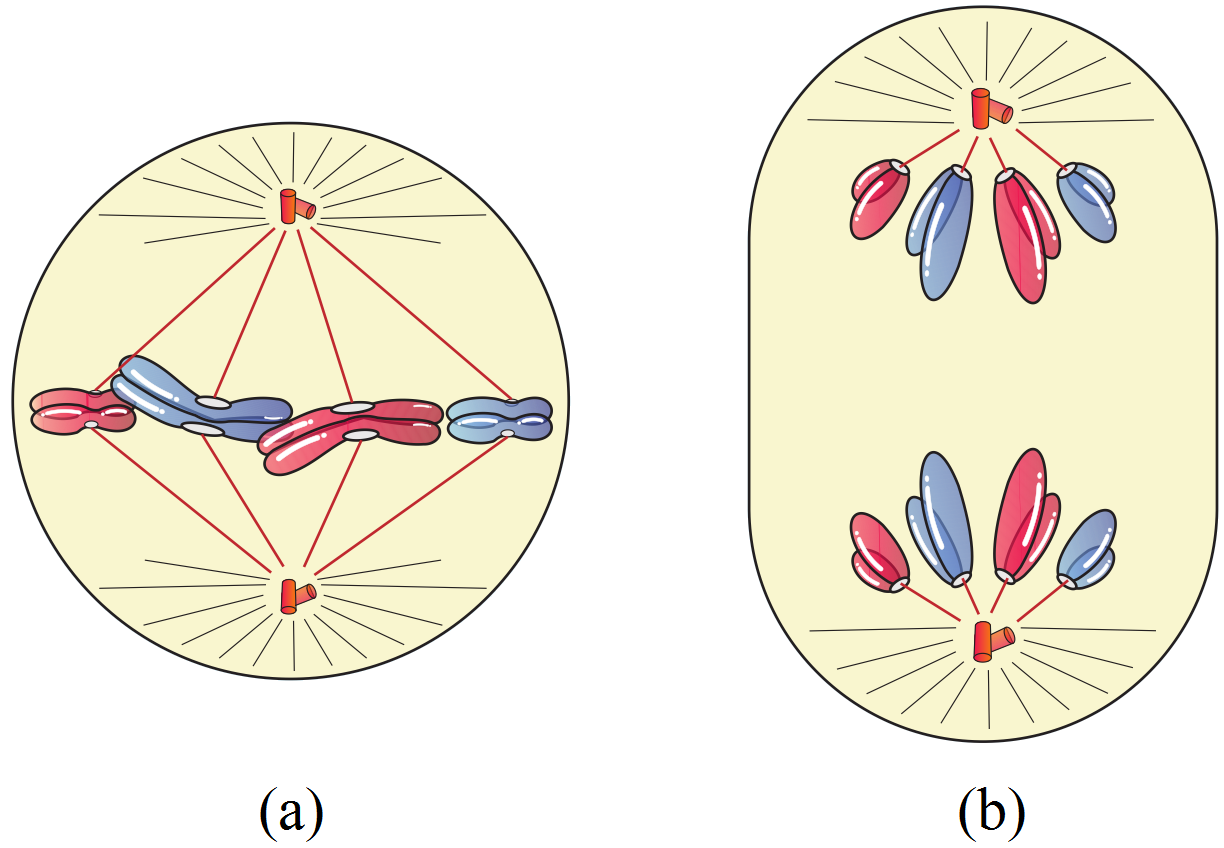
Name the stages and type of cell division represented in (a) and (b) respectively.
Answer
  1. Metaphase I, meiosis.
  2. Anaphase I, meiosis.
View full question & answer
Question 512 Marks
Name the pathological condition when uncontrolled cell division occurs.
Answer
Cancer is the pathological condition in which the cells lose control over cell division and this result into malformation of the organ in which such cell division occurs.
View full question & answer
Question 522 Marks
Name the stages of cell division at which the following events occur:
  1. Chromosomes cluster at opposite spindle poles.
  2. Centromere splits and chromatids separate.
  3. Chromosomes move to spindle equator.
  4. Crossing over between non-sister chromatids takes place.
Answer
  1. Telophase.
  2. Anaphase.
  3. Metaphase.
  4. Zygotene of Prophase.
View full question & answer
Question 532 Marks
  1. Define meiosis.
  2. Name the last/ final stage of prophase I. What marks this stage?
Answer
  1. Meiosis is a specialised kind of cell division that reduces the number of chromosomes to half and forms haploid daughter cells.
  • Diakinesis is the last-stage of prophase I.
  • It is marked by the terminalisation of chiasmata.
View full question & answer
Question 542 Marks
What are the disadvantages of multicellularity?
Answer
The disadvantages of multicellularity are:
  1. Specialised cells often lose the power of division, so that injury is not repaired, e.g., Nerve cells.
  2. Regeneration ability of multicellular organisms decrease with specialisation.
  3. Specialised cells may lose vital functions in order to carry out specific activity, e.g., RBCs, sieve tube cells.
View full question & answer
Question 552 Marks
  1. How many division take place in meiosis? How many times, the chromosomes replicate during meiotic cell division?
  2. How many daughter cells are produced during mitotic cell division and a meiotic cell division?
  3. What is the status of chromosomes and DNA content in each daughter cell?
Answer
  1. Two divisions take place in meiosis, i.e., meiosis-I and meiosis-II. During meiotic division, chromosomes replicate one time in meiosis II.
  2. 2 daughter cells are produced in mitotic division and 4 daughter cells are produced in meiotic division.
  3. During mitosis, DNA and chromosomes remain same in daughter cells as in parental, while DNA and chromosome number reduces to half in meiosis in daughter cells.
View full question & answer
Question 562 Marks
What are chiasmata? What is their significance?
Answer
  • Chiasmata are the X-shaped structures formed at the point of crossing over.
  • They represent the sites of cross overs and hence exchange of genetic material or recombination.
View full question & answer
Question 572 Marks
While examining the mitotic stage in a tissue, one finds some cells with 16 chromosomes and some with 32 chromosomes. What possible reasons could you assign to this difference in chromosome number. Do you think cells with 16 chromosomes could have arisen from cells with 32 chromosomes or vice versa?
Answer
Cells with 16 chromosomes are produced by meiosis while that with 32 chromosomes are produced by mitosis.
  • Cells with 16 chromosomes could have arisen from cells with 32 chromosomes through meiosis.
  • Cells with 32 chromosomes could have arisen from cells with 16 chromosomes through fertilization or syngamy.
View full question & answer
Question 582 Marks
What is the process of cell division in prokaryotes?
Answer
Prokaryotes do not have nucleus. So, there is no elaborate karyokinesis, as seen in eukaryotes. In prokaryotes the replication of DNA starts the process of cell division. Once genetic material is replicated, it is followed by division of cytoplasm. The process is known as binary fission.
View full question & answer
Question 592 Marks
How do the ribosomes of prokaryotic cells differ from the ribosomes of eukaryotic cells? Also tell what is similar about them?
Answer
Ribosomes in the cytoplasm of prokaryotic and eukaryotic cells slightly differ. However, prokaryotes have 70S ribosomes, each consisting of a (small) 30S and a (large) SOS subunit whereas, eukaryotes have SOS ribosomes, each consisting of (small) 40S and a bound (large) 60S submit. Both prokaryotic and eukaryotic ribosomes are composed of ribosomal RNA and ribosomal proteins. Their basic functioning is protein synthesis.
View full question & answer
Question 602 Marks
Enumerate the key events of telophase of mitosis.
Answer
The key events of telophase are:
  1. Chromosomes cluster at the opposite poles of the spindle and their identity is lost as discrete bodies as they start uncoiling.
  2. Nuclear envelope becomes assembled around the chromosome clusters.
  3. Nucleolus, endoplasmic reticulum and golgi complex are reformed.
View full question & answer
Question 612 Marks
Define cytokinesis. How is it accomplished in animal cells?
Answer
Cytokinesis is the process by which the cytoplasm of a cell divides; it corresponds to the separation of the two daughter nuclei (formed by karyokinesis) into two daughter cells.
  • In animal cells, a furrow appears in the cell membrane during late anaphase or early telophase.
  • The furrow deepens and when it joins in the centre, the cytoplasm (cell) is divided into two compartments; each compartment with a daughter nucleus, is known as a daughter cell.
View full question & answer
Question 622 Marks
Mitosis results in producing two cells are similar to other. What would be the consequence if the following irregularities occur during mitosis? Cytokinesis does not occur.
Answer
If cytokines is does not occur, then multinucleate condition called coenocytes, syncytium is produced, as in Rhizopus and Vaucheria, etc.
View full question & answer
Question 632 Marks
State the role of centrioles in cell division.
Answer
Centrioles play an important role in formation of spindle during cell division. They organise the mitotic spindle and thus, help in the completion of cytokinesis. They generate the cell's cytoskeleton and help in the formation of the mitotic spindles. In organisms with flagella and cilia, the position of these organelles is determined by the mother centriole, which becomes the basal body.
View full question & answer
Question 642 Marks
  1. Why can cytokinesis not occur in plant cells the same way as it occurs in animal cells?
  2. How is it accomplished in plant cells?
Answer
  1. Plant cells cannot undergo cytokinesis like animal cells because they have a rigid/ inextensible cell wall.
  1.  
  • In plant cells, cytokinesis starts with the formation of a precursor, called cell plate.
  • This extends from the centre of the cell towards the lateral walls and cuts the cell into two halves, each with a daughter nucleus.
  • During cytokinesis, the cell organelles like mitochondria, plastids, etc. also get distributed between the daughter cells.
View full question & answer
Question 652 Marks
A cell has 32 chromosomes. It undergoes mitotic division. What will be the chromosome number (N) during metaphase? What would be the DNA content (C) during anaphase?
Answer
When a cell has 32 chromosomes and undergoes a mitotic division, the chromosome number (n) during metaphase is the same. The number of chromatids gets double during replication. Each chromosome has 2 chromatids. But the number of chromatid will be 64.
View full question & answer
Question 662 Marks
State the role of centrioles other than spindle formation.
Answer
Centrioles also serve other purposes apart from its role in spindle formation it formed the basal body of cilia and flagella. They also help in formation of microtubules and sperm tail.
View full question & answer
Question 672 Marks
Give a description of metaphase I of meiosis.
Answer
The bivalent chromosomes align on the equatorial plate. The microtubules from the opposite poles of the spindle attach to the pair of homologous chromosomes.
View full question & answer
Question 682 Marks
What is crossing over? Name the enzyme responsible for it.
Answer
  • Crossing over is defined as the phenomenon of exchange of equivalent segments between non-sister chromatids of homologous chromosomes during prophase I of meiosis.
  • The enzyme involved is recombinase.
View full question & answer
Question 692 Marks
Comment on the statement–Meiosis enables the conservation of specific chromosome number of each species even though the process per se, results in reduction of chromosome number.
Answer
Meiosis is reductional division which ensures production of haploid phase in life cycle of sexually reproducing organisms, but fertilization restores the diploid phase, thus, enables conservation of specific chromosome number. E.g., gametes produced by 2n parents are haploid (n), but the zygote is diploid.
View full question & answer
Question 702 Marks
Label the diagram and also determine the stage at which this structure is visible.
Answer
The given diagram shows transition from prophase to metaphase.
View full question & answer
Question 712 Marks
Which four different sites in plant cells have ribosomes?
Answer
Ribosomes are found in plant cell at following different sites:
  1. Freely in the cytoplasm.
  2. Attached to ER in the cytoplasm.
  3. Inside mitochondria.
  4. Inside plastids (chloroplasts).
View full question & answer
Question 722 Marks
What happens when a normal cell turns into a malignant cell?
Answer
Cells usually stop dividing after certain number of divisions. In malignant or cancerous cells this automatic stoppage of cell division does not work. As a result malignant cells keep on dividing endlessly causing the cancerous growth.
View full question & answer
Question 732 Marks
Imagine a situation if there was no meiosis. Then what would have happened to the next generation?
Answer
In the absence of meiosis the next generation would have double the number of chromosomes after fusion of gametes. This would have resulted in the birth of an altogether new species. The maintenance of characters set would have been possible only through asexual reproduction.
View full question & answer
Question 742 Marks
Name three phases of interphase. Give one major event of each phase.
Answer
Three main events that occur in interphase are
$\mathrm{G}_1$-phase (post-mitotic or pre-synthetic phase), S-phase (synthesising phase) and $\mathrm{G}_2$-phase (postsynthetic or pre-mitotic phase).
Major events of each phase are:
i. $\mathrm{G}_1$-phase is the longest phase during which synthesis of RNA and DNA takes place.
ii. S-phase is the phase during which chromosomes replicates and prepare themselves for equal distribution.
iii. $\mathrm{G}_2$-phase, is the phase in which synthesis of DNA gets stopped. However, formation of RNA takes place.
View full question & answer
Question 752 Marks
Differentiate between S-phase and $G _2$-phase
Answer
Differences between S-phase and $G _2$-phase are
S.No.
S-phase
$G _2$-phase
1
It is called synthetic phase.
It is called pre-mitotic phase.
2
Replication of DNA occurs.
RNA of all three types and proteins precursors of asters and spindle are synthesised in it.
3
It lasts for 6-8 hours
It lasts for 2-5 years.
View full question & answer