Questions

3 Marks Question

Take a timed test

17 questions · self-marked practice — reveal the answer and mark yourself.

Question 13 Marks
List the hormones secreted by the following: Pituitary.
Answer
The pituitary gland has two components i.e., adenohypophysis and neurohypophysis. Hormones secreted by the adenohypophysis are:
  1. Growth hormone (GH)
  2. Prolactin
  3. Thyroid-stimulating hormone (TSH)
  4. Adrenocorticotrophic hormone (ACTH)
  5. Luteinizing hormone (LH)
  6. Follicle-stimulating hormone (FSH)
  7. Melanocyte-stimulating hormone (MSH)
Hormones secreted by the neurohypophysis are:
  1. Oxytocin.
  2. Vasopressin.
View full question & answer
Question 23 Marks
List the hormones secreted by the following: Hypothalamus.
Answer
Hypothalamus: Hormones secreted by the hypothalamus include:
  1. Releasing hormones: These hormones stimulate the secretions of the pituitary hormone.
Examples of these hormones are:
  1. Gonadotrophin-releasing hormone.
  2. Thyrotrophin-releasing hormone.
  3. Somatotropin-releasing hormone.
  4. Adrenocorticotrophin-releasing hormone.
  1. Inhibiting hormones: These hormones inhibit the secretions of the pituitary hormone.
Examples of these hormones are:
  1. Somatostatin.
  2. Growth-inhibiting hormone.
  3. Melanocyte-inhibiting hormone.
View full question & answer
Question 33 Marks
Briefly mention the mechanism of action of FSH.
Answer
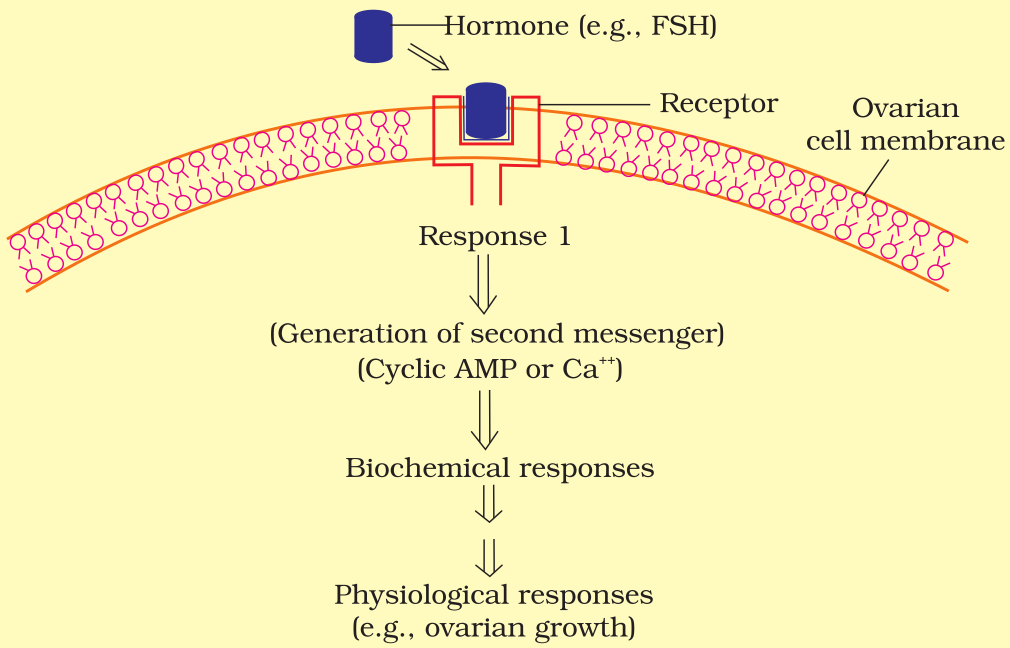
Follicle stimulating hormone (FSH) stimulates growth and development of the ovarian follicles in females. FSH produces its effect by binding to its specific receptors present on the ovarian cell membrane. Binding of FSH hormone to its specific receptor present over the cell surface activates an enzyme called adenylate cyclase. This enzyme converts ATP into cyclic AMP. The cyclic AMP is called the second messenger and carries out various biochemical responses in the cell by activating the existing enzyme system in the cell. The biochemical responses then lead to physiological responses like ovarian growth.
View full question & answer
Question 43 Marks
Give scientific reasons of the following statements:
  1. Adrenals are called glands of emergency.
  2. Parathormone is also called Collip's hormone.
  3. The hormones released by the posterior lobe of pituitary are not its own products.
  4. Endocrine glands directly release their products into the blood.
Answer
  1. It is called so, because hormones of adrenal medulla increases the metabolism for preparing the animal to face physical, emotional stress as well as emergencies which could be life threatening.
  2. It is called so, because a Canadian Endocrinologist James B Collip, discovered parathormone in 1925.
  3. The hormones, released by posterior lobe of pituitary hot gland are, in fact, synthesised by the neurons in the hypothalamus and sent to the former via axons for release.
  4. Endocrine glands are ductless glands and their products act at a distant organ or tissue.
View full question & answer
Question 53 Marks
How are the hypothalamic hormones transported to the target organs?
Answer
  1. The hypothalamic hormones are secreted by the nuclei and transported through their axons and released at their axon terminals or nerve endings.
  2. The hormones are collected by hypophyseal portal vein and transported to anterior pituitary.
  3. The posterior pituitary hormones pass through the axons that reach the posterior pituitary and remain stored in the axon terminals, till they are stimulated for release.
View full question & answer
Question 63 Marks
  1. Where is thyroid gland located in our body? Briefly describe its structure.
  2. Write the cause of cretinism. Mention any four symptoms of this disorder.
Answer
  1. Thyroid gland:
  • It is composed of two lobes, which are located on either side of the trachea.
  • The two lobes are interconnected by a thin flap of connective tissue, called isthmus.
  • The thyroid gland is composed of follicles and stromal/ parafollicular tissue.
  • Each follicle is composed of follicular cells, arranged with a central cavity.
  1. Cretinism:
  • It is caused by hypothyroidism of mother during pregnancy that leads to defective development and maturation of the growing foetus:
Symptoms:
  • Stunted growth.
  • Mental retardation.
  • Low intelligence quotient.
  • Deaf-mutism.
  • Abnormal skin.
View full question & answer
Question 73 Marks
A milkman is very upset one morning as his cow refuses to give any milk. The milkman’s wife gets the calf from the shed. On fondling by the calf, the cow gave sufficient milk. Describe the role of endocrine gland and pathway associated with this response?
Answer

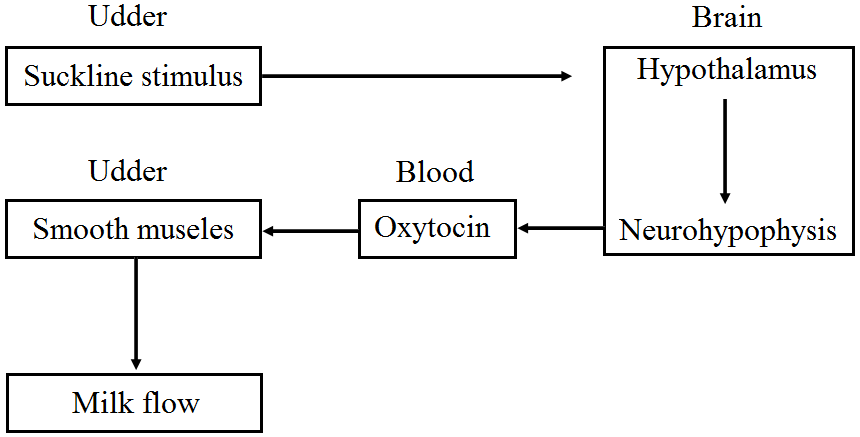
Milk secretion in mammals is stimulated by hormone oxytocin which works on positive feedback mechanism.
  1. When the calf sucks the cow's udder; it triggers nerve impulses.
  2. Nerve impulses send signals to the hypothalamus which starts secreting oxytocin.
  3. Oxytocin causes the contraction of smooth muscles around the alveoli (in udder) and milk is released.
The following figure shows the positive feedback mechanism of oxytocin.
View full question & answer
Question 83 Marks
Mention any four activities regulated by the estrogen hormone.OR
List any four effects produced by estrogen.
Answer
Estrogen controls:
  1. The growth and functions of female secondary sex organs.
  2. The appearance of female sexual characters.
  3. Development of mammary glands.
  4. Development of ovarian follicles.
  5. The female sexual behaviour.
View full question & answer
Question 93 Marks
Which hormones are secreted by the posterior pituitary gland? What function does each serve? Where are these hormones actually produced? How are these hormones transported to the region from where they are released?
Answer
Oxytocin and vasopressin are secreted by the posterior pituitary gland.
  1. Oxytocin: is released into the blood when hypothalamic neurons are stimulated by the widening of uterus at the time of delivery or by the sucking of breasts by an infant. It induces contraction of smooth muscles of the uterus during the birth of a youngone and myoepithelial cells of mammary glands to cause release of milk during sucking by an infant. Therefore, it is also known as 'birth hormone'.
  2. Vasopressin: is also called Antidiuretic Hormone (ADH). It decreases the loss of water in urine by increasing reabsorption of water in distal convoluted tubules, collecting tubules and collecting ducts of kidneys.
View full question & answer
Question 103 Marks
On an educational trip to Uttaranchal, Ketki and her friends observe that many local people were having swollen necks. Please help Ketki and her friends to find out the solutions to the following questions.
  1. Which probable disease are these people suffering from?
  2. How is it caused?
  3. What effect does this condition have on pregnancy?
Answer
  1. Goitre.
  2. Iodine deficiency in diet.
  3. Hypothyroidism during pregnancy causes defective development and maturation of the growing baby leading to stunted growth (cretinism), mental retardation, low intelligence quotient, abnormal skin, deaf- mutism, etc.
View full question & answer
Question 113 Marks
  1. What is termed as first messenger and second messenger in the target cells.
  2. How do protein hormones act on target cells?
Answer
  1. Hormone is called first messenger and cAMP is called second messenger.
  2. Protein hormone is water soluble, it binds to the extrinsic receptor present on the cell surface of the plasma membrane. Hormones when bind to them activates, a membrane bound enzyme adenyl cyclase, which catalyses the conversion of ATP to CAMP.
The CAMP then activates one more enzyme known as protein kinases. After phosphorylation of protien, alteration of its function occurs which thereby, leads to some metabolic effect.
View full question & answer
Question 123 Marks
Inflammatory responses can be controlled by a certain steroid. Name the steroid, its source and also its other important functions.
Answer
Cortisol is a steroid hormone that produces anti-inflammatory responses and suppresses the immune response. It is secreted by adrenal cortex. It also stimulates gluconeogenesis, lipolysis and proteolysis, and in hibit cellular uptake and utilization of amino acids. It is also involved in maintaining the cardio-vascular system as well as the kidney function. It also stimulates the RBC production.
View full question & answer
Question 133 Marks
Name the hormones, their source glands and their mode of functioning to achieve calcium hormeostasis in the human body.
Answer
  1. Thyrocalcitonin (TCT) secreted by the parafollicular cells of thyroid and the parathyroid hormone (PTH) secreted by parathyroid glands are involved in achieving calcium homeostasis in humans.
  2. TCT is secreted when the calcium level in the blood becomes high; it is a hypocalcemic hormone that reduces the calcium level in blood.
  3. PTH is secreted when the calcium levels of blood become low; it increases the calcium level by resorption of bone, reabsorption of calcium from renal tubules and absorption of calcium from digested food.
View full question & answer
Question 143 Marks
Explain how hypothalamus functions as an endocrine gland?
Answer
  1. The neurosecretory cells, called nuclei, of hypothalamus secrete hormones, which regulate the synthesis and secretion of pituitary hormones.
  2. The hormones produced are of two types:
  • Releasing hormones, which stimulate the secretion of pituitary hormones, e.g. gonadotropin-releasing hormone (GnRH) stimulates the anterior pituitary to secrete gonadotropins namely follicle-stimulating hormone (FSH) and luteinizing hormone (LH).
  • Inhibiting hormones, which inhibit the synthesis of hormones by the pituitary, e.g. somatostatin inhibits the secretion of growth hormone by the anterior pituitary.
  1. These hormones are transported to the anterior pituitary through a portal circulatory system.
  2. The posterior pituitary is under the direct neural regulation of the hypothalamus; the hormones oxytocin and vasopressin synthesised by hypothalamus are transported axonally to the posterior pituitary and remain stored in the axon terminals there.
View full question & answer
Question 153 Marks
Radha's father who is a diabetic patient does not avoid food items doctor has told him in diet. He also feels lazy to go for a walk. One day, his glucose level was checked by his doctor. The doctor advised him to take injections regularly, as he was not able to control his diabetes with diet and medication. He came home and while telling the things to Radha's mother, Radha (biology student) heard them and interrupted in between. She explained that, doctor has given insulin injections to control his blood glucose level. This may be discontinued, if he will take precautions in his daily routine.
  1. Which endocrine gland and its part is involved in the secretion of inslin?
  2. Why doctor preferred him to take insulin injections and what is the role of insulin in controlling level of glucose in blood?
  3. What precaution he should take to protect himself from such disorder?
  4. What are the values reflected from Radha's character as a biology student and a daughter?
Answer
  1. Pancreas and its part, i.e. islet of Langerhans are related to the secretion of insulin.
  2. Doctor preferred him to take insulin in order to control the level of glucose in the blood. Insulin in the form of injection directly stimulates pancreas in place of natural insulin produced by the body). It helps in transport of sugar from blood into other body tissues where it is used for energy.
  3. Precautions that should be taken are:
  1. Taking balanced good fibre diet is must.
  2. Regular exercise is also required.
  1. Radha is protective, caring and concerned for his father's health, has scientific knowledge and is attentive as a biology student.
View full question & answer
Question 163 Marks
What are the effects of hypothyroidism (observed during pregnancy) on the development and maturation of a growing baby?
Answer
If a woman is suffering from hypothyroidism; it can have deleterious effect on the development and maturation of the foetus. There can be stunted growth (cretinism) of the foetus which may result in an underweight newborn. The effects of hypothyroidism remains even after birth. The child's brain may not develop properly and show mental retardation. The child can also exhibit abnormal skin and deaf-mutism.
View full question & answer
Question 173 Marks
A sample of urine was diagnosed to contain high content of glucose and ketone bodies. Based on this observation, answer the following:
  1. Which endocrine gland and hormone is related to this condition?
  2. Name the cells on which this hormone acts.
  3. What is the condition called and how can it be rectified?
Answer
  1. Pancreas is the gland and hormone is Insulin decreases the level of glucose in blood by increasing the rate at which glucose is transported out of blood and into the cell. When insulin is not produced adequately glucose uptake is hampered and hence glucose starts appearing in urine along with ketone bodies.
  2. Hepatocytes and adipocytes.
  3. The condition is called diabetes mellitus. It can be rectified by insulin therapy.
View full question & answer