Questions

1 Marks Question

Take a timed test

71 questions · self-marked practice — reveal the answer and mark yourself.

Question 11 Mark
Which is the first step in cellular respiration?
Answer
Glycolysis, which involves breaking down of sugar to form pyruvic acid, is the first step in cellular respiration.
View full question & answer
Question 21 Mark
Why oxygen is an ultimate acceptor of electrons in ETS?
Answer
Oxygen is the ultimate acceptor of electrons in ETS because it is highly reactive and combines with protons to form metabolic water.
View full question & answer
Question 31 Mark
In Kreb's cycle, citric acid is formed when acetyl CoA combines with:
  1. Malic acid.
  2. Succinic acid.
  3. Funaric acid.
  4. Oxaloacetic acid.
Answer
  1.  
View full question & answer
Question 41 Mark
What percentage of energy from a glucose molecule is liberated during fermentation?
Answer
Less than seven percent.
View full question & answer
Question 61 Mark
Write the overall equation of respiration.
Answer
$\mathrm{C}_6 \mathrm{H}_{12} \mathrm{O}_6+6 \mathrm{O}_2 \rightarrow 6 \mathrm{CO}_2+6 \mathrm{H}_2 \mathrm{O}+$ Energy (ATP).
View full question & answer
Question 71 Mark
What is the name given to the oxidation, found in aerobic respiration occurring towards the end of the catabolic process involving the passage of both electrons and protons of reduced coenzymes to oxygen.
Answer
The name given is terminal oxidation.
View full question & answer
Question 81 Mark
How many molecules of ATP are produced after glycolysis of one molecule of glucose?
Answer
Two molecules of ATP are produced. In fact, 4 molecules are produced out of which 2 molecules are utilized for intermediate processes.
View full question & answer
Question 91 Mark
List two instances where lactic acid is formed by fermentation.
Answer
Instances where lactic acid is formed by fermentation are:
  1. During fermentation by lactic acid bacteria.
  2. During strenuous exercise, in the striated muscles in humans.
View full question & answer
Question 101 Mark
Name the following:
  1. The enzyme that catalyses the phosphorylation of glucose.
  2. The connecting link between glycolysis and Kreb's cycle.
Answer
  1. Hexokinase
  2. Acetyl CoA
View full question & answer
Question 131 Mark
Mark the odd one of the following group.Citric acid → $\alpha$-keto glutaric acid.
$\alpha$-keto glutaric acid → Succinic acide.
Succinic acid → Fumaric acid.
Malic acid → Oxaloacetic acid.
Answer
Succinic acid → Fumaric acid.
View full question & answer
Question 141 Mark
We commonly call ATP as the energy currency of the cell, why? Can you think of some other energy carriers present in a cell? Give name any two.
Answer
ATP is known as the energy currency of the cell because it acts as reservoir of energy and it releases energy. The other energy carriers present in a cell are ADP and AMP.
View full question & answer
Question 151 Mark
Pyruvic acid, the key/end product of glycolysis has many metabolic fates. What does it form under aerobic condition?
Answer
It forms carbon dioxide and water, with the release of energy.
View full question & answer
Question 161 Mark
Write the first step of reaction in TCA cycle.
Answer
Acetyl CoA combines with oxalo acetic acid, to form citric acid.
View full question & answer
Question 181 Mark
How many molecules of ATP is generated after oxidation of 1 molecule of glucose during cellular respiration?
Answer
36 to 38 molecules of ATP.
View full question & answer
Question 191 Mark
Which amongst the following are 3 and 6 carbon compound? Oxaloacetate, phosphoglyceraldehyde, isocitrate, $\alpha-$ketoglutarate.
Answer
Phosphoglyceraldehyde → 3C, isocitrate → 6C.
View full question & answer
Question 201 Mark
Name the two openings in plants through which exchange of gases takes place.
Answer
Stomata and lenticels.
View full question & answer
Question 221 Mark
How does a tree trunk exchange gases with the environment although it lacks stomata?
Answer
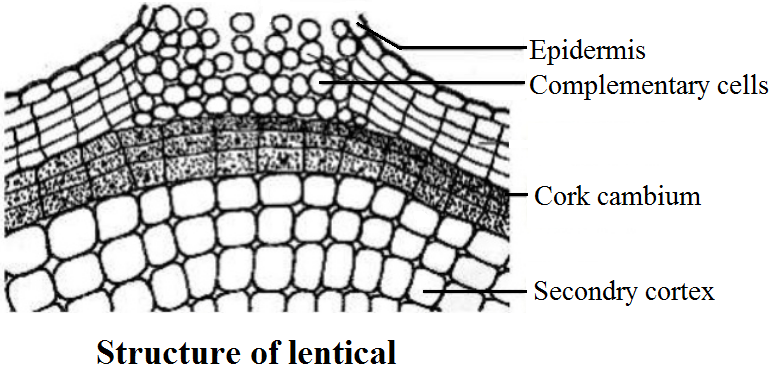
The old tree trunk is covered by dead woody tissue called cork. The epidermal layers of such tree get ruptured and outer cortical cells are loosely arranged. These structures are called as lenticels. These are the sites of gases exchange and transpiration.
View full question & answer
Question 231 Mark
Why is no distinction made between ATP and GTP in calculating energy yield in cell respiration?
Answer
The energy produced from the breaking of high energy bonds of both GTP and ATP is of same amount.
View full question & answer
Question 241 Mark
How many molecules of ATP are produced from,
  1. One molecule of pyruvic acid on its aerobic oxidation.
  2. Complete oxidation of one molecule of acetyl CoA?
Answer
  1. 15
  2. 12
View full question & answer
Question 251 Mark
Indicate the step in the citric acid cycle, where FAD is reduced to $\mathrm{FADH}_2$.
Answer
During the conversion of succinic acid into fumaric acid.
View full question & answer
Question 261 Mark
Write the equation for respiration of glucose.
Answer
$\text{C}_6\text{H}_{12}\text{O}_6+6\text{O}_2\rightarrow6\text{CO}_2+6\text{H}_2\text{O}+\text{energy}$
View full question & answer
Question 271 Mark
Glucose _____ A _____ 3-phosphoglyceric acid _____ B _____ pyruvic acid _____ $C + CO _2$.
Answer
Glucose A - Glyceraldehyde-3-phosphate B -Phosphoenol pyruvate C - Ethanol.
View full question & answer
Question 281 Mark
How many protons pass through complex V for the synthesis of two molecules of ATP?
Answer
Two pairs (4) of protons.
View full question & answer
Question 291 Mark
F particles participate in the synthesis of ________________.
Answer
$\mathrm{F}_0-\mathrm{F}_1$ particles participate in the synthesis of ATP.
View full question & answer
Question 301 Mark
What are the end products of alcoholic fermentation?
Answer
Ethyl alcohol and $\mathrm{CO}_2$ are the end products of alcoholic fermentation.
View full question & answer
Question 311 Mark
Mark the odd one of the following group. Oxaloacetic acid, citric acid, succinic acid, pyruvic acid.
Answer
Pyruvic acid.
View full question & answer
Question 331 Mark
Why does anaerobic respiration/ fermentation yields less energy than aerobic respiration?
Answer
It happens due to incomplete oxidation of the substrate.
View full question & answer
Question 341 Mark
Where does glycolysis occur and what does glucose break down into, during this process?
Answer
  • Glycolysis occurs in the cytoplasm of a cell.
  • Glucose breaks down into two molecules of pyruvic acid (pyruvate).
View full question & answer
Question 351 Mark
What is the fate of the product of glycolysis?
Answer
Pyruvic acid, the product of glycolysis can undergo any of the following three processes for further oxidation and energy release:
  1. Lactic Acid Fermentation.
  2. Ethanol Fermentation.
  3. Krebs' Cycle.
View full question & answer
Question 371 Mark
What are the products formed by the splitting of fructose-1, 6-bisphosphate?
Answer
Glyceraldehyde-3-phosphate and dihydroxy acetone phosphate.
View full question & answer
Question 381 Mark
What is the respiratory quotient when fats are used in respiration?
Answer
If the respiratory substrate is fat, then RQ of the respiring cells will be less than one because the volume of $\mathrm{CO}_2$ evolved is quite less in comparison to the volume of $\mathrm{O}_2$ being consumed.
View full question & answer
Question 391 Mark
Write the reaction where substrate level phosphorylation takes place in glycolysis.
Answer
Substrate level phosphorylation takes place during the following reactions:
  1. When 1, 3-bisphosphoglycerate is converted into 3-phosphoglycerate.
  2. When phosphoenol pyruvate is converted into pyruvic acid.
View full question & answer
Question 401 Mark
Mention the number of protons that passes through complex V for the synthesis of 2 molecules of ATP.
Answer
Two pairs of protons (i.e., 4) pass through complex V for the synthesis of 2 molecules of ATP from 2 ADP and 2 inorganic phosphate molecules.
View full question & answer
Question 411 Mark
What is the source of ATP which is utilized during glycolysis?
Answer
The ATP for glycolysis comes from the cytoplasm.
View full question & answer
Question 421 Mark
Define respiratory substrate.
Answer
The molecule which undergoes oxidation during cellular respiration is called respiratory substrate. Usually glucose is the respiratory substrate, but sometimes even protein and fat is oxidized during cellular respiration.
View full question & answer
Question 431 Mark
Pyruvic acid, the key end product of glycolysis has many metabolic fates. What does it form under aerobic condition?
Answer
It forms carbon dioxide and water, with the release of energy.
View full question & answer
Question 441 Mark
Name two instances where lactic acid is formed by fermentation.
Answer
  • During fermentation by lactic acid bacteria.
  • During strenuous exercise, in the striated muscles in humans.
View full question & answer
Question 451 Mark
Mention the step of citric acid cycle, which is not mediated by dehydrogenase enzyme.
Answer
Conversion of oxaloacetic acid to citric acid is not mediated by dehydrogenase enzyme.
View full question & answer
Question 471 Mark
Name the first step in cellular respiration.
Answer
Glycolysis, which involves breaking down of sugar to pyruvic acid is the first step in cellular respiration.
View full question & answer
Question 481 Mark
Define cellular respiration.
Answer
Cellular respiration involves oxidation of glucose to produce energy, trapping of that energy and utilization of that energy. All of this happens inside a cell. Following is the equation for respiration.
$\mathrm{C}_6 \mathrm{H}_{12} \mathrm{O}_6+6 \mathrm{O}_2 \rightarrow 6 \mathrm{CO}_2+6 \mathrm{H}_2 \mathrm{O}+674 \mathrm{kcal}$
View full question & answer
Question 491 Mark
Where does the formation of acetyl Co-A take place in a cell?
Answer
Acetyl Co-A synthesis takes place in the mitochondrial matrix.
View full question & answer
Question 501 Mark
For what purpose is the energy from electron transfers used in electron transport chain?
Answer
The energy carried by electrons is used for synthesis of ATP from ADP and Pi in the ETC.
View full question & answer
Question 511 Mark
We commonly call ATP as the energy currency of the cell. Can you think of some other energy carriers present in a cell? Name any two.
Answer
ATP is known as energy currency of the cell. Two other energy carriers present are GTP (guano sine triphosphate) and CTP (cytidine triphosphate).
View full question & answer
Question 521 Mark
What is the function of invertase in plants?
Answer
It catalyses conversion of sucrose into glucose and fructose.
View full question & answer
Question 541 Mark
I What makes dough spongy when it is kept over night?
Answer
Dough kept overnight in warm water becomes spongy due to release of $\mathrm{CO}_2$ during fermentation.
View full question & answer
Question 561 Mark
If a person is feeling dizzy, glucose or fruit juice is given immediately but not a cheese sandwich Explain.
Answer
The glucose as absorbed and reaches blood, giving instant energy Whereas, cheese sandwich will require time for digestion, and absorption. Sick person requires immediate energy supply so glucose or fruit Juices contains glucose are given to them.
View full question & answer
Question 571 Mark
Name the haem protein present in the ETC.
Answer
Cytochrome is a small protein containing iron atom, so it is called haem protein.
View full question & answer
Question 581 Mark
Mention the significance of $F_0-F_1$ combination in mitochondria.
Answer
It helps in maintaining proton gradient on the two sides of the membrane. It also helps in synthesis of ATP molecule.
View full question & answer
Question 591 Mark
Name:
  1. The reduced form of ubiquinone.
  2. The terminal acceptor of electrons in respiration.
Answer
  1. Ubiquinol.
  2. Oxygen.
View full question & answer
Question 601 Mark
The energy yield in terms of ATP is higher in aerobic respiration than in anaerobic respiration. Why?
Answer
In anaerobic respiration, the respiratory substrate is only partially oxidised; it can further be oxidised to yield more energy whereas in aerobic process, there is complete oxidation of glucose and no more energy can be obtained.
View full question & answer
Question 611 Mark
Name the two enzymes involved in the fermentation process in yeast.
Answer
Pyruvic decarboxylase and alcohol dehydrogenase.
View full question & answer
Question 621 Mark
Write the step in glycolysis, where $NADH + H _{+}$ are formed. How many molecules of NADH are formed during glycolysis of one molecule of glucose?
Answer
  • When 3-phosphoglyceraldehyde is converted into 1, 3 bisphosphoglyceric acid.
  • Two molecules of NADH are formed.
View full question & answer
Question 631 Mark
Which of the following is a product of lactic acid fermentation?
  1. Beer.
  2. Vinegar.
  3. Cake.
  4. Molasses.
Answer
  1. Cake.
View full question & answer
Question 641 Mark
What are the products formed by the splitting of fructose 1,6 bisphosphate?
Answer
3-phosphoglyceraldehyde and dihydroxyacetone phosphate.
View full question & answer
Question 661 Mark
At which step of respiration, hydrogen of $NADH _2$ is used?
Answer
The hydrogen atoms accepted by $NADH _2$ during glycolysis are introduced to route I of ETS. In this route, 3 ATP molecules are produced.
View full question & answer
Question 671 Mark
Respiration requires $\mathrm{O}_2$. How did the first cells on the earth manage to survive in an atmosphere with no oxygen present at that time?
Answer
The first cells on the earth manage to survive in an atmosphere that lacked $\mathrm{O}_2$ by the process of anaerobic respiration.
View full question & answer
Question 681 Mark
Respiratory quotient (RQ) of carbohydrates is one. Why?
Answer
Respiratory quotient (RQ) of carbohydrates is one because the volume of $CO _2$ evolved and the volume of oxygen consumes is equal.
View full question & answer
Question 691 Mark
How many $NADH _2$ molecules are produced from one molecule of acetyl Co-AM TCA cycle?
Answer
$3NADH _2$ molecules are produced from one molecule of acetyl Co-A in TCA cycle.
View full question & answer
Question 701 Mark
Mark the odd one of the following group. Glucose, pyruvic acid, acetyl CoA, Ribulose 1, 5 bisphosphate.
Answer
Ribulose-1, 5, bisphosphate.
View full question & answer