MCQ 11 Mark
Krebs' cycle takes place in:
MCQ 21 Mark
In which one of the following do the two names refer to one and the same thing?
- A
Tricarboxylic acid cycle and urea cycle.
- B
Krebs cycle and Calvin cycle.
- ✓
Tricarboxylic acid cycle and citric acid cycle.
- D
Citric acid cycle and Calvin cycle.
AnswerCorrect option: C. Tricarboxylic acid cycle and citric acid cycle.
View full question & answer→MCQ 31 Mark
The major reason that glycolysis is not as energy productive as respiration is that.
AnswerCorrect option: A. Pyruvate is more reduced than $CO_2$ it still contains much of the energy from glucose.
View full question & answer→MCQ 41 Mark
Which of the following is the first step of glycolysis?
- A
- ✓
Phosphorylation of glucose
- C
Conversion of glucose into fructose
- D
Dehydrogenation of glucose
AnswerCorrect option: B. Phosphorylation of glucose
View full question & answer→MCQ 51 Mark
View full question & answer→MCQ 61 Mark
Which of the following causes $\text{RQ}$ to vary?
View full question & answer→MCQ 71 Mark
The respiratory quotient during cellular respiration would depend on:
- A
The nature of enzymes involved
- ✓
The nature of the substrate
- C
The amount of carbon dioxide released
- D
The amount of oxygen utilised
AnswerCorrect option: B. The nature of the substrate
View full question & answer→MCQ 81 Mark
What is the similarity between glycolysis and Krebs cycle?
AnswerCorrect option: B. Substrate level phosphorylation
View full question & answer→MCQ 91 Mark
Ite of glycolysis or $\text{EMP}$ is:
View full question & answer→MCQ 101 Mark
Degradation of sugar and fat to Acetyl $\text{CoA}$ will not take place if this organelle is not present in a eukaryotic cell. Which organelle is that?
AnswerDegradation of sugar and fat to form acetyl$\text{-CoA}$ is the initial step in Krebs cycle.Krebs cycle takes place in mitochondria, which is called as the power house of cell. In aerobic respiration, major reactions take place in mitochondria.So, without it, aerobic respiration can not be completed.
View full question & answer→MCQ 111 Mark
The end product of oxidative phosphorylation is:
AnswerCorrect option: D. $\text{ATP} + \ce{H_2O}$.
Oxidative phosphorylation is the transfer of electrons to oxygen to form $\ce{H_2O}$ in the mitochondrial electron transport chain that is coupled to $\text{ATP}$ synthesis from $\text{ADP}$ and inorganic phosphate by the $\text{ATP}$ synthase.
View full question & answer→MCQ 121 Mark
Mitochondria are called powerhouses of the cell. Which of the following observations support this statement?
AnswerCorrect option: A. Mitochondria synthesise $\text{ATP}.$
View full question & answer→MCQ 131 Mark
Which one of the following cofactors a $\text{NOT}$ involved in the pyruvate dehydrogenate complex?
View full question & answer→MCQ 141 Mark
A characteristic of drupe is:
MCQ 151 Mark
Which of the following respiratory material requires the highest numbers of $O_2$ molecules for its complete oxidation?
View full question & answer→MCQ 161 Mark
Incomplete oxidation of glucose into pyruvic acid with several intermediate steps is know as
- A
$\text{TCA}$ pathway.
- ✓
- C
- D
View full question & answer→MCQ 171 Mark
Which one is removed from substrate during glycolysis:
AnswerCorrect option: C. Both $A$ and $B$
View full question & answer→MCQ 181 Mark
Apparatus to measure rate of respiration and $RQ$ is:
View full question & answer→MCQ 191 Mark
The overall goal of glycolysis, Krebs cycle and the electron transport system is the formation of:
AnswerCorrect option: A. $\text{ATP}$ in small stepwise units.
View full question & answer→MCQ 201 Mark
In Kreb’s cycle, the $\text{FAD}$ participates as electron acceptor during the conversion of.
AnswerCorrect option: C. Succinic acid to fumaric acid.
View full question & answer→MCQ 211 Mark
At a temperature above $35^\circ C.$
- ✓
Rate of photosynthesis will decline earlier than that of respiration.
- B
Rate of respiration will decline earlier than that of photosynthesis.
- C
There is no fixed pattern.
- D
Both decline simultaneously.
AnswerCorrect option: A. Rate of photosynthesis will decline earlier than that of respiration.
View full question & answer→MCQ 221 Mark
Which of the following acts as mobile carrier for transfer of electrons between complex $III$ and complex $IV$?
- ✓
Cytochrome $c$
- B
Cytochrome $a_3$
- C
Cytochrome $a$
- D
$\ce{FADH_2}$
AnswerCorrect option: A. Cytochrome $c$
Cytochrome c is a small protein attached to outer surface of the inner membrane and acts as mobile carrier for transfer of electrons between complex $III$ and $IV$.
View full question & answer→MCQ 231 Mark
Out of $\text{36 ATP}$ molecules produced per glucose molecule during respiration.
- A
$2$ are produced outside glycolysis and $34$ during repiratory chain.
- ✓
$2$ are produced outside mitochondria and $34$ inside the mitochondria.
- C
All the formed inside mitochondria.
- D
$2$ during glycolysis and $34$ during kreds cycle.
AnswerCorrect option: B. $2$ are produced outside mitochondria and $34$ inside the mitochondria.
View full question & answer→MCQ 241 Mark
Angiosperm pollen is generally released at the:
- A
$1-$celled stage.
- ✓
$2-$celled stage.
- C
$3-$celled stage.
- D
Male gamete formation stage.
AnswerCorrect option: B. $2-$celled stage.
View full question & answer→MCQ 251 Mark
Which of the following is essential for conversion of pyruvic acid into acetyl $Co-A$?
- A
$\text{LAA}$
- B
$\text{NAD+}$
- C
$\text{TPP}$
- ✓
View full question & answer→MCQ 261 Mark
Incomplete oxidation of glucose into pyruvic acid with several intermediate steps is known as:
- ✓
- B
- C
$\text{TCA}-$pathway.
- D
$\text{HMS}-$pathway.
View full question & answer→MCQ 271 Mark
Match the following and choose the correct option from those given below.
| |
Column $I$ |
|
Column $II$ |
| $A.$ |
Molecular oxygen. |
$i$ |
$\alpha $ Ketoglutaric acid. |
| $B.$ |
Electron acceptor. |
$ii$ |
hydrogen acceptor. |
| $C.$ |
Pyruvate dehydrogenase. |
$iii$ |
cytochrome $C$. |
| $D.$ |
Decarboxylation. |
$iv$ |
acetyl $Co A.$ |
- ✓
$\text{A-ii, B-iii, C-iv, D-i.}$
- B
$\text{A-iii, B-iv, C-ii, D-i.}$
- C
$\text{A-ii, B-i, C-iii, D-iv.}$
- D
$\text{A-iv, B-iii, C-i, D-ii}$.
AnswerCorrect option: A. $\text{A-ii, B-iii, C-iv, D-i.}$
View full question & answer→MCQ 281 Mark
Which enzyme catalyses the reaction below? Pyruvic acid $\rightarrow$ Carbon dioxide $+$ Ethanol
- A
Pyruvic acid decarboxylase.
- B
- C
- ✓
View full question & answer→MCQ 291 Mark
When one glucose molecule is completely oxidised, it changes.
- A
$\text{36 ADP}$ molecules into $\text{36 ATP}$ molecules.
- ✓
$\text{38 ADP}$ molecules into $\text{38 ATP}$ molecules.
- C
$\text{30 ADP}$ molecules into $\text{30 ATP} $ molecules.
- D
$\text{32 ADP}$ molecules into $\text{32 ATP}$ molecules.
AnswerCorrect option: B. $\text{38 ADP}$ molecules into $\text{38 ATP}$ molecules.
View full question & answer→MCQ 301 Mark
Harden and Young's ester is formed during glycolysis from:
- ✓
Fructose $1, 6-$bisphosphate
- B
Glucose$-6-$phosphate
- C
Glucose $1, 6-$bisphosphate
- D
fructose $6-$phosphate
AnswerCorrect option: A. Fructose $1, 6-$bisphosphate
View full question & answer→MCQ 311 Mark
Which of the following is a biological uncoupler of oxidative phosphorylation?
MCQ 321 Mark
In alcoholic fermentation.
- A
Oxygen is the electron acceptor.
- ✓
Triose phosphate is the electron donor while acetaldehyde is the electron acceptor.
- C
Triose phosphate is the electron donor while pyruvic acid is the electron acceptor.
- D
There is no electron donor.
AnswerCorrect option: B. Triose phosphate is the electron donor while acetaldehyde is the electron acceptor.
View full question & answer→MCQ 331 Mark
Anaerobic respiration normally occurs in:
AnswerAnaerobic respiration is carried out in the absence of oxygen and is also known as fermentation.
View full question & answer→MCQ 341 Mark
How many $\text{ATP}$ molecules could maximally be generated from one molecule of glucose, if the complete oxidation of one mole of glucose to $\ce{CO_2}$ and $\ce{H_2O}$ yields $686$ kcal and the useful chemical energy available in the high energy phosphate bond of one mole of $\text{ATP}$ is $12$ kcal?
View full question & answer→MCQ 351 Mark
Out of $38 \ \text{ATP}$ molecules produced per glucose$,32 \ \text{ATP}$ molecules are formed from $\text{NADH/ FADH}$ in:
- ✓
- B
- C
Oxidative decarboxylation.
- D
$\text{EMP}.$
View full question & answer→MCQ 361 Mark
How many molecules of $\text{ATP}$ is made during fermentation of one molecule of glucose?
View full question & answer→MCQ 371 Mark
In aerobic respiration, first $CO_2$ is liberated during:
View full question & answer→MCQ 381 Mark
In $\text{EMP}$ pathway, one molecule of fructose $1, 6$ bisphosphate splits into:
- A
Two molecules of phosphoglycerate.
- B
Two molecules of pyruvate.
- ✓
One molecule of phosphoglyceraldehyde and one of dihydroxy acetone phosphate.
- D
Two molecules of dihydroxy acetone phosphate.
AnswerCorrect option: C. One molecule of phosphoglyceraldehyde and one of dihydroxy acetone phosphate.
View full question & answer→MCQ 391 Mark
End product of glycolysis is:
- A
Acetyl Coenzyme $A.$
- B
$\text{PEP}$
- ✓
- D
$\text{OAA}$
AnswerThe end product of glycolysis is pyruvate.
View full question & answer→MCQ 401 Mark
Excess $\text{ATP}$ inhibits respiration by inhibiting one of the following enzymes:
View full question & answer→MCQ 411 Mark
Electron Transport System $\text{(ETS)}$ is located in mitochondrial:
View full question & answer→MCQ 421 Mark
A mutant cell lacking mitochondria will show.
- A
Inability to synthesize glucose.
- B
Inability to oxidize fats.
- ✓
Inability to oxidize carbohydrates and fats.
- D
Inability to oxidize carbohydrates.
AnswerCorrect option: C. Inability to oxidize carbohydrates and fats.
View full question & answer→MCQ 431 Mark
The mechanism of $\text{ATP}$ formation both in chloroplast and mitochondria is explained by:
AnswerCorrect option: C. Chemiosmotic theory of Mitchell.
View full question & answer→MCQ 441 Mark
Alternate name for Krebs cycle is:
- A
- B
- ✓
- D
$\text{EMP}$ pathway.
AnswerThe Krebs cycle occurs in the mitochondrial matrix and as the first stable product of Krebs cycle is citric acid, it is also called as the citric acid cycle.
View full question & answer→MCQ 451 Mark
In Krebs cycle $\text{FAD}$ participates as electron acceptor during the conversion of:
AnswerCorrect option: C. Succinic acid to fumaric acid.
View full question & answer→MCQ 461 Mark
One of the following is common to glycolysis as well as Krebs cycle in eukaryotes.
- ✓
Substrate level phosphorylation.
- B
- C
Localization in mitochondria.
- D
AnswerCorrect option: A. Substrate level phosphorylation.
View full question & answer→MCQ 471 Mark
The most common respiratory substrate is:
MCQ 481 Mark
What is the $RQ$ of protein?
View full question & answer→MCQ 491 Mark
In carbon dioxide reduction$, \text{ATP}$ is:
View full question & answer→MCQ 501 Mark
In which of the following, respiration takes place in absence of oxygen?
MCQ 511 Mark
The end product of fermentation in yeast other than energy are:
- ✓
Ethyl alcohol and carbon dioxide.
- B
Ethyl alcohol and oxygen.
- C
Methyl alcohol and oxygen.
- D
Methyl alcohol and carbon dioxide.
AnswerCorrect option: A. Ethyl alcohol and carbon dioxide.
View full question & answer→MCQ 521 Mark
Respiratory quotient $\text{(RQ)}$ for fatty acid is:
View full question & answer→MCQ 531 Mark
Net gain of $\text{ATP}$ molecules during aerobic respiration is:
- A
$36$ molecules.
- ✓
$38$ molecules.
- C
$40$ molecules.
- D
$48$ molecules.
AnswerCorrect option: B. $38$ molecules.
View full question & answer→MCQ 541 Mark
The significant morphological feature of passion flower is the presence of.
MCQ 551 Mark
Respiratory enzymes are located in:
MCQ 561 Mark
Which is the location for electron transport system?
- A
Outer membrane of mitochondria.
- ✓
Inner membrane of mitochondria.
- C
- D
AnswerCorrect option: B. Inner membrane of mitochondria.
View full question & answer→MCQ 571 Mark
During fermentation which is another product other than ethanol?
AnswerCorrect option: A. $CO_2$
View full question & answer→MCQ 581 Mark
Oxidative phosphorylation involves simultaneous oxidation and phosphorylation to finally form.
- A
- B
$\text{NADP}.$
- C
$\text{APN}.$
- ✓
$\text{ATP}.$
AnswerCorrect option: D. $\text{ATP}.$
View full question & answer→MCQ 591 Mark
Hexose monophosphate shunt does not take place when.
AnswerCorrect option: B. $\text{NAD}$ is available.
View full question & answer→MCQ 601 Mark
The pyruvic acid formed during glycolysis is oxidised to $\ce{CO_2}$ and $\ce{H_2O}$ in a cycle called:
View full question & answer→MCQ 611 Mark
The product formed by malic acid dehydrogenase is:
MCQ 621 Mark
Mitochondria supply most of the necessary biological energy by:
AnswerCorrect option: B. Oxidizing substrates of $\text{TCA}$ cycle
View full question & answer→MCQ 631 Mark
Quantasomes are found in.
MCQ 641 Mark
Fermentation products of yeast are.
- A
$\ce{H_2O + CO_2}$
- B
Methyl alcohol $+ \ce{CO_2}$
- C
Methyl alcohol $+ \ce{H_2O}$
- ✓
Ethyl alcohol $+ \ce{CO_2}$
AnswerCorrect option: D. Ethyl alcohol $+ \ce{CO_2}$
View full question & answer→MCQ 651 Mark
In mitochondria, cristae act as a site for:
AnswerCorrect option: B. Oxidation$-$reduction reaction
View full question & answer→MCQ 661 Mark
The complete oxidation of pyruvate take place in:
- A
- B
Inner mitochondrial membrane.
- ✓
- D
View full question & answer→MCQ 671 Mark
During the early stages of alcoholic fermentation there is a high rate of growth of yeast. After some time the rate decreases. Which of the following conditions in the culture medium is least likely to have caused this?
- ✓
- B
Depletion of mineral salts.
- C
Accumulation of waste products.
- D
View full question & answer→MCQ 681 Mark
Substrate level phosphorylation occurs in:
- A
Glycolysis and electron transport.
- B
Electron transport and Kreb's cycle.
- ✓
Kreb's cycle and glycolysis.
- D
Glycolysis, Kreb's cycle and electron transport.
AnswerCorrect option: C. Kreb's cycle and glycolysis.
View full question & answer→MCQ 691 Mark
What is the $RQ$ of fat?
View full question & answer→MCQ 701 Mark
Which is the location for Kreb's cycle?
- A
Outer membrane of mitochondria.
- B
Inner membrane of mitochondria.
- C
- ✓
View full question & answer→MCQ 711 Mark
Which of the following is a direct oxidation pathway being performed without glycolysis?
- A
$\text{TCA}$ cycle
- ✓
$\text{HMP}$ pathway
- C
Both $A$ and $B$
- D
AnswerCorrect option: B. $\text{HMP}$ pathway
View full question & answer→MCQ 721 Mark
What is the $\text{RQ}$ of carbohydrates?
View full question & answer→MCQ 731 Mark
Foul smell in the water of tanks, ponds etc., is due to:
MCQ 741 Mark
Enzymes of citric acid cycle or Kreb's cycle occur in:
- A
Outer mitochondrial membrane
- B
Inner mitochondrial membrane
- C
- ✓
View full question & answer→MCQ 751 Mark
A mixture containing equal quantity of germinating maize and groundnut seeds are taken. The $RQ$ of this mixture would be:
View full question & answer→MCQ 761 Mark
The respiratory substrate yielding maximum number of $\text{ATP}$ molecules among the following is:
View full question & answer→MCQ 771 Mark
The ultimate electron acceptor of respiration in an aerobic organisms is:
MCQ 781 Mark
Mechanism of aerobic respiration was discovered by:
MCQ 791 Mark
- ✓
Generally in all the cells
- B
- C
- D
AnswerCorrect option: A. Generally in all the cells
View full question & answer→MCQ 801 Mark
Krebs cycle takes place in the:
MCQ 811 Mark
End products of aerobic respiration are.
- A
- B
- ✓
Carbon dioxide, water and energy.
- D
Carbon dioxide and energy.
AnswerCorrect option: C. Carbon dioxide, water and energy.
View full question & answer→MCQ 821 Mark
How many molecules of $\text{ATP}$ are produced by the complete oxidation of one molecule of acetyl $\text{COA}?$
View full question & answer→MCQ 831 Mark
Ethanol is formed from acetaldehyde by an enzyme called:
MCQ 841 Mark
End product of citric acid$/$Krebs cycle is:
AnswerCorrect option: D. $\ce{CO_2 + H_2O}$
View full question & answer→MCQ 851 Mark
The term 'fermentation' was coined by?
MCQ 861 Mark
Which of the following is true for $\text{TCA}$ cycle in eukaryotes?
- ✓
Takes place in mitochondria
- B
Produces no $\text{ATP}$
- C
Takes place in Golgi complex
- D
Independent of electron transport chain
AnswerCorrect option: A. Takes place in mitochondria
View full question & answer→MCQ 871 Mark
Phosphorylation of glucose during glycolysis is catalysed by:
MCQ 881 Mark
Which of the following is a $4-$carbon compound?
View full question & answer→MCQ 891 Mark
Aleurone layer takes part in.
- A
Protection of delicate embryo.
- ✓
- C
Transfer of food to cotyledons.
- D
Transfer of food from cotyledons to embryo tips.
View full question & answer→MCQ 901 Mark
Krebs cycle takes place in the:
- ✓
- B
- C
- D
Mitochondrial intermembrane space.
View full question & answer→MCQ 911 Mark
Fermentation is anaerobic production of:
- A
- ✓
Alcohol, lactic acid or similar compounds.
- C
- D
Alcohol and lipoproteins.
AnswerCorrect option: B. Alcohol, lactic acid or similar compounds.
View full question & answer→MCQ 921 Mark
Number of carbons in pyruvic acid is:
MCQ 931 Mark
Which one is a product of aerobic respiration?
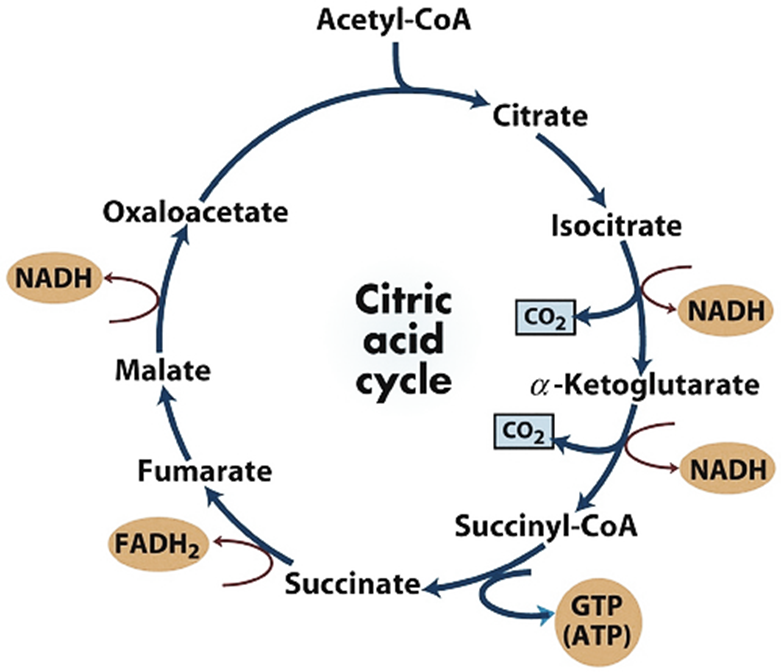
AnswerPyruvic acid is a product of Glycolysis, Malic acid is a product of aerobic respiration in the Kreb's cycle, and Ethyl alcohol$/$ Lactic acid are the products of anaerobic respiration. Phosphoglyceric acid is the first stable product of photosynthesis in $C_3$ plants.
View full question & answer→MCQ 941 Mark
Common enzyme in glycolysis and pentose phosphate pathways is:
MCQ 951 Mark
Before combining with $\text{OAA},$ pyruvic acid is changed into:
AnswerCorrect option: C. Acetyl $\text{CoA}$
View full question & answer→MCQ 961 Mark
Site of respiration in bacteria is:
MCQ 971 Mark
Which of the following is a product of lactic acid fermentation?
MCQ 981 Mark
Which of the following is not true for oxidative phosphorylation?
AnswerCorrect option: C. It uses oxygen as the initial electron donor.
View full question & answer→MCQ 991 Mark
Which is formed along with $\text{ATP}$ in glycolysis:
- ✓
$\text{NADH}$
- B
$\text{NADPH}$
- C
$\text{FAD}$
- D
$\ce{FADH_2}$
AnswerCorrect option: A. $\text{NADH}$
The net yield of the process of glycolysis is $\text{2 ATP}$ molecules and $\text{2 NADH}$ molecules, and $2$ protons for each glucose molecule oxidized to pyruvate.
Four $\text{ATP}$ molecules are produced in the sixth and ninth steps of glycolysis.
Two $\text{ATP}$ molecules are consumed in the first and third steps of glycolysis.
Two molecules of $\text{NADH}$ are formed in step $5$ of glycolysis by the acceptance of $2$ protons and four electrons by two molecules of $\text{NAD+.}$
View full question & answer→MCQ 1001 Mark
How many $\text{ATP}$ molecules are produced by aerobic oxidation of one molecule of glucose?
View full question & answer→MCQ 1011 Mark
The site of glycolysis in a cell is:
MCQ 1021 Mark
Which one of the following describes the spikelet of a cereal or grass plant.
MCQ 1031 Mark
End product of fermentation of sugars is:
- A
- ✓
Alcohol and carbon dioxide
- C
- D
AnswerCorrect option: B. Alcohol and carbon dioxide
View full question & answer→MCQ 1041 Mark
Respiratory quotient of carbohydrates is:
Answer$RQ \ i.e.$ respiratory quotient is $1.$
$RQ =$ volume of $CO_2$ evolved$/$ volume of $O_2$ consumed.
View full question & answer→MCQ 1051 Mark
Phosphoglyceraldehyde and dihydroxy acetone phosphate are:
MCQ 1061 Mark
Krebs cycle is a type of:
MCQ 1071 Mark
Which of the following forms the connecting link between glycolysis and Kreb's cycle?
MCQ 1081 Mark
Cofactors$(s)$ required for the formation of acetyl $\text{COA}$ is$/$are:
AnswerCorrect option: A. $Mg^{2+}$ and $\text{COA}.$
View full question & answer→MCQ 1091 Mark
In Kreb's cycle, citric acid is formed when acetyl $\text{CoA}$ combines with:
View full question & answer→MCQ 1101 Mark
The energy$-$releasing process in which the substrate is oxidised without an external electron acceptor is called:
View full question & answer→MCQ 1111 Mark
The organism in which the Krebs cycle does occur in mitochondria is:
MCQ 1121 Mark
$\text{ATP}$ is injected in cyanide poisoning because it is:
- ✓
Necessary for cellular functions.
- B
Necessary for $Na^+ -K^+$ pump.
- C
$Na^+ -K^+$ pump operates at the cell membranes.
- D
$\text{ATP}$ breaks down cyanide.
AnswerCorrect option: A. Necessary for cellular functions.
View full question & answer→MCQ 1131 Mark
In glycolysis, during oxidation electrons are removed by.
AnswerCorrect option: B. Glyceraldehyde$-3-$phosphate.
View full question & answer→MCQ 1141 Mark
Which of the following is an important intermediate found in all the types of respiration?
MCQ 1151 Mark
Aerobic respiratory pathway is appropriately termed:
MCQ 1161 Mark
Which of the following is widely accepted to respire in absence of oxygen?
AnswerYeast can respire both aerobically as well as anaerobically. Under anaerobic conditions yeast carries out alcoholic fermentation.
Thus, it yields carbon dioxide as a product after this process.
View full question & answer→MCQ 1171 Mark
Pyruvic acid, the key product of glycolysis can have many metabolic fates. Under aerobic condition it forms:
AnswerCorrect option: C. Acetyl $\ce{CoA + CO_2}$.
Pyruvic acid undergoes dehydrogenation and the reaction produces Acetyl $\ce{CoA, CO_2}$ and $\ce{NAD_H}$.
View full question & answer→MCQ 1181 Mark
Chemiosmotic theory of $\text{ATP}$ synthesis in the chloroplasts and mitochondria is based on:
View full question & answer→MCQ 1191 Mark
Herkogamy is a contrivance for:
MCQ 1201 Mark
Chemiosmotic theory of $\text{ATP}$ synthesis in the chloroplast and mitochondria is based on.
View full question & answer→MCQ 1211 Mark
How much energy is produced after respiration of one molecule of glucose?
- A
$576\ kcal.$
- ✓
$674\ kcal.$
- C
$768\ kcal.$
- D
$467\ kcal.$
AnswerCorrect option: B. $674\ kcal.$
View full question & answer→MCQ 1221 Mark
What is the end product of glycolysis of a glucose molecule.
- A
Pyruvate and $\text{ATP}.$
- B
- ✓
Lactic acid and $\text{ATP}.$
- D
Fructose $1, 6-$diphosphate.
AnswerCorrect option: C. Lactic acid and $\text{ATP}.$
View full question & answer→MCQ 1231 Mark
Amino acids are mostly synthesized from.
- A
- B
- C
- ✓
$A-$ketoglutaric acid.
AnswerCorrect option: D. $A-$ketoglutaric acid.
View full question & answer→MCQ 1241 Mark
Out of $36 \ \text{ATP}$ molecules produced per glucose molecule during respiration.
- A
$2$ are produced outside glycolysis and $34$ during respiratory chain.
- ✓
$2$ are produced outside mitochondria and $34$ inside mitochondria.
- C
$2$ during glycolysis and $34$ during Krebs cycle.
- D
All are formed inside mitochondria.
AnswerCorrect option: B. $2$ are produced outside mitochondria and $34$ inside mitochondria.
View full question & answer→MCQ 1251 Mark
Final electron acceptor in oxidative phosphorylation is:
MCQ 1261 Mark
End product of glycolysis is:
- A
Acetyl $\ce{Co-A}.$
- ✓
- C
Glucose $1-$phosphate.
- D
Fructose $1-$phosphate.
View full question & answer→MCQ 1271 Mark
Choose the correct answers from the alternatives given: In certain organisms and under certain conditions, which of the following can be used as an energy alternative to glucose:
MCQ 1281 Mark
Pyruvic acid enters $\text{TCA}$ cycle in the form of:
- ✓
Acetyl $\text{CoA}.$
- B
Succinyl $\text{CoA}.$
- C
- D
AnswerCorrect option: A. Acetyl $\text{CoA}.$
View full question & answer→MCQ 1291 Mark
Complete the reaction. $......... + O_2 \rightarrow \ce{CO_2} + ......... +$ Energy.
- A
$\ce{C_6H_{12}O_6, 2H_2O}$
- B
$\ce{C_{12}H_{22}O_{11}$, $6H_2O} $
- ✓
$\ce{C_6H_{12}O_6$, $6H_2O}$
- D
$\ce{C_{12}H_{22}O_{11}$, $11H_2O}$
AnswerCorrect option: C. $\ce{C_6H_{12}O_6$, $6H_2O}$
$\ce{C_6H_{12}O_6, 6H_2O →6CO_2 + 6H_2O +}$ Energy
View full question & answer→MCQ 1301 Mark
Oxidative phosphorylation is production of.
- A
$\text{ATP}$ in photosynthesis.
- B
$\text{NADPH}$ in photosynthesis.
- ✓
$\text{ATP}$ in respiration.
- D
$\text{NADH}$ in respiration.
AnswerCorrect option: C. $\text{ATP}$ in respiration.
View full question & answer→MCQ 1311 Mark
In animal cells, the first stage of glucose break down is:
- A
- ✓
- C
Oxidative phosphorylation.
- D
$\text{ETC}$
View full question & answer→MCQ 1321 Mark
One molecule of glucose yields $........\text{ ATP}$ molecules in aerobic respiration.
AnswerOne molecule of glucose yields $38$ molecules of $\text{ATP}$ during aerobic respiration.
View full question & answer→MCQ 1331 Mark
$\text{EMP}$ can produce a total of:
- A
$\text{6 ATP}$
- ✓
$\text{8 ATP}$
- C
$\text{24 ATP}$
- D
$\text{38 ATP}$
AnswerCorrect option: B. $\text{8 ATP}$
View full question & answer→MCQ 1341 Mark
In order for glucose to be used as an energy source, it is necessary that:
AnswerCorrect option: C. $2$ molecules of $\text{ATP}$ be invested in the system
View full question & answer→MCQ 1351 Mark
Enzyme helping in oxidative decarboxylation of pyruvic acid is:
MCQ 1361 Mark
Life without air would be.
- A
- B
Free from oxidative damage.
- C
- ✓
View full question & answer→MCQ 1371 Mark
Kerbs cycle $..........?$
- ✓
Liberates a minor part of energy during respiration
- B
Is operative in photorespiration
- C
Reactions are independent of oxygen supply
- D
Is a like between carbohydrate and nitrogen metabolism
AnswerCorrect option: A. Liberates a minor part of energy during respiration
View full question & answer→MCQ 1381 Mark
Which of the following is utilized first in respiration?
MCQ 1391 Mark
Connecting link between glycolysis and Krebs cycle is$/$ before entering Krebs cycle pyruvate is changed to:
AnswerCorrect option: D. Acetyl $\text{CoA}.$
View full question & answer→MCQ 1401 Mark
Which of the following processes make direct use of oxygen?
MCQ 1411 Mark
Connecting link between glycolysis and Krebs cycle is $($before entering Krebs cycle pyruvate changed to$)$
- A
- B
$\text{PEP.}$
- C
- ✓
Acetyl $\text{Co-A.}$
AnswerCorrect option: D. Acetyl $\text{Co-A.}$
View full question & answer→MCQ 1421 Mark
The final electron acceptor in electron transport chain is:
- A
Cytochrome $C$
- B
$\text{FADH}$
- C
$\text{NADH}$
- ✓
AnswerOxygen acts as the final electron acceptor in electron transport chain.
View full question & answer→MCQ 1431 Mark
$\text{TCA}$ cycle was discovered by:
View full question & answer→MCQ 1441 Mark
View full question & answer→MCQ 1451 Mark
Terminal cytochrome of respiratory chain which donates electrons to oxygen is:
- A
$\text{cyt. b}$
- B
$\text{cyt. c}$
- C
$\ce{cyt. a_1}$
- ✓
$\ce{cyt.-a_3}$
AnswerCorrect option: D. $\ce{cyt.-a_3}$
View full question & answer→MCQ 1461 Mark
Production of alcohol by yeast fermentation is:
MCQ 1471 Mark
The end products of fermentation when sugar is used as raw materials is$/$ are:
- ✓
Alcohol and $CO_2$.
- B
- C
$CO_2$.
- D
AnswerCorrect option: A. Alcohol and $CO_2$.
View full question & answer→MCQ 1481 Mark
Which of the following exhibits the highest rate of respiration?
MCQ 1491 Mark
Number of oxygen molecules required for glycolytic breakdown of one glucose molecule is:
MCQ 1501 Mark
Link between glycolysis, Krebs cycle and poxidation of fatty acid or carbohydrate and fat metabolism is:
AnswerCorrect option: D. Acetyl $\ce{Co-A}.$
View full question & answer→MCQ 1511 Mark
Which of the following is produced by fermentation?
MCQ 1521 Mark
Respiratory substrate yielding maximum number of $\text{ATP}$ molecule is:
View full question & answer→MCQ 1531 Mark
$R.Q$ is ratio of:
- A
$CO_2$ produced to substrate consumed.
- ✓
$CO_2$ produced to $O_2$ consumed.
- C
Oxygen consumed to $CO_2$ produced.
- D
Oxygen consumed to water produced.
AnswerCorrect option: B. $CO_2$ produced to $O_2$ consumed.
View full question & answer→MCQ 1541 Mark
Which is the end product of glycolysis?
MCQ 1551 Mark
Most common mineral activator of glycolytic enzymes is:
MCQ 1561 Mark
During which stage, in the complete oxidation of glucose are the greatest number of $\text{ATP}$ molecules formed from $\text{ADP}.$
AnswerCorrect option: D. Electron transport chain.
View full question & answer→