Question 15 Marks
Find the eccentricity, coordinates of foci, length of the latus-rectum of the following ellipse:$9\text{x}^2+25\text{y}^2=225$
Answer$\Rightarrow\frac{\text{x}^2}{25}+\frac{\text{y}^2}{9}=1$
This is of form $\frac{\text{x}^2}{\text{a}^2}+\frac{\text{y}^2}{\text{b}^2}=1,$ where $\text{a}^2=25$ and $\text{b}^2=9,\text{ i}.\text{e}.\text{ a}=5$ and $\text{b}=3.$
Clearly, a > b
Now, $\text{e}=\sqrt{1-\frac{\text{a}^2}{\text{b}^2}}$
$\Rightarrow\text{e}=\sqrt{1-\frac{9}{25}}$
$\Rightarrow\text{e}=\sqrt{\frac{16}{25}}$
$\Rightarrow\text{e}=\frac{4}{{5}}$
Coordinates of the foci $=(\pm, 0)=(\pm4, 0)$
Length of the latus rectum $=\frac{2\text{a}^2}{\text{b}}$
$\\=\frac{2\times9}{5}$
$=\frac{{18}}{5}$
View full question & answer→Question 25 Marks
Find the equation to the ellipse in the following case:
eccentricity $\text{e}=\frac{1}{2}$ and semi-major axis $= 4$
AnswerLet the equation of the required ellipse be
$\frac{\text{x}^2}{\text{a}^2}+\frac{\text{y}^2}{\text{b}^2}=1\ \dots(\text{i})$
Then, semi-major axis $= a$
$\therefore\ \text{a}=4$ $\big[\because$ semi-major axis = 4$\big]$
$\Rightarrow\text{b}^2=16$
Now, $\text{b}^2=\text{a}^2\big(1-\text{e}^2\big)$
$\Rightarrow{\text{b}^2}=16\Big[1-\big(\frac{1}{2}\big)^2\Big]$ $\big[\because\text{e}=\frac{1}{2}\big]$
$\Rightarrow{\text{b}^2}=16\Big[1-\frac{1}{4}\Big]$
$\Rightarrow\text{b}^2=16\times\frac{3}{4}$
$\Rightarrow\text{b}^2=12$
Substituting the value of $a^2$ and $b^2$ in $(i),$ we get
$\frac{\text{x}^2}{16}+\frac{\text{y}^2}{12}=1$
$\Rightarrow3\text{x}^2+4\text{y}^2=48$
This is the equation of the required ellipse.
View full question & answer→Question 35 Marks
Find the equation of the ellips whose focus is in the following case:focus is (1, 2), directricx is 3x + 4y - 5 = 0 and $\text{e}=\frac{1}{2}.$
AnswerLet P (x, y) be a point on the ellipse. Then, by definition SP - e PM
Here $\text{e}-\frac{1}{2},$ coordinates of S are (1, 2) and the eqation of directrix is 3x + 4y - 5 - 0
$\therefore\text{ SP}-\frac{1}{2}\text{ pm}$
$\Rightarrow\text{SP}^2-\frac{1}{4}(\text{PM})^2$
$\Rightarrow4\text{SP}^2-\text{PM}^2$
$\Rightarrow4\big[(\text{x}-1)^2+(\text{y}-2)^2\big]-\bigg[\frac{3\text{x}+4\text{y}-5}{\sqrt{3^2+4^2}}\bigg]^2$
$\Rightarrow\big[\text{x}^2+1-2\text{x}+\text{y}^2+4-4\text{y}\big]-\frac{(3\text{x}+4\text{y}-5)^2}{25}$
$\Rightarrow100\big[\text{x}^2+\text{y}^2-2\text{x}-4\text{y}+5\big]-(3\text{x}+4\text{y}-5)^2$
$\Rightarrow100\text{x}^2+100\text{y}-200\text{x}-400\text{y}+500=(3\text{x}+4\text{y}-5)^2$
$\Rightarrow10\text{x}^2+100\text{y}-200\text{x}-400\text{y}+500\\=(3\text{x})^2+(4\text{y})^2+(-5)^2+2\times3\text{x}\times4\text{y}\times(-5)+2\times(-5)\times3\text{x}$
$\Rightarrow100\text{x}^2+100\text{y}^2-200\text{x}-400\text{y}+500\\-9\text{x}^2+16\text{y}^2+25+24\text{xy}-40\text{y}-30\text{x}$
$\Rightarrow100\text{x}^2-9\text{x}^2+100\text{y}^2-16\text{y}^2-24\text{xy}-200\\+30\text{x}-400\text{y}+40\text{y}+500-25=0$
$\Rightarrow91\text{x}^2+84\text{y}^2-24\text{xy}-170\text{x}-360\text{y}+475-0$
This is the required equation of the ellipse.
View full question & answer→Question 45 Marks
Find the eccentricity, coordinates of foci, length of the latus-rectum of the following ellipse:
$5\text{x}^2+4\text{y}^2=1$
Answer$\Rightarrow\frac{\text{x}^2}{\frac{1}{5}}+\frac{\text{y}^2}{\frac{1}{4}}=1$
This is of form $\frac{\text{x}^2}{\text{a}^2}+\frac{\text{y}^2}{\text{b}^2}=1,$ where $\text{a}^2=\frac{1}{5}$ and $\text{b}^2=\frac{1}{4},\text{ i}.\text{e}.\text{ a}=\frac{1}{\sqrt{5}}$and $\text{b}=\frac{1}{2}.$
Clearly b > a
Now, $\text{e}=\sqrt{1-\frac{\text{a}^2}{\text{b}^2}}$
$\Rightarrow\text{e}=\sqrt{1-\frac{\frac{1}{5}}{\frac{1}{4}}}$
$\Rightarrow\text{e}=\sqrt{1-\frac{4}{5}}$
$\Rightarrow\text{e}=\frac{1}{\sqrt{5}}$
Coordinates of the foci $=(0, \pm\text{be})=\big (0, \pm\frac{1}{2\sqrt{5}}\big)$
Length of the latus rectum $=\frac{2\text{a}^2}{\text{b}}$
$\\=\frac{2\times\frac{1}{5}}{\frac{1}{2}}$
$=\frac{4}{5}$
View full question & answer→Question 55 Marks
Find the eccentricity, coordinates of foci, length of the latus-rectum of the following ellipse:$25\text{x}^2+16\text{y}^2=1600.$
Answer$\Rightarrow\frac{\text{x}^2}{64}+\frac{\text{y}^2}{100}=1$
This is of form $\frac{\text{x}^2}{\text{a}^2}+\frac{\text{y}^2}{\text{b}^2}=1,$ where $\text{a}^2=64$ and $\text{b}^2=100,$ i.e. $\text{ a}=8$ and $\text{b}=10.$
Clearly, b > a
Now, $\text{e}=\sqrt{1-\frac{\text{a}^2}{\text{b}^2}}$
$\Rightarrow\text{e}=\sqrt{1-\frac{64}{100}}$
$\Rightarrow\text{e}=\sqrt{1-\frac{36}{100}}$
$\Rightarrow\text{e}=\frac{6}{{10}}$ or $\frac{3}{5}$
Coordinates of the foci $=(0, \pm 6)$
Length of the latus rectum= $\frac{2\text{a}^2}{\text{b}}$
$\\=\frac{2\times64}{10}$
$=\frac{{64}}{5}$
View full question & answer→Question 65 Marks
Find the eccentricity, coordinates of foci, length of the latus-rectum of the following ellipse:
$4\text{x}^2+3\text{y}^2=1$
Answer$\Rightarrow\frac{\text{x}^2}{\frac{1}{4}}+\frac{\text{y}^2}{\frac{1}{3}}=1$
This is of form $\frac{\text{x}^2}{\text{a}^2}+\frac{\text{y}^2}{\text{b}^2}=1,$ where $\text{a}^2=\frac{1}{4}$ and $\text{b}^2=\frac{1}{3},\text{ i}.\text{e}.\text{ a}=\frac{1}{{2}}$ and $\text{b}=\frac{1}{\sqrt{3}}.$
Clearly b > a
Now, $\text{e}=\sqrt{1-\frac{\text{a}^2}{\text{b}^2}}$
$\Rightarrow\text{e}=\sqrt{1-\frac{\frac{1}{4}}{\frac{1}{3}}}$
$\Rightarrow\text{e}=\sqrt{1-\frac{3}{4}}$
$\Rightarrow\text{e}=\frac{1}{{2}}$
Coordinates of the foci $=(0, \pm\text{be})=\big (0, \pm\frac{1}{2\sqrt{3}}\big)$
Length of the latus rectum= $\frac{2\text{a}^2}{\text{b}}$
$\\=\frac{2\times\frac{1}{4}}{\frac{1}{\sqrt{3}}}\\=\frac{\sqrt{3}}{2}$
View full question & answer→Question 75 Marks
A rod of length 12cm moves with its ends always touching the coordinate axes. Determine the equation of the locus of a point P on the rod, which is 3 cm from the end in contact with x-axis.
Answer
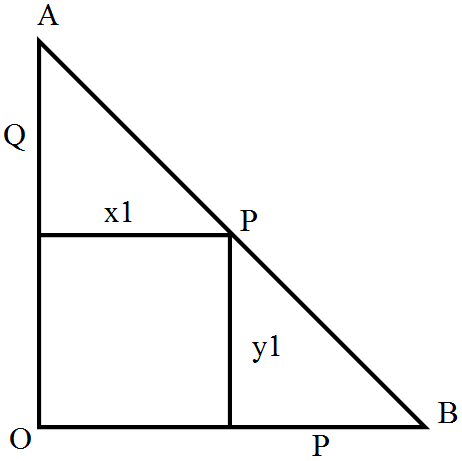 Using similar triangle principle, we can write
$\frac{\text{Q}}{9}=\frac{\text{y}_1}{3}$
$\text{Q}=3\text{y}_1$
Similarly, $\text{p}=\frac{\text{x}}{3}$
Point $\text{P}(\text{x,y})$
So $\text{OB}=\text{x}+\frac{\text{x}}{3}$
$\text{OA}=\text{y}+3\text{y}=4\text{y}$
Using Pythageorus theorem, we get
$(\text{4y})^2+\Big(\frac{4\text{x}}{3}\Big)^2=12^2$
$\frac{\text{y}^2}{9}+\frac{\text{x}^2}{81}=1$ is the equation of ellipse. View full question & answer→Question 85 Marks
Find the equation of an ellipse whose vertices are $(0,\pm10)$ and eccentricity $\text{e}=\frac{4}{5}.$
AnswerLet the equation of the ellipse be$\frac{\text{x}^2}{\text{b}^2}+\frac{\text{y}^2}{\text{b}^2}=1\ ,\dots(\text{i})$
The coordinates of vertices are $(0,\pm\text{b})$ i.e., $(0,\pm10).$
$\therefore\ \text{b}=10$
$\Rightarrow\text{b}^2=100$
Now, $\text{a}^2=\text{b}^2\big(1-\text{e}^2\big)$
$\Rightarrow\text{a}^2=100\Big[1-\Big(\frac{4}{5}\Big)^2\Big]$
$\Rightarrow\text{a}^2=100\Big[1-\frac{16}{25}\Big]$
$\Rightarrow\text{a}^2=100\Big[\frac{9}{25}\Big]$
$\Rightarrow\text{a}^2=4\times9=36$
Putting $a^2 = 36$ and $b^2 = 100$ in equation $(i),$ we get$\frac{\text{x}^2}{36}+\frac{\text{y}^2}{100}=1$
$\Rightarrow\frac{100\text{x}^2+36\text{y}^2}{3600}=1$
$\Rightarrow100\text{x}^2+36\text{y}^2=3600$
this is the equation of the required ellipse.
View full question & answer→Question 95 Marks
Find the eccentricity, coordinates of foci, length of the latus-rectum of the following ellipes:
$4\text{x}^2+9\text{y}^2=1$
Answer$\Rightarrow\frac{\text{x}^2}{\frac{1}{4}}+\frac{\text{y}^2}{\frac{1}{9}}=1$This is of the form $\frac{\text{x}^2}{\text{a}^2}+\frac{\text{y}^2}{\text{b}^2}=1,$ where $\text{a}^2=\frac{1}{4}$ and $\text{b}^2=\frac{1}{9},\text{ i}.\text{e}.\text{a}=\frac{1}{2}$and $\text{b}=\frac{1}{3}.$
Clearly a > b
Now, $\text{e}=\sqrt{1-\frac{\text{b}^2}{\text{a}^2}}$
$\Rightarrow\text{e}=\sqrt{1-\frac{\frac{1}{9}}{\frac{1}{4}}}$
$\Rightarrow\text{e}=\sqrt{1-\frac{4}{9}}$
$\Rightarrow\text{e}=\frac{\sqrt{5}}{3}$
Coordinates of the foci $=(\pm\text{ae, 0})=\Big(\pm\frac{\sqrt{5}}{6},0\Big)$
Length of the latus rectum $=\frac{2\text{b}^2}{\text{a}}$
$=\frac{2\times\frac{1}{9}}{\frac{1}{2}}$
$=\frac{4}{9}$
View full question & answer→Question 105 Marks
Find the equation to the ellipse in the following case:Foci $(\pm3, 0), a = 4$
AnswerLet the equation of the required ellipse be$\frac{\text{x}^2}{\text{a}^2}+\frac{\text{y}^2}{\text{b}^2}=1\ \dots(\text{i})$
we have, Length of major axis $= 16\text{a}=4$
$\Rightarrow\text{a}^2=16$
and, the coordinates of foci are $(\pm3, 0)$
$\therefore\ \text{ae}=3$
$\Rightarrow4\times\text{e}=3$
$\Rightarrow\text{e}=\frac{3}{4}$
Now, $\text{b}^2=\text{a}^2(1-\text{e}^2)$
$=4^2\Big[1-\Big(\frac{3}{4}\Big)^2\Big]$
$=16\times\Big(1-\frac{9}{16}\Big)$
$=16\times\frac{7}{16}$
$=7$ Substituting the values of $a^2$ and $d^2$ in $(i),$ we get$\frac{\text{x}^2}{16}+\frac{\text{y}^2}{7}=1$
This is the equation of the required ellipse.
View full question & answer→Question 115 Marks
Find the equation to the ellipse in the following case:
The ellipse passes through $(1, 4)$ and $(-6, 1).$
AnswerLet the equation of the required ellipse be$\frac{\text{x}^2}{\text{a}^2}+\frac{\text{y}^2}{\text{b}^2}=1\ \dots(\text{i})$
Since the ellipse passes through
$(1, 4)$ and $(-6, 1).$
$\therefore\ \frac{(1)^2}{\text{a}^2}+\frac{(4)^2}{\text{b}^2}=1$
$\Rightarrow\frac{1}{\text{a}^2}+\frac{16}{\text{b}^2}=1$
$\Rightarrow\text{b}^2+16\text{a}^2=\text{a}^2\text{b}^2\ \dots(\text{ii})$
and $\frac{(-6)^2}{\text{a}^2}+\frac{(1)^2}{\text{b}^2}=1$
$\Rightarrow\frac{36}{\text{a}^2}+\frac{1}{\text{b}^2}=1$
$\Rightarrow\frac{36}{\text{a}^2}+\frac{1}{\text{b}^2}=1$
$\Rightarrow36\text{b}^2+\text{a}^2=\text{a}^2\text{b}^2\ \dots\text{(iii)}$
Multipliying equation $(iii)$ by $16$, we get
$576\text{b}^2+16\text{a}^2=16\text{a}^2\text{b}^2\ \dots(\text{iv})$
Substituting equation $(ii)$ from eqation $(iv),$ we get
$576\text{b}^2-\text{b}^2=16\text{a}^2\text{b}^2-\text{a}^2\text{b}^2$
$\Rightarrow575\text{b}^2=15\text{a}^2\text{b}^2$
$\Rightarrow575=15\text{a}^2$
$\Rightarrow\text{a}^2=\frac{575}{15}-\frac{115}{3}$
Putting $\text{a}^2=\frac{115}{3}$ in equation (ii), we get
$\text{b}^2+16\times\frac{115}{3}-\frac{115}{3}\times\text{b}^2$
$\Rightarrow\text{b}^2-\frac{115}{3}\text{b}^2=-16\times\frac{115}{3}$
$\Rightarrow\frac{3\text{b}^2-115\text{b}^2}{3}=-\frac{16\times115}{3}$
$\Rightarrow-112\text{b}^2=-16\times115$
$\Rightarrow\text{b}^2=\frac{16\times115}{112}$
Substututing the value of $a^2$ and $b^2$ in $(i),$ we get
$\frac{\frac{\text{x}^2}{115}}{3}+\frac{\frac{\text{y}^2}{115}}{7}=1$
$\Rightarrow\frac{3\text{x}^2+7\text{y}^2}{115}=1$
$\Rightarrow3\text{x}^2+7\text{y}^2=115$
This is the required equation of the ellipse.
View full question & answer→Question 125 Marks
Find the equation of the ellipse (referred to its axes as the axes of x and y respectively) which passes through the point (-3, 1) and eccentricity $\sqrt\frac{2}{5}.$
AnswerLet the equation of the required ellipse be$\frac{\text{x}^2}{\text{a}^2}+\frac{\text{y}^2}{\text{b}^2}=1\ \dots(\text{i})$
$\therefore\text{ e}=\sqrt{1-\frac{\text{b}^2}{\text{a}^2}}$
$\Rightarrow\sqrt\frac{2}{5}=\sqrt{1-\frac{\text{b}^2}{\text{a}^2}}$ $\bigg[\because\text{eccentricity}=\sqrt{\frac{2}{5}}\bigg]$
$\Rightarrow\sqrt\frac{2}{5}=1-\frac{\text{b}^2}{\text{a}^2}$
$\Rightarrow\frac{\text{b}^2}{\text{a}^2}=1-\frac{2}{5}$
$\Rightarrow\frac{\text{b}^2}{\text{a}^2}=\frac{3}{5}$
$\Rightarrow5\text{b}^2=3\text{a}^2$
$\Rightarrow\text{b}^2=\frac{3\text{a}^2}{5}\ \dots(\text{ii})$
Putting the value of $\text{b}^2=\frac{3\text{a}^2}{5}$in equation (ii), we get
$\frac{9}{\text{a}^2}+\frac{1}{\frac{3\text{a}^2}{5}}=1$
$\Rightarrow\frac{9}{\text{a}^2}+\frac{5}{3\text{a}^2}=1$
$\Rightarrow\frac{1}{\text{a}^2}\big[9+\frac{5}{3}\big]=1$
$\Rightarrow9+\frac{5}{3}=\text{a}^2$
$\Rightarrow\text{a}^2=\frac{32}{3}\ \dots(\text{iii})$
Putting $\text{a}^2=\frac{32}{3}$ in equation (ii), we get
$\text{b}^2=\frac{3}{5}\times\frac{32}{3}=\frac{32}{5}\ \dots(\text{iv})$
$\therefore$ The required equation of ellipse is
$\frac{\text{x}^2}{\frac{32}{3}}+\frac{\text{y}^2}{\frac{32}{5}}=1$
$\Rightarrow\frac{3\text{x}^2}{32}+\frac{5\text{y}^2}{32}=1$
$\Rightarrow3\text{x}^2+5\text{y}^2=32.$
This is the required equation of ellipse.
View full question & answer→Question 135 Marks
Find the centre, the lengths of the axes, eccentricity, foci of the following ellipse:$\text{x}^2+4\text{y}^2-2\text{x}=0$
AnswerWe have,$\text{x}^2+4\text{y}^2-2\text{x}=0$
$\Rightarrow\text{x}^2-2\text{x}+4\text{y}^2=0$
$\Rightarrow\Big(\text{x}^2-2\text{x}+1^2-1^2\Big)+4\text{y}^2=0$
$\Rightarrow\big(\text{x}-1\big)^2-1+4\text{y}^2=0$
$\Rightarrow\big(\text{x}-1\big)^2+4\text{y}^2=1$
$\Rightarrow\frac{\big(\text{x}-1\big)^2}{1}+\frac{\text{y}^2}{\frac{1}{4}}=1$
$\Rightarrow\frac{\big(\text{x}-1\big)^2}{1^2}+\frac{\text{y}^2}{\Big(\frac{1}{2}\Big)^2}=1\ \dots(\text{i})$
$\therefore\ $The coordinates of centre of the ellipse are (1, 0).
Shifting the origin at (1, 0) without rotating the coordinate axes and denoting the new coordinates with respect to the new axes by x and y, we havex = x + 1 and y = y $\dots(\text{ii})$
using these relations, equation (i) reduces to
$\Rightarrow\frac{\text{x}^2}{1^2}+\frac{\text{y}^2}{\Big(\frac{1}{2}\Big)^2}=1,$ where $\text{a}=1$ and $\text{b}=\frac{1}{2}$
clearly, a > b. so, the given equation represents an ellipse whose and minor axes are along x and y axes respectively. Length of the axes:Major-axis = $2\times\text{a}=2\times1=2$
and, Minor-axis = $2\times\text{b}=2\times\frac{1}{2}=1$
Eccentricity: The eccentricity e is given by
$\text{e}=\sqrt{1-\frac{\text{b}^2}{\text{a}^2}}$
$=\sqrt{1-\frac{1}{\frac{4}{1}}}$
$=\sqrt{1-\frac{1}{{4}}}$
$=\sqrt{\frac{3}{4}}$
$=\frac{\sqrt{3}}{2}$
foci: The coordinates of the foci with respect to the new axes are given by $\big(\text{x}=\pm\text{ae},\ \text{y}=0\big)$ i.e., $\big(\text{x}=\pm\frac{\sqrt{3}}{2},\ \text{y}=0\big)$
Putting $\text{x}=\pm\frac{\sqrt{3}}{2}$ and $\text{y}=0$ in equation (iii), we get
$\text{x}=\pm\frac{\sqrt{3}}{2}+1$ and $\text{y}=0$
$\text{x}=1\pm\frac{\sqrt{3}}{2}$ and $\text{y}=0$
So, the coordinates of foci with respect to the old axes given by $\Big(1\pm\frac{\sqrt{3}}{2},\ 0\Big).$
View full question & answer→Question 145 Marks
Find the equation of an ellipse, the distance between the foci is 8 units and the distance between the directrices is 18 units.
AnswerThe distance between the foci is 8 units.i. e. 2ae = 8 $\dots(1)$
The distance between the directrices is 18 units.i. e. $\frac{2\text{a}}{\text{e}}=\ 18\dots(2)$
Comparing eqs. (1) and (2), we get:$\text{e}=\frac{8}{2\text{a}}$
Substituting the value of eq. (2), we get:$\frac{2\text{a}}{\frac{8}{2\text{a}}}=18$
$\Rightarrow4\text{a}^2=18\times8$
$\Rightarrow\text{a}^2=36$ or $\text{a}=6$
Now, $2\text{ae}=8$
$\Rightarrow12\text{e}=8$ or $\text{a}^2\big(1-\text{e}^2\big)$
$\Rightarrow\text{b}^2=36\big(1-\frac{4}{9}\big)$
$\Rightarrow\text{b}^2=36\times\frac{5}{9}$
$\Rightarrow\text{b}^2=20$
$\therefore\ \frac{\text{x}^2}{36}+\frac{\text{y}^2}{20}=1$
This is the required equation of ellipse.
View full question & answer→Question 155 Marks
Find the equation of the ellipse in the following case:focus is (-1, 1), directrix is x - y + 3 = 0 and $\text{e}=\frac{1}{2}.$
AnswerLet P(x, y) be a point on the ellipse. Then, by definition SP = e PMHere $\text{e}=\frac{1}{2},$ coordinates of S are (-1, 1) and the equation of directrix is x - y + 3 = 0
$\therefore\text{ SP}=\frac{1}{2}\text{PM}$
$\Rightarrow\text{SP}^2=\frac{1}{4}(\text{PM})^2$
$\Rightarrow4\text{SP}^2=\text{PM}^2$
$\Rightarrow4\big[(\text{x}+1)^2+(\text{y}-1)^2\big]=\bigg[\frac{\text{x}-\text{y}+3}{\sqrt{1^2+(-1)^2}}\bigg]^2$
$\Rightarrow4\big[\text{x}^2++1+2\text{x}+\text{y}^2+1-2\text{y}\big]=\frac{(\text{x}-\text{y}+3)^2}{2}$
$\Rightarrow8\big[\text{x}^2+\text{y}^2+2\text{x}-2\text{y}+2\big]=(\text{x}-\text{y}+3)^2$
$\Rightarrow8\text{x}^2+8\text{y}^2+16\text{x}-16\text{y}+16\\=\text{x}^2+(-\text{y})^2+3^2+2\times(-\text{y})\times3+2\times(\text{x})\times(-\text{y})+2\times3\times\text{x}\\$ $\big[\because(\text{a}+\text{b}+\text{c})^2=\text{a}^2+\text{b}^2+\text{c}^2+2\text{ab}+2\text{bc}+2\text{ca}\big]$
$\Rightarrow8\text{x}^2+8\text{y}^2+16\text{x}-16\text{y}+16=\text{x}^2+\text{y}^2+9-6\text{y}-2\text{xy}+6\text{x}$
$\Rightarrow8\text{x}^2-\text{x}^2+8\text{y}^2-\text{y}^2+2\text{xy}+16\text{x}-6\text{x}-16\text{y}+6\text{y}+16-9=0$
$\Rightarrow7\text{x}^2+7\text{y}^2+2\text{xy}+10\text{x}-10\text{y}+7=0$
This is the required equation of the ellipse.
View full question & answer→Question 165 Marks
Find the equation to the ellipse in the standard form whose minor axis is equal to the distance between foci and whose latus-rectum is $10.$
AnswerThe coordinates of foci are $(\pm\text{ae, 0}).$
$\therefore 2ae = 2b$
$\Rightarrow ae = b$
$\Rightarrow(\text{ae})^2=\text{b}^2\ \dots\text{(i)}$
The length of latus-rectum is 10.
$\Rightarrow\frac{2\text{b}^2}{\text{a}^2}=10$ $\big[\because\ $latus-rectum = $\frac{2\text{b}^2}{\text{a}^2}\ \big]$
$\Rightarrow\text{b}^2=\frac{10\text{a}}{2}$
$\Rightarrow\text{b}^2=5\text{a}\ \dots(\text{ii})$
Now, $\text{b}^2=\text{a}^2(1-\text{e}^2)$
$\Rightarrow\text{b}^2=\text{a}^2-\text{a}^2\text{e}^2$
$\Rightarrow\text{b}^2=\text{a}^2-\text{b}^2$
$\Rightarrow\text{b}^2=\frac{\text{a}^2}{2}$
Substituting $\text{b}^2=\frac{\text{a}^2}{2}$ in equation (ii), we get
$\frac{\text{a}^2}{2}=5\text{a}$
$\Rightarrow\text{a}^2=10\text{a}$
$\Rightarrow\text{a}=10$
$\Rightarrow\text{a}^2=100$
Putting $a^2 = 100$ in $\text{b}^2=\frac{\text{a}^2}{2},$ we get
$\text{b}^2=\frac{100}{2}=50$
$\therefore$ The required equation of ellipse is
$\frac{\text{x}^2}{\text{a}^2}+\frac{\text{y}^2}{\text{b}^2}=1$
$\Rightarrow\frac{\text{x}^2}{100}+\frac{\text{y}^2}{50}=1$
$\Rightarrow\frac{\text{x}^2+2\text{y}^2}{100}=100$
$\Rightarrow\text{x}^2+2\text{y}^2=100$
This is the required equation of the ellipse.
View full question & answer→Question 175 Marks
Find the equation to the ellipse in the following case:Vertices $(\pm5, 0),$ foci $(\pm4, 0)$
AnswerLet the equation of the required ellipse be$\frac{\text{x}^2}{\text{a}^2}+\frac{\text{y}^2}{\text{b}^2}=1\ \dots(\text{i})$
The coordinates of its vertices and foci are $(\pm\text{a}, 0)$ and $(\pm\text{ae}, 0)$ respectively.
$\therefore\ a = 5$ and $ae = 4 \Rightarrow\text{e}=\frac{4}{5}$
Now,$\text{b}^2=\text{a}^2\big(1-\text{e}^2\big)\Rightarrow\text{b}^2=25\Big(1-\frac{16}{25}\Big)=9$
substituting the values of $a^2$ and $d^2$ in $(i),$ we get
$\frac{\text{x}^2}{25}+\frac{\text{y}^2}{9}=1,$ which is the equation of the required ellipse.
View full question & answer→Question 185 Marks
Find the equation of na ellipse whose foci are at $(\pm3,\ 0)$ and which passes through (4, 1).
AnswerLet the equation of the ellipse be $\frac{\text{x}^2}{\text{a}^2}+\frac{\text{y}^2}{\text{b}^2}=1\ \dots(\text{i})$Then ae = 3
Also x = 4 and y = 1 [Ellipse passing through (4, 1)]
Substititing the values of x and y in eq. (i), we get:
$\frac{4^2}{\text{a}^2}+\frac{1^2}{\text{b}^2}=1$
$\Rightarrow\frac{16}{\text{a}^2}+\frac{1}{\text{b}^2}=1$
Now, $\text{b}^2=\text{a}^2(1-\text{e}^2)$
$\Rightarrow\text{b}^2=\text{a}^2-\text{a}^2\text{e}^2$
$\Rightarrow\text{b}^2=\text{a}^2-9$ or $\text{a}^2=\text{b}^2+9\ \dots(\text{ii})$
$\Rightarrow\frac{16}{\text{a}^2}+\frac{1}{\text{b}^2}=1$
$\Rightarrow16\text{b}^2+\text{a}^2+\text{a}^2\text{b}^2$
$\Rightarrow16\text{b}^2+\text{b}^2+9=\text{b}^2\big(\text{b}^2+9\big)$
$\Rightarrow17\text{b}^2+9=\text{b}^4+9\text{b}^2$
$\Rightarrow\text{b}^4-8\text{b}^2-9=0$
$\Rightarrow\big(\text{b}^2-9\big)\big(\text{b}^2+1\big)$
$\Rightarrow\text{b}=\pm3$
Substituting the value of b in eq. (2), we get:
$\text{a}=3\sqrt{2}$
$\therefore\frac{\text{x}^2}{18}+\frac{\text{y}^2}{9}=1$
This is the required equation of the ellipse.
View full question & answer→Question 195 Marks
Find the equation of an ellipse whose axes lie along coordinate axes, which passes through the point (-3, 1) and has eccentricity equal to $\sqrt{\frac{2}{5}}.$
AnswerLet the equation of the required ellipse be$\frac{\text{x}^2}{\text{a}^2}+\frac{\text{y}^2}{\text{b}^2}=1,$ where a > b
$\big[\because\ $axes lie along the coordinates axes $\big]$
Now, $\text{b}^2=\text{a}^2(1-\text{e}^2)$
$\Rightarrow\text{b}^2-\text{a}^2\Bigg[1-\bigg(\sqrt{\frac{2}{5}}\bigg)^2\Bigg]$ $\Big[\because\text{e}=\sqrt{\frac{2}{5}}\ \Big]$
$\Rightarrow\text{b}^2=\text{a}^2\Big[1-\frac{2}{5}\Big]$
$\text{b}^2-\text{a}^2\times\frac{3}{5}$
$\Rightarrow\text{b}^2=\frac{3\text{a}^2}{5}\ \dots(\text{ii})$
The required ellipse passes through (-3, 1)
$\therefore\ \frac{(-3)^2}{\text{a}^2}+\frac{1^2}{\text{b}^2}=1$
$\Rightarrow\frac{9}{\text{a}^2}+\frac{1}{\text{b}^2}=1\ \dots(\text{ii})$
Putting $\text{b}^2=\frac{3\text{a}^2}{5}$ in equation (ii), we get
$\frac{9}{\text{a}^2}+\frac{1}{\frac{3\text{a}^2}{5}}=1$
$\Rightarrow\frac{9}{\text{a}^2}+\frac{5}{3\text{a}^2}=1$
$\Rightarrow\frac{1}{\text{a}^2}\Big[\frac{9}{1}+\frac{5}{3}\Big]=1$
$\Rightarrow\frac{27+5}{3}=\text{a}^2$
Putting $\text{a}^2=\frac{32}{3}$ in equation (ii), we get
$\text{b}^2=\frac{3}{5}\times\frac{32}{3}=\frac{32}{5}$
Substituting $\text{a}^2=\frac{32}{3}$ and $\text{b}^2=\frac{32}{5}$ in equation (i), we get
$\frac{\text{x}^2}{\frac{32}{3}}+\frac{\text{y}^2}{\frac{32}{5}}=1$
$\Rightarrow\frac{3\text{x}^2}{32}+\frac{5\text{y}^2}{32}=1$
$\Rightarrow3\text{x}^2+5\text{y}^2=32$
This is the eqution of the required ellipse.
View full question & answer→Question 205 Marks
Find the equation to the ellipse in the following case:Length of major axis 16 foci $(0, \pm6)$
AnswerLet the equation of the required ellipse be$\frac{\text{x}^2}{\text{a}^2}+\frac{\text{y}^2}{\text{b}^2}=1\ \dots(\text{i})$
we have, Length of major axis = 16$\Rightarrow2\text{a}=16$
$\Rightarrow\text{a}=\frac{16}{2}=8$
$\Rightarrow\text{a}=64$
The coordinates of foci are $(0, \pm\text{be}).$
$\therefore\ \text{ae}=6$ $\big[\therefore\ $foci: $(0, \pm6)\ \big]$
$\Rightarrow(\text{be})^2=36$
Now, $\text{a}^2=\text{b}^2(1-\text{e}^2)$
$\Rightarrow\text{a}^2=\text{b}^2-\text{b}^2\text{e}^2$
$\Rightarrow64=\text{b}^2-36$
$\big[\because(\text{be}^2)=36$ and $\text{a}^2=64\big]$
$\Rightarrow64+36=\text{b}^2$
$\Rightarrow\text{b}^2=100$
Substituting the values of $a^2$ and $d^2$ in (i), we get$\frac{\text{x}^2}{64}+\frac{\text{y}^2}{100}=1$
This is the equation of the required ellipse.
View full question & answer→Question 215 Marks
Find the centre, the lengths of the axes, eccentricity, foci of the following ellipse:$4\text{x}^2+\text{y}^2-8\text{x}+2\text{y}+1=0$
AnswerWe have,$4\text{x}^2+\text{y}^2-8\text{x}+2\text{y}+1=0$
$\Rightarrow4\big(\text{x}^2-2\text{x}\big)+\big(\text{y}^2+2\text{y}\big)+1=0$
$\Rightarrow4\Big[\big(\text{x}^2-2\text{x}+1\big)-1\Big]+\Big[\big(\text{y}^2+2\text{y}-1\big)\Big]+1=0$
$\Rightarrow4\Big[\big(\text{x}-1\big)^2-1\Big]+\Big[\big(\text{y}+1\big)^2-1\Big]+1=0$
$\Rightarrow4\big(\text{x}-1\big)^2-4+\big(\text{y}+1\big)^2-1+1=0$
$\Rightarrow4\big(\text{x}-1\big)^2+\big(\text{y}+1\big)^2-4=0$
$\Rightarrow4\big(\text{x}-1\big)^2+\big(\text{y}+1\big)^2=4$
$\Rightarrow\frac{\big(\text{x}-2\big)^2}{1}+\frac{\big(\text{y}+3\big)^2}{4}=1$
$\Rightarrow\frac{\big(\text{x}-1\big)^2}{1^2}+\frac{\big(\text{y}+1\big)^2}{2^2}=1\ \dots(\text{i})$
$\therefore\ $The coordinates of centre of the ellipse are (1, -1).
Shifting the origin at (1, -1) without rotating the coordinate axes and denoting the new coordinates with respect to the new axes by x and y, we have
x = x + 1 and y = y - 1 $\dots(\text{ii})$
using these relations, equation (i) reduces to
$\frac{\text{x}^2}{\text{1}^2}+\frac{\text{y}^2}{\text{2}^2}=1$
This is of the form
$\frac{\text{x}^2}{\text{a}^2}+\frac{\text{y}^2}{\text{b}^2}=1,$ where a = 1 and b = 2
clearly, a > b. so, the given equation represents an ellipse whose and minor axes are along x and y axes respectively.
Length of the axes:
Major-axis = $2\text{a}=2\times2=4$
Minor-axis = $2\text{a}=2\times1=2$
Eccentricity: The eccentricity e is given by
$\text{e}=\sqrt{1-\frac{\text{b}^2}{\text{a}^2}}$
$=\sqrt{1-\frac{1}{{4}}}$
$=\sqrt{\frac{4-1}{4}}$
$=\sqrt{\frac{3}{4}}$
$={\frac{\sqrt3}{2}}.$
foci: The coordinates of the foci with respect to the new axes are given by $\big(\text{x}=0,\ \text{y}=\pm\text{be}\big)$ i.e., $\Big(\text{x}=0,\ \text{y}=\pm\sqrt{3}\Big)$
Putting $\text{x}=0$ and $\text{y}=\pm\sqrt{3}$ in equation (iii), we get
$\text{x}=0+1$ and $\text{y}=\pm\sqrt{3}-1$
$\Rightarrow\text{x}=1$ and $\text{y}=-1\pm\sqrt{3}$
View full question & answer→Question 225 Marks
Find the equation of the ellips whose focus is (1, -2), the directrix $3\text{x}-2\text{y}+5=0$ and eccentricity equal to $\frac{1}{2}$
AnswerLet S(1, -2) be the focus and ZZ' be the directrix.
Let P(x, y) be any point on the ellipse and let PM be the perpendicular from P on the directix.
Then by the definition of an ellipse, we have:
$\text{SP}=\text{e}.\text{PM},\text{where e}=\frac{1}{2}$
$\Rightarrow\text{SP}^2=\text{e}^2.\text{PM}^2$
$\Rightarrow(\text{x}-1)^2+(\text{y}+2)^2=\Big(\frac{1}{2}\Big)^2\times\Bigg|\frac{\text{3}\text{x}-2\text{y}+5}{\sqrt{(3)^2+(-2)^2}}\Bigg|^2$
$\Rightarrow\text{x}^2+1-2\text{x}+\text{y}^2+4+4\text{y}\\=\Big(\frac{1}{4}\Big)\times\bigg|\frac{9\text{x}^2+4\text{y}^2+25-12\text{xy}-20\text{y}+30\text{x}}{13}\bigg|$
$\Rightarrow52\big(\text{x}^2+1-2\text{x}+\text{y}^2+4+4\text{y}\big)\\=9\text{x}^2+4\text{y}^2+25-12\text{xy}-20\text{y}+30\text{x}$
$\Rightarrow52\text{x}^2+52-104\text{x}+52\text{y}^2+208+208\text{y}\\=9\text{x}^2+4\text{y}^2+25-12\text{xy}-20\text{y}+30\text{x}$
$\Rightarrow43\text{x}^2+48\text{y}^2-134\text{x}+228\text{y}+235=0$
This is the equation of the required ellipse.
View full question & answer→Question 235 Marks
Find the centre, the lengths of the axes, eccentricity, foci of the following ellipse:$3\text{x}^2+4\text{y}^2-12\text{x}+8\text{y}+4=0$
AnswerWe have,$3\text{x}^2+4\text{y}^2-12\text{x}+8\text{y}+4=0$
$\Rightarrow3\text{x}^2-12\text{x+4}\text{y}^2-8\text{y}+4=0$
$\Rightarrow3\Big(\text{x}^2-4\text{x}\Big)+4\Big(\text{y}^2-2\text{y}\Big)+4=0$
$\Rightarrow3\Big[\text{x}-2\times\text{x}\times2+2^2-2^2\Big]+4\Big[\text{y}^2-2\text{xy}\times1^2-1^2\Big]+4=0$
$\Rightarrow3\Big[\big(\text{x}-2\big)^2-4\Big]+4\Big[\big(\text{y}+1\big)^2-1\Big]+4=0$
$\Rightarrow3\big(\text{x}-2\big)^2-12+4\big(\text{y}-1\big)^2-4+4=0$
$\Rightarrow3\big(\text{x}-2\big)^2+4\big(\text{y}-1\big)^2-12=0$
$\Rightarrow3\big(\text{x}-2\big)^2+4\big(\text{y}-1\big)^2=12$
$\Rightarrow\frac{3\big(\text{x}-2\big)^2}{12}+\frac{4\big(\text{y}-1\big)^2}{{12}}=1$
$\Rightarrow\frac{\big(\text{x}-2\big)^2}{4}+\frac{\big(\text{y}-1\big)^2}{{3}}=1$
$\Rightarrow\frac{\big(\text{x}-2\big)^2}{2^2}+\frac{\big(\text{y}-1\big)^2}{\big(\sqrt{3}\big)^2}=1\ \dots(\text{i})$
$\therefore\ $The coordinates of centre of the ellipse are (2, -1).
Shifting the origin at (2, -1) without rotating the coordinate axes and denoting the new coordinates with respect to the new axes by x and y, we havex = x + 2 and y = y - 1 $\dots(\text{ii})$
using these relations, equation (i) reduces to
$\frac{\text{x}^2}{2^2}+\frac{\text{y}^2}{\big(\sqrt{3}\big)^2}=1,$ where $\text{a}=2$ and $\text{b}=\sqrt{3}$
clearly, a > b. so, the given equation represents an ellipse whose and minor axes are along x and y axes respectively. Length of the axes:Major-axis = $2\text{a}=2\times2=4$
and, Minor-axis = $2\text{b}=2\times\sqrt{3}=2\sqrt{3}$
Eccentricity: The eccentricity e is given by
$\text{e}=\sqrt{1-\frac{\text{b}^2}{\text{a}^2}}$
$=\sqrt{1-\frac{3}{{4}}}$
$=\sqrt{\frac{1}{4}}$
$=\frac{1}{2}$
foci: The coordinates of the foci with respect to the new axes are given by $\big(\text{x}=\pm\text{ae},\ \text{y}=0\big)$ i.e., $\big(\text{x}=\pm1,\ \text{y}=0\big)$
Putting $\text{x}=\pm\ 1$ and $\text{y}=0$ in equation (iii), we get
$\text{x}=\pm\ 1+2$ and $\text{y}=0+1$
$\Rightarrow\text{x}=2\pm1$ and $\text{y}=1$
So the coordinates of foci with respect to old axes are qiven by $(2\pm1, 1)$ i.e., (3, 1) and (1, 1).
View full question & answer→Question 245 Marks
Find the equation to the ellipse in the following case:
eccentricity $\text{e}=\frac{1}{2}$ and lenght of latus-rectum = 5
AnswerLet the equation of the required ellipse be$\frac{\text{x}^2}{\text{a}^2}+\frac{\text{y}^2}{\text{b}^2}=1\ \dots(\text{i})$
The length of lacus-rectum = 5$\therefore\ \frac{2\text{b}^2}{\text{a}}=5$
$\Rightarrow\text{b}^2=\frac{5\text{a}}{2}\ \dots(\text{ii})$
Now, $\text{b}^2=\text{a}^2\big(1-\text{e}^2\big)$
$\Rightarrow\frac{5\text{a}}{2}=\text{a}^2\Big[1-\big(\frac{2}{3}\big)^2\Big]$ $\big[\because\text{e}=\frac{2}{3}\big]$
$\Rightarrow\frac{5\text{a}}{2}=\text{a}^2\Big[1-\frac{4}{9}\Big]$
$\Rightarrow\frac{5\text{a}}{2}=\text{a}\Big(\frac{5}{9}\Big)$
$\Rightarrow\frac{5}{2}\times\frac{9}{5}=\text{a}$
$\Rightarrow\text{a}=\frac{9}{2}$
$\Rightarrow\text{a}^2=\frac{81}{4}$
Putting $\text{a}=\frac{9}{2}$ in $\text{b}^2\frac{5\text{a}}{2},$ we get
$\text{b}^2=\frac{5}{2}\times\frac{9}{2}$
$\Rightarrow\text{b}^2=\frac{45}{4}$
Substituting $\text{a}^2=\frac{81}{4}$ and $\text{b}^2=\frac{45}{4}$ in equation (i), we get
$\frac{\text{x}^2}{\frac{81}{4}}+\frac{\text{y}^2}{\frac{45}{4}}=1$
$\Rightarrow\frac{4\text{x}^2}{81}=\frac{4\text{y}^2}{45}=1$
$\frac{4\text{x}^2\times5+4\text{y}^2\times9}{405}=1$
$\Rightarrow20\text{x}^2+36\text{y}^2=405$
This is the equation of the required ellipse.
View full question & answer→Question 255 Marks
Find the equation to the ellipse in the following case:Ends of major axis $(0, \pm\sqrt{5}),$ ends of minor axis $(\pm1, 0)$
AnswerLet the equation of the required ellipse be $\frac{\text{x}^2}{\text{a}^2}+\frac{\text{y}^2}{\text{b}^2}=1\ \dots(\text{i})$
The coordinates of its ends of major axis and minor axis are $(0, \pm\text{b}),$ and $(\pm\text{a}, 0)$ respectively.
$\therefore\ \text{b}=\sqrt{5}$ $\big[\because\ $Ends of major axis = $(0, \pm\sqrt{5})$ $\big]$
$\Rightarrow\ \text{a}^2=5$and $\text{b}=1$ $\big[\because\ $Ends of major axis = $(\pm1, 0)$ $\big]$
$\Rightarrow\ \text{b}^2=1$ Substituting the values of $a^2$ and $d^2$ in (i),
we get $\frac{\text{x}^2}{9}+\frac{\text{y}^2}{4}=1$ This is the equation of the required ellipse.
View full question & answer→Question 265 Marks
Find the equation of an ellipse whose eccentricity is $\frac{2}{3},$ the latus-rectum is 5 and the centre is at the origin.
AnswerLet the ellipse be $\frac{\text{x}^2}{\text{a}^2}+\frac{\text{y}^2}{\text{b}^2}=1.\ \dots(\text{i})$$\text{e}=\frac{2}{3}$ and latus rectum $= 5 ($Given$)$
Now, $\frac{2\text{b}^2}{\text{a}}=5$
$\Rightarrow2\text{b}^2=5\text{a}\ \dots(\text{ii})$
$\Rightarrow2\text{a}^2\big(1-\text{e}^2\big)=5\text{a}$ $\Big[\because\ \text{b}^2=\text{a}^2\big(1-\text{e}^2\big)\Big]$
$\Rightarrow2\text{a}^2\Big[1-\frac{4}{9}\Big]=5\text{a}$
$\Rightarrow2\text{a}^2\times\frac{5}{9}=5\text{a}$
$\Rightarrow10\text{a}^2=45\text{a}$
$\Rightarrow\text{a}=\frac{9}{2}$
Substituting the value of a in eq. (ii), we get:
$2\text{b}^2=5\times\frac{9}{2}$
$\Rightarrow\text{b}^2=\frac{45}{4}$
Substituting the value of $a^2$ and $b^2$ in eq. (i), we get
$\frac{\text{x}^2}{\frac{81}{4}}+\frac{\text{y}^2}{\frac{45}{4}}=1$
$\Rightarrow\frac{4\text{x}^2}{81}+\frac{4\text{y}^2}{45}=1$
This is the required equation of the ellipse.
View full question & answer→Question 275 Marks
Find the equation of the ellipse in the following case:focus is (0, 1), directrix is x + y = 0 and $\text{e}=\frac{1}{2}.$
AnswerLet P(x, y) be a point on the ellips. Then, by definition SP - ePMHere $\text{e}-\frac{1}{2}.$ coordinates of S are (0, 1) and the euation of the directrix is x + y - 0.
$\therefore\text{SP}=\frac{1}{2}\text{PM}$
$\Rightarrow\text{SP}^2=\frac{1}{2}(\text{PM})^2$
$\Rightarrow4\text{SP}^2-(\text{PM})^2$
$\Rightarrow4\big[(\text{x-0})^2+(\text{y-1})^2\big]-\bigg[\frac{\text{x+y}}{\sqrt{1^2+1^2}}\bigg]$
$\Rightarrow4\big[\text{x}^2+\text{y}^2+1-2\text{y}\big]=\frac{(\text{x+h})^2}{2}$
$\Rightarrow4\times2\big[\text{x}^2+\text{y}^2-2\text{y}+1\big]=\text{x}^2+\text{y}^2+2\text{xy}$
$\Rightarrow8\text{x}^2+8\text{y}^2-16\text{y}+8=\text{x}^2+ \text{y}^2+2\text{xy}$
$\Rightarrow8\text{x}^2-\text{x}^2+8\text{y}^2-2\text{xy}-16\text{y}+8=0$
$\Rightarrow7\text{x}^2+7\text{y}^2-2\text{xy}-16\text{y}+8-0$
This is the required equation of the ellipse.
View full question & answer→Question 285 Marks
Find the equation of an ellipse whose axes lie along coordinate axes and which passes through (4, 3) and (-1, 4).
AnswerLet the equation of the required ellipse be$\frac{\text{x}^2}{\text{a}^2}+\frac{\text{y}^2}{\text{b}^2}=1,$ where a > b $\dots(\text{i})$
The required ellipse passes through (4, 3) and (-1, 4)$\therefore\ \frac{(4)^2}{\text{a}^2}+\frac{(3)^2}{\text{b}^2}=1$
$\Rightarrow\frac{16}{\text{a}^2}+\frac{9}{\text{b}^2}=1$
$\Rightarrow16\text{b}^2+9\text{a}^2=\text{a}^2\text{b}^2\ \dots(\text{ii})$
and $\frac{(-1)^2}{\text{a}^2}+\frac{(4)^2}{\text{b}^2}=1$
$\Rightarrow\frac{1}{\text{a}^2}\times\frac{16}{\text{b}^2}=1$
$\Rightarrow\text{b}^2+16\text{a}^2=\text{a}^2\text{b}^2\ \dots(\text{iii})$
Multiplying equation (iii) by 16, we get$16\text{b}^2+256\text{a}^2=16\text{a}^2\text{b}^2\ \dots(\text{iv})$
Substracting equation (ii) from equation (iv), we get$256\text{a}^2-9\text{a}^2-16\text{a}^2\text{b}^2-\text{a}^2\text{b}^2$
$\Rightarrow247\text{a}^2=15\text{a}^2\text{b}^2$
$\Rightarrow\frac{247}{15}-\text{b}^2$
$\Rightarrow\text{b}^2-\frac{247}{15}$
Putting $\text{b}^2-\frac{247}{15}$ in equation (iii) we get
$\frac{247}{15}+16\text{a}^2=\text{a}^2\times\frac{247}{15}$
$\Rightarrow16\text{a}^2-\frac{247\text{a}^2}{15}=\frac{-247}{15}$
$\Rightarrow\frac{240\text{a}^2-247\text{a}^2}{15}=\frac{-247}{15}$
$\Rightarrow-7\text{a}^2=-247$
$\Rightarrow\text{a}^2=\frac{247}{7}$
Putting $\text{a}^2=\frac{247}{7}$ and $\text{b}^2=\frac{247}{15}$ in equation equation (i), we get
$\frac{\text{x}^2}{\frac{247}{7}}+\frac{\text{y}^2}{\frac{247}{15}}=1$
$\Rightarrow\frac{7\text{x}^2}{247}+\frac{15\text{y}^2}{247}=1$
This is the equation of the required ellipse.
View full question & answer→Question 295 Marks
Find the equation to the ellipse in the following case:
eccentricity $\text{e}=\frac{1}{2}$ and major axis = 12
AnswerLet the equation of the required ellipse be $\frac{\text{x}^2}{\text{a}^2}+\frac{\text{y}^2}{\text{b}^2}=1$ where major axis $=2\text{a}\ \dots(\text{i})$Now, $2\text{a}=12$ $\big[\because$ major axis = 12$\big]$
$\Rightarrow\text{a}=6$ $\Rightarrow\text{a}^2=36$ Now, $\text{b}^2=\text{a}^2\big(1-\text{e}^2\big)$ $\Rightarrow{\text{b}^2}=36\Big(1-\frac{1}{4}\Big)$ $\big[\because\text{e}=\frac{1}{2}\big]$ $\Rightarrow{\text{b}^2}=36\times\frac{3}{4}$ $\Rightarrow\text{b}^2=27$ Substituting the value of $\text{a}^2$ and $\text{b}^2$ in (i), we get $\frac{\text{x}^2}{36}+\frac{\text{y}^2}{27}=1$ $\Rightarrow\frac{1}{9}\Big[\frac{\text{x}^2}{4}+\frac{\text{y}^2}{3}\Big]=1$ $\Rightarrow\frac{3\text{x}^2+4\text{y}^2}{12}=9$ $\Rightarrow3\text{x}^2+4\text{y}^2=108$ This is the equation of the required ellipse.
View full question & answer→Question 305 Marks
Find the centre, the lengths of the axes, eccecntricity, foci of the following ellipse:$\text{x}^2+4\text{y}^2-4\text{x}+24\text{y}+31=0$
AnswerWe have,$\text{x}^2+4\text{y}^2-4\text{x}+24\text{y}+31=0$
$\Rightarrow\text{x}^2+4\text{x}+4+\big(\text{y}^2+6\text{y}\big)+31=0$
$\Rightarrow\big[\text{x}^2-2\times\text{x}\times2^2-2^2\big]+4\big[\text{y}^2+2\times3\times\text{xy}+3^2-3^2\big]+31=0$
$\Rightarrow\Big[\big(\text{x}-2\big)^2-2^2\Big]+4\Big[\big(\text{y}+3\big)^2-9\Big]+31=0$
$\Rightarrow\big(\text{x}-2\big)^2-4+4\big(\text{y}+3\big)^2-36+31=0$
$\Rightarrow\big(\text{x}-2\big)^2+4\big(\text{y}+3\big)^2-5-4=0$
$\Rightarrow\big(\text{x}-2\big)^2+4\big(\text{y}+3\big)^2=9$
$\Rightarrow\frac{\big(\text{x}-1\big)^2}{9}\frac{4\big(\text{y}+3\big)^2}{9}=1$
$\Rightarrow\frac{\big(\text{x}-2\big)^2}{9}+\frac{\big(\text{y}+3\big)^2}{\frac{9}{4}}=1$
$\Rightarrow\frac{\big(\text{x}-2\big)^2}{(3)^2}+\frac{\big(\text{y}+3\big)^2}{\Big(\frac{3}{{2}}\Big)^2}=1\ \dots(\text{i})$
$\therefore\ $The coordinates of centre of the ellipse are (2, -3).
Shifting the origin at (2, -3) without rotating the coordinate axes and denoting the new coordinates with respect to the new axes by x and y, we havex = x + 1 and y = y - 3 $\dots(\text{ii})$
using these relations, equation (i) reduces to
$\Rightarrow\frac{\text{x}^2}{3^2}+\frac{\text{y}^2}{\Big(\frac{3}{{2}}\Big)^2}=1\ \dots(\text{iii})$
This is of the form$\frac{\text{x}^2}{\text{a}^2}+\frac{\text{y}^2}{\text{b}^2}=1,$ where a = 3
and $\text{b}=\frac{3}{{2}}.$
clearly, a > b. so, the given equation represents an ellipse whose and minor axes are along x and y axes respectively. Length of the axes:major-axis = $2\text{a}=2\times3=6$
and, minor-axis = $2\text{b}=2\times\frac{3}{{2}}=3$
eccentricity: The eccentricity e is given by
$\text{e}=\sqrt{1-\frac{\text{b}^2}{\text{a}^2}}$
$=\sqrt{1-\frac{9}{\frac{4}{9}}}$
$=\sqrt{1-\frac{9}{4\times9}}$
$=\sqrt{1-\frac{1}{4}}$
$=\sqrt{1-\frac{3}{4}}$
$=\frac{\sqrt{3}}{2}.$
foci: The coordinates of the foci with respect to the new axes are given by $\big(\text{x}=\pm\text{ae},\text{y}=0\big)$ i.e., $\Big(\text{x}=\pm\frac{3\sqrt{3}}{2},\ \text{y}=0\Big)$
Putting $\text{x}=\pm\frac{3\sqrt{3}}{2}$ and $\text{y}=0$ in equation (ii), we get
$\text{x}=\pm2$ and $\text{y}=0-3$
$\Rightarrow\text{x}=2\pm\frac{3\sqrt{3}}{\sqrt{2}}$ and $\text{y}=-3.$
So, the coordinates of foci with respect to old axes are given by $\bigg(2\pm\frac{3\sqrt{3}}{\sqrt{2}},-3\bigg)$
View full question & answer→Question 315 Marks
Find the equation of an ellipse with its foci on y-axis, eccentricity $\frac{3}{4},$ centre at the origin and passing througth (6, 4).
AnswerLet the equation of the required ellipse be$\frac{\text{x}^2}{\text{a}^2}+\frac{\text{y}^2}{\text{b}^2}=1,$ where a < b $\dots(\text{i})$
Now, $\text{a}^2=\text{b}^2\big(1-\text{e}^2\big)$
$\Rightarrow\text{a}^2=\text{b}^2\Big[1-\Big(\frac{3}{4}\Big)^2\Big]$
$\Rightarrow\text{a}^2=\text{b}^2\Big[1-\frac{9}{16}\Big]$
$\Rightarrow\text{a}^2=\text{b}^2\times\frac{7}{16}$
$\Rightarrow\text{a}^2=\frac{7}{16}\text{b}^2\ \dots(\text{ii})$
The required ellipse through (6, 4)$\therefore\ \frac{(6)^2}{\text{a}^2}+\frac{(4)^2}{\text{b}^2}=1$
$\Rightarrow\frac{36}{\text{a}^2}+\frac{16}{\text{b}^2}=1$
$\Rightarrow\frac{36}{\frac{7}{16}\text{b}^2}+\frac{16}{\text{b}^2}=1$ $\Big[\because\ \text{a}^2=\frac{7}{16}\text{b}^2\Big]$
$\Rightarrow\frac{36\times16}{7\text{b}^2}+\frac{16}{\text{b}^2}=1$
$\Rightarrow\frac{576}{7\text{b}^2}+\frac{16}{\text{b}^2}=1$
$\Rightarrow\frac{36}{\frac{7}{16}\text{b}^2}+\frac{16}{\text{b}^2}=1$ $\Big[\because\text{a}^2=\frac{7}{16}\text{b}^2\Big]$
$\Rightarrow\frac{36\times16}{7\text{b}^2}+\frac{16}{\text{b}^2}=1$
$\Rightarrow\frac{576}{7\text{b}^2}+\frac{16}{\text{b}^2}=1$
$\Rightarrow\frac{1}{\text{b}^2}\Big[\frac{576}{7}+\frac{16}{1}\Big]=1$
$\Rightarrow\frac{576}{7}+\frac{16}{1}=\text{b}^2$
$\Rightarrow\frac{576+112}{7}=\text{b}^2$
$\Rightarrow\text{b}^2=\frac{688}{7}.$
Putting $\text{b}^2=\frac{688}{7}$ in equation (i), we get
$\text{a}^2=\frac{7}{16}\times\frac{688}{7}$
$\Rightarrow\text{a}^2=\frac{688}{16}=43$
Putting $\text{a}^2=43$ and $\text{b}^2=\frac{688}{7}$ in equation (i), we get
$\frac{\text{x}^2}{43}+\frac{\text{y}^2}{\frac{688}{7}}=1$
$\Rightarrow\frac{\text{x}^2}{43}+\frac{7\text{y}^2}{688}=1$
This is the equation of the required ellipse.
View full question & answer→Question 325 Marks
Find the equation to the ellipse in the following case:Length of major axis $26,$ foci $(\pm5, 0)$
AnswerLet the equation of the required ellipse be$\frac{\text{x}^2}{\text{a}^2}+\frac{\text{y}^2}{\text{b}^2}=1\ \dots(\text{i})$
we have, Length of major axis = 26$\Rightarrow2\text{a}=26$
$\Rightarrow\text{a}=\frac{26}{2}=13$
$\Rightarrow\text{a}=169$
The coordinates of foci are $(\pm\text{ae, 0}).$
$\therefore\ \text{ae}=5$
$\Rightarrow13\times\text{e}=5$
$\Rightarrow\text{e}=\frac{5}{13}$
Now, $\text{b}^2=\text{a}^2(1-\text{e}^2)$
$\Rightarrow\text{b}^2=169\Big[1-\Big(\frac{5}{13}\Big)^2\Big]$
$\Rightarrow\text{b}^2=169\Big[1-\frac{25}{169}\Big]$
$\Rightarrow\text{b}^2=169\Big[\frac{144}{169}\Big]$
$\Rightarrow\text{b}^2=144$
Substituting the values of $a^2$ and $d^2$ in $(i),$ we get$\frac{\text{x}^2}{169}+\frac{\text{y}^2}{144}=1$
This is the equation of the required ellipse.
View full question & answer→Question 335 Marks
Find the equation to the ellipse in the following case:Vertices $(\pm6, 0),$ foci $(\pm4, 0)$
AnswerLet the equation of the required ellipse be $\frac{\text{x}^2}{\text{a}^2}+\frac{\text{y}^2}{\text{b}^2}=1\ \dots(\text{i})$
The coordinates of its vertices and foci are $(\pm\text{a}, 0),$ and $(\pm\text{ae}, 0)$ respectively.
$\therefore\ $a = 6 $\big[\because\ $vertices: $(\pm6, 0)$ $\big]$
$\Rightarrow\text{a}^2=36$and $\text{ae}=4$ $\big[\because\ $foci: $(\pm4, 0)$ $\big]$
$\Rightarrow6\times\text{e}=4$ $\Rightarrow\text{e}=\frac{4}{6}=\frac{2}{3}$
Now, $\text{b}^2=\text{a}^2\big(1-\text{e}^2\big)$
$\Rightarrow\text{b}^2=36\Big[1-\Big(\frac{2}{3}\Big)^2\Big]$
$=36\Big[1-\frac{4}{9}\Big]$ $=36\times\frac{5}{9}$ $=4\times5$$=20$
substituting the values of $a^2$ and $d^2$ in $(i),$
we get $\frac{\text{x}^2}{36}+\frac{\text{y}^2}{20}=1$ This is the equation of the required ellipse.
View full question & answer→Question 345 Marks
Find the equation to the ellipse in the following case:Ends of major axis $(\pm3, 0),$ ends of minor axis $(0, \pm2)$
AnswerLet the equation of the required ellipse be
$\frac{\text{x}^2}{\text{a}^2}+\frac{\text{y}^2}{\text{b}^2}=1\ \dots(\text{i})$
The coordinates of its ends of major axis and minor are $(\pm\text{a}, 0),$ and $(0, \pm\text{b})$ respectively.
$\therefore\ $a = 3 $\big[\because\ $Ends of major axis = $(\pm3, 0)$ $\big]$
$\Rightarrow\text{a}^2=9$and $\text{b}=2$ $\big[\because\ $Ends of major axis $(0, \pm2)$ $\big]$
$\Rightarrow\text{b}^2=4$
substituting the values of $a^2$ and $d^2$ in $(i),$
we get $\frac{\text{x}^2}{9}+\frac{\text{y}^2}{4}=1$
This is the equation of the required ellipse.
View full question & answer→Question 355 Marks
Find the equation to the ellipse whose foci are $(-4, 0)$, and $(-4, 0),$ eccentricity = $\frac{1}{3}.$
AnswerLet the equation of the required ellipse be$\frac{\text{x}^2}{\text{a}^2}+\frac{\text{y}^2}{\text{b}^2}=1\ \dots(\text{i})$
The coordinates of foci are $(+\text{ae}, 0)$ and $(-\text{ae, 0}).$
$\therefore\ $a = 4 $\big[\because\ $focai: $(\pm4, 0)$ $\big]$
$\Rightarrow\text{a}\times\frac{1}{3}=4$ $\Big[\because\text{e}=\frac{1}{3}\Big]$
$\Rightarrow\text{a}=12$
$\Rightarrow\text{a}^2=144$
Now, $\text{b}^2=\text{a}^2\big(1-\text{e}^2\big)$
$\Rightarrow\text{b}^2=144\Big[1-\Big(\frac{1}{3}\Big)^2\Big]$
$\Rightarrow\text{b}^2=144\Big[1-\frac{1}{9}\Big]$
$\Rightarrow\text{b}^2=144\times\frac{8}{9}$
$\Rightarrow\text{b}^2=16\times8=128$
substituting the values of $a^2$ and $d^2$ in $(i),$
we get$=\frac{\text{x}^2}{144}+\frac{\text{y}^2}{128}=1$
$\Rightarrow\frac{1}{16}\Big[\frac{\text{x}^2}{9}+\frac{\text{y}^2}{8}\Big]=1$
$\Rightarrow\frac{\text{x}^2}{9}+\frac{\text{y}^2}{8}=16$
This is the equation of the required ellipse.
View full question & answer→Question 365 Marks
Find the centre, the lengths of the axes, eccentricity, foci of the following ellipse:$\text{x}^2+2\text{y}^2-2\text{x}+12\text{y}+10=0$
AnswerWe have,$\text{x}^2+2\text{y}^2-2\text{x}+12\text{y}+10=0$
$\Rightarrow\text{x}^2-2\text{x}+2\text{y}^2+12\text{y}+10=0$
$\Rightarrow\big(\text{x}^2-2\text{x}+1-1\big)+2\big(\text{y}^2+6\text{y}\big)+10=0$
$\Rightarrow\Big[\big(\text{x}-1\big)^2-1\Big]+2\Big[\big(\text{y}^2+2\times\text{y}\times3+9\big)\Big]+10=0$
$\Rightarrow\big(\text{x}-1\big)^2-1+2\Big[\big(\text{y}+3\big)^2-9\Big]+10=0$
$\Rightarrow\big(\text{x}-1\big)^2+2\big(\text{y}+3\big)^2-18-1+10=0$
$\Rightarrow\big(\text{x}-1\big)^2+2\big(\text{y}+3\big)^2-19+10=0$
$\Rightarrow\big(\text{x}-1\big)^2+2\big(\text{y}+3\big)^2-9=0$
$\Rightarrow\big(\text{x}-1\big)^2+2\big(\text{y}+3\big)^2=9$
$\Rightarrow\frac{\big(\text{x}-1\big)^2}{9}+2\frac{\big(\text{y}+3\big)^2}{9}=1$
$\Rightarrow\frac{\big(\text{x}-1\big)^2}{9}+\frac{\big(\text{y}+3\big)^2}{\frac{9}{2}}=1$
$\Rightarrow\frac{\big(\text{x}-1\big)^2}{(3)^2}+\frac{\big(\text{y}+3\big)^2}{\Big(\frac{3}{\sqrt{2}}\Big)^2}=1\ \dots(\text{i})$
$\therefore\ $The coordinates of centre of the ellipse are (1, -3).
Shifting the origin at (1, -3) without rotating the coordinate axes and denoting the new coordinates with respect to the new axes by x and y, we havex = x + 1 and y = y - 3 $\dots(\text{i})$
using these relations, equation (i) reduces to
$\Rightarrow\frac{\text{x}^2}{3^2}+\frac{\text{y}^2}{\Big(\frac{3}{\sqrt{2}}\Big)^2}=1\ \dots(\text{iii})$
This is of the form$\frac{\text{x}^2}{\text{a}^2}+\frac{\text{y}^2}{\text{b}^2}=1,$ where a = 3
and $\text{b}=\frac{3}{\sqrt{2}}.$
clearly, a > b. so, the given equation represents an ellipse whose and minor axes are along x and y axes respectively. Length of the axes:major-axis = $2\text{a}=2\times3=6$
and, minor-axis = $2\text{b}=\frac{2\times3}{\sqrt{2}}=3\sqrt{2}$
eccentricity: The eccentricity e is given by
$\text{e}=\sqrt{1-\frac{\text{b}^2}{\text{a}^2}}$
$=\sqrt{1-\frac{\Big(\frac{3}{\sqrt{2}}\Big)^2}{3^2}}$
$\sqrt{1-\frac{9}{2\times9}}$
$=\sqrt{1-\frac{1}{2}}$
$=\sqrt{\frac{1}{2}}$
$={\frac{1}{2}}$
foci: The coordinates of the foci with respect to the new axes given by $\big(\text{x}=\pm\text{ae},\text{y}=0\big)$ i.e., $\Big(\text{x}=\pm\frac{3}{\sqrt{2}},\ \text{y}=0\Big)$
Putting $\text{x}=\pm\frac{3}{\sqrt{2}}$ and $\text{y}=0$ in equation (ii), we get
$\text{x}=\pm\frac{3}{\sqrt{2}}+1$ and $\text{y}=0-3$
$\Rightarrow\text{x}=1\pm\frac{3}{\sqrt{2}}$ and $\text{y}=-3$
View full question & answer→Question 375 Marks
Find the equation to the ellipse in the following case:Vertices $(0, \pm13),$ foci $(0, \pm5)$
AnswerLet the equation of the required ellipse be
$\frac{\text{x}^2}{\text{a}^2}+\frac{\text{y}^2}{\text{b}^2}=1\ \dots(\text{i})$
The coordinates of its vertices and foci are $(0, \pm\text{b})$ and $(0, \pm\text{be})$ respectively.
$\therefore\ b = 13 \big[\because\ $vertices: $(0, \pm13)$ $\big]$
$\Rightarrow\ b^2 = 169$ and $\text{be}=5$ $\big[\because\ $foci: $(0, \pm5)$ $\big]$
$\Rightarrow13\times\text{e}=5$ $\Rightarrow\text{e}=\frac{5}{13}$ Now, $\text{a}^2=\text{b}^2\big(1-\text{e}^2\big)$
$\Rightarrow\text{a}^2=(13)^2\Big[1-\Big(\frac{5}{13}\Big)^2\Big]$
$\Rightarrow\text{a}^2=169\Big[1-\frac{25}{169}\Big]$
$\Rightarrow\text{a}^2=169\Big[\frac{144}{169}\Big]$
$\Rightarrow\text{a}^2=144$ substituting the values of $a^2$ and $d^2$ in $(i),$
we get $\frac{\text{x}^2}{144}+\frac{\text{y}^2}{169}=1$
This is the equation of the required ellipse.
View full question & answer→Question 385 Marks
Find the equation to the ellipse whose centre is $(-2, 3)$ and semi-axis are $3$ and $2$ when major axis is parallel to $x-$axis
AnswerLet $2a$ and $2b$ the major and minor axes of the ellipse. Then, its equation is$\frac{(\text{x}+2)^2}{\text{a}^2}+\frac{(\text{y}-3)^2}{\text{b}^2}=1$ $\big[\because\ $centre:$ (-2, 3) \dots(\text{i})\ \big]$
we have, semi-major axis $= a = 3 \Rightarrow \text{a}^2=9$
and semi-major axis$ = b = 2 \Rightarrow \text{b}^2=4$
Putting $a^2 = 9$ and $b^2 = 4$ in equation $(i),$ we get$\frac{(\text{x}+2)^2}{9}+\frac{(\text{y}-3)^2}{4}=1$
$\Rightarrow\frac{4(\text{x}+2)^2+9(\text{y}-3)^2}{36}=1$
$\Rightarrow4(\text{x}+2)^2+9(\text{y}-3)^2=36$
$\Rightarrow\big[\text{x}^2+4+4\text{x}\big]+9\big[\text{y}^2+9-6\text{y}\big]=36$
$\Rightarrow4\text{x}^2+16+16\text{x}^2+9\text{y}^2+81-54\text{y}=36$
$\Rightarrow4\text{x}^2+9\text{y}^2+16\text{x}-54\text{y}+16+81-36=0$
$\Rightarrow4\text{x}^2+9\text{y}^2+16\text{x}-54\text{y}+61=0$
View full question & answer→Question 395 Marks
Find the centre, the lengths of the axes, eccentricity, foci of the following ellipse:$4\text{x}^2+16\text{y}^2-24\text{x}-32\text{y}-12=0$
AnswerWe have,$4\text{x}^2+16\text{y}^2-24\text{x}-32\text{y}-12=0$
$\Rightarrow4\text{x}^2-24\text{x}++16\text{y}^2-32\text{y}-12=0$
$\Rightarrow4\Big(\text{x}^2-6\text{x}\Big)+16\Big(\text{y}^2-2\text{y}\Big)-12=0$
$\Rightarrow4\Big[\text{x}^2-2\times\text{x}\times3+3^2-3^2\Big]+16\Big[\text{y}^2-2\text{y}\times1^2-1^2\Big]-12=0$
$\Rightarrow4\Big[\big(\text{x}-3\big)^2-9\Big]+16\Big[\big(\text{y}-1\big)^2-1\Big]-12=0$
$\Rightarrow4\big(\text{x}-3\big)^2-36+16\big(\text{y}-1\big)^2-16-12=0$
$\Rightarrow4\big(\text{x}-3\big)^2+16\big(\text{y}-1\big)^2-36-28=0$
$\Rightarrow4\big(\text{x}-3\big)^2+16\big(\text{y}-1\big)^2-64=0$
$\Rightarrow4\big(\text{x}-3\big)^2+16\big(\text{y}-1\big)^2=64$
$\Rightarrow\frac{4\big(\text{x}-3\big)^2}{64}+\frac{\big(\text{y}-1\big)^2}{{64}}=1$
$\Rightarrow\frac{\big(\text{x}-3\big)^2}{16}+\frac{\big(\text{y}-1\big)^2}{{4}}=1$
$\Rightarrow\frac{\big(\text{x}-3\big)^2}{(4)^2}+\frac{\big(\text{y}-1\big)^2}{(2)^2}=1\ \dots(\text{i})$
$\therefore\ $The coordinates of centre of the ellipse are (3, 1).
Shifting the origin at (3, 1) without rotating the coordinate axes and denoting the new coordinates with respect to the new axes by x and y, we havex = x + 3 and y = y + 1 $\dots(\text{ii})$
using these relations, equation (i) reduces to
$\frac{\text{x}^2}{4^2}+\frac{\text{y}^2}{2^2}=1,$ where $\text{a}=4$ and $\text{b}=2$
clearly, a > b. so, the given equation represents an ellipse whose and minor axes are along x and y axes respectively. Length of the axes:Major-axis = $2\text{a}=2\times4=8$
and, Minor-axis = $2\text{b}=2\times2=4$
Eccentricity: The eccentricity e is given by
$\text{e}=\sqrt{1-\frac{\text{b}^2}{\text{a}^2}}$
$=\sqrt{1-\frac{4}{{16}}}$
$=\sqrt{1-\frac{1}{{4}}}$
$=\sqrt{\frac{3}{4}}$
$=\frac{\sqrt{3}}{2}$
foci: The coordinates of the foci with respect to the new axes are given by $\big(\text{x}=\pm\text{ae},\ \text{y}=0\big)$ i.e., $\big(\text{x}=\pm2\sqrt{3},\ \text{y}=0\big)$
Putting $\text{x}=\pm2\sqrt{3}$ and $\text{y}=0$ in equation (iii), we get
$\text{x}=\pm2\sqrt{3}+3$ and $\text{y}=0+1$
$\Rightarrow\text{x}=3\pm2\sqrt{3}$ and $\text{y}=1$
View full question & answer→Question 405 Marks
Find the equation of the set of all points whose distance from (0, 4) are $\frac{2}{3}$ of their distances from the liney y = 9.
Answer
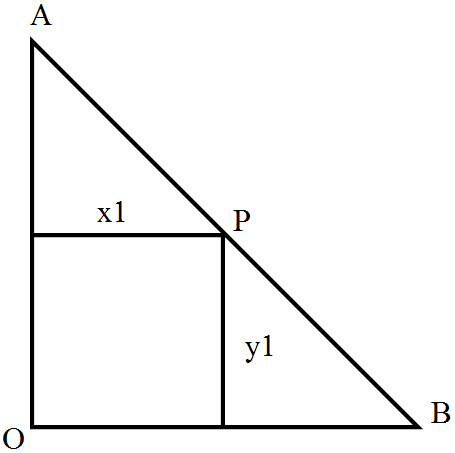 From above figure,
Assum e length AB = l
AP = a, PB = b
Assume $\overbrace{\text{ABQ}}=\theta$
So $\text{x}_1=\text{a}\cos\theta,\ \text{y}_1=\text{b}\sin\theta$
$\Rightarrow\Big(\frac{\text{x}_1}{\text{a}}\Big)^2+\Big(\frac{\text{y}_1}{\text{b}}\Big)^2=1$ View full question & answer→Question 415 Marks
Find the equation of the ellipse in the following case:
eccentricity $\text{e}=\frac{1}{2}$ and foci $(\pm2, 0)$
AnswerLet the equation of the required ellipse be$\frac{\text{x}^2}{\text{a}^2}+\frac{\text{y}^2}{\text{b}^2}=1\ \dots(\text{i})$
The coordinates of the foci are $(\pm2, 0).$ This means that the major and minor axes of the ellipse are along $x$ and $y$ axes respectively and the coordinates of foci are $(\pm\text{ae, 0})$
$\therefore\text{ ae}=2$
$\Rightarrow\text{a}\times\frac{1}{2}=2$ $\big[\because\text{e}=\frac{1}{2}\big]$
$\Rightarrow\text{a}=4$
$\Rightarrow\text{a}^2=16$
Now, $\text{b}^2=\text{a}^2(1-\text{e}^2)$
$\Rightarrow\text{b}^2=(4)^2\bigg[1-\big(\frac{1}{2}\big)^2\bigg]$
$\Rightarrow\text{b}^2=16\big[1-\frac{1}{4}\big]$
$\Rightarrow\text{b}^2=16\times\frac{3}{4}=12$
Substituting the value of $a^2$ and $b^2$ in $(i),$ we get
$\frac{\text{x}^2}{16}+\frac{\text{y}^2}{12}=1$
$\Rightarrow3\text{x}^2+4\text{y}^2=48$
required equation of ellipse.
View full question & answer→