MCQ 11 Mark
The number of ways in which the letters of the word $\text{'CONSTANT'}$ can be arranged without changing the relative positions of the vowels and consonants is.
AnswerThe word $\text{CONSTANT}$ consists of two vowels that are placed at the $2^{nd}$ and $6^{th}$ position, and six consonants.
The two vowels can be arranged at their respective places,
i.e. $2^{nd}$ and $6^{th}$ place, in $2!$ ways.
The remaining $6$ consonants can be arranged at their respective places in $\frac{6!}{2!\ 2!}$ ways.
$\therefore$ Total number of arrangements $=2!\times\frac{6!}{2!\ 2!}=360$
View full question & answer→MCQ 21 Mark
The number of non$-$negative integral solutions of $\text{x} + \text{y}+\text{z}\leq\text{n},$ where $\text{n}\in\text{N}$ is:
- ✓
$\text{n}+\ ^3\text{C}_3$
- B
$\text{n}+\ ^4\text{C}_4$
- C
$\text{n}+\ ^5\text{C}_5$
- D
$\text{n}+\ ^2\text{C}_2$
AnswerCorrect option: A. $\text{n}+\ ^3\text{C}_3$
View full question & answer→MCQ 31 Mark
How many $3 -$ letter words with or without meaning, can be formed out of the letters of the word, $\text{LOGARITHMS,}$ if repetition of letters is not allowed:
AnswerThe word $\text{LOGARITHMS}$ has $10$ different letters.
Hence, the number of $3-$letter words $($with or without meaning$)$ formed by using these letters.
$=\ ^{10}\text{P}_3$
$=10\times9\times8$
$=720$
View full question & answer→MCQ 41 Mark
In a chess tournament each of six players will play every other player exactly once. How many matches will be played during the tournament?
AnswerFirst player can play $5$ matches with other five players.
Second player can play $4$ matches with other four players and proceeding this way, the fifth player will playonly one match with sixth player.
$\therefore$ Total number of matches played $= 5 +4 + 3 + 2 + 1 = 15.$
Short cut : Number of matches played by $4$ players $=\frac{\text{n}(\text{n+1)}}{2}$
View full question & answer→MCQ 51 Mark
In a crossword puzzle, $20$ words are to be guessed of which $88$ words have each an alternative solution also.The number of possible solutions will be:
- A
$\ ^{20}\text{P}_8$
- B
$\ ^{20}\text{C}_8$
- C
$515$
- ✓
$256$
Answer$8$ out of the $20$ words have an alternative solution.
So $12$ words are fixed,
so they wont affect the number of ways.
So now we find the number of ways in which the remaining $8$ words can be guessed.
Now every word have $2$ solutions,
so there are $2$ ways to fill each of these words, and for $8$ such words, it can be done in
$2\times2\times2\times2\times2\times2\times2\times2$
$=2^8$
$=256$
View full question & answer→MCQ 61 Mark
How many factors are $2^5\times3^6\times5^2$ are perfect squares:
AnswerAny factors of $ 2^5\times3^6\times5^2 $ which is a perfect square will be of the form $ 2^\text{a}\times3^\text{b}\times5^\text{c} $
where a can be $0$ or $2$ or $4,$
So there are $3$ ways.
$b$ can be $0$ or $2$ or $4$ or $6$,
So there are $4$ ways.
$a$ can be $0$ or $2,$
So there are $2$ ways.
So, the required number of factors $=3\times4\times2=24$
View full question & answer→MCQ 71 Mark
There are $44$ candidates for a Natural science scholarship, $22$ for a Classical and $66$ for a Mathematical scholarship, then find the no.of ways one of these scholarship can be awarded is:
AnswerNatural science scholarship can be awarded to anyone of the four candidates.
So, there are $44$ ways of awarding natural science scholarships.
Similarly, mathematical and classical scholarships can be awarded in $22$ and $66$ ways respectively.
By the fundamental principle of addition, number of ways of awarding one of the three scholarships is.
$= 4 + 2 + 6$
$= 12$
View full question & answer→MCQ 81 Mark
If $^\text{k}+5\text{P}_\text{k+1}=\frac{11(\text{k}-3)}{2}.\ ^\text{k+3}\text{P}_\text{k}$, then the values of $k$ are:
- A
$7$ and $11$
- ✓
$6$ and $7$
- C
$2$ and $11$
- D
$2$ and $6$
AnswerCorrect option: B. $6$ and $7$
$^\text{k}+5\text{P}_\text{k+1}=\frac{11(\text{k}-3)}{2}.\ ^\text{k+3}\text{P}_\text{k}$
$\Rightarrow \frac{(\text{k}+5)!}{(\text{k}+5-\text{k}-1)!}=\frac{11(\text{k}-1)}{2}\times \frac{(\text{k}+3)!}{(\text{k}+3-\text{k})!}$
$\Rightarrow \frac{(\text{k}+5)!}{(\text{k}+3)!}=\frac{11(\text{k}-1)}{2}\times\frac{4!}{3!}$
$\Rightarrow (\text{k}+5)(\text{k}+4)=22(\text{k}-1)$
$\Rightarrow \text{k}^2+9\text{k}+20=22\text{k}-22$
$\Rightarrow \text{k}^2-13\text{k}+42=0$
$\Rightarrow \text{k}=6,7$
View full question & answer→MCQ 91 Mark
The number of five$-$digit telephone numbers having at least one of their digits repeated is:
- A
$90000.$
- B
$100000.$
- C
$30240.$
- ✓
$69760$
AnswerCorrect option: D. $69760$
Total number of five digit numbers $($since there is no restriction of the number $0XXXX)$
$= 10 \times 10 \times 10 \times 10 \times 10$
$= 100000.$
These numbers also include the numbers where the digits are not being repeated.
So, we need to subtract all such numbers.
Number of $5$ digit numbers that can be formed without any repetition of digits
$= 10 \times 9 \times 8 \times 7 \times 6$
$= 30240$
$\therefore$ Number of five$-$digit telephone numbers having at least one of their digits repeated
$= \{$Total number of $5$ digit numbers$\} - \{$Number of numbers that do not have any digit repeated$\}$ $= 100000 - 30240$
$= 69760$
View full question & answer→MCQ 101 Mark
The number of rectangles that you can find on a chess board is:
AnswerCorrect option: B. $1296$
View full question & answer→MCQ 111 Mark
The number of ways in which the letters of the word $\text{ARTICLE}$ can be arranged so that even places are always occupied by consonants is:
- ✓
$576$
- B
$^4C_3 \times 4!$
- C
$2 \times 4!$
- D
AnswerThere are $3$ even places in the $7$ letter word $\text{ARTICLE.}$
So, we have to arrange $4$ consonants in these $3$ places in $\ ^4P_3$ ways.
And the remaining $4$ letters can be arranged among themselves in $4!$ ways.
$\therefore$ Total number of ways of arrangement $=\ ^4P_3\times 4! = 4! \times 4! = 576$
View full question & answer→MCQ 121 Mark
It is required to seat $5$ men and $4$ women in a row so that the women occupy the even places.The number of ways such arrangements are possible are
- A
$8820$
- ✓
$2880$
- C
$2088$
- D
$2808$
AnswerCorrect option: B. $2880$
Total number of persons are $9$ in which there are $5$ men and $4$ women.
So total number of place $= 9$
Now women seat in even place.
So total number of arrangement $\text{= 4! (_W_W_W_W_) (W-Woman)}$
Men sit in odd place.
So total number of arrangement $= 5! (\text{MWMWMWMWM) (M-Man)}$
Now Total number of arrangement $= 5! \times 4! = 120 \times 24 = 2880$
View full question & answer→MCQ 131 Mark
Total number of four digit odd numbers that can be formed using $0, 1, 2, 3, 5, 7 ($using repetition allowed$)$ are:
View full question & answer→MCQ 141 Mark
In how many ways a committee consisting of $5$ men and $3$ women, can be chosen from $9$ men and $12$ women:
- A
$10258$
- B
$16870$
- ✓
$27720$
- D
$38982$
AnswerCorrect option: C. $27720$
View full question & answer→MCQ 151 Mark
Choose the correct option for the following. $n! = n(n − 1)(n − 2).....3.2.1:$
AnswerFactorial: the product of an integer and all integer less than that
$\therefore n! = n \times (n − 1) \times (n − 2).....3 \times 2 \times 1$
$\therefore$ The given statement
$n! = n \times (n − 1) \times (n − 2)....3 \times 2 \times 1$ is True.
View full question & answer→MCQ 161 Mark
If $ (1 + \text{x})^\text{ⁿ} = \text{C}_{0} +\text{C}_1\text{x} +\text{C}_2\text{ x}^² + …+ \ ^\text{C}\text{n} \text{ x}ⁿ,$ then the value of$\ ^\text{C}0^² + \ ^\text{C}1^² + \ ^\text{C}2^² + .....+ ^\text{C}\text{n}^\text{ⁿ} =\ ^{2\text{n}}\text{C}_\text{n}$ is:
- A
$\frac{(2\text{n})!}{(\text{n}!)}$
- ✓
$\frac{(2\text{n})!}{(\text{n}!\times\text{n}!)}$
- C
$\frac{(2\text{n})!}{(\text{n}!\times\text{n}!)2}$
- D
$\text{None of these}$
AnswerCorrect option: B. $\frac{(2\text{n})!}{(\text{n}!\times\text{n}!)}$
Given,$ (1 + \text{x})^\text{ⁿ} = \text{C}_{0} +\text{C}_1\text{x} +\text{C}_2\text{ x}^² + …+ \ ^\text{C}\text{n} \text{ x}ⁿ .....1$
and $(1 + \text{x})^\text{n} = \ ^\text{C}0 \text{ x}^\text{n} + \ ^\text{C}1\text{x}^\text{n-1}+ \ ^\text{C}2 \text{ x}^\text{n-2} + .... \ ^\text{C}\text{r}\text{x }^\text{n-r} + … + \ ^\text{C}\text{n-1 } \text{x} + \ ^\text{C}\text{n } ... 2$
Multiply $1$ and $2,$ we get
$ (1 + \text{x})^\text{2ⁿ} = (\text{C}_{0} +\text{C}_1\text{x} +\text{C}_2\text{ x}^² + …+ \ ^\text{C}\text{n} \text{ x}^\text{n}\times)(\ ^\text{C}0\text{ x}^\text{n}+\text{C}_1\text{ x}^\text{n-1}+\text{C}_2\text{ x}^\text{n-2}+...+\text{C}_\text{r} \text{x}^\text{n-r}+...+\text{C}_\text{n-1}\text{ x}+\text{C}_\text{n})$
Now, equating the coefficient of $xn$ on both side, we get
$\ ^\text{C}0^2 + \ ^\text{C}1^2 + \ ^\text{C}2^² + ….+ \ ^\text{C}\text{n}^\text{n} = \ ^\text{2n}\text{C}_\text{n} = \frac{(2\text{n})!}{(\text{n}! × \text{n}!)}$
View full question & answer→MCQ 171 Mark
There are mn letters and $n$ post boxes.The number of ways in which these letters can be posted is:
- A
$(\text{mn})^\text{n}$
- B
$(\text{mn})^\text{m}$
- C
$\text{m}^\text{mn}$
- ✓
$\text{n}^\text{mn}$
AnswerCorrect option: D. $\text{n}^\text{mn}$
Every letter can be posted in any of the n post boxes.
$\therefore$ Total number of ways $=\text{n}\times\text{n}\times\text{n}\times.....(\text{m}\times\text{n})=\text{n}^\text{mn}$
View full question & answer→MCQ 181 Mark
In how many ways in which $8$ students can be sated in a circle is:
- A
$40302$
- B
$40320$
- ✓
$5040$
- D
$50040$
AnswerCorrect option: C. $5040$
The number of ways in which $8$ students can be sated in a circle $= ( 8 – 1)!$
$= 7!$
$= 5040$
View full question & answer→MCQ 191 Mark
A car driver knows four different routes from Delhi to Amritsar. From Amritsar to Pathankot, he knows three different routes and from Pathankot to Jammu he knows two different routes. How many routes does he know from Delhi to Jammu?
AnswerThe car driver can reach Amritsar in $4$ ways.
From each of these four ways, he can reach Pathankot in $3$ different ways and so he can reach from Delhi to Pathankot in $(4 \times 3)$
i.e $12$ ways.
Again from Pathankot to Jammu, there are $2$ ways.
Hence he can reach Jammu from Delhi in $(12 \times 2)$ i.e. in $24$ ways.
View full question & answer→MCQ 201 Mark
A $5-$digit number divisible by $3$ is to be formed using the digits $0, 1, 2, 3, 4$ and $5$ without repetition. The total number of ways in which this can be done is:
- ✓
$216$
- B
$600$
- C
$240$
- D
$3125$
AnswerA number is divisible by $3$ when the sum of the digits of the number is divisible by $3.$
Out of the given $6$ digits,
there are only two groups consisting of $5$ digits whose sum is divisible by $3.$
$= 1 + 2 + 3 + 4 + 5 = 15$
$= 0 + 1 + 2 + 4 + 5 = 12$
Using the digits $1, 2, 3, 4$ and $5,$ the $5$ digit numbers that can be formed $= 5!$
Similarly, using the digits $0, 1, 2, 4$ and $5,$
the number that can be formed $= 5! - 4! \{$since the first digit cannot be $0\}$
$\therefore$ Total numbers that are possible $= 5! + 5! - 4! = 240 - 24 = 216$
View full question & answer→MCQ 211 Mark
Six identical coins are arranged in a row.The number of ways in which the number of tails is equal to the number of heads is:
MCQ 221 Mark
Choose the correct answer. Total number of words formed by $2$ vowels and $3$ consonants taken from $4$ vowels and $5$ consonants is equal to.
AnswerCorrect option: C. $7200$
Given that total number of vowels $= 4$
and number of consonants $= 5$
The total of words formed by $2$ vowels and $3$ consonents
$=\ ^4\text{C}_2\times\ ^5\text{C}_3$
$=\frac{4!}{2!\ 2!}\times\frac{5!}{3!\ 2!}$
$=\frac{4\times3\times2!}{2\times1\times2!}\times\frac{5\times4\times3!}{3!\times2}$
Now permutation of $2$ vowels and $3$ consonants $= 5! = 5 \times 4 \times 3 \times 2 \times 1 = 120$
So, the total number of words $= 60 \times 120 = 7200.$
View full question & answer→MCQ 231 Mark
A group of $1200$ persons consisting of captains and soldiers is travelling in a train. For every $15$ soldiers there is one captain. The number of captains in the group is:
AnswerOut of $16$ men, there is a captain.
Number of captains in $1200$ men $= 1200 \div 16 = 75.$
View full question & answer→MCQ 241 Mark
If a secretary and a joint secretary are to be selected from acommittee of $11$ members, then in how many ways can they be selected:
View full question & answer→MCQ 251 Mark
An automobile dealer provides motorcycles and scooters in three body patterns and $4$ different colors each. The number of choices open to a customer is:
- A
$5C_3$
- B
$4C_3$
- C
$4 \times 3$
- ✓
$4 \times 3 \times 2$
AnswerCorrect option: D. $4 \times 3 \times 2$
View full question & answer→MCQ 261 Mark
There are $15$ points in a plane, no two of which are in a straight line except $4,$ all of which are in a straight line.The number of triangle that can be formed by using these $15$ points is:
- A
$\ ^{15}\text{C}_3$
- B
$490$
- ✓
$451$
- D
$415$
AnswerThe required number of triangle $ =\ ^{15}\text{C}_3-\ ^4\text{C}_3 = 455-4 = 451$
View full question & answer→MCQ 271 Mark
Find the number of rectangles and squares in an $8$ by $8$ chess board respectively.
- A
$296, 204$
- ✓
$1092, 204$
- C
$204, 1092$
- D
$204, 1296$
AnswerCorrect option: B. $1092, 204$
Chess board consists of $9$ horizontal $9$ vertical lines.
A rectangle can be formed by any two horizontal and two vertical lines.
Number of rectangles $= \ ^9\text{C}_2\times\ ^9\text{C}_2 = 1296.$
For squares there is one $8$ by $8$ square four $7$ by $7$ squares, nine $6$ by $6$ squares and like this
Number of squares on chess board $= 1^2+2^2…..8^2 = 204$
Only rectangles $ = 1296-204 = 1092$
View full question & answer→MCQ 281 Mark
Six boys and six girls sit along a line alternately in $x$ ways and along a circle $($again alternatively in $y$ ways$)$, then:
- A
$x = y$
- B
$y = 12x$
- C
$x = 10y$
- ✓
$x = 12y$
AnswerCorrect option: D. $x = 12y$
Given, six boys and six girls sit along a line alternately in $x$ ways and along a circle
$($again alternatively in $y$ ways$).$
Now, $\text{x} = 6!\times6!+6!\times6!$
$\Rightarrow\text{x}=2\times(6!)^2$
and $\text{y}=5!\times6!$
Now,$\frac{\text{x}}{\text{y}} =\frac{{2\times(6!)^2}}{(5!\times6!)}$
$\Rightarrow\frac{\text{x}}{\text{y}}=\frac{(2\times6!\times6!)}{5!\times6\!}$
$\Rightarrow\frac{\text{x}}{\text{y}} =\frac{({2\times6!})}{5!}$
$\Rightarrow\frac{\text{x}}{\text{y}} =\frac{({2\times6\times5!})}{5!}$
$\frac{\text{x}}{\text{y}} = 12$
$\Rightarrow\text{x} = 12\text{y}$
View full question & answer→MCQ 291 Mark
Out of $100$ students $50$ fail in English and $30$ in Maths. If $12$ students fail in both English and Maths, then the number of students passing both the subjects is:
AnswerTotal number of students $= 100$
Number of students fail in English $= (50 - 12) = 38$
Number of students fail in Maths $= (30 - 12) = 18$
Number of students fail in both $= 12$
Therefore total failing students $= (38 + 18 + 12) = 68$
Pass in both the subjects $= (100 - 68) = 32$ students
$32$ students have passed in both subjects.
View full question & answer→MCQ 301 Mark
$^xC_7 −^xC_5 = 0$, then $x =:$
View full question & answer→MCQ 311 Mark
If $\ ^\text{n}\text{P}_5 = 60\ ^\text{n-1}\text{P}_3,$ the value of $n$ is:
AnswerGiven that $\ ^\text{n}\text{P}_5 = 60\ ^\text{n-1}\text{P}_3,$
We know that $\text{P}(\text{n, r}) = \ ^\text{n}\text{P}_r = \frac{\text{n!}}{(\text{n-r})!}$
Now, apply the formula on both sides to get the value of $n.$
$\frac{\text{n!}}{(\text{n}-5)!} = 60 \bigg[\frac{(\text{n}-1)!}{(\text{n}-1)-3!}\bigg]$
On solving the above equation,
we get $n= -6$ and $n=10.$
Since the value of $n$ cannot be negative, the value of $n$ is $10.$
View full question & answer→MCQ 321 Mark
Arranging people, digits, numbers, alphabets, letters, and colours are example of:
AnswerPermutation : Arranging people, digits, numbers, alphabets, letters, and colours:
View full question & answer→MCQ 331 Mark
There are $4$ parcels and $5$ post offices.In how many ways can $4$ parcels be got registered:
- A
$20$
- B
$4^5$
- ✓
$5^4$
- D
$5^4- 4^5$
View full question & answer→MCQ 341 Mark
The number of $6 -$ digit numbers can be formed from the digits $0, 1, 3, 5, 7$ and $9$ which are divisible by $10$ and no digit is repeated are:
AnswerA number is divisible by $10$ if the unit digit of the number is $0.$
Given digits are $0, 1, 3, 5, 7, 9$
Now we fix digit $0$ at unit place of the number.
Remaining $5$ digits can be arranged in $5!$ ways
So, total $6 -$ digit numbers which are divisible by $10 = 5! = 120$
View full question & answer→MCQ 351 Mark
The number of different signals which can be given from $6$ flags of different colours taking one or more at a time, is:
AnswerCorrect option: B. $1956$
Number of permutations of six signals taking $1$ at a time $=\ ^6P_1$
Number of permutations of six signals taking $2$ at a time $=\ ^6P_2$
Number of permutations of six signals taking $3$ at a time $=\ ^6P_3$
Number of permutations of six signals taking $4$ at a time $=\ ^6P_4$
Number of permutations of six signals taking $5$ at a time $=\ ^6P_5$
Number of permutations of six signals taking all at a time $=\ ^6P_6$
$\therefore$ Total number of signals
$=\frac{6!}{5!}+\frac{6!}{4!}+\frac{6!}{3!}+\frac{6!}{2!}+\frac{6!}{1!}+6!$
$=6+30+120+360+720+720$
$=1956$
View full question & answer→MCQ 361 Mark
Choose the correct answer. The number of $5-$digit telephone numbers having atleast one of their digits repeated is.
- A
$90,000$
- B
$10,000$
- C
$30,240$
- ✓
$69,760$
AnswerCorrect option: D. $69,760$
Total number of telephone numbers when there is no restriction $=10^5$
Also number of telephone numbers having all digits different $={ }^{10}{P}_5$
Required number of ways
$=10^5-{ }^{10} {P}_5$
$=1000000-10 \times 9 \times 8 \times 7 \times 6$
$=1000000-30240$
$= 69760$
View full question & answer→MCQ 371 Mark
If ${^\text{20}}\text{C}_{\text{r}}={^\text{20}}\text{C}_{\text{r+4}}$ is then ${^\text{r}}\text{C}_{\text{3}}$ equal to:
Answer$\text{r}+\text{r}+4=20$
$\Rightarrow 2\text{r}+4=20$
$\Rightarrow 2\text{r}=16$
$\Rightarrow \text{r}=8$
Now,
${^\text{r}}\text{C}_{\text{3}}={^\text{8}}\text{C}_{\text{3}}$
$\therefore\ {^\text{8}}\text{C}_{\text{3}}={^\text{8}}\text{C}_{\text{3}}$
$\therefore\ {^\text{8}}\text{C}_{\text{3}}=\frac{8!}{3!5!}$
$=\frac{8\times7\times6}{3\times2\times1}$
$=56$
View full question & answer→MCQ 381 Mark
If$\ ^\text{n+1}\text{C}_3 = 2\ ^\text{ⁿ}\text{C}_2,$ then the value of $n$ is:
AnswerGiven,$\ ^\text{n+1}\text{C}_3 = 2\ ^\text{ⁿ}\text{C}_2,$
$\Rightarrow\bigg[\frac{(\text{n + 1})!}{(\text{n} + 1 – 3)}\times3!\bigg] = \frac{2\text{n}!}{(\text{n} – 2)}\times2!$
$\Rightarrow\bigg[\frac{(\text{n}\times1!)}{(\text{n}-2)}\times3!\bigg] = \frac{2\text{n}!}{(\text{n} – 2)}\times2$
$\Rightarrow\frac{\text{n}}{3!} = 1$
$\Rightarrow\frac{\text{n}}{6} = 1$
$\Rightarrow\text{n} = 6$
View full question & answer→MCQ 391 Mark
Factorial of negative numbers is always greater than $1:$
AnswerFactorial: product of an integer with integer less than it.
Factorial can be interpolated using gamma function and gamma function and gamma function is not defined for negative integer.
Factorial is not defined for negative integer.
View full question & answer→MCQ 401 Mark
From a committee of $8$ persons, in how many ways can we choose a chairman and a vice $-$ chairman assuming one person cannot hold more than one position:
View full question & answer→MCQ 411 Mark
The number of ways in which $6$ men can be arranged in a row so that three particular men are consecutive, is:
- ✓
$4! \times 3!$
- B
$4!$
- C
$3! \times 3!$
- D
AnswerCorrect option: A. $4! \times 3!$
According to the question, $3$ men have to be 'consecutive' means that they have to be considered as a single man. But, these $3$ men can be arranged among themselves in $3!$ ways.
And, the remaining $3$ men, along with this group, can be arranged among themselves in $4!$ ways.
$\therefore$ Total number of arrangements $= 4! \times 3!$
View full question & answer→MCQ 421 Mark
The value of $({^\text{7}}\text{C}_{\text{0}}+{^\text{7}}\text{C}_{\text{1}})+({^\text{7}}\text{C}_{\text{1}}+{^\text{7}}\text{C}_{\text{3}})+.....+({^\text{7}}\text{C}_{\text{6}}+{^\text{7}}\text{C}_{\text{7}})$ is:
- A
$2^{7}-1$
- ✓
$2^{8}-2$
- C
$2^{8}-1$
- D
$2^{8}$
AnswerCorrect option: B. $2^{8}-2$
$({^\text{7}}\text{C}_{\text{0}}+{^\text{7}}\text{C}_{\text{1}})+({^\text{7}}\text{C}_{\text{1}}+{^\text{7}}\text{C}_{\text{3}})+({^\text{7}}\text{C}_{\text{2}}+{^\text{7}}\text{C}_{\text{3}})+({^\text{7}}\text{C}_{\text{3}}+{^\text{7}}\text{C}_{\text{4}})+......$
$=1+2\times{^\text{7}}\text{C}_{\text{1}}+2\times{^\text{7}}\text{C}_{\text{2}}+2\times{^\text{7}}\text{C}_{\text{3}}+2\times{^\text{7}}\text{C}_{\text{4}}+2\times{^\text{7}}\text{C}_{\text{5}}..$
$=2+2^{2}({^\text{7}}\text{C}_{\text{1}}+{^\text{7}}\text{C}_{\text{2}}+{^\text{7}}\text{C}_{\text{3}})$
$=2+2^{2}(7+\frac{7}{2}\times6+\frac{7}{3}\times\frac{6}{2}\times5)$
$=2+252$
$=254$
$=2^{8}-2$
View full question & answer→MCQ 431 Mark
How many ways can $6$ coins be chosen from $20,$ one rupees coins, $10$ fifty paise coins, $7$ twenty paise coins:
- ✓
$28$
- B
$56$
- C
$\ ^{37}\text{C}_6$
- D
$38 $
View full question & answer→MCQ 441 Mark
How many $5 -$ digit telephone numbers can be constructed using the digits $0$ to $9$, if each number starts with $67$ and no digit appears more than once:
View full question & answer→MCQ 451 Mark
Three persons enter a railway compartment. If there are $5$ seats vacant, in how many ways can they take these seats?
AnswerThree persons can take $5$ seats in $^5C_3$ ways.
Moreover $3$ persons can sit in $3!$ ways.
Required number of ways ${^\text{5}}\text{C}_{\text{3}}\times3!$
$=10\times6$
$=60$
View full question & answer→MCQ 461 Mark
If ${^\text{15}}\text{C}_{3\text{r}}={^\text{15}}\text{C}_{\text{r+3}},$ is then equal to:
Answer$3\text{r}+\text{r}+3=15$
$\Rightarrow 4\text{r}+3=15$
$\Rightarrow 4\text{r}=12$
$\Rightarrow \text{r}=3$
View full question & answer→MCQ 471 Mark
Let $Tn$ denote the number of triangles which can be formed using the vertices of a regular polygon of $n$ sides.If $\text{T}_\text{n+1} -\text{T}_\text{n} = 21,$ then $n$ equals:
View full question & answer→MCQ 481 Mark
Choose the correct answer. The number of ways in which we can choose a committee from four men and six women so that the committee includes at least two men and exactly twice as many women as men is.
AnswerNumber of men $= 4$
Number of women $= 6$
We are given that the committee includes $2$ men and exactly twice as many women as men.
Thus, the possible selection can be $2$ men and $4$ women and $3$ men and $6$ women
So, the number of committee = ${ }^4 C_2 \times{ }^6 C_4+{ }^4 C_3 \times{ }^6 C_6$
$=6 \times 15+41$
$=90+4$
$=94$
View full question & answer→MCQ 491 Mark
Given $5$ flags of different colours, how many different signals can be generated, if each signal requires the use of $2$ flags, one below the other:
View full question & answer→MCQ 501 Mark
The number of numbers of $9$ different non$-$zero digits such that all the digits in the first four places are less than the digit in the middle and all the digits in the last four places are greater than the digit in the middle is:
AnswerCorrect option: B. $(4!)^2$
View full question & answer→MCQ 511 Mark
If $\ ^5\text{P}_\text{r}=\ ^{26}\text{p}_\text{r}-1, $ then the value of r is:
View full question & answer→MCQ 521 Mark
There are $5$ doors to a lecture hall.The number of ways that a student can enter the hall and leave it by a different door is:
AnswerA student has $5$ different doors to enter,
Every door a student enters through, there are $4$ more doors to leave through.
So,
Total no. of ways $=5\times4=20$
View full question & answer→MCQ 531 Mark
Amy and Adam are making boxes of truffles to give out as wedding favors. They have an unlimited supply of $5$ different types of truffles. If each box holds $2$ truffles of different types, how many different boxes can they make?
Answer$10$ boxes In every combination, $2$ types of truffles will be in the box, and $3$ types of truffles will not.
Therefore, this problem is a question about the number of anagrams that can be made from the "word" $\text{YYNNN:}$
$\frac{5!}{2!3!}=\frac{5\times4\times3\times2\times1}{3\times2\times1\times2\times1}$
$=5\times2$
$=10$
View full question & answer→MCQ 541 Mark
Permutation relates to the act of arranging all the members of a set into some sequence or order.
AnswerTrue, permutation relates to the act of arranging all the members of a set into some sequence or order.
View full question & answer→MCQ 551 Mark
A group consists of $4$ couples in which each of the $4$ persons have one wife each.In how many ways could they be arranged in a straight line such that the men and women occupy alternate positions:
- ✓
$1152$
- B
$1278$
- C
$1296$
- D
$1176$
AnswerCorrect option: A. $1152$
Required no of ways $= 2 \times 4! \times 4!$
$= 1152$
View full question & answer→MCQ 561 Mark
The total number of $9$ digit numbers of different digits is:
- A
$99!$
- B
$9!$
- C
$8 \times 9!$
- ✓
$9 \times 9!$
AnswerCorrect option: D. $9 \times 9!$
Given digit in the number $= 9$
$1^{st}$ place can be filled $= 9$ ways $= 9 ($from $1 - 9$ any number can be placed at first position$)$
$2^{nd}$ place can be filled $= 9$ ways $($from $0 - 9$ any number can be placed except the number which is placed at the first position$)$
$3^{rd}$ place can be filled $= 8$ ways.
$4^{th}$ place can be filled $= 7$ ways.
$5^{th}$ place can be filled $= 6$ ways.
$6^{th}$ place can be filled $= 5$ ways.
$7^{th}$ place can be filled $= 4$ ways.
$8^{th}$ place can be filled $= 3$ ways.
$9^{th}$ place can be filled $= 2$ ways.
So total number of ways $= 9 \times 9 \times 8 \times 7 \times 6 \times 5 \times 4 \times 3 \times 2$
$= 9 \times 9!$
View full question & answer→MCQ 571 Mark
The number of ways in which $7$ pictures can be hung from $5$ picture nails on the wall is:
AnswerCorrect option: C. $2520$
View full question & answer→MCQ 581 Mark
If the letters of the word $\text{KRISNA}$ are arranged in all possible ways and these words are written out as in a dictionary, then the rank of the word $\text{KRISNA}$ is:
AnswerWhen arranged alphabetically, the letters of the word $\text{KRISNA}$ are $\text{A, I, K, N, R}$ and $\text{S.}$
Number of words that will be formed with $A$ as the first letter $=$ Number of arrangements of the remaining $5$ letters $= 5!$
Number of words that will be formed with $I$ as the first letter $=$ Number of arrangements of the remaining $5$ letters $= 5!$
$\therefore$ The number of words beginning with $\text{KA} =$ Number of arrangements of the remaining $4$ letters = $4!$
The number of words beginning with $\text{KA} =$ Number of arrangements of the remaining $4$ letters $= 4!$
The number of words starting with $\text{KN} =$ Number of arrangements of the remaining $4$ letters $= 4!$
Alphabetically, the next letter will be $\text{KR.}$
Number of words starting with $\text{KR}$ followed by $A,$
i.e. $\text{KRA} =$ Number of arrangements of the remaining $3$ letters $= 3!$
Number of words starting with $\text{KRI}$ followed by $A,$
i.e. $\text{KRIA} =$ Number of arrangements of the remaining $2$ letters $= 2!$
Number of words starting with $\text{KRI}$ followed by $N$,
i.e. $\text{KRIN} =$ Number of arrangements of the remaining $2$ letters $= 2!$
The first word beginning with $\text{KRIS}$ is the word $\text{KRISAN}$ and the next word is $\text{KRISNA.}$
$\therefore$ Rank of the word $\text{KRISNA} = 5! + 5! + 4! + 4! + 4! + 3! + 2! + 2! + 2$
$= 324$
View full question & answer→MCQ 591 Mark
If in a group of n distinct objects, the number of arrangements of $4$ objects is $12$ times the number of arrangements of $2$ objects, then the number of objects is:
AnswerAccording to the question:
$^\text{n}\text{P}_4=12\times\ ^\text{n}\text{P}_2$
$\Rightarrow \frac{\text{n!}}{(\text{n}-4)!}=12\times\frac{\text{n!}}{\text{(n-2)!}}$
$\Rightarrow \frac{(\text{n}-2)!}{(\text{n}-4)!}=12$
$\Rightarrow (\text{n}-2)(\text{n}-3)=4\times 3$
$\Rightarrow \text{n}-2=4$
$\Rightarrow \text{n}=6$
View full question & answer→MCQ 601 Mark
A garrison of $nn$ men had enough food to last for $30$ days. After $10$ days, $50$ more men joined them. If the food now lasted for $1616$ days, what is the value of $n?$
AnswerAfter $10$ days, the food for $n$ men is there for $20$ days.
This food can be eaten by $(\text{n}+50)$ men in $16$ days.
$\therefore20\text{n}=16(\text{n}+5)$
$\therefore\text{n}=200$
View full question & answer→MCQ 611 Mark
The number of ways in which $10$ different diamonds can be arranged to form a necklace, is:
- ✓
$181440$
- B
$161400$
- C
$261960$
- D
AnswerCorrect option: A. $181440$
View full question & answer→MCQ 621 Mark
The number of permutations of $n$ different things taking $r$ at a time when $3$ particular things are to be included is:
- A
$^{\text{n}-3}\text{P}_{\text{r}-3}$
- B
$^{\text{n}-3}\text{P}_{\text{r}}$
- C
$^{\text{n}}\text{P}_{\text{r}-3}$
- ✓
$\text{r! }^{ \text{n}-3}\text{C}_{\text{r}-3}$
AnswerCorrect option: D. $\text{r! }^{ \text{n}-3}\text{C}_{\text{r}-3}$
Here, we have to permute $n$ things of which $3$ things are to be included.
So, only the remaining $(n − 3)$ things are left for permutation, taking $(r − 3)$ things at a time.
This is because $3$ things have already been included.
But, these $r$ things can be arranged in $r!$ ways.
$\therefore$ Total number of permutations $=\text{r! }^{ \text{n}-3}\text{C}_{\text{r}-3}$
View full question & answer→MCQ 631 Mark
$15$ buses operate between Hyderabad and Tirupathi.The number of ways can a man go to Tirupathi from Hyderabad by a bus and return by a different bus is:
AnswerWhile going ,number of ways to choose $1$ bus out of $15$ is $^{15}C_1$.
While return trip, in order to come with different bus, number of buses left $= 14.$
Number of ways to choose $1$ bus for return trip $=\ ^{14}C_1$
So, the required number of ways for going and return $=\ ^{15}C_1×^{14}C_1 = 210$
View full question & answer→MCQ 641 Mark
The number of words that can be formed out of the letters of the word $"\text{ARTICLE}"$ so that vowels occupy even places is:
AnswerThe word $\text{ARTICLE}$ consists of $3$ vowels that have to be arranged in the three even places.
This can be done in $3!$ ways.
And, the remaining $4$ consonants can be arranged among themselves in $4!$ ways.
$\therefore$ Total number of ways $= 3! \times 4! = 144$
View full question & answer→MCQ 651 Mark
If ${^\text{20}}\text{C}_{\text{r}}={^\text{20}}\text{C}_{\text{r-10}}$ is then ${^\text{18}}\text{C}_{\text{r}}$ equal to:
Answer$\text{r}+\text{r}-10=20$
$\Rightarrow 2\text{r}-10=20$
$\Rightarrow 2\text{r}=30$
$\Rightarrow \text{r}=15$
Now,
${^\text{18}}\text{C}_{\text{r}}={^\text{18}}\text{C}_{\text{15}}$
$\therefore\ {^\text{18}}\text{C}_{\text{15}}={^\text{18}}\text{C}_{\text{3}}$
$\therefore\ {^\text{18}}\text{C}_{\text{3}}=\frac{18}{3}\times\frac{17}{2}\times16$
$=816$
View full question & answer→MCQ 661 Mark
A coin is tossed $n$ times, the number of all the possible outcomes is:
- A
$2n$
- ✓
$2^n$
- C
$C(n, 2)$
- D
$P(n, 2)$
AnswerWe know that, when a coin is tossed, we will get either head or tail.
Therefore, the number of all possible outcomes when a coin is tossed $n$ times is $2^n$.
View full question & answer→MCQ 671 Mark
The greatest number that can be formed by the digits $7, 0, 9, 8, 6, 3$
- A
$9, 87, 360$
- B
$9, 87, 063$
- ✓
$9, 87, 630$
- D
$9, 87, 603$
AnswerCorrect option: C. $9, 87, 630$
The greatest number that can be formed by the digits $7, 0, 9, 8, 6, 3$ is $9\ 8\ 7\ 6\ 3\ 0$ To achieve this arrange the given numbers in descending order.
View full question & answer→MCQ 681 Mark
Five persons $\text{A, B, C, D}$ and $\text{E}$ occupy seats in a row such that $\text{A}$ and $\text{B}$ sit next to each other.In how many possible ways can these five people sit:
Answer$4! \times 2$ ways.
i.e, $24 \times 2 = 48$ ways
View full question & answer→MCQ 691 Mark
Seven different lecturers are to deliver lectures in seven periods of a class on a particular day. $A B,$ and $C$ are three of the lecturers.The umber of ways in which a routine for the day can be made such that $A$ delivers his lecture before $B$ and $B$ before $C,$ is:
View full question & answer→MCQ 701 Mark
A batsman can score $0, 1, 2, 3, 4$ or $6$ runs from a ball. The number of different sequences in which he can score exactly $30$ runs in an over of six balls is:
View full question & answer→MCQ 711 Mark
Choose the correct answer. The number of triangles that are formed by choosing the vertices from a set of $12$ points, seven of which lie on the same line is.
AnswerTotal number of triangle formed from $12$ points taking $3$ at a time $=\ ^{12}C_3$
But given that out of $12$ points $7$ are collinear.
So, these seven points will form no triangle.
$\therefore$ The required number of triangles $=\ ^{12}C_3\ –\ ^{7}C_3$
$=\frac{12!}{3!\ 9!}-\frac{7!}{3!\ 4!}$
$=\frac{12\times11\times10\times9}{3\times2\times1\times9!}-\frac{7\times6\times5\times4!}{3\times2\times1\times4!}$
$=\frac{12\times11\times10}{3\times2}-\frac{7\times6\times5}{3\times2}$
$=220-35$
$=185$
View full question & answer→MCQ 721 Mark
The number of ways to arrange the letters of the word $\text{CHEESE}$ are:
AnswerTotal number of arrangements of the letters of the word $\text{CHEESE} =$ Number of arrangements of $6$ things taken all at a time, of which $3$ are of one kind $=\frac{6!}{3!}=120$
View full question & answer→MCQ 731 Mark
The number of ways in which four particular persons $\text{A, B, C, D,}$ and six more persons can stand in a queue so that $A$ always stands before $\text{B B,}$ before $\text{C}$ and $\text{C}$ before $\text{D,}$ is:
- A
$7! 4!$
- B
$10!-7! 4! $
- ✓
$\frac{10!}{4!}$
- D
$\text{None of these}$
AnswerCorrect option: C. $\frac{10!}{4!}$
View full question & answer→MCQ 741 Mark
Find the number of permutations if $n = 12$ and $r = 2.$
AnswerThe solution is here:
$\text{n}=12$
$\text{r}=2$
Using the formula given above:
Permutation:
$\ ^\text{n}\text{p}_\text{r}$
$=\frac{\text{(n})!}{\text{(n-r)}!}$
$=\frac{(12)!}{(12-2)}$
$=\frac{12!}{10!}$
$=\frac{(12\times11\times10!)}{10!}$
$=132$
View full question & answer→MCQ 751 Mark
If $^{(\text{a}^2-\text{a})}\text{C}_{\text{2}}=^{(\text{a}^2-\text{a})\text{}}\text{C}_{\text{4}},$ is then $x:$
Answer$\text{a}^{2}-\text{a}=2+4$
$\Rightarrow \text{a}^{2}-\text{a}-6=0$
$\Rightarrow \text{a}^{2}-3\text{a}+2\text{a}-6=0$
$\Rightarrow \text{a}(\text{a}-3)+2(\text{a}-3)=0$
$\Rightarrow (\text{a}+2)(\text{a}-3)=0$
$\Rightarrow \text{a}=-2,\text{a}=3$
$\text{a}=3$
View full question & answer→MCQ 761 Mark
Total number of divisors of $5880$ is equal to:
View full question & answer→MCQ 771 Mark
The exponent of $3$ in $100!$ is:
View full question & answer→MCQ 781 Mark
How many factors are $2^5\times 3^6 \times 5^2$ are perfect squares:
AnswerAny factors of $2^5\times 3^6 \times 5^2$ which is a perfect square will be of the form $2^a \times 3^b \times 5^c$
where a can be $0$ or $2$ or $4,$
So there are $3$ ways.
$b$ can be $0$ or $2$ or $4$ or $6,$
So there are $4$ ways.
$a$ can be $0$ or $2,$
So there are $2$ ways.
So, the required number of factors $= 3 \times 4 \times 2 = 24$
View full question & answer→MCQ 791 Mark
The number of different ways in which $8$ persons can stand in a row so that between two particular persons $A$ and $B$ there are always two persons, is:
- ✓
$60 \times 5!$
- B
$15 \times 4! \times 5!$
- C
$4! \times 5!$
- D
AnswerCorrect option: A. $60 \times 5!$
The four people, i.e $A, B$ and the two persons between them are always together.
Thus, they can be considered as a single person.
So, along with the remaining $4$ persons, there are now total $5$ people who need to be arranged.
This can be done in $5!$ ways.
But, the two persons that have to be included between $A$ and $B$ could be selected out of the remaining $6$ people in $^6P_2$ ways, which is equal to $30.$
For each selection, these two persons standing between $A$ and $B$ can be arranged among themselves in $2$ ways.
$\therefore$ Total number of arrangements $= 5! \times 30 \times 2 = 60 \times 5!$
View full question & answer→MCQ 801 Mark
There are $6$ letters and $6$ directed envelopes.Find the number of ways in which all letters are put in the wrong envelopes.
View full question & answer→MCQ 811 Mark
The number of ways in which $6$ men add $5$ women can dine at a round table, if no two women are to sit together, is given by:
- A
$30$
- ✓
$5! \times 5!$
- C
$5! \times 4!$
- D
$7! \times 5!$
AnswerCorrect option: B. $5! \times 5!$
Again, $6$ girls can be arranged among themselves in $5!$ ways in a circle.
So, the number of arrangements where boys and girls sit attentively in a circle $= 5! \times 5!$
View full question & answer→MCQ 821 Mark
The product of $r$ consecutive positive integers is divisible by:
- ✓
$r!$
- B
$(r − 1)!$
- C
$(r + 1)!$
- D
AnswerThe product of $r$ consecutive integers is equal to $r!,$
so it will be divisible by $r!.$
View full question & answer→MCQ 831 Mark
Choose the correct answer.The number of words which can be formed out of the letters of the word $\text{ARTICLE,}$ so that vowels occupy the even place is.
- A
$1440$
- ✓
$144$
- C
$7!$
- D
$^4C_4 \times ^3C_3$
AnswerTotal number of letters in the$ ‘\text{ARTICLE’}$ is $7$ out which $\text{A, E, I}$ are vowels and $\text{R, T, C, L}$ are consonants
Given that vowels occupy even place
$\therefore$ Possible arrangement can be shown as below
$\text{C, V, C, V, C, V, C}$
i.e. on $2^{\text {nd }}, 4^{\text {th}}$ and $6^{\text {th }}$ places
Therefore, number of arrangement $={ }^3 P_3=3!=6$ ways
Now consonants can be placed at $1,3,5$ and $7^{\text {th }}$ place
$\therefore$ Number of arrangement $={ }^4{P}_4=4!=24$
So, the total number of arrangements $= 6 \times 24 = 144$
View full question & answer→MCQ 841 Mark
The value of $P(n, n - 1)$ is:
AnswerWe know that $\text{P}(\text{n}, \text{r}) = \ ^\text{n}\text{P}_\text{r} = \frac{\text{n}!}{(\text{n}-\text{r})!}$
Hence, $\text{P}(\text{n}, \text{r}) = \ ^\text{n}\text{P}_\text{n-1} = \frac{\text{n}!}{\big[\text{n}-\text{r}\big]!}$
$\text{P}(\text{n, n-1}) = \frac{\text{n!}}{(\text{n}-\text{n}+1)!} = \frac{\text{n}!}{1!} = \text{n}!$
Therefore, the value of $\text{P}(\text{n}, \text{n}-1)$ is $\text{n}!.$
View full question & answer→MCQ 851 Mark
The number of ways $4$ boys and $3$ girls can be seated in a row so that they are alternate is:
AnswerGiven that, there are $4$ boys and $3$ girls.
The only pattern $4$ boys and $3$ girls are arranged in an alternate way is $\text{BGBGBGB.}$
Therefore, the total number of ways is $4! \times 3! = 144.$
View full question & answer→MCQ 861 Mark
If $={^\text{43}}\text{C}_{\text{r-6}}={^\text{43}}\text{C}_{\text{3r+1}},$ then the value of $r$ is is:
Answer$\text{r}-6+3\text{r}+1=43$
$\Rightarrow 4\text{r}-5=43$
$\Rightarrow 4\text{r}=48$
$\Rightarrow \text{r}=12$
View full question & answer→MCQ 871 Mark
$6$ men and $4$ women are to be seated in a row so that no two women sit together.The number of ways they can be seated is:
- ✓
$604800$
- B
$17280$
- C
$120960$
- D
$518400$
AnswerCorrect option: A. $604800$
$6$ men can be sit as $\text{M}\times\text{M}\times\text{M}\times\text{M}\times\text{M}\times\text{M}$
Now, there are $7$ spaces and $4$ women can be sit as $ \ ^7\text{P}_4 = \ ^7\text{P}_3 = \frac{7!}{3!} = \frac{(7\times6\times5\times4\times3!)}{3!}$
$=7\times6\times5\times4$
$=840$
Now, total number of arrangement $= 6!\times840$
$= 720\times840$
$= 604800$
View full question & answer→MCQ 881 Mark
How many different signals can be transmitted by arranging $3$ red, $2$ yellow and $2$ green flags on a pole: $[$Assume that all the $7$ flags are used to transmit a signal$].$
AnswerHere, $\text{n}=3+2+2=7$
$\text{P}_1=3,\text{P}_2=2$ and $\text{P}_3=2$
$\therefore$ Required number of different signals
$=\frac{\text{n}!}{\text{p}_1!\text{p}_1\text{p}_1}$
$=\frac{7!}{3!2!1!}$
$=\frac{7.6.5.4}{2.2}$
$=7.6.5$
$=210$
View full question & answer→MCQ 891 Mark
On the eve of Diwali festival, a group of $12$ friends greeted every other friend by sending greeting cards. Find the number of cards purchased by the group:
AnswerThere being $12$ friends in the group, each friend must have purchased $(12 - 1)$
i.e. $11$ cards for sending greeting to rest of his $11$ friends.
Thus total number of cards purchased by all the friends together is $12 \times 11$
i.e. $132.$
View full question & answer→MCQ 901 Mark
The number of ways in which $8$ students can be seated in a line is:
- A
$5040$
- B
$50400$
- C
$40230$
- ✓
$40320$
AnswerCorrect option: D. $40320$
For the $1^{st}$ position, there are $8$ possible choices.
For the $2^{nd}$ position, there are $7$ possible choices.
For the $3^{rd}$ position, there are $7$ possible choices, etc.
And for the eighth position, there is only one possible choice.
Hence, this can be written as $8!$
$($i.e.$) 8! = 8 \times 7 \times 6 \times 5 \times 4 \times 3 \times 2 \times 1$
$= 40,320$
View full question & answer→MCQ 911 Mark
How many numbers amongst the numbers $9$ to $54$ are there which are exactly divisible by $9$ but not by $3?$
AnswerAny number divisible by $9$ is also divisible by $3.$
View full question & answer→MCQ 921 Mark
The number of products that can be formed with $10$ prime numbers taken two or more at a time is:
- A
$2^{10}$
- B
$2^{10}- 1$
- ✓
$2^{10}- 11$
- D
$2^{10}-10$
AnswerCorrect option: C. $2^{10}- 11$
View full question & answer→MCQ 931 Mark
Choose the correct answer. If $^nC_{12}$=$^nC_8$ , then n is equal to.
AnswerGive that $^\text{n}\text{C}_{12}=\ ^\text{n}\text{C}_8[\because\ ^\text{n}\text{C}_\text{r}=\ ^\text{n}\text{C}_\text{n-r}]$
$^\text{n}\text{C}_{12}=\ ^\text{n}\text{C}_\text{n-8}$
$\therefore\text{n}-8=12$
$\Rightarrow\text{n}=12+8=20$
View full question & answer→MCQ 941 Mark
Each combination corresponds to many permutations:
AnswerIn combination.
Each combination can be considered as a set of selection an order.
Each selection has a defined order.
They can be considered as a permutation.
Each cpmbination corresponds to many permutations.
Hence the above statement is true.
View full question & answer→MCQ 951 Mark
In a room there are $12$ bulbs of the same wattage, each having a separate switch. The number of ways to light the room with different amounts of illumination is:
- A
$12^2 − 1$
- B
$2^{12}$
- ✓
$2^{12} − 1$
- D
AnswerCorrect option: C. $2^{12} − 1$
Each of the bulb has its own switch,
i.e each bulb will have two outcomes $−$ it will either glow or not glow.
Thus, each of the $12$ bulbs will have $2$ outcomes.
$\therefore$ Total number of ways to illuminate the room $= 2^{12}$
Here, we have also considered the way in which all the bulbs are switched$-$off.
However, this is not required as we need to find out only the number of ways of illuminating the room.
Hence, we subtract that one way from the total number of ways.
$= 2^{12}− 1$
View full question & answer→MCQ 961 Mark
A lady gives a dinner party for six guests. The number of ways in which they may be selected from among ten friends if two of the friends will not attend the party together is:
AnswerSuppose there are two friends, $A$ and $B,$ who do not attend the party together.
If both of them do not attend the party, then the number of ways of selecting $6$ guests $={^\text{8}}\text{C}_{\text{6}}=28$
If one of them attends the party, then the number of ways of selecting $6$ guests $=2{^\text{8}}\text{C}_{\text{5}}=112$
Total number of ways $= 112 + 28 = 140$
View full question & answer→MCQ 971 Mark
A committee of $7$ has to be formed from $9$ boys and $4$ girls.In how many ways can this be done when the committee consists of at least $3$ girls.
AnswerGiven number of boys $= 9$
Number of girls $= 4$
Now, A committee of $7$ has to be formed from $9$ boys and $4$ girls.
Now, the committee consists of atleast $3$ girls:
$^4\text{C}_3\times\ ^9\text{C}_4+\ ^4\text{C}_4\times\ ^9\text{C}_3$
$= \bigg[\frac{4!}{(3! \times 1!)}\times\frac{9!}{(4! \times 5!)}\bigg] +\ ^9\text{C}_3$
$=[\frac{(4 \times 3!)}{3!}\times\frac{(9\times8\times7\times6\times5!)}{(4!\times5!)]} +\frac{9!}{(3!\times6!)}$
$= \bigg[\frac{4\times(9\times8\times7\times6)}{4!}\bigg] + \frac{(9\times8\times7\times6!)}{(3!\times6!)}$
$= \bigg[\frac{4\times(9\times8\times7\times6)}{4\times3\times2\times1}\bigg] + \frac{(9\times8\times7)}{(3!)}$
$=(9\times8\times7) + \frac{(9\times8\times7)}{(3\times2\times1)}$
$=504+\big(\frac{504}{6}\big)$
$=504+84$
$=588$
View full question & answer→MCQ 981 Mark
Two persons entered a Railway compartment in which $7$ seats were vacant.The number of ways in which they can be seated is:
Answer$\rightarrow$ The $1^{st}$ person can take one of the $7$ seats
$\rightarrow 2^{nd}$ person can take any one of the remaining $6$ seats.
$\Rightarrow$ So, the total $= 7 \times 6 = 42$
View full question & answer→MCQ 991 Mark
In a colony, there are $55$ members. Every member posts a greeting card to all the members. How many greeting cards were posted by them?
- A
$990$
- ✓
$2970$
- C
$1980$
- D
$890$
AnswerCorrect option: B. $2970$
First player can post greeting cards to the remaining $54$ players in $54$ ways.
Second player can post greeting card to the $54$ players.
Similarly, it happens with the rest of the players.The total numbers of greeting cards posted are.
$54 + 54 + 54 …$
$54 (55 \text{times}) = 54 \times 55 = 2970.$
View full question & answer→MCQ 1001 Mark
The value of $2 \times P(n, n - 2)$ is:
AnswerGiven, $ 2\times\text{P}(\text{n}, \text{n} – 2)$
$= 2\times\frac{\text{n!}}{(\text{n} – (\text{n} – 2))}$
$= 2\times\frac{\text{n!}}{(\text{n} – (\text{n}+2))}$
$= 2\times\big(\frac{\text{n!}}{2}\big)$
$= \text{n!}$
So, $ 2\times\text{P}(\text{n}, \text{n} – 2)=\text{n}!$
View full question & answer→MCQ 1011 Mark
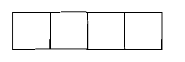
How many numbers of four digits can be formed from the digits $0, 1, 2, 3,$ and $4?$
AnswerThe first box can be filled in four ways, because we cannot put $0$ in the first box.
The second box can also be filled in four ways, because we cannot put $0.$
The third box can be filled in three ways and the fourth in two ways.
Therefore, Total numbers $= 4 \times 4 \times 3 \times 2 = 96$
View full question & answer→MCQ 1021 Mark
There are $13$ players of cricket, out of which $4$ are bowlers. In how many ways a team of eleven be selected from them so as to include at least two bowlers?
Answer$4$ out of $13$ players are bowlers.
In other words, $9$ players are not bowlers.
A team of $11$ is to be selected so as to include at least $2$ bowlers.
Number of ways $={^\text{4}}\text{C}_{\text{2}}\times{^\text{9}}\text{C}_{\text{9}}+{^\text{4}}\text{C}_{\text{3}}\times{^\text{9}}\text{C}_{\text{8}}+{^\text{4}}\text{C}_{\text{4}}\times{^\text{9}}\text{C}_{\text{7}}$
$=6+36+36$
$=78$
View full question & answer→MCQ 1031 Mark
${^\text{5}}\text{C}_{\text{1}}+{^\text{5}}\text{C}_{\text{2}}+{^\text{5}}\text{C}_{\text{3}}+{^\text{5}}\text{C}_{\text{4}}+{^\text{5}}\text{C}_{\text{5}}$ is equal to:
Answer${^\text{5}}\text{C}_{\text{1}}+{^\text{5}}\text{C}_{\text{2}}+{^\text{5}}\text{C}_{\text{3}}+{^\text{5}}\text{C}_{\text{4}}+{^\text{5}}\text{C}_{\text{5}}$
$={^\text{5}}\text{C}_{\text{1}}+{^\text{5}}\text{C}_{\text{2}}+{^\text{5}}\text{C}_{\text{2}}+{^\text{5}}\text{C}_{\text{1}}+{^\text{5}}\text{C}_{\text{5}}$
$=2\times{^\text{5}}\text{C}_{\text{1}}+2\times{^\text{5}}\text{C}_{\text{2}}+{^\text{5}}\text{C}_{\text{5}}$
$= 2\times5+2\times\frac{5!}{2!3!}+1$
$=10+20+1$
$=31$
View full question & answer→MCQ 1041 Mark
Find the number of ways of arranging the letters of the words Danger so that no vowel occupies odd place.
AnswerThe given word is $\text{DANGER.}$ Number of letters is $6.$
Number of vowels is $2 ($ i.e., $\text{A, E}).$
Number of consonants is $4 ($ i.e., $\text{D,N,G,R}).$
As the vowels cannot occupy odd
places, they can be arranged in even places.
Two vowels can be arranged in $3$ even places in $3P2$ ways
i.e., $6.$ Rest of the consonants can arrange in the remaining $4$ places in $4!$ ways.
The total number of
arrangements is $6 \times 4! = 144.$
View full question & answer→MCQ 1051 Mark
The letters of the word $\text{RACHIT}$ are written in all possible manner and words are written as in dictionary. The rank of word $\text{RACHIT}$ is:
View full question & answer→MCQ 1061 Mark
Choose the correct answer. Given $5$ different green dyes, four different blue dyes and three different red dyes, the number of combinations of dyes which can be chosen taking at least one green and one blue dye is.
- A
$3600$
- ✓
$3720$
- C
$3800$
- D
$3600 $
AnswerCorrect option: B. $3720$
At least one green dye can be chosen in $^5\text{C}_1+\ ^5\text{C}_2\ +\ ^5\text{C}_3+\ ^5\text{C}_4+\ ^5\text{C}_5=22^5-1$ways.
At least one blue dye can be chosen in $^4\text{C}_1+\ ^4\text{C}_2\ +\ ^4\text{C}_3+\ ^4\text{C}_4=2^4-1$ ways.
Any number of red dyes can be chosen in $^3\text{C}_0+\ ^3\text{C}_1\ +\ ^3\text{C}_2+\ ^3\text{C}_3=2^3$ ways.
so, total nnumber of required selection $=(2^5-1)\times(2^4-1)\times2^3=3720$
View full question & answer→MCQ 1071 Mark
Choose the correct answer. A five digit number divisible by $3$ is to be formed using the numbers $0, 1, 2, 3, 4$ and $5$ without repetitions. The total number of ways this can be done is.
- ✓
$216$
- B
$600$
- C
$240$
- D
$3125$
AnswerWe know that a number is divisible by $3$ if the sum of its digits is divisible by $3.$
Now sum of the given six digits is $15$ which is divisible by $3.$
So to form a number of five$-$digit which is divisible by $3$ we can remove either $'O\ '$ or $'3\ '.$
If digits $1, 2, 3, 4, 5$ are used then number of required numbers $= 5!$
If digits $0, 1, 2, 4, 5$ are used then first place from left can be filled in $4$ ways and remaining $4$ places can be filled in $4!$ ways.
So in this case required numbers are $4 \times 4!$ ways.
So, total number of numbers $= 120 + 96 = 216$
View full question & answer→MCQ 1081 Mark
The number of words that can be made by re$-$arranging the letters of the word $\text{APURBA}$ so that vowels and consonants are alternate is:
AnswerThe word $\text{APURBA}$ is a $6$ letter word consisting of $3$ vowels that can be arranged in $3$ alternate places,
in $\frac{3!}{2!}$ ways.
The remaining $3$ consonants can be arranged in the remaining $3$ places in $3!$ ways.
$\therefore$ Total number of words that can be formed $=\frac{3!}{2!}\times3!=18$
But this whole arrangement can be set$-$up in total two ways,
i.e either $\text{VCVCVC}$ or $\text{CVCVCV.}$
$\therefore$ Total number of words $= 18 \times 2 = 36$
View full question & answer→MCQ 1091 Mark
How many different committees of $5$ can be formed from $6$ men and $4$ women on which exact $3$ men and $2$ women serve?
AnswerNumber of committes that can be formed $={^\text{6}}\text{C}_{\text{3}}\times{^\text{4}}\text{C}_{\text{2}}$
$=\frac{6!}{3!3!}\times\frac{4!}{2!2!}$
$=\frac{6\times5\times4}{3\times2}\times\frac{4\times3}{2}$
$=120$
View full question & answer→MCQ 1101 Mark
There are $'m\ '$ copies each of $'n\ '$ different books in a university library. The number of ways in which one or more than one book can be selected is:
- A
$m^n− 1$
- ✓
$(m + 1)^n− 1$
- C
$(m + 1)^n− m^n$
- D
$(m + 1)^n− m$
AnswerCorrect option: B. $(m + 1)^n− 1$
View full question & answer→MCQ 1111 Mark
There are $15$ points in a plane, no two of which are in a straight line except $4$, all of which are in a straight line.The number of triangle that can be formed by using these $15$ points is:
- A
$\ ^{15}\text{C}_3$
- B
$490$
- ✓
$451$
- D
$415$
AnswerThe required number of triangle$\ ^{15}\text{C}_3-\ ^4\text{C}_3=455-4=451$
View full question & answer→MCQ 1121 Mark
The number of unsuccessful attempts that can be made by a thief to open a number lock having $3$ rings in which each rings contains $6$ numbers is:
AnswerTotal number of attempts that can be made by thief is equal to placing $6$ number on $3$ places $($number may be repeated$).$
Total $= 6 \times 6 \times 6 = 216$
Hence, total number of unsuccessful attempt $= 216 − 1 = 215$
View full question & answer→MCQ 1131 Mark
There are $10$ true $-$ false questions in an examination.These questions can be answered in:
- A
$20$ ways.
- B
$100$ ways.
- C
$512$ ways.
- ✓
$1024$ ways.
AnswerCorrect option: D. $1024$ ways.
Given that there are $10$ questions.
Each question can be answered in two ways. $($i.e. either true or false$).$
Hence, the number of ways these questions can be answered is $2^{10}$,
which is equal to $1024.$
View full question & answer→MCQ 1141 Mark
At the end of a business conference, the ten people present all shake hands with each other once. How many handshakes will there be altogether?
AnswerEach person shakes hands with others.
Calculation : Total number of handshakes $= ^{10}C_2 = \frac{(10\times9)}{2} = 45$ handshakes.
View full question & answer→MCQ 1151 Mark
The total number of $9 -$ digit numbers which have all different digits is:
- A
$10!$
- B
$9!$
- ✓
$99x!$
- D
$10x, 10!$
AnswerCorrect option: C. $99x!$
View full question & answer→MCQ 1161 Mark
Choose the correct answer. The number of possible outcomes when a coin is tossed $6$ times is.
AnswerWe know that a coin has Head and Tail $(\text{H, T})$
$\therefore$ When a coin is tossed $6$ times, then the
Possible outcome $= 2^6 = 64$
View full question & answer→MCQ 1171 Mark
The number of ways $10$ digit numbers can be written using the digits $1$ and $2$ is:
AnswerCorrect option: A. $2^{10}$
Given digits are $1$ and $2.$
Here, each place can be filled in two ways either with $1$ or $2$ and every place has two chances.
Therefore, the number of ways $10$ digit numbers can be written using the digits $1$ and $2$ is $2^{10}$
View full question & answer→MCQ 1181 Mark
$...........$ are the ways to represent a group of objects by selecting them in a set and forming subsets.
AnswerCorrect option: C. Both $A$ and $B$
Permutation and combination are the ways to represent a group of objects by selecting them in a set and forming subsets.
View full question & answer→MCQ 1191 Mark
Ten different letter of an alphabet are given.Words with five letters are formed from these given letters.Then the number of words which have at least one letter repeated is:
- A
$19670$
- B
$39758$
- ✓
$69760$
- D
$99748$
AnswerCorrect option: C. $69760$
The total number of words that can be formed with five letters out of the ten given letters
$= 105 = 100000$
View full question & answer→MCQ 1201 Mark
In how many ways can $12$ people be divided into $3$ groups where $4$ persons must be there in each group?
AnswerCorrect option: D. $\frac{12!}{3!\times(4!)^3}$
Number of ways in which
$\text{m}\times\text{n"}>$
$\text{m}\times\text{n}$ distinct things can be divided equally into $n$
$\text{n"}>$ groups
$=\frac{(\text{mn})!}{\text{n}!\times(\text{m}!)\text{n}}$
Given, $12(3\times4)$ people needs to be divided into $3$ groups where $4$ persons must be there in each group.
So, the required number of ways $=\frac{({12})!}{{3}!\times(4!)\text{n}}$
View full question & answer→MCQ 1211 Mark
The total number of ways in which $9$ different boys can be distributed among three different children, so that the youngest gets $4,$ the middle gets $3$ and the oldest gets $2,$ is:
- A
$137$
- B
$236$
- C
$1240$
- ✓
$1260$
AnswerCorrect option: D. $1260$
View full question & answer→MCQ 1221 Mark
Choose the correct answer. The number of different four digit numbers that can be formed with the digits $2, 3, 4, 7$ and using each digit only once is
AnswerGiven digits $2, 3, 4$ and $7,$ we have to form four$-$digit numbers using these digits.
$\therefore$ Required number of ways $=^4P_4 = 4! = 4 \times 3 \times 2 \times 1 = 24$
View full question & answer→MCQ 1231 Mark
In how many ways can a committee of $5$ be made out of $6$ men and $4$ women containing at least one women?
AnswerRequired number of ways $={^\text{4}}\text{C}_{\text{1}}\times{^\text{6}}\text{C}_{\text{4}}+{^\text{4}}\text{C}_{\text{2}}\times{^\text{6}}\text{C}_{\text{3}}+{^\text{4}}\text{C}_{\text{3}}\times{^\text{6}}\text{C}_{\text{2}}+{^\text{4}}\text{C}_{\text{4}}\times{^\text{6}}\text{C}_{\text{1}}$
$=60+120+60+6$
$=246$
View full question & answer→MCQ 1241 Mark
There are $10$ points in a plane and $4$ of them are collinear. The number of straight lines joining any two of them is:
AnswerNumber of straight lines formed by joining the $10$ points if we take $2$ points at a time
$={^\text{10}}\text{C}_{\text{2}}=\frac{10}{2}\times\frac{9}{1}=45$
Number of straight lines formed by joining the $4$ points if we take $2$ points at a time
$={^\text{4}}\text{C}_{\text{2}}=\frac{4}{2}\times\frac{3}{1}=6$
But, $4$ collinear points, when joined in pairs, give only one line.
Required number of straight lines $= 14 - 6 + 1 = 40$
View full question & answer→MCQ 1251 Mark
Arrange the given words in the sequence in which they occur in the dictionary and then choose the correct sequence.
$1.$Page $2.$Pagan $3.$Palisade $4.$Pageant $5.$Palate
- A
$1, 4, 2, 3, 5$
- B
$2, 4, 1, 3, 5$
- ✓
$2, 1, 4, 5, 3$
- D
$1, 4, 2, 5, 3$
AnswerCorrect option: C. $2, 1, 4, 5, 3$
Words $1, 2$ and $4$ have first $3$ letter as pag and words $3$ and $5$ have first $3$ letters as pal.
So words starting with pal will come later than words starting with pag as in Alphabet set the letter $g$ comes after letter $a.$
The fourth letter of word $5$ is $a$ and of word $3$ is $i$ hence word $3$ will be the last in order.
So choice $A$ and $B$ are incorrect and the answer will be either $C$ or $D.$
Simply arranging the $4^{th}$ letter of words $1, 2$ and $4$ will give the correct sequence choice as $C.$
View full question & answer→MCQ 1261 Mark
How many combinations of two$-$digit numbers having $8$ can be made from the following numbers?
$8, 5, 2, 1, 7, 6:$
AnswerThe possible two$-$digit number are $88, 85, 82, 81, 87, 86, 58, 28, 18, 78, 68.$
These are $11$ in number.
View full question & answer→MCQ 1271 Mark
The number of ways in which four letters of the word $\text{MATHEMATICS}$ can be arranged is given by:
- A
$136$
- B
$192$
- C
$1680$
- ✓
$2454$
AnswerCorrect option: D. $2454$
View full question & answer→MCQ 1281 Mark
If ${^\text{m}}\text{C}_{\text{1}}={^\text{n}}\text{C}_{\text{2}},$ is then:
- A
$2m = n$
- B
$2m = n(n + 1)$
- ✓
$2m = n(n - 1)$
- D
$2n = m(m - 1)$
AnswerCorrect option: C. $2m = n(n - 1)$
${^\text{m}}\text{C}_{\text{1}}={^\text{n}}\text{C}_{\text{2}}$
$\Rightarrow \frac{\text{m!}}{1!(\text{m}-1)!}=\frac{\text{n!}}{2!(\text{n}-2)!}$
$\Rightarrow \frac{\text{m}(\text{m}-1)!}{(\text{m}-1)!}=\frac{\text{n}(\text{n}-1)(\text{n}-2)!}{2!(\text{n}-2)!}$
$\Rightarrow2\text{m}=\text{n}(\text{n}-1)$
View full question & answer→MCQ 1291 Mark
If ${^\text{n+1}}\text{C}_{\text{3}}=2.{^\text{n}}\text{C}_{\text{2}},$ then $n:$
Answer${^\text{n+1}}\text{C}_{\text{3}}=2\times{^\text{n}}\text{C}_{\text{2}}$
$\Rightarrow \frac{(\text{n}+1)!}{3!(\text{n-2})!}=2\times\frac{\text{n}!}{2!(\text{n}-1)!}$
$\Rightarrow \text{n+1}=6$
$\Rightarrow \text{n}=5$
View full question & answer→MCQ 1301 Mark
Using the digits $0, 2, 4, 6, 8$ not more than once in any number, the number of $5$ digited numbers that can be formed is:
AnswerTotal number of $5$ digit numbers will be $5!.$
Among these the ones starting with $0,$ are $4!.$
Hence the total number of $5$ digit numbers will be
$5! - 4!$
$= 4!(4)$
$=24\times4$
$=96$
View full question & answer→MCQ 1311 Mark
If $\ ^\text{n}\text{C}_9 = \ ^\text{n}\text{C}_8,$ what is the value of$\ ^\text{n}\text{C}_{17} $
View full question & answer→MCQ 1321 Mark
Match the terms given in Column$-I$ with the terms given in Column$-II$ and choose the correct option from the codes given below.
| |
Column$-I$ |
|
Column$-II$ |
| $(A)$ |
If $\text{P}(\text{n},4)=20.\text{P}(\text{n},2)$ then the value of $n$ is |
$(1)$ |
$28$ |
| $(B)$ |
$\ ^5\text{p}_\text{r}=\ ^{26}\text{p}_\text{r-1}$ |
$(2)$ |
$4$ |
| $(C)$ |
$\ ^5\text{p}_\text{r}=\ ^{6}\text{p}_\text{r-1}$ |
$(3)$ |
$7$ |
| $(D)$ |
Value of $\frac{8!}{6!\times2!}$ is |
$(4)$ |
$3$ |
Codes $\text{ABCD}$ - A
$4321$
- B
$3412$
- C
$4231$
- ✓
$3421$
AnswerCorrect option: D. $3421$
View full question & answer→MCQ 1331 Mark
A bag contains $3$ black, $4$ white and $2$ red balls, all the ballsbeing different. Number of selections of atmost $6$ balls containing balls of all the colours is:
- ✓
$1008$
- B
$1080$
- C
$1204$
- D
$1130$
AnswerCorrect option: A. $1008$
View full question & answer→MCQ 1341 Mark
Selection of menu, food, clothes, subjects, the team are examples of combinations:
MCQ 1351 Mark
There are $5$ roads leading to a town from a village.The number of different ways in which a villager can go to the town and return back, is:
AnswerA Permutation is an arrangement of all or part of a set of objects, with regard to the order of the arrangement.
For example, Suppose we have a set of three letters :$A, B$ and $C.....$ each possible arrangement would be an example of permutation.
Here in this question, there are $5$ roads leading to a town from a village.
He can go by $5$ ways and can return by $4$ ways.
So the number of different ways in which a villager can go to the town and return back is.
$5\times4=20$
View full question & answer→MCQ 1361 Mark
A shelf contains $1515$ books, of which $44$ are single volume and the others are $88$ and $33$ volumes respectively.In how many ways can these books be arranged on the shelf so that order of the volumes of same work is maintained ?
- A
$4!$
- B
$8!$
- C
$3!$
- ✓
$4! 8! 3! 3!$
AnswerCorrect option: D. $4! 8! 3! 3!$
No of books $1515$ No of ways $44$ volumes are arranged are $4!$ ways No of ways $88$ volumes are arranged are $8!$ ways No of ways $33$ volumes are arranged are $3!$ ways They are arranged in $3!$ ways one above the other.
So no of ways is $4!8!3!3!$
View full question & answer→MCQ 1371 Mark
There are $12$ points in a plane. The number of the straight lines joining any two of them when $3$ of them are collinear is:
AnswerNumber of straight lines joining $12$ points if we take $2$ points at a time $={^\text{12}}\text{C}_{\text{2}}$
$=\frac{12!}{2!10!}$
$=66$
Number of straight lines joining $3$ points if we take $2$ points at a time $={^\text{3}}\text{C}_{\text{2}}=3$
Required number of straight lines $= 66 - 3 + 1 = 64$
View full question & answer→MCQ 1381 Mark
The number of arrangements of the word $"\text{DELHI}"$ in which $E$ precedes I is:
AnswerThere are $4$ cases where $E$ precedes $I$ i.e.
Case $1:$ When $E$ and $I$ are together, which are possible in $4$ ways whereas other $3$ letters are arranged in $3!,$
So, the number of arrangements $= 4 \times 3! = 24$
Case $2:$ When $E$ and $I$ have $1$ letter in between, which are possible in $3$ ways whereas other $3$ letters are arranged in $3!,$
So,the number of arrangements $= 3 \times 3! = 18$
Case $3:$ When $E$ and I have $2$ letters in between, which are possible in $2$ ways whereas other $3$ letters are arranged in $3!,$
So,the number of arrangements $= 2 \times 3! = 12$
Case $4:$ When $E$ and I have $3$ letters in between, which are possible in $1$ way whereas other $3$ letters are arranged in $3!,$
So,the number of arrangements $= 1 \times 3! = 6$
Thus, total number of arrangements $= 24 + 18 +12 + 6 = 60$
View full question & answer→MCQ 1391 Mark
How many numbers of $4 -$ digits can be formed by using the digits $1, 2, 3, 4, 5, 6, 7$ if atleast one digit is repeated:
- A
$\ ^7\text{P}_4$
- B
$7^4$
- ✓
$7^4-\ ^7\text{p}_4$
- D
$\text{None of these}$
AnswerCorrect option: C. $7^4-\ ^7\text{p}_4$
View full question & answer→MCQ 1401 Mark
There were two women participants in a chess tournament.The number of games the men played between themselves exceeded by $52$ the number of games they played with women. If each player played one game with each other, the number of men in the tournament, was:
View full question & answer→MCQ 1411 Mark
Number of odd numbers of five distinct digits can be formed by the digits $0, 1, 2, 3, 4,$ is:
AnswerWe have total digits $0, 1, 2, 3, 4.$
We want to form odd number, then at last digit can become $1$ or $3.$
So, two number are fixed for last.
Now, we have option for $1^{st,} 2^{nd}, 3^{rd}$ and $4^{th}$ place are $3, 3, 2, 1$
So, number of getting odd numbers using given five distinct digit $= 3 \times 3 \times 2 \times 1 \times 2 = 36$
Hence, this is the answer.
View full question & answer→MCQ 1421 Mark
The number of nine digit numbers that can be formed with different digits is:
- A
$9.8!$
- B
$8.9!$
- ✓
$9.9!$
- D
$10!$
AnswerCorrect option: C. $9.9!$
The first digit is one of $(1, 2, 3, 4, 5, 6, 7, 8, 9) ($i.e., all expect $0).$
So, the no of ways $=9$
The remaining $8$ digits are to be taken from the remaining $9$ numbers.
So, the no of ways $= \ ^9\text{P}_8$
So, total no. of ways $=9\times\ ^9\text{P}_8$
$=9\times9!$
View full question & answer→MCQ 1431 Mark
The value of ${ }^{10} \mathrm{C}_4+{ }^{10} \mathrm{C}_5$ is:
View full question & answer→MCQ 1441 Mark
In the series given below. count the number of $9s,$ each of which Is not immediately preceded by $5$ but is immediately followed by either $2$ or $3.$ How many such 9s are there? $1\ 9\ 2\ 6\ 5\ 9\ 3\ 8\ 3\ 9\ 3\ 2\ 5\ 9\ 2\ 9\ 3\ 4\ 8\ 2\ 6\ 9\ 8:$
AnswerThere are $3$ such $9s$ that are not immediately preceded by $5$ and immediately followed by $2$ or $3$ in the given series. They are marked in bold.
$1\ 9\ 2\ 6\ 5\ 9\ 3\ 8\ 3\ 9\ 3\ 2\ 5\ 9\ 2\ 9\ 3\ 4\ 8\ 2\ 6\ 9\ 8.$
View full question & answer→MCQ 1451 Mark
If ${^\text{n}}\text{C}_{\text{r}}+{^\text{n}}\text{C}_{\text{r+1}}={^\text{n+1}}\text{C}_{\text{x}},$ is then $x:$
- A
$\text{r}$
- B
$\text{r}-1$
- C
$\text{n}$
- ✓
$\text{r}+1$
AnswerCorrect option: D. $\text{r}+1$
We have,
${^\text{n}}\text{C}_{\text{r}}+{^\text{n}}\text{C}_{\text{r+1}}={^\text{n+1}}\text{C}_{\text{x}}$
$\Rightarrow {^\text{n+1}}\text{C}_{\text{r+1}}={^\text{n+1}}\text{C}_{\text{x}}$
$\Rightarrow \text{r}+1=\text{x}$
${^\text{n}}\text{C}_{\text{x}}={^\text{n}}\text{C}_{\text{y}}$
$\Rightarrow \text{n}=\text{x}+\text{y},\text{x}=\text{y}$
View full question & answer→MCQ 1461 Mark
Choose the correct answer. The number of ways in which a team of eleven players can be selected from $22$ players always including $2$ of them and excluding $4$ of them is.
- A
$ { }^{16}{C}_{11} $
- B
$ { }^{16} {C}_5 $
- ✓
$ { }^{16} {C}_9 $
- D
$ { }^{20} {C}_9 $
AnswerCorrect option: C. $ { }^{16} {C}_9 $
Total number of players $= 22$
$2$ players are always included and $4$ are always excluding or never included $= 22 – 2 – 4 = 16$
$\therefore$ Required number of selection $= { }^{16} {C}_9 $
View full question & answer→MCQ 1471 Mark
The number of diagonals that can be drawn by joining the vertices of an octagon is:
AnswerAn octagon has $8$ vertices.
The number of diagonals of a polygon is given by $\frac{\text{n}(\text{n}-3)}{2}$
Number of diagonals of an octagon $=\frac{\text{8}(\text{8}-3)}{2}=20$
View full question & answer→MCQ 1481 Mark
The number of ways in which a committee of $6$ members can be formed from $8$ gentlemen and $4$ ladies so that the committee contains atleast $3$ ladies is:
View full question & answer→MCQ 1491 Mark
The number of arrangements of the letters of the word $\text{BHARAT}$ taking $3$ at a time is:
AnswerWhen we make words after selecting letters of the word $\text{BHARAT,}$ it could consist of a single $A,$ two As or no $A.$
Case$-I: A$ is not selected for the three letter word.
Number of arrangements of three letters out of $\text{B, H, R}$ and $\text{T} = 4 \times 3 \times 24 \times 3 \times 2 = 24$
Case$-II:$ One $A$ is selected and the other two letters are selected out of $\text{B, H, R}$ or $T.$ Possible ways of selection: Selecting two letters out of $\text{B, H, R}$ or $\text{T}$ can be done in $^4P_2 = 12$ ways. Now, in each of these $12$ ways, these two letters can be placed at any of the three places in the three letter word in $3$ ways.
$\therefore$ Total number of words that can be formed $= 12 \times 3 = 36$
Case$-III:$ Two $A's$ and a letter from $\text{B, H, R}$ or $\text{T}$ are selected.
Possible ways of arrangement:
Number of ways of selecting a letter from $\text{B, H, R}$ or $\text{T} = 4 $ And now this letter can be placed in any one of the three places in the three letter word other than the two $A's$ in $3$ ways.
$\therefore$ Total number of words having $2 A's = 4 \times 3 = 12$
Hence, total number of words that can be formed $= 24 + 36 + 12 = 72$
View full question & answer→MCQ 1501 Mark
How many numbers greater than $10$ lacs be formed from $2, 3, 0, 3, 4, 2, 3?$
Answer$10$ lakhs consists of seven digits.
Number of arrangements of seven numbers of which $2$ are similar of first kind, $3$ are similar of second kind $=\frac{7!}{2!\ 3!}$
But, these numbers also include the numbers in which the first digit has been considered as $0.$ This will result in a number less than $10$ lakhs.
Thus, we need to subtract all those numbers.
Numbers in which the first digit is fixed as $0 =$ Number of arrangements of the remaining $6$ digits $=\frac{6!}{2!\ 3!}$
Total numbers greater than $10$ lakhs that can be formed using the given digits $=\frac{7!}{2!\ 3!}-\frac{6!}{2!\ 3!}$
$=420-60$
$=360$
View full question & answer→MCQ 1511 Mark
Eight straight lines are drawn in the plane such that no two lines are parallel and no three lines are concurrent.The number of parts into which these lines divide the plane, is:
MCQ 1521 Mark
If $C_0+ C_1 + C_2 + ... + C_n = 256$, then $^{2n}C_2$ is equal to:
AnswerIf set $S$ has $n$ elements, then $\text{C (n, k)C n, k}$ is the number of ways of choosing $k$ elements from $S.$
Thus, the number of subsets of $\text{SS}$ of all possible values is given by,
$\text{C}(\text{n},0)+\text{C}(\text{n},1)+\text{C}(\text{n},3)+.....+\text{C}(\text{n},\text{n})=2^\text{n}$
Comparing the given equation with the above equation:
$2^\text{n}=256$
$\Rightarrow 2^\text{n}=2^{8}$
$\Rightarrow \text{n}=8$
$\therefore {^\text{2n}}\text{C}_{\text{2}}={^\text{16}}\text{C}_{\text{2}}$
$\Rightarrow {^\text{16}}\text{C}_{\text{2}}=\frac{16!}{2!4!}=\frac{16\times15}{2}=120$
View full question & answer→MCQ 1531 Mark
Choose the correct answer. The total number of $9$ digit numbers which have all different digits is.
- A
$10!$
- B
$9 !$
- ✓
$9 \times 9!$
- D
$10\times 10!$
AnswerCorrect option: C. $9 \times 9!$
We have to form $9-$digit number which has all different digit.
First digit from the left can be filled in $9$ ways $($excluding $'0\ ').$
Now nine digits are left including $'O\ '.$
So remaining eight places can be filled with these nine digits in ${ }^9 P_S$ ways.
So, total number of numbers $=9 \times{ }^9 \mathrm{P}_8=9 \times 9$ !
View full question & answer→MCQ 1541 Mark
The number of ways in which a host lady can invite for a party of $8$ out of $12$ people of whom two do not want to attend the party together is:
- A
$2\times{^\text{11}}\text{C}_{\text{7}}+{^\text{10}}\text{C}_{\text{8}}$
- B
${^\text{10}}\text{C}_{\text{8}}+{^\text{11}}\text{C}_{\text{7}}$
- ✓
${^\text{12}}\text{C}_{\text{8}}-{^\text{10}}\text{C}_{\text{6}}$
- D
AnswerCorrect option: C. ${^\text{12}}\text{C}_{\text{8}}-{^\text{10}}\text{C}_{\text{6}}$
A host lady can invite $8$ out of $12$ people in ways.
Two out of these $12$ people do not want to attend the party together.
Number of ways $={^\text{12}}\text{C}_{\text{8}}-{^\text{10}}\text{C}_{\text{6}}.$
View full question & answer→MCQ 1551 Mark
In how many ways can we paint the six faces of a cube with six different colours:
AnswerNow, let us consider the $6$ different colours: $c^1, c^2, c^3, c^4, c^5, c^6$
Assume that the face of the cube facing up is $c^1$
So, the face of the cube at the bottom can be painted in $5$ different ways.
So, $4$ faces on the horizontal side of the cube are in circular permutation and they can be painted in $(4 - 1)!$ ways.
Hence, the total number of ways we can paint the faces of a cube with six different colours is $5 \times (4 - 1)!$ ways.
Hence, $5 \times (4 - 1)!$ ways $= 5 \times 3! = 5 \times 3 \times 2 \times 1 = 30$ ways.
View full question & answer→MCQ 1561 Mark
If ${^\text{20}}\text{C}_{3\text{r+1}}={^\text{20}}\text{C}_{\text{r-1}},$ is then $r$ equal to:
Answer$\text{r}+\text{1}+\text{r}-1=20$ $[\therefore \ ^\text{n}\text{C}_{\text{x}} = \ ^\text{n}\text{C}_{\text{y}} \Rightarrow \text{n} = \text{x} + \text{y} \text{ or } \text{x = y}]$
$\Rightarrow 2\text{r}=20$
$\Rightarrow \text{r}=10$
View full question & answer→MCQ 1571 Mark
The value of $ 2^\text{n}\big[1·3· 5…(2\text{n}-3)2\text{n}-1\big)$ is:
- ✓
$\frac{(2\text{n} )!}{\text{n!}}$
- B
$\frac{(2\text{n})!}{2^\text{n}}$
- C
$\frac{\text{n}!}{( 2\text{n})!}$
- D
$\text{None of these}$
AnswerCorrect option: A. $\frac{(2\text{n} )!}{\text{n!}}$
View full question & answer→MCQ 1581 Mark
Choose the correct answer.
The sum of the digits in unit place of all the numbers formed with the help of $3, 4, 5$ and $6$ taken all at a time is.
AnswerIf the unit place is $'3\ '$ then remaining three places can be filled in $3!$ ways.
Thus $'3\ '$ appears in unit place in $3!$ times.
Similarly each digit appear in unit place $3!$ times.
So, sum of digits in unit place $= 3! (3 + 4 + 5 + 6) = 18 \times 6 = 108$
View full question & answer→MCQ 1591 Mark
The products of any $r$ consecutive natural numbers is always divisible by:
View full question & answer→MCQ 1601 Mark
In how many ways can the letters of the word $\text{CORPORATION}$ be arranged so that vowels always occupy even places:
- A
$120$
- B
$2700$
- C
$720$
- ✓
$7200$
AnswerCorrect option: D. $7200$
View full question & answer→MCQ 1611 Mark
A garrison of $'n\ ' $men had enough food to last for $30$ days. After $10$ days, $50$ more men joined them. If the food now lasted for $16$ days, what is the value of $n?$
AnswerAfter $10$ days, the food for $n$ men is there for $20$ days.
This food can be eaten by $(n + 50)$ men in $16$ days.
$\therefore 20n = 16(n + 50)$
$\therefore n = 200$
View full question & answer→MCQ 1621 Mark
If $^\text{ⁿ}\text{C}_{15} = \ ^\text{ⁿ}\text{C}_6$ then the value of $\ ^\text{ⁿ}\text{C}_{21}$ is:
AnswerWe know that
if $\ ^\text{ⁿ}\text{Cr}_1 =\ ^ⁿ\text{Cr}_2$
$\Rightarrow\text{n}= \text{r}^1 + \text{r}^2$
Given, $^\text{ⁿ}\text{C}_{15} = \ ^\text{ⁿ}\text{C}_6 $
$\Rightarrow\text{n} = 15 + 6$
$\Rightarrow\text{n} = 21$
Now, $ ^{21}\text{C}_{21} = 1$
View full question & answer→MCQ 1631 Mark
$3$ letters are posted in $5$ letters boxes. If all the letters are not posted in the same box, then number of ways of posting is:
AnswerAccording to problem, $3$ letters are posted $5$ boxesimplies that, we have a letter and can be posted in any of the $5$ boxes.
Similarly next letter can be posted in $5$ ways, and the all other follow same methodimplies that.
$(5)^3=5\times5\times5=125$
View full question & answer→MCQ 1641 Mark
The formula for permutations and combinations are related as:$ \ ^\text{n}\text{C}_\text{r} =\frac {\ ^\text{n}\text{P}\text{r}}{\text{r}!}$
AnswerThe formula for permutations and combinations are related as:
$\ ^\text{n}\text{C}_\text{r} =\frac {\ ^\text{n}\text{P}\text{r}}{\text{r}!}$
View full question & answer→MCQ 1651 Mark
Choose the correct answer.
Every body in a room shakes hands with everybody else. The total number of hand shakes is $66.$ The total number of persons in the room is.
AnswerBetween any two person there is one hand shake.
So, number of hand shakes $=\ ^\text{n}\text{C}_2=\frac{\text{n!}}{2!(\text{n}-2)!}=\frac{\text{n}(\text{n}-1)}{2}=66($given$)$
$\Rightarrow\text{n}(\text{n}-1)=132$
$\Rightarrow\text{n}^2-\text{n}-132=0$
$\Rightarrow(\text{n}-12)(\text{n}=11)=0$
$\therefore\text{n}=12$
View full question & answer→MCQ 1661 Mark
Among $14$ players, $5$ are bowlers. In how many ways a team of $11$ may be formed with at least $4$ bowlers?
AnswerAmong $14$ players, $5$ are bowlers.
A team of $11$ players has to be selected such that at least $4$ bowlers are included in the team.
Required number of ways $={^\text{5}}\text{C}_{\text{4}}\times{^\text{9}}\text{C}_{\text{7}}+{^\text{5}}\text{C}_{\text{5}}\times{^\text{9}}\text{C}_{\text{6}}$
$=180+84$
$=264$
View full question & answer→MCQ 1671 Mark
The number of parallelograms that can be formed from a set of four parallel lines intersecting another set of three parallel lines is:
AnswerA parallelogram can be formed by choosing two parallel lines from the set of four parallel lines and two parallel lines from the set of three parallel lines.
Two parallel lines from the set of four parallel lines can be chosen in ${^\text{4}}\text{C}_{\text{2}}$ ways and two parallel lines from the set of $3$ parallel lines can be chosen in ${^\text{3}}\text{C}_{\text{2}}$ ways.
Number of parallelograms that can be formed
$={^\text{4}}\text{C}_{\text{2}}\times{^\text{3}}\text{C}_{\text{2}}$
$=\frac{4!}{2!2!}\times\frac{3!}{2!1!}$
$=6\times3$
$=18$
View full question & answer→MCQ 1681 Mark
If a represents the number of permutations of $(x + 2)$ things taken together b represents the number of permutation of $11$ things taken together out of $x$ things, and $c$ represents the number of permutation of $(x – 11)$ things taken together so that $a = 182, bc =$ then $x$ is equal to:
View full question & answer→MCQ 1691 Mark
Choose the correct answer. The number of parallelograms that can be formed from a set of four parallel lines intersecting another set of three parallel lines is.
AnswerTo form parallelogram we required a pair of line from a set of $4$ lines and another pair of line from another set of $3$ lines.
Required number of parallelograms $= { }^4 C_2 \times{ }^3 C_2=6 \times 3=18$
View full question & answer→MCQ 1701 Mark
A committee of $7$ has to be formed from $9$ boys and $4$ girls. In how many ways can this be done when the committee consists of exactly $3$ girls:
AnswerGiven number of boys $= 9$
Number of girls $= 4$
Now, A committee of $7$ has to be formed from $9$ boys and $4$ girls.
Now, If in committee consist of exactly $3$ girls:
$\ ^4\text{C}_3\times\ ^9\text{C}_4$
$= \bigg(\frac{4!}{(3! \times 1!)}\bigg)\times\bigg(\frac{9!}{(4!\times5!)}\bigg)$
$= \bigg(\frac{4\times3}{(3!)}\bigg)\times\bigg(\frac{9\times8\times7\times6\times5!}{(4!\times5!)}\bigg)$
$= 4\times\frac{(9\times 8\times7\times6)}{4!}$
$= 4\times\frac{(9\times 8\times7\times6)}{(4\times3\times2\times1)}$
$=9\times8\times7$
$= 504$
View full question & answer→MCQ 1711 Mark
On the occasion of Deepawali festival, each student of a class sends greeting cards to the others.If there are $20$ students in the class, then the total number of greeting cards exchanged by the students is:
- A
$\ ^{20}\text{C}_2$
- ✓
$2\ ^{20}\text{C}_2$
- C
$2\ ^{20}\text{P}_2$
- D
$\text{None of these}$
AnswerCorrect option: B. $2\ ^{20}\text{C}_2$
View full question & answer→MCQ 1721 Mark
In how many ways $8$ distinct toys can be distributed among $5$ children?
- A
$\ ^8\text{P}_5$
- B
$\ ^5\text{P}_8$
- ✓
$5^8$
- D
$8^5$
AnswerGiven that, the number of toys $ = 8$
The number of children $ = 5.$
Hence, the number of ways $8$ distinct toys can be distributed among $5$ children is $5\times5\times5\times5\times5\times5\times5\times5 =5^8.$
View full question & answer→MCQ 1731 Mark
Total number of words formed by $2$ vowels and $3$ consonants taken from $4$ vowels and $5$ consonants is equal to:
AnswerCorrect option: C. $7200$
$2$ out of $4$ vowels can be chosen in ${ }^4 C_2$ ways and $3$ out of $5$ consonants can be chosen in ${ }^5 C_3$ ways.
Thus, there are $({^\text{4}}\text{C}_{\text{2}}\times{^\text{5}}\text{C}_{\text{3}})$ groups, each containing $2$ vowels and $3$ consonants.
Each group contains $5$ letters that can be arranged in $5!$ ways.
Required number of words $=({^\text{4}}\text{C}_{\text{2}}\times{^\text{5}}\text{C}_{\text{3}})\times5!$
$=60\times120$
$=7200$
View full question & answer→MCQ 1741 Mark
Given $11$ points, of which $5$ lie on one circle, other than these $5$, no $4$ lie on one circle. Then the number of circles that can be drawn so that each contains at least $3$ of the given points is:
AnswerWe need at least three points to draw a circle that passes through them.
Now, number of circles formed out of $11$ points by taking three points at a time $={^\text{11}}\text{C}_{\text{3}}=165$
Number of circles formed out of $5$ points by taking three points at a time $={^\text{5}}\text{C}_{\text{3}}=10$
It is given that $5$ points lie on one circle.
Required number of circles $= 165 - 10 + 1 = 156.$
View full question & answer→MCQ 1751 Mark
A person wishes to make up as many different parties as he can out of $20$ friends. Each party consists of the same number of friends. How many should be invited at a time:
View full question & answer→MCQ 1761 Mark
Number of all four digit numbers having different digits formed of the digits $1, 2, 3, 4$ and $5$ and divisible by $4$ is:
AnswerIn order to make a number divisible by $4$, its last two digits must be divisible by $4,$ which in this case can be $12, 24, 32$ or $52.$
Since repetition of digits is not allowed, the remaining first two digits can be arranged in $3 \times 2$ ways in each case.
$\therefore$ Total number of numbers that can be formed $= 4 \times {3 \times 2} = 24$
View full question & answer→MCQ 1771 Mark
If $C(n, 12) = C(n, 8)$ is then $r$ equal to:
Answer${^\text{n}}\text{C}_{\text{12}}={^\text{n}}\text{C}_{\text{8}}$
$\Rightarrow \text{n}=12+8=20$
${^\text{n}}\text{C}_{\text{x}}={^\text{n}}\text{C}_{\text{y}}$
$\Rightarrow \text{n}=\text{x}+\text{y}, \text{x}=\text{y}$
Now,
${^\text{22}}\text{C}_{\text{n}}={^\text{22}}\text{C}_{\text{20}}$
$=\frac{22}{2}\times\frac{21}{1}$
$=231$
View full question & answer→MCQ 1781 Mark
Value of $0!$ is always $1:$
Answerwe know $1! = 1$
Also $n! = n \times (n − 1) \times (n − 2)........3 \times 2 \times 1n!$
$= n \times (n − 1)! 1 !$
$= 1(1 − 1)! 1$
$= 1(0)! 0 !$
$= 1$
$0!$ is always $1$
View full question & answer→MCQ 1791 Mark
Let $R = (a, b, c, d)$ and $S = (1, 2, 3),$ then the number of functions $f,$ from $R$ to $S,$ which are onto is:
AnswerTotal number of functions $= 3^4 = 81$
All the four elements can be mapped to exactly one element in $3$ ways, and exactly $3$
elements in $3(2^4- 2) = 3(16 - 2) = 3 \times 14 = 42$
Thus the number of onto functions $= 81 - 42 - 3 = 81 - 45 = 36$
View full question & answer→MCQ 1801 Mark
The number of six letter words that can be formed using the letters of the word $"\text{ASSIST}"$ in which $\text{S's}$ alternate with other letters is:
AnswerAll $S's$ can be placed either at even places or at odd places,
i.e. in $2$ ways. The remaining letters can be placed at the remaining places in $3!,$
i.e. in $6$ ways.
$\therefore$ Total number of ways $= 6 \times 2 \times 2 = 12$
View full question & answer→MCQ 1811 Mark
In how many ways can $10$ lion and $6$ tigers be arranged in a row so that no two tigers are together?
- ✓
$10!\times\ ^{11}\text{p}_6$
- B
$10!\times\ ^{10}\text{p}_6$
- C
$6!\times\ ^{10}\text{p}_7$
- D
$6!\times\ ^{10}\text{p}_6$
AnswerCorrect option: A. $10!\times\ ^{11}\text{p}_6$
View full question & answer→MCQ 1821 Mark
A letter lock contains $5$ rings each marked with for different letters.The number of all possible unsuccessful attempts to open the lock is:
- A
$625$
- ✓
$1024$
- C
$624$
- D
$1023$
AnswerCorrect option: B. $1024$
View full question & answer→MCQ 1831 Mark
The number of words from the letters of the word $'\text{BHARAT}'$ in which $B$ and $H$ will never come together, is:
AnswerTotal number of words that can be formed of the letters of the word $\text{BHARAT} =\frac{6!}{2!}$
Number of words in which the letters $B$ and $H$ are always together $=2\times\frac{5!}{2!}$
$=120$
$\therefore$ Number of words in which the letters $B$ and $H$ are never together $=360-120$
$=240$
View full question & answer→MCQ 1841 Mark
If ${^\text{n}}\text{C}_{\text{12}}={^\text{n}}\text{C}_{\text{8}},$ is then $n:$
View full question & answer→MCQ 1851 Mark
In a class there are $18$ boys who are over $160 \ cm$ tall If these constitute three$-$fourths of the boys and the total number of boys is tow$-$third of the total number of students in the class what is the number of girls in the class?
AnswerGiven in class there are $18$ boys who over $160 \ cm$ tall and these are three- fourths of total boys
Then total boys in class $=18\div\frac{3}{4}=18\times\frac{4}{3}=24$
And total no of student in class $=24\times\frac{3}{2}=36$
Then number of girls $=36-24=12$
View full question & answer→MCQ 1861 Mark
The value of $^6C_4$ is:
Answer$^6\text{c}_4=^6\text{c}_{6-4}=^6\text{c}_2=\frac{6\times5}{2\times1}=15$
View full question & answer→