MCQ 11 Mark
Directions: In the following questions, the Assertions $(A)$ and Reason$(s) (R)$ have been put forward. Read both the statements carefully and choose the correct alternative from the following:
Assertion: The probability of drawing either an ace or a king from a pack of cards in a single draw is $\frac{2}{13}.$
Reason: For two events $A$ and $B$ which are not mutually exclusive,
$\text{P}(\text{A}\cup\text{B})=\text{P}(\text{A})+\text{P}(\text{B})-\text{P}(\text{A}\cap\text{B}).$
- A
Assertion and Reason both are correct statements and Reason is the correct explanation of Assertion.
- ✓
Assertion and Reason both are correct statements but Reason is not the correct explanation of Assertion.
- C
Assertion is correct statement but Reason is wrong statement.
- D
Assertion is wrong statement but Reason is correct statement.
AnswerCorrect option: B. Assertion and Reason both are correct statements but Reason is not the correct explanation of Assertion.
$P($Drawing either an ace or a king$)=\frac{4}{52}+\frac{4}{52}$
$=\frac{2}{13} (\therefore$ Both events are mutually exclusive$)$
Clearly, both Assertion and Reason are correct but Reason is not the correct explanation for Assertion.
View full question & answer→MCQ 21 Mark
Directions: In the following questions, the Assertions $(A)$ and Reason$(s) (R)$ have been put forward. Read both the statements carefully and choose the correct alternative from the following:
Consider the experiment of rolling a die. Then, sample space is $S = \{1, 2, 3, 4, 5, 6\}.$
Assertion: The event $EF : “$the number appears on the die is a multiple of $7”,$ is an impossible event.
Reason: The event $F : “$the number turns up is odd or even$”,$ is a sure event.
- A
Assertion and Reason both are correct statements and Reason is the correct explanation of Assertion.
- ✓
Assertion and Reason both are correct statements but Reason is not the correct explanation of Assertion.
- C
Assertion is correct statement but Reason is wrong statement.
- D
Assertion is wrong statement but Reason is correct statement.
AnswerCorrect option: B. Assertion and Reason both are correct statements but Reason is not the correct explanation of Assertion.
Given, $E$ be the event $“$the number appears on the die is a multiple of $7”.$
It is impossible to have a multiple of $7$ on the upper face of the die.
Thus, the event $\text{E}=\phi$ is an impossible event.
The another event $F$ is “the number turns up is odd or even”.
Clearly, $F = \{1, 2, 3, 4, 5, 6\} = S,$
i.e., all possible outcomes of the experiment ensure the occurrence of the event $F.$
Thus, the event $F$ is a sure event.
View full question & answer→MCQ 31 Mark
Directions: In the following questions, the Assertions $(A)$ and Reason(s) $(R)$ have been put forward. Read both the statements carefully and choose the correct alternative from the following:
Assertion: A coin is tossed and then a die is rolled only in case a head is shown on the coin. The sample space for the experiment is $S = (H_1, H_2, H_3, H_4, H_5, H_6, T).$
Reason: $2$ boys and $2$ girls are in room $X,$ and $1$ boy and $3$ girls are in room $Y.$ Then, the sample space for the experiment in which a room is selected and then a person, is $S = \{XB_1, XB_2, XG_1, XG_2, YB_3, YG_3, YG_4, YG_5\}$ where $B_i,$ denote the boys and $G_j,$ denote the girls.
- A
Assertion and Reason both are correct statements and Reason is the correct explanation of Assertion.
- ✓
Assertion and Reason both are correct statements but Reason is not the correct explanation of Assertion.
- C
Assertion is correct statement but Reason is wrong statement.
- D
Assertion is wrong statement but Reason is correct statement.
AnswerCorrect option: B. Assertion and Reason both are correct statements but Reason is not the correct explanation of Assertion.
Assertion: The sample space is $S = \{H1, H2, H3, H4, H5, H6, T\}$ where, $H$ and $T$ represents head and tail respectively of a coin.
Reason: When room $X$ is selected,
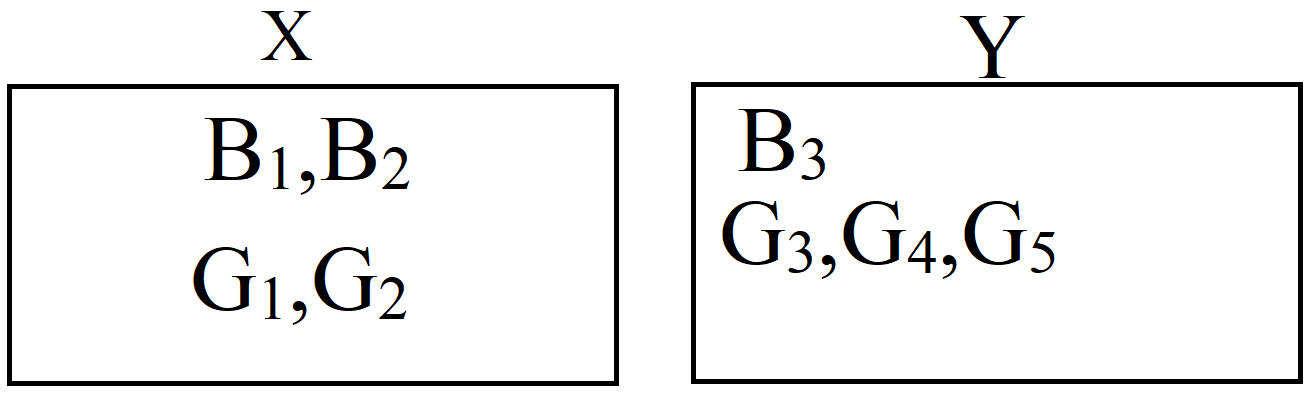
then there are four possibilities for selection of a person which are $B_1, B_2, G_1, G_2. $ Similarly, there will be four possibilities for room $Y.$
So, the sample space is
$S = \{XB_1, XB_2, XG_1, XG_2, YB_3, YG_3, YG_4, YG_{5\}}.$ View full question & answer→MCQ 41 Mark
Directions: In the following questions, the Assertions $(A)$ and Reason(s) $(R)$ have been put forward. Read both the statements carefully and choose the correct alternative from the following:
Assertion: A coin is tossed. If it shows head, we draw a ball from a bag consisting of $3$ brown and $4$ red balls; if it shows tail we throw a die, then the sample space of this experiment is $S = \{HB_1, HB_2, HB_3, HR_1, HR_2, HR_3, HR_4, T1, T2, T3, T4, T5, T6\}.$
Reason: Consider the experiment in which a coin is tossed repeatedly until a head comes up, then the sample space is $S = \{H, TH, TTH, TTTH,........ \}.$
- A
Assertion and Reason both are correct statements and Reason is the correct explanation of Assertion.
- ✓
Assertion and Reason both are correct statements but Reason is not the correct explanation of Assertion.
- C
Assertion is correct statement but Reason is wrong statement.
- D
Assertion is wrong statement but Reason is correct statement.
AnswerCorrect option: B. Assertion and Reason both are correct statements but Reason is not the correct explanation of Assertion.
Assertion: Let us denote brown balls by $B_1, B_2, B_3,$ and the red balls by $R_1, R_2, R_3, R_4. $ Then, a sample space of the experiment is $S = \{HB_1, HB_2, HB_3, HR_1, HR_2, HR_3, HR_4, T1, T2, T3, T4, T5, T6\}.$
Reason: In the experiment, head may come up on the $1^{st}$ toss, or the $2^{nd}$ toss, or the $3^{rd}$ toss and so on till head is obtained. Hence, the desired sample space is $S = \{H, TH, TTH, TTTH, TTTTH......\}$
View full question & answer→MCQ 51 Mark
Directions: In the following questions, the Assertions $(A)$ and Reason$(s) (R)$ have been put forward. Read both the statements carefully and choose the correct alternative from the following:
Consider the experiment of rolling a die. Then, sample space is $S = \{1, 2, 3, 4, 5, 6\}.$
Assertion: If sample space of an experiment is $S = \{1, 2, 3, 4, 5, 6\}$ and the events $A$ and $B$ are defined as
$A :$ “a number less than or equal to $3$ appears”
$B :$ “ anumber greater than or equal to $3$ appears”,
then $A$ and $B$ are exhaustive events.
Reason: Events are exhaustive if atleast one of them necessarily occur whenever the experiment is performed.
- ✓
Assertion and Reason both are correct statements and Reason is the correct explanation of Assertion.
- B
Assertion and Reason both are correct statements but Reason is not the correct explanation of Assertion.
- C
Assertion is correct statement but Reason is wrong statement.
- D
Assertion is wrong statement but Reason is correct statement.
AnswerCorrect option: A. Assertion and Reason both are correct statements and Reason is the correct explanation of Assertion.
We have $A =\{1, 2, 3\}$ and $B = \{3, 4, 5, 6\}$
Since $\text{A}\cup\text{B}=\text{S},$
so, $A$ and $B$ are exhaustive events.
View full question & answer→