Questions

3 Marks Question

Take a timed test

12 questions · self-marked practice — reveal the answer and mark yourself.

Question 13 Marks
Show that for any sets A and B, A = ( A $\cap$ B ) $\cup$ ( A – B ) and A $\cup$ ( B – A ) = ( A $\cup$ B )
Answer
We have to prove: $A=(A \cap B) \cup(A-B)$
Proof: Let $x \in A$
Now, we need to show that $x \in(A \cap B) \cup(A-B)$
In Case I,
$x \in(A \cap B)$
$\Rightarrow X \in(A \cap B) \subset(A \cup B) \cup(A-B)$
In Case II,
$X \notin A \cap B$
$\Rightarrow x \notin B \ or \ x \notin A$
$\Rightarrow X \notin B(X \notin A)$
$\Rightarrow X \notin A-B \subset(A \cup B) \cup(A-B)$
$\therefore A \subset(A \cap B) \cup(A-B)(i)$
It can be concluded that, $A \cap B \subset A \ and \ (A-B) \subset A$
Therefore, (A $\cap$ B) $\cap$ (A - B) $\subset $ A (ii)
Equating (i) and (ii),we get
$A=(A \cap B) \cup(A-B)$
Now, we need to show, $A \cup(B-A) \subset A \cup B$
Suppose that,
$X \in A \cup(B-A)$
$X \in A \ or \ X \in(B-A)$
$\Rightarrow X \in A \ or \ (X \in B \text { and } X \notin A)$
$\Rightarrow(X \in A \text { or } X \in B) \ and \ (X \in A \text { and } X \notin A)$
$\Rightarrow X \in(B \cup A)$
$\therefore A \cup(B-A) \subset(A \cup B)$(iii)
Now, to prove: $(A \cup B) \subset A \cup(B-A)$
Let y $\in A\cup B$
$\mathrm{y} \in \mathrm{A}\ or \ \mathrm{y} \in \mathrm{B}$
$(y \in A \text { or } y \in B)\ and \ (X \in A \text { and } X \notin A)$
$\Rightarrow y \in A \ or \ (y \in B \text { and } y \notin A)$
$\Rightarrow y \in A \cup(B-A)$
Therefore, $A \cup B \subset A \cup(B-A)$ (iv)
$\therefore$ Using (iii) and (iv), we obtain
$A \cup(B-A)=A \cup B$
View full question & answer
Question 23 Marks
Show that the following four conditions are equivalent :
  1. $A \subset B$
  2. $A – B = \phi$
  3. $A \cup B = B$
  4. $A \cap B = A$
Answer
Here, first we will prove $(i) \Leftrightarrow (ii)$
Where, $(i) = A \subset B$ and $(ii) = A - B \neq\phi$
Suppose that $\mathrm{A} \subset \mathrm{B}$
Now, we need to prove $A-B \neq \phi$
If possible, let $A-B \neq \phi$
Thus, there exists $X \in A, X \neq B,$ but this is impossible as $A \subset B$
$\therefore A-B=\phi$
And $\mathrm{A} \subset \mathrm{B}\Rightarrow\mathrm{A}-\mathrm{B} \neq \phi$
Let suppose that $\mathrm{A}-\mathrm{B} \neq \phi$
Now, we have to prove: $\mathrm{A} \subset \mathrm{B}$
Let $\mathrm{X} \in \mathrm{A}$
It can be concluded that $\begin{equation} X \in B(\text { if } X \notin B, \text { then } A-B \neq \phi) \end{equation}$
Thus, $A - B = \begin{equation} \phi = A \subset B \end{equation}$
$\therefore (i) \Leftrightarrow (ii)$
Let us assume that $A \subset B$
To prove: $A \cup B = B$
$\begin{equation} \Rightarrow B \subset A \cup B \end{equation}$
Let us assume that, $\begin{equation} x \in A \cup B \end{equation}$
$\begin{equation} \Rightarrow x \in A \text { or } x \in B \end{equation}$
Taking case $I: \begin{equation} X \in B \end{equation}$
$\begin{equation} A \cup B=B \end{equation}$
Taking Case $II : \begin{equation} X \in A \end{equation}$
$\begin{equation} \Rightarrow X \in B(A \subset B) \end{equation}$
$\begin{equation} \Rightarrow A \cup B \subset B \end{equation}$
Let $A \cup B = B$
Let us assume that $\begin{equation} X \in A \end{equation}$
$\begin{equation} \Rightarrow X \in A \cup B(A \subset A \cup B) \end{equation}$
$\begin{equation} \Rightarrow X \in B(A \cup B=B) \end{equation}$
$\begin{equation} \therefore A \subset B \end{equation}$
Thus, $(i) \Leftrightarrow (iii)$
Now, to prove $(i) \Leftrightarrow (iv)$
Suppose that $A \subset B$
It can be observed that $\begin{equation} A \cap B \subset A \end{equation}$
Let $\begin{equation} X \in A \end{equation}$
To show: $\begin{equation} X \in A \cap B \end{equation}$
Since, $\begin{equation} A \subset B \text { and } X \in B \end{equation}$
Therefore, $\begin{equation} \mathrm{X} \in \mathrm{A} \cap \mathrm{B} \end{equation}$
$\begin{equation} \Rightarrow A \subset A \cap B \end{equation}$
$\begin{equation} \Rightarrow A=A \cap B \end{equation}$
Similarly, let us assume that $\begin{equation} \mathrm{A} \cap \mathrm{B}=\mathrm{A} \end{equation}$
Let $\begin{equation} X \in A \end{equation}$
$\begin{equation} \Rightarrow X \in A \cap B \end{equation}$
$\begin{equation} \Rightarrow X \in B \text { and } X \in A \end{equation}$
$\begin{equation} \Rightarrow A \subset B \end{equation}$
$\therefore (i) \Leftrightarrow (ii)$
Therefore, proved that $(i) \Leftrightarrow (ii) \Leftrightarrow (iii) \Leftrightarrow (iv)$
View full question & answer
Question 33 Marks
In a survey it was found that 21 people liked product A, 26 liked product B and 29 liked product C. If 14 people liked products A and B, 12 people liked products C and A, 14 people liked products B and C and 8 liked all the three products. Find how many liked product C only?
Answer
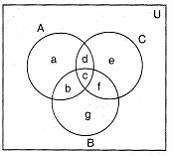
Here
n (A) = a + b + c + d = 21 ....(i)
n(B) = b + c + f + g = 26 ....(ii)
n(C) = c + d + e + f = 29 ....(iii)
$n(A \cap B) $ = b + c = 14 ....(iv)
$n(C \cap A) $ = c + d = 12 ....(v)
$n(B \cap C) $ = c + f = 14 ....(vi)
$n(A \cap B \cap C) $ = c = 8 ....(vii)

Putting value of c in (iv), (v) and (vi)
b + 8 = 14 $\Rightarrow $ b = 6
8 + d = 12 $\Rightarrow $ d = 4
8 + f = 14 $\Rightarrow $ f = 6
Putting value of c, d, f in (iii),
8 + 4 + e + 6 = 29 $\Rightarrow $ e = 29 - 18 = 11
Number of people who like product C only = 11
View full question & answer
Question 43 Marks
Let A and B are sets. If $A \cap X = B \cap X = \phi $ and $A \cup X = B \cup X$ for some set X. Show that A = B.
[Hints A = A $\cap$ ( A $\cup$ X ) , B = B $\cap$ ( B $\cup$ X ) and use Distributive law ]
Answer
Here $A \cup X = B \cup X$for some X
$\Rightarrow A \cap (A \cup X) = A \cap (B \cup X)$
$\Rightarrow A = (A \cap B) \cup (A \cap X)$$\,[\because A \cap (A \cup X) = A]$
$ \Rightarrow A = (A \cap B) \cup \phi $$[\because A \cap X = \phi ]$
$ \Rightarrow A = A \cap B$. . . (i)
$ \Rightarrow A \subset B$
Also $A \cup X = B \cup X$
$ \Rightarrow B \cap (A \cup X) = B \cap (B \cup X)$
$\Rightarrow (B \cap A) \cup (B \cap X) = B\,$$[\because B \cap (B \cup X) = B]$
$\Rightarrow (B \cap A) \cup \phi = B$$[\because B \cap X = \phi ]$
$\Rightarrow B \cap A = B$
$\Rightarrow B \cap A$. . . (ii)
From (i) and (ii), we have
A = B.
View full question & answer
Question 53 Marks
Decide among the following sets which sets are subsets of each another:
A = {X : X $\in$ R} and x satisfies x2 - 8x + 12 = 0}, B = {2, 4, 6} , C = {2, 4, 6, 8, ...}, D = {6}
Answer
It is given in the question that,
$A=\left\{x: x \in R \text { and } x \text { satisfy } x^{2}-8 x+12=0\right\}$
As, 2 and 6 are the only solutions of $x^{2}-8 x+12=0$
$\therefore A=\{2,6\}$
Also it is given that,
$B=\{2,4,6\}$
$C=\{2,4,6,8, \ldots .\}$
And, $D=\{6\}$
$\therefore \mathrm{D} \subset \mathrm{A} \subset \mathrm{B} \subset \mathrm{C}$
Hence, $A \subset B, A \subset C, B \subset C, D \subset A, D \subset B, D \subset C$
View full question & answer
Question 63 Marks
A college awarded 38 medals in Football, 15 in Basketball and 20 in Cricket. If these medals went to a total of 58 men and only three men got medals in all three sports, then how many received medals in exactly two of the three sports.
Answer
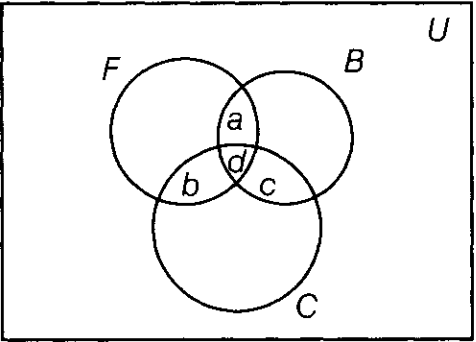
Suppose $n(F), n(B)\ and\ n(C)$ denote the number of men who received medals in Football, Basketball and Cricket, respectively. Then,
n(F) = 38, n(B) = 15, n(C) = 20, n($F \cup B \cup C$) = 58 and n($F \cap B \cap C$) = 3
$\because n ( F \cup B \cup C )$= n(F) + n(B) + n(C) + $n ( F \cap B \cap C )$ $- n ( F \cap B ) - n ( F \cap C ) - n ( B \cap C )$
58 = 38 + 15 + 20 + 3$- n ( F \cap B ) - n ( F \cap C ) - n ( B \cap C )$
$\Rightarrow n ( F \cap B ) + n ( F \cap C ) + n ( B \cap C )$ = 76 - 58 = 18

Here, 'a' = the number of men who got medals in Football and Basketball only.
‘b' = the number of men who got medals in Football and Cricket only.
'c' = the number of men who got medals in Basketball and Cricket only.
'd ’= the number of men who got medals in all the three games.
Thus, d = $n ( F \cap B \cap C )$ = 3
and $n ( F \cap B ) + n ( F \cap C ) + n ( B \cap C )$ = 18
$\Rightarrow$ (a + d) + (b + d) + (c + d) = 18
$\Rightarrow$ a + b + c + 3d = 18
$\Rightarrow$ a + b + c+ 3(3) = 18 [Put d = 3, given]
$\therefore$ a + b + c = 9
Hence, people who got medals in exactly two of the three sports is 9.
View full question & answer
Question 73 Marks
Out of 500 car owners investigated, 400 owned Maruti car and 200 owned Hyundai car, 50 owned both cars. Is this data correct?
Answer
Let U be the set of the total number of car owners investigated, M be the set of persons who owned Maruti cars and H be the set of persons who owned Hyundai cars.
According to Question,
n (U) = 500, n(M) = 400, n (H) = 200 and n(M $\cap$ H) = 50.
Now, We know that
$n ( M \cup H ) = n ( M ) + n ( H ) - n ( M \cap H ) $
= 400 + 200 - 50
= 550
But,
$M \cup H \subseteq U$
$\therefore n ( M \cup H ) \leq n ( U ) $
⇒ n(M∪H) ≤ 500
but 550 > 500
Therefore, it is a contradiction. Hence, the given data is incorrect.
View full question & answer
Question 83 Marks
A market research group conducted a survey of 1000 consumers and reported that 720 consumers like product A and 450 consumers like product B, what is the least number that must have liked both products?
Answer
Let U be the set of consumers questioned, S be the set of consumers who liked the product A and T be the set of consumers who like the product B.
Given that:
n(U) = 1000, n(S) = 720, n(T) = 450
Therefore, n(S $\cup$ T) = n(S) + n(T) – n(S ∩ T)
= 720 + 450 – n (S ∩ T) = 1170 – n(S $\cup$ T)
Thus, n(S $\cup$ T) is maximum when n(S $\cap$ T) is least. But S $\cup$ T $\subset$ U implies
n(S $\cup$ T) ≤ n ($\cup$) = 1000. So, maximum values of n(S $\cup$ T) is 1000.
Therefore, the least value of n(S $\cup$ T) is 170.
View full question & answer
Question 93 Marks
Show that A $\cup$ B = A $\cap$ B implies A = B
Answer
Suppose a $\in$ A.
Then a $\in$ A $\cup$ B. Since A $\cup$ B = A $\cap$ B , a $\in$ A $\cap$ B. So a $\in$ B.
Thus,A ⊂ B. Similarly, if b ∈ B, then b ∈ A ∪ B.
A $\cup$ B = A $\cap$ B, b $\in$ A $\cap$ B. So, b $\in$ A.
Thus, B $\subset$ A. $\Rightarrow$ A = B
View full question & answer
Question 103 Marks
In a survey of 400 students in a school, 100 were listed as taking apple juice, 150 as taking orange juice and 75 were listed as taking both apple as well as orange juice. Find how many students were taking neither apple juice nor orange juice.
Answer
Let A denote the set of students taking apple juice and B denote the set of students taking orange juice
n(U) = 400, n(A) = 100, n (B) = 150 n(A $ \cap $) =75
$n\left( {A' \cap B'} \right) = n\left( {A \cup B} \right)'$
$ = n\left( \cup \right) - n\left( {A \cup B} \right)$
$ = n\left( \cup \right) - [n(A) + n(B) - n(A \cap B)]$
=400-100-150+75=225
View full question & answer
Question 113 Marks
In a class of 35 students, 24 like to play cricket and 16 like to play football. Also, each student likes to play at least one of the two games. How many students like to play both cricket and football?
Answer
Let C be the set of students who like to play cricket and F be the set of students who like to play football.
Here n(C) = 24, n(F) = 16, $n(C \cup F) $ = 35.
We know that
$n(C \cup F) = n(C) + n(F) - n(C \cap F)$
35 = 24 + 16 - $n(C \cap F)$
$n(C \cap F) $ = 40 - 35 = 5
View full question & answer
Question 123 Marks
Let U be universal set of all the students of Class XI of a coeducational school and A be the set of all girls in Class XI. Find A′.
Answer
We know that,In a coeducational school, there can be only boys and girls in a school.
A is the set of all girls,then
A' = Set of all Students - Set of all girls
A' = Set of all boys in class XI
View full question & answer