MCQ 11 Mark
Directions: In the following questions, a statement of assertion $(A)$ is followed by a statement of reason $(R).$ Mark the correct choice as:
Assertion: If $\text{A}\subset\text{B}$ for any two sets $A$ and $B.$
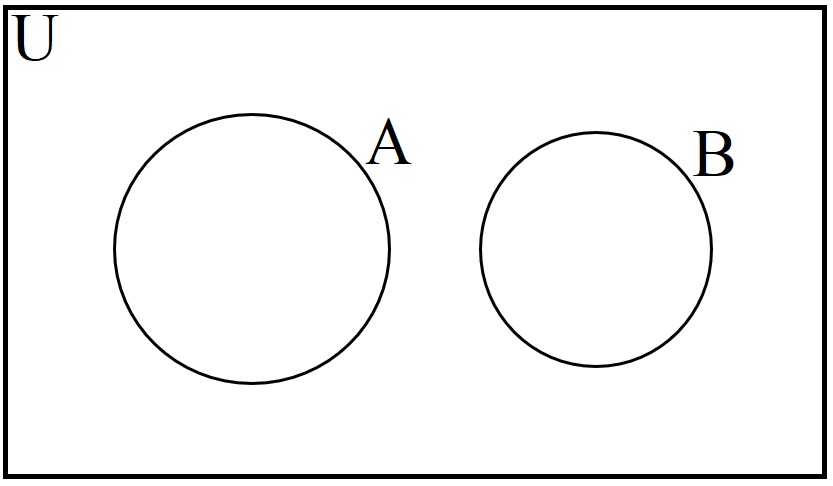
Then, above Venn diagram represents correct relationship between $A$ and $B.$
Reason: If $\text{A}\subset\text{B},$ then all elements of $A$ is also in $B.$ - A
$A$ is true, $R$ is true; $R$ is a correct explanation of $A.$
- B
$A$ is true, $R$ is true; $R$ is not a correct explanation of $A.$
- C
$A$ is true; $R$ is false.
- ✓
$A$ is false; $R$ is true.
AnswerCorrect option: D. $A$ is false; $R$ is true.
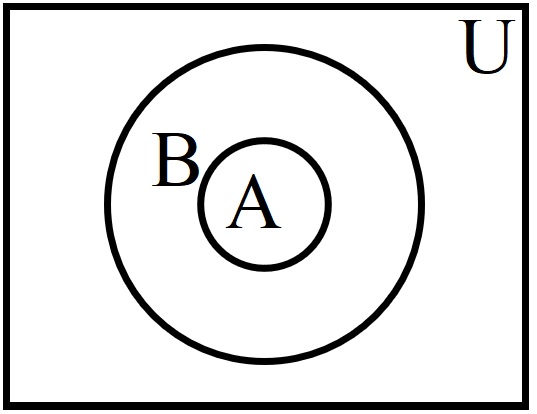
Assertion: If $\text{A}\subset\text{B},$ then every element of $A$ is in $B.$
Hence, this can be represented by Venn diagram as
View full question & answer→MCQ 21 Mark
Directions: In the following questions, a statement of assertion $(A)$ is followed by a statement of reason $(R).$ Mark the correct choice as:
Assertion: The set $D = \{x : x$ is a prime number which is a divisor of $60\}$ in roster form is $\{1, 2, 3, 4, 5\}.$
Reason: The set $E =$ the set of all letters in the word $‘\text{TRIGONOMETRY}’,$ in the roster form is $\text{\{T, R, I, G, O, N, M, E, Y\}}.$
- A
$A$ is true, $R$ is true; $R$ is a correct explanation of $A.$
- B
$A$ is true, $R$ is true; $R$ is not a correct explanation of $A.$
- C
$A$ is true; $R$ is false.
- ✓
$A$ is false; $R$ is true.
AnswerCorrect option: D. $A$ is false; $R$ is true.
Assertion: We can write $60 = 2 \times 2 \times 3 \times 5.$
$\therefore$ Prime factors of $60$ are $2, 3$ and $5.$
Hence, the set $D$ in roster form is $\{2, 3, 5\}.$
Reason: There are $12$ letters in the word $‘\text{TRIGONOMETRY’}$ out of which three letters $T, R$ and $O$ are repeated.
Hence, set $Z$ in the roster form is $\text{\{T, R, I, G, O, N, M, E, Y\}.}$
View full question & answer→MCQ 31 Mark
Directions: In the following questions, a statement of assertion $(A)$ is followed by a statement of reason $(R)$. Mark the correct choice as:
Assertion: The set $A = \{x : x$ is an even prime number greater than $2\}$ is the empty set.
Reason: The set $B = \{x : x^2 = 4, x$ is odd$\} $ is not an empty set.
- A
$A $ is true, $R$ is true; $R$ is a correct explanation of $A.$
- B
$A$ is true, $R$ is true; $R$ is not a correct explanation of $A$.
- ✓
$A $ is true; $R$ is false.
- D
$A$ is false; $R$ is true.
AnswerCorrect option: C. $A $ is true; $R$ is false.
Assertion: $2$ is the only even prime number.
So, set $A$ is the empty set.
Reason: The equation $x^2 = 4$ is not satisfied by any odd value of $x$.
So, set $B$ is the empty set.
View full question & answer→MCQ 41 Mark
Directions: In the following questions, a statement of assertion $(A)$ is followed by a statement of reason $(R).$ Mark the correct choice as:
Assertion: If $n(A) = 3, n(B) = 6$ and $\text{A}\subset\text{B},$ then the number of elements in $\text{A}\cup\text{B}$ is $9.$
Reason: If $A$ and $B$ are disjoint, then $\text{n}(\text{A}\cup\text{B})$ is $\text{n(A) + n(B).}$
- A
$A$ is true, $R$ is true; $R$ is a correct explanation of $A.$
- B
$A$ is true, $R$ is true; $R$ is not a correct explanation of $A.$
- C
$A$ is true; $R$ is false.
- ✓
$A$ is false; $R$ is true.
AnswerCorrect option: D. $A$ is false; $R$ is true.
Assertion: $\text{A}\subset\text{B}$
$\Rightarrow\text{n}(\text{A}\cup\text{B})=\text{n}(\text{B})=6$
Reason: If $A$ and $B$ are disjoint, then
$\text{n}(\text{A}\cup\text{B})=\text{n}(\text{A})+\text{n}(\text{B})$
View full question & answer→MCQ 51 Mark
Directions: In the following questions, a statement of assertion $(A)$ is followed by a statement of reason $(R).$ Mark the correct choice as:
Assertion: The interval $\{\text{x}:\text{x}\in\text{R},-4<\text{x}\leq6\}$ is represented by $(-4, 6).$
Reason: The interval $\{\text{x}:\text{x}\in\text{R}, -12 -4 < x < 10\}$ is represented by $[-12, -10].$
- A
$A$ is true, $R$ is true; $R$ is a correct explanation of $A.$
- B
$A$ is true, $R$ is true; $R$ is not a correct explanation of $A.$
- ✓
$A$ is true; $R$ is false.
- D
$A$ is false; $R$ is true.
AnswerCorrect option: C. $A$ is true; $R$ is false.
Assertion: The interval $\{\text{x}:\text{x}\in\text{R},-4<\text{x}\leq6\}$ is represented by $(-4, 6).$
Reason: The interval $\{\text{x}:\text{x}\in\text{R}, -12 -4 < x < 10\}$ is represented by $(-12, -10).$
View full question & answer→MCQ 61 Mark
Directions: In the following questions, a statement of assertion $(A)$ is followed by a statement of reason $(R).$ Mark the correct choice as:
Assertion: Let $A = \{a, b\}$ and $B = \{a, b, c\}.$ Then, $A ⊄ B.$
Reason: If $\text{A}\subset\text{B},$ then $\text{A}\cup\text{B}=\text{B}.$
- A
$A$ is true, $R$ is true; $R$ is a correct explanation of $A.$
- B
$A$ is true, $R$ is true; $R$ is not a correct explanation of $A.$
- C
$A$ is true; $R$ is false.
- ✓
$A$ is false; $R$ is true.
AnswerCorrect option: D. $A$ is false; $R$ is true.
Assertion: $A = \{a, 5\}, B = \{a, b, c\}$
Since, all the elements of $A$ are in $B.$
So, $\text{A}\subset\text{B}$
Reason: $\therefore\text{A}\subset\text{B}$
$\Rightarrow\text{A}\cup\text{B}=\text{B}.$
View full question & answer→MCQ 71 Mark
Directions: In the following questions, a statement of assertion $(A)$ is followed by a statement of reason $(R).$ Mark the correct choice as:
Assertion: The set $A = \{a, b, c, d, e, g\}$ is finite set.
Reason: The set $B = \{$men living presently in different parts of the world$\}$ is finite set.
- A
$A$ is true, $R$ is true; $R$ is a correct explanation of $A.$
- ✓
$A$ is true, $R$ is true; $R$ is not a correct explanation of $A.$
- C
$A$ is true; $R$ is false.
- D
$A$ is false; $R$ is true.
AnswerCorrect option: B. $A$ is true, $R$ is true; $R$ is not a correct explanation of $A.$
Assertion: We know that, a set which is empty or consists of a definite number of elements, is called finite, other wise the set is called infinite.
Since, set $A$ contains finite number of elements.
So, it is a finite set.
Reason: We do not know the number of elements in $B,$ but it is some natural number.
So, $B$ is also finite.
View full question & answer→MCQ 81 Mark
Directions: In the following questions, a statement of assertion $(A)$ is followed by a statement of reason $(R).$ Mark the correct choice as:
Assertion: ‘The collection of all natural numbers less than $100”$ is a set.
Reason: A set is a well $-$ defined collection of the distinct objects.
- ✓
$A$ is true, $R$ is true; $R$ is a correct explanation of $A.$
- B
$A$ is true, $R$ is true; $R$ is not a correct explanation of $A.$
- C
$A$ is true; $R$ is false.
- D
$A$ is false; $R$ is true.
AnswerCorrect option: A. $A$ is true, $R$ is true; $R$ is a correct explanation of $A.$
Assertion: The collection of all natural numbers less than $100’,$ is a well $-$ defined collection.
So, it is a set.
View full question & answer→MCQ 91 Mark
Directions: In the following questions, a statement of assertion $(A)$ is followed by a statement of reason $(R).$ Mark the correct choice as:
Assertion: Let $A = \{1, 2, 3\}$ and $B = \{1, 2, 3, 4\}$. Then, $\text{A}\subset\text{B}.$
Reason: If every element of $X$ is also an element of $Y$, then $X$ is a subset of $Y.$
- ✓
$A$ is true, $R$ is true; $R$ is a correct explanation of $A.$
- B
$A$ is true, $R$ is true; $R$ is not a correct explanation of $A.$
- C
$A$ is true; $R$ is false.
- D
$A$ is false; $R$ is true.
AnswerCorrect option: A. $A$ is true, $R$ is true; $R$ is a correct explanation of $A.$
Assertion: Since, every element of $A$ is in $B,$
so $\text{A}\subset\text{B}.$
View full question & answer→MCQ 101 Mark
Directions: In the following questions, a statement of assertion $(A)$ is followed by a statement of reason $(R)$. Mark the correct choice as:
Assertion: The set $\{x : x$ is a month of a year not having $31$ days$\}$ in roster form is $\{$February, April, June, September, November$\}.$
Reason: The set $F = \{x : x$ is a consonant in the English alphabet which precedes $k\}$ in roster form is $F = \{b, c, d, f, g, h, J\}.$
- A
$A$ is true, $R$ is true; $R$ is a correct explanation of $A.$
- ✓
$A$ is true, $R$ is true; $R$ is not a correct explanation of $A.$
- C
$A$ is true; $R$ is false.
- D
$A$ is false; $R$ is true.
AnswerCorrect option: B. $A$ is true, $R$ is true; $R$ is not a correct explanation of $A.$
Assertion: The months not containing $31$ days are February, April, June, September, November.
So, the given set in roster form is $\{$February, April, June, September, November$\}.$
Reason: The given set can be represented in roster form as $F = \{b, c, d, f, g, h, j\}.$
View full question & answer→MCQ 111 Mark
Directions: In the following questions, a statement of assertion $(A)$ is followed by a statement of reason $(R)$. Mark the correct choice as:
Assertion: The set $\{1, 4, 9, ... 100\}$ in the set $-$ builder form is $\{x : x = n^2, $ where $\text{n}\in\text{N}$ and $1\leq\text{n}\leq10\}.$
Reason: In roster form, the order in which the elements are listed is, immaterial.
- A
$A$ is true, $R$ is true; $R$ is a correct explanation of $A.$
- ✓
$A$ is true, $R$ is true; $R$ is not a correct explanation of $A.$
- C
$A$ is true; $R$ is false.
- D
$A$ is false; $R$ is true.
AnswerCorrect option: B. $A$ is true, $R$ is true; $R$ is not a correct explanation of $A.$
Assertion: We see that each member in the given set is the square of a natural number.
Hence, the given set in set $-$ builder form is $\{x : x = n^2,$ where $\text{n}\in\text{N}$ and $1\leq\text{n}\leq10\}.$
Therefore, Assertion is true.
View full question & answer→MCQ 121 Mark
Directions: In the following questions, a statement of assertion $(A)$ is followed by a statement of reason $(R)$. Mark the correct choice as:
Assertion: Set of English alphabets is the universal set for the set of vowels in English alphabets.
Reason: The set of vowels is the subset of set of consonants in the English alphabets.
- A
$A$ is true, $R$ is true; $R$ is a correct explanation of $A.$
- B
$A$ is true, $R$ is true; $R$ is not a correct explanation of $A.$
- ✓
$A$ is true; $R$ is false.
- D
$A$ is false; $R$ is true.
AnswerCorrect option: C. $A$ is true; $R$ is false.
Assertion: Since, the set of vowels is the subset of the set of English alphabets.
So, the set of English alphabets is the universal set for set of vowels in English alphabets.
Reason: We know set of vowels is not the subset of the set of consonants.
View full question & answer→MCQ 131 Mark
Directions: In the following questions, a statement of assertion $(A)$ is followed by a statement of reason $(R).$ Mark the correct choice as:
Assertion: If $A =$ set of prime numbers less than $6$ and $B =$ set of prime factors of $30,$ then $A = B.$
Reason: If $P = \{1, 2, 3\}$ and $Q = \{2, 2, 1, 3, 3\},$ then $P$ and $Q$ are not equal.
- A
$A$ is true, $R$ is true; $R$ is a correct explanation of $A.$
- B
$A$ is true, $R$ is true; $R$ is not a correct explanation of $A.$
- ✓
$A$ is true; $R$ is false.
- D
$A$ is false; $R$ is true.
AnswerCorrect option: C. $A$ is true; $R$ is false.
Assertion: $A = \{2, 3, 5\}$ Factors of $30$ are $1, 2, 3, 5, 6, 10, 15$ and $30.$
So, $B = \{2, 3, 5\}$
$\therefore A = B$
Reason: We know that, a set does not change, if one or more elements of the set are repeated.
Hence, Pand Qare equal.
View full question & answer→MCQ 141 Mark
Directions: In the following questions, a statement of assertion $(A)$ is followed by a statement of reason $(R).$ Mark the correct choice as:
Assertion: The power set of the set $\{1, 2\}$ is the set $\{\phi, \{1\}, \{2\}, \{1, 2\}\}.$
Reason: The power set is set of all subsets of the set.
- ✓
$A$ is true, $R$ is true; $R$ is a correct explanation of $A.$
- B
$A$ is true, $R$ is true; $R$ is not a correct explanation of $A.$
- C
$A$ is true; $R$ is false.
- D
$A$ is false; $R$ is true.
AnswerCorrect option: A. $A$ is true, $R$ is true; $R$ is a correct explanation of $A.$
Assertion: The subsets of the sets $\{1, 2\}$ are $\phi, \{1\}, \{2\}$ and $\{1, 2\}.$
So, $P(A) = \{\phi, \{1\}, \{2\}. \{1, 2\}\}.$
View full question & answer→MCQ 151 Mark
Directions: In the following questions, a statement of assertion $(A)$ is followed by a statement of reason $(R).$ Mark the correct choice as:
Assertion: The set of positive integers greater than $100$ is infinite.
Reason: The set of prime numbers less than $99$ is finite.
- A
$A$ is true, $R$ is true; $R$ is a correct explanation of $A.$
- ✓
$A$ is true, $R$ is true; $R$ is not a correct explanation of $A.$
- C
$A$ is true; $R$ is false.
- D
$A$ is false; $R$ is true.
AnswerCorrect option: B. $A$ is true, $R$ is true; $R$ is not a correct explanation of $A.$
Assertion: There are infinite positive integer greater than $100$.
So, the set of positive integers greater than $100$ is infinite.
Reason: There are $25$ prime numbers less than $99.$
So, the set of prime numbers less than $99$ is finite.
View full question & answer→