Questions

Case study (4 Marks)

Take a timed test

6 questions · self-marked practice — reveal the answer and mark yourself.

Question 14 Marks
A class teacher Mamta Sharma of class $XI$ write three sets $A, B$ and Care such that $A = \{1, 3, 5, 7, 9\}, B = \{2, 4, 6, 8\}$ and $C = \{2, 3, 5, 7, 11\}.$
Answer the following questions which are based on above sets.
  1. Find $\text{A}\cap\text{B}.$
  1. $\{3, 5, 7\}$
  2. $\phi$
  3. $\{1, 5, 7\}$
  4. $\{2, 5, 7\}$
  1. Find $\text{A}\cap\text{C}.$
  1. $\{3, 5, 7\}$
  2. $\{1, 5, 7\}$
  3. $\phi$
  4. $\{3, 4, 7\}$
  1. Which of the following is correct for two sets $A$ and $B$ to be disjoint?
  1. $\text{A}\cap\text{B}=\phi$
  2. $\text{A}\cap\text{B}\neq\phi$
  3. $\text{A}\cup\text{B}=\phi$
  4. $\text{A}\cup\text{B}\neq\phi$
  1. Which of the following is correct for two sets $A$ and $C$ to be intersecting?
  1. $\text{A}\cap\text{C}=\phi$
  2. $\text{A}\cap\text{C}\neq\phi$
  3. $\text{A}\cup\text{C}=\phi$
  4. $\text{A}\cup\text{C}\neq\phi$
  1. Write the $n[P(B)].$
  1. $8$
  2. $4$
  3. $16$
  4. $12$
Answer
We have, $A = \{1, 3, 5, 7, 9\},$
$B = \{2, 4, 6, 8\}$ and $C = \{2, 3, 5, 7, 11\}$
  1. $(b) \phi$
Solution:
$\text{A}\cap\text{B}=\{1,3,5,7,9\}\cap\{2,4,6,8\}$
$=\phi$
  1. $(a) \{3, 5, 7\}$
Solution:
$\text{A}\cap\text{C}=\{1,3,5,7,9\}\cap\{2,3,5,7,11\}$
$=\{3,5,7\}$
  1. $(a) \text{A}\cap\text{B}=\phi$
Solution:
Here, $\text{A}\cap\text{B}=\phi$
  1. $(b) \text{A}\cap\text{C}\neq\phi$
Solution:
The correct option for intersecting of two sets $A$ and $C$ is
$\text{A}\cap\text{C}\neq\phi$
  1. $(c) 16$
Solution:
The number of elements in set $B$ are $4.$
Therefore, the number of elements in $n[P(B)]$ are $2^4 $ i.e. $16.$
View full question & answer
Question 24 Marks
The school organised a farewell party for $100$ students and school management decided three types of drinks will be distributed in farewell party ie. Milk $(M),$ Coffee $(C)$ and Tea $(T)$. Organiser reported that $10$ students had all the three drinks $M, C, T. 20$ students had $M$ and $C; 30$ students had $C$ and $T; 25$ students had $M$ and $T. 12$ students.had $M$ only; $5$ students had $C$ only; $8$ students had $T$ only.

Based on the above information, answer the following questions.
  1. The number of students who did not take any drink, is
  1. $20$
  2. $30$
  3. $10$
  4. $25$
  1. The number of students who prefer Milk is
  1. $47$
  2. $45$
  3. $53$
  4. $50$
  1. The number of students who prefer Coffee is
  1. $47$
  2. $53$
  3. $45$
  4. $50$
  1. The number of students who prefer Tea is
  1. $51$
  2. $53$
  3. $50$
  4. $47$
  1. The number of students who prefer Milk and Coffee but not tea is
  1. $12$
  2. $10$
  3. $15$
  4. $20$
Answer
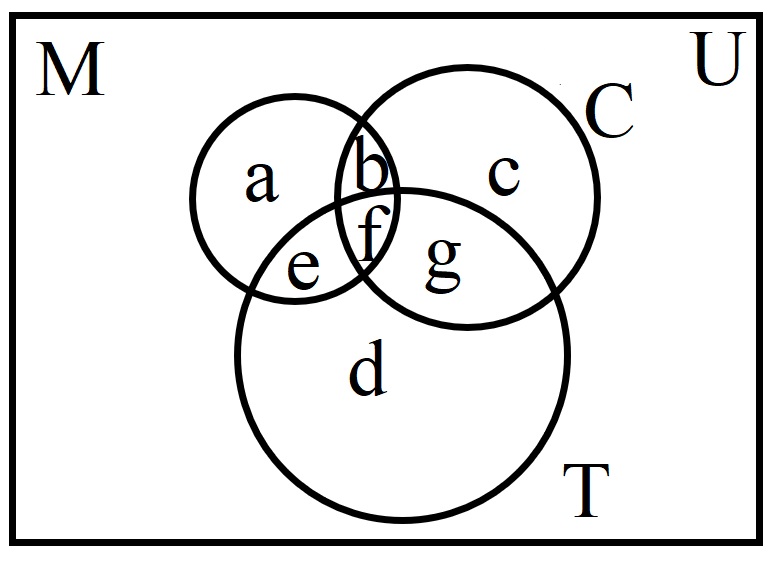
Consider the following Venn diagram

where,
$a =$ Number of students who had $M$ only
$b =$ Number of students who had $M$ and $C$ only
$c =$ Number of students who had $C$ only
$d =$ Number of students who had $T$ only
$e =$ Number of students who had $M$ and $T$ only
$f =$ Number of students who had three drinks $M, C, T$ and $g =$ Number of students who had $C$ and $T$ only
Then, we have
$a = 12, b + f = 20, c = 5, d = 8, e + f = 25, f = 10$ and $g + f = 30$
$a = 12, b = 10, c = 5, d = 8, e = 15, f = 10$ and $g = 20$
  1. $(a) 20$
Solution:
Number of students who did not take any drink
$= 100 - (a + b + c + d + e + f + g)$
$= 100 - (12 + 10 + 5 + 8 + 15 + 10 + 20)$
$= 100 - 80 = 20$
  1. $(a) 47$
Solution:
Number of students who prefer Milk
$= a + b + f + e = 12 + 10 + 10 + 15 = 47$
  1. $(c) 45$
Solution:
Number of students who prefer Coffee
$= b + c + f + g = 10 + 5 + 10 + 20 = 45$
  1. $(b) 53$
Solution:
Number of students who prefer Tea
$= d + e + f + g = 8 + 15 + 10 + 20 = 53$
  1. $(b) 10$
Solution:
Number of students who prefer Milk and Coffee but not Tea is $4,$ i.e. $10.$
View full question & answer
Question 34 Marks
In a library, $25$ students read physics, chemistry and mathematics books. It was found that $15$ students read mathematics, $12$ students read physics while $11$ students read chemistry. $5$ students read both mathematics and chemistry, $9$ students read physics and mathematics. $4$ students read physics and chemistry and $3$ students read all three subject books.

Based on the above information, answer the following questions.
  1. The number of students who reading only chemistry is:
  1. $5$
  2. $4$
  3. $2$
  4. $1$
  1. The number of students who reading only mathematics is:
  1. $4$
  2. $3$
  3. $5$
  4. $11$
  1. The number of students who reading only one of the subjects is:
  1. $5$
  2. $11$
  3. $8$
  4. $6$
  1. The number of students who reading atleast one of the subject is:
  1. $20$
  2. $22$
  3. $23$
  4. $21$
  1. The number of students who reading none of the subject is:
  1. $2$
  2. $4$
  3. $3$
  4. $5$
Answer
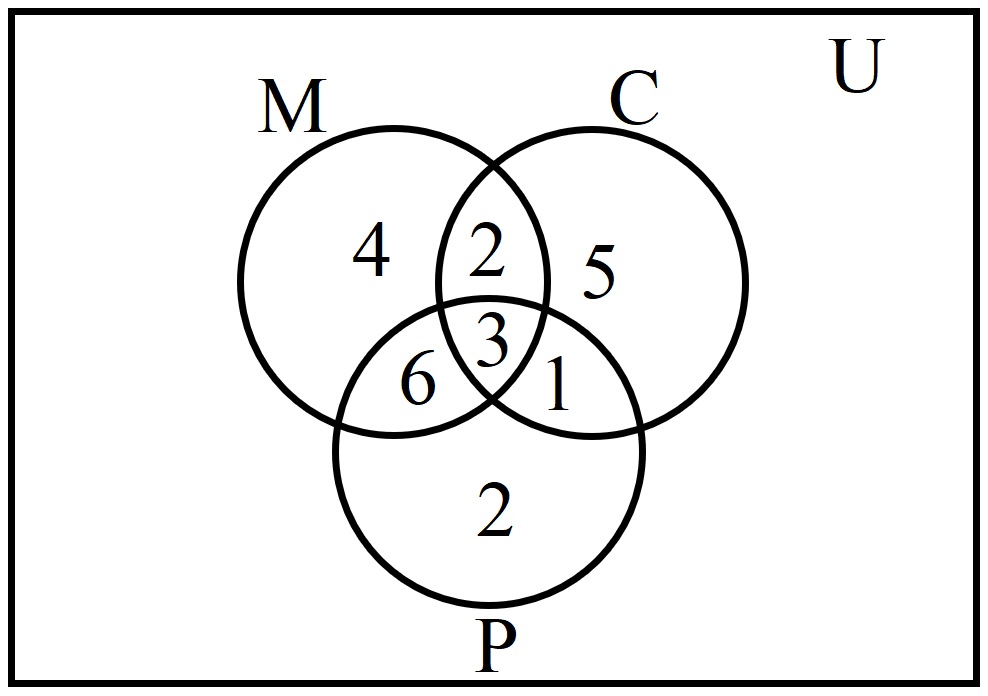
Let $M$ denotes set of student who reading mathematics books, $P$ denotes who reading Physics books and $C$ denotes who reading chemistry books.
we have,
$\text{n}(\text{U})=25,\text{n}(\text{M})=15,\text{n}(\text{P})=12,\text{n}(\text{C})=11,$
$\text{n}(\text{M}\cap\text{C})=5,\text{n}(\text{M}\cap\text{P})=9,\text{n}(\text{P}\cap\text{C})=4,\text{n}(\text{M}\cap\text{P}\cap\text{C})=3$
  1. $(a) 5$
Solution:
The number of students who reading only Chemistry is $5.$
  1. $(a) 4$
Solution:
The number of students who reading only Mathematics is $4.$
  1. $(c) 8$
Solution:
The number of students who reading only one of the subject is $4 + 5 + 2$ i.e. $11.$
  1. $(c) 23$
Solution:
The number of students who reading atleast one of the subject is $4 + 6 + 3 + 2 + 5 + 1 + 2$ i.e. $23.$​​​​​​​
  1. $(a) 2$
Solution:
The number of students who reading none of the subject is $25 - 23$ i.e. $2.$
View full question & answer
Question 44 Marks
In a company, $100$ employees offered to do a work. In out of them, $10$ employees offered ground floor only, $15$ employees offered first floor only, $10$ employees offered second floor only, $30$ employees offered second floor and ground floor to work, $25$ employees offered first and second floor, $15$ employees offered ground and first floor, $60$ employees offered second floor.

Based on the above information answer the following questions.
  1. The number of employees who offered all three floors.
  1. $5$
  2. $3$
  3. $4$
  4. $6$
  1. The number of employees who offered ground floor.
  1. $50$
  2. $60$
  3. $65$
  4. $70$
  1. The number of employees who offered first floor.
  1. $40$
  2. $45$
  3. $50$
  4. $55$
  1. The number of employees who offered ground and first floor but not second floor.
  1. $10$
  2. $15$
  3. $20$
  4. $25$
  1. The number of employees who did not offer any of the above three floors.
  1. $15$
  2. $10$
  3. $5$
  4. $0$
Answer
Let $G, F$ and $S$ be the sets of employees who offered ground floor, first floor and second floor respectively. Let $x$ be the number of employees who offered all three floors, then the number of members in different regions are shown in the following diagram.
  1. $(a) 5$
Solution:
From the Venn diagram, we get the number of employees who offered second floor
$= (30 - x) + x +(25 - x) + 10 = 60 [$given$]$
$65 - x = 60$
$x = 5$
  1. $(a) 50$
Solution:
The number of employees who offered ground floor
$= 10 + (15 - x) + x + (30 - x)$
$= 55 - x$
$= 55 - 5$
$= 50$
  1. $(c) 50$
Solution:
The number of employees who offered first floor
$= 15 + (15 - x) + x + (25 - x)$
$= 55 - x$
$= 55 - 5$
$= 50$
  1. $(a) 10$
Solution:
The number of employees who offered ground and first floor but not second floor
$= 15 - x$
$= 15 - 5$
$= 10$
  1. $(c) 5$
Solution:
The number of employees who offer anyone of the three floors
$= 10 + 15 + 10 + (15 - x) + (25 - x) + (30 - x) + x$
$= 105 - 2x$
$= 105 - 2 . 5$
$= 95$
$\therefore$The number of employees who did not offer any of the three floors
$= 100 - 95$
$= 5$
View full question & answer
Question 54 Marks
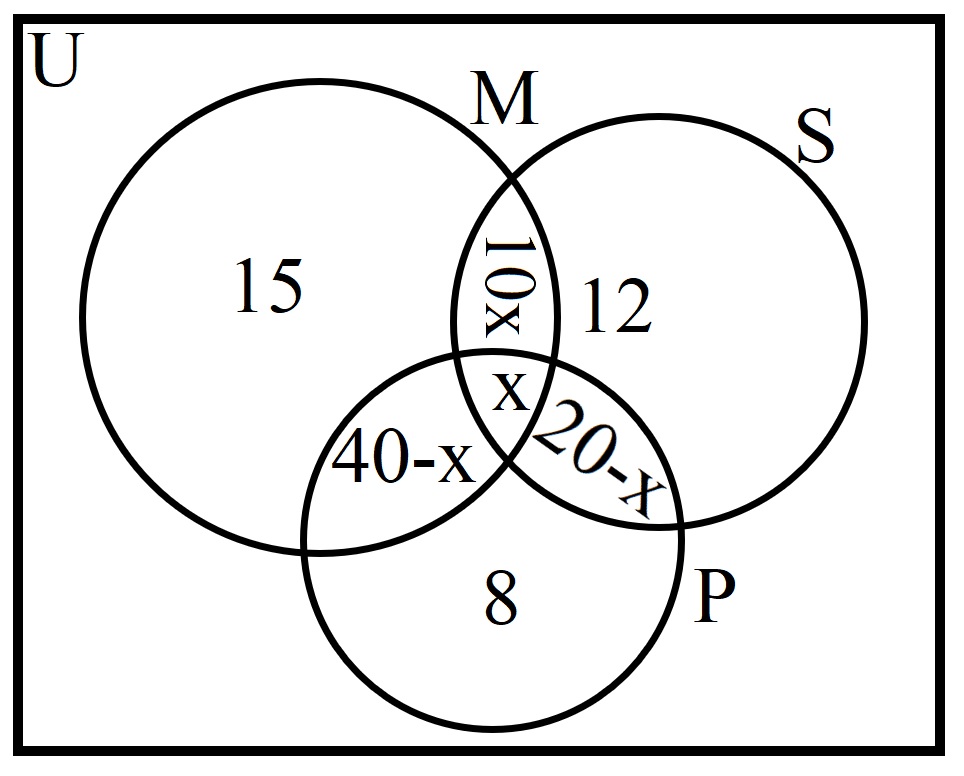
In an University, out of $100$ students $15$ students offered Mathematics only, $12$ students offered Statistics only, $8$ students offered only Physics, $40$ students offered Physics and Mathematics, $20$ students offered Physics and Statistics, $10$ students offered Mathematics and Statistics, $65$ students offered Physics.
Based on the above information answer the following questions.
  1. The number of students who offered all the three subjects is:
  1. $4$
  2. $3$
  3. $2$
  4. $5$
  1. The number of students who offered Mathematics is:
  1. $62$
  2. $65$
  3. $55$
  4. $60$
  1. The number of students who offered statistics is:
  1. $31$
  2. $35$
  3. $39$
  4. $34$
  1. The number of students who offered mathematics and statistics but not physics is:
  1. $7$
  2. $6$
  3. $5$
  4. $4$
  1. The number of students who did not offer any of the above three subjects is:
  1. $4$
  2. $1$
  3. $5$
  4. $3$
Answer
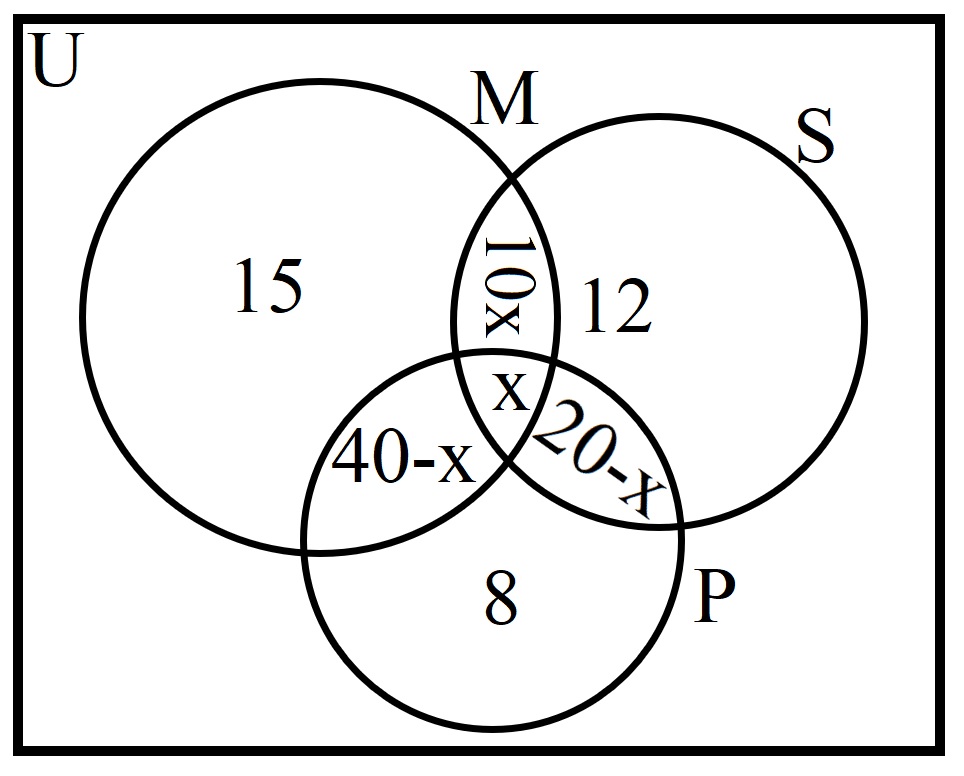
Let $M, S$ and $P$ be the sets of students wo offered Mathematics, Statistics and Physics respectively. Let $x$ be the number of students who offered all the three subjects, then the number of members in different regions are shown in the following diagram.

From the Venn diagram, we get, the number of students who offered Physics.
$= (40 - x) + x + (20 - x) + 8 = 65 [$given$]$
$\Rightarrow 68 - x = 65$
$\Rightarrow x = 3$
  1. $(b) 3$
Solution:
The number of students who offered all the three subjects are $3.$
  1. $(a) 62$
Solution:
The number of students who offered Mathematics
$= 15 + (10 - x) + x + (40 - x)$
$= 65 - x$
$= 65 - 3 = 62 [\because x = 3]$
  1. $(c) 39$
Solution:
The number of students who offered Statistics
$= 12 + (10 - x) + x + (20 - x)$
$= 42 - x$
$= 42 - 3 = 39 [\because x = 3]$​​​​​​​
  1. $(a) 7$
Solution:
$10 - x = 10 - 3 = 7$
  1. $(b) 1$
Solution:
The number of students who offered anyone of the three subjects
$= 15 + 12 + 8 + (10 - x) + (40 - x) + (20 - x) + x$
$= 105 - 2x$
$= 105 - 2 . 3 = 99 [\because x = 3]$
$\therefore$ The number of students who did not offer anyone of the three subjects $= 100 -99 =1$
View full question & answer
Question 64 Marks
The school organised a cultural event for $100$ students. In the event, $15$ students participated in dance, drama and singing. $25$ students participated in dance and drama; $20$ students participated in drama and singing; $30$ students participated in dance and singing. $8$ students participated in dance only; $5$ students in drama only and $12$ students in singing only.

Based on the above information, answer the following questions.
  1. The number of students who participated in dance, is:
  1. $18$
  2. $30$
  3. $40$
  4. $48$
  1. The number of students who participated in drama, is:
  1. $35$
  2. $30$
  3. $25$
  4. $20$
  1. The number of students who participated in singing, is:
  1. $42$
  2. $45$
  3. $47$
  4. $37$
  1. The number of students who participated in dance and drama but not in singing, is:
  1. $20$
  2. $5$
  3. $10$
  4. $15$
  1. The number of students who did not participate in any of the events, is:
  1. $20$
  2. $30$
  3. $25$
  4. $35$
Answer
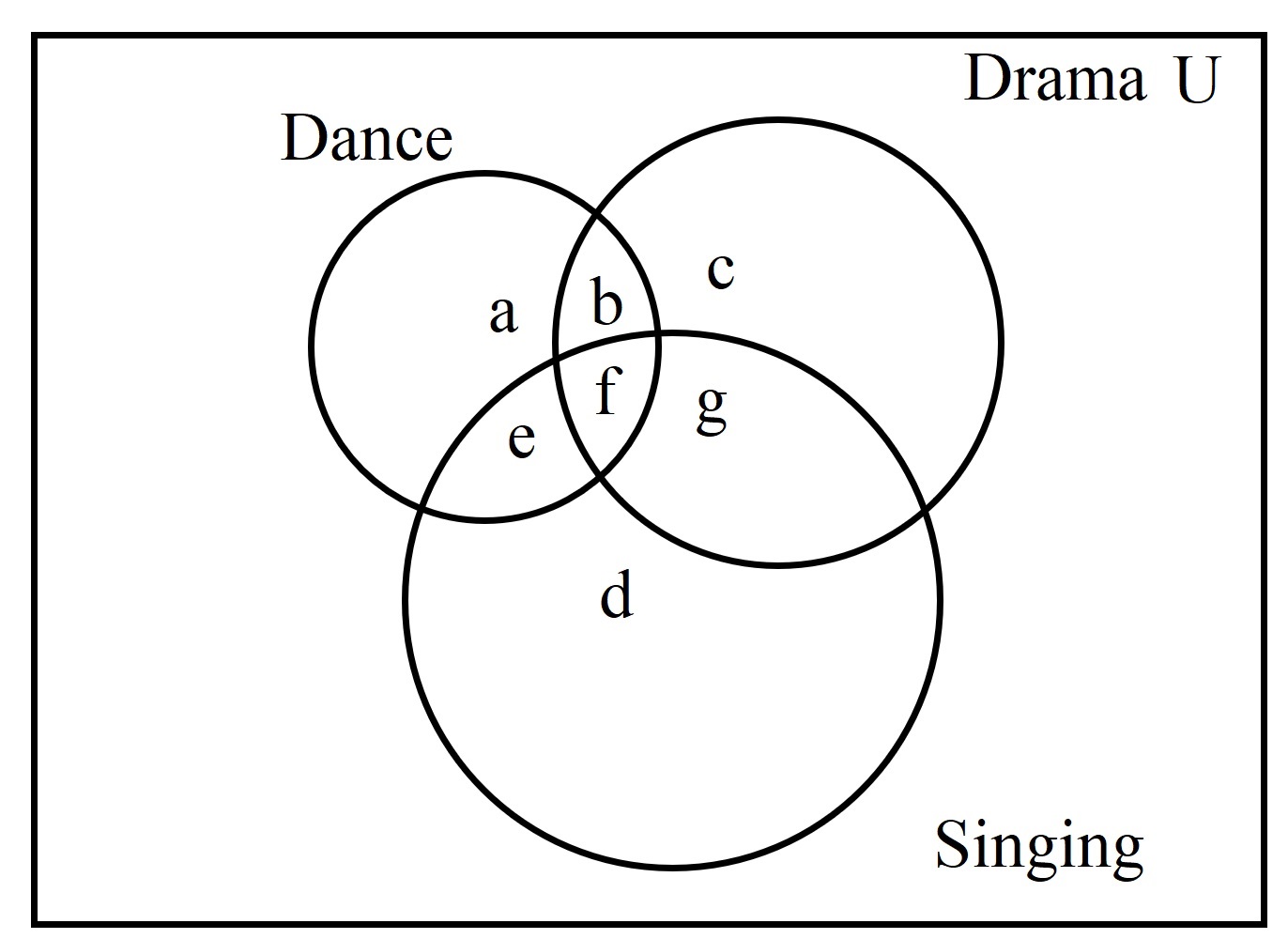
Consider the following Venn diagram

Where,
$a =$ Number of students who participated in dance only
$b =$ Number of students who participated in dance and drama only
$c =$ Number of students who participated in drama only
$d =$ Number of students who participated in singing only
$e =$ Number of students who participated in dance and singing only
$f =$ Number of students who participated in all three events dance, drama and singing and
$g =$ Number of students who participated in drama and singing only
Then, we have
$a = 8, b + f = 25, c = 5, d = 12, e + f = 30, f = 15$ and $g + f = 20$
$\Rightarrow a = 8, b = 10, c = 5, d = 12, e = 15, f = 15$ and $g = 5$
  1. $(d) 48$
Solution:
The number of students who participated in dance
$= a + b + e + f$
$= 8 + 10 + 15 + 15$
$= 48$
  1. $(a) 35$
Solution:
The number of students who participated indram
$a = b + c + f + g$
$= 10 + 5 + 15 + 5$
$= 35$
  1. $(c) 47$
Solution:
The number of students who participated in singing
$= d + e + f + g$
$= 12 + 15 + 15 + 5$
$= 47$
  1. $(c) 10$
Solution:
The number of students who participated in dance and drama but not in singing $= b = 10$.
  1. $(b) 30$
Solution:
The number of students who did not participats in any of the events
$= 100 - (a + b + c + d + e + f + g)$
$= 100 - (8 +10 + 5 + 12 + 15 + 15 + 5)$
$= 100 - (70)$
$= 30$
View full question & answer