Question 13 Marks
A thin prism of crown glass $(\mu_\text{r}=1.515,\mu_\text{v}=1.525)$ and a thin prism of flint glass $(\mu_\text{r}=1.612,\mu_\text{v}=1.632)$ are placed in contact with each other. Their refracting angles are 5.0° each and are similarly directed. Calculate the angular dispersion produced by the combination.
Answer
View full question & answer→Given that,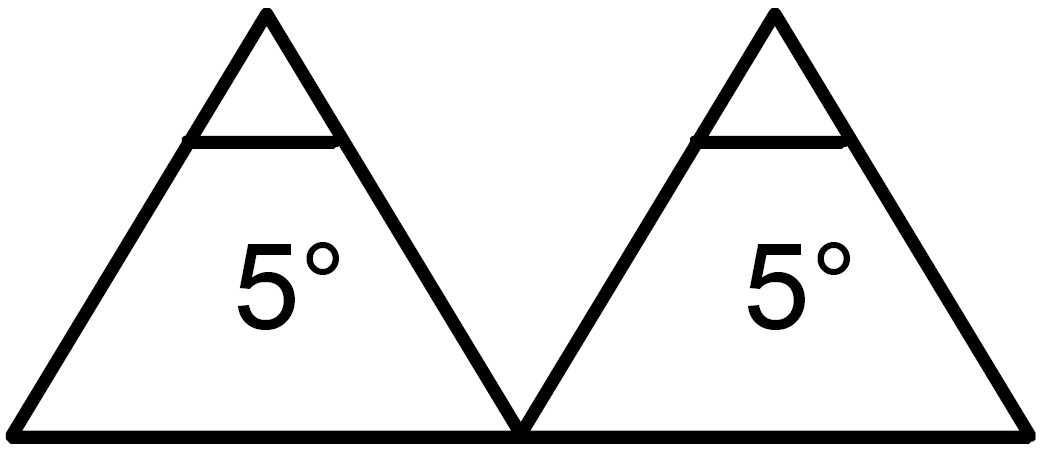
$\mu_\text{cr}=1.515,\mu_\text{cv}=1.525$ and $\mu_\text{fr}=1.612,\mu_\text{fv}=1.632$ and A = 5°
Since, they are similarly directed, the total deviation produced is given by,$\delta=\delta_\text{c}+\delta_\text{r}=(\mu_\text{c}-1)\text{A}+(\mu_\text{r}-1)\text{A}$ $=(\mu_\text{c}+\mu_\text{r}-2)\text{A}$
So, angular dispersion of the combination is given by,$\delta_\text{v}-\delta_\text{y}=(\mu_\text{cv}+\mu_\text{fv}-2)\text{A}-(\mu_\text{cr}+\mu_\text{fr}-2)\text{A}$
$=(\mu_\text{cv}+\mu_\text{fv}-\mu_\text{cr}-\mu_\text{fr})\text{A}$ $=(1.525+1.632-1.515-1.612)5=0.15^\circ$
$\mu_\text{cr}=1.515,\mu_\text{cv}=1.525$ and $\mu_\text{fr}=1.612,\mu_\text{fv}=1.632$ and A = 5°
Since, they are similarly directed, the total deviation produced is given by,$\delta=\delta_\text{c}+\delta_\text{r}=(\mu_\text{c}-1)\text{A}+(\mu_\text{r}-1)\text{A}$ $=(\mu_\text{c}+\mu_\text{r}-2)\text{A}$
So, angular dispersion of the combination is given by,$\delta_\text{v}-\delta_\text{y}=(\mu_\text{cv}+\mu_\text{fv}-2)\text{A}-(\mu_\text{cr}+\mu_\text{fr}-2)\text{A}$
$=(\mu_\text{cv}+\mu_\text{fv}-\mu_\text{cr}-\mu_\text{fr})\text{A}$ $=(1.525+1.632-1.515-1.612)5=0.15^\circ$
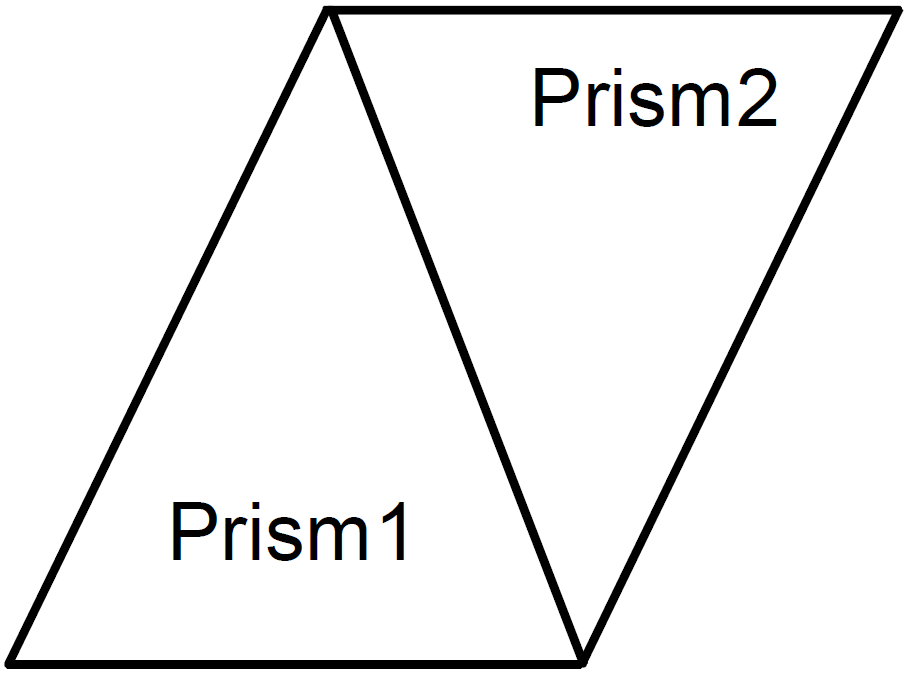 $\mu'_\text{v}=1.52$ and $\mu_\text{v}=1.62,\delta_\text{v}=1^\circ$