Questions

5 Marks Questions

Take a timed test

3 questions · self-marked practice — reveal the answer and mark yourself.

Question 15 Marks
The refractive index of a material $M_1$ changes by $0.014$ and that of another material $M_2$ changes by $0.024$ as the colour of the light is changed from red to violet. Two thin prisms one made of $M_1(A = 5.3^\circ)$ and other made of $M_2(A = 3.7^\circ)$ are combined with their refracting angles oppositely directed.
  1. Find the angular dispersion produced by the combination.
  2. The prisms are now combined with their refracting angles similarly directed. Find the angular dispersion produced by the combination.
Answer
Given that, $\mu'_\text{v}-\mu'_\text{r}=0.014$ and $\mu_\text{v}-\mu_\text{r}=0.024$ $\text{A}' = 5.3^\circ\ \text{and A} = 3.7^\circ$
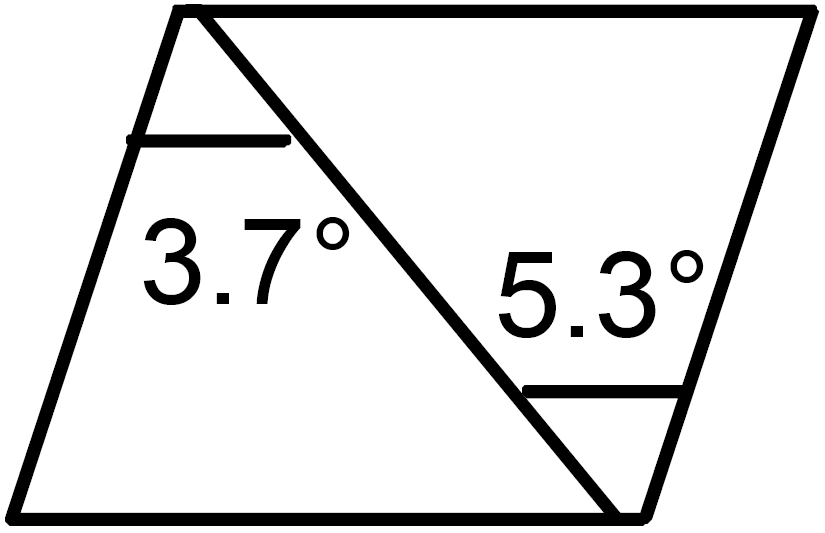
  1. When the prisms are oppositely directed,


angular dispersion $=(\mu_\text{v}-\mu_\text{r})\text{A}-(\mu'_\text{v}-\mu'_\text{r})\text{A}'$
$=0.024\times3.7^\circ-0.014\times5.3^\circ=0.0146^\circ$
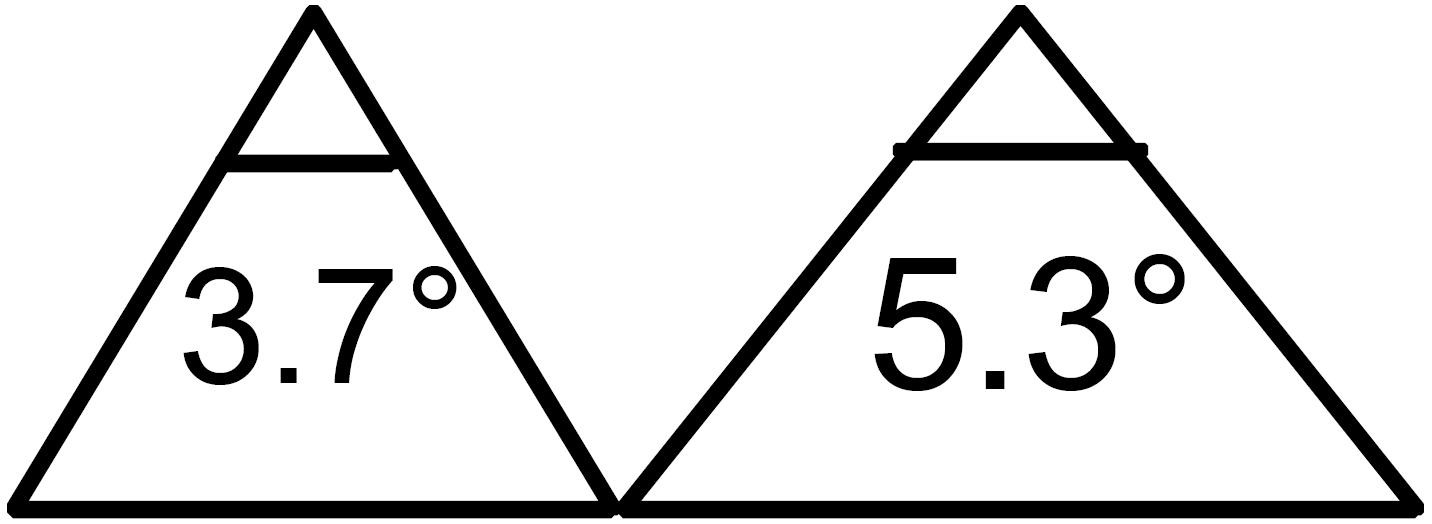
  1. When they are similarly directed,


angular dispersion $=(\mu_\text{v}-\mu_\text{r})\text{A}+(\mu'_\text{v}-\mu'_\text{r})\text{A}'$
$=0.024\times3.7^\circ+0.014\times5.3^\circ=0.163^\circ$
View full question & answer
Question 25 Marks
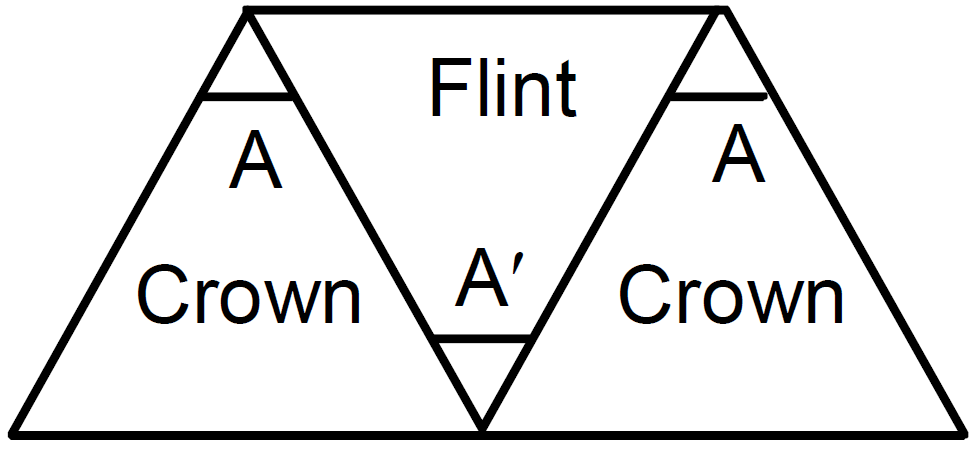
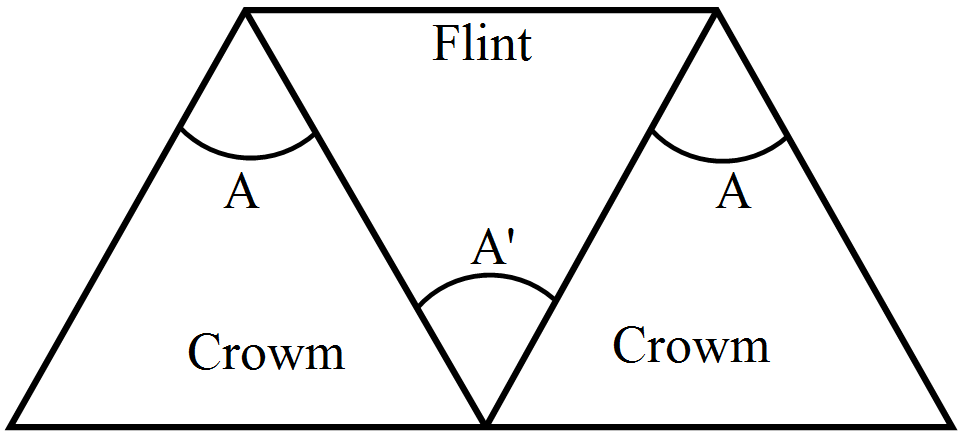
Three thin prisms are combined as shown in figure. The refractive indices of the crown glass for red, yellow and violet rays are $\mu_\text{r},\mu_\text{y}$ and $\mu_\text{v}$ respectively and those for the flint glass are $\mu'_\text{r},\mu'_\text{y}$ and $\mu'_\text{v}$ respectively. Find the ratio $\frac{\text{A}'}{\text{A}}$ for which.
  1. There is no net angular dispersion.
  2. There is no net deviation in the yellow ray.
Answer
Total deviation for yellow ray produced by the prism combination is, $\delta_\text{y}=\delta_\text{cy}-\delta_\text{fy}+\delta_\text{cy}=2\delta_\text{cy}-\delta_\text{fy}$ $=2(\mu_\text{cy}-1)\text{A}-(\mu_\text{cy}-1)\text{A}'$
Similarly the angular dispersion produced by the combination is$\delta_\text{v}-\delta_\text{r}=\big[(\mu_\text{vc}-1)\text{A}-(\mu_\text{vf}-1)\text{A}'+(\mu_\text{vc}-1)\text{A}\big]\\\big[(\mu_\text{rc}-1)\text{A}-(\mu_\text{rf}-1)\text{A}'+(\mu_\text{r}-1)\text{A})\big]$
$=2(\mu_\text{vc}-1)\text{A}-(\mu_\text{vf}-1)\text{A}'$
  1. For net angular dispersion to be zero,
$\delta_\text{v}-\delta_\text{r}=0$
$\Rightarrow2(\mu_\text{vc}-1)\text{A}=(\mu_\text{vf}-1)\text{A}'$
$\Rightarrow\frac{\text{A}'}{\text{A}}=\frac{2(\mu_\text{cv}-\mu_\text{rc})}{(\mu_\text{vf}-\mu_\text{rf}}$
$=\frac{2(\mu_\text{v}-\mu_\text{r})}{(\mu'_\text{v}-\mu'_\text{r})}$
  1. For net deviation in the yellow ray to be zero,
$\delta_\text{y}=0$
$\Rightarrow2(\mu_\text{cy}-1)\text{A}=(\mu_\text{fy}-1)\text{A}'$
$\Rightarrow\frac{\text{A}'}{\text{A}}=\frac{2(\mu_\text{cy}-1)}{(\mu_\text{fy}-1)}$
$=\frac{2(\mu_\text{y}-1)}{(\mu'_\text{y}-1)}$
View full question & answer
Question 35 Marks
A thin prism of angle $6.0^\circ,\omega=0.07$ and $\mu_\text{y}=1.50$ is combined with another thin prism having $\omega=0.08$ and $\mu_\text{y}=1.60.$ The combination produces no deviation in the mean ray.
  1. Find the angle of the second prism.
  2. Find the net angular dispersion produced by the combination when a beam of white light passes through it.
  3. If the prisms are similarly directed, what will be the deviation in the mean ray
  4. Find the angular dispersion in the situation described in (c).
Answer
Given that, $\text{A}'=6^\circ,\ \omega'=0.07,\ \mu'_\text{y}=1.50$$\text{A}=?\ \omega=0.08,\ \mu_\text{y}=1.60$
The combination produces no deviation in the mean ray.
  1. $\delta_\text{y}=(\mu_\text{y}-1)\text{A}-(\mu'_\text{y}-1)\text{A}'=0$ [Prism must be oppositely directed]

$\Rightarrow(1.60-1)\text{A}=(1.50-1)\text{A}'$
$\Rightarrow\text{A}=\frac{0.50\times6^\circ}{0.60}=5^\circ$
  1. When a beam of white light passes through it,
Net angular dispersion $=(\mu_\text{y}-1)\omega\text{A}-(\mu'_\text{y}-1)\omega'\text{A}'$
$\Rightarrow(1.60-1)(0.08)(5^\circ)-(1.50-1)(0.07)(6^\circ)$
$\Rightarrow0.24^\circ-0.21^\circ=0.03^\circ$
  1. If the prisms are similarly directed,

$\delta_\text{y}=(\mu_\text{y}-1)\text{A}+(\mu'_\text{y}-1)\text{A}$
$=(1.60-1)5^\circ+(1.50-1)6^\circ=3^\circ+3^\circ=6^\circ$
  1. Similarly, if the prisms are similarly directed, the net angular dispersion is given by,
$\delta_\text{v}-\delta_\text{r}=(\mu_\text{y}-1)\omega\text{A}-(\mu'\text{y}-1)\omega'\text{A}'$ $=0.24^\circ+0.21^\circ=0.45^\circ$
View full question & answer