MCQ 11 Mark
The electric potential decreases uniformly from $120V$ to $80V$ as one moves on the $x-$axis from $x = -1\ cm$ to $x = + 1\ cm.$ The electric field at the origin.
- ✓Must be equal to $20Vcm^{-1}$
- BMay be equal to $20Vcm^{-1}$
- CMay be greater than $20Vcm^{-1}$
- DMay be lees than $20Vcm^{-1}$
Answer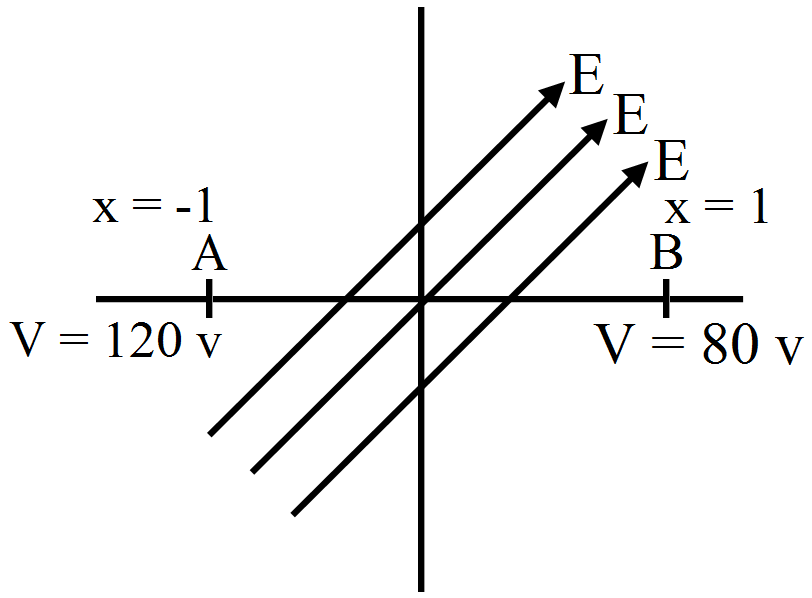
$\triangle\text{V}=-\text{E}.\text{dr}$
$(\text{V}_\text{f}-\text{V}_\text{i})=-\text{E}.\text{dr}=\text{E}_\text{x}(\text{B}-\text{A})$
$(80-120)=-\text{E}_\text{x}.(2)$
$\text{E}_\text{x}=\frac{40}{2}=20\text{v/m}$
If electric field lines lies in $'x\ '$ direction than it may be equal to $20v/cm.$
If Electric field lines liesin $'x - y'$ direction than it may be greater than $20v/cm.$
View full question & answer→Correct option: A.
Must be equal to $20Vcm^{-1}$
$\triangle\text{V}=-\text{E}.\text{dr}$
$(\text{V}_\text{f}-\text{V}_\text{i})=-\text{E}.\text{dr}=\text{E}_\text{x}(\text{B}-\text{A})$
$(80-120)=-\text{E}_\text{x}.(2)$
$\text{E}_\text{x}=\frac{40}{2}=20\text{v/m}$
If electric field lines lies in $'x\ '$ direction than it may be equal to $20v/cm.$
If Electric field lines liesin $'x - y'$ direction than it may be greater than $20v/cm.$