Question 14 Marks
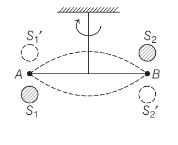
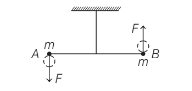
Read the passage given below and answer the following questions from 1 to 5. Cavendish’s Experiment The figure shows the schematic drawing of Cavendish’s experiment to determine the value of the gravitational constant. The bar AB has two small lead spheres attached at its ends. The bar is suspended from a rigid support by a fine wire. Two large lead spheres are brought close to the small ones but on opposite sides as shown. The value of G from this experiment came to be $6.67\times10^{-11}\frac{\text{N-m}^2}{\text{Kg}^2}$
- The big spheres attract the nearby small ones by a force which is:
- equal and opposite
- equal but in same direction
- unequal and opposite
- None of the above
- The net force on the bar is:
- non-zero
- zero
- Data insufficient
- None of these
- The net torque on the bar is:
- zero
- non-zero
- F times the length of the bar, where F is the force of attraction between a big sphere and its neighbouring
- Both (b) and (c)
- The torque produces twist in the suspended wire. The twisting stops when:
- restoring torque of the wire equals the gravitational torque
- restoring torque of the wire exceeds the gravitational torque
- the gravitational torque exceeds the restoring torque of the wire
- None of the above
- After Cavendish’s experiment, there have been given suggestions that the value of the gravitational constant G becomes smaller when considered over very large time period (in billions of years) in the future. If that happens, for our earth:
- nothing will change
- we will become hotter after billions of years
- we will be going around but not strictly in closed orbits
- None of the above
Answer
The force of attraction on small spheres due to big sphere are equal and opposite in direction. Hence, equal and opposite force separated by a fixed distance forms a couple.
$\big|\text{F}_\text{net}\big|=\text{Zero}$
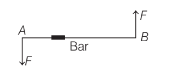
Magnitude of torque due to a couple
= (Either Force) × (Distance between of forces)
= F × l
where, l = length of the bar and F = force of attraction between a big sphere and its neighbouring small sphere.
The torque produces a twist in the suspended wire. The twisting stops when the restoring torque of the wire equal the gravitational torque.
We know that, gravitational force between the earth and the sun.
$\text{F}_\text{g}=\frac{\text{GMm}}{\text{r}^2}$,
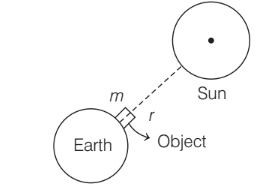
where M is mass of the sun and m is mass of the earth. When G decreases with time, the gravitational force $F_G$ will become weaker with time. As $F_G$ is changing with time. Due to it, the earth will be going around the sun not strictly in closed orbit and radius also increases, since the attraction force is getting weaker. Hence, after long time the earth will leave the solar system.
View full question & answer→- (a) equal and opposite.
The force of attraction on small spheres due to big sphere are equal and opposite in direction. Hence, equal and opposite force separated by a fixed distance forms a couple.
- (b) zero
$\big|\text{F}_\text{net}\big|=\text{Zero}$
- (d) Both (b) and (c)
Magnitude of torque due to a couple
= (Either Force) × (Distance between of forces)
= F × l
where, l = length of the bar and F = force of attraction between a big sphere and its neighbouring small sphere.
- (a) restoring torque of the wire equals the gravitational torque.
The torque produces a twist in the suspended wire. The twisting stops when the restoring torque of the wire equal the gravitational torque.
- (c) we will be going around but not strictly in closed orbits
We know that, gravitational force between the earth and the sun.
$\text{F}_\text{g}=\frac{\text{GMm}}{\text{r}^2}$,
where M is mass of the sun and m is mass of the earth. When G decreases with time, the gravitational force $F_G$ will become weaker with time. As $F_G$ is changing with time. Due to it, the earth will be going around the sun not strictly in closed orbit and radius also increases, since the attraction force is getting weaker. Hence, after long time the earth will leave the solar system.