Questions

2 Marks Questions

Take a timed test

23 questions · self-marked practice — reveal the answer and mark yourself.

Question 12 Marks
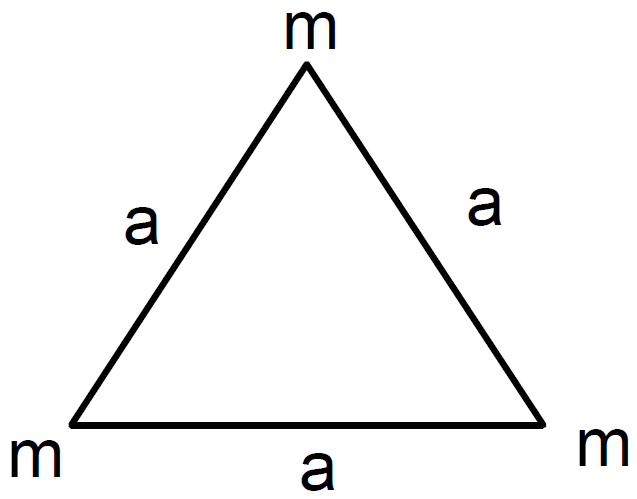
Three particles of mass m each are placed at the three corners of an equilateral triangle of side a. Find the work which should be done on this system to increase the sides of the triangle to 2a.
Answer
Initially, the ride of $\Delta$ is a To increase it to 2a, work done $=\frac{\text{Gm}^2}{2\text{a}}+\frac{\text{Gm}^2}{\text{a}}=\frac{3\text{Gm}^2}{2\text{a}}$
View full question & answer
Question 22 Marks
Find the acceleration due to gravity in a mine of depth 640m if the value at the surface is $9.800 \mathrm{~m} / \mathrm{s}^2$. The radius of the earth is 6400km.
Answer
Let g' be the acceleration due to gravity in mine. Then, $\text{g'}=\text{g}\Big(1-\frac{\text{d}}{\text{R}}\Big)$$=9.8\Big(1-\frac{640}{6400\times10^3}\Big)-9.8\times0.9999=9.799\text{m/s}^2$
View full question & answer
Question 32 Marks
Can you think of two particles which do not exert gravitational force on each other?
Answer
No. All practicals which have mass exert gravitational force on each other. Even massless particles experience the same gravitational force like other particles, because they do have relativistic mass.
View full question & answer
Question 42 Marks
At noon, the sun and the earth pull the objects on the earth's surface in opposite directions. At midnight the sun and the earth pull these objects in same direction. Is the weight of an object, as measured by a spring balance on the earth's surface, more at midnight as compared to its weight at noon?
Answer
No. Due to the revolution of the Earth around the Sun, the gravitational force of the Sun on the Earth system is almost zero. Hence, the body will not experience any force due to the Sun. Therefore, weight of the object will remain the same.
View full question & answer
Question 52 Marks
A mass of $6 \times 10^{24}kg$ (equal to the mass of the earth) is to be compressed in a sphere in such a way that the escape velocity from its surface is $3 \times 10^8m/s$. What should be the radius of the sphere?
Answer
The man of the sphere = $6 \times 10^{24}kg$. Escape velocity = $3 \times 10^8m/s \text{V}_{\text{c}}=\sqrt{\frac{2\text{GM}}{\text{R}}}$
or $\text{R}=\frac{\text{2GM}}{\text{V}_\text{c}^2}$$=\frac{2\times6.67\times10^{-11}\times6\times10^{24}}{(3\times10^8)^2}$
$=\frac{80.02}{9}\times10^{-3}$
$=8.89\times10^{-3}\text{m}\approx9\text{mm}.$
View full question & answer
Question 62 Marks
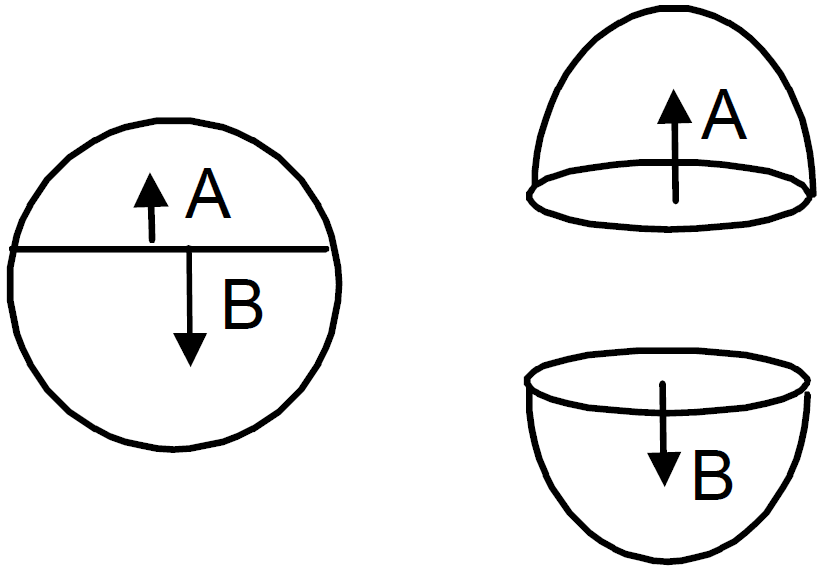
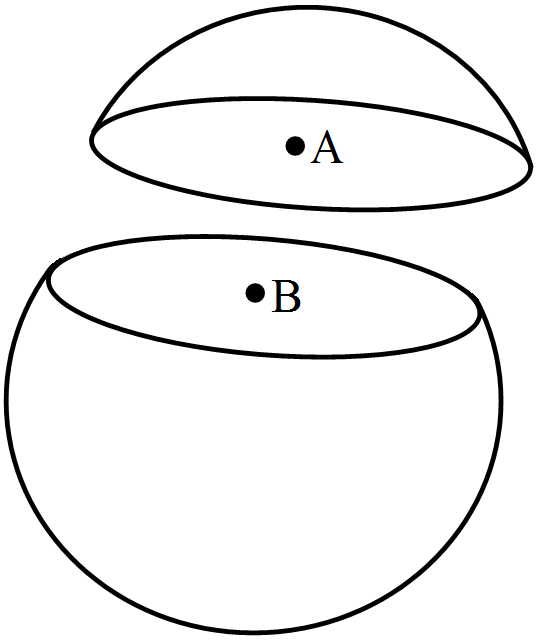
A thin spherical shell having uniform density is cut in two parts by a plane and kept separated as shown in figure (11-E3). The point A is the centre of the plane section of the first part and B is the centre of the plane section of the second part. Show that the gravitational field at A due to the first part is equal in magnitude to the gravitational field at B due to the second part.
Answer
We know in the thin spherical shell of uniform density has gravitational field at its internal point is zero.
At A and B point, field is equal and opposite and cancel each other so Net field is zero.
Hence, $E_A=E_B$
View full question & answer
Question 72 Marks
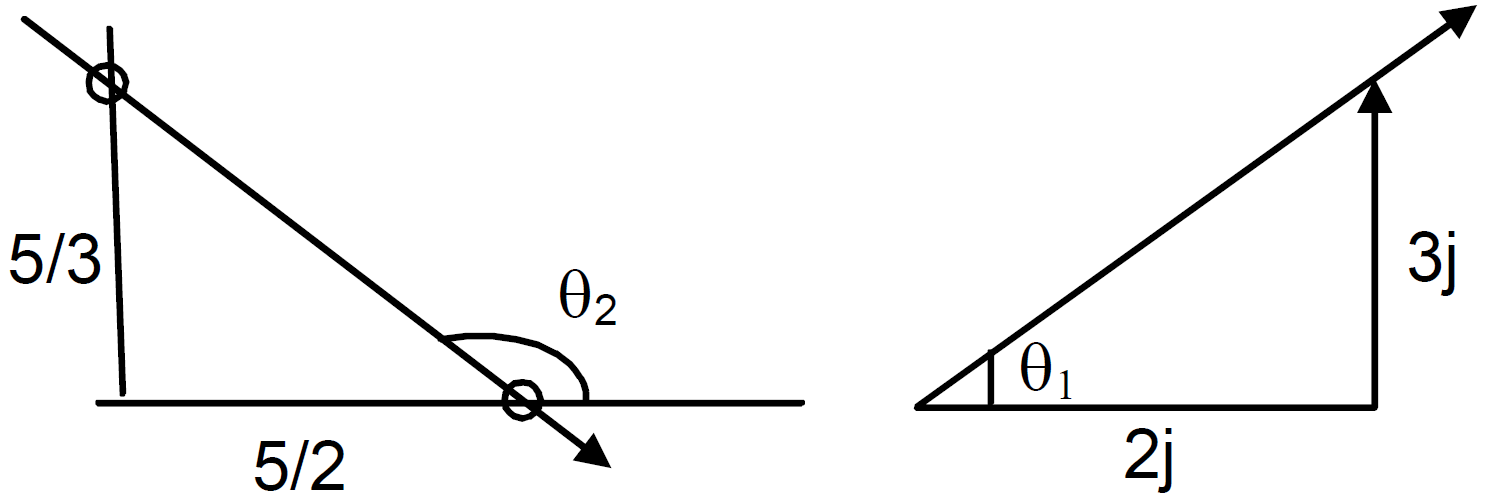
The gravitational field in a region is given by $\text{E}=(2\hat{\text{i}}+3\hat{\text{i}})\text{N/kg}.$ Show that no work is done by the gravitational field when a particle is moved on the line 3y + 2x = 5.
Hint: If a line y = mx + c makes angle $\theta$ with the X-axis, m $=\tan\theta$
Answer
$\overrightarrow{\text{E}}=2\hat{\text{i}}+3\hat{\text{j}}$The field is represented as
$\tan\theta_1=\frac{3}{2}$
Again the line 3y + 2x = 5 can be represented as
$\tan\theta_2=-\frac{2}{3}$
$\text{m}_1\text{M}_2=-1$
Since, the direction of field and the displacement are perpendicular, is done by the particle on the line.
View full question & answer
Question 82 Marks
At what rate should the earth rotate so that the apparent g at the equator becomes zero? What will be the length of the day in this situation?
Answer
The apparent ‘g’ at equator becomes zero.$\text{i}.\text{e}.\ \text{g}'=\text{g}-\omega^2\text{R}=0$
$\text{g}=\omega^2\text{R}$
$\omega=\sqrt{\frac{\text{g}}{\text{R}}}=\sqrt{\frac{9.8}{6400\times10^3}}=\sqrt{1.5\times10^{-6}}$
$=1.2\times10^{-3}\text{rad/s.}$
$\text{T}=\frac{2\pi}{\omega}=\frac{2\times3.14}{1.2\times10^{-3}}=1.5\times10^{-6}\sec.1.41\text{hour}$
View full question & answer
Question 92 Marks
Two spherical balls of mass 10kg each are placed 10cm apart. Find the gravitational force of attraction between them.
Answer
Gravitational force of attraction,$\text{F}=\frac{\text{GMm}}{\text{r}^2}$
$=\frac{6.67\times10^{-11}\times10\times10}{(0.1)^2}=6.67\times10^{-7}\text{N}$
View full question & answer
Question 102 Marks
The radius of a planet is $R_1$ and a satellite revolves round it in a circle of radius $R_2$. The time period of revolution is $T$. Find the acceleration due to the gravitation of the planet at its surface.
Answer
$\text{T}=2\pi\sqrt{\frac{\text{R}_2^3}{\text{gR}_1^2}}$$\text{T}^2=4\pi^2\frac{\text{R}_2^3}{\text{gR}_1^2}$
$\text{g}=\frac{4\pi^2\text{R}_2^3}{\text{T}^2\text{R}_1^2}$
$\therefore$ Acceleration due to gravity of the planet is $=\frac{4\pi^2\text{R}_2^3}{\text{T}^2\text{R}_1^2}$
View full question & answer
Question 112 Marks
Two satellites going in equatorial plane have almost same radii. As seen from the earth one moves from east to west and the other from west to east. Will they have the same time period as seen from the earth? If not, which one will have less time period?
Answer
No, both satellites will have different time periods as seen from the Earth. The satellite moving opposite (east to west) to the rotational direction of the Earth will have less time period, because its relative speed with respect to the Earth is more.
View full question & answer
Question 122 Marks
A nut becomes loose and gets detached from a satellite revolving around the earth. Will it land on the earth? If yes, where will it land? If no, how can an astronaut make it land on the earth?
Answer
No, it will not land on the Earth. The nut will start revolving in the orbit of the satellite with the same orbital speed as that of the satellite due to inertia of motion. An astronaut can make it land on the Earth by projecting it with some velocity toward the Earth.
View full question & answer
Question 132 Marks
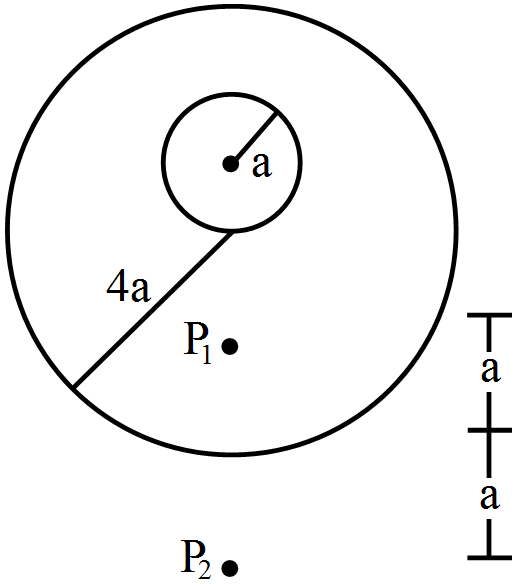
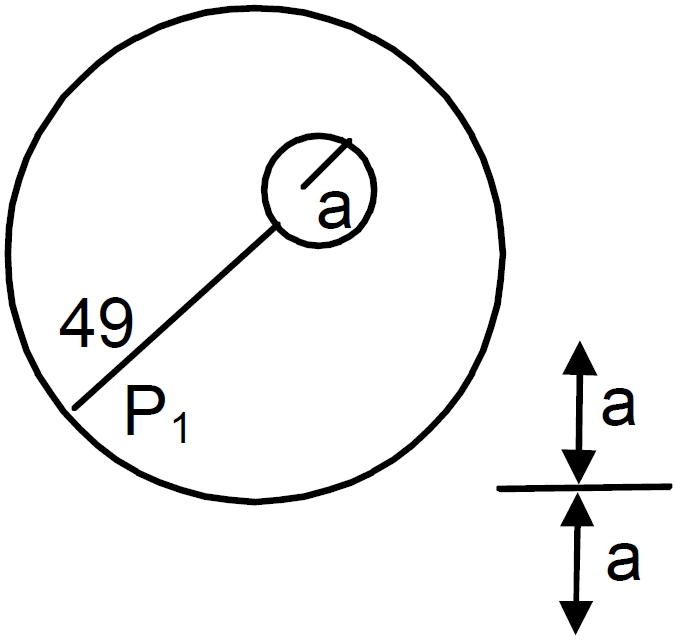
A uniform metal sphere of radius a and mass M is surrounded by a thin uniform spherical shell of equal mass and radius 4a The centre of the shell falls on the surface of the inner sphere. Find the gravitational field at the points $P_1$ and $P_2$ shown in the figure.
Answer
At $P_1$, Gravitational field due to sphere $\text{M}=\frac{\text{GM}}{(3\text{a}+\text{a})^2}=\frac{\text{GM}}{16\text{a}^2}$ At $P_2$, Gravitational field is due to sphere & shell,$=\frac{\text{GM}}{(\text{a}+4\text{a}+\text{a})^2}+\frac{\text{GM}}{(\text{4a}+\text{a})^2}$
$=\frac{\text{GM}}{\text{a}^2}\Big(\frac{1}{36}+\frac{1}{25}\Big)=\Big(\frac{61}{900}\Big)\frac{\text{GM}}{\text{a}^2}$
View full question & answer
Question 142 Marks
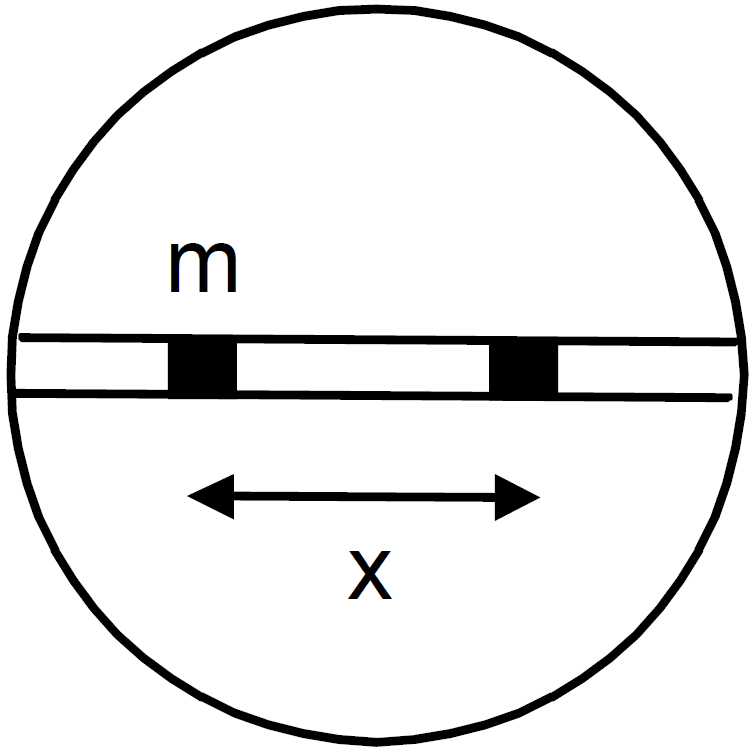
A tunnel is dug along a diameter of the earth. Find the force on a particle of mass m placed in the tunnel at a distance x from the centre.
Answer
Man of earth $\text{M}=\Big(\frac{4}{3}\Big)\pi\text{R}^3\rho$ Man of the imaginary sphere, having Radius $=\text{x}\text{M'}=\Big(\frac{4}{3}\Big)\pi\text{x}^3\rho$ or $\frac{\text{M'}}{\text{M}}=\frac{\text{X}^3}{\text{R}^3}$$\therefore$ Gravitational force on $\text{F}=\frac{\text{GM'm}}{\text{m}^2}$
or $\text{F}=\frac{\text{GMx}^3\text{m}}{\text{R}^3\text{x}^2}=\frac{\text{GMmx}}{\text{R}^3}$
View full question & answer
Question 152 Marks
The earth revolves round the sun because the sun attracts the earth. The sun also attracts the moon and this force is 'about twice as large as the attraction of the earth on the moon. Why does the moon not revolve round the sun? Or does it?
Answer
We know that the Earth-Moon system revolves around the Sun. The gravitational force of the Sun on the system provides the centripetal force its revolution. Therefore, the net force on the system is zero and the Moon does not experience any force from the Sun. This is the reason why the Moon revolves around the Earth and not around the Sun.
View full question & answer
Question 162 Marks
The gravitational field in a region is given by $\overrightarrow{\text{E}}=(5\text{N/kg})\overrightarrow{\text{i}}+(12\text{N/kg})\overrightarrow{\text{j}}.$
  1. Find the magnitude of the gravitational force acting on a particle of mass $2\ kg$ placed at the origin.
  2. Find the potential at the points $(12m, 0)$ and $(0, 5m)$ if the potential at the origin is taken to be zero.
  3. Find the change in gravitational potential energy if a particle of mass $2\ kg$ is taken from the origin to the point $(12m, 5m)$.
  4. Find the change in potential energy if the particle is taken from $(12m, 0)$ to $(0, 5m)$.
Answer
$\overrightarrow{\text{E}}=(5)\text{N/kg)}\hat{\text{i}}+(12\text{N/kg})\hat{\text{j}}$
  1. $\overrightarrow{\text{F}}=\overrightarrow{\text{E}}\text{m}$
$=2\text{kg}[(5\text{N/kg})]\hat{\text{i}}+(12\text{N/kg})\hat{\text{j}}]=(10\text{N})\hat{\text{i}}+(12\text{N})\hat{\text{j}}$
$\bigg|\overrightarrow{\text{F}}\bigg|=\sqrt{100+576}=26\text{N}$
  1. $\overrightarrow{\text{V}}=\overrightarrow{\text{E}}\ \text{r}$
$\text{At}(12\text{m},0)\overrightarrow{\text{V}}=-(60\text{J/kg})\hat{\text{i}}\bigg|\overrightarrow{\text{V}}\bigg|=60\text{J}$
$\text{At}(0, 5\text{m})\overrightarrow{\text{V}}=-(60\text{J/kg})\hat{\text{i}}\bigg|\overrightarrow{\text{V}}\bigg|=-60\text{J}$
  1. $\Delta\overrightarrow{\text{V}}=\int\limits^{(1,\ 2,\ 5)}_{(0,\ 0)}\overrightarrow{\text{E}}\text{mdr}=\Big[\Big[(10\text{N})\hat{\text{i}}+(24\text{N})\hat{\text{j}}\Big]\text{r}\Big]^{\text{12, 5}}_{0, 0}$
$=-(120\text{J}\hat{\text{i}}+120\text{J}\hat{\text{i}}=240\text{J}$
  1. $\Delta\text{V}=-\big[\text{r}(10\text{N}\hat{\text{i}}+24\text{N}\text{j})\Big]^{(0, \ 5\text{m)}}_{12\text{m},\ 0}$
$=-120\hat{\text{j}}+120\hat{\text{i}}=0$
View full question & answer
Question 172 Marks
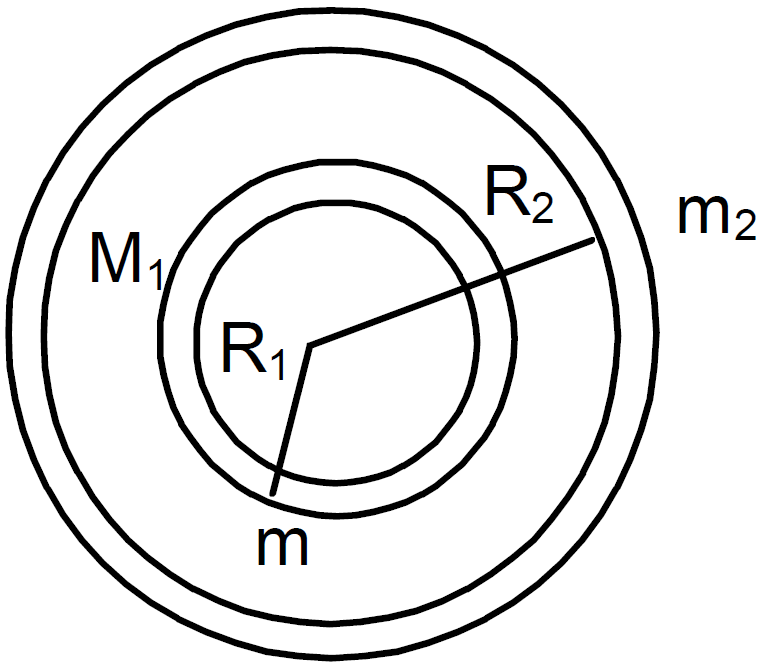
Two concentric spherical shells have masses $M_1, M_2$ and radii $R_1, R_2 (R_1, < R_2)$. What is the force exerted by this system on a particle of mass $m_1$ if it is placed at a distance $\frac{\text{R}_1+\text{R}_2}{2}$ from the centre?
Answer
The gravitational force on ‘m’ due to the shell of $M_2$ is 0. M is at a distance $\frac{\text{R}_1+\text{R}_2}{2}$ Then the gravitational force due to M is given by$=\frac{\text{GM}_1\text{m}}{(\text{R}_1+\text{R}_2)^2}=\frac{4\text{GM}_1\text{m}}{(\text{R}_1+\text{R}_2)^2}$
View full question & answer
Question 182 Marks
What is the acceleration due to gravity on the top of Mount Everest? Mount Everest is the highest mountain peak of the world at the height of 8848m. The value at sea level is $9.80 \mathrm{~m} / \mathrm{s}^2$.
Answer
Let g' be the acceleration due to gravity on mount everest.$\text{g'}=\text{g}\Big(1-\frac{2\text{h}}{\text{R}}\Big)$
$=9.8\Big(1-\frac{17696}{6400000}\Big)=9.8(1-0.00276)=9.773\text{m/s}^2$
View full question & answer
Question 192 Marks
A body is weighed by a spring balance to be 1.000kg at the north pole. How much will it weigh at the equator? Account for the earth's rotation only.
Answer
Let $g^{\prime}$ be the acceleration due to gravity at equation $\&$ that of pole $=g g^{\prime}=g-\omega^2 R$ $=9.81-\left(7.3 \times 10^{-5}\right)^2 \times 6400 \times 10^3=9.81-0.034=9.776 \mathrm{~m} / \mathrm{s}^2 \mathrm{mg}^{\prime}=1 \mathrm{~kg} \times 9.776 \mathrm{~m} / \mathrm{s}^2=9.776 \mathrm{~N}$ or $0.997 \mathrm{~kg}$ The body will weigh $0.997 \mathrm{~kg}$ at equator.
View full question & answer
Question 202 Marks
A Mars satellite moving in an orbit of radius $9.4 \times 10^3 \mathrm{~km}$ takes 27540s to complete one revolution. Calculate the mass of Mars.
Answer
$\text{T}=2\pi\sqrt{\frac{\text{r}^3}{\text{GM}}}$$\Rightarrow27540=2\times3.14\sqrt{\frac{(9.4\times10^3\times10^3)^3}{6.67\times10^{-11}\times\text{M}}}$
$(27540)^2=(6.28)^2\frac{(9.4\times10^6)^2}{6.67\times10^{11}\times\text{M}}$
$\text{M}=\frac{(6.28)^2\times(9.4)^3\times10^{18}}{6.67\times10^{-11}\times(27540)^2}=6.5\times10^{23}\text{kg.}$
View full question & answer
Question 212 Marks
Is it necessary for the plane of the orbit of a satellite to pass through the centre of the earth?
Answer
According to Kepler first law of planetary motion all planets move in elliptical orbits with sun at one of its foci. It applies to any planet and its satellite as well. This implies that plane of the satellite has to pass through the centre of planet (earth).
View full question & answer
Question 222 Marks
Find the height over the earth's surface at which the weight of a body becomes half of its value at the surface.
Answer
Let the height be h$\therefore\Big(\frac{1}{2}\Big)\frac{\text{GM}}{\text{R}^2}=\frac{\text{GM}}{(\text{R}+\text{h})^2}$
$2\text{R}^2=(\text{R}+\text{h})^2$
$\sqrt{2}\text{R}=\text{R}+\text{h}$
$\text{h}=(\text{r}_2-1)\text{R}$
View full question & answer
Question 232 Marks
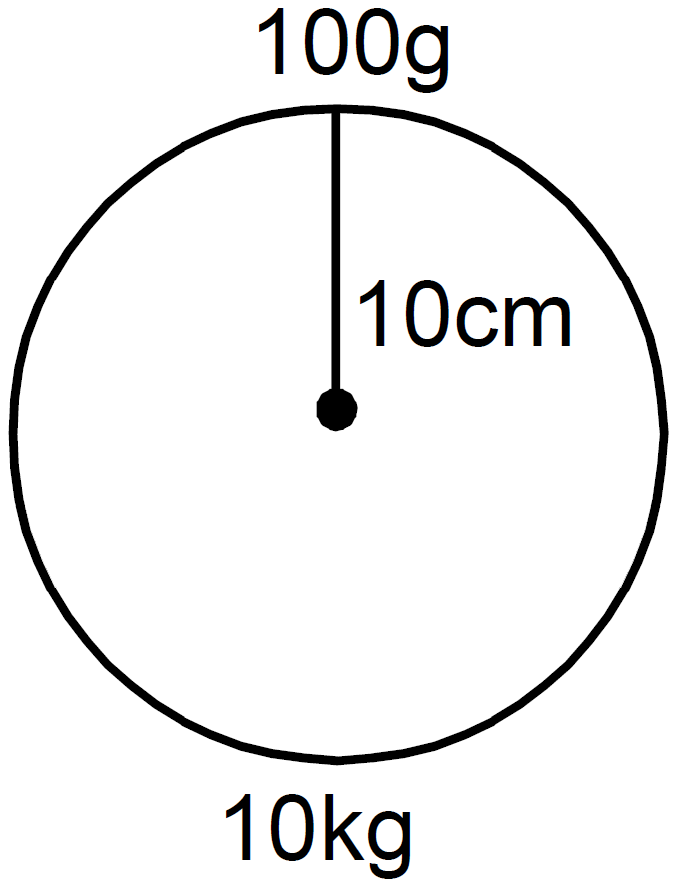
A particle of mass 100g is kept on the surface of a uniform sphere of mass 10kg and radius 10cm. Find the work to be done against the gravitational force between them to take the particle away from the sphere.
Answer
Work done against gravitational force to take away the particle from sphere,$=\frac{\text{G}\times10\times0.1}{0.1\times0.1}$
$=\frac{6.67\times10^{-11}\times1}{1\times10^{-1}}$
$=6.67\times10^{-10}\text{J}$
View full question & answer