Questions

5 Marks Questions

Take a timed test

16 questions · self-marked practice — reveal the answer and mark yourself.

Question 15 Marks
A gas mixture consists of $2.0$ moles of oxygen and $4.0$ moles of neon at temperature T. Neglecting all vibrational modes, calculate the total internal energy of the system. (Oxygen has two rotational modes.)
Answer
To find total energy of a given molecule of a gas we must find its degree of freedom. In molecule of oxygen it has 2 atom.
So it has degree of freedom 3T + 2R = 5, so total internal energy $=\frac{5}{2}\text{RT}$ per mole as gas $O_2$ is 2 mole
So total internal energy of 2 mole oxygen $=\frac{2\times5}{2}\text{RT}=5\text{RT}$
Neon gas is mono atomic so its degree of freedom is only 3 hence total internal energy $=\frac{3}{2}\text{RT}$ per mole.
So, total internal energy of 4 mole Ne $=\frac{4\times3}{2}\text{RT}=6\text{RT}$
Total internal energy of 2 mole oxygen and 4 mole Ne = 5RT + 6RT = 11RT
View full question & answer
Question 25 Marks
A ballon has $5.0g$ mole of helium at $7^\circ C$. Calculate.
  1. The number of atoms of helium in the balloon,
  2. The total internal energy of the system.
Answer
For gas helium n = 5 mole
T = 7 + 273 = 280k
  1. Number of atoms of he is 5 mole = $5 \times 6.023 \times 10^{23}atoms$
$= 30.115 \times 10^{23}$ atoms
$= 30.115 \times 10^{24}$ atoms.
  1. He atoms is mono atomic so degree of freedom is 3 So average kinetic energy
$=\frac{3}{2}\text{K}_\text{B}\text{T}$ per molecule
$=\frac{3}{2}\text{K}_\text{B}\text{T}\times$ Number of He Atom
$=\frac{3}{2}\times1.38\times10^{-23}\times280\times3.0115\times10^{24}$
Total E of 15 mole of He = $1.74 \times 10^4J$
View full question & answer
Question 35 Marks
Two molecules of a gas have speeds of $9 \times 10^{16} ms^{-1}$ and $1 \times 10^6ms^{-1}$ respectively. What is the root mean square speed of these molecules?
Answer
rms speed for w-molecules is defined as:$\text{v}_{\text{rms}}=\sqrt{\frac{\text{v}_1^2+\text{v}_2^2+\text{v}_3^2+.....+\text{v}_\text{n}^2}{\text{n}}}$ [v_{rms}$ = root mean square velocity]
Where $v_1, v_2, v_1, ......vn$ are individual velocities of n-molecules of the gas. For two molecules, According to the problem, $v_1 = 9 \times 10^6m/s$ and $v_2 = 1 \times 10^6m/s$
$\therefore\text{v}_\text{rms}=\sqrt{\frac{(9\times10^6)^2+(1\times10^6)}{2}}$
$=\sqrt{\frac{81\times10^{12}+1\times10^{12}}{2}}$
$=10^6\sqrt{\frac{81+1}{2}}=\sqrt{41}\times10^6\text{ms}^{-1}$
View full question & answer
Question 45 Marks
Calculate the number of degrees of freedom of molecules of hydrogen in $1cc$ of hydrogen gas at NTP.
Answer
Key concept: Total number of degrees of freedom in a thermodynamical system = Number of degrees of freedom associated per molecule x number of molecules. At NPT, Volume occupied by $6.023 \times 10^{23}$ molecules of gas = 22400cc
$\therefore$ Number of molecules in I cc of hydrogen $=\frac{6.023\times10^{23}}{22400}=2.688\times10^{19}$
$H_2$ is a diatomic gas, having a total of 5 degree of freedom. (3 translational + 2 rotational)$\therefore$ Total degrees of freedom possessed by all the molecules
$= 5 \times 2.688 \times 10^{19} = 1.344 \times 10^{20}$
View full question & answer
Question 55 Marks
Consider an ideal gas with following distribution of speeds.
Speed m/s
200
400
600
800
1000
% of molecules
10
20
40
20
10
Calculate $V_{rms}$ and hence T. $(m = 3.0 \times 10^{-26}kg)$
Answer
$\text{v}_\text{rms}^2=\frac{\text{n}_1\text{v}_1^2+\text{n}_2\text{v}_2^2...\text{n}_\text{n}\text{v}_\text{n}^2}{\text{n}_1+\text{n}_2+\text{n}_3...\text{n}_\text{n}}$$\text{v}_\text{rms}^2=\frac{10\times(200)^2+20(400)^2+40(600)^2+20\times(800)^2+10(1000)^2}{10+20+40+20+10}$
$\text{v}_\text{rms}^2=\frac{10^5[1\times2^1+2\times(4)^2+4\times6^2+2\times8^2+1\times10^2]}{100}$
$\text{v}^2_\text{rms}=\frac{10^5[4+32+144+128+100}{100}=10^3[408]$
$\text{v}_\text{rms}^2=\sqrt{10^4\times40.8}=10^2\times6.39\text{m\s}$
$\frac{1}{2}\text{m v}_\text{rms}^2=\frac{3}{2}\text{K}_\text{B}\text{T}$
$\text{T}=\frac{\text{ms}^2_\text{rms}}{3\text{k}_\text{B}}=\frac{3\times10^{-26}\times10^5\times4.08}{3\times1.38\times10^{-23}}$
$=\frac{204\times10^{-23}\times10^2}{68\times10^{-23}}$
$\text{T}=2.96\times10^2=296\text{K}$
View full question & answer
Question 65 Marks
Explain why.
There is no atmosphere on moon.
Answer
As acceleration due to gravity on moon is 1/6th of g on earth. So the escape velocity on moon $\text{V}_{\text{es}}=\sqrt{2\text{gR}}=2.38\text{km}/\text{s}$ M = Mass of hydrogen, As $H_2$ is lightest gas $m = 1.67 \times 10^{-24}kg$$\text{v}_\text{rms}=\sqrt{\frac{3\text{K}_\text{B}\text{T}}{\text{m}}}=\sqrt{\frac{3\times1.38\times10^{-23}\times300}{1.67\times10^{-24}}}$
= 2.72 km/s Due to small gravitational force and $v_{rms}$ is greater than escape velocity so molecule of air can escape out. As the distance of moon from sun is approximately equal to that of earth so the intensity of energy of sun reaches to moon is larger due to lower density of atmosphere, distance become smaller than earth when moon is towards sun during its rotation around earth. Due to this (sun light), rms speed of molecule increase and some of them can speed up more than escape velocity and so probability of escaping out increased. Hence over a long time moon has lost most of its atmosphere.
View full question & answer
Question 75 Marks
The molecules of a given mass of a gas have root mean square speeds of 1 $100ms− at 27C ^\circ$ and $1.00$ atmospheric pressure. What will be the root mean square speeds of the molecules of the gas at $127^\circ C$ and $2.0$ atmospheric pressure?
Answer
$V_{ms} = 100m/ s T_1 = 27 + 273 = 300K\ V_{2rms} = ? T_2 = 127 + 273 = 400K \text{v}_{\text{ms}}=\sqrt{\frac{3\text{RT}}{\text{M}}}$
M = Molar mass of gas for a gas M is constant.$\therefore\text{v}_\text{ms}\infty\sqrt{\text{T}}$
$\frac{\text{v}_{1\text{ms}}}{\text{v}_{2\text{ms}}}=\sqrt{\frac{\text{T}_1}{\text{T}_2}}$
$\frac{100}{\text{v}_{2\text{ms}}}=\sqrt{\frac{300}{400}}$
$\text{V}_{2\text{ms}}=\frac{100\times\sqrt{400}}{\sqrt{300}}$
$=\frac{100\times2\times10}{10\sqrt{3}}\times\frac{\sqrt{3}}{\sqrt{3}}$
$=\frac{200\times\sqrt{3}}{3}=\frac{200\times1.732}{3}$
$\text{v}_{2\text{rms}}=115.\text{ms}^{-1}$
View full question & answer
Question 85 Marks
When air is pumped into a cycle tyre the volume and pressure of the air in the tyre both are increased. What about Boyle’s law in this case?
Answer
Here, according to the question, when air is pumped, more molecules are pumped and Boyle’s law is stated for situation where, mass of molecules remains constant.$\text{PV}=\text{P}\Big(\frac{\text{m}}{\rho}\Big)=\text{constant}$
$\Rightarrow\frac{\text{P}}{\rho}=\text{constant or}\frac{\text{P}_1}{\rho_1}=\frac{\text{P}_2}{\rho_2}$
$\Big(\text{As volume}=\frac{\text{m}}{\rho(\text{Density of the gas})}\text{and m}=\text{constant}\Big)$
In this case, when air is pumped into a cycle tyre, mass of air in it increases as the number of air molecules keep increasing. Hence, this is a case of variable mass, Boyle’s law (and even Charle’s law) is only applicable in situations, where mass of gas molecules remains fixed. Hence, Boyle’s law is not applicable in this case.
View full question & answer
Question 95 Marks
A gas mixture consists of molecules of A, B and C with masses $m_A > m_B > m_c$. Rank the three types of molecules in decreasing order of (a) average KE, (b) rms speeds.
Answer
We know that the average KE of translation per molecule is$\text{KE}=\frac{3}{2}\text{k}_\text{B}\text{T}$
Now as, $\text{V}_\text{rms}=\sqrt{\frac{3\text{PV}}{\text{M}}}=\sqrt{\frac{3\text{RT}}{\text{M}}}$$=\sqrt{\frac{3\text{RT}}{\text{mN}}}=\sqrt{\frac{3\text{kT}}{\text{m}}}$
Where, M = molar mass of the gas m = mass of each molecular of the gas, R = gas constant Clearly, $\text{v}_\text{rms}\propto\sqrt{\frac{1}{\text{m}}}$ From above eqution (i) $\text{KE}\propto\sqrt{\text{T}}$ Which remains same for all the three types of molecules, as conditions of temperature and pressure are the same. As k = Boltzmann constant T = absolute temperature (same for all) But $\text{m}_\text{A}>\text{m}_\text{B}>\text{m}_\text{C}$
$\therefore\ (\text{v}_\text{rms})_\text{A}<(\text{v}_\text{rms})_\text{B}<(\text{v}_\text{rms})_\text{C}$
Or $(\text{v}_\text{rms})_\text{C}>(\text{v}_\text{rms})_\text{B}>(\text{v}_\text{rms})_\text{A}$
View full question & answer
Question 105 Marks
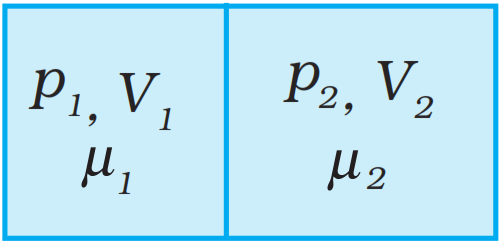
The container shown in Fig. has two chambers, separated by a partition, of volumes $V_1 = 2.0$ litre and $V_2= 3.0$ litre. The chambers contain $\mu _1 = 4.0$ and $\mu _2 = 5.0$ moles of a gas at pressures $p_1 = 1.00$ atm and $p_2 = 2.00$atm. Calculate the pressure after the partition is removed and the mixture attains equilibrium.
Answer
For ideal gas equation,$\text{PV}=\mu\text{RT}$
For gasses in chamber 1 and 2,$\text{P}_1\text{V}_1=\mu_1\text{RT}_1$
$\text{P}_2\text{V}_2=\mu_2\text{RT}_2$
$\text{P}_1=1\text{atm},\text{P}_2=2\text{atm}$
$\text{V}_1=2\text{L},\text{V}_2=3\text{L}$
$\text{T}_1=\text{T},\text{T}_2=\text{T}$
$\mu_1=4,\mu_2=5$
When partition between gasses removed then$\mu=\mu_1+\mu_2$ and $\text{V}=\text{V}_1+\text{V}_2$
By the kinetic theory of gases The kinetic translational energy $=\text{PV}=\frac{2}{3}\text{E}$ per mole$\text{P}_1\text{V}_1=\frac{2}{3}\mu_1\text{E}_1$ and $\text{P}_2\text{V}_2=\frac{2}{3}\mu_2\text{E}_2$
Adding both above,$\text{P}_1\text{V}_1+\text{P}_2\text{V}_2=\frac{2}{3}\mu_1\text{E}_1+\frac{2}{3}\mu_2\text{E}_2$
Or $\mu_1\text{E}_1+\mu_2\text{E}_2=\frac{3}{2}(\text{P}_1\text{V}_1+\text{P}_2\text{V}_2)$ Combined effect, $\text{PV}=\frac{2}{3}\text{E}$ Total per mole $=\frac{3}{2}\mu\text{E}$ per mole$\text{P}(\text{V}_1+\text{V}_2)=\frac{2}{3}\Big[\frac{3}{2}(\text{P}_1\text{V}_1+\text{P}_2+\text{V}_2)\Big]$
$\text{P}=\frac{\text{P}_1\text{V}_1+\text{P}_2\text{V}_2}{\text{V}_1+\text{V}_2}$
$=\frac{1.00\times1.0+2.00\times3.0}{2.0+3.0}\text{atm}$
$\text{P}=\frac{2+6}{5}=\frac{8}{5}=1.6\text{atm}$
View full question & answer
Question 115 Marks
Consider an ideal gas with following distribution of speeds.
Speed m/s
200
400
600
800
1000
% of molecules
10
20
40
20
10
If all the molecules with speed 1000m/s escape from the system, calculate new $V_{rms}$ and hence T.
Answer
$\text{v}_\text{rms}^2=\frac{10\times(200)^2+20\times(400)^2+40(600)^2+20(800)^2}{10+20+40+20}$
$\text{v}_\text{rms}^2=\frac{10\times(200)^2+20(400)^2+40(600)^2+20\times(800)^2+10(1000)^2}{10+20+40+20+10}$
$\text{v}_\text{rms}^2=\frac{10^5[1\times2^2+2\times4^2+4\times6^2+2\times8^2]}{90}$
$\text{v}^2_\text{rms}=\frac{10^5[4+32+144+128]}{90}$
$\text{v}_\text{rms}=\sqrt{\frac{10^5[308]}{90}}=\sqrt{\frac{10^4}{9}\times308}=\frac{100}{3}\sqrt{308}$
$=33.33\times17.55\cong585\text{m/s}$
$\text{T}=\frac{1}{3}\frac{\text{ms}^2_\text{rms}}{\text{k}_\text{B}}=\frac{3\times10^{-26}\times(585)^2}{3\times1.38\times10^{-23}}$
$=\frac{(585)^2}{138}\times10^{-24+23}$
$\text{T}=4.24\times10^{-1}\times585=248.04\text{K}$
View full question & answer
Question 125 Marks
Ten small planes are flying at a speed of 150km/h in total darkness in an air space that is 20 × 20 × 1.5km 3 in volume. You are in one of the planes, flying at random within this space with no way of knowing where the other planes are. On the average about how long a time will elapse between near collision with your plane. Assume for this rough computation that a safety region around the plane can be approximated by a sphere of radius 10m.
Answer
Planes can be considered as the motion of molecules in confined space. Time of relaxation for mean free path is distance between two planes travelled between the collision or just to avoid accident.$\text{Time} = \frac{\text{distance}}{\text{speed}}=\frac{\lambda}{\text{v}}=\frac{1}{\sqrt{2}\text{n}.\pi\text{d}^2.\text{v}}$
N = number of particles per unit volume $\text{v}=\frac{\text{N}}{\text{Volume}}$$\text{n}=\frac{10}{20\times20\times1.5\text{km}^3}=0.0167\text{km}^{-3}$
$\text{d}=2\times10\text{m}=20\text{m}=20\times10^{-3}\text{km/hr}$
$\therefore\text{time}=\frac{1}{\sqrt{2}\text{n}\pi\text{d}^2\text{v}}$
$=\frac{1}{1.414\times0.0167\times3.14\times20\times10^{-6}\times150}$
$\text{t}=\frac{10^6}{4448.8}=225\text{hrs}$
View full question & answer
Question 135 Marks
An insulated container containing monoatomic gas of molar mass m is moving with a velocity $v_0$. If the container is suddenly stopped, find the change in temperature.
Answer
Since, the container is suddenly stopped which is initially moving with velocity $v_0$, there is no time for exchange of heat in the process. Then total KE of the container is transferred to gas molecules in the form of translational KE, thereby increasing the absolute temperature. Let n be the no. of moles of the monoatomic gas in the container. Since molar mass of the gas is m. Total mass of the container, M = mn KE of molecules due to velocity $v_0$,$\text{KE} =\frac{1}{2}\text{(mn) v}_0^2$
Final KE of gas = 0 Change in kinetic energy, $\Delta\text{K}=\frac{1}{2}\text{(nm)v}^2$ If $\Delta\text{T}$ = change in absolute tempereture Then the internal energy of the gas$\Delta\text{U}=\text{nC}_\text{v}\Delta\text{T}=\text{n}\Big(\frac{3}{2}\text{R}\Big)\Delta\text{T}$
According to conservation of mechanical energy, we get$\Delta\text{K}=\Delta\text{U}$
By equating Eqs. (i) and (ii), we get$\Rightarrow\frac{1}{2}\text{(mn)v}_0^2=\text{n}\frac{3}{2}\text{R}(\Delta\text{T})$
$\text{(mn)v}_0^2=\text{n}3\text{R}(\Delta\text{T})$
$\Rightarrow\Delta\text{T}=\frac{\text{(mt)v}_0^2}{3\text{nR}}=\frac{\text{mv}_0^2}{3\text{R}}$
View full question & answer
Question 145 Marks
We have $0.5g$ of hydrogen gas in a cubic chamber of size $3cm$ kept at NTP. The gas in the chamber is compressed keeping the temperature constant till a final pressure of $100atm$. Is one justified in assuming the ideal gas law, in the final state? (Hydrogen molecules can be consider as spheres of radius 1 A).
Answer
Volume of 1 molecule$=\frac{4}{3}\pi\text{r}^3=\frac{4}{3}\times3.14\times(10^{-10})^3$
$\text{r}=1\text{A}=10^{-10}\text{m}$ (Given)
$\therefore$ Volume of 1 molecule = $4 \times 1.05 \times 10^{-30}m^3 = 4.20 \times 10^{-30}m^3$
Number of mole in $0.5\text{g}\ \text{H}_2\text{gas}=\frac{0.5}{2}=0.25$ mole [$\therefore H_2$​​​​​​​ has 2 mole]$\therefore$ Volume of $H_2$​​​​​​​_ molecules in .25 mole
$= 0.25 \times 6.023 \times 10^{23}\times 4.2 \times 10^{-30}m^3 = 1.05 \times 6.023 \times 10^{+23-30} = 6.324 \times 10^{+23-30}$​​​​​​​ Volume of $H_2$​​​​​​​ molecules $= 6.3 \times 10^{-7}m^3$​​​​​​​ Now for ideal gas at constant temperature$\text{P}_\text{t}\text{V}_\text{t}=\text{P}_\text{f}\text{V}_\text{f}$
$\text{V}_\text{f}=\frac{\text{P}_\text{t}\text{V}_\text{t}}{\text{P}_\text{f}}=\frac{1}{100}\times(3\times10^{-2})^3$ [$\because$ vol. of cube Vt = (side)3 and Pt = 1atm at NTP]
$\text{V}_\text{f}=\frac{27\times10^{-5}}{100}=2.7\times10^{-5-2}=2.7\times10^{-7}\text{m}^3$
Hence on compression the volume of the gas of the order of nuclear force of interaction will play the role, as in kinetic theory of gas molecules do not interact each other so gas will not obey the ideal gas behavior.
View full question & answer
Question 155 Marks
Consider a rectangular block of wood moving with a velocity $v_0$ in a gas at temperature T and mass density ρ. Assume the velocity is along x-axis and the area of cross-section of the block perpendicular to v0 is A. Show that the drag force on the block is $4\rho\text{ Av}_0\sqrt{\frac{\text{KT}}{\text{m}}}$ where m is the mass of the gas molecule.
Answer
Let $\rho_\text{m}$ is the number of molecule per unit volume i.e. $\rho_\text{m}$ is molecular density per unit volume. $v = v_{rms}$ is velocity of gas molecules When box moves in gas the molecules of gas strike to front face in opposite direction and on back face in same direction as v >> $v_0$ (box) so relative velocity on back face = $(v - v_0)$ Change in momentum by a molecule on front face $= 2m(v + v_0)$ Change in momentum by a molecule on back side $= 2m(v - v_0)$ Number of molecule striking on front face in $\Delta\text{t time}= \frac{1}{2}$ volume x molecular density/ vol.
To front face$=\frac{1}{2}[\text{A}.(\text{v}+\text{v}_0)\Delta\text{t}]\rho_\text{m}$
Number of molecules striking to front face,
$\text{N}_\text{F}=\frac{1}{2}(\text{v}+\text{v}_0)\text{A }\rho_\text{m}\Delta\text{t}$
Similarly as the speed of molecule and block are same so number of molecule striking on backend face,
$\text{N}_\text{B}=\frac{1}{2}(\text{v}-\text{v}_0)\text{A }\rho_\text{m}\Delta\text{t}$
Total change in momentum due to striking the molecule on front face,
$\text{P}_\text{F}=2\text{m}(\text{v}+\text{v}_0)\text{N}_\text{F}=2\text{m}(\text{v}+\text{v}_0)\times\frac{1}{2}(\text{v}+\text{v}_0)\text{A}\ \rho_\text{m}\Delta\text{t}$
$\text{P}_\text{F}=-\text{m}(\text{v}+\text{v}_0)^2\ \text{A}\rho_\text{m}\Delta\text{t}$ (Backward direction)
So rate of change of momentum on front face is equal to the force,
$\text{F}_\text{F}=-\text{m}(\text{v}+\text{v}_0)^2\ \text{A}\rho_\text{m}$ in Backward direction.
Similarly force on back end $\text{F}_\text{B}=+\text{m}(\text{v}-\text{v}_0)^2\ \text{A}\rho_\text{m}$
Net dragging force $=-\text{m}(\text{v}+\text{v}_0)^2\ \text{A}\rho_\text{m}+\text{m}(\text{v}-\text{v}_0)^2\ \text{A}\rho_\text{m}$
$=-\text{mA}\rho_\text{m}[(\text{v}+\text{v}_0)^2-(\text{v}-\text{v}_0)^2]$
$=-\text{mA}\rho_\text{m}[\text{v}^2+\text{v}_0^2+2\text{vv}_0-(\text{v}^2+\text{v}_0^2-2\text{v}.\text{v}_0]$
$=-\text{mA}\rho_\text{m }4\text{v.v}_0$
So magnitude of dragging force due to gas molecule $=4\text{mvv}_0\text{AP}_\text{m}$
KE of gas molecule.
$=\frac{1}{2}\text{mv}^2=\frac{3}{2}\text{K}_\text{B}\text{T}$
$\therefore\text{v}=\sqrt{\frac{\text{K}_\text{B}\text{T}}{\text{m}}}$ [using equ. (A) of Q.13.30]
$\therefore$ Dragging force becomes,
$=4\text{m}\text{ AP}_\text{m}\text{v}_0\sqrt{\frac{\text{K}_\text{B}\text{T}}{\text{m}}}$
View full question & answer
Question 165 Marks
A box of $1.00m3$ is filled with nitrogen at $1.5$ atm at $300K$. The box has a hole of an area $0.010\ mm2$. How much time is required for the pressure to reduce by $0.10$atm, if the pressure outside is 1atm.
Answer
Volume of box $= 1m^3 = V_1$ Initial pressure $= 1.5atm = P_1$ Final pressure =$ 1.5 – 0.1 =1.4atm =P’_2$ Air pressure out side box = $P_2 = 1$atm Initial temperature $T_1 = 300K$ Final temperature $T_2 = 300K$ a = area of hole = $0.01mm^2 = 0.01 \times 10^{-6}m^2 = 10^{-8}m^2$ initial pressure difference between tyre and atmosphere $\Delta\text{P}=(1.5-1)$ atm mass of a $N_2$ gas molecule,$=\frac{0.028\text{kg}}{6.023\times10^{23}}=46.5\times10^{-27}\text{kg}$
Let $P_{nl}$ is the initial number of $N_2$ gas molecule per unit volume in time $\Delta\text{t}$ Let $v_{tx}$ is the speed of molecules along x axis. Number of molecule colliding in time $\Delta$ t on a wall of cube$\frac{1}{2}\rho_\text{ni}[(\text{v}_\text{tx})\Delta\text{t}]\text{A}$
$\frac{1}{2}$ is multiplied as other $\frac{1}{2}$ molecule will strike to opposite wall
$\text{v}_\text{rms}^2(\text{N}_2\text{ molecule})=\text{v}^2+\text{v}^2_\text{1y}+\text{v}^2_\text{1z}$
$\because|\text{v}_\text{tx}|=|\text{v}_\text{ty}|=|\text{v}_\text{1z}|$
Then $\text{v}^2_\text{rms}=3\text{v}^2_\text{tx}$ KE of gas molecule $=\frac{3}{2}\text{K}_\text{B}\text{T}$$\frac{1}{2}\text{mv}^2_\text{rms}=\frac{3}{2}\text{K}_\text{B}\text{T}$
$\text{m}3\text{v}^2_\text{tx}=3\text{K}_\text{B}\text{T}$
$\text{v}_\text{tx}=\sqrt{\frac{\text{K}_\text{B}\text{T}}{\text{m}}}(\text{A})$
Number of $N_2$ gas molecule striking to a wall in $\Delta\text{t}$ time Outward out $=\frac{1}{2}\rho_\text{ni}\sqrt{\frac{\text{K}_\text{B}\text{T}}{\text{m}}}\Delta\text{t.a}$ Temperature inside the box and air are equal to T The number of air molecule striking to hole in $\Delta\text{t}$ inward $=\frac{1}{2}\rho_\text{n2}\sqrt{\frac{\text{K}_\text{B}\text{T}}{\text{m}}}\Delta\text{ta}-\frac{1}{2}\rho_\text{n2}\sqrt{\frac{\text{K}_\text{B}\text{T}}{\text{m}}}\Delta\text{t}.\text{a}$ a inward Net number of molecules going out from hole in $\Delta\text{t}$ time$=\frac{1}{2}[\rho_\text{n1}-\rho_\text{n2}]\sqrt{\frac{\text{K}_\text{B}\text{T}}{\text{m}}}\Delta\text{t}.\text{a}\ (\text{I})$
Gas equation $\text{P}_1\text{V}=\mu\text{RT}\Rightarrow\mu=\frac{\text{P}_1\text{V}}{\text{RT}}$ As for box $\frac{\mu}{\text{V}}=\frac{\text{P}_1}{\text{RT}}$ ($\mu$ = No. of moles of gas in box)$\rho_\text{n1}=\frac{\text{N (Total no. of molecule in box)}}{\text{volume of box}}=\frac{\mu\text{N}_\text{A}}{\text{V}}$
$=\frac{\text{P}_1\text{N}_\text{A}}{\text{RT}}$ Per unit volume
Let after time T pressure reduced by 0.1 and becomes (1.5 - 1) = 1.4atm $P'_2$ Then final new density of $N_A$ molecule $\rho'_\text{n1}$$\rho'_\text{n1}=\frac{\text{P}_1\text{N}_\text{A}}{\text{RT}}$ Per unit volume (III)
Net number of molecules going out from volume V$=(\rho_\text{n1}-\rho_\text{n}1)\text{v}=\frac{\text{P}_1\text{N}_\text{A}}{\text{RT}}\text{V}-\frac{\text{P}_2\text{N}_\text{A}}{\text{RT}}\text{v}$
$=\frac{\text{N}_\text{A}\text{V}}{\text{RT}}[\text{P}_1-\text{P}_2]$ (iv) (from II, III)
$P_2$ = final pressure of box. From (I) total number of molecule going out in time $\imath$ from hole$=\frac{1}{2}[\rho_\text{n1}-\rho_\text{n2}]\sqrt{\frac{\text{K}_\text{B}\text{T}}{\text{m}}}\imath.\text{a}$
$\rho_\text{n1}-\rho_\text{n2}=\frac{\text{N}_\text{A}}{\text{RT}}-\frac{\text{P}_2\text{N}_\text{A}}{\text{RT}}$
$\therefore\rho_\text{n1}-\rho_\text{n2}=\frac{\text{N}_\text{A}}{\text{RT}}[\text{P}_1-\text{P}_2]$ ($P_2$ = Press of air out of box)
Net number of molecule going out in $\imath$ time from above$=\frac{1}{2}\frac{\text{N}_\text{a}}{\text{RT}}[\text{P}_1-\text{P}_2]\sqrt{\frac{\text{K}_\text{B}\text{T}}{\text{m}}}.\imath\text{ a}$
From (V) and IV$\frac{\text{N}_\text{A}\text{V}}{\text{RT}}(\text{P}_1-\text{P}_2)=\frac{1}{2}\frac{\text{N}_\text{A}}{\text{RT}}(\text{P}_1-\text{P}_2)\sqrt{\frac{\text{K}_\text{B}\text{T}}{\text{m}}}.\imath\text{ a}$
$\imath=\frac{\text{N}_\text{A}\text{V}}{\text{RT}}(\text{P}_1-\text{P}_2)\frac{2\text{RT}}{\text{N}_\text{A}(\text{P}_1-\text{P}_2)}\sqrt{\frac{\text{m}}{\text{K}_\text{B}\text{T}}}.\frac{1}{\text{a}}$
$\imath=\frac{2(\text{P}_1-\text{P}_2)}{(\text{P}_1-\text{P}_2)}\frac{\text{V}}{\text{a}}\sqrt{\frac{\text{m}}{\text{K}_\text{B}\text{T}}}$
$=\frac{2[1.5-1.4}{(1.5-1)}\frac{1}{10^{-8}}\sqrt{\frac{46.5\times10^{-27}}{1.38\times10^{-23}\times300}}$
$=\frac{2\times0.1}{0.5\times10^{-8}}\sqrt{\frac{4650\times10^{-27+23-2}}{138\times3}}$
$=0.4\times10^{+8}\sqrt{\frac{775\times10^{-6}}{69}}$
$= 0.4 \times 10^{8}\times10^{-3}\times\sqrt{11.23}=0.4\times10^5\times3.35$
$\imath=1.34\times10^5\text{ seconds}$
View full question & answer