Questions

2 Marks Questions

Take a timed test

14 questions · self-marked practice — reveal the answer and mark yourself.

Question 12 Marks
A circular coil of radius 2.0cm has 500 turns and carries a current of 1.0A. Its axis makes an angle of 30° with the uniform magnetic field of magnitude 0.40 T that exists in the space. Find the torque acting on the coil.
Answer
$\text{n}=500$$\text{r}=0.02\text{m}$
$\theta=30^\circ$
$\text{i}=2\text{A}$
$\text{B}=4\times10^{-1}\text{T}$
$=500\times1\times3.14\times4\times10^{-4}\times4\times10^{-1}\times\Big(\frac{1}{2}\Big)$
$12.56\times10^{-2}=0.1256\approx0.13\text{N-M}$
View full question & answer
Question 22 Marks
Verify that the units weber and volt-second are the same.
Answer
$\text{v}=\frac{\text{d}\phi}{\text{dt}}$$\Rightarrow\text{d}\phi=\text{dt}$
Charge in flux has unit weber and potential difference as volt.
View full question & answer
Question 32 Marks
A wire, carrying a current i, is kept in the x−y plane along the curve $\text{y}=\text{A}\sin\Big(\frac{2\pi}{\lambda}\text{x}\Big).$ A magnetic field B exists in the z direction. Find the magnitude of the magnetic force on the portion of the wire between $\text{x}=0$ and $\text{x}=\lambda.$
Answer
Here the displacement vector $\overrightarrow{\text{dl}}=\lambda$
So magnetic for $\text{i}\rightarrow\text{t}\overrightarrow{\text{dl}}\times\vec{\text{B}}=\text{i}\times\lambda\text{B}$
View full question & answer
Question 42 Marks
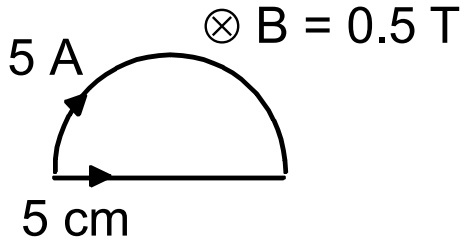
A semicircular wire of radius 5.0cm carries a current of 5.0A. A magnetic field B of magnitude 0.50T exists along the perpendicular to the plane of the wire. Find the magnitude of the magnetic force acting on the wire.
Answer

Force on a semicircular wire
= 2iRB
= 2 × 5 × 0.05 × 0.5
= 0.25N
View full question & answer
Question 52 Marks
The torque on a current loop is zero if the angle between the positive normal and the magnetic field is either $\theta=0^\circ$ or $\theta=180^\circ$ In which of the two orientations, the equilibrium is stable?
Answer
As we know the potential energy.$\text{U}=-\vec{\text{m}}.\vec{\text{B}}$
In the case of stable equilibrium potential energy is minimum. So, far $\theta=0^\circ$ Potential Energy is -ve and minimum.
View full question & answer
Question 62 Marks
A rectangular coil of 100 turns has length 5cm and width 4cm. It is placed with its plane parallel to a uniform magnetic field and a current of 2A is sent through the coil. Find the magnitude of the magnetic field B if the torque acting on the coil is $0.2N m^{-1}$.
Answer
$\tau=\text{ni}\overrightarrow{\text{A}}\times\overrightarrow{\text{B}}$$\Rightarrow\tau=\text{ni}\text{ AB}\sin90^\circ$
$\Rightarrow0.2=100\times2\times5\times4\times10^{-4}\times\text{B}$
$\Rightarrow\text{B}=\frac{0.2}{100\times2\times5\times4\times10^{-4}}=0.5$ Tesla
View full question & answer
Question 72 Marks
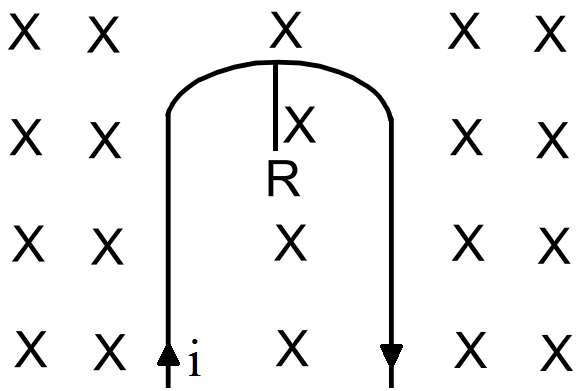
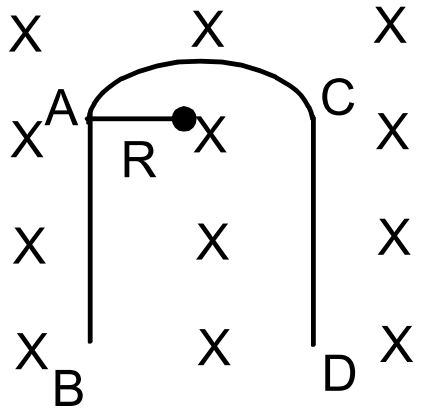
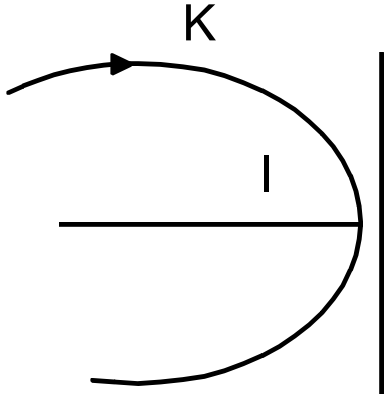
A rigid wire consists of a semi-circular portion of radius R and two straight sections The wire is partially immersed in a perpendicular magnetic field B, as shown in the figure. Find the magnetic force on the wire if it carries a current i.
Answer

Force due to the wire AB and force due to wire CD are equal and opposite to each other.
Thus they cancel each other.
Net force is the force due to the semicircular loop = 2iRB
View full question & answer
Question 82 Marks
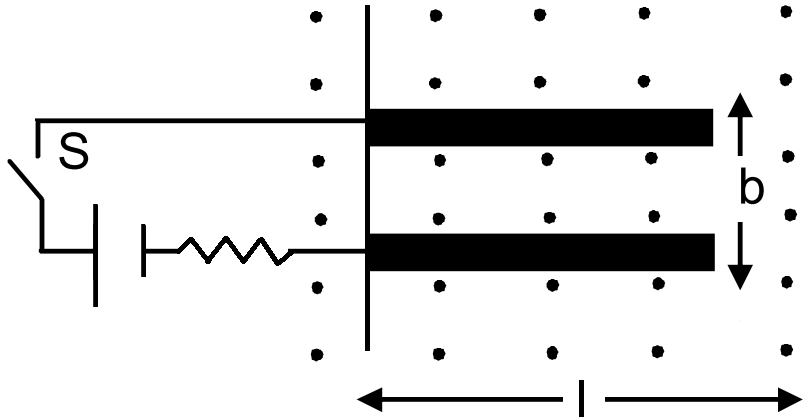
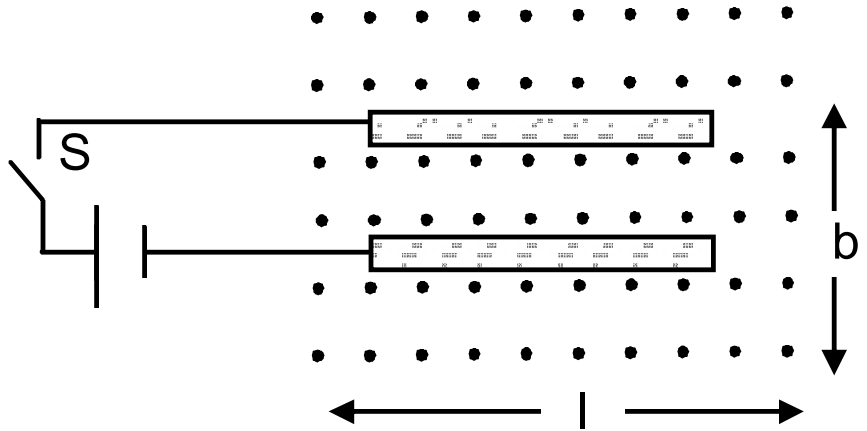
Two metal strips, each of length l, are clamped parallel to each other on a horizontal floor with a separation b between them. A wire of mass m lies on them perpendicularly, as shown in A vertically-upward magnetic field of strength B exists in the space. The metal strips are smooth but the coefficient of friction between the wire and the floor is $\mu.$ A current i is established when the switch S is closed at the instant t = 0. Discuss the motion of the wire after the switch is closed. How far away from the strips will the wire reach?
Answer

Let ‘F’ be the force applied due to magnetic field on the wire and ‘x’ be the dist covered.
So, $\text{F}\times\text{l}=\mu\text{mg}\times\text{x}$
$\Rightarrow\text{ibBl}=\mu\text{mgx}$
$\Rightarrow\text{x}\frac{\text{ibBl}}{\mu\text{mg}}$
View full question & answer
Question 92 Marks
An alpha particle is projected vertically upward with a speed of $3.0 \times 10^4km ~s^{-1}$ in a region where a magnetic field of magnitude 1.0T exists in the direction south to north. Find the magnetic force that acts on the α-particle.
Answer
$\text{q}=2\times1.6\times10^{-19}\text{C},$$\text{v}=3\times10^4\text{km/s}$
$\text{B}=1\text{T},\ \text{F}=\text{qBv}$
$=2\times1.6\times10^{19}\times3\times10^7\times1$
$=9.610^{12}\text{N}.$
View full question & answer
Question 102 Marks
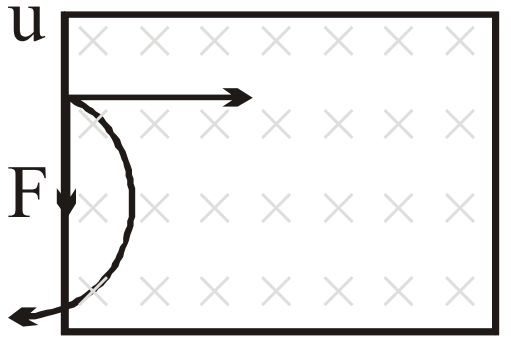
An electron beam projected along the positive X-axis deflects along the positive Y-axis. If this deflection is caused by a magnetic field, what is the direction of the field? Can we conclude that the field is parallel to the Z-axis?
Answer
There must exist a component of magnetic field in +Z direction. There can be magnetic field in +X direction also because of which there will be no initial deflection.
View full question & answer
Question 112 Marks
Protons with kinetic energy K emerge from an accelerator as a narrow beam. The beam is bent by a perpendicular magnetic field, so that it just misses a plane target kept at a distance l in front of the accelerator. Find the magnetic field.
Answer

Radius = l, K.E = K
$\text{L}=\frac{\text{Mv}}{\text{qB}}$
$\Rightarrow\text{l}=\frac{\sqrt{2\text{mk}}}{\text{ql}}$
$\Rightarrow\text{B}=\sqrt{\frac{2\text{mk}}{\text{ql}}}$
View full question & answer
Question 122 Marks
The net charge in a current-carrying wire is zero. Then, why does a magnetic field exert a force on it?
Answer
The positive charge at nucleus do not actually move while the negative charges in the conductor moves. So, force is on moving electron and not on proton as they are at rest.
View full question & answer
Question 132 Marks
Consider a 10cm long portion of a straight wire carrying a current of 10A placed in a magnetic field of 0.1T making an angle of 53° with the wire. What magnetic force does the wire experience?
Answer
$\text{l}=10\text{cm}=10\times10^{-3}\text{m}=10^{-1}\text{m}$$\text{i}=10\text{A},\ \text{B}=0.1\text{T},\ \theta=53^\circ$
$|\text{F}|=\text{iL B}\sin\theta=10\times10^{-1}\times0.1\times0.79$
$=0.0798\approx0.08$
direction of F is along a direction $\perp\text{r}$ to both l and B.
View full question & answer
Question 142 Marks
Assume that the magnetic field is uniform in a cubical region and is zero outside. Can you project a charged particle from outside into the field so that the particle describes a complete circle in the field?
Answer
No,
View full question & answer