Questions · Page 1 of 3

1 Marks Question

Take a timed test

50 questions · self-marked practice — reveal the answer and mark yourself.

Question 11 Mark
Fill in the blanks using the word (s) from the list appended with statement: For solids with elastic modulus of rigidity, the shearing force is proportional to . . . while for fluids it is proportional to . . . (shear strain/ rate of shear strain).
Answer
For solids with elastic modulus of rigidity, the shearing force is proportional to shear strain while for fluids it is proportional to rate of shear strain. With reference to the elastic modulus of rigidity for solids, the shearing force is proportional to the shear strain. With reference to the elastic modulus of rigidity for fluids, the shearing force is proportional to the rate of shear strain.
View full question & answer
Question 21 Mark
A tank with a square base of area $1.0 \mathrm{~m}^2$ is divided by a vertical partition in the middle. The bottom of the partition has a small-hinged door of area $20 \mathrm{~cm}^2$. The tank is filled with water in one compartment, and an acid (of relative density 1.7 ) in the other, both to a height of 4.0 m . compute the force necessary to keep the door close.
Answer
Water compartment, $\mathrm{p}=\mathrm{hpg}=4 \times 1.0 \times 109 \times 9.8$
$=39.2 \times 10 \mathrm{~Pa}$
Acid compartment, $\mathrm{P}=\mathrm{hp}$ 's
$=4 \times 1.7 \times 103 \times 9.8$
$=66.64 \times 10 \mathrm{~Pa}$
$\mathrm{P}^{\prime}-P=66.64 \times 103-39.2 \times 10^3$
$=27.44 \times 10^3 \mathrm{~Pa}$
$A=20 \mathrm{~cm}$
$20 \times 10^{-4} \mathrm{~m}^2$
Area, using pressure, $\mathbf{P}=\frac{\mathrm{F}}{\mathrm{A}}$
$\mathrm{F}=\mathrm{PA}$
$\mathrm{~F}=\left(20 \times 10^{-4}\right) \times\left(27.44 \times 10^3\right)$
$=54.88 \mathrm{~N}$
View full question & answer
Question 31 Mark
During blood transfusion the needle is inserted in a vein where the gauge pressure is 2000Pa. At what height must the blood container be placed so that blood may just enter the vein? [Use the density of whole blood from Table 10.1].
Answer
pressure, P = 2000Pa Density of whole blood, $\rho=1.06\times^3\text{kg m}^{-3}$ Acceleration due to gravity, $\mathrm{g}=9.8 \mathrm{~m} / \mathrm{s}^2$ Height of the blood container = h Pressure of the blood container, P = hpg $\therefore\text{h}=\frac{\text{P}}{\rho\text{g}}$ $=\frac{2000}{1.06\times^3\times9.8}$ $=0.1925\text{m}$ The blood may enter the vein if the blood container is kept at a height greater than 0.1925m, i.e., about 0.2m.
View full question & answer
Question 41 Mark
Fill in the blanks using the word (s) from the list appended with statement: For a fluid in steady flow, the increases inflow speed at a constriction follows from…… while the decrease of pressure there follows from….....(conservation of mass/ Bernoulli’s principle).
Answer
For a fluid in steady flow, the increases inflow speed at a constriction follows from conservation of mass while the decrease of pressure there follows from Bernoulli's principle. For a steady-flowing fluid, an increase in its flow speed at a constriction follows the conservation of mass/ Bernoulli's principle.
View full question & answer
Question 51 Mark
Fill in the blanks using the word (s) from the list appended with statement: Viscosity of gases . . . with temperature, whereas viscosity of liquids . . . with temperature. (increases/ decreases)
Answer
Viscosity of gases Increases with temperature, whereas viscosity of liquids decreases with temperature. Most fluids offer resistance to their motion. This is like internal mechanical friction, known as viscosity. Viscosity of gases increases with temperature, while viscosity of liquids decreases with temperature.
View full question & answer
Question 61 Mark
Explain why When we try to close a water tap with our fingers, fast jets of water gush through the openings between our fingers.
Answer
By doing so the area of outlet of water jet is reduced, so velocity of water increases according to equation of continuity, Area × Velocity = Constant.
View full question & answer
Question 71 Mark
Fill in the blanks using the word(s) from the list appended with statement: Surface tension of liquids generally . . . with temperatures. (increases/ decreases)
Answer
Surface tension of liquids generally decreases with temperatures. The surface tension of a liquid is inversely proportional to temperature.
View full question & answer
Question 81 Mark
Explain why Atmospheric pressure at a height of about 6km decreases to nearly half of its value at the sea level, though the height of the atmosphere is more than 100km.
Answer
Density of air is the maximum near the sea level. Density of air decreases with increase in height from the surface. At a height of about 6km, density decreases to nearly half of its value at the sea level. Atmospheric pressure is proportional to density. Hence, at a height of 6km from the surface, it decreases to nearly half of its value at the sea level.
View full question & answer
Question 91 Mark
Fill in the blanks using the word (s) from the list appended with statement: For the model of a plane in a wind tunnel, turbulence occurs at a ... speed for turbulence for an actual plane (greater/ smaller).
Answer
For the model of a plane in a wind tunnel, turbulence occurs at a Greater speed for turbulence for an actual plane (greater/ smaller). For the model of a plane in a wind tunnel, turbulence occurs at a greater speed than it does for an actual plane. This follows from Bernoulli's principle and different Reynolds' numbers are associated with the motions of the two planes.
View full question & answer
Question 101 Mark
What is the work done in blowing a soap bubble of radius 'r and surface tension $'\sigma'?$
Answer
Work done = S.T. area of soap bubble$=\sigma\times(4\pi\text{r}^2)\times2=8\pi\text{r}^2$
View full question & answer
Question 111 Mark
Water flows faster than honey. Why?
Answer
Coefficient of viscosity n is less as compared to the value of honey. So, water flows faster than honey.
View full question & answer
Question 121 Mark
Why does the cotton wick in an oil filled lamp keep on burning?
Answer
In the cotton wick, there are very large number of capillaries in which oil continues to rise.
View full question & answer
Question 131 Mark
What is pitot tube? State the principle on which it is based.
Answer
It is a simple device which is used for measuring the velocity of the flow at any depth in a flowing liquid. It is based on Bernoulli's theorem.
View full question & answer
Question 141 Mark
When two soap bubbles stay in contact, what is the radius of the interface?
Answer
If $\text{r}_1$ and $\text{r}_2$ are the radii of the soap bubbles, the net excess pressure at the interface is,$\frac{4\sigma}{\text{r}_{\text{eq}}}=\frac{4\sigma}{\text{r}_1}-\frac{4\sigma}{\text{r}_2}$
$\therefore\frac{1}{\text{r}_\text{eq}}=\frac{1}{\text{r}_1}-\frac{1}{\text{r}_2}$
View full question & answer
Question 151 Mark
Why the aeroplanes and cars are given a streamline shape?
Answer
This is done to reduce the backward drag of the atmosphere.
View full question & answer
Question 171 Mark
Surface tension of all lubricating oils and paints is kept low. Why?
Answer
In order to have low value of surface tension so that it can spread over large area.
View full question & answer
Question 181 Mark
When air is blown in between two balls suspended close to each other, they are attracted towards each other. Give reason.
Answer
When air is blown in between two balls suspended close to each other with high speed, a low pressure is created between the balls which is much less than the atmospheric pressure beyond the balls. Due to this, balls are attracted towards each other. This is according to Bernoulli's theorem.
View full question & answer
Question 191 Mark
A mercury barometer is placed in the mercury trough in a way that the angle made with the vertical is 60°. Find the height of mercury column.
Answer
The height of mercury in the inclined case will be 76cm.
View full question & answer
Question 201 Mark
If a mercury barometer is fitted such that the angle made with the vertical is 30°, what will be the height of mercury column under one atmosphere?
Answer
Under normal conditions, it will be 76cm of vertical column. So, the height of mercury in the slant length has to be 76cm.
View full question & answer
Question 211 Mark
Why is it that a liquid set in rotation comes to rest after some time?
Answer
The liquid comes to rest due to the viscous force i.e., due to internal fluid friction between its different layers.
View full question & answer
Question 241 Mark
Does Archimedes' principle hold in a vessel in free fall or in a satellite moving in a circular orbit?
Answer
No.
View full question & answer
Question 251 Mark
Three vessels have same base area and different neck area. Equal volume of liquid is poured into them, which will possess more pressure at the base?
Answer
If the volumes are same, then height of the liquid will be highest in which the cross-sectional area is least at the top. So, the vessel having least cross-sectional area at the top possess more pressure at the base $\because(\text{P}=\rho\text{gh})$
View full question & answer
Question 261 Mark
What are the values of Reynolds number ($N_R$) for different types of flows?
Answer
For streamline or laminar flow $0<N_R<2000$, For turbulent flow, $N_R>3000$ If N, lies between 2000 to 3000 , the flow is unstable i.e., change from streamline flow to turbulent flow.
View full question & answer
Question 271 Mark
A block of wood is floating in a lake. What is apparent weight of the floating block?
Answer
The apparent weight of the floating block is equal to zero because the weight of the block acting vertically downwards is balanced by the buoyant force acting on the block upwards.
View full question & answer
Question 291 Mark
What happens to surface tension, when impurity is mixed in liquid?
Answer
Surface tension of the liquid decreases.
View full question & answer
Question 301 Mark
What is $(i)$ velocity head $(ii)$ pressure head?
Answer
  1. $\frac{\upsilon^2}{2\text{g}}$
  2. $\frac{\text{P}}{\rho\text{g}}$
View full question & answer
Question 311 Mark
A square framed with a wire of side 'L' is dipped in a liquid. On taking out, a membrane is formed. What will be the force acting on the frame if the surface tension of liquid is S?
Answer
The membrane has two surfaces. Force on frame due to surface tension = 8SL.
View full question & answer
Question 321 Mark
Why is the dam of water reservoir thick at the bottom?
Answer
It is so because the pressure of water in reservoir increases with depth.
View full question & answer
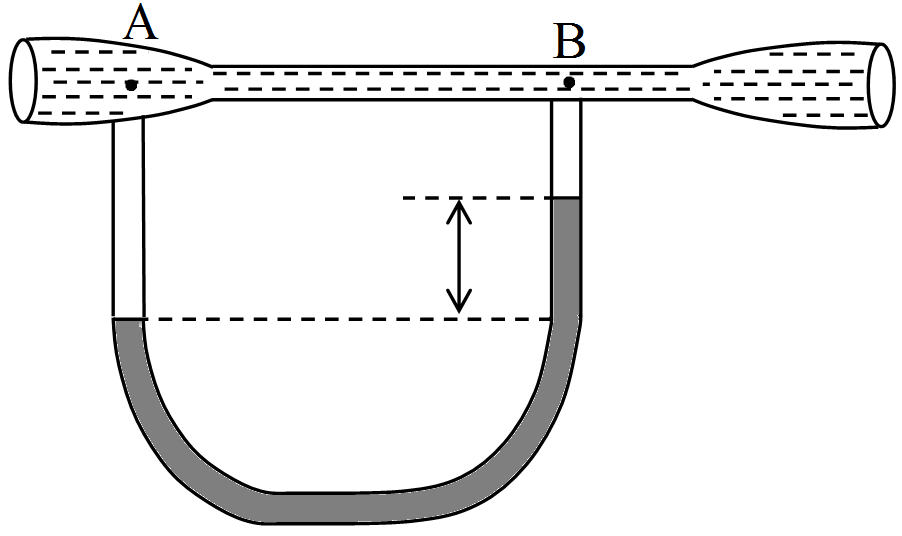
Question 341 Mark
Why does the liquid level stay higher below the point B?
Answer
Due to increased velocity in the lesser cross-sectional area, the pressure will be less as there exists a streamlined flow.
View full question & answer
Question 351 Mark
What is the excess pressure in a soap bubble of radius 10mm, if surface tension is $2.5 \times 10^{-2} \mathrm{~N} / \mathrm{m}$?
Answer
In a soap bubble, excess pressure $=\text{P}=\frac{4\sigma}{\text{r}}$$\therefore\text{P}=\frac{4\times2.5\times10^2}{10\times10^{-3}}=10\text{Nm}^{-2}$
View full question & answer
Question 361 Mark
A tank with a square base of area $1.0 \mathrm{~m}^2$ is divided by a vertical partition in the middle. The bottom of the partition has a small-hinged door of area $20 \mathrm{~cm}^2$. The tank is filled with water in one compartment, and an acid (of relative density 1.7 ) in the other, both to a height of 4.0 m . compute the force necessary to keep the door close.
Answer
Water compartment, $p=h p g=4 \times 1.0 \times 109 \times 9.8$
$=39.2 \times 10 \mathrm{~Pa}$
Acid compartment, $\mathrm{P}=\mathrm{hp}$ 's
$=4 \times 1.7 \times 103 \times 9.8$
$=66.64 \times 10 \mathrm{~Pa}$
$P^{\prime}-P=66.64 \times 103-39.2 \times 10^3$
$=27.44 \times 10^3 \mathrm{~Pa}$
$A=20 \mathrm{~cm}$
$20 \times 10^{-4} \mathrm{~m}^2$
Area, using pressure, $\mathrm{P}=\frac{\mathrm{F}}{\mathrm{A}}$
$\mathrm{F}=\mathrm{PA}$
$\mathrm{~F}=\left(20 \times 10^{-4}\right) \times\left(27.44 \times 10^3\right)$
$=54.88 \mathrm{~N}$
View full question & answer
Question 371 Mark
Show the variation of pressure in the atmosphere with height in km. Considering that the density of air is not dependent on pressure.
View full question & answer
Question 381 Mark
Why the speed of a whirl wind in a tornado is alarmingly high?
Answer
Due to reduction in moment of inertia, angular velocity increases to keep the angular momentum constant.
View full question & answer
Question 391 Mark
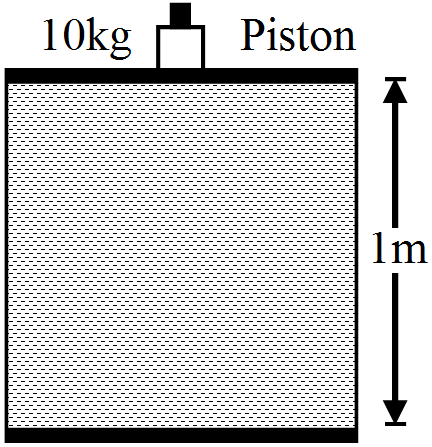
A container of area $0.02m^2$ is filled with water. Find the pressure at the bottom of the container if a weight is placed on the piston. (as shown in the figure).
Answer

The net force acting on the base,$=(\rho\text{gh})\text{A}+\text{mg}$
$\text{F}=1000\times9.8\times1\times0.02+10\times9.8$
$=294\text{N}$
$\therefore$ Pressure $=\frac{\text{Trust}}{\text{Area}}=\frac{294\text{N}}{0.02}=14700\text{N}$
View full question & answer
Question 401 Mark
What is the impact on surface tension when $(i)$ impurity is increased, and $(ii)$ temperature is decreased?
Answer
Surface tension:
  1. Reduces with increasing impurity.
  2. Increases with decrease in temperature.
View full question & answer
Question 411 Mark
A steel ball is floating in a trough of mercury. If we fill the empty part of the trough with water, what will happen to the steel ball?
Answer
It will move up.
View full question & answer
Question 421 Mark
Under which condition $(i)$ the centre of buoyancy coincides with the centre of gravity $(ii)$ the centre of buoyancy does not coincide with the centre of gravity.
Answer
  1. For a solid body of uniform density, the centre of gravity coincides with the centre of buoyancy.
  2. For a solid body having different densities over different parts, its centre of gravity does not coincide with the centre of buoyancy.
View full question & answer
Question 431 Mark
What is the effect of gravity on pressure?
Answer
Pressure increases as it is proportional to the depth we move into a liquid due to the weight of the liquid between the two layers.
View full question & answer
Question 441 Mark
Why do fire fighters have a jet attached to the head of their water pipes?
Answer
This is done to increase the velocity of water flowing out of the pipe.
View full question & answer
Question 451 Mark
Can two streamlines cross each other in a flowing liquid?
Answer
No, two streamlines cannot cross each other.
View full question & answer
Question 461 Mark
Why water cannot be poured into a bottle with a narrow neck with the aid of glass tube?
Answer
The pressure of air inside the bottle and the adhesive force between water and glass do not permit the water to get filled in the bottle with narrow neck.
View full question & answer
Question 471 Mark
What is the use of open tube manometer?
Answer
Open tube manometer is used for measuring pressure difference.
View full question & answer
Question 481 Mark
During blood transfusion the needle is inserted in a vein where the gauge pressure is 2000Pa. At what height must the blood container be placed so that blood may just enter the vein? [Use the density of whole blood from Table 10.1].
Answer
pressure, P = 2000Pa Density of whole blood, $\rho=1.06\times^3\text{kg m}^{-3}$ Acceleration due to gravity, $\mathrm{g}=9.8 \mathrm{~m} / \mathrm{s}^2$ Height of the blood container = h Pressure of the blood container, P = hpg$\therefore\text{h}=\frac{\text{P}}{\rho\text{g}}$
$=\frac{2000}{1.06\times^3\times9.8}$
$=0.1925\text{m}$
The blood may enter the vein if the blood container is kept at a height greater than 0.1925m, i.e., about 0.2m.
View full question & answer
Question 491 Mark
Why a hot liquid moves faster than a cold liquid?
Answer
Due to decrease in viscosity with increase of temperature.
View full question & answer
1 Marks Question - Physics STD 11 Science Questions - Vidyadip