Questions

M.C.Q (1 Marks)

Take a timed test

16 questions · auto-graded multiple-choice test.

MCQ 11 Mark
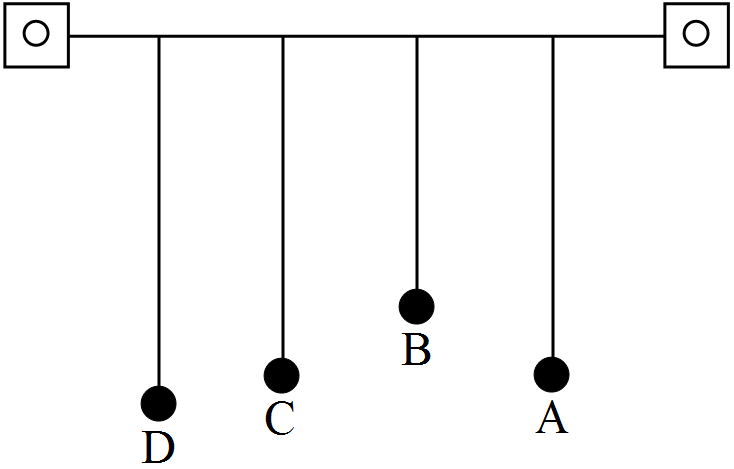
Four pendulums A, B, C and D are suspended from the same elastic support as shown in Fig A and C are of the same length, while B is smaller than A and D is larger than A. If A is given a transverse displacement,
  • A
    D will vibrate with maximum amplitude.
  • C will vibrate with maximum amplitude.
  • C
    B will vibrate with maximum amplitude.
  • D
    All the four will oscillate with equal amplitude.
Answer
Correct option: B.
C will vibrate with maximum amplitude.
Here A is given a transverse displacement. Through the elastic support the disturbance is transferred to all the pendulums.
A and C are having same length, hence they will be in resonance, because of their time period of oscillation. Since length of pendulums A and C is same and $\text{T}=2\pi\sqrt{\frac{\text{L}}{\text{g}}}$ hence their time period is same and they will have frequency of vibration. Due to it, a resonance will take place and the pendulum C will vibrate with maximum amplitude.
View full question & answer
MCQ 21 Mark
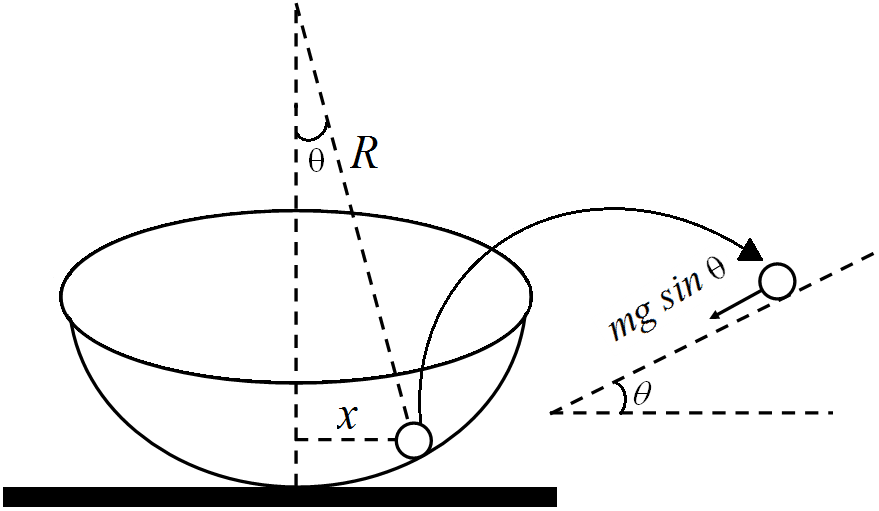
Motion of a ball bearing inside a smooth curved bowl, when released from a point slightly above the lower point is:
  1. Simple harmonic motion.
  2. Non$-$periodic motion.
  3. Periodic motion.
  4. Periodic but not $\text{S.H.M}$
  • A
    $A$ and $B$
  • $A$ and $C$
  • C
    $B$ and $C$
  • D
    $A$ and $D$
Answer
Correct option: B.
$A$ and $C$

For small angular displacement, the situation is shown in the figure. Only one restoring force creates.
motion in ball inside bowl.
Only one restoring force creates motion in ball inside bowl.
$\text{F}=-\text{mg}\sin\theta$
As $\theta\ \text{is small},\sin\theta=\theta$
So, $\text{ma}=-\text{mg}\frac{\text{x}}{\text{R}}$
Or, $\text{a}=-\Big(\frac{\text{g}}{\text{R}}\Big)\text{x}\Rightarrow\text{a}\propto-\text{x}$
So, motion of the ball is $\text{S.H.M}$ and periodic.
View full question & answer
MCQ 31 Mark
The rotation of earth about its axis is:
  1. Periodic motion.
  2. Simple harmonic motion.
  3. Periodic but not simple harmonic motion.
  4. Non$-$periodic motion.
  • A
    $A$ and $D$
  • B
    $A$ and $B$
  • $A$ and $C$
  • D
    $C$ and $D$
Answer
Correct option: C.
$A$ and $C$

Rotation of earth about its axis repeats its motion after a fixed interval of lime,
so its motion is periodic.
The rotation of earth is obviously not a to and fro type of motion about a fixed point,
hence its motion is not an oscillation.
Also this motion does not follow $\text{S.H.M}$ equation, $\text{a}\propto-\text{x}$
Hence, this motion is not a $\text{S.H.M.}$

View full question & answer
MCQ 41 Mark
The displacement of a particle is represented by the equation:$\text{y}=3\cos\Big(\frac{\pi}{4}-2\omega\text{t}\Big)$
The motion of the particle is:
  • A
    Simple harmonic with period $2\frac{\text{P}}{\text{w}}.$
  • Simple harmonic with period $\frac{\pi}{\omega}.$
  • C
    Periodic but not simple harmonic.
  • D
    Non-periodic.
Answer
Correct option: B.
Simple harmonic with period $\frac{\pi}{\omega}.$
A simple harmonic motion is produced when a force (called restoring force) proportional to the displacement acts on a particle.
All sine and cosine functions of t are simple harmonic in nature.
Hence the motion is simple harmonic motion.
A simple harmonic motion is always periodic.
the motion is simple harmonic with time period $\frac{\pi}{\omega}.$
View full question & answer
MCQ 51 Mark
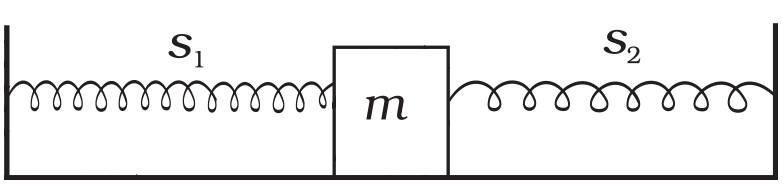
When a mass in is connected individually to two springs $S_1$ and $S_2$, the oscillation frequencies are $V_1$ and $V_2$. If the same mass is attached to the two springs as shown in figure, the oscillation frequency would be:
  • $\text{v}_1+\text{v}_2$
  • B
    $\sqrt{\text{v}_1^2+\text{v}_2^2}$
  • C
    $\Big(\frac{1}{\text{v}_1}+\frac{1}{\text{v}_2}\Big)^{-1}$
  • D
    $\sqrt{\text{v}_1^2-\text{v}_2^2}$
Answer
Correct option: A.
$\text{v}_1+\text{v}_2$

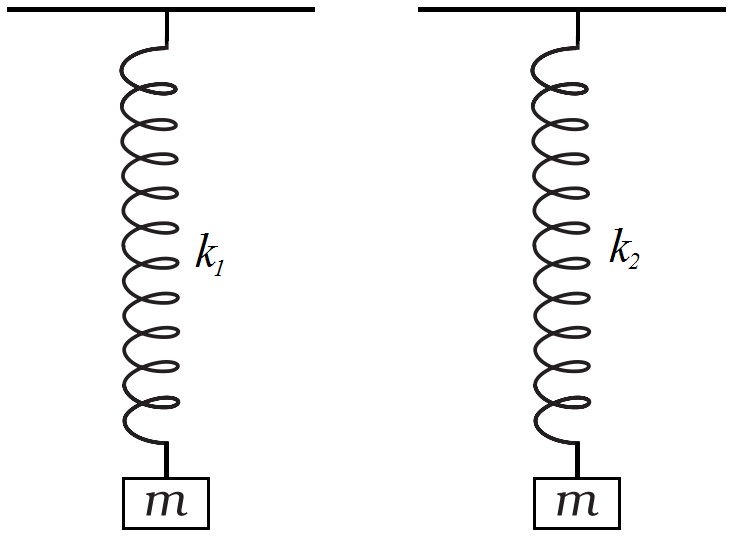
When the mass is connected to the two springs individually.
$\text{v}_1=\frac{1}{2\pi}\sqrt{\frac{\text{k}_1}{\text{m}}}\ ...(1)$
$\text{v}_2=\frac{1}{2\pi}\sqrt{\frac{\text{k}_2}{\text{m}}}\ ...(2)$
Now, the block is connected with two springs considered as parallel.
Here equivalent spring constant $\text{K}_\text{eq}=\text{K}_1+\text{K}_2$
Time period of oscillation of the spring block$-$system is
$\text{T}=2\pi\sqrt{\frac{\text{m}}{\text{k}_\text{eq}}}=2\pi\sqrt{\frac{\text{m}}{\text{k}_1+\text{k}_2}}$
Hence frequency,
$\text{v}=\frac{1}{\text{T}}=\frac{1}{2\pi}\times\sqrt{\frac{\text{k}_1+\text{k}_2}{\text{m}}}\ ...(3)$
$\text{v}=\frac{1}{2\pi}\Big[\frac{\text{k}_1}{\text{m}}+\frac{\text{k}_2}{\text{m}}\Big]^{\frac{1}{2}}$
From Eq. $(i) \frac{\text{k}_1}{\text{m}}=4\pi^2\text{v}_1^2$ and from Eq. $(ii) \frac{\text{k}_2}{\text{m}}=4\pi^2\text{v}_2^2$
$\Rightarrow\text{v}=\frac{1}{2\pi}\Big[\frac{4\pi^2\text{v}_1^2}{1}+\frac{4\pi^2\text{v}_2^2}{1}\Big]^\frac{1}{2}=\frac{2\pi}{2\pi}[\text{v}_1^2+\text{v}_2^2]^\frac{1}{2}$
$\Rightarrow\text{v}=\sqrt{\text{v}_1^2+\text{v}_2^2}$
View full question & answer
MCQ 61 Mark
A particle is in linear simple harmonic motion between two points $A$ and $B, 10\ cm$ apart Take the direction from $A$ to $B$ as the $+ ve$ direction and choose the correct statements:
  • A
    The sign of velocity, acceleration and force on the particle when it is $3\ cm$ away from $A$ going towards $B$ are positive.
  • B
    The sign of acceleration and force on the particle when it is at point $B$ is negative.
  • C
    The sign of velocity, acceleration and force on the particle when it is $4\ cm$ away from $B$ going towards $A$ are negative.
  • All of the above
Answer
Correct option: D.
All of the above
  1. when the particle is going from $A$ to $B (+$ve direction$)$ and it is $3 \ cm$ from $A$ velocity increases up to $O$ so velocity is positive. Acceleration in $\text{SHM}$ is towards $+ve.$ So both $v$ and $a$ are $+ve.$
  2. As the particle is going towards $B$ so velocity is Positive not negative.
  3. As the particle is at $4\ cm$ from $B$ and $B$ and going towards $A$ i.e. $(-)ve$ side, so velocity and acceleration towards mean position at $O.$ So both are negative.
  4. When particle is at $B$ force and acceleration both are towards $'O\ ',$ so both are negative.
View full question & answer
MCQ 71 Mark
The equation of motion of a particle is $\text{x}=\text{a}\cos(\alpha\text{t})^2.$
The motion is:
  • A
    Periodic but not oscillatory.
  • B
    Periodic and oscillatory.
  • Oscillatory but not periodic.
  • D
    Neither periodic nor oscillatory.
Answer
Correct option: C.
Oscillatory but not periodic.
$\text{x}=\text{a}\cos(\propto\text{t})^2$ is a cosine function and x varies between -a and +a, the motion is oscillatory. Now checking for periodic motion, putting t + T in place of t. T is supposed as period of the function ω(t).
$\text{x}(\text{t}+\text{T})=\text{a}\cos[\alpha(\text{t}+\text{T})]^2$
$=\text{a}\cos[\alpha^2\text{t}^2+\text{a}^2\text{T}^2+2\alpha^2\text{tT}]\neq\text{x}(\text{t})$
Hence, it is not periodic.
View full question & answer
MCQ 81 Mark
The displacement of a particle varies with time according to the relation : $\text{y}=\text{a}\sin\omega\text{t}+\text{b}\cos\omega\text{t}$
  • A
    The motion is oscillatory but not $\text{S.H.M.}$
  • B
    The motion is $\text{S.H.M.}$ with amplitude $a + b.$
  • C
    The motion is $\text{S.H.M.}$ with amplitude $\text{a}^2+\text{b}^2$
  • The motion is $\text{S.H.M.}$ with amplitude $\sqrt{\text{a}^2+\text{b}^2}.$
Answer
Correct option: D.
The motion is $\text{S.H.M.}$ with amplitude $\sqrt{\text{a}^2+\text{b}^2}.$
key concept: The sum of two $\text{S.H.Ms}$ of same frequencies is a $\text{S.H.M.}$
According to the question, the displacement
$\text{y}=\text{a}\sin\omega\text{t}+\text{b}\cos\omega\text{t}$
Given $\text{x}=\text{a}\sin\omega\text{t}+\text{b}\cos\omega\text{t}$
Let $\text{a}=\text{A}\cos\phi$
And $\text{b}=\text{A}\sin\phi$
Squaring and adding $(ii)$ and $(iii)$, we get
$\text{a}^2+\text{b}^2=\text{A}^2\cos^2\phi+\text{A}^2\sin^2\phi=\text{A}^2$
$=\text{A}^2\Rightarrow\text{A}=\sqrt{\text{a}^2+\text{b}^2}$
$\text{y}=\text{A}\sin\phi.\sin\omega\text{t}+\text{A}\cos\phi.\cos\omega\text{t}$
$=\text{A}\sin(\omega\text{t}+\phi)$
$\frac{\text{dy}}{\text{dt}}=\text{A}\omega\cos(\omega\text{t}+\phi)$
$\frac{\text{d}^2\text{y}}{\text{dt}^2}=-\text{A}\omega^2\sin(\omega\text{t}+\phi)$
$=-\text{A}\text{y}\omega^2=(-\text{A}\omega^2)\text{y}$
$\Rightarrow\frac{\text{d}^2\text{y}}{\text{dt}^2}\propto(-\text{y})$
Hence, it is an equation of $\text{SHM}$ with amplitude
$\text{A}=\sqrt{\text{a}^2+\text{b}^2}$
View full question & answer
MCQ 91 Mark
A particle executing $\text{S.H.M.}$ has a maximum speed of $30\ cm/ s$ and a maximum acceleration of $60\ cm/ s^2$. The period of oscillation is:
  • $\pi\ \text{s}.$
  • B
    $\frac{\pi}{2}\ \text{s}.$
  • C
    $2\pi\ \text{s}.$
  • D
    $\frac{\pi}{\text{t}}\ \text{s}.$
Answer
Correct option: A.
$\pi\ \text{s}.$
Key concept: Let equation of an $\text{SHM}$ is represented by $\text{y}=\text{a}\sin\omega\text{t}$
$\text{v}=\frac{\text{dy}}{\text{dt}}=\text{a}\omega\cos\omega\text{t}$
Hence $(\text{v})_{\text{max}}=\text{a}\omega$
Acceleration $(\text{A})=\frac{\text{dx}^2}{\text{dt}^2}=-\text{a}\omega^2\sin\omega\text{t}$
Hence $\text{A}_{\text{max}}=\omega^2\text{a}$
Maximum speed, $\text{v}_\text{max}=\omega\text{A}$
Maximum acceleration, $\text{a}_{\text{max}}=\omega^2\text{A}$
Divide eqn. $(ii)$ by eqn. $(i),$ we get
$\frac{\text{a}_\text{max}}{\text{v}_\text{max}}=\frac{\omega^2\text{A}}{\omega\text{A}}=\omega$
$\therefore\frac{\text{a}_\text{max}}{\text{v}_\text{max}}=\frac{2\pi}{\text{T}}$
Here, $\text{v}_\text{max}=30\text{cms}^{-1},\text{a}_\text{max}=60\text{cms}^2$
$\therefore\text{T}=2\pi\Big(\frac{30\text{cms}^{-1}}{60\text{cms}^{-2}}\Big)=\pi\text{s}$
View full question & answer
MCQ 101 Mark
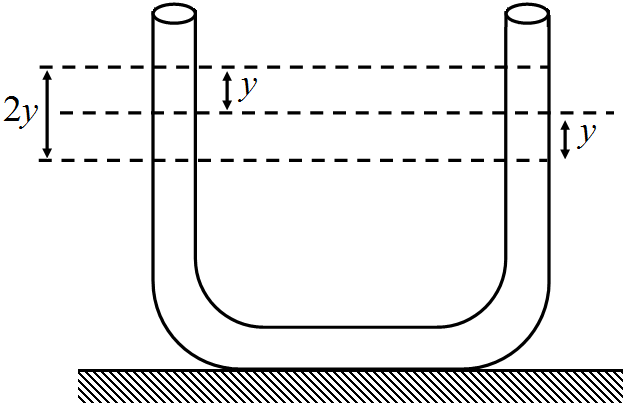
Motion of an oscillating liquid column in a U-tube is:
  • A
    Periodic but not simple harmonic.
  • B
    Non-periodic.
  • Simple harmonic and time period is independent of the density of the liquid.
  • D
    Simple harmonic and time-period is directly proportional to the density of the liquid.
Answer
Correct option: C.
Simple harmonic and time period is independent of the density of the liquid.

Restoring Force F = Weight of liquid column of height 2y
$\Rightarrow\text{FF}=-(\text{A}\times2\text{y}\times\rho)\times\text{g}=-2\text{A}\rho\text{gy}$
$\Rightarrow\text{F}\propto-\text{y}$
Motion is SHM with force constant
$\text{K}=2\text{A}\rho\text{g}$
$\Rightarrow\text{Time period}\text{T}=2\pi\sqrt{\frac{\text{m}}{\text{k}}}$
$=2\pi\sqrt{\frac{\text{A}\times2\text{h}\times\rho}{2\text{A}\rho\text{g}}}=2\pi\sqrt{\frac{\text{h}}{\text{g}}}$
Which is independent of the density of the liquid.
View full question & answer
MCQ 111 Mark
The displacement of a particle is represented by the equation $\text{y}=\sin^3\omega\text{t}.$ The motion is:
  • A
    Non-periodic.
  • B
    Periodic but not simple harmonic.
  • Simple harmonic with period $\frac{2\pi}{\omega}.$
  • D
    Simple harmonic with period $\frac{\pi}{\omega}.$
Answer
Correct option: C.
Simple harmonic with period $\frac{2\pi}{\omega}.$
All sine and cosine functions of t are simple harmonic in nature.
Hence the motion is simple harmonic motion.
A simple harmonic motion is always periodic.
$\text{Time period}=\text{T}'=\frac{2\pi}{\omega'}$
hence the motion is simple harmonic with time period $\frac{2\pi}{\omega}.$
View full question & answer
MCQ 121 Mark
A body is performing $\text{S.H.M.}$ Then its:
  • A
    Average total energy per cycle is equal to its maximum kinetic energy.
  • B
    Average kinetic energy per cycle is equal to half of its maximum kinetic energy.
  • C
    Root mean square velocity is $\frac{1}{\sqrt{2}}$ times of its maximum velocity.
  • All of the above
Answer
Correct option: D.
All of the above
In case of $\text{S.H.M,}$ average total energy per cycle
$=$ Maximum kinetic energy $(K_0)$
$=$ Maximum potential energy$ (U_0)$
Average $KE$ per cycle $=\frac{0+\text{K}_0}{2}=\frac{\text{K}_0}{2}$
Let us write the equation for the $\text{SHM} \text{x}=\text{a}\sin\omega\text{t}.$
Clearly, it is a periodic motion as it involves sine function.
Let us find velocity of the particle, $\text{v}=\frac{\text{dx}}{\text{dt}}=\frac{\text{d}}{\text{dt}}(\text{a}\sin\omega\text{t})=\text{a}\omega\cos\omega\text{t}$
Mean velocity over a complete cycle,
$\text{v}_\text{mean}=\frac{\int_{0}^{2\pi}\omega\text{a}\cos\theta\text{d}\theta}{2\pi}=\frac{\omega\text{a}[\sin\theta]^2_0}{2\pi}=0$
So, $\text{v}_\text{mean}\neq\frac{2}{\pi}\text{v}_\text{max}$
Root mean square speed,
$\text{v}_\text{ms}=\sqrt{\frac{\text{v}^2_\text{min}+\text{v}^2_\text{max}}{2}}=\sqrt{\frac{0+\text{v}^2-\text{max}}{2}}$
$\text{v}_\text{ms}=\frac{1}{\sqrt{2}}\text{v}_\text{max}$
View full question & answer
MCQ 131 Mark
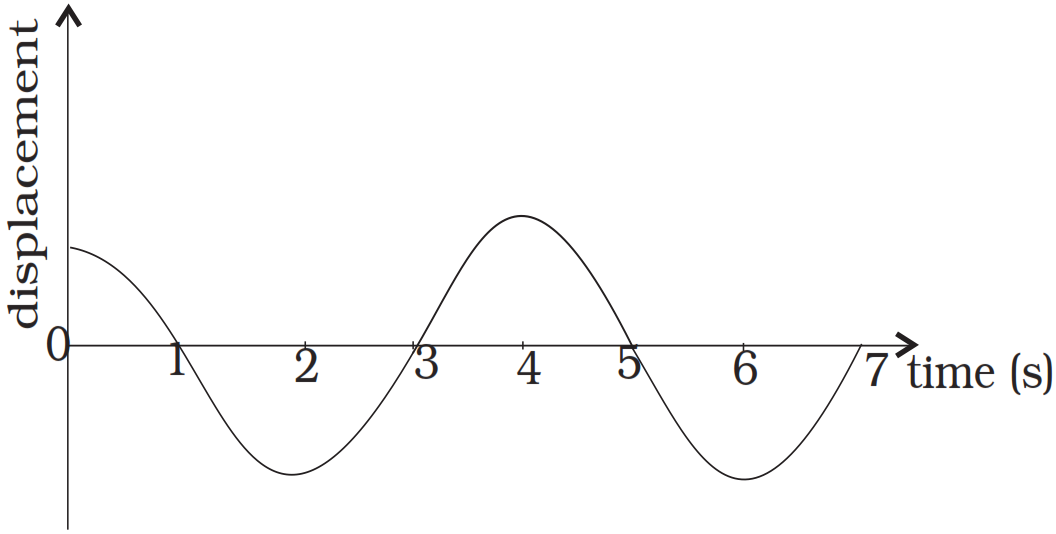
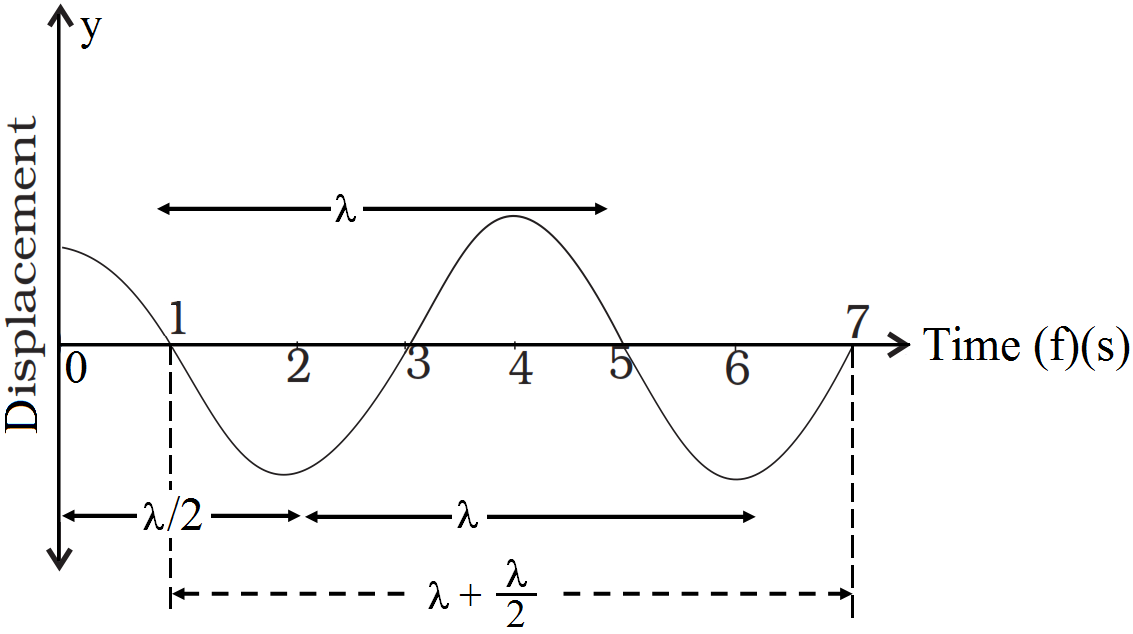
Displacement vs. time curve for a particle executing $\text{S.H.M.}$ is shown in Fig. Choose the correct statements:
  • A
    Phase of the oscillator is same at $t = 0 s$ and $t = 2 s.$
  • B
    Phase of the oscillator is same at $t = 2 s$ and $t = 6 s.$
  • C
    Phase of the oscillator is same at $t = 1 s$ and $t = 5 s.$
  • Both $B$ and $C$
Answer
Correct option: D.
Both $B$ and $C$
Two particles are said to be in same phases if the mode of vibration is same i.e, their distance will be $\text{n}\lambda(\text{n}=1,2,3...)$
Distance between particles at $t = 0$ and $t = 2$ is $\frac{\lambda}{2}.$
So, articles are not in same phase.

As from figure the particles at $t = 2 \sec$ are at distance $\lambda$, so are in same phase.
Particles at $t = 1, t = 7$ are the distance $\lambda+\frac{\lambda}{2}=\frac{3\lambda}{2}$ so are not in phase.
Particles at $t = 1$ and $5\sec$ are at distance $= \lambda$ so are in same phase.
View full question & answer
MCQ 141 Mark
A particle is acted simultaneously by mutually perpendicular simple hormonic motions $\text{x}=\text{a}\cos\omega\text{t}\ \text{and}\ \text{y}=\text{a}\sin\omega\text{t}.$ The trajectory of motion of the particle will be:
  • A
    An ellipse.
  • B
    A parabola.
  • A circle.
  • D
    A straight line.
Answer
Correct option: C.
A circle.
Resultant displacement is x + y
$\text{x}=\text{a}\cos\omega\text{t}\ ...(1)$
$\text{y}=\text{A}\sin\omega\text{t}\ ...(2)$
Dispacement $=\text{a}\cos\omega\text{t}+\text{a}\sin\omega\text{t}$
$\text{y}'=\text{a}\sqrt{2}\Big[\frac{\cos\omega\text{t}}{\sqrt{2}}+\frac{\sin\omega\text{t}}{\sqrt{2}}\Big]$
$\text{y}'\text{a}\sqrt{2}\ [\cos\omega\text{t}\cos45^\circ+\sin\omega\text{t}\sin45^\circ]$as the particle is acted simultaneously by Mutually perpendicular direction.
$\text{y}'=\text{a}\sqrt{2}\cos\text{s}(\omega\text{t}-45^\circ)$
Hence the displacement is neither a straight line nor a parabola.
Now, squaring and adding (i), (ii)
$\text{x}^2+\text{y}^2=\text{a}^2\cos^2\omega\text{t}+\text{a}^2\sin^2\omega\text{t}=\text{a}^2[\cos^2\omega\text{t}+\sin^2\omega\text{t}]$
$\text{x}^2+\text{y}^2=\text{a}^2$
This shows the equation of circle, hence the motion is circular motion.
View full question & answer
MCQ 151 Mark
Which of the following statements is/ are true for a simple harmonic oscillator?
  • A
    Force acting is directly proportional to displacement from the mean position and opposite to it.
  • B
    Motion is periodic.
  • C
    The velocity is periodic.
  • All of the above
Answer
Correct option: D.
All of the above
Let us write the equation for the $\text{SHM} \text{x}=\text{a}\sin(\omega\text{t}+\phi)$
Clearly, it is a periodic motion as it involves sine function.
Let us find velocity of the particle, $\text{v}=\frac{\text{dx}}{\text{dt}}=\frac{\text{d}}{\text{dt}}(\text{a}\sin(\omega\text{t}+6\phi))$
Velocity is also periodic because it is a cosine function.
Now let us find acceleration, $\text{A}=\frac{\text{dv}}{\text{dt}}=\frac{\text{d}^2\text{x}}{\text{dt}^2}=-\text{a}\omega^2\sin(\omega\text{t}+\phi)$
The acceleration is a sine function, hence cannot be constant.
$\Rightarrow\text{A}=-(\omega^2\text{a})\sin(\omega\text{t}+\phi)=-\omega^2\text{x}$
Force, $F =$ mass $\times$ acceleration.
$=\text{mA}=-\text{m}\omega^2\text{x}$
Hence, force acting is directly proportional to displacement from the mean position and opposite to it.
View full question & answer
MCQ 161 Mark
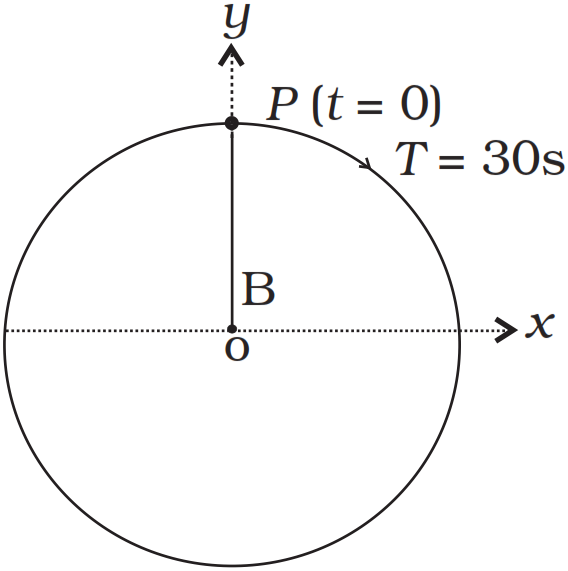
Figure shows the circular motion of a particle. The radius of the circle, the period, sense of revolution and the initial position are indicated on the figure. The simple harmonic motion of the x-projection of the radius vector of the rotating particle P is:
  • $\text{x}(\text{t})=\text{B}\sin\Big(\frac{2\pi\text{t}}{30}\Big).$
  • B
    $\text{x}(\text{t})=\text{B}\cos\Big(\frac{\pi\text{t}}{15}\Big).$
  • C
    $\text{x}(\text{t})=\text{B}\sin\Big(\frac{\pi\text{t}}{15}+\frac{\pi}{2}\Big).$
  • D
    $\text{x}(\text{t})=\text{B}\cos\Big(\frac{\pi\text{t}}{15}+\frac{\pi}{2}\Big).$
Answer
Correct option: A.
$\text{x}(\text{t})=\text{B}\sin\Big(\frac{2\pi\text{t}}{30}\Big).$
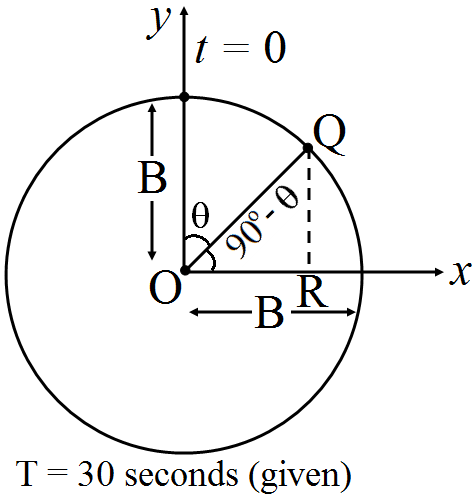
As the particle P is executing circular motion with radius B. let particle P is at Q at instant t, foot of perpendicular on x-axis is at R vector OQ makes $<\theta$ with its zero position not p displacement for O to R.

$\text{x}=\text{OQ}\cos(90^\circ-\theta) $
$\text{x}=\text{OQ}\sin\theta=\text{B}\sin\omega\text{t}\therefore\theta=\omega\text{t}$
$\text{x}=\text{B}\sin\frac{2\pi}{\text{T}}\text{t}$
$\therefore\text{x}=\text{B}\sin\Big(\frac{2\pi}{30}\text{t}\Big)$
View full question & answer