Questions

M.C.Q (1 Marks)

Take a timed test

17 questions · 16 auto-graded MCQ + 1 self-marked written.

MCQ 11 Mark
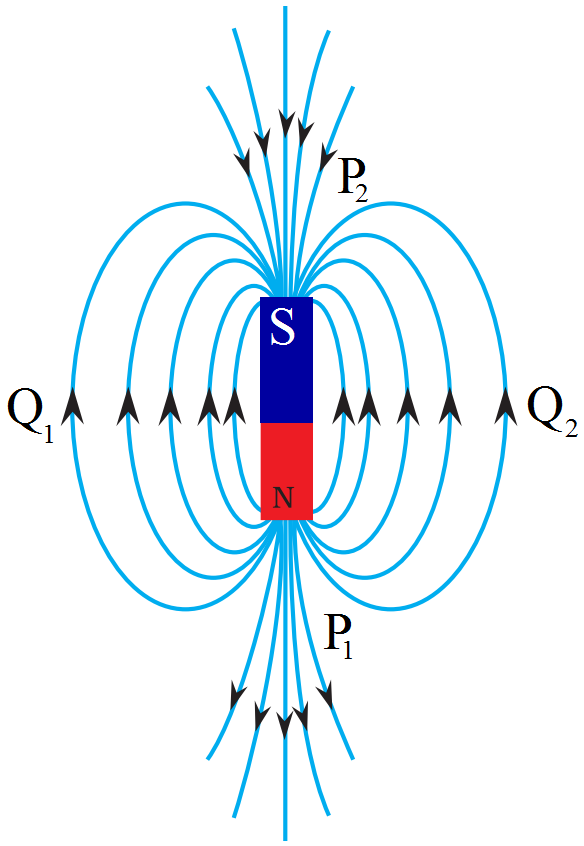
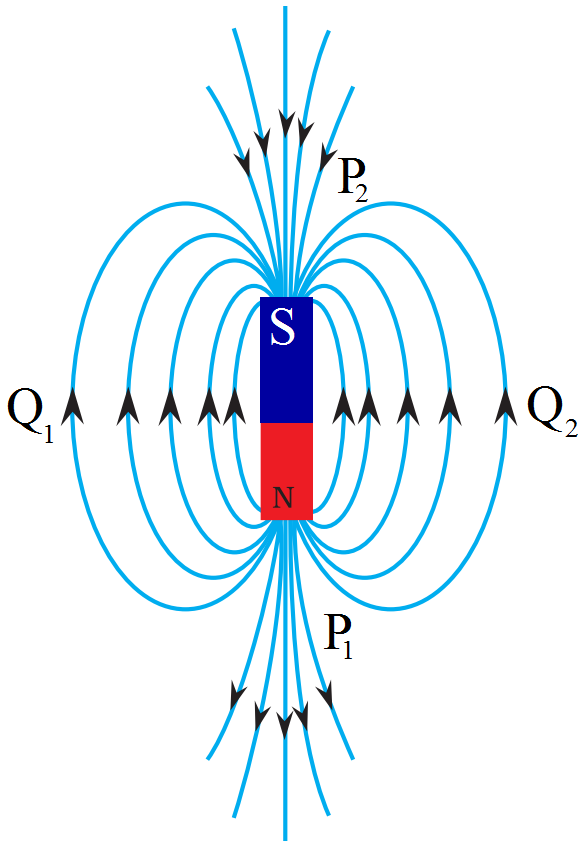
Consider a magnetic dipole kept in the north to south direction. Let $P_1, P_2, Q_1, Q_2$ be four points at the same distance from the dipole towards north, south, east and west of the dipole respectively. The directions of the magnetic field due to the dipole are the same at:
  • $P_1$ and $P_2$
  • B
    $Q_1$ and $Q_2$
  • C
    $P_1$ and $Q_1$
  • D
    $P_2$ and $Q_2$
Answer
Correct option: A.
$P_1$ and $P_2$
We know that magnetic field lines are directed from the north pole to the south pole. From the given figure, we can say that the direction of magnetic field $\overrightarrow{\text{B}}$ is the same only at points $P_1$ and $P_2$ and at points $Q_1$ and $Q_2$.
View full question & answer
MCQ 21 Mark
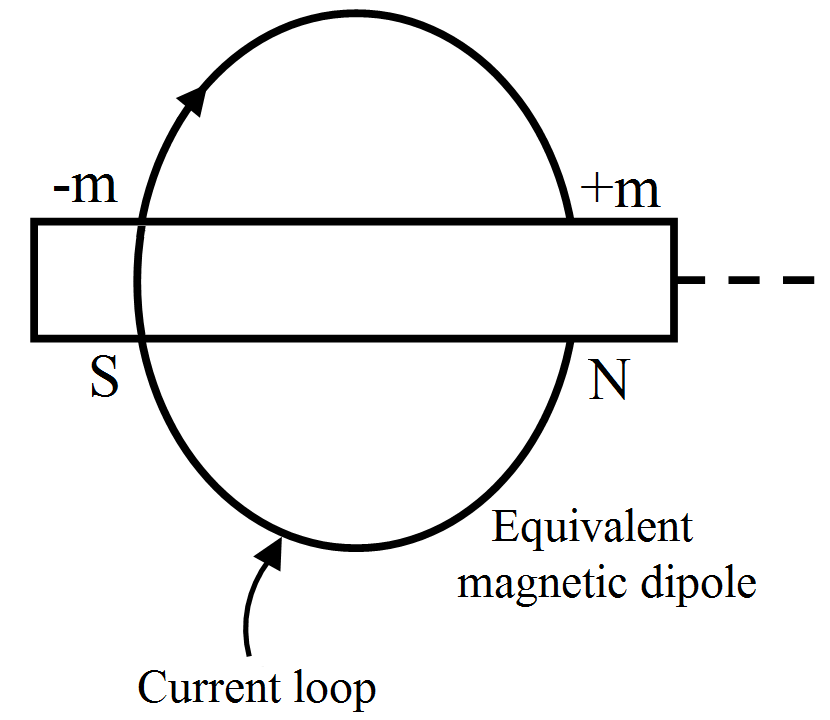
A circular loop carrying a current is replaced by ann equivalent magnetic dipole. A point on the axis of the loop is in:
  • End-on position.
  • B
    Broadside-on position.
  • C
    Both.
  • D
    None.
Answer
Correct option: A.
End-on position.


Points lying on the axis of a magnet are called end-on points. In our case, the point on the axis of the loop (on replacing the circular loop with an equivalent magnetic dipole) lies on the axis of the magnetic dipole or on the end-on position.
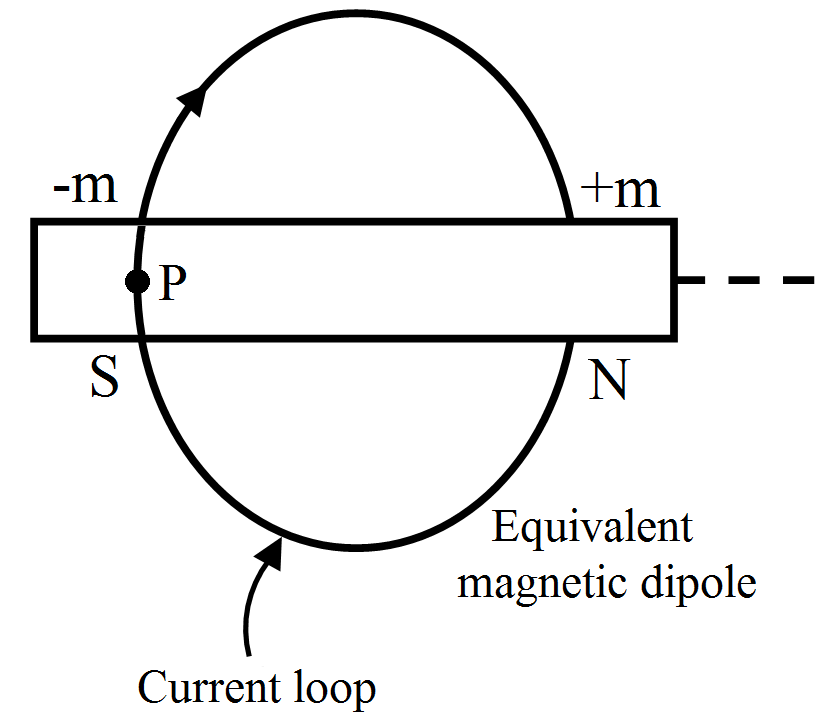
If P was the point on the axis of the loop, then it is clear from the figure that P lies on the end-on position of the equivalent magnetic dipole.
View full question & answer
MCQ 31 Mark
A dip circle is taken to geomagnetic equator. The needle is allowed to move in a vertical plane perpendicular to the magnetic meridian. The needle will stay:
  • A
    In horizontal direction only.
  • B
    In vertical direction only.
  • C
    In any direction except vertical and horizontal.
  • In the direction it is released.
Answer
Correct option: D.
In the direction it is released.
At the geomagnetic equator, the needle tries to suspend itself in horizontal direction. But here the needle is restricted to move only in the vertical plane perpendicular to the magnetic meridian. Hence, the needle will stay in the direction it is released.
View full question & answer
MCQ 41 Mark
A circular loop carrying a current is replaced by an equivalent magnetic dipole. A point on the loop is in:
  • A
    End-on position.
  • Broadside-on position.
  • C
    Both.
  • D
    None.
Answer
Correct option: B.
Broadside-on position.


The position of the points lying on the equator of a magnetic dipole is called the broadside-on position. In our case, the point on the loop (after replacement of the circular loop with an equivalent magnetic dipole) lies on the equatorial position of the equivalent magnetic dipole. Hence, the point lies on the broadside-on position.
If P was the point on the loop, then it is clear from the figure that point P lies on the broadside-on position of the equivalent magnetic dipole.
View full question & answer
MCQ 51 Mark
A horizontal circular loop carries a current that looks clockwise when viewed from above. It is replaced by an equivalent magnetic dipole consisting of a south pole $S$ and a north pole $N:$
  1. The line $SN$ should be along a diameter of the loop.
  2. The line $SN$ should be perpendicular to the plane of the loop.
  3. The south pole should be slow the loop.
  4. The north pole should be below the loop.
  • A
    $A$ and $B$
  • $B$ and $C$
  • C
    Only $A$
  • D
    None of these
Answer
Correct option: B.
$B$ and $C$
A horizontal circular loop carrying current in clockwise direction acts like the south pole of a magnet. Hence, the south pole of the magnet coincides with the loop.
Now, when the loop carrying current in clockwise direction is viewed from above, it looks like the magnetic lines of force are entering the loop thus it acts like south pole of a magnet. And if we view from below the loop then it appears that magnetic lines of force are leaving the loop. Hence, the north pole should be below the loop.
View full question & answer
MCQ 61 Mark
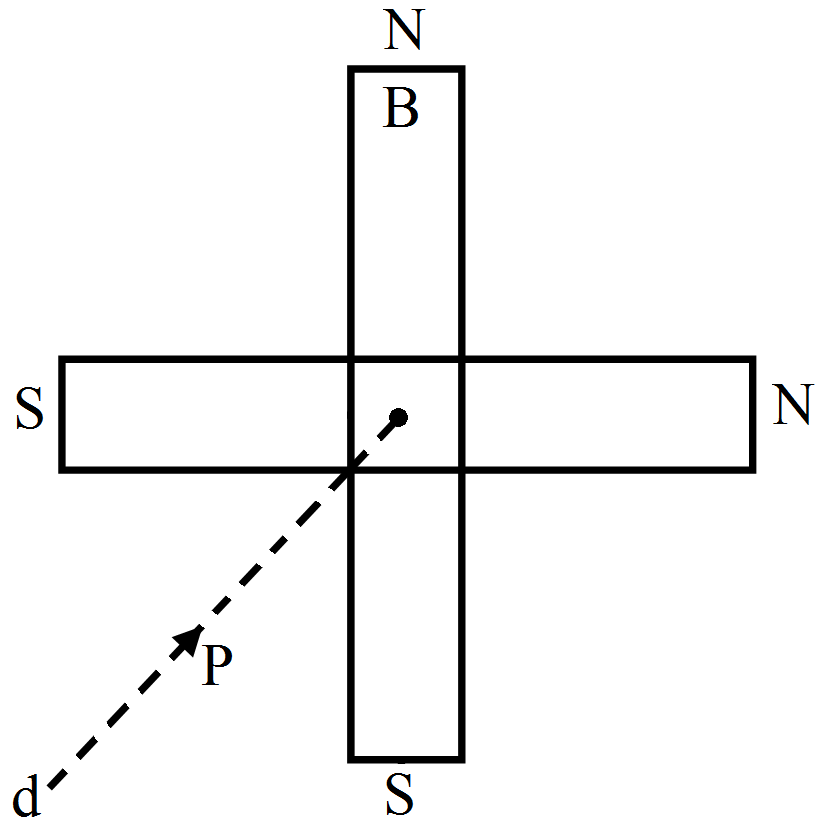
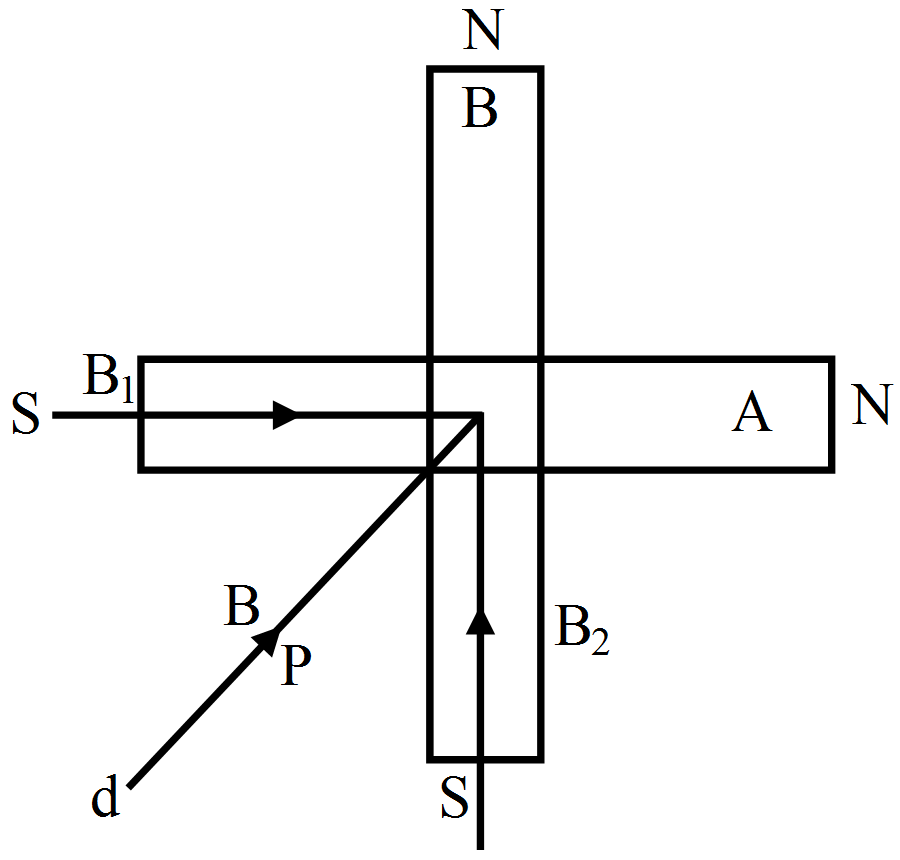
Two short magnets of equal dipole moments $M$ are fastened perpendicularly at their centre $($figure$).$ The magnitude of the magnetic field at a distance d from the centre on the bisector of the right angle is:
  • A
    $\frac{\mu_0}{4\pi}\frac{\text{m}}{\text{d}^3}$
  • B
    $\frac{\mu_0}{4\pi}\frac{\sqrt{2}\text{M}}{\text{d}^3}$
  • $\frac{\mu_0}{4\pi}\frac{\sqrt[2]{2}\text{M}}{\text{d}^3}$
  • D
    $\frac{\mu_0}{4\pi}\frac{2\text{M}}{\text{d}^3}$
Answer
Correct option: C.
$\frac{\mu_0}{4\pi}\frac{\sqrt[2]{2}\text{M}}{\text{d}^3}$

Magnetic field $(B_1)$ due to the short dipole $A$ of dipole moment $M$ at an axial point is given by,
$\vec{\text{B}_1}=\frac{\mu_0}{4\pi}\frac{2\text{M}}{\text{d}^3}\dots(1)$
Magnetic field $(B_2)$ due to the short dipole $B$ of dipole moment $M$ at an axial point is given by,
$\vec{\text{B}_2}=\frac{\mu_0}{4\pi}\frac{2\text{M}}{\text{d}_3}\dots(2)$
Resultant magnetic field $(B)$ will be,
$\text{B}=\sqrt{\text{B}_1^2+\text{B}_2^2}$
$\text{B}=\frac{\mu_0}{4\pi}\frac{\sqrt[2]{2}\text{M}}{\text{d}^3}$
View full question & answer
MCQ 71 Mark
Magnetic meridian is:
  • A
    A point.
  • B
    A line along north-south.
  • C
    A horizontal plane.
  • A vertical plane.
Answer
Correct option: D.
A vertical plane.
Magnetic meridian at a place is not a line but a vertical plane passing through the axis of a freely suspended magnet.
View full question & answer
MCQ 81 Mark
A tangent galvanometer is connected directly to an ideal battery. If the number of turns in the coil is doubled the deflection will:
  • A
    Increase.
  • B
    Decrease.
  • Remain unchanged.
  • D
    Either increase or decrease.
Answer
Correct option: C.
Remain unchanged.
For a tangent galvanometer, deflection is given by
$\theta=\tan^{-1}\Big(\frac{\text{i}}{\text{k}}\Big)$
Here, k is the constant called reduction factor.
From the above formula, we can say that deflection is independent of the number of turns.
Hence, on doubling the number of turns, deflection remains the same.
View full question & answer
MCQ 91 Mark
If the current is doubled, the deflection is also doubled in:
  • A
    A tangent galvanometer.
  • A moving-coil galvanometer.
  • C
    Both.
  • D
    None.
Answer
Correct option: B.
A moving-coil galvanometer.
The current and deflection dependence of a moving coil galvanometer is given by
$\text{i}=\frac{\text{k}}{\text{nAB}}\theta\Rightarrow\text{i}\propto\theta$
Therefore, if we double the current, the deflection also gets doubled.
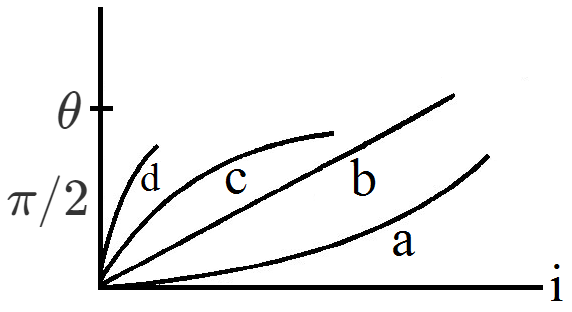
However, in a tangent galvanometer, $\text{i}\propto\tan\theta$; that is, there is no direct relation between $\theta$ and current.
Hence, the correct option is (b).
View full question & answer
MCQ 101 Mark
A compass needle which is allowed to move in a horizontal plane is taken to a geomagnetic pole. It:
  • A
    Will stay in north-south direction only.
  • B
    Will stay in east-west direction only.
  • C
    Will become rigid showing no movement.
  • Will stay in any position.
Answer
Correct option: D.
Will stay in any position.
When taken to a geomagnetic pole, a compass needle that is allowed to move in a horizontal plane will try to suspend itself vertically to the horizontal plane containing the compass. In other words, the horizontal plane containing the compass will restrict the compass to suspend itself in vertical direction; hence, the compass will stay in any position.
However, a freely suspended magnet will become vertical at poles, with its north pole pointing towards Earth at its north pole (which is magnetic south).
View full question & answer
MCQ 111 Mark
Let r be the distance of a point on the axis of a magnetic dipole from its centre. The magnetic field at such a point is proportional to:
  • A
    $\frac{1}{\text{r}}$
  • B
    $\frac{1}{\text{r}^2}$
  • $\frac{1}{\text{r}^3}$
  • D
    None of these.
Answer
Correct option: C.
$\frac{1}{\text{r}^3}$
Magnetic field B due to a bar magnet of magnetic moment M at distance r of the point on the axis from its centre is given by
$\text{B}=\frac{\mu_02\text{Mr}}{4\pi(\text{r}^2-\text{l}^2)^2}$
Here, 2l is the length of the magnet.
When the distance of the point where the magnetic field has to be calculated is greater than the length of the magnet, i.e r >> l, the bar magnet acts like a magnetic dipole whose magnetic field is
$\text{B}\propto\frac{1}{\text{r}^3}$
Now, l in the denominator can be neglected.
So, the correct option is (c).
View full question & answer
MCQ 121 Mark
Pick the correct options:
  1. Magnetic field is produced by electric charges only.
  2. Magnetic poles are only mathematical assumptions having no real existence.
  3. A north pole is equivalent to a clockwise current and a south pole is equivalent to an anticlockwise current.
  4. A bar magnet is equivalent to a long, straight current.
  • $A$ and $B$
  • B
    $B$ and $C$
  • C
    $C$ and $D$
  • D
    Only $D$
Answer
Correct option: A.
$A$ and $B$
Justification of $(a)$ and $(b):$
Investigators and experimenters have failed to find any sign of magnetic monopoles. So, we can assume that magnetic monopoles are only a mathematical assumption.
A magnetic field is produced by the motion of an electric charge only. In paramagnets or ferromagnets, the motion of an electron $($charge$)$ and the alignment of domains $($bunch of charges with particular alignment$)$ create paramagnetism and ferromagnetism, respectively.
Therefore, the only cause behind the magnetic field is the motion of an electric charge.
Denial of $(c):$
The north pole is equivalent to an anticlockwise current and the south pole is equivalent to a clockwise current.
Denial of $(d):$
A bar magnet is not equivalent to a long, straight current because the distribution and orientation of magnetic field lines do not resemble each other.
View full question & answer
MCQ 131 Mark
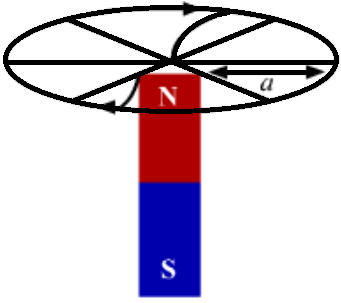
A very long bar magnet is placed with its north pole coinciding with the centre of a circular loop carrying as electric current i. The magnetic field due to the magnet at a point on the periphery of the wire is B. The radius of the loop is a. The force on the wire is:
  • Very nearly $2\pi\text{aiB}$ perpendicular to the plane of the wire.
  • B
    $2\pi\text{aiB}$ in the plane of the wire.
  • C
    $\pi\text{aiB}$ along the magnet.
  • D
    Zero.
Answer
Correct option: A.
Very nearly $2\pi\text{aiB}$ perpendicular to the plane of the wire.

In this case, the north pole of the magnet is coinciding with the centre of the circular loop carrying electric current i. So, the magnetic field lines almost lie on the plane of the ring and the force due to the field lines is perpendicular to the field lines and to the plane of the circular ring.
Let idl be the current element, B be the magnetic field and dF be the force on the current element idl.
Now
$\text{dF}=\text{Bidl}\Rightarrow\text{F}=\int_{0}^{2\pi\text{a}} \text{Bidl}$
$\Rightarrow\text{F}=2\pi\text{aiB}$
Thus, the force acting on the wire is $2\pi\text{aiB}$ and it is perpendicular to the plane of the wire.
View full question & answer
Question 141 Mark
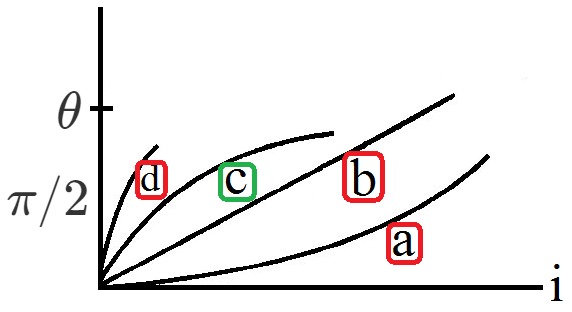
Which of the following four graphs may best represent the current$-$deflection relation in a tangent galvanometer?
Answer


Since i $\propto\tan \theta,$ the only graph that represents this correlation is curve. 
View full question & answer
MCQ 151 Mark
Let r be the distance of a point on the axis of a bar magnet from its centre. The magnetic field at such a point is proportional to:
  • A
    $\frac{1}{\text{r}}$
  • B
    $\frac{1}{\text{r}^2}$
  • C
    $\frac{1}{\text{r}^3}$
  • None of these.
Answer
Correct option: D.
None of these.
Magnetic field B due to a bar magnet of magnetic moment M at distance r of the point on the axis of the magnet from its centre is given by.
$\text{B}=\frac{\mu_\text{o}}{4\pi}\frac{2\text{Mr}}{(\text{r}^2-\text{l}^2)^2}$
Here, 2I is the length of the magnet.
So, from the above formula, it can be easily seen that $\text{B}\propto\frac{\text{r}}{(\text{r}^2-\text{r}^2)^2}$
View full question & answer
MCQ 161 Mark
Consider the situation of the previous problem. The directions of the magnetic field due to the dipole are opposite at:
  • A
    $P_1$ and $P_2$
  • B
    $Q_1$ and $Q_2$
  • C
    $P_1$ and $Q_1$
  • $P_2$ and $Q_2$
Answer
Correct option: D.
$P_2$ and $Q_2$
We know that magnetic field lines are directed from the north pole to the south pole. From the given figure, we can say that the direction of the magnetic field $\overrightarrow{\text{B}}$ is opposite at points $P_1$ and $Q_1$ and at points $P_2$ and $Q_2$.
View full question & answer
MCQ 171 Mark
When a current in a circular loop is equivalently replaced by a magnetic dipole:
  • A
    The pole strength m of each pole is fixed.
  • B
    The distance d between the poles is fixed.
  • The product md is fixed.
  • D
    None of the above.
Answer
Correct option: C.
The product md is fixed.
When we replace a circular current-carrying loop with a magnetic dipole to resemble field lines of the circular loop, the pole strength m and the distance between the poles are not fixed.
But the magnetic dipole moment of both systems is always fixed. It is the product of the magnetic moment and the distance between the poles. In other words, md is fixed.
A current loop of area A and current I can be replaced with a magnetic dipole of dipole moment md.
i.e. md = IA
View full question & answer