Questions

2 Marks Questions

Take a timed test

6 questions · self-marked practice — reveal the answer and mark yourself.

Question 12 Marks
Find the maximum kinetic energy of the photoelectrons ejected when light of wavelength 350nm is incident on a cesium surface. Work function of cesium = 1.9eV
Answer
$\lambda=350\text{nm}=350\times10^{-9}\text{m}$$\phi=1.9\text{ev}$
Max KE of electrons $=\frac{\text{hC}}{\lambda}-\phi$
$=\frac{6.63\times10^{-34}\times3\times10^{8}}{350\times10^{-9}\times1.6\times10^{-19}}-1.9$
$=1.65\text{ev}=1.6\text{ev.}$
View full question & answer
Question 22 Marks
A photographic film is coated with a silver bromide layer. When light fells on this film, silver bromide molecules dissociate end the film records the light there. A minimum of 0.6eV is needed to dissociate a silver bromide molecule. Find the maximum wavelength of light that can be recorded by the film.
Answer
$w_0 = 0.6ev$ For $w_0$ to be min $'\lambda'$ becomes maximum.$\text{w}_0=\frac{\text{hc}}{\lambda}$
$=\frac{\text{hc}}{\text{w}_0}=\frac{6.63\times10^{-34}\times3\times10^{8}}{0.6\times1.6\times10^{-19}}$
$=20.71\times10-7\text{m}=2071\text{nm.}$
View full question & answer
Question 32 Marks
An atom absorbs a photon of wavelength 500nm and emits another photon of wavelength 700nm. Find the net energy absorbed by the atom in the process.
Answer
$\lambda_1=500\text{nm}=500\times10^{-9}\text{m}$$\lambda_2=700\text{nm}=700\times10^{-9}\text{m}$
$\text{E}_1-\text{E}_2$ = Energy absorbed by the atom in the process.
$=\text{hc}\Big[\frac{1}{\lambda_1}-\frac{1}{\lambda_2}\Big]$
$\Rightarrow6.63\times3\Big[\frac{1}{7}-\frac{1}{7}\Big]\times10^{-19}$
$=1.136\times10^{-19}\text{J}$
View full question & answer
Question 42 Marks
Calculate the momentum of a photon of light of wavelength 500nm.
Answer
$\lambda=\frac{\text{h}}{\lambda}$$\Rightarrow\text{p}=\frac{\text{h}}{\lambda}=\frac{6.63\times10^{-34}}{500\times10^{-9}}\text{J-S}$
$1.326\times10^{-27}=1.33\times10^{-27}\text{kg}-\text{m/s.}$
View full question & answer
Question 52 Marks
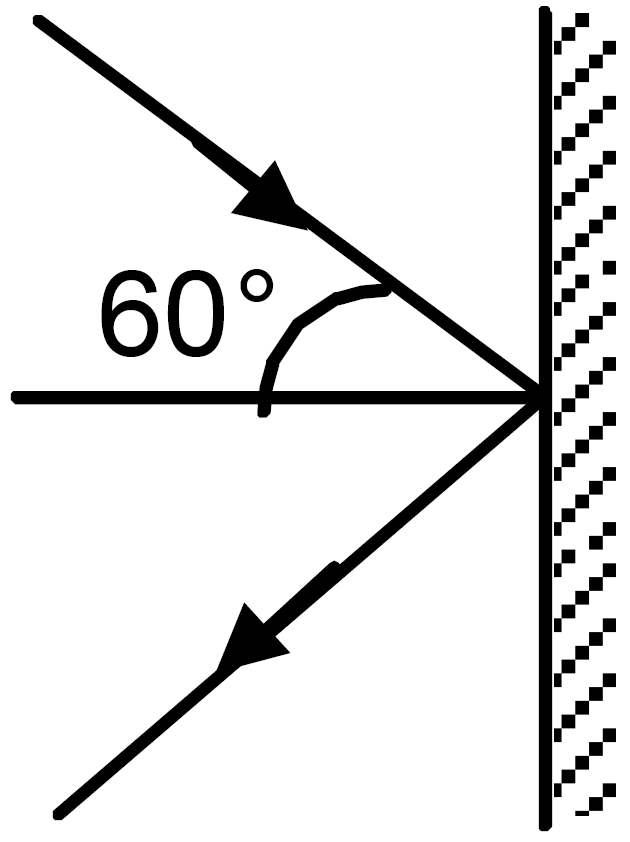
A parallel beam of monochromatic light of wavelength 663nm is incident on a totally reflecting plane mirror. The angle of incidence is 60° and the number of photons striking the mirror per second is $1.0 \times 10^{19}$. Calculate the force exerted by the light beam on the mirror.
Answer


$\lambda=663\times10^{-9}\text{m,}\theta=60$$\text{n}=1\times10^{19},\lambda=\frac{\text{h}}{\text{p}}$
$\Rightarrow\text{p}=\frac{\text{p}}{\lambda}=10^{-27}$
Force exerted on the wall
$=\text{n}(\text{mv}\cos\theta-(-\text{mv}\cos\theta))=2\text{n}\text{ mv}\cos\theta.$
$=2\times1\times10^{19}\times10^{-27}\times\frac{1}{2}=1\times10^{-8}\text{N.}$
View full question & answer
Question 62 Marks
If an electron has a wavelength, does it also have a colour?
Answer
Colour is a characteristic of electromagnetic waves. Electrons behave as a de-Broglie wave because of their velocity. A de-Broglie wave is not an electromagnetic wave and is one dimensional. Hence, no colour is shown by an electron.
View full question & answer