Questions

1 Marks Question

Take a timed test

21 questions · self-marked practice — reveal the answer and mark yourself.

Question 11 Mark
A 5.0cm long straight piece of thread is kept on the surface of water. Find the force with which the surface on one side of the thread pulls it. Surface tension of water = 0.076N/m.
Answer
Given:
Length of thread $\mathrm{I}=5 \mathrm{~cm}=5 \times 10^{-2} \mathrm{~m}$
Surface tension of water $T=0.76 \mathrm{~N} / \mathrm{m}$
We know that:
$F=T \times I=0.76 \times 5 \times 10^{-2}$
$=3.8 \times 10^{-3} \mathrm{~N}$
Therefore, the water surface on one side of the thread pulls it with a force of $3.8 \times 10^{-3} \mathrm{~N}$.
View full question & answer
Question 21 Mark
The elastic limit of steel is $8 \times 10^8N/m^2$ and its Young's modulus $2 \times 10^{11}N/m^2$. Find the maximum elongation of a half meter steel wire that can be given without exceeding the elastic limit.
Answer
It means the maximum stress in the wire $\sigma =8\times 10^8\text{N}/\text{m}^2$
$Y = 2.0 \times 10^{11}N/ m^2$
Length of the wire L = 0.50m
Let corresponding maximum elongation = lm
Strain $\in=\frac{\text{l}}{\text{L}}=\frac{\text{l}}{0.50}=2\text{l}$
we have $\frac{\sigma}{\in}=\text{Y}$
$\Rightarrow\in=\frac{\sigma}{\text{Y}}$
$\Rightarrow2\text{l}=8\times\frac{10^8}{2.0}\times10^{11}$
$\Rightarrow\text{l}=\frac{2}{100}\text{m}=2\text{mm}$
View full question & answer
Question 31 Mark
Two persons pull a rope towards themselves. Each person exerts a force of 100N on the rope. Find the Young's modulus of the material of the rope if it extends in length by 1cm. Original length of the rope = 2m and the area of cross-section $= 2cm^2$.
Answer
Area of cross-section A $=2\text{cm}^2=\frac{2}{1000}\text{m}^2$ Force F = 100N Stress $\sigma=\frac{\text{F}}{\text{A}}$$=\frac{100}{\big(\frac{2}{1000}\big)}$
$=\frac{1000000}{2}$
$=500000$
$=5\times10^5\text{N}/\text{m}^2$
$\text{l}=1\text{cm}=\frac{1}{100}\text{m}=0.01\text{m}$
Strain $\in=\frac{l}{\text{L}}=\frac{0.01}{2}=0.005$ Young's modulus of the material Y $=\frac{\sigma}{\in}$$=5\times\frac{10^5}{0.005}\text{N}/\text{m}^2$
$=1\times10^8\text{N}/\text{m}^2$
View full question & answer
Question 41 Mark
Find the excess pressure inside:
  1. A drop of mercury of radius $2mm$.
  2. A soap bubble of radius $4mm$.
  3. An air bubble of radius $4mm$ formed inside a tank of water. Surface tension of mercury, soap solution and water are $0.465N/m, 0.03N/m$ and $0.076N/m$ respectively.
Answer
Given:
Radius of mercury drop $\mathrm{r}=2 \mathrm{~mm}=2 \times 10^{-3} \mathrm{~m}$
Radius of soap bubble $r=4 \mathrm{~mm}=4 \times 10^{-3} \mathrm{~m}$
Radius of air bubble $\mathrm{r}=4 \mathrm{~mm}=4 \times 10^{-3} \mathrm{~m}$
Surface tension of mercury $\mathrm{T}_{\mathrm{Hg}}=0.465 \mathrm{~N} / \mathrm{m}$
Surface tension of soap solution $T_5=0.03 \mathrm{~N} / \mathrm{m}$
Surface tension of water $T_a=0.076 \mathrm{~N} / \mathrm{m}$
  1. Excess pressure inside mercury drop:
$\text{P}=\frac{2\text{T}_\text{Hg}}{\text{r}}$
$=\frac{0.465\times2}{2\times10^{-3}}=465\text{N}/\text{m}^2$
  1. Excess pressure inside the soap bubble:
$\text{P}=\frac{4\text{T}_\text{S}}{\text{r}}$
$=\frac{4\times0.03}{4\times10^{-3}}=30\text{N}/\text{m}^2$
  1. Excess pressure inside the air bubble:
$\text{P}=\frac{4\text{T}_\text{a}}{\text{r}}$
$=\frac{2\times0.076}{4\times10^{-3}}=38\text{N}/\text{m}^2$
View full question & answer
Question 51 Mark
A vertical metal cylinder of radius $2\ cm$ and length $2m$ is fixed at the lower end and a load of $100\ kg$ is put on it. Find
  1. The stress.
  2. The strain and.
  3. The compression of the cylinder. Young's modulus of the metal $= 2 \times 10^{11} N/m^2$.
Answer
  1. Length of the cylinder $L = 2m$
Area of cross-section $\text{A}=\pi\text{r}^2\Big(\frac{2}{100}\Big)^2\text{m}^2=\frac{4\pi}{10000}\text{m}^2$
Force on the cylinder $\text{F}=100\times10\text{N}=1000\text{N}$
Hence the stress $=\frac{\text{F}}{\text{A}}=\frac{1000}{\Big(\frac{4\pi}{10000}\Big)}\text{N}/\text{m}^2$
$=\Big(\frac{1}{4\pi}\Big)\times10^7\text{N}/\text{m}^2$
$=0.0796\times10^7\text{N}/\text{m}^2$
$=7.96\times10^5\text{N}/\text{m}^2$
  1. $\text{Strain}=\frac{\text{Stress}}{\text{Y}}=\frac{\Big(\frac{\text{F}}{\text{A}}\Big)}{\text{Y}}$
$=\frac{\{7.96\times10^5\}}{2.0\times10^{11}}$
$=3.98^{-6}\approx4\times10^{-6}$
  1. Let the comoression of the cyilender $= lm$
The strain $=\frac{\text{l}}{\text{L}}=\frac{\text{l}}{2}$
$\Rightarrow4\times10^{-6}=\frac{\text{l}}{2}$
$\Rightarrow\text{l}=8\times10^{-6}\text{m}$
View full question & answer
Question 61 Mark
Find the increase in pressure required to decrease the volume of a water sample by 0.01%. Bulk modulus of water = $2.1 \times 10^9N/m^2$.
Answer
Given:
Bulk modulus of water B = $2.1 \times 10^9Nm^{-2}$
In order to decrease the volume (V) of a water sample by 0.01%, let the increase in pressure be P.
$\frac{\text{v}\times0.1}{100}=\triangle\text{V}$
$\Rightarrow\frac{\triangle\text{V}}{\text{V}}=10^{-4}$
From B $=\frac{\text{P}\text{V}}{\triangle\text{V}},$ We have:
$\Rightarrow\text{P}= \text{B}\Big(\frac{\triangle\text{V}}{\text{V}}\Big)$
$=2.1\times10^{9}\times10^{-4}$
$=2.1\times10^{5}\text{N}/\text{m}^2$
Hence, the requred increase in pressure is $2.1 \times 10^5Nm^{-2}​​​​​​​$.
View full question & answer
Question 71 Mark
Water flows at a speed of $6cm/s$ through a tube of radius $1cm$. Coefficient of viscosity of water at room termperature is $0.01$ poise. Calculate the Reynolds number. Is it a steady flow?
Answer
Given: Speed of water, $v=6 \mathrm{~cm} / \mathrm{s}=6 \times 10^{-2} \mathrm{~m} / \mathrm{s}$ Radius of tube, $\mathrm{r}=1 \mathrm{~cm}=10^{-2} \mathrm{~m}$ Diameter of tube, $D=2 \times 10^{-2} \mathrm{~m}$
Coefficient of viscosity, $\eta=0.01$ poise Let the Reynolds number be R and the density of water be $\rho.$$\Rightarrow\text{R}=\frac{\text{v}\rho\text{D}}{\eta}$
$=\big(6\times10^{-3}\big)\times10^3\times\frac{2\times10^{-2}}{10^{-2}}$
$=120$
Here, the Reynolds number is less than $2000$. Therefore, it is a steady flow.
View full question & answer
Question 81 Mark
A drop of mercury of radius 2mm is split into 8 identical droplets. Find the increase in surface energy. Surface tension of mercury = $0.465J/m^2$.
Answer
Given: Initial radius of mercury drop $R = 2mm = 2 \times 10^{-3}m$ Surface tension of mercury $T = 0.465J/m^2$ Let the radius of a small drop of mercury be r. As one big drop is split into 8 identical droplets: volume of initial drop = 8 × (volume of a small drop)$\Big(\frac{4}{3}\Big)\pi\text{R}^3=\Big(\frac{4}{3}\big)\pi\text{r}^3\times8$
Taking cube root on both sides of the above equation:$\text{r}=\frac{\text{R}}{2}=10^{-3}\text{m}$
Surface energy = T × surface area$\therefore$ Increase in surface energy = TA' - TA
$=(8\times4\pi\text{r}^2-4\pi\text{R}^2)\text{T}$
$=4\pi\text{T}\Big[8\times\Big(\frac{\text{R}^2}{4}\Big)-\text{R}^2\Big]$
$=4\pi\text{T}\text{R}^2$
$=4\times(3.14)\times(0.465)\times\big(4\times10^{-6}\big)$
$=23.36\times10^{-6}$
$=23.4\mu\text{j}$
Hence, the required increase in the surface energy of the mercury droplets is $23.4\mu\text{j}$
View full question & answer
Question 91 Mark
A steel rod of cross-sectional area $4 \mathrm{~cm}^2$ and length 2 m shrinks by 0.1 cm as the temperature decreases in night. If the rod is clamped at both ends during the day hours, find the tension developed in it during night hours. Young's modulus of steel $=1.9 \times 10^{11} \mathrm{~N} / \mathrm{m}^2$.
Answer
Length of the rod = L = 2m

The length increased during the night = 1 = 0.1cm = 0.001m

The strain developed during the night $=\frac{\text{l}}{\text{L}}=\frac{0.001}{2}=0.0005$

If the tension developed = TN

The stress developed $=\frac{\text{T}}{\text{A}}\text{N}/\text{m}^2$

$=\frac{\text{T}}{0.0004}\text{N}/\text{m}^2$

But stress = strain × y

$\frac{\text{T}}{0.0004}=0.0005\times1.9\times10^{11}\text{N}$

$\Rightarrow\text{T}=0.0004\times0.0005\times1.9\times10^{11}\text{N}$

$\Rightarrow\text{T}=2\times10^{-7}\times1.9\times10^{11}\text{N}$

$\Rightarrow\text{T}=3.8\times10^4\text{N}$
View full question & answer
Question 101 Mark
Frictional force between solids operates even when they do not move with respect to each other. Do we have viscous force acting between two layers even if there is no relative motion?
Answer
No. For a liquid at rest, no viscous forces exist.
Viscous forces oppose relative motion between the layers of a liquid. These layers do not exist in a liquid that is at rest. Therefore, it is obvious that viscous forces are non-existent in a static liquid.
View full question & answer
Question 111 Mark
A steel plate of face area $4 \mathrm{~cm}^2$ and thickness $0.5\ cm$ is fixed rigidly at the lower surface. A tangential force of $10\ N$ is applied on the upper surface. Find the lateral displacement of the upper surface with respect to the lower surface. Rigidity modulus of steel $=8.4 \times 10^{10} \mathrm{~N} / \mathrm{m}^2$.
Answer
Given:
Face area of steel plate $A=4 \mathrm{~cm}^2=4 \times 10^{-4} \mathrm{~m}^2$
Thickness of steel plate $\mathrm{d}=0.5 \mathrm{~cm}=0.5 \times 10^{-2} \mathrm{~m}$
Applied force on the upper surface $F=10 \mathrm{~N}$
Rigidity modulus of steel $=8.4 \times 10^{10} \mathrm{Nm}^{-2}$
Let $\theta$ be the angular displacement,
$\text { Rigidity modulus } \mathrm{m}=\frac{\mathrm{F}}{\mathrm{~A} \theta}$
$\Rightarrow \mathrm{~m}=\left(\frac{10}{4 \times 10^{-4} \theta}\right)$
$\Rightarrow \theta=\frac{10}{4 \times 10^{-4} \times 8.4 \times 10^{10}}$
$=0.297 \times 10^{-6}$
$\therefore$ Lateral displacement of the upper surface with respect to the lower surface $=\theta \times \mathrm{d}$
$\Rightarrow(0.297) \times 10^{-6} \times(0.5) \times 10^{-2}$
$\Rightarrow 1.5 \times 10^{-9} \mathrm{~m}$
Hence, the required lateral displacement of the steel plate is $1.5 \times 10^{-9} \mathrm{~m}$.
View full question & answer
Question 121 Mark
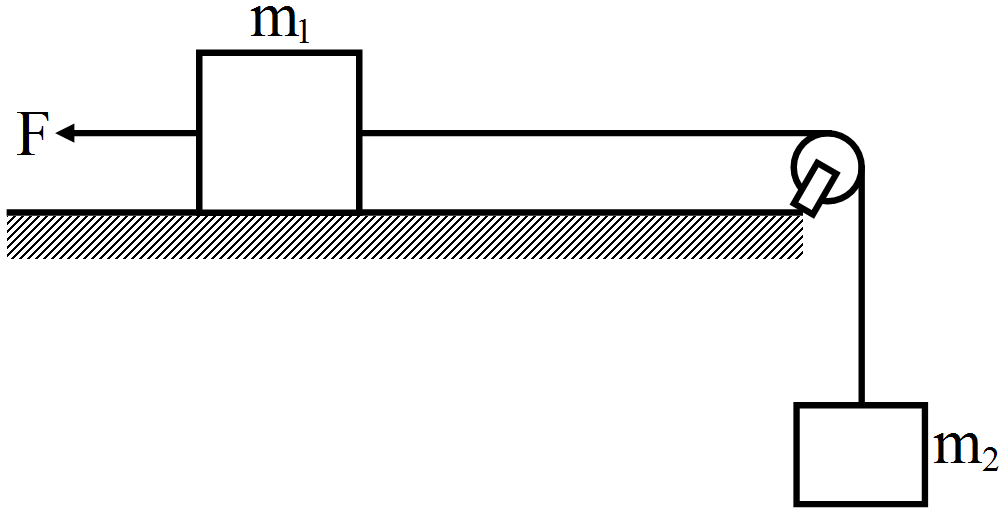
Consider the situation shown in The force F is equal to the $\frac{\text{m}_2\text{g}}{2}$ If the area of cross-section of the string is A and its Young's modulus Y, find the strain developed in it. The string is light and there is no friction anywhere.
Answer
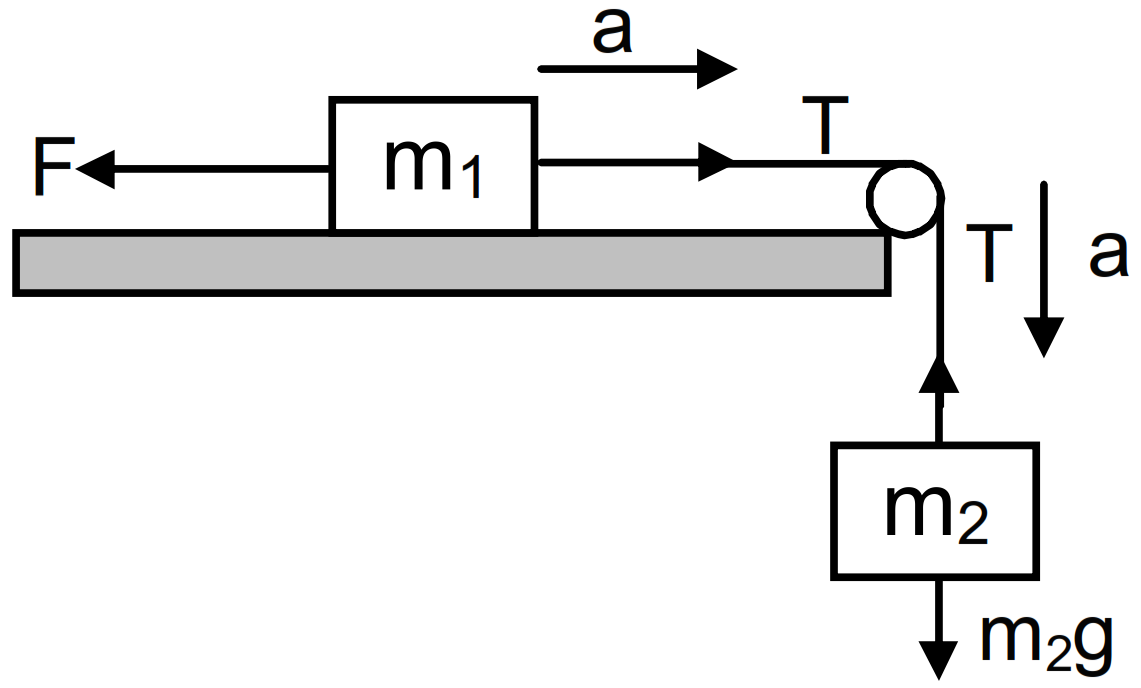
Let the tension in the string = T and the acceleration of the block = a, For the hanging block$\text{m}_2\text{g}-\text{T}=\text{m}_2\text{a}$
$\Rightarrow\text{a}=\text{g}-\frac{\text{T}}{\text{m}_2}$
For the block on the table$\text{T}-\text{F}=\text{m}_1\text{a}$
$\Rightarrow\text{T}=\text{m}_1\text{a}+\text{F}$
$\Rightarrow\text{T}=\text{M}_1\text{a}+\frac{\text{m}_2\text{g}}{2}$
$\Rightarrow\text{T}=\text{m}_1\text{g}-\text{m}_1\frac{\text{T}}{\text{m}_2}+\frac{\text{m}_2\text{g}}{2}$ {Putting the value of a}
$\Rightarrow\text{T}\frac{(\text{m}_1+\text{m}_2)}{\text{m}_2}=\frac{(2\text{m}_1+\text{m}_2)\text{g}}{2}$
$\Rightarrow\text{T}=\text{m}_2\frac{(2\text{m}_1+\text{m}_2)\text{g}}{2(\text{m}_1+\text{m}_2)}$
The strain $=\frac{\text{Stress}}{\text{Y}}$$=\frac{\text{T}}{\text{AY}}$
$=\frac{\text{m}_2\text{g}(2\text{m}_1+\text{m})_2}{2\text{AY}(\text{m}_1\text{m)}_2}$
View full question & answer
Question 131 Mark
The ratio $\frac{\text{Stress}}{\text{strain}}$ remains constant for small deformation of a metal wire. When the deformation is made larger, will this ratio increase or decrease?
Answer
The ratio of stress to strain will decrease.
Beyond the elastic limit, the body loses its ability to restore completely when subjected to stress. Thus, there occurs more strain for a given stress. At some points, however, the body undergoes strain without the application of stress. So, the ratio of stress to strain decreases.
View full question & answer
Question 141 Mark
When the skeleton of an elephant and the skeleton of a mouse are prepared in the same size, the bones of the elephant are shown thicker than those of the mouse. Explain why the bones of an elephant are thicker than proportionate. The bones are expected to withstand the stress due to the weight of the animal.
Answer
The elephant has a greater weight than a mouse, but the material that makes their bones is the same. This means that in order to sustain an elephant's weight, one's bones need to suffer less stress. Stress $\text{stress}=\frac{\text{force}}{\text{area}}.$ A greater cross-section area reduces stress on the bones. This is why an elephant's bones are thicker.
View full question & answer
Question 151 Mark
Consider a small surface area of $1mm^2$ at the top of a mercury drop of radius $4.0mm$. Find the force exerted on this area:
  1. By the air above it.
  2. By the mercury below it and.
  3. By the mercury surface in contact with it. Atmospheric pressure = $1.0 \times 10^5Pa$ and surface tension of mercury = $0.465N/m$. Neglect the effect of gravity. Assume all numbers to be exact.
Answer
Given:
Surface area of mercury drop, $A=1 \mathrm{~mm}^2=10^{-6} \mathrm{~m}^2$
Radius of mercury drop, $r=4 \mathrm{~mm}=4 \times 10^{-3} \mathrm{~m}$
Atmospheric pressure, $\mathrm{P}_0=1.0 \times 10^5 \mathrm{~P}_{\mathrm{a}}$
Surface tension of mercury, $\mathrm{T}=0.465 \mathrm{~N} / \mathrm{m}$
  1. Force exerted by air on the surface area:
$\text{F}=\text{P}_0\text{A}$
$\Rightarrow\text{F}=1.0\times10^5\times10^{-6}=0.1\text{N}$
  1. Force exerted by mercury below the surface area:
Pressure $\text{P}'=\text{P}_0+\frac{2\text{T}}{\text{r}}$
$\text{F}=\text{P}'\text{A}=\Big(\text{P}_0+\frac{2\text{T}}{\text{r}}\Big)\text{A}$
$=\big(0.1+\frac{2\times0.465}{4\times10^{-3}}\Big)\times10^{-6}$
$=1+0.00023=0.10023\text{N}$
  1. Force exerted by mercury surface in contact with it:
$\text{P}=\frac{2\text{T}}{\text{r}}$
$\text{F}=\text{PA}=\frac{2\text{T}}{\text{r}}\text{A}$
$=\frac{2\times0.465}{4\times10^{-3}}\times10^{-6}=0.00023\text{N}$
View full question & answer
Question 161 Mark
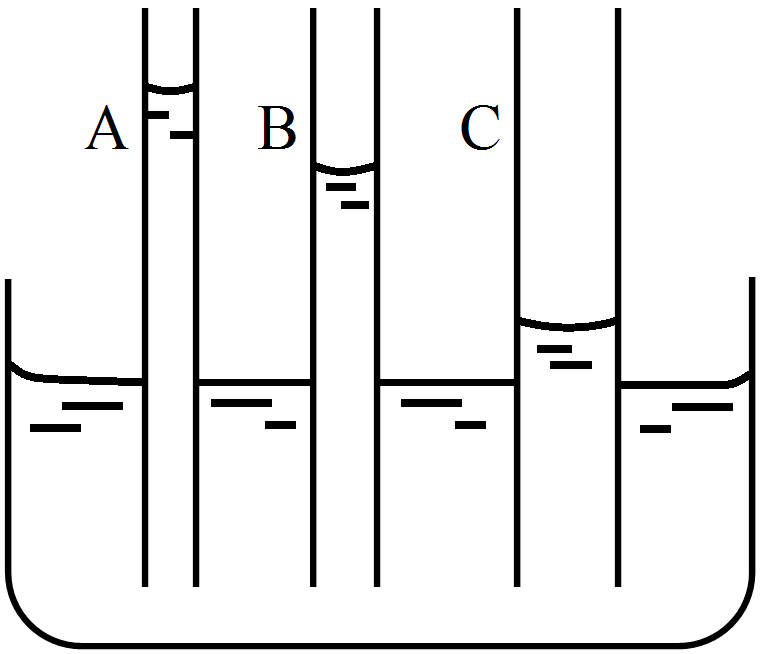
The capillaries shown in have inner radii $0.5mm, 1.0mm$ and $1.5mm$ respectively. The liquid in the beaker is water. Find the heights of water level in the capillaries. The surface tension of water is $7.5 \times 10^{-2}N/m$.
Answer
Given:
Surface tension of water $T = 7.5 \times 10^{-2}N/m$
Taking $\cos\theta=1$
Radius of capillary $A(r_A) = 0.5mm = 0.5 \times 10^{-3}m$
Height of water level in capillary A:
$\text{h}_\text{A}=\frac{2\text{T}\cos\theta}{\text{r}_\text{A}\rho\text{g}}$
$=\frac{2\times7.5\times10^{-2}}{0.5\times10^{-3}\times1000\times10}$
$=3\times10^{-2}\text{m}=3\text{cm}$
Radius of capillary $B(r_B) =1mm = 1 \times 10^{-3}m$
Height of water level in capillary B:
$\text{h}_\text{B}=\frac{2\text{T}\cos\theta}{\text{r}_\text{B}\rho\text{g}}$
$=\frac{2\times7.5\times10^{-2}}{1\times10^{-3}\times10^3\times 10}$
$=15\times10^{-3}\text{m}=1.5\text{cm}$
Radius of capillary $C(r_C) = 1.5mm = 1.5 \times 10^{-3}m$
Height of water level in capillary C:
$\text{h}_\text{C}=\frac{2\text{T}\cos\theta}{\text{r}_\text{C}\rho_\text{g}}$
$=\frac{2\times7.5\times10^{-2}}{1.5\times10^{-3}\times10^{3}\times10}$
$=\frac{15}{1.5}\times10^{-3}\text{m}=1\text{cm}$
View full question & answer
Question 171 Mark
Find the surface energy of water kept in a cylindrical vessel of radius 6.0cm. Surface tension of water $= 0.075J/m^2$.
Answer
Given:
Radius of cylindrical vessel, $\mathrm{r}=6.0 \mathrm{~cm}=0.06 \mathrm{~m}$
Surface tension of water, $T=0.075 \mathrm{~J} / \mathrm{m}^2$
Area, $\mathrm{A}=\pi \mathrm{r}^2=\pi \times(0.06)^2$
Surface energy $=\mathrm{T} \times \mathrm{A}$
$=(0.075) \times(3.14) \times(0.06)^2$
$=8.5 \times 10^{-4} \mathrm{~J}$
Therefore, the surface energy of water kept in a cylindrical vessel is $8.5 \times 10^{-4}$ J.
View full question & answer
Question 181 Mark
When the size of a soap bubble is increased by pushing more air in it, the surface area increases. Does it mean that the average separation between the surface molecules is increased?
Answer
No, The average intermolecular distances do not increase with an increase in the surface area.
A soap bubble's layer consists of several thousand layers of molecules. An increase in the surface area causes the surface energy to also increase. This in turn allows more and more molecules from the inner liquid layers of the bubble to attain potential energy, enabling them to enter the outer surface of the bubble. Hence, the surface area increases.
View full question & answer
Question 191 Mark
A capillary tube of radius $0.50mm$ is dipped vertically in a pot of water. Find the difference between the pressure of the water in the tube $5.0cm$ below the surface and the atmospheric pressure. Surface tension of water = $0.075N/m$.
Answer
Given:
Radius of capillary tube $r=0.5 \mathrm{~mm}=5 \times 10^{-4} \mathrm{~m}$
Depth (where pressure is to be found) $h=5.0 \mathrm{~cm}=5 \times 10^{-2} \mathrm{~m}$
Surface tension of water $T=0.075 \mathrm{~N} / \mathrm{m}$
Excess pressure at 5 cm before the surface:
$\mathrm{P}=\rho_{\mathrm{hg}}=1000 \times\left(5 \times 10^{-2}\right) \times 9.8=490 \mathrm{~N} / \mathrm{m}^2$
Excess pressure at the surface is given by:
$P_0=\frac{2 T}{r}=\frac{2 \times(0.75)}{\left(5 \times 10^{-4}\right)}$
$=300 \mathrm{~N} / \mathrm{m}^2$
Difference in pressure: $P_0-P=490=300=190 \mathrm{~N} / \mathrm{m}^2$
Hence, the required difference in pressure is $190 \mathrm{~N} / \mathrm{m}^2$.
View full question & answer
Question 201 Mark
The lower end of a capillary tube of radius $1mm$ is dipped vertically into mercury:
  1. Find the depression of mercury column in the capillary.
  2. If the length dipped inside is half the answer of part $(a)$, find the angle made by the mercury surface at the end of the capillary with the vertical. Surface tension of mercury $= 0.465N/m$ and the contact angle of mercury with glass $=$ $135^\circ$ .
Answer
Given:
Radius of tube $r = 1mm = 10^{-3}m$
Contact angle of mercury with glass $\theta=135^\circ$
Surface tension of mercury $T = 0.465N/m$
Let $\rho$ be the density of mercury.
  1. Depression of mercury level is expressed as follows:
$\text{h}=\frac{2\text{T}\cos\theta}{\text{r}\rho\text{g}}\ \cdots(1)$
$\Rightarrow\text{h}=\frac{2\times0.465\times\cos135^\circ}{10^{-3}\times13600\times(9.8)}$
$=0.0053\text{m}=5.3\text{mm}$
  1. If the length dipped inside is half the result obtained above:
New depression $\text{h}'=\frac{\text{h}}{2}$
Let the new contact angle of mercury with glass be $\theta'\cdot$
$\therefore\text{h}'=\frac{2\text{T}\cos\theta'}{\text{r}\rho\text{g}}\ \cdots(2)$
Dividing equation $(1)$ by $(2)$, we get:
$\frac{\text{h}'}{\text{h}}=\frac{\cos\theta^\circ}{\cos\theta}$
$\Rightarrow\cos\theta'=\frac{\cos\theta}{2}$
$\Rightarrow\theta=112^\circ$
View full question & answer
Question 211 Mark
A capillary tube of radius $1\ mm$ is kept vertical with the lower end in water:
  1. Find the height of water raised in the capillary.
  2. If the length of the capillary tube is half the answer of part $(a)$, find the angle $\theta$ made by the water surface in the capillary with the wall.
Answer
Given:
Radius of capillary tube $r = 1mm = 10^{-3}m$
  1. Let $T$ be the surface tension and $\rho$ be the density of the liquid.
Then, for $\cos\theta=1,$ height $(h)$ of liquid level:
$\text{h}=\frac{2\text{T}}{\text{r}\rho_\text{g}}\ \cdots(1)$
where $g$ is the acceleration due to gravity:
$\Rightarrow\text{h}=\frac{2\times(0.076)}{10^{-3}\times10\times100}$
$=1.52\text{cm}$
$=1.52\times10^{-2}\text{m}$
$=1.52\text{cm}$
  1. Let the new length of the tube be $h'.$
$\text{h}'=\frac{2\text{T}\cos\theta}{\text{r}\rho\text{g}}$
$\cos\theta=\frac{\text{h'}\text{r}\rho\text{g}}{2\text{T}}$
Using equation $(1)$, we get:
$\cos\theta=\frac{\text{h}'}{\text{h}}=\frac{1}{2}$
$\Big($Because $\text{h}'=\frac{\text{h}}{2}\Big)$
$\Rightarrow\theta=\cos^{-1}\Big(\frac{1}{2}\Big)=60^\circ$
The water surface in the capillary makes an angle of $60^\circ$ with the wall.
View full question & answer