Questions · Page 2 of 2

1 Marks Question

Question 511 Mark
Work depends on path in a thermodynamical process. How?
Answer
Depending on the process carried out, the work done varies. So, it is dependent on path.
View full question & answer
Question 521 Mark
At what temperature do the Kelvin and Celsius scales coincide?
Answer
Kelvin and Celsius scales never coincide.
View full question & answer
Question 531 Mark
Can we decide whether change in internal energy of a system is due to heating or performance of work?
Answer
No, as internal energy might change due to both heating and performance of work.
View full question & answer
Question 541 Mark
Is reversible process possible in nature?
Answer
A reversible process is never possible in nature because of dissipative forces and condition for a quasi-static process is not practically possible.
View full question & answer
Question 551 Mark
Why can an engine working under isothermal conditions produce no useful work?
Answer
We know that $\eta=1-\frac{\text{T}_2}{\text{T}_1}$ For isothermal operation of the engine, $\text{T}_1=\text{T}_2$ So, $\eta=0$ Hence an engine working under isothermal condition can do no useful work.
View full question & answer
Question 561 Mark
Why a gas is cooled when it expand?
Answer
When a gas expands, it does work on the surroundings. This work is done on the expense of internal energy and that is why its internal energy and so its temperature decreases.
View full question & answer
Question 571 Mark
Can two isothermal curves intersect? Why?
Answer
No, since then for two different sets of physical parameters the system may be identified, leading to different states.
View full question & answer
Question 581 Mark
Can the temperature of a system be increased without heating it?
Answer
Yes, for example in adiabatic compression.
View full question & answer
Question 591 Mark
Why can a Carnot's engine not get 100% efficiency?
Answer
Due to transmission loss, the energy required to carry the process itself and the inability to build a sink at zero kelvin, one cannot get 100% efficient Carnot's engine.
View full question & answer
Question 601 Mark
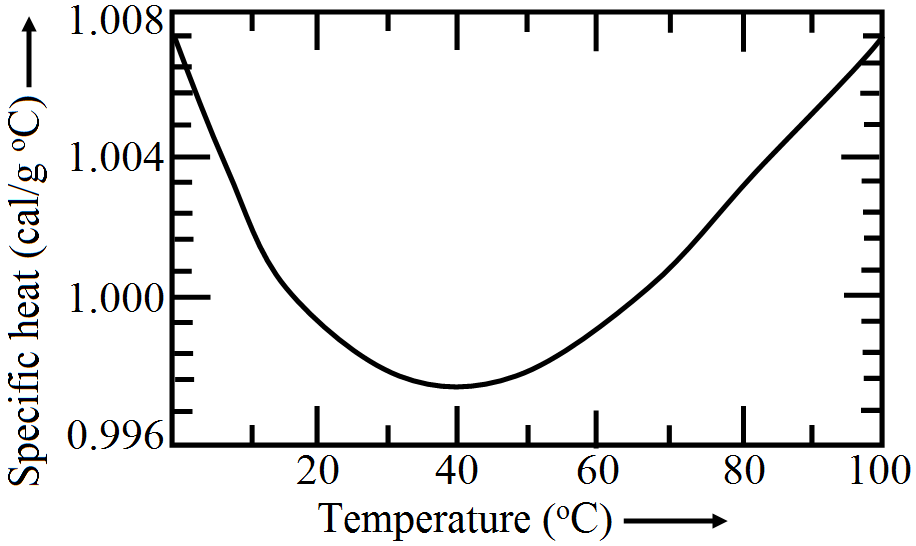
Plot a graph showing the variation of specific heat of water with temperature.
Answer
Variation of specific heat of water with temperature:
View full question & answer
Question 611 Mark
Under what ideal condition can the efficiency of a Carnot engine be 100%?
Answer
The efficiency of a Carnot engine can be 100% if the temperature of sink is absolute zero.
View full question & answer
Question 621 Mark
A body at higher temperature contains more heat. Comment.
Answer
The statement may not be true always because heat content of a body depends on mass of body, its specific heat and temperature.
View full question & answer
Question 641 Mark
Why does the brake drum of an automobile get heated up while moving down at constant speed?
Answer
To make the vehicle to move at constant speed, constantly the brake has to be applied to work against the available energy. So, it gets heated up.
View full question & answer
Question 651 Mark
Can a ship be moved with the energy of the sea water?
Answer
No, a ship cannot be moved in a sea by the use of the energy of sea water because refrigerator is against the second law of thermodynamics.
View full question & answer
Question 661 Mark
Can the temperature of an isolated system change?
Answer
Yes, in an adiabatic process the temperature of an isolated system changes. It increases when the gas is compressed adiabatically.
View full question & answer
Question 671 Mark
The coefficient of performance of a refrigerator depends on which factor?
Answer
The coefficient of performance of a refrigerator depends on the temperatures of source and sink.
View full question & answer
Question 681 Mark
State First law of thermodynamics.
Answer
According to first law of thermodynamics when some quantity of heat (dQ) is supplied to a system capable of doing external work, then quantity of heat absorbed by the system (dQ) is equal to sum of increase in internal energy of system (dU) due to rise in temperature and external work done by system (dW) in expansion i.e. dQ = dU + dW
View full question & answer
Question 691 Mark
What forbids the complete conversion of heat into work?
Answer
Second law of thermodynamics, which says that 100% conversion of heat into work is impossible.
View full question & answer
Question 701 Mark
Name the principle used in the mercury thermometer.
Answer
It is based on the fact that the change in volume of mercury is nearly proportional to the change in temperature.
View full question & answer
Question 711 Mark
What is the principle of calorimetry?
Answer
Heat lost by a body is equal to heat gained by the other when they are mixed.
View full question & answer
Question 721 Mark
A piece of lead is hammered. Does its internal energy increase? Does the heat enter the lead from outside?
Answer
Yes, internal energy of lead increases. No heat energy from outside enters the lead.
View full question & answer
Question 741 Mark
On what factors, the efficiency of a Carnot engine depends?
Answer
The efficiency of a carnot engine depends on the temperature of source of heat and the sink.
View full question & answer
Question 751 Mark
What thermodynamic variable is defined by:
  1. Zeroth law.
  2. First law?
Answer
  1. Zeroth law defines temperature.
  2. First law defines internal energy.
View full question & answer
Question 761 Mark
Is first law a conservation law? How?
Answer
Yes, the total heat energy change is the sum of the internal energy change and work done. $\Delta\text{Q}=\Delta\text{U}+\Delta\text{W}.$
View full question & answer
Question 771 Mark
If the temperature of the sink is increased, what will happen to the efficiency of Carnot engine?
Answer
Efficiency, $\eta=1-\frac{\text{T}_1}{\text{T}_2}$ By increasing ($T_2$), the efficiency of the Carnot engine will decrease.
View full question & answer
1 Marks Question - Page 2 - Physics STD 11 Science Questions - Vidyadip