- AAll sides equal and diagonals unequal.
- ✓All sides equal and diagonals equal.
- CAll sides unequal and diagonals equal.
- DNone of these.
50 questions · timed · auto-graded
A parallelogram is a quadrilateral whose opposites sides are parallel.
Both a square and a rectangle's angles are right angles, but the other necessary condition for a quadrilateral to be a square is that its four sides must be equal.
This is because the initial points in these rays are $A$ and $B,$ respectively, and are extended endlessly towards $B$ and $A,$ respectively.
A $10$ sided figure is called Decagon.
A diagonal is a line segment joining two opposite vertices. Since we cannot have diagonal to the vertex of either side, as it would lay on top of a side. Hence triangle being only $3$ sides, each vertex joining vertex is its own side. So there are no diagonals in a triangle.
The correct answer is $135^\circ $
Since, $1$ right angle $= 90^\circ $
Therefore, $\frac{3}{2}$ right angles $=\frac32\times90^\circ$
A line can extend infinitely from both directions, so its length is Not defined.
The diagonals of a parallelogram bisect each other and Rectangle is a parallelogram.
Three non-collinear points define one specific circle. From any two given points, infinite number of circles can be drawn.
Since, the line has no end points, so the length of a line cannot be measured. Hence, line has no fixed length.
Edge of a book gives us a line segment.
The non-parallel sides of an isosceles trapezium are equal.
Parallel lines are those which never intersects.Option $(A), (B), (C)$ are property of parallel lines. Since they dont intersect each other so they can never form an angle.
The symbol of a line-segment is
Hence, a line segment $RS$ is symbolically written as $\overline{\text{RS}}$
Two points in a plane determine exactly one line segment with those two points as its end points.
A trapezium is a quadrilateral that has only one pair of parallel sides.
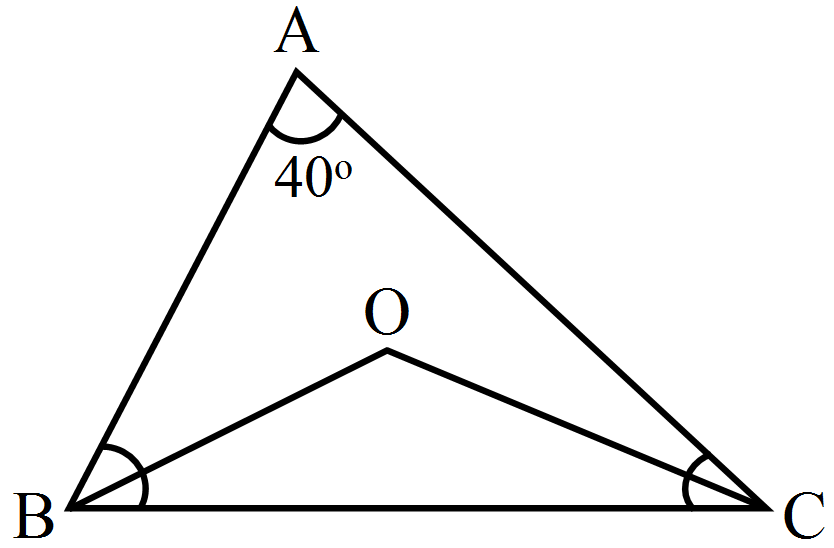
In an isosceles $\triangle\text{ABC}$, $\angle\text{B} = \angle\text{C}$ and bisector of $\angle\text{B}$ and $\angle\text{C}$ meet at $O$ and $\angle\text{A} = 40^\circ $

$\therefore\angle\text{B}=\angle\text{C}=\frac{\Big(180^\circ-40^\circ\Big)}{2}$
$=\frac{140^\circ}{2}=70^\circ$
$\therefore\frac{1}{2}\angle\text{B}=\frac{1}{2}\angle\text{C}=\frac{70^\circ}{2}=35^\circ$
Now in $\triangle\text{OBC}$
$\angle\text{BOC}+\angle\text{OBC}+\angle\text{OCB}=180^\circ$
$\angle\text{BOC}+\frac{1}{2}\angle\text{B}+\frac{1}{2}\angle\text{C}=180^\circ$
$\Rightarrow\angle\text{BOC}+35^\circ+35^\circ=180^\circ$
$\Rightarrow\angle\text{BOC}=180^\circ-70^\circ=110^\circ$
A polygon is one which is made of straight line segments and encloses a single area that is bounded by them.
For which we need more than $2$ line segments
$36$ spokes has $360^\circ .$
Angle between two adjacent spokes.
$=\frac{360^\circ}{36^\circ}=10^\circ$
An angle measuring $90^\circ $ is called a right angle.
Instruments used to bisect a given line segments are scale and compass. A scale is used to draw the line segment, while a compass helps bisect it.
A straight angle has $180^\circ .$
The number of line segments in a polygon is same as the number of angles.