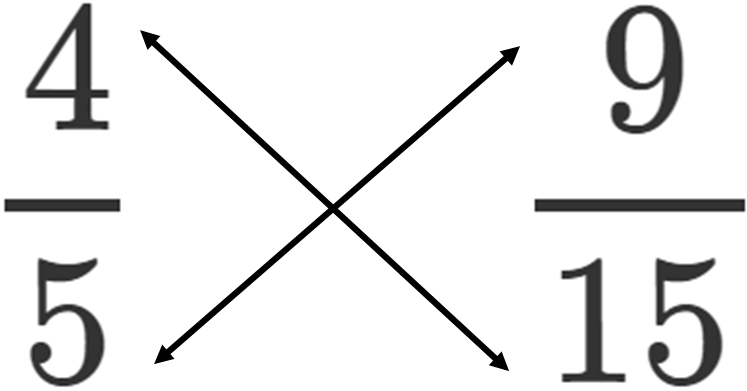
MCQ 511 Mark
The two consecutive integers between which the fraction $\frac57$ lies are:
- A
$5$ and $6.$
- ✓
$0$ and $1.$
- C
$5$ and $7.$
- D
$6$ and $7.$
AnswerCorrect option: B. $0$ and $1.$
We know that, if the numerator is less than the denominator, then the value of fraction is less than $1.$
Hence, the fraction $\frac57$ lies between $0$ and $1.$
View full question & answer→MCQ 521 Mark
$1\frac{3}{4}$ is a ____ fraction.
Answer$1\frac{3}{4}$ is a mixed fraction as:
$1+\frac{3}{4}=1\frac{3}{4}$
View full question & answer→MCQ 531 Mark
Choose the fraction which is equivalent to $\frac{15}{20}.$
- A
$\frac{12}{15}$
- B
$\frac{51}{12}$
- C
$\frac{4}{3}$
- ✓
$\frac{12}{16}$
AnswerCorrect option: D. $\frac{12}{16}$
$\frac{15}{20}$ can be written in the simplest form $\frac{4}{3}.$
Now, look at the options, then option $D$ can also be written in the simplest form $\frac{4}{3}.$
That means option $D$ is equivalent to $\frac{15}{20}.$
View full question & answer→MCQ 541 Mark
The vulgar fraction of $0.231$ can be expressed as ____________.
- A
$\frac{229}{990}$
- B
$\frac{229}{900}$
- ✓
$\frac{231}{1000}$
- D
$\frac{231}{999}$
AnswerCorrect option: C. $\frac{231}{1000}$
$0.231=\frac{0.231}{1}$ Multiplying numerator and denominator by $100.\frac{231}{1000}$Hence.
View full question & answer→MCQ 551 Mark
Product of $\displaystyle \frac{11}{12} \times \displaystyle \frac{16}{4} \times \displaystyle \frac{9}{16}$ is equal to:
- ✓
$\displaystyle 2\frac{1}{16}$
- B
$\displaystyle \frac{3}{4}$
- C
$\displaystyle \frac{2}{8}$
- D
$\displaystyle \frac{9}{6}$
AnswerCorrect option: A. $\displaystyle 2\frac{1}{16}$
Given, $\displaystyle \frac{11}{12} \times \displaystyle \frac{16}{4} \times \displaystyle \frac{9}{16}$
$=\frac{11}{12} \times 4 \times \frac{9}{16}$
$\rightarrow \displaystyle \frac{11}{3} \times \frac{9}{16}$
$\rightarrow \displaystyle 11 \times \frac{3}{16} = \frac{33}{16} = 2 \frac{1}{16}$
View full question & answer→MCQ 561 Mark
Which of the following is an improper fraction?
- ✓
$\dfrac{15}{1}$
- B
$\dfrac{1}{3}$
- C
$\dfrac{2}{3}$
- D
AnswerCorrect option: A. $\dfrac{15}{1}$
$\dfrac{15}{1}$
View full question & answer→MCQ 571 Mark
The proper fraction of $6\frac { 1 }{ 5 }$ is.
AnswerCorrect option: A. $\displaystyle \frac { 31 }{ 5 }$
Proper fraction of $6\cfrac{1}{5}= \cfrac{5 \times 6 + 1}{5} = \cfrac{30 + 1}{5} = \cfrac{31}{5}$
View full question & answer→MCQ 581 Mark
Mark $(\checkmark)$ against the correct answer in the following:
If $\frac{3}{4}$ is equivalent to $\frac{\text{x}}{20}$ then the value of $x$ is:
Answer$\Big(\frac{3}{4}=\frac{\text{x}}{20}\Big)$
We have,
$20 = 4 \times 5$
So, we have to multiply the numerator by $5.$
Therefore, $x = 3 \times 5 = 15$
View full question & answer→MCQ 591 Mark
Example for a proper fraction is:
- A
$\frac{28}{13}$
- ✓
$\frac{11}{23}$
- C
$\frac{16}{9}$
- D
$\frac{14}{3}$
AnswerCorrect option: B. $\frac{11}{23}$
A proper fraction is a fraction where the numerator (the top number) is less than the denominator (the bottom number).
In given options $\frac{11}{23}$ is proper fraction.
View full question & answer→MCQ 601 Mark
The decimal $0.238$ is equal to the fraction:
- ✓
$\frac{119}{500}$
- B
$\frac{238}{25}$
- C
$\frac{119}{25}$
- D
$\frac{119}{50}$
AnswerCorrect option: A. $\frac{119}{500}$
We know that a decimal can be converted into a fraction by taking the numerator as the number obtained by removing the decimal point from the given decimal and taking the denominator as the number obtained by inserting as many zeroes with $1$ as there are number of places in the decimal part.
Finally, converting the obtained fraction in its lowest form by dividing numerator and denominator by their $HCF.$
$0.238=\frac{238}{1000}=\frac{238\div2}{1000\div2}=\frac{119}{500}[\because$ $HCF$ of $238$ and $1000$ is $2]$
View full question & answer→MCQ 611 Mark
he lowest form of $\frac {20}{50}$ is ..........
- A
$ \frac {1}{5}$
- B
$ \frac {1}{2}$
- ✓
$ \frac {2}{5}$
- D
$ \frac {10}{25}$
AnswerCorrect option: C. $ \frac {2}{5}$
Given, $\frac{20}{50}$ To obtain the lowest form of given fraction, divide it by $10.$
Then the lowest form of $\frac {20}{50}$ is $ \frac{2}{5}$
View full question & answer→MCQ 621 Mark
Which of the following is a proper fraction?
- ✓
$\frac{7}{8}$
- B
$1\frac{7}{8}$
- C
$\frac{8}{7}$
- D
$\text{None of these}$
AnswerCorrect option: A. $\frac{7}{8}$
If the numerator is less than the denominator then the fraction is called as proper fraction.
Hence, $\frac{7}{8}$ is a proper fraction.
View full question & answer→MCQ 631 Mark
Mark the correct alternative of the following:
If $\frac{\text{a}}{\text{b}}=\frac{4}{3},$ then the value of $\frac{6\text{a}+4\text{b}}{6\text{a}-5\text{b}}$ is:
Answer$\frac{\text{a}}{\text{b}}=\frac{4}{3}$
$\Rightarrow\text{a}=\frac{4\text{b}}{3}$
On putting the value of $\text{a}=\frac{4\text{b}}{3}$ in $\frac{6\text{a}+\text{4b}}{6\text{a}-5\text{b}},$ we get:
$\frac{6\text{a}+4\text{b}}{6\text{a}-5\text{b}}=\frac{6\Big(\frac{4\text{b}}{3}\Big)+4\text{b}}{6\Big(\frac{4\text{b}}{3}\Big)-5\text{b}}=\frac{\frac{24\text{b}}{3}+4\text{b}}{\frac{24\text{b}}{3}-5\text{b}}$
$LCM$ of $3$ and $1$ is $3$.
$\frac{\frac{24\text{b}}{3}+\frac{4\text{b}\times3}{1\times3}}{\frac{24\text{b}}{3}-\frac{5\text{b}\times3}{1\times3}}=\frac{\frac{24\text{b}}{3}+\frac{12\text{b}}{3}}{\frac{24\text{b}}{3}-\frac{15\text{b}}{3}}$
$=\frac{\frac{24\text{b}+12\text{b}}{3}}{\frac{24\text{b}-15\text{b}}{3}}$
$=\frac{\frac{36\text{b}}{3}}{\frac{9\text{b}}{3}}$
$=\frac{36}{9}$
On dividing the numerator & denominator by the $HCF$ of $36$ & $9$, we get:
$\frac{36\div9}{9\div9}=4$
View full question & answer→MCQ 641 Mark
Mark the correct alternative of the following:
The smallest of the fractions $\frac{3}{5},\frac{2}{3},\frac{5}{6},\frac{7}{10}$ is:
- A
$\frac{2}{3}$
- ✓
$\frac{3}{5}$
- C
$\frac{5}{6}$
- D
$\frac{7}{10}$
AnswerCorrect option: B. $\frac{3}{5}$
Fractions can be compared by converting them into like fractions and then arranging them in ascending or descending order.
$\frac{3}{5}=\frac{3}{5}\times\frac{6}{6}=\frac{18}{30}$
$\frac{2}{3}=\frac{2}{3}\times\frac{10}{10}=\frac{20}{30}$
$\frac{5}{6}=\frac{5}{6}\times\frac{5}{5}=\frac{25}{30}$
$\frac{7}{10}=\frac{7}{10}\times\frac{3}{3}=\frac{21}{30}$
We know,
$18 < 20 < 21 < 25$
$\Rightarrow\frac{18}{30}<\frac{20}{30}<\frac{21}{30}<\frac{25}{30}$
$\Rightarrow\frac{3}{5}<\frac{2}{3}<\frac{7}{10}<\frac{5}{6}$
$\therefore$ the smallest fraction is $\frac{3}{5}.$
Hence, the correct option is $(b).$
View full question & answer→MCQ 651 Mark
$13.572$ correct to the tenths place is:
- A
$10$
- B
$13.57$
- C
$14.5$
- ✓
$13.6$
AnswerCorrect option: D. $13.6$
For rounding off to tenths place, we look at the hundredths place.
Here, the digit at hundredths place is $7$ which is greater than $5.$
So, the digit at the tenths place $(5)$ will be increased by $1$ and digits at the hundredths and thousandths place will be written as equal to zero.
Hence, rounding off $13.572$ to nearest tenths, we get $13.6.$
View full question & answer→MCQ 661 Mark
Which of the following fractions is the smallest?
- A
$\frac78$
- B
$\frac98$
- ✓
$\frac38$
- D
$\frac58$
AnswerCorrect option: C. $\frac38$
Since, for comparing fractions with same denominators, fraction with smaller numerator is
$\therefore\frac38<\frac58<\frac78<\frac98$
Hence, $\frac38$ is the smallest fraction.
View full question & answer→MCQ 671 Mark
Which of the following statements is $CORRECT?$
- A
$14$ tenths $4$ thousandths $= 0.144$
- B
$2$ tenths $13$ hundredths $= 0.213$
- C
$4$ hundredths $2$ tenths $= 0.024$
- ✓
$7$ tenths $17$ hundredths $= 0.87$
AnswerCorrect option: D. $7$ tenths $17$ hundredths $= 0.87$
Let us check with all options:
$(A) 14$ tenths $4$ thousandths $=\frac{14}{10}+\frac{4}{1000}=1.4+0.004=1.404.$
$(B) 2$ tenths $13$ hundredths $=\frac{2}{10}+\frac{13}{10}=0.33.$
$(C) 4$ hundredths $2$ tenths $=\frac{4}{100}+\frac{2}{10}=0.24.$
$(D) 7$ tenths $17$ hundredths $=\frac{7}{10}+\frac{17}{100}=0.87.$ Hence, it is correct.
View full question & answer→MCQ 681 Mark
Simplifying the fraction $\frac{\dfrac{6}{5}}{\dfrac{4}{5}}$ gives.
- A
$ \frac{1}{2}$
- ✓
$ \frac{3}{2}$
- C
$22$
- D
$11$
AnswerCorrect option: B. $ \frac{3}{2}$
$\displaystyle \frac{\dfrac{6}{5}}{\dfrac{4}{5}} = \frac{6}{5}\times \frac{5}{4} = \frac{6}{4}=\frac{3}{2}$
View full question & answer→MCQ 691 Mark
Example of proper fraction from the given options is _____
- ✓
$\frac{5}{7}$
- B
$\frac{4}{3}$
- C
$\frac{16}{15}$
- D
$\frac{22}{21}$
AnswerCorrect option: A. $\frac{5}{7}$
In a proper fraction, the numerator is smaller than the denominator.
Of the given fractions, $\frac{5}{7}$ has numerator smaller than the denominator.
View full question & answer→MCQ 701 Mark
Mark the correct alternative of the following:
A fraction equivalent to $\frac{8}{12}$ is:
- A
$\frac{8+4}{12+4}$
- ✓
$\frac{8\div4}{12\div4}$
- C
$\frac{8-4}{12-4}$
- D
AnswerCorrect option: B. $\frac{8\div4}{12\div4}$
Fraction equivalent to a given fraction can be obtained by multiplying or dividing its numerator and denominator by a non-zero number.
Therefore, the fraction equivalent to $\frac{8}{12}$ is $\frac{8-4}{12-4}.$
Hence, the correct option is $(b).$
View full question & answer→MCQ 711 Mark
Mark the correct alternative of the following:
If $\frac{5}{12}$ is equivalent of $\frac{\text{x}}{3},$ then $x =$
- ✓
$\frac{5}{4}$
- B
$\frac{4}{5}$
- C
$\frac{5}{3}$
- D
$\frac{3}{5}$
AnswerCorrect option: A. $\frac{5}{4}$
$\frac{5}{12}=\frac{\text{x}}{3}$
On cross-multiplying, we get:
$5\times3=\text{x}\times12$
$\Rightarrow\text{x}=\frac{5\times3}{12}$
$\Rightarrow\text{x}=\frac{15}{12}$
$\text{x}=\frac{5}{4}$
View full question & answer→MCQ 721 Mark
Which of the following is not a proper fraction?
- A
$\displaystyle \frac{2}{3}$
- B
$\displaystyle \frac{3}{4}$
- C
$\displaystyle \frac{5}{7}$
- ✓
$\displaystyle \frac{6}{5}$
AnswerCorrect option: D. $\displaystyle \frac{6}{5}$
Proper fraction is a fraction that is less than one, with the numerator less than the denominator.
View full question & answer→MCQ 731 Mark
Mark the correct alternative of the following:
A fraction equivalent to $\frac{2}{3}$ is:
AnswerCorrect option: C. $\frac{2\times5}{3\times5}$
Fraction equivalent to a given fraction can be obtained by multiplying or dividing its numerator and denominator by a non-zero number.
Therefore, the fraction equivalent to $\frac{2}{3}$ is $\frac{2\times5}{3\times5}.$
Hence, the correct option is $(c).$
View full question & answer→MCQ 741 Mark
Which of the following is not a proper fraction?
- A
$\frac{2}{3}$
- B
$\frac{3}{4}$
- C
$\frac{5}{7}$
- ✓
$\frac{6}{5}$
AnswerCorrect option: D. $\frac{6}{5}$
Proper fraction is a fraction that is less than one, with the numerator less than the denominator.
View full question & answer→MCQ 751 Mark
Mark the correct alternative of the following:
Which of the following fractions is the smallest?
$\frac{1}{2},\frac{3}{7},\frac{3}{5},\frac{4}{9}$
- A
$\frac{4}{9}$
- B
$\frac{3}{5}$
- ✓
$\frac{3}{7}$
- D
$\frac{1}{2}$
AnswerCorrect option: C. $\frac{3}{7}$
The $LCM$ of numerators is $12$, so we can convert each fraction into an equivalent fraction with numerator $12.$
$\frac{1}{2}=\frac{1}{2}\times\frac{12}{12}=\frac{12}{24}$
$\frac{3}{7}=\frac{3}{7}\times\frac{4}{4}=\frac{12}{28}$
$\frac{3}{5}=\frac{3}{5}\times\frac{4}{4}=\frac{12}{20}$
$\frac{4}{9}=\frac{4}{9}\times\frac{3}{3}=\frac{12}{27}$
When numerator is the same, the fraction with greater denominator is the smallest.
Thus, $\frac{3}{7}$ is the smallest fraction.
View full question & answer→MCQ 761 Mark
Mark $(\checkmark)$ against the correct answer in the following:
$\frac{5}{8}-\frac{1}{8}=\ ?$
- A
$\frac{1}{4}$
- ✓
$\frac{1}{2}$
- C
$\frac{1}{16}$
- D
AnswerCorrect option: B. $\frac{1}{2}$
$=\frac{5}{8}-\frac{1}{8}$
$=\frac{(5-1)}{8}$
$=\frac{4}{8}$
$=\frac{1}{2}$
View full question & answer→MCQ 771 Mark
Write the fraction in which?
$1.$ Numerator $= 5$ and denominator $= 13$
$2.$ Denominator $= 23$ and numerator $= 17$
- A
$\text{(i) }\dfrac{23}{17},\text{(ii) }\dfrac{5}{13}$
- ✓
$\text{(i)}\dfrac{5}{13},\text{(ii) }\dfrac{17}{23}$
- C
$\text{(i) }\dfrac{17}{23},\text{(ii) }\dfrac{5}{13}$
- D
$\text{(i) }\dfrac{13}{5},\text{(ii) }\dfrac{23}{17}$
AnswerCorrect option: B. $\text{(i)}\dfrac{5}{13},\text{(ii) }\dfrac{17}{23}$
$\text{(i)}\dfrac{5}{13},\text{(ii) }\dfrac{17}{23}$
View full question & answer→MCQ 781 Mark
Convert into Improper fraction: $\displaystyle 2\frac { 3 }{ 7 }$
AnswerCorrect option: A. $\displaystyle \frac { 17 }{ 7 }$
Improper fraction of
$2\cfrac{3}{7}= \cfrac{7 \times 2 + 3}{7}$
$= \cfrac{14 + 3}{7}= \cfrac{17}{7}$
View full question & answer→MCQ 791 Mark
Mark $(\checkmark)$ against the correct answer in the following
$\frac{24}{11}$ is an example of:
AnswerIn an improper fraction, the numerator is greater than the denominator.
View full question & answer→MCQ 801 Mark
Write down $9275$ meters in km, as a decimal fraction.
- A
$927.5\ Km$
- B
$92.75\ Km$
- C
$10.275\ Km$
- ✓
$9.275\ Km$
AnswerCorrect option: D. $9.275\ Km$
$9275$ meters in km, as decimal fraction
$=\frac{9275}{1000}\text{km}=9.275\text{km}$
View full question & answer→MCQ 811 Mark
The proper fraction of $6\frac{1}{5}$ is:
- ✓
$\frac{31}{5}$
- B
$\frac{29}{5}$
- C
$\frac{28}{5}$
- D
$\frac{6}{5}$
AnswerCorrect option: A. $\frac{31}{5}$
Proper fraction of
$6\frac{1}{5}=\frac{5\times6+1}{5}=\frac{30+1}{5}=\frac{31}{5}$
View full question & answer→MCQ 821 Mark
Mark the correct alternative of the following:
A fraction equivalent to $\frac{3}{5}$ is:
AnswerCorrect option: C. $\frac{3\times2}{5\times2}$
On dividing the numerator & denominator by $2$, we get $\frac{3}{5}.$
View full question & answer→MCQ 831 Mark
Which of the following is improper fraction?
- A
$\dfrac{1}{3}$
- ✓
$\dfrac{4}{3}$
- C
$\dfrac{3}{5}$
- D
AnswerCorrect option: B. $\dfrac{4}{3}$
$\dfrac{4}{3}$
View full question & answer→MCQ 841 Mark
Which of the following is an improper fraction?
AnswerCorrect option: A. $\frac{15}{1}$
Since numerator $>$ denominator only in option $A$. Therefore, it is correct.
View full question & answer→MCQ 851 Mark
Mark $(\checkmark)$ against the correct answer in the following
The largest of the fractions $\frac{2}{3},\frac{5}{9},\frac{1}{2}$ and $\frac{7}{12}$ is:
- ✓
$\frac{2}{3}$
- B
$\frac{5}{9}$
- C
$\frac{7}{12}$
- D
$\frac{1}{2}$
AnswerCorrect option: A. $\frac{2}{3}$
$L.C.M.$ of $3, 9, 2$ and $12 = ( 2 \times 2 \times 3 \times 3) = 36$
Now, we have:
$\frac{2}{3}=\frac{2\times12}{3\times12}=\frac{24}{36}$
$\frac{5}{9}=\frac{5\times4}{9\times4}=\frac{20}{36}$
$\frac{1}{2}=\frac{1\times18}{2\times18}=\frac{18}{36}$
$\frac{7}{12}=\frac{7\times3}{12\times3}=\frac{21}{36}$
Hence, $\frac{24}{36}=\frac{2}{3}$ is the largest fraction.
View full question & answer→MCQ 861 Mark
Example for an improper fraction from the given options is:
- A
$\dfrac {25}{26}$
- B
$\dfrac {12}{13}$
- ✓
$\dfrac {15}{14}$
- D
$\dfrac {19}{20}$
AnswerCorrect option: C. $\dfrac {15}{14}$
In an improper fraction, the numerator is greater than the denominator.
Of the given fractions, $\dfrac {15}{14}$ has numerator greater than the denominator.
Hence, $\dfrac {15}{14}$ is a proper fraction.
View full question & answer→MCQ 871 Mark
Which of these are improper fractional numbers?
- A
$\frac{2}{7}$
- B
$\frac{7}{11}$
- ✓
$\frac{13}{2}$
- D
$\frac{7}{8}$
AnswerCorrect option: C. $\frac{13}{2}$
Improper fractions are the one who numerator is more than the denominator
In $ \frac{13}{2}$ and $ \frac{7}{3}, $ the numerator is greater than the denominator
So, they are not proper fractions Whereas in $\frac{2}{7}$ and $\frac{7}{11},$ the numerator is less than the denominator
Thus, they are proper fractions.
Hence, $\frac{13}{2}$ and $\frac{7}{3} $ are improper fractional numbers.
View full question & answer→MCQ 881 Mark
$1\frac{3}{4}$ is a ____ fraction.
Answer$1\frac{3}{4}$ is a mixed fraction as:
$1\dfrac{3}{4}=1\dfrac{3}{4}$
View full question & answer→MCQ 891 Mark
Mark $(\checkmark)$ against the correct answer in the following:
Which of the following are like fractions?
- A
$\frac{2}{5},\frac{2}{7},\frac{2}{9},\frac{2}{11}$
- B
$\frac{2}{3},\frac{3}{4},\frac{4}{5},\frac{5}{6}$
- ✓
$\frac{1}{8},\frac{3}{8},\frac{5}{8},\frac{7}{8}$
- D
AnswerCorrect option: C. $\frac{1}{8},\frac{3}{8},\frac{5}{8},\frac{7}{8}$
(Fractions having the same denominator are called like fractions.)
View full question & answer→MCQ 901 Mark
$\frac{1.5}{0.2+\text{x}}=5,$ then $x =$
- A
$-3.7$
- ✓
$0.1$
- C
$0.3$
- D
$0.5$
AnswerGiven that
$\frac{1.5}{0.2+\text{x}}=5$
cross multiplying
$\Rightarrow 5 \times (0.2 + x) = 1.5$
$\Rightarrow 5 \times 0.2 + 5x = 1.5$
$\Rightarrow 1 + 5x = 1.5$
$\Rightarrow 5x = 1.5 − 1 = 0.5$
$\Rightarrow 5x = 0.5$
$\Rightarrow x = 0.1$
View full question & answer→MCQ 911 Mark
What percent of $8.25m$ is $75\ cm?$
- A
$\frac{150}{11}\text{%}$
- B
$\frac{75}{11}\text{%}$
- C
$\frac{80}{11}\text{%}$
- ✓
$\frac{100}{11}\text{%}$
AnswerCorrect option: D. $\frac{100}{11}\text{%}$
We know that $1\ m = 100\ cm \ 8.25\ m = 825\ cm$ as per problem,
$\frac{75}{825}\times100=\frac{7500}{825}=\frac{1500}{165}=\frac{100}{11}$
Therefore $75\ cm$ is $\frac { 100 }{ 11 }\text{%} $ of $8.25m$
View full question & answer→MCQ 921 Mark
Which of these are improper fractional numbers?
- A
$\displaystyle\frac{2}{7}$
- B
$\displaystyle\frac{7}{11}$
- ✓
$\displaystyle\frac{13}{2}$
- D
$\displaystyle\frac{7}8$
AnswerCorrect option: C. $\displaystyle\frac{13}{2}$
Improper fractions are the one who numerator is more than the denominator
In $\displaystyle\frac{13}{2}$ and $\dfrac{7}{3}$, the numerator is greater than the denominator So, they are not proper fractions Whereas in $\dfrac{2}{7}$and $\dfrac{7}{11}$, the numerator is less than the denominatorThus, they are proper fractions.Hence, $\dfrac{13}{2}$ and $\dfrac{7}{3}$ are improper fractional numbers.
View full question & answer→MCQ 931 Mark
- A
$0.2$ and $0.3$
- ✓
$0.02$ and $0.03$
- C
$0.03$ and $0.029$
- D
$0.026$ and $0.024$
AnswerCorrect option: B. $0.02$ and $0.03$
Since, $0.023$ is greater than $0.02$ and less than $0.03.$
Therefore, $0.023$ lies between $0.02$ and $0.03.$
$0.02 < 0.023 < 0.03$
View full question & answer→MCQ 941 Mark
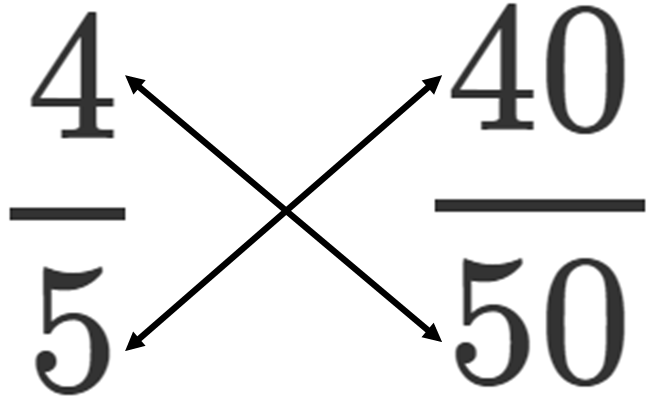
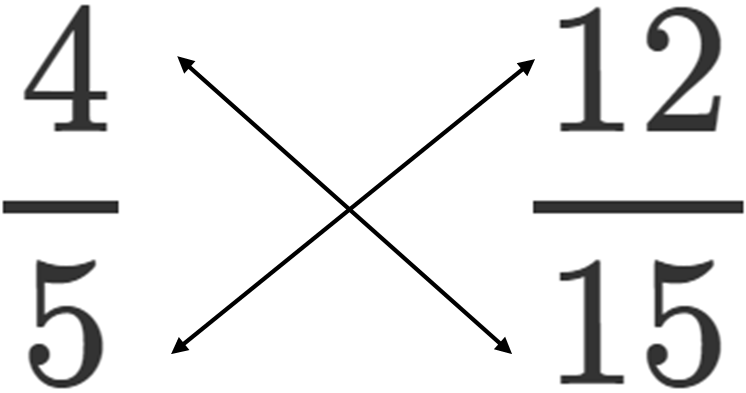
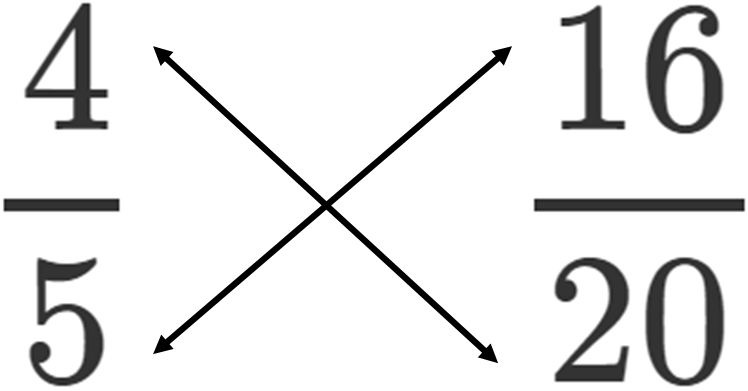
The fraction which is not equal to $\frac45$ is:
- A
$\frac{ 40}{ 50}$
- B
$\frac{ 12}{ 15}$
- C
$\frac{16}{ 20}$
- ✓
$\frac{9}{ 15}$
View full question & answer→MCQ 951 Mark
Which of the following is/are simple fraction $(s)?$
- A
$\frac{20.5}{100}$
- B
$\frac{14.7}{100}$
- C
$0.58$
- ✓
$\frac{3}{7}$
AnswerCorrect option: D. $\frac{3}{7}$
$\frac{3}{7}$ is a simple fraction because both numerator and denominator are integers.
View full question & answer→MCQ 961 Mark
Mark the correct alternative of the following:
Which of the following fractions is the smallest?
$\frac{5}{9},\frac{4}{9},\frac{2}{9},\frac{11}{9}$
- A
$\frac{11}{9}$
- B
$\frac{4}{9}$
- C
$\frac{5}{9}$
- ✓
$\frac{2}{9}$
AnswerCorrect option: D. $\frac{2}{9}$
$2 < 4 < 5 < 11$
$\Rightarrow\frac{2}{9}<\frac{4}{9}<\frac{5}{9}<\frac{11}{9}$
$\therefore$ the smallest fraction is $\frac{2}{9}.$
Hence, the correct option is $(d).$
View full question & answer→MCQ 971 Mark
In which of the following pairs of numbers it is true that their sum is $11$ times their product?
- A
$1,\frac{1}{11}$
- ✓
$1,\frac{1}{10}$
- C
$1,\frac{1}{12}$
- D
$1,10$
AnswerCorrect option: B. $1,\frac{1}{10}$
This happens in only option
$\text{B}1+\frac{1}{10}=\frac{11}{10}=11\times1\times\frac{1}{10}$
View full question & answer→MCQ 981 Mark
What is $6050.287$ rounded to the nearest tenths?
- A
$6050$
- B
$6100$
- C
$6050.29$
- ✓
$6050.3$
AnswerCorrect option: D. $6050.3$
To round to the nearest tenth, write down the number with a decimal point, and find the tenths place directly to the right of the decimal.
Then, to the right of the tenths place, look at the number in the hundredths place.
In $6050.287$ the number in the hundredths is $.2.$
So, $6050.287$ rounded to the nearest tenths will be $6050.3$
View full question & answer→MCQ 991 Mark
Which of the following represents the division problem using two other symbols?
- A
$63\times7=9;63-7=9$
- B
$\frac{7}{9}=63;\frac{9}{63)7}$
- C
$\frac{7}{63}=9;\frac{7}{63)9}$
- ✓
$\frac{63}{7}=9;\frac{9}{7)63}$
AnswerCorrect option: D. $\frac{63}{7}=9;\frac{9}{7)63}$
A proper or improper fraction which is completely divisible denotes the denominator is the divider and the numerator is the divident.
The quotient is the answer of that division. We see that option $D$ is the only option that shows this relationship through two different symbols.
View full question & answer→MCQ 1001 Mark
- ✓
$\frac{18}{1000}$
- B
$\frac{18}{10}$
- C
$\frac{18}{100}$
- D
$\frac{2}{1000}$
AnswerCorrect option: A. $\frac{18}{1000}$
$\frac{18}{1000}$
View full question & answer→