Questions

M.C.Q. [1 Marks Each]

🎯

Test yourself on this topic

18 questions · timed · auto-graded

MCQ 11 Mark
On the number line, the integer $5$ is located:
  • A
    To the left of $0$.
  • To the right of $0$.
  • C
    To the left of $1$.
  • D
    To the left of $-2$.
Answer
Correct option: B.
To the right of $0$.
We know that, all the positive integers lie on the right of $0$.
So, integer $5$ is also located to the right of $0$.
View full question & answer
MCQ 21 Mark
The additive inverse of a negative integer:
  • A
    Is always negative.
  • Is always positive.
  • C
    Is the same integer.
  • D
    Zero.
Answer
Correct option: B.
Is always positive.
Additive inverse of an integer is obtained by changing the sign of the integer.
Therefore, the additive inverse of a negative integer is always positive.
Let a nagative integer be $-5$. Then, additive inverse of $-5 = -(-5) = 5.$
View full question & answer
MCQ 31 Mark
The successor of the predecessor of $-50$ is:
  • A
    $-48$
  • B
    $-49$
  • $-50$
  • D
    $-51$
Answer
Correct option: C.
$-50$
For predecessor, we subtract $1$ from the given integer and for successor, we add $1$ to the given integer.
The predecessor of $-50 = -50 -1 = -51$ and the successor of $-51 = -51 + 1 = -50.$
View full question & answer
MCQ 41 Mark
The least integer lying between $-10$ and $-15$ is:
  • A
    $-10$
  • B
    $-11$
  • C
    $-15$
  • $-14$
Answer
Correct option: D.
$-14$
The integers lying between $-10$ and $-15$ are $-11, -12, -13$ and $-14.$
The least integer among these is $-14.$ [because with negative sign, greater number is smaller]
View full question & answer
MCQ 51 Mark
In which of the following pairs of integers, the first integer is not on the left of the other integer on the number line?
  • A
    $(-1, 10)$
  • $(-3, -5)$
  • C
    $(-5, -3)$
  • D
    $(-6, 0)$
Answer
Correct option: B.
$(-3, -5)$
Firstly, draw a number line and mark all the given pairs of integers on it.

Clearly, we observe that $-3$ is on the right of $-5$.
View full question & answer
MCQ 61 Mark
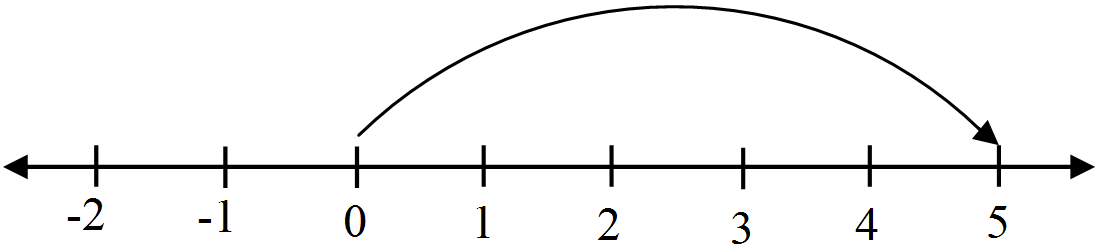
The integer ‘$5$ units to the right of $0$ on the number line’ is:
  • $+5$
  • B
    $-5$
  • C
    $+4$
  • D
    $-4$
Answer
Correct option: A.
$+5$
Firstly, draw a number line and mark some points at equal distance on it. Mark a point as zero on it. On moving $5$ units to the right of $0$, we reach on $+5.$

Hence, point/ $4$ represents $+5$.
Note: All the positive integers lie to the right of 0 and the negative integers to the left of $0$ on the number line.
View full question & answer
MCQ 71 Mark
The statement "When an integer is added to itself, the sum is greater than the integer" is:
  • A
    Always true.
  • B
    Never true.
  • True only when the integer is positive.
  • D
    True for non-negative integers.
Answer
Correct option: C.
True only when the integer is positive.
Suppose we take two integers one positive $(+1)$ and other negative $-1$.
On adding $1$ to itself, we get $1 + 1 = 2.$
Here, the sum is greater than the integer $(+1).$
Again, adding $-1$ to itself, we get $-1 + (-1) = -1 -1 = -2$ Here, the sum is less than the integer $-1.$
Hence, the given statement is true only when the integer is positive.
View full question & answer
MCQ 81 Mark
The greatest integer lying between $-10$ and $-15$ is:
  • A
    $-10$
  • $-11$
  • C
    $-15$
  • D
    $-14$
Answer
Correct option: B.
$-11$
The integers lying between $-10$ and $-15$ are $-11, -12, -13$ and $-14.$
The greatest integer among these is $-11.$
with negative sign, smaller number is greater.
View full question & answer
MCQ 91 Mark
Every integer less than $0$ has the sign:
  • A
    $+$
  • $-$
  • C
    $\times $
  • D
    $÷$
Answer
Correct option: B.
$-$
Every integer less than $0$ has the negative $(-)$ sign.
Note: An integer is positive, if it is greater than zero and negative, if it is less than zero.
View full question & answer
MCQ 101 Mark
Number of integers lying between $-1$ and $1$ is:
  • $1$
  • B
    $2$
  • C
    $3$
  • D
    $0$
Answer
Correct option: A.
$1$
The integers lying between $-1$ and $1$ is $0$, so there is only one integer.
View full question & answer
MCQ 111 Mark
The predecessor of the integer $-1$ is:
  • A
    $0$
  • B
    $2$
  • $-2$
  • D
    $1$
Answer
Correct option: C.
$-2$
We know that, one less than a given number, gives a predecessor. Predecessor of the integer $-1 = -1 -1 = -2$
Hence, predecessor of the integer $-1$ is $-2$.
View full question & answer
MCQ 121 Mark
Which of the following shows the maximum rise in temperature?
  • A
    $0^\circ C$ to $10^\circ C.$
  • $-4^\circ C$ to $8^\circ C.$
  • C
    $-15^\circ C$ to $-8^\circ C.$
  • D
    $-7^\circ C$ to $0^\circ C.$
Answer
Correct option: B.
$-4^\circ C$ to $8^\circ C.$
We know that, the maximum rise in the temperature is equal to the maximum value of difference of two temperatures.
$b.$ Difference of $0^\circ C$ to $10^\circ C = 10^\circ C - 0^\circ C = +10^\circ C.$
$c.$ Difference of $-4^\circ C$ to $8^\circ C = 8^\circ C - (-4^\circ C) = 8^\circ C + 4^\circ C = +12^\circ C [$maximum$]$
$d.$ Difference of -$15^\circ C to -8^\circ C = -8^\circ C - (-15^\circ C) = -8^\circ C + 15^\circ C = +7^\circ C.$
$e.$ Difference of $-7^\circ C to 0^\circ C = 0^\circ C - (-7^\circ C) = 0^\circ C + 7^\circ C = +7^\circ C$
Hence, the option $(b)$ shows the maximum rise in temperature.
View full question & answer
MCQ 131 Mark
Number of whole numbers lying between $-5$ and $5$ is:
  • A
    $10$
  • B
    $3$
  • C
    $4$
  • $5$
Answer
Correct option: D.
$5$
The integers lying between $-5$ and 5 are $-4, -3, -2, -1, 0, 1, 2, 3$ and $4$. Whole numbers are $0, 1, 2, 3$ and $4.$
The number of whole numbers $= 5$ $[$whole numbers are the group of numbers that consist of the numbers i.e. $0, 1, 2, 3, 4, 5,…]$
View full question & answer
MCQ 141 Mark
Amulya and Amar visited two places $A$ and $B$ respectively in Kashmir and recorded the minimum temperatures on a particular day as $-4^\circ C$ at $A$ and $–1^\circ C$ at $B$. Which of the following statement is true?
  • $A$ is cooler than $B$.
  • B
    $B$ is cooler than $A$.
  • C
    There is a difference of $2^\circ C$ in the temperature.
  • D
    The temperature at $A$ is $4^\circ C$ higher than that at $B$.
Answer
Correct option: A.
$A$ is cooler than $B$.
We know that, if the temperature decreases, the cooling increases.
Given, minimum temperature on a particular at $A = -4^\circ C$ and
minimum temperature on a particular at $B = -1^\circ C$
We know that, $-4^\circ C < -1^\circ C.$
So, $A$ is cooler than $6$.
Hence, option $(a)$ is true.
View full question & answer
MCQ 151 Mark
When a negative integer is subtracted from another negative integer, the sign of the result:
  • A
    Is always negative.
  • B
    Is always positive.
  • C
    Is never negative.
  • Depends on the numerical value of the integers.
Answer
Correct option: D.
Depends on the numerical value of the integers.
Suppose we take two negative integers $-2$ and $-3$.
We subtract $(-3)$ from $(-2)$ and give a minus sign to get the result. i.e $-2 -(-3) = -2 + 3 = 1.$
Again, we subtract $(-2)$ from $-3$ and give a plus sign to get the result. i.e $-3 - (-2) = -3 + 2 = -1.$
So, the sign of the result depends on the numerical value of the integers..
View full question & answer
MCQ 161 Mark
The integer with negative sign $(-)$ is always less than:
  • $0$
  • B
    $-3$
  • C
    $-1$
  • D
    $-2$
Answer
Correct option: A.
$0$
We know that, negative integer is always less than $0.$
View full question & answer
MCQ 171 Mark
An integer with positive sign $(+)$ is always greater than:
  • $0$
  • B
    $1$
  • C
    $4$
  • D
    $3$
Answer
Correct option: A.
$0$
We know that, positive integer is always greater than $0$.
View full question & answer
MCQ 181 Mark
Which of the following fractions is the greatest?
  • A
    $\frac57$
  • $\frac56$
  • C
    $\frac59$
  • D
    $\frac58$
Answer
Correct option: B.
$\frac56$
In order to find the greatest fraction among the above given fractions, we will convert all the fractions to an equivalent fraction with denominator equal to the $LCM$ of their denominator.
$\begin{array}{c|c} 2&7,6,9,8\\\hline2&7,3,7,4\\\hline2&7,3,9,2\\\hline 3&7,3,9,1\\\hline3&7,1,3,1\\\hline7&7,1,1,1\\\hline&1,1,1,1\end{array}$
So, $LCM$ of denominator i.e. $LCM$ of $7, 6, 9$ and $8 = 2 \times 2 \times 2 \times 3 \times 3 \times 7 = 504$
Now, we converty the givn fraction to equivalent fractions with denominator 504.
$\frac{5\times72}{7\times72}=\frac{360}{504},\frac{5\times84}{6\times84}=\frac{420}{504}$
$\frac{5\times56}{9\times56}=\frac{280}{504},\frac{5\times63}{8\times63}=\frac{315}{504}$
Clearly, $\frac{420}{504},$ i.e. $\frac56$ is greatest.

View full question & answer