Question 11 MarkWhich of the following statementare true and which are false? An angle with equal arms has its bisector as the line of symmetry.AnswerTrue.View full question & answer→
Question 21 MarkWhich of the following statementare true and which are false? A parallelogram has no line of symmetry.AnswerTrue.View full question & answer→
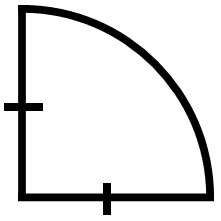
Question 31 MarkDraw the line (or lines) of symmetry of the following figure. View full question & answer→
Question 41 MarkWhich of the following statementare true and which are false? An equilateral triangle has three lines of symmetry.AnswerTrue. An equilateral triangle is symmetrical about each one of the bisectors of its interior angle. Also, it has three bisectors.View full question & answer→
Question 51 MarkWhich of the following statementare true and which are false? A square has four lines of symmetry.AnswerTrue. A square is symmetrical about each one of its diagonal and the lines joining the midpoints of the opposite sides.View full question & answer→
Question 61 MarkWhich of the following statementare true and which are false? A rectangle has two lines of symmetry.AnswerTrue. A rectangle is symmetrical about the lines joining the midpoints of the opposite sides.View full question & answer→
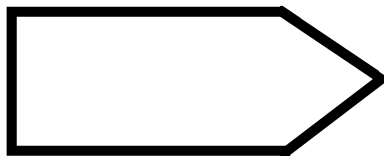
Question 71 MarkDraw the line (or lines) of symmetry of the following figure.View full question & answer→
Question 81 MarkWhich of the following statementare true and which are false? Each one of the letters $H, I, O, X$ of the English alphabet has two lines of symmetry.AnswerTrue.View full question & answer→
Question 91 MarkWhich of the following statementare true and which are false? A rhombus has four lines of symmetry.AnswerFalse. A rhombus has two lines of symmetry. It is symmetrical about each one of its diagonals.View full question & answer→
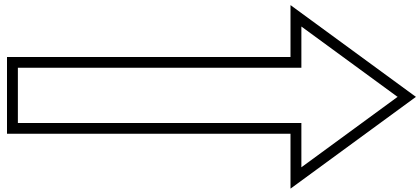
Question 101 MarkDraw the line (or lines) of symmetry of the following figure.View full question & answer→
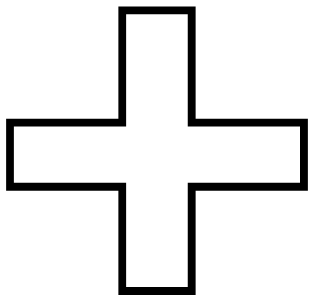
Question 111 MarkDraw the line (or lines) of symmetry of the following figure.View full question & answer→